Privacy-Preserving Federated Radio Map Learning for Wireless Digital Twins via Adaptive Noise Allocation
Pith reviewed 2026-05-20 16:44 UTC · model grok-4.3
The pith
Adaptive allocation of a fixed noise budget across transmitter-sensitive model groups strengthens privacy in federated radio map learning while preserving reconstruction quality.
A machine-rendered reading of the paper's core claim, the machinery that carries it, and where it could break.
Core claim
By redistributing a fixed perturbation budget across transmitter-sensitive upload groups identified via low-dimensional statistics from the two-stage RadioUNet architecture, the adaptive noise allocation mechanism delivers stronger protection against location leakage and higher reconstruction quality than uniform or fixed-structure noise defenses under matched budgets.
What carries the argument
Budget-constrained adaptive noise allocation mechanism that identifies transmitter-sensitive groups from upload statistics and dynamically scales noise group-wise before client transmission.
If this is right
- The allocation occurs locally on each client before any upload occurs.
- It operates under a single unified noise multiplier across clients.
- It outperforms both uniform noise and other structure-aware baselines on the two privacy and quality metrics.
- The method preserves the overall federated training process while targeting only sensitive coordinates.
Where Pith is reading between the lines
- The same group-identification step could transfer to other neural architectures whose updates carry spatially varying private information.
- Combining the adaptive scale with existing differential privacy accounting might yield tighter privacy budgets without extra accuracy loss.
- Wireless digital twin deployments could adopt this pattern to meet regulatory location-privacy rules while still using crowd-sourced radio data.
Load-bearing premise
Low-dimensional upload statistics from the two-stage RadioUNet reliably flag transmitter-sensitive groups, and group-wise noise scaling neither creates new leaks nor disrupts federated training.
What would settle it
An experiment in which adaptive group-wise allocation produces both higher transmitter localization error and lower radio map reconstruction mean squared error than uniform noise addition when the total perturbation budget is held constant.
Figures

read the original abstract
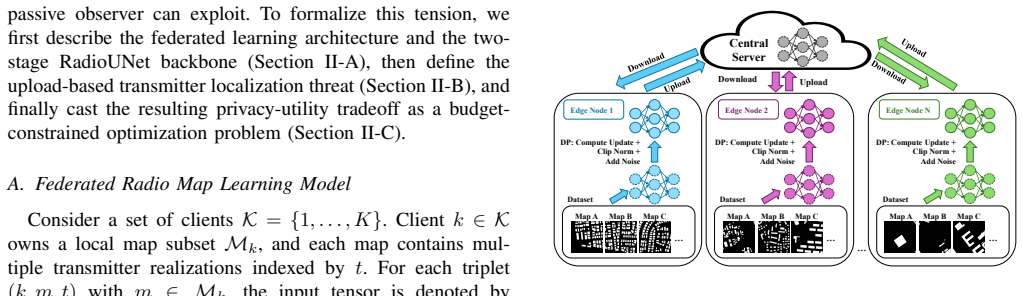
Radio maps provide a foundational data layer for wireless digital twins, and federated learning offers a natural framework for their distributed construction without centralizing raw radio environment data. However, the exchanged client model updates may still leak transmitter-location information, even when the underlying measurement data are never shared. Existing noise-based privacy defenses inject perturbation either uniformly across all uploaded coordinates or according to a fixed static rule, thereby ignoring the architecture-specific structure of this leakage. This paper proposes a budget-constrained adaptive noise allocation mechanism that redistributes a fixed perturbation budget across transmitter-sensitive upload groups identified from the two-stage RadioUNet architecture. The proposed method uses low-dimensional upload statistics to dynamically adjust group-wise noise scales and is integrated locally before client upload transmission. We evaluate the framework on a federated radio map learning task under a unified noise multiplier, comparing it against uniform and structure-aware baselines using reconstruction mean squared error and transmitter localization error as metrics. Results show that adaptive allocation achieves the strongest privacy protection while maintaining the best reconstruction quality among all noise-based defenses under a matched perturbation budget.
Editorial analysis
A structured set of objections, weighed in public.
Referee Report
Summary. The manuscript proposes a budget-constrained adaptive noise allocation mechanism for privacy-preserving federated radio map learning. It identifies transmitter-sensitive upload groups via low-dimensional statistics extracted from a two-stage RadioUNet architecture, then locally rescales noise variances on those groups before upload. The approach is compared to uniform and structure-aware baselines under a matched perturbation budget, with claims that it yields the strongest privacy (via transmitter localization error) while preserving the best reconstruction quality (via MSE).
Significance. If the low-dimensional statistics reliably isolate sensitive groups without creating side-channel leakage through the resulting scale vector and without biasing federated averaging, the method could improve the privacy-utility frontier for distributed construction of wireless digital twins. The architecture-aware allocation is a targeted idea that avoids uniform noise waste, and the evaluation on external downstream metrics (localization error) is a reasonable choice for the application.
major comments (3)
- [Abstract] Abstract: the headline claim that adaptive allocation 'achieves the strongest privacy protection while maintaining the best reconstruction quality' is stated without any numerical MSE values, localization-error values, confidence intervals, dataset size, or description of how the unified noise multiplier was selected. This absence prevents verification of whether the reported superiority is practically meaningful or statistically reliable.
- [§3] §3 (Method): the mapping from low-dimensional upload statistics to transmitter-sensitive coordinate groups is presented as stable and non-leaking, yet no derivation, stability argument, or information-theoretic bound is given showing that the scale choices themselves do not constitute a new side-channel that an eavesdropper observing the final noisy update could exploit.
- [§4] §4 (Experiments): no ablation is reported that isolates the effect of heterogeneous noise scales on federated averaging convergence or on the final MSE; without this, it is impossible to confirm that the claimed reconstruction-quality advantage is not an artifact of unaccounted bias in the averaging step.
minor comments (2)
- [Abstract] The phrase 'unified noise multiplier' appears without a preceding definition or reference to its concrete value or selection criterion.
- [§3] Notation for the group-wise noise scales and the low-dimensional statistics should be introduced with explicit equations rather than descriptive prose only.
Simulated Author's Rebuttal
We thank the referee for the constructive feedback on our manuscript. We address each major comment below and indicate the planned revisions to strengthen the presentation and analysis.
read point-by-point responses
-
Referee: [Abstract] Abstract: the headline claim that adaptive allocation 'achieves the strongest privacy protection while maintaining the best reconstruction quality' is stated without any numerical MSE values, localization-error values, confidence intervals, dataset size, or description of how the unified noise multiplier was selected. This absence prevents verification of whether the reported superiority is practically meaningful or statistically reliable.
Authors: We agree that the abstract would be strengthened by including key quantitative results. In the revised manuscript we will report the specific MSE and transmitter localization error values achieved by the proposed method versus the baselines, state the dataset size, and briefly describe how the unified noise multiplier was chosen under the matched budget. Space permitting, we will also note confidence intervals from repeated trials. revision: yes
-
Referee: [§3] §3 (Method): the mapping from low-dimensional upload statistics to transmitter-sensitive coordinate groups is presented as stable and non-leaking, yet no derivation, stability argument, or information-theoretic bound is given showing that the scale choices themselves do not constitute a new side-channel that an eavesdropper observing the final noisy update could exploit.
Authors: We acknowledge the absence of a formal stability argument or information-theoretic bound. The scale vector is computed entirely locally from the two-stage RadioUNet statistics and is never transmitted; only the final noisy model update is uploaded. We will revise §3 to add a concise discussion clarifying that the heterogeneous noise variances are applied before upload and that the server observes only the aggregate noisy update, which does not directly expose the per-group scale choices. A complete information-theoretic analysis of residual leakage through the noise pattern is beyond the current scope and would require additional theoretical development. revision: partial
-
Referee: [§4] §4 (Experiments): no ablation is reported that isolates the effect of heterogeneous noise scales on federated averaging convergence or on the final MSE; without this, it is impossible to confirm that the claimed reconstruction-quality advantage is not an artifact of unaccounted bias in the averaging step.
Authors: We agree that an explicit ablation isolating the impact of heterogeneous scales on convergence and MSE is needed to rule out averaging bias. In the revised §4 we will add an ablation that compares convergence curves and final MSE under the adaptive allocation versus a uniform-scale control with identical total perturbation budget, thereby confirming that the reported quality advantage is not an artifact of the averaging procedure. revision: yes
Circularity Check
No circularity: adaptive allocation is an independent algorithmic proposal evaluated on external metrics
full rationale
The paper describes a budget-constrained adaptive noise allocation method that uses low-dimensional upload statistics from a two-stage RadioUNet to identify transmitter-sensitive groups and dynamically rescale noise variances before upload. This is framed as an algorithmic defense integrated locally, with performance assessed via reconstruction MSE and transmitter localization error against uniform and structure-aware baselines under matched perturbation budgets. No equations, predictions, or central claims reduce to fitted parameters by construction, nor do they rely on self-citation chains or imported uniqueness theorems for their validity. The derivation chain consists of a practical mechanism whose correctness is tested against independent benchmarks rather than being tautological with its inputs.
Axiom & Free-Parameter Ledger
Reference graph
Works this paper leans on
-
[1]
A tutorial on environment-aware communications via channel knowledge map for 6G,
Y . Zeng, J. Chen, J. Xu, D. Wu, X. Xu, S. Jin, X. Gao, D. Gesbert, S. Cui, and R. Zhang, “A tutorial on environment-aware communications via channel knowledge map for 6G,”IEEE Commun. Surv. Tutor ., vol. 26, no. 3, pp. 1478–1519, 2024
work page 2024
-
[2]
RadioUNet: Fast radio map estimation with convolutional neural networks,
R. Levie, C. Yapar, G. Kutyniok, and G. Caire, “RadioUNet: Fast radio map estimation with convolutional neural networks,”IEEE Trans. Wirel. Commun., vol. 20, no. 6, pp. 4001–4015, 2021
work page 2021
-
[3]
Physics-aware tensor recon- struction for radio maps in pixel-based fluid antenna systems,
M. Jia, H. Sun, J. Chen, and P.-Y . Kam, “Physics-aware tensor recon- struction for radio maps in pixel-based fluid antenna systems,”arXiv preprint arXiv:2602.05579, 2026
-
[4]
Bayesian localization of a moving source via map-informed sensing using a low-altitude UA V,
H. Sun, M. Jia, X. Yu, and J. Chen, “Bayesian localization of a moving source via map-informed sensing using a low-altitude UA V,” inProc. Eur . Wirel., Sophia-Antipolis, France, Oct. 2025
work page 2025
-
[5]
Joint CFO-channel estimation over CFO-coherent SS burst sets for low-altitude radio mapping,
B. Li, H. Zhang, M. Jia, J. Chen, and N. Pappas, “Joint CFO-channel estimation over CFO-coherent SS burst sets for low-altitude radio mapping,”arXiv preprint arXiv:2512.01386, 2025
work page internal anchor Pith review arXiv 2025
-
[6]
UA V detection and localization: A RF-based framework via multiple stations collaboration,
T. Liang, M. Jia, T. Zhang, J. Chen, L. Zhou, T. Q. S. Quek, and P.- Y . Kam, “UA V detection and localization: A RF-based framework via multiple stations collaboration,”IEEE Trans. Netw. Sci. Eng., vol. 13, pp. 5736–5751, 2026
work page 2026
-
[7]
H. Wang, “Dynamic topology evolution and multi-objective routing op- timization for efficient V ANET communication,”IEEE Access, vol. 13, pp. 36 124–36 134, 2025
work page 2025
-
[8]
Communication-efficient learning of deep networks from decentralized data,
B. McMahan, E. Moore, D. Ramage, S. Hampson, and B. A. y Arcas, “Communication-efficient learning of deep networks from decentralized data,” inProc. Int. Conf. Artif. Intell. Statist. (AISTATS), 2017, pp. 1273– 1282
work page 2017
-
[9]
J. Tian, W. Chen, and J. Chen, “Differential privacy in federated learning for collaborative radio map construction and environment sensing,” in Proc. IEEE Int. Conf. Commun. (ICCWorkshops), Denver, CO, USA, Jun. 2024, pp. 792–797
work page 2024
-
[10]
Geometry-aligned differen- tial privacy for location-safe federated radio map construction,
J. Tian, W. Chen, J. Chen, and P.-Y . Kam, “Geometry-aligned differen- tial privacy for location-safe federated radio map construction,”arXiv preprint arXiv:2512.08263, 2025
-
[11]
Auditing privacy defenses in federated learning via generative gradient leakage,
Z. Li, J. Zhang, L. Liu, and J. Liu, “Auditing privacy defenses in federated learning via generative gradient leakage,” inProc. IEEE/CVF Conf. Comput. Vis. Pattern Recognit. (CVPR), 2022, pp. 10 132–10 142
work page 2022
-
[12]
Federated learning with differential privacy: Algorithms and performance analysis,
K. Wei, J. Li, M. Ding, C. Ma, H. H. Yang, F. Farokhi, S. Jin, T. Q. S. Quek, and H. V . Poor, “Federated learning with differential privacy: Algorithms and performance analysis,”IEEE Trans. Inf. F orensics Secur ., vol. 15, pp. 3454–3469, 2020
work page 2020
-
[13]
Deep completion autoencoders for radio map estimation,
Y . Teganya and D. Romero, “Deep completion autoencoders for radio map estimation,”IEEE Trans. Wirel. Commun., vol. 21, no. 3, pp. 1710– 1724, 2022
work page 2022
discussion (0)
Sign in with ORCID, Apple, or X to comment. Anyone can read and Pith papers without signing in.