REVIEW 4 major objections 3 minor 76 references
Hyperfine constants and line separations for the $^{1}S_{0}-\,^{3}P_{1}$ intercombination line in neutral ytterbium with sub-Doppler resolution
T0 review · 4 major / 3 minor · reviewed 2026-08-14 · deepseek-v4-flash
Pith's one-line read Sub-Doppler spectra of ytterbium's 556 nm line shift the hyperfine centers of gravity from previously reported values.
desk verdict The A and B hyperfine constants for the Yb 3P1 state are now the best available and agree with prior work, but the center-of-gravity values carry an unexplained ~0.8 MHz discrepancy with Pandey et al. that the authors themselves flag. read the letter →
The pith
A machine-rendered reading of the paper's core claim, the machinery that carries it, and where it could break.
The reading
What carries the argument
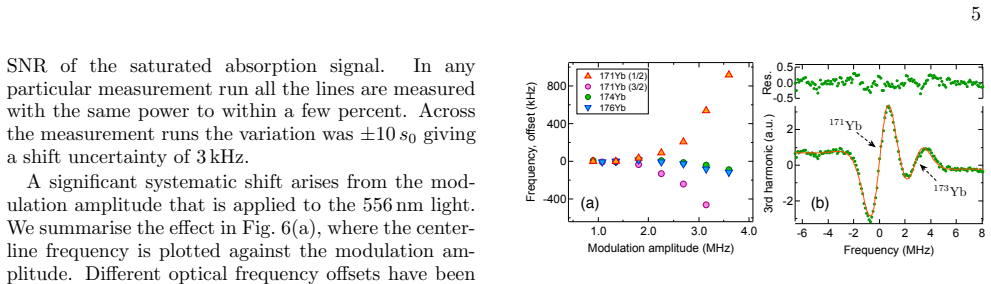
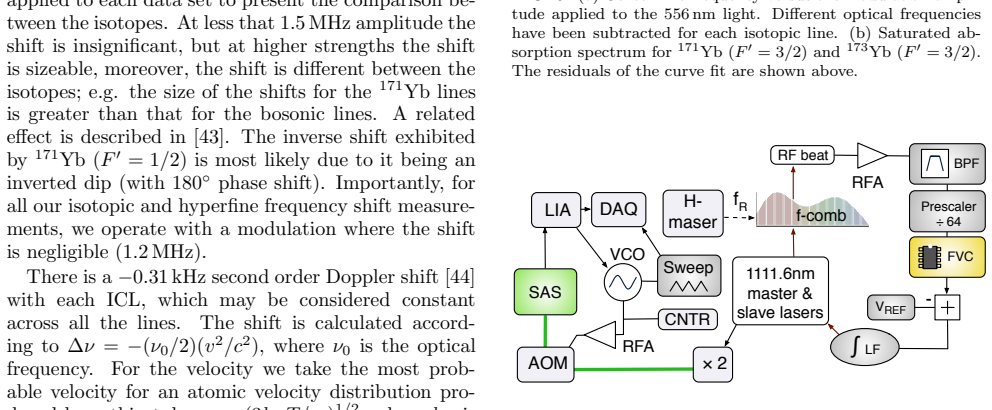
The measurement rests on saturated-absorption spectroscopy with detection at the third harmonic of a 33 kHz modulation, producing a dispersive line shape whose zero crossing is the laser lock point. The frequency axis is calibrated by beating the 1112 nm sub-harmonic of the 556 nm light against the hydrogen-maser-referenced frequency comb. Hyperfine constants are extracted from measured separations between $F$ levels using the standard shift formula $E_{\mathrm{HF}}/h = \tfrac{1}{2}AK + B\,\frac{3K(K+1)-4I(I+1)J(J+1)}{8I(2I-1)J(2J-1)}$ with $K = F(F+1)-I(I+1)-J(J+1)$, so each quoted $A$ and $B$ is a combination of line differences rather than an absolute frequency. A key enabling step is resolving the $^{171}$Yb ($F'=3/2$) and $^{173}$Yb ($F'=3/2$) lines, separated by only $2.679(24)\,\mathrm{MHz}$, through curve fitting of the third-harmonic line shape.
What would settle it
Measure the $^{171}$Yb ($F'=1/2$) transition with a technique that cannot produce crossover resonances, such as Ramsey-Bordé interferometry or resolved-sideband spectroscopy on a cold sample, and compare its line center with the crossover-determined value; a difference larger than the reported $\sim 34$ kHz uncertainty would invalidate the assumed coincidence and propagate into $A(^{171}\mathrm{Yb})$ and the center of gravity.
Extended reading notes
Core claim
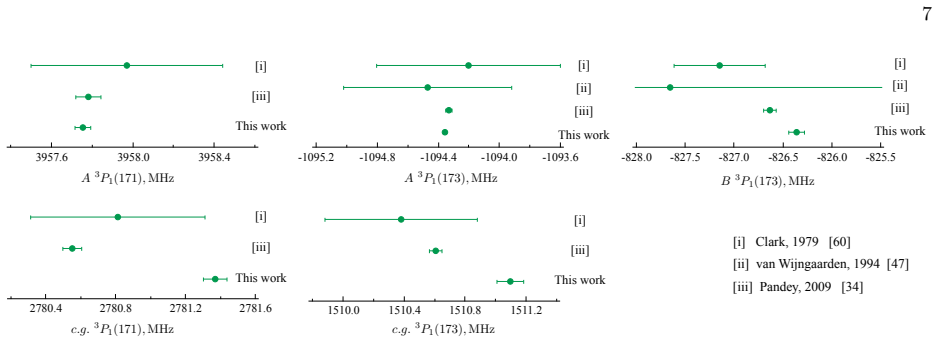
The central claim is that sub-Doppler spectroscopy on a collimated atomic beam, with frequency counting against a hydrogen-maser-referenced frequency comb, measures the ytterbium intercombination line separations with tens-of-kilohertz uncertainty. From those separations the paper derives $A(^{3}P_1, ^{171}\mathrm{Yb}) = 3957.754(34)\,\mathrm{MHz}$, $A(^{3}P_1, ^{173}\mathrm{Yb}) = -1094.361(11)\,\mathrm{MHz}$, and $B(^{3}P_1, ^{173}\mathrm{Yb}) = -826.351(79)\,\mathrm{MHz}$, with centers of gravity $2781.369(66)\,\mathrm{MHz}$ and $1511.129(88)\,\mathrm{MHz}$ relative to $^{176}$Yb. The $A$ values agree with a previous measurement, $B$ is in reasonable agreement, but the centers of gravity disagree with the earlier values by many times the combined uncertainty, a discrepancy the paper does not explain. The paper also uses the new $A$ ratio to compute a hyperfine anomaly of $\Delta_{\mathrm{HF}}^A = -0.3857(51)\%$ for the $6s6p\,^{3}P_1$ state, consistent with a recent tabulated value but more precise.
Load-bearing premise
$^{171}$Yb ($F'=1/2$) is treated as an inverted crossover resonance whose center coincides exactly with the true line center, so any offset between the resonance feature and the line center shifts $A(^{171}\mathrm{Yb})$ and the $^{171}$Yb center of gravity by the same amount.
Editorial extensions
If this is right
- If the new centers of gravity are right, previously published isotope-shift values for the odd ytterbium isotopes are off by several hundred kilohertz, which would affect any analysis of nuclear charge radii or mass shifts built on those values.
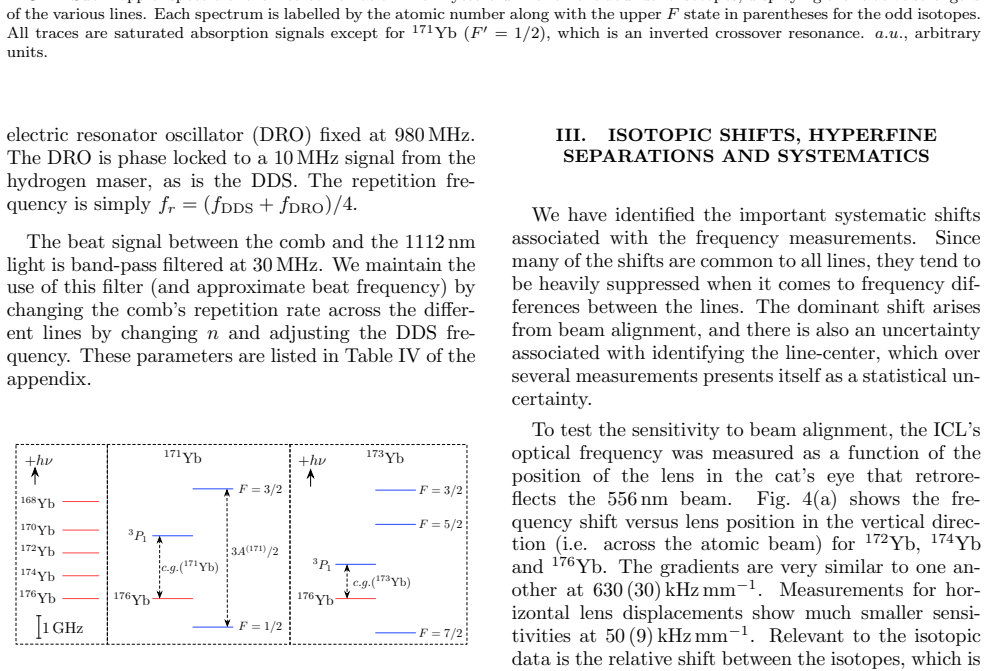
- The resolved $^{171}$Yb ($F'=3/2$) and $^{173}$Yb ($F'=3/2$) separation becomes a direct experimental anchor for the hyperfine constants, removing ambiguity from partially overlapping lines.
- The refined $A$ ratio yields a more precise hyperfine anomaly for the $6s6p\,^{3}P_1$ state, giving atomic many-body calculations a tighter target to match.
- The consistent set of isotope shifts across all abundant isotopes can be combined with clock-line measurements in a King-plot analysis to test for new physics in isotope shifts.
Reading between the lines
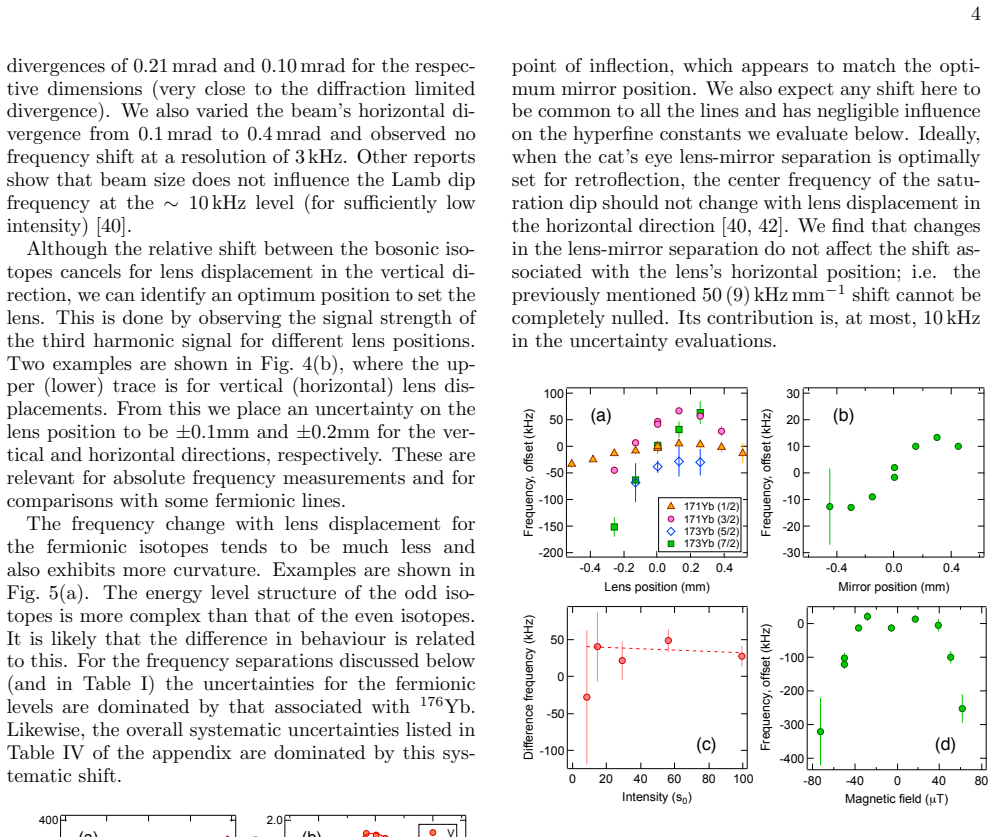
- The unexplained center-of-gravity discrepancy may point to a systematic bias in the earlier measurements, such as unresolved hyperfine structure or modulation-induced line shifts of the kind documented here; re-analyzing the earlier spectra with a line-shape model that includes neighbouring lines would test this.
- If the new centers of gravity survive independent verification, isotope-shift searches for physics beyond the Standard Model that use ytterbium would need recalibration, since those analyses depend on precise isotope shifts.
- A Ramsey-Bordé interferometer on a cold atomic beam could independently check the assumption that the inverted crossover resonance of $^{171}$Yb ($F'=1/2$) sits exactly at the true line center, a test this paper does not perform.
Signed reviews
Editorial analysis
A structured set of objections, weighed in public.
Referee Report
Summary. The paper reports sub-Doppler saturated-absorption spectroscopy of the 556 nm 1S0-3P1 intercombination line in ytterbium, using an atomic beam, a frequency comb referenced to a hydrogen maser, and third-harmonic dispersive detection. The authors measure optical frequencies of all abundant isotopes and derive isotope shifts, hyperfine separations for 171Yb and 173Yb, and the hyperfine constants A(3P1) and B(3P1), as well as centers of gravity relative to 176Yb. The reported values are A(171Yb)=3957.754(34) MHz, A(173Yb)=-1094.361(11) MHz, B(173Yb)=-826.351(79) MHz, and centers of gravity 2781.369(66) MHz and 1511.129(88) MHz for 171Yb and 173Yb, respectively. The A and B constants agree with prior work of Pandey et al., but the centers of gravity disagree by roughly 0.5-0.8 MHz, a discrepancy the authors state they cannot explain.
Significance. The experimental work is careful and transparent: the authors characterize lens-alignment, intensity, modulation-amplitude, magnetic-field, and line-locking systematics; check reproducibility over three years; and provide detailed uncertainty tables. The hyperfine constants are derived directly from measured frequency intervals using Eq. (4), with no fit to theory, and the agreement of A(171Yb) and B(173Yb) with prior values is a meaningful cross-check. If the absolute tie to 176Yb were validated, the improved precision and the resolved 171Yb(3/2)-173Yb(3/2) pair would be useful for many-body tests and hyperfine-anomaly studies. However, the unexplained discrepancies in the centers of gravity and in several individual isotope shifts relative to Ref. [34] currently leave the central c.g. claim unverified. The paper's honesty about the discrepancy is commendable, but acknowledgment alone does not establish the measurement.
major comments (4)
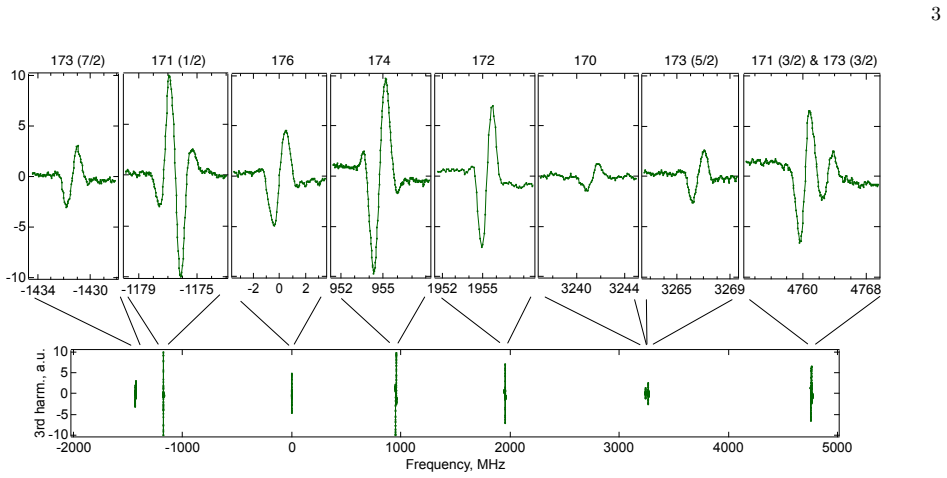
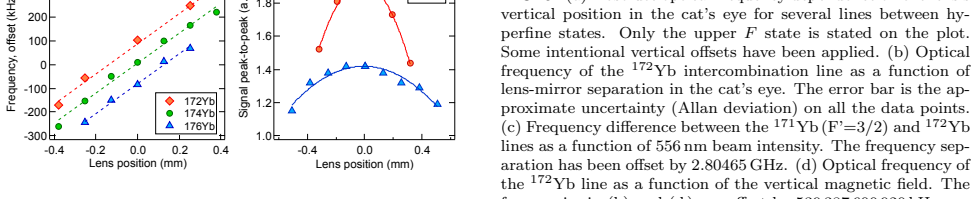
- [Table I] Table I shows differences from Ref. [34] that are much larger than the quoted uncertainties for several isotope shifts, not only for the centers of gravity. For example, the 172Yb shift is 1955.526(36) MHz versus 1954.852(60) MHz, a difference of about 0.67 MHz or roughly 9-10 times the combined uncertainty; the 173Yb (F'=7/2) shift differs by about 0.48 MHz; and the 171Yb (F'=1/2) shift differs by about 0.82 MHz. The manuscript discusses the center-of-gravity disagreement but does not address these individual line-shift discrepancies. Since the reported 'shift from 176Yb' values are central outputs of Section III, these discrepancies need either a quantitative explanation or a systematic uncertainty large enough to cover them.
- [Section IV, Table III] The centers of gravity are stated as 2781.369(66) MHz and 1511.129(88) MHz relative to 176Yb, but they disagree with Ref. [34] by 0.819 MHz and 0.522 MHz, respectively, which is many times the combined uncertainty. The text says 'We do not have an explanation for this difference.' Because the center-of-gravity values are one of the main results, an unresolved discrepancy of this size means the claim is not established. The authors should identify the source, for example a common-mode offset in the 176Yb tie, the AOM frequency calibration, or the lock-point definition, and correct for it, or present the values with an explicit caveat.
- [Section III] The exclusion of the 2016 data for 171Yb (F'=1/2), 171Yb (F'=3/2), and 173Yb (F'=3/2) is motivated by the use of a higher modulation amplitude and by the unresolved 173Yb (3/2) line. However, the paper does not show a re-analysis of those discarded points using the measured modulation-amplitude dependence of Fig. 6(a), nor does it give a quantitative criterion for the exclusion. As written, the selection appears post hoc, and because these are the same lines whose shifts are in disagreement with Ref. [34], the exclusion directly affects the central comparison. A corrected re-analysis or a sensitivity analysis that includes the excluded points is needed.
- [Section II, Fig. 2] The 171Yb (F'=1/2) feature is an inverted crossover resonance, not a saturated absorption dip, and the paper assumes its center coincides with the true line center, citing Ref. [37], but assigns no uncertainty to this assumption. This assumption enters A(171Yb) and the 171Yb center of gravity. The good agreement of A(171Yb) with Pandey et al. suggests any offset is small, but this inference is not stated or propagated. The manuscript should either quantify the crossover-center offset from Ref. [37] or list it as a systematic uncertainty.
minor comments (3)
- [Section IV and Table III caption] The phrase 'systemic shifts' should be corrected to 'systematic shifts' in the sentence preceding Table III.
- [Abstract] The abstract describes the method as sub-Doppler fluorescence spectroscopy, but the observed linewidths are modulation-broadened to about 1 MHz; consider clarifying that the improvement is in the dispersive discrimination rather than in the spectral linewidth.
- [Section II, Eq. (1)] The sign convention for f_o and f_b in Eq. (1) should be stated explicitly, since the sentence 'maintained at -20 MHz' is not sufficient for a reader to reproduce the absolute frequency without checking the comb locking polarity.
Circularity Check
No circularity: hyperfine constants are direct inversions of measured separations; the c.g. discrepancy is a systematic/accuracy issue, not a definitional loop.
full rationale
The derivation chain is self-contained. A and B are obtained by inserting measured hyperfine line separations (Table I) into the standard hyperfine energy formula Eq. (4); there is no fitted parameter that reappears as a prediction. The centers of gravity are linear combinations of the same measured line positions and the derived constants, so they are reported measurements rather than outputs of a model. The only self-citation is the use of [37] to justify that the inverted crossover resonance of 171Yb (F'=1/2) sits at the true line center; this is an independent published calibration, and the agreement of A(171) with Ref. [34] to 27 kHz corroborates it, so it does not reduce the result to its own input. The paper explicitly states in Sec. IV that 'We do not have an explanation for this difference' for the c.g. disagreement; that is a limitation in accuracy/systematics, not a circular step. The decision not to use the 2016 data for three lines is a documented modulation-shift correction, also not circular. Hence no load-bearing step is equivalent by construction to its inputs.
Assumptions & free parameters
free parameters (2)
- Line shape width gamma =
not quoted (fit result)
- Line shape scale factors c1 and c2 =
not quoted
assumptions (5)
- domain assumption The hyperfine interaction is described by the standard magnetic dipole plus electric quadrupole Hamiltonian of Eq. (4).
- domain assumption The 171Yb (F'=1/2) inverted crossover resonance has its center exactly at the line center, as stated in Section II and based on [37].
- domain assumption The lower 1S0 state has no hyperfine structure, so measured transition frequencies directly give 3P1 hyperfine level energies.
- domain assumption The frequency reference (hydrogen maser and frequency comb) is accurate at the kHz level, well below the reported uncertainties.
- domain assumption The line shape model of Eqs. (2) and (3) with a dispersive third-derivative profile correctly describes the overlapping 171Yb(3/2) and 173Yb(3/2) resonances.
Cite this review
Pith. "Pith review of Hyperfine constants and line separations for the $^{1}S_{0}-\,^{3}P_{1}$ intercombination line in neutral ytterbium with sub-Doppler resolution." pith.science (2026). https://pith.science/paper/JZUZPCOJ
@misc{pith2026190803350,
  author       = {Pith},
  title        = {Pith review of: Hyperfine constants and line separations for the $^1S_0-\,^3P_1$ intercombination line in neutral ytterbium with sub-Doppler resolution},
  year         = {2026},
  howpublished = {\url{https://pith.science/paper/JZUZPCOJ}},
  note         = {Machine review of arXiv:1908.03350}
}
abstract
Optical frequency measurements of the intercombination line $(6s^{2})\,^{1}S_{0} -(6s6p)\,^{3}P_{1}$ in the isotopes of ytterbium are carried out with the use of sub-Doppler fluorescence spectroscopy on an atomic beam. A dispersive signal is generated to which a master laser is locked, while frequency counting of an auxiliary beat signal is performed via a frequency comb referenced to a hydrogen maser. The relative separations between the lines are used to evaluate the $^{3}P_{1}$-level magnetic dipole and electric quadrupole constants for the fermionic isotopes. The center of gravity for the $^3P_1$ levels in $^{171}$Yb and $^{173}$Yb are also evaluated, where we find significant disagreement with previously reported values. These hyperfine constants provide a valuable litmus test for atomic many-body computations in ytterbium.
Figures


Figures from the paper (7 more)
Reference graph
Works this paper leans on
-
[34]
Ginges and V
J. Ginges and V. Flambaum, Physics Reports 397, 63 (2004)
2004
-
[37]
V. A. Dzuba, V. V. Flambaum, and J. S. M. Ginges, Phys. Rev. D 66, 076013 (2002)
work page 2002
-
[1]
Bouganne et al., New Journal of Physics 19, 113006 (2017)
R. Bouganne et al., New Journal of Physics 19, 113006 (2017)
work page 2017
-
[2]
-1431.392 (35) -1431.872 (60) -1432.6 (12) 171Yb (1 2→ 1
-
[3]
-1176.412 (87) -1177.231 (60) -1177.3 (11) 176Yb 0 0 0 174Yb 954.734 (31) 954.832 (60) 954.2 (9) 172Yb 1955.526 (36) 1954.852 (60) 1954.8 (16) 170Yb 3241.342 (43) 3241.177 (60) 3241.5 (28) 173Yb (5 2→ 5
work page 1955
-
[4]
3266.557 (95) 3266.243 (60) 3267.1 (28) 168Yb - 4609.960 (80) 4611.9 (44) 171Yb (1 2→ 3
-
[5]
4760.247 (64) 4759.440 (80) 4761.8 (37) 173Yb (5 2→ 3
-
[6]
4762.926 (77) 4762.110 (120) 4761.8 (37) TABLE II. Frequency differences relevant to the hyperfine constants along with systematic and statistical uncertain- ties. Isotope F′ pair ∆ f ∆ustat ∆usyst (MHz) (MHz) (MHz) 171Yb ( 1 2 , 3
Show all 76 references
-
[7]
5936.632 0.027 0.039 173Yb ( 3 2 , 5
-
[8]
1496.375 0.058 0.030 173Yb ( 3 2 , 7
-
[9]
6194.306 0.028 0.024 173Yb ( 5 2 , 7
-
[10]
Only in the case of the cen- ters of gravity are the uncertainties relating to 176Yb included
4697.939 0.071 0.051 the differences between the hyperfine levels, therefore the error analysis incorporates uncertainties associated with the difference between hyperfine lines, not those with respect to 176Yb. Only in the case of the cen- ters of gravity are the uncertainties re...
-
[11]
Yamamoto, J
R. Yamamoto, J. Kobayashi, T. Kuno, K. Kato, and Y. Takahashi, New Journal of Physics 18, 023016 (2016)
2016
-
[12]
Taie et al
S. Taie et al. , Science Advances 1 (2015)
2015
-
[13]
Hansen et al
A. Hansen et al. , Phys. Rev. A 84, 011606 (2011)
2011
-
[14]
Dorscher et al
S. Dorscher et al. , Rev. Sci. Instrum. 84, 043109 (2013)
2013
-
[15]
Ozawa, S
H. Ozawa, S. Taie, Y. Takasu, and Y. Takahashi, Phys. Rev. Lett. 121, 225303 (2018)
2018
-
[16]
Nakajima et al
S. Nakajima et al. , Nature Physics 12 (2016)
2016
-
[17]
Dalibard, F
J. Dalibard, F. Gerbier, G. Juzeliunas, and P. Ohberg, Rev. Mod. Phys. 83, 1523 (2011)
2011
-
[18]
S. Taie, R. Yamazaki, S. Sugawa, and Y. Takahashi, Nat. Phys. 8, 825 (2012)
2012
-
[19]
Scazza et al
F. Scazza et al. , Nature Physics 10, 779 (2014)
2014
-
[20]
Braun et al
S. Braun et al. , Science 339, 52 (2013)
2013
-
[21]
H¨ oferet al
M. H¨ oferet al. , Phys. Rev. Lett. 115, 265302 (2015)
2015
-
[22]
Guttridge et al
A. Guttridge et al. , Phys. Rev. A 97, 063414 (2018)
2018
-
[23]
S. Taie, S. Watanabe, T. Ichinose, and Y. Takahashi, Phys. Rev. Lett. 116, 043202 (2016)
2016
-
[24]
Nemitz et al
N. Nemitz et al. , Nat. Photon. 10, 258 (2016)
2016
-
[25]
Takamoto et al
M. Takamoto et al. , Comptes Rendus Physique 16, 489 (2015)
2015
-
[26]
W. F. McGrew et al. , Nature (2018)
2018
-
[27]
Schioppo et al
M. Schioppo et al. , Nature Photonics 11, 48 (2017)
2017
-
[28]
Pizzocaro et al
M. Pizzocaro et al. , Metrologia 54, 102 (2017)
2017
-
[29]
Tsigutkin et al
K. Tsigutkin et al. , Phys. Rev. Lett. 103, 071601 (2009)
2009
-
[30]
Antypas, A
D. Antypas, A. Fabricant, L. Bougas, K. Tsigutkin, and D. Budker, Hyperfine Interactions 238, 21 (2017)
2017
-
[31]
Wood et al
C. Wood et al. , Science 275, 1759 (1997)
1997
-
[32]
V. A. Dzuba and V. V. Flambaum, International Jour- nal of Modern Physics E 21, 1230010 (2012)
2012
-
[33]
Antypas et al
D. Antypas et al. , Nature Physics 15, 120 (2019)
2019
-
[35]
M. S. Safronova et al. , Rev. Mod. Phys. 90, 025008 (2018)
2018
-
[36]
V. A. Dzuba and V. V. Flambaum, Phys. Rev. A 83, 042514 (2011)
2011
-
[38]
Dilip, B
A. Dilip, B. P. Das, W. F. Perger, M. K. Samal, and K. P. Geetha, Journal of Physics B 34, 3089 (2001)
2001
-
[39]
Campbell, I
P. Campbell, I. Moore, and M. Pearson, Progress in Particle and Nuclear Physics 86, 127 (2016)
2016
-
[40]
Derevianko, S
A. Derevianko, S. G. Porsev, and K. Beloy, Phys. Rev. A 78, 010503 (2008). 9 TABLE IV. Summary of the experimental parameters for 1S0− 3P1 isotopic shifts and hyperfine splittings in ytterbium, along systematic and statistical uncertainties with respect to 176Yb. Transition Mod...
2008
-
[41]
68 380 31 16 171Yb (1 2→ 1
-
[42]
68 630 81 30 176Yb 71 250 0 0 174Yb 73 170 16 25 172Yb 75 170 27 21 170Yb 77 480 26 29 173Yb (5 2→ 5
-
[43]
77 520 92 51 171Yb (1 2→ 3
-
[44]
80 510 52 32 173Yb (5 2→ 3
-
[45]
Hyperfine energy shifts for 171Yb and 173Yb
80 510 52 57 TABLE V. Hyperfine energy shifts for 171Yb and 173Yb. Isotope F E HF /h 171 1/2 −A(171) 171 3/2 A(171)/2 173 3/2 −7A(173)/2 + 7B(173)/10 173 5/2 −A(173)− 4B(173)/5 173 7/2 5 A(173)/2 + B(173)/4
-
[46]
V. A. Dzuba, V. V. Flambaum, and J. S. M. Ginges, Phys. Rev. A 76, 034501 (2007)
2007
-
[47]
J. H. Han, J. H. Kang, M. Lee, and Y. Shin, Phys. Rev. A 97, 013401 (2018)
2018
-
[48]
Pandey, A
K. Pandey, A. K. Singh, P. V. K. Kumar, M. V. Surya- narayana, and V. Natarajan, Phys. Rev. A 80, 022518 (2009)
2009
-
[49]
R. W. Berends and L. Maleki, J. Opt. Soc. Am. B 9, 332 (1992)
1992
-
[50]
M˚ artensson-Pendrill, D
A.-M. M˚ artensson-Pendrill, D. S. Gough, and P. Han- naford, Phys. Rev. A 49, 3351 (1994)
1994
-
[51]
L. A. Salter, E. de Clercq, and J. J. McFerran, Journal of Physics B: Atomic, Molecular and Optical Physics 50, 165003 (2017)
2017
-
[52]
Kostylev, C
N. Kostylev, C. R. Locke, M. E. Tobar, and J. McFer- ran, Applied Physics B 118, 517 (2015)
2015
-
[53]
J. J. McFerran, Opt. Lett. 43, 1475 (2018)
2018
-
[54]
Courtillot et al
I. Courtillot et al. , Eur. Phys. J. D 33, 161 (2005)
2005
-
[55]
J. J. Snyder, Appl. Opt. 14, 1825 (1975)
1975
-
[56]
Morinaga, F
A. Morinaga, F. Riehle, J. Ishikawa, and J. Helmcke, Applied Physics B: Lasers and Optics 48, 165 (1989)
1989
-
[57]
du Burck and O
F. du Burck and O. Lopez, Measurement Science and Technology 15, 1327 (2004)
2004
-
[58]
Barger, Opt
R. Barger, Opt. Lett. 6, 145 (1981)
1981
-
[59]
Demtr¨ oder, Laser Spectroscopy, Experimental Techniquesvolume 2, 4 ed
W. Demtr¨ oder, Laser Spectroscopy, Experimental Techniquesvolume 2, 4 ed. (Springer, 2008)
2008
-
[60]
Nenadovi´ c and J
L. Nenadovi´ c and J. McFerran, Journal of Physics B: Atomic, Molecular and Optical Physics 49, 065004 (2016)
2016
-
[61]
van Wijngaarden and J
W. van Wijngaarden and J. Li, J. Opt. Soc. Am. B 11, 2163 (1994)
1994
-
[62]
R. C. Brown et al. , Phys. Rev. A 87, 032504 (2013)
2013
-
[63]
Kleinert, M
M. Kleinert, M. E. Gold Dahl, and S. Bergeson, Phys. Rev. A 94, 052511 (2016)
2016
-
[64]
Arimondo, M
E. Arimondo, M. Inguscio, and P. Violino, Rev. Mod. Phys. 49, 31 (1977)
1977
-
[65]
Budick and J
B. Budick and J. Snir, Phys. Rev. A 1, 545 (1970)
1970
-
[66]
B¨ uttgenbach, Hyperfine Interactions20, 1 (1984)
S. B¨ uttgenbach, Hyperfine Interactions20, 1 (1984)
1984
-
[67]
Olschewski, Z
L. Olschewski, Z. Physik 249, 205 (1972)
1972
-
[68]
Persson, Atomic Data and Nuclear Data Tables 99, 62 (2013)
J. Persson, Atomic Data and Nuclear Data Tables 99, 62 (2013)
2013
-
[69]
Friebe et al
J. Friebe et al. , Phys. Rev. A 78, 033830 (2008)
2008
-
[70]
Riehle, A
F. Riehle, A. Witte, T. Kisters, and J. Helmcke, Appl. Phys. B 54, 333 (1992)
1992
-
[71]
Celikov, F
A. Celikov, F. Riehle, V. Velichansky, and J. Helmcke, Opt. Commun. 107, 54 (1994)
1994
-
[72]
R. L. Barger, J. C. Bergquist, T. C. English, and D. J. Glaze, Appl. Phys. Lett. 34, 850 (1979)
1979
-
[73]
J. J. McFerran, J. G. Hartnett, and A. N. Luiten, App. Phys. Lett. 95, 031103 (2009)
2009
-
[74]
Clark, M
D. Clark, M. Cage, D. Lewis, and G. Greenlees, Phys. Rev. A 20, 239 (1979)
1979
-
[75]
Frugiuele, E
C. Frugiuele, E. Fuchs, G. Perez, and M. Schlaffer, Phys. Rev. D 96, 015011 (2017)
2017
-
[76]
J. C. Berengut et al. , Phys. Rev. Lett. 120, 091801 (2018)
2018
Reviewed August 14, 2026 · model on record in the stance chip above.
Discussion (0). Continue with ORCID to comment.