REVIEW 3 major objections 5 minor 107 references
Design of Wireless Sensors for IoT with Energy Storage and Communication Channel Heterogeneity
T0 review · 3 major / 5 minor · reviewed 2026-08-14 · deepseek-v4-flash
Pith's one-line read A single measured radio burst determines the supercapacitor size for a hybrid IoT sensor supply, reported here as 0.6 µF.
desk verdict The claimed 0.6 µF supercapacitor sizing is off by about two orders of magnitude from the paper's own equations, but the transceiver current data is real and worth preserving. read the letter →
The pith
A machine-rendered reading of the paper's core claim, the machinery that carries it, and where it could break.
The reading
What carries the argument
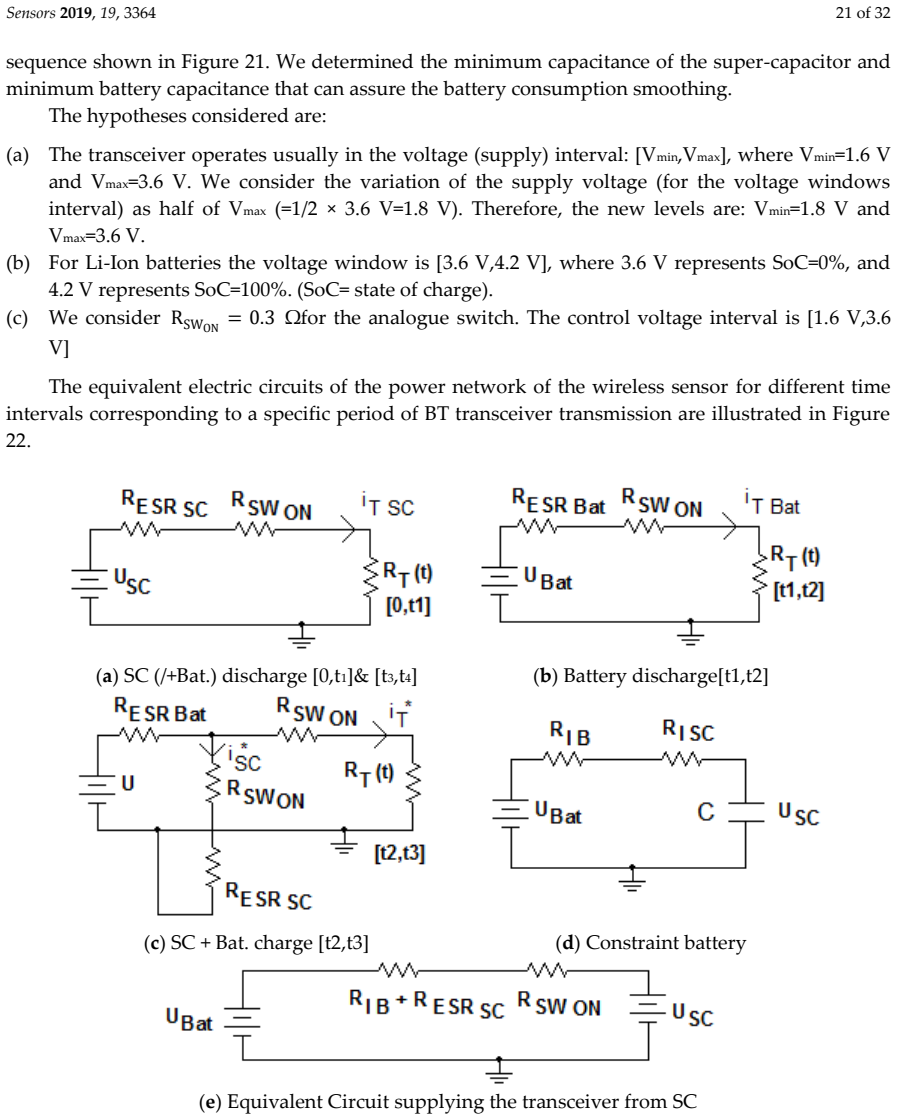
The load-bearing identity is Equation (10), $C_{\mathrm{equiv}} = 2.66 W_{e1}/(V_{\max}^2 - V_{\min}^2)$, a closed-form sizing rule derived from the capacitor energy relation $W = \frac{1}{2} C U^2$. The factor $2.66$ comes from writing $W_{e1} \ge 0.75 W_{\mathrm{SC}}$ (so $W_{\mathrm{SC}} = 1.33 W_{e1}$) and then solving $\frac{1}{2} C (V_{\max}^2 - V_{\min}^2) = 1.33 W_{e1}$. The machinery also includes the time-interval decomposition of the current waveform - active maximum, wake/sleep, active minimum - and the constraint that the battery recharges the supercapacitor to $V_{\max}$ in the quiet interval; together these turn one oscilloscope measurement into a component value.
What would settle it
Take the HC-05 current burst the paper measures (roughly 40-65 mA over about 1 ms at 5 V), integrate it to obtain $W_{e1}$, then evaluate Equation (10) with $V_{\max}=3.6$ V and $V_{\min}=1.8$ V; if the result is not near $0.6\,\mu\mathrm{F}$, the reported value is not reproducible from the paper's own data. A bench check would then charge a $0.6\,\mu\mathrm{F}$ capacitor to 3.6 V, connect it to the HC-05 during a burst, and observe whether the voltage stays above 1.8 V; if it collapses, the sizing rule or its assumed energy ratio fails.
Extended reading notes
Core claim
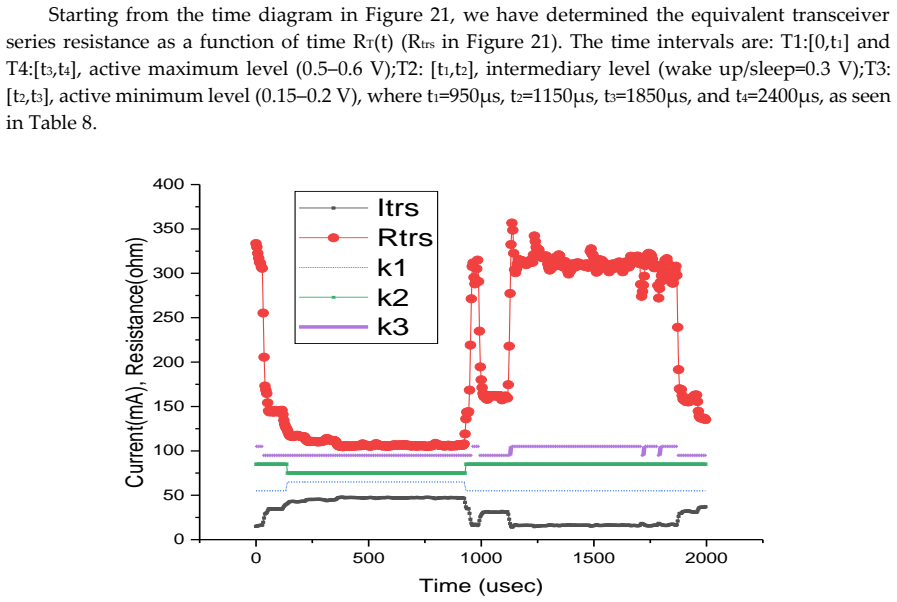
The authors claim that duplicating both the communication path and the storage path - BLE for short range inside the 2.4 GHz ISM band, nRF24 outside it, and a battery-supercapacitor hybrid supply - yields a measurable gain in energy efficiency. The sizing methodology is the mathematical core: from the time diagram of a Bluetooth transceiver's current draw, four intervals are distinguished, and for the most active interval $T_1$ the energy $W_{e1}$ is assumed to represent at least 75% of the supercapacitor's stored energy. With the voltage window $V_{\max}=3.6$ V to $V_{\min}=1.8$ V (half of $V_{\max}$), the capacitance follows from $W = \frac{1}{2} C U^2$ as $C_{\mathrm{equiv}} = 2.66 W_{e1}/(V_{\max}^2 - V_{\min}^2)$, which the paper evaluates to $0.6\,\mu\mathrm{F}$. The companion operational claim is that the battery must recharge the supercapacitor back to $V_{\max}$ during the low-activity interval, and that this smoothing, together with dual-transceiver communication, avoids accelerated battery aging and supports energy harvesting.
Load-bearing premise
The whole sizing method presumes that the energy used by the transceiver in its main active interval is known and is at least three-quarters of what the supercapacitor stores, and that the capacitor is allowed to swing from 3.6 V down to half that, 1.8 V; if those numbers are not right for a given transceiver, the calculated capacitance changes.
Editorial extensions
If this is right
- A designer who measures the transceiver's current burst can size the supercapacitor directly from $C_{\mathrm{equiv}} = 2.66 W_{e1}/(V_{\max}^2 - V_{\min}^2)$, skipping iterative simulation.
- Smoothing the burst with a supercapacitor keeps the battery's delivered current close to constant, which should extend battery cycle life because the method targets rapid current variation as the aging stress.
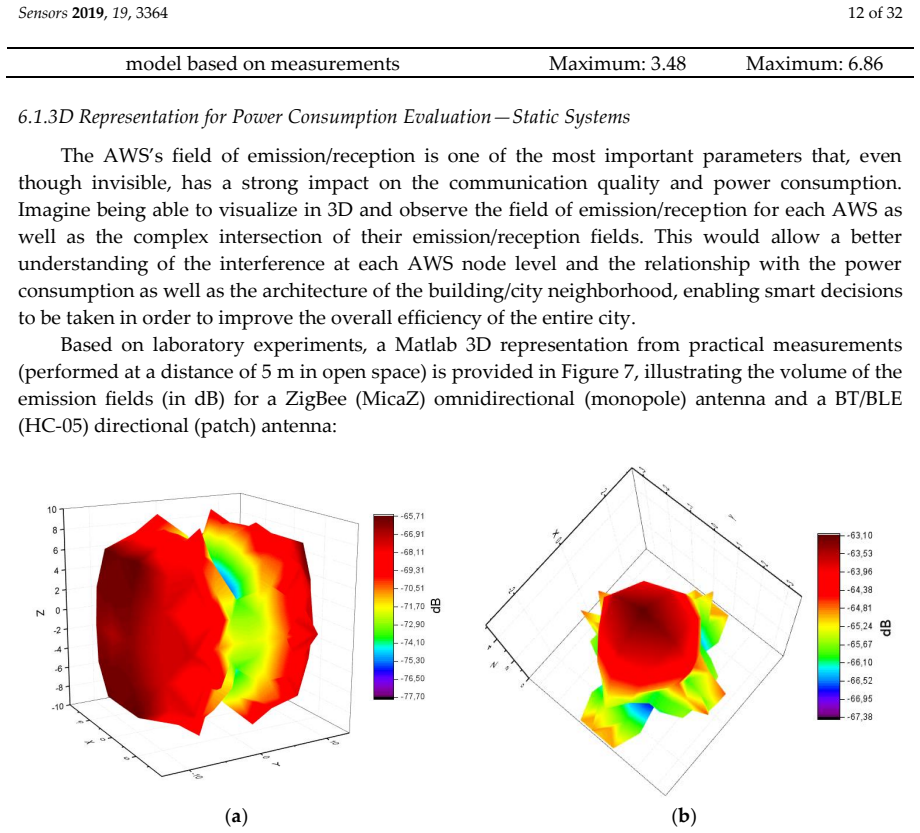
- Dual-transceiver operation (BLE in the 2400-2420 MHz sub-band, nRF24 in the 2480-2525 MHz band) offers a coexistence strategy that keeps throughput loss below about 20% in the tested scenarios.
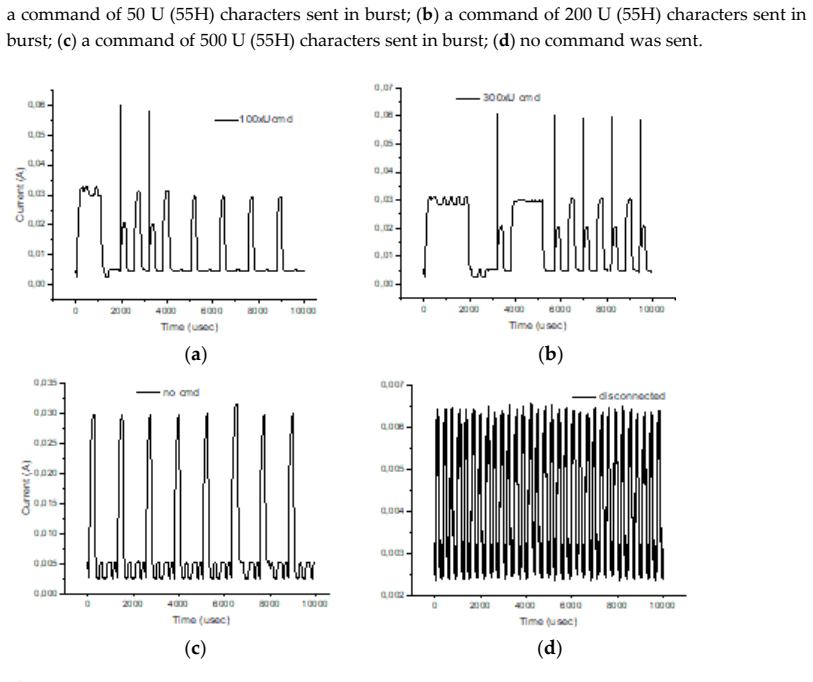
- Payload and protocol choices matter on the order of 7-30% in energy, so the same hardware can be tuned per application by selecting data payload extremes and transceiver type.
Reading between the lines
- A natural test of the scaling assumption is to apply the same formula to HM-10 (BLE) and JDY-30 (BT) using the paper's own Table 7 energies; the formula predicts different capacitances per transceiver, and a bench test comparing those predictions with measured voltage sag would isolate whether the 75% ratio is the right rule.
- The 0.6 microfarad result appears difficult to reconcile with the measured 40-65 mA bursts; recomputing from the same data with typical burst durations yields values in the tens of microfarads, which would place the required storage at conventional supercapacitor sizes rather than on-chip graphene capacitors.
- The same voltage-window reasoning could be turned into a battery-side constraint: the quiet-interval recharge condition gives a lower bound on battery internal resistance, offering a second sizing output for the hybrid supply.
Signed reviews
Editorial analysis
A structured set of objections, weighed in public.
Referee Report
Summary. The paper proposes a design methodology for IoT wireless sensor nodes that combine two transceivers (BT/BLE and RFM) and a hybrid power supply (battery plus supercapacitor). It reports experimental current and energy measurements for HC-05, JDY-30, HM-10, and NRF24L01 transceivers, analyzes band coexistence and 3D emission fields, and derives a sizing formula for the supercapacitor (Eq. (10)). The central quantitative claim is that the calculated equivalent capacitance Cequiv reaches 0.6 µF, and the conclusions state that the developed methodology enables optimal supercapacitor sizing.
Significance. If correct, the methodology would allow a designer to size a hybrid supply from a single measured transceiver current waveform, which is an attractive practical goal. The paper's strengths include a substantial set of empirical transceiver current/energy measurements (Tables 5-8, Figures 9-18), a concrete dual-transceiver testbed, and an explicit energy-balance derivation rather than a purely abstract model. The sizing derivation itself is not circular in the formal sense: Eq. (10) is a direct energy-balance calculation from the measured We1. However, the reported numerical result is internally inconsistent with the paper's own equations and data. The claimed 0.6 µF value is roughly two orders of magnitude below the value obtained by substituting the stated We1 and voltage window into Eq. (10). Because this value is the paper's central quantitative deliverable, the inconsistency is load-bearing and undermines the claim of optimal supercapacitor sizing.
major comments (3)
- [Section 7, Eq. (10) and Table 8] The claimed value Cequiv = 0.6 µF does not follow from the paper's own equations. Equation (10) is Cequiv = 2.66·We1/(Vmax²−Vmin²). With the stated Vmax = 3.6 V and Vmin = 1.8 V, the denominator is 9.72 V². For the HC-05 transceiver, Table 8 lists the T1 energy as 204,703 µJ, which in the decimal-comma convention used elsewhere in the paper means 204.703 µJ. Substituting gives Cequiv ≈ 56 µF, not 0.6 µF; for HM-10 (80.501 µJ) the result is ≈ 22 µF. No plausible unit reinterpretation (e.g., treating 204,703 as 204703 µJ, or using Vmin = 0) yields 0.6 µF. This is an internal arithmetic inconsistency in the central result, not a matter of disagreement with external consensus.
- [Section 7, assumptions (a) and (c)] The voltage window is chosen without physical justification and directly controls the result. The text first states Vmin = 1.6 V and Vmax = 3.6 V, then replaces Vmin with Vmax/2 = 1.8 V, with no circuit-level reason given. Since Cequiv scales as (Vmax²−Vmin²)⁻¹, this assumption alone changes the capacitance by more than a factor of two relative to the initially stated 1.6 V lower bound. The authors should justify the 50% depth-of-discharge window or provide a sensitivity analysis over the allowable voltage range.
- [Section 7, Eq. (6) and validation] The sizing methodology is not experimentally validated. The 75% energy ratio in Eq. (6) is asserted as a design choice, and no measurements of supercapacitor voltage, battery current, or battery stress are reported for a hybrid prototype. The paper's conclusion that hybridization 'generates an improvement in energy efficiency' is therefore not supported by the presented data; at most it is a plausible qualitative expectation. A validation experiment or a clear statement that the hybrid supply was not implemented is needed before the 'optimal sizing' claim can be assessed.
minor comments (5)
- [Table 8] The use of a comma as a decimal separator in entries such as '204,703' is inconsistent with the rest of the paper and is a source of ambiguity; use '204.703' (or state the convention explicitly) so that the reader can reproduce Eq. (10).
- [Figure 21 and Table 8] The time intervals T1-T4 are defined with t4 = 2400 µs, while the tables refer to a 2500 µs period; the relationship between the measured interval and the total transmission period should be clarified.
- [Equations (12)-(15)] Variables such as RESRSC, RIB, and RE are used without definition in the text; define them or label them in Figure 22.
- [Abstract and Conclusions] The phrase 'duplicates the transceivers and also the power source' overstates the architectural novelty; a quantitative comparison with prior hybrid energy storage system (HESS) designs would help position the contribution.
- [Section 6.2, Tables 5 and 6] The current values use a comma as a decimal separator in some places and a period in others; unify the notation throughout the paper.
Circularity Check
No significant circularity: the super-capacitor sizing formula is a direct energy-balance calculation from measured transceiver energy; the reported 0.6 µF value is an internal numerical inconsistency, not a circular reduction.
full rationale
The central sizing procedure in Section 7 is not circular in the formal sense. Equation (10), Cequiv = 2.66·We1/(Vmax² − Vmin²), is obtained by combining the explicitly stated hypotheses We1 ≥ 0.75·WeSC (Eq. 6), WeSC,min = 1.33·We1 (Eq. 7), and the stored-energy relation WeSC = ½·C·U² (Eq. 8). This is a transparent energy-balance calculation. The transceiver energy We1 comes from the paper's own measured current waveforms integrated in Section 6.3 (Eqs. 1–4), so the sizing uses measured data as an input rather than redefining a fitted parameter as a prediction. The choices Vmin = Vmax/2 = 1.8 V and the 75% ratio are stated assumptions; conditional assumptions do not make a derivation circular, though they affect validity. The claimed result 'The calculated value for Cequiv reaches 0.6µF' does not follow from Eq. (10) with the numbers in Table 8: for HC-05, T1 ≈ 204.7 µJ, Vmax = 3.6 V and Vmin = 1.8 V give Cequiv ≈ 56 µF, not 0.6 µF. This is a serious internal numerical inconsistency and a correctness/verification problem, but it is not a circularity: the result contradicts the paper's own equation rather than being equivalent to its inputs by construction. The self-citations in the paper ([105]–[107]) support background material and IoT applications, not the load-bearing sizing derivation, so no self-citation chain forces the main result. Under the stated rules, an arithmetic mismatch should be reported as a correctness risk, not as circularity. Consequently, no circular step is identified and the circularity score is 0.
Assumptions & free parameters
free parameters (4)
- We1 energy ratio threshold =
0.75
- Vmin supply window =
1.8 V
- Switch on-resistance RSWON =
0.3 ohm
- Time interval boundaries t1-t4 =
950, 1150, 1850, 2400 microseconds
assumptions (6)
- ad hoc to paper Transceiver operates in the supply interval [Vmin,Vmax] with Vmin = Vmax/2
- domain assumption Battery behaves as an ideal voltage source with internal resistance; transitory regimes are excluded
- ad hoc to paper We1 must be at least 75% of the supercapacitor energy
- domain assumption Li-Ion battery SoC window is [3.6 V, 4.2 V]
- domain assumption Data payload extremes 00H and 55H bound the number of voltage transitions
- domain assumption Equivalent transceiver series resistance can be derived from the measured current waveform
Cite this review
Pith. "Pith review of Design of Wireless Sensors for IoT with Energy Storage and Communication Channel Heterogeneity." pith.science (2026). https://pith.science/paper/K27F25VK
@misc{pith2026190809088,
  author       = {Pith},
  title        = {Pith review of: Design of Wireless Sensors for IoT with Energy Storage and Communication Channel Heterogeneity},
  year         = {2026},
  howpublished = {\url{https://pith.science/paper/K27F25VK}},
  note         = {Machine review of arXiv:1908.09088}
}
read the original abstract
Autonomous Wireless Sensors (AWSs) are at the core of every Wireless Sensor Network (WSN). Current AWS technology allows the development of many IoT-based applications, ranging from military to bioengineering and from industry to education. The energy optimization of AWSs depends mainly on: Structural, functional, and application specifications. The holistic design methodology addresses all the factors mentioned above. In this sense, we propose an original solution based on a novel architecture that duplicates the transceivers and also the power source using a hybrid storage system. By identifying the consumption needs of the transceivers, an appropriate methodology for sizing and controlling the power flow for the power source is proposed. The paper emphasizes the fusion between information, communication, and energy consumption of the AWS in terms of spectrum information through a set of transceiver testing scenarios, identifying the main factors that influence the sensor node design and their inter-dependencies. Optimization of the system considers all these factors obtaining an energy efficient AWS, paving the way towards autonomous sensors by adding an energy harvesting element to them.
Figures


Figures from the paper (20 more)





Reference graph
Works this paper leans on
-
[1]
Energy -Efficient Wireless Sensor Networks for Precision Agriculture: A Review
Jawad, H.; Nordin, R.; Gharghan , S.; Jawad, A.; Ismail, M. Energy -Efficient Wireless Sensor Networks for Precision Agriculture: A Review. Sensors 2017, 17, 1781,doi:10.3390/s17081781
-
[2]
Sánchez-Álvarez, D.; Linaje, M.; Rodríguez -Pérez, F.J. A framework to design the computational load distribution of wireless sensor networks in power consumption constrained environments. Sensors 2018, 18, 954,doi:10.3390/s18040954
-
[3]
Emerging Wireless Technologies in the Internet of Things : A Comparative Study
Elkhodr, M.; Shahrestani, S.; Cheung, H. Emerging Wireless Technologies in the Internet of Things : A Comparative Study. Int. J. Wirel. Mob. Netw. 2016, 8, doi:10.5121/ijwmn.2016.8505
arXiv 2016
-
[4]
Yelamarthi, K.; Aman , M.S. ; Abdelgawad, A. An application -driven modular IoT architecture. Wirel. Commun. Mob. Comput. 2017,doi:10.1155/2017/1350929
-
[5]
Razaque, A.; Elleithy, K. Energy -Efficient Boarder Node Medium Access Control Protocol for Wireless Sensor Networks Sensors2014, 14, 5074–5117,doi:10.3390/s140305074
-
[6]
Garcia, C.G.; Ruiz, I.L.; Gómez-Nieto, M.A. State of the Art, Trends and Future of Bluetooth Low Energy, Near Field Communication and Visible Light Communication in the Development of Smart Cities.Sensors 2016,16,1968,doi:10.3390/s16111968
-
[7]
Fisher, R.; Ledwaba, L.; Hancke, G.; Kruger, C. Open hardw are: A role to play in wireless sensor networks? Sensors2015, 15, 6818–6844,doi:10.3390/s150306818
-
[8]
Opportunistic Sensor Data Collection with Bluetooth Low Energy
Aguilar, S.; Vidal, R.; Gomez, C. Opportunistic Sensor Data Collection with Bluetooth Low Energy. Sensors2017, 17, 159,doi:10.3390/s17010159
Show all 107 references
-
[9]
From Sensor Networks to Internet of Things
Hortelano, D.; Olivares, T.; Ruiz, M.; Garrido -Hidalgo, C.; López, V. From Sensor Networks to Internet of Things. Bluetooth Low Energy, a Standard for This Evolution. Sensors2017, 17, 372, doi:10.3390/s17020372
-
[10]
Performance Evaluation of Bluetooth Low Energy: A Systematic Review
Tosi, J.; Taffoni, F.; Santacatterina, M.; Sannino, R .; Formica, D. Performance Evaluation of Bluetooth Low Energy: A Systematic Review. Sensors2017, 17, 2898, doi:10.3390/s17122898
-
[11]
Wireless Sensor Network Security Enhancement Using Directional Antennas: State of the Art and Research Challenges
Curiac, D.I. Wireless Sensor Network Security Enhancement Using Directional Antennas: State of the Art and Research Challenges. Sensors2016, 16, 488, doi:10.3390/s16040488
-
[12]
Pattanaik , S.R
Sahoo, P.K. ; Pattanaik , S.R. ; Wu , S.L. A reliable data transmission model for IEEE 802.15.4e enabled wireless sensor network under Wi-Fi interference. Sensors2017,17,doi:10.3390/s17061320
-
[13]
Recent Advances in Security and Privacy for Wireless Sensor Networks.J
Yu, F.; Chang , C.C.; Shu, J.; Ahmad, I.; Zhang, J.; Maria de Fuentes, J. Recent Advances in Security and Privacy for Wireless Sensor Networks.J. Sens. 2017, 3, doi:10.1155/2017/3057534
2017 doi
-
[14]
Mellouk, A
Senouci, M.R. ; Mellouk, A. Deploying Wireless Sens or Networks Theory and Practice;Elsevier,ScienceDirect:Amsterdam, The Netherlands, 2016
2016
-
[15]
Gomez, C
Darroudi, S.M. ; Gomez, C. Bluetooth Low Energy Mesh Networks: A Survey. Sensors 2017, 17, 1467 , doi:10.3390/s17071467
2017 doi
-
[16]
A Survey of Potential Security Issues in Existing Wi reless Sensor Network Protocols.IEEE Internet Things J
Tomić, I .; McCann, J.A. A Survey of Potential Security Issues in Existing Wi reless Sensor Network Protocols.IEEE Internet Things J. 2017, 6, 1910–1923, doi:10.1109/JIOT.2017.2749883
2017
-
[17]
Security in software-defined wireless sensor networks: Threats, challenges and potential solutions
Pritchard, S.W.; Hancke, G.P.; Abu-Mahfouz, A.M. Security in software-defined wireless sensor networks: Threats, challenges and potential solutions. In Proceedings of the 2017 IEEE 15th International Conference on Industrial Informatics, Emden, Germany, 24–26 July 2017; doi:10...
2017
-
[18]
A survey on security, privacy, and trust in mobile crowdsourcing
Feng, W .; Yan, Z.; Zhang, H.; Zeng, K .; Xiao, Y.; Hou, Y.T. A survey on security, privacy, and trust in mobile crowdsourcing. IEEE InternetThingsJ.2017, 5, 2971–2992, doi:10.1109/JIOT.2017.2765699. Sensors 2019, 19, 3364 28 of 32
2017
-
[19]
Recent advances in attacks, technical challenges, vulnerabilities and their countermeasures in wireless sensor networks
Bhushan, B .; Sahoo, G. Recent advances in attacks, technical challenges, vulnerabilities and their countermeasures in wireless sensor networks. Wirel. Pers. Commun. 2018, 98, 2037 –2077, doi:10.1007/s11277-017-4962-0
2018 doi
-
[20]
Security Challenges in Wireles s Sensor Networks
Rajput, M .;Ghawte, U. Security Challenges in Wireles s Sensor Networks. Int. J. Comput. Appl. 2017, 168, doi:10.5120/ijca2017914414
2017 doi
-
[21]
A Review on Security Issues in Wireless Sensor Network
Khara, S. A Review on Security Issues in Wireless Sensor Network. Int. J. Sens. Netw. Data Commun.2017, S1, 1, doi:10.4172/2090-4886.S1-001
2017 doi
-
[22]
Integration of wireless sensor network and Web of Things: Security perspective
Salleh, A .;Mamat, K .;Darus, M.Y. Integration of wireless sensor network and Web of Things: Security perspective. In Proceedings of the 2017 IEEE 8th Control and System Graduate Research Colloquium, ShahAlam, Malaysia, 4–5 August 2017;doi:10.1109/ICSGRC.2017.8070583
2017
-
[23]
Security issues in Wireless Sensor Network-A review
Grover, J.; Sharma, S. Security issues in Wireless Sensor Network-A review. In Proceedings of the 2016 5th International Conference on Reliability, Infoco m Technologies and Optimization : Trends and Future Directions:Palladam, Tamil Nadu, India, 10 –11 February 201 6;Volume 1...
2016
-
[24]
Integrated Evaluation of Reliability and Power Consumption of Wireless Sensor Networks
Dâmaso, A.; Rosa, N.; Maciel, P. Integrated Evaluation of Reliability and Power Consumption of Wireless Sensor Networks. Sensors2017, 17, 2547,doi:10.3390/s17112547
-
[25]
Kwon, S.J
Park, E .; del Pobil , A.P. ; Kwon, S.J. The role of Internet of Things (IoT) in smart cities: Technology roadmap-oriented approaches. Sustainability 2018, 10,1388,doi:10.3390/su10051388
2018 doi
-
[26]
Internet of Things: A Review on Technologies, Architecture, Challenges, Applications, Future Trends
Kaur, J.; Kaur, K. Internet of Things: A Review on Technologies, Architecture, Challenges, Applications, Future Trends. Int. J. Comput. Netw. Inf. Secur. 2017, 9, 57–70, doi:10.5815/ijcnis.2017.04.07
2017 doi
-
[27]
Internet of Things (IoT) for building smart home system
Malche, T.;Maheshwary, P. Internet of Things (IoT) for building smart home system. In Proceedings of the International Conference on IoT in Soci al, Mobile, Analytics and Clou d,Palladam, Tamil Nadu, India,10–11 February2017;65–70, doi:10.1109/I-SMAC.2017.8058258
-
[28]
Smart-home automation using IoT -based sensing and monitoring platform
Al-Kuwari, M.; Ramadan, A.; Ismael, Y.; Al-Sughair, L.;Gastli, A.;Benammar, M. Smart-home automation using IoT -based sensing and monitoring platform. In Proceedings of the 2018 IEEE 12th International Conference on Compatibility, Power El ectronics and Power Engineeri ng,Doha...
2018
-
[29]
Smart Home Automation System using Arduino and IOT
Raju, V.S.D.S.M.V. Smart Home Automation System using Arduino and IOT. Int. J. Sci. Res. (IJSR)2018, 7, 182–184. Available online:https://www.ijsr.net/archive/v7i9/ART2019985.pdf (accessed on 25 July 2019)
2018
-
[30]
IoT and a sustainable city
Liu, L. IoT and a sustainable city. Energy Procedia2018, 153, 342–346, doi:10.1016/j.egypro.2018.10.080
2018 doi
-
[31]
Smart governance of heterogeneous internet of things for smart cities
Kazmi, A.; Serrano, M.; Lenis, A. Smart governance of heterogeneous internet of things for smart cities. In Proceedings of the International Conferen ce on Sensing Technolo gy;Macquarie University , Sydney, Australia, 2–4 December2019;pp.58–64, doi:10.1109/ICSensT.2018.8603657
-
[32]
The Role of Internet of Things and Smart Grid for the Development of a Smart City
Tanwar, S.; Tyagi, S.; Kumar, S. The Role of Internet of Things and Smart Grid for the Development of a Smart City. In Lecture Notes in Networks and Systems; Springer: Berlin, Germany, 2018;Volume 19, pp. 23–33, doi: 10.1007/978-981-10-5523-2_3
2018 doi
-
[33]
Internet of Things Enhanced User Experience for Smart W ater and Energy Management
Curry, E .; Hasan, S .;Kouroupetroglou, C .; Fabritius, W .; Hassan, U .;Derguech, W . Internet of Things Enhanced User Experience for Smart W ater and Energy Management. IEEE Internet Comput. 2018, 22, 18–28, doi:10.1109/MIC.2018.011581514
2018
-
[34]
Smart water management using IOT
Wadekar, S .;Vakare, V .; Prajapati, R .; Yadav, S .;Yadav, V . Smart water management using IOT. In Proceedings of the 2016 5th International Conference on Wireless Netwo rks and Embedded Systems,Rajpura, India,14–16 October2016; Volume 1, doi:10.1109/WECON.2016.7993425
2016
-
[35]
SMART2L: Smart Water Level and Leakage Detection
Hafiz Kadar, H .;SyarmilaSameon, S .;EzaneeRusli, M. SMART2L: Smart Water Level and Leakage Detection. Int. J.Eng. Technol. 2018, 7, 448, doi:10.14419/ijet.v7i4.36.23914
2018 doi
-
[36]
Zhang, N.; Yang, P.; Gui, L.; Shen, X .M.Software defined Internet of vehicles: Architecture, challenges and solutions.J
Chen, J.C.;Zhou, H.B. ; Zhang, N.; Yang, P.; Gui, L.; Shen, X .M.Software defined Internet of vehicles: Architecture, challenges and solutions.J. Commun. Inf. Netw.2016,1,14–26
2016
-
[37]
Internet of Things (IoT) in the Smart Automotive Sector: A Review
Bajaj, R.K.; Rao, M.;Agrawal, H. Internet of Things (IoT) in the Smart Automotive Sector: A Review. IOSRJ. Comput. Eng.2018,pp. 36–44
2018
-
[38]
Smart and connecting city parking -Leveraging lot
Rakshit, N.; Som, S.; Tuli, V.; Khatri , S.K. Smart and connecting city parking -Leveraging lot. In Proceedings of the 2017 International Conference on Infocom Technologies and Unmanned System s: Trends and Future Direction s,Dubai, UAE, 18–20 December 2017; Volume 2018, pp. 5...
2017
-
[39]
Car security using Internet of Things
Sehgal, V.K.; Mehrotra, S.; Marwah, H. Car security using Internet of Things. In Proceedings of the 1st IEEE International Conference on Power Electronics, Intelligent Control and Energy Systems, Delhi, India, 4–6July2016;doi:10.1109/ICPEICES.2016.7853207
-
[40]
IOT Based Smart Agriculture System
Sushanth, G.; Sujatha, S. IOT Based Smart Agriculture System. In Proceedings of the 2018 International Conference on Wireless Communications, Signal Processing and Networking,Chennai, India, 22–24 March 2017;doi:10.1109/WiSPNET.2018.8538702
2018
-
[41]
Wireless sensor and actuator system for smart irrigation on the cloud
Sales, N.; Remédios, O.; Arsenio, A. Wireless sensor and actuator system for smart irrigation on the cloud. In Proceedings of t he 2nd IEEE World Forum on Internet of Things (WF -IoT ‘15),Milan, Italy , 14–16 December 2015; pp. 693–698
2015
-
[42]
IoT and agriculture data analysis for smart farm
Muangprathub, J.; Boonnam, N.; Kajornkasirat, S.; Lekbangpong, N.; Wanichsombat, A.; Nillaor, P. IoT and agriculture data analysis for smart farm. Comput. Electron. Agric. 2019, 156, 467 –474, doi:10.1016/j.compag.2018.12.011
2019 doi
-
[43]
A custom Internet of Things healthcare system
Maksimović, M.; Vujović, V.; Perišić, B. A custom Internet of Things healthcare system. In Proceedings of the 10th Iberian Conference on Information Systems and Technologies (CIS TI ‘15), Aveiro, Portugal,17–20June 2015; pp.1–6
2015
-
[44]
An implementation of IoT for healthcare
Kodali, R.K.; Swamy, G.; Lakshmi, B. An implementation of IoT for healthcare. In Proceedings of the 2015 IEEE Recent Advances in Int elligent Computational System s,Trivadrum, Kerala, India, 10–12 December 2015; pp. 411–416, doi:10.1109/RAICS.2015.7488451
2015
-
[45]
Geetha, G
Velrani, K.S. ; Geetha, G. Sensor based healthcare information system. In Proceedings of the 2016 IEEE International Conference on Technological Innovations in ICT for Agriculture an d Rural Development, TIAR, Chennai, India,15–16 July 2016; pp. 86–92, doi:10.1109/TIAR.2016.7801219
2016
-
[46]
Available online: https://www.ericsson.com/en/mobility-report/future-mobile-data-usage-and-traffic-growth (accessed on 1 October 2018)
Future Mobile Data Usage and Traffic Growth . Available online: https://www.ericsson.com/en/mobility-report/future-mobile-data-usage-and-traffic-growth (accessed on 1 October 2018)
2018
-
[47]
A.; Bakar, S.; Rudati, P.S
Faisal, M. A.; Bakar, S.; Rudati, P.S. The development of a data acquisition system based on internet of things framework.In Proceedings of the 2014 International Conference on ICT for Smart Society (ICISS ‘14), Bandung, Indonesia,24–25 September 2014; pp. 211–216
2014
-
[48]
Atabekov, A.; He, J.; Bobbie, P.O. Internet of things -based framework to facilitate indoor localization education.InProceedings of the 2016 IEEE 40th Annual Computer Software and Applications Conference (COMPSAC ‘16), Atlanta, GA, USA,10–14 June 2016; pp. 269–274
2016
-
[49]
-M.; Nikander, P.; Liljeberg, P.; Tenhunen, H
Granados, J.; Rahmani, A. -M.; Nikander, P.; Liljeberg, P.; Tenhunen, H. Towards energy -efficient HealthCare: An Internet-of-Things architecture using intelligent gateways .In Proceedings of the 4th International Conference on Wireless Mobile Communication and Healthcare (MOB...
-
[50]
An IoT -based online monitoring system for continuous steel casting.IEEE Internet Things J
Zhang, F.; Liu, M.; Zhou, Z.; Shen, W. An IoT -based online monitoring system for continuous steel casting.IEEE Internet Things J. 2016, 3, 1355–1363
2016
-
[51]
A Stream processing system for multisource heterogeneous sensor data.J
Hu, L.; Sun, R.; Wang, F.; Fei, X.; Zhao, K . A Stream processing system for multisource heterogeneous sensor data.J. Sens. 2016, 8, 4287834
2016
-
[52]
Internet of things : A survey on enabling technologies, protocols, and applications
Al-Fuqaha, A.; Guizani, M.; Mohammadi, M.; Aledhari, M.; Ayyash, M. Internet of things : A survey on enabling technologies, protocols, and applications. IEEE Commun. Surv. Tutor. 2015,17, 2347–2376
2015
-
[53]
Designing IoT architecture(s): A European perspective
Krco, S.; Pokric, B.; Carrez, F. Designing IoT architecture(s): A European perspective. In Proceedings of the 2014 IEEE World Forum on Internet of Things (WF-IoT ‘14),Seoul, Korea, 6–8 March 2014; pp. 79–84
2014
-
[54]
A bridge between the smart grid and the Internet of Things: Theoretical and practical roles o f LoRa
Hwang, L.C.; Chen, C.S.; Ku, T.T.; Shyu, W.C. A bridge between the smart grid and the Internet of Things: Theoretical and practical roles o f LoRa. Int. J. Electr. Power Energy Syst. 2019, 113, 971 –981, doi:10.1016/j.ijepes.2019.06.001
2019 doi
-
[55]
A survey on LPWA technology: LoRa and NB -IoT
Sinha, R.S.; Wei, Y.; Hwang, S.H. A survey on LPWA technology: LoRa and NB -IoT. ICT Express 2017, 3, 17–21,doi:10.1016/j.icte.2017.03.004
2017 doi
-
[56]
All-Solid-State Lithium-Ion Micro-batteries: A Review of Various Three-Dimensional Concepts.Adv
Oudenhoven, J.F.M.; Baggetto, L.; Notten, P.H.L. All-Solid-State Lithium-Ion Micro-batteries: A Review of Various Three-Dimensional Concepts.Adv. Energy Mater.2011, 1, 10–33
2011
-
[57]
Reviving the lithium metal anode for high -energy batteries.Nat
Lin, D.; Liu Y.; Cui Y. Reviving the lithium metal anode for high -energy batteries.Nat. Nanotechnol. 2017, 12, 194–206
2017
-
[58]
Energy -efficient ZigBee-based wireless sensor network for track bicycle performance monitoring
Gharghan, S.K.; Nordin, R.; Ismail, M. Energy -efficient ZigBee-based wireless sensor network for track bicycle performance monitoring. Sensors2014, 14, 15573–15592, doi:10.3390/s140815573. Sensors 2019, 19, 3364 30 of 32
2019 doi
-
[59]
Design and field test of a WSNplatform prototype for long -term environmental monitoring
Lazarescu, M.T. Design and field test of a WSNplatform prototype for long -term environmental monitoring. Sensor 2015, 15, 9481–9518,doi:10.3390/s150409481
2015 doi
-
[60]
Sensotube: A scalable hardware design architecture for wireless sensors and actuators networks nodes in the agricultural domain
Piromalis, D.; Arvanitis, K. Sensotube: A scalable hardware design architecture for wireless sensors and actuators networks nodes in the agricultural domain. Sensors2016, 16, 1227,doi: 10.3390/s16081227
-
[61]
Delgado, A.; Gómez -Bravo, F.; Jiménez, R
Medina-García, J.; Sánchez -Rodríguez, T.; Galán , J.A.G. ; Delgado, A.; Gómez -Bravo, F.; Jiménez, R. A wireless sensor system for real -time monitoring and fault detection of motor arrays. Sensors2017, 17, 469, doi:10.3390/s17030469
-
[62]
An Efficient Wireless Sensor Network for Industrial Monitoring and Control
Aponte-Luis, J.; Gómez-Galán, J.; Gómez-Bravo, F.; Sánchez-Raya, M.; Alcina-Espigado, J.; Teixido-Rovira, P. An Efficient Wireless Sensor Network for Industrial Monitoring and Control. Sensors2018, 18, 182,doi:10.3390/s18010182
-
[63]
-V.;Kaddoum, G
Tran, H. -V.;Kaddoum, G. Robust Design of AC Computing -Enabled Receiver Architecture for SWIPT Networks. IEEE Wirel. Commun. Lett. 2019, doi:10.1109/lwc.2019.2894118
2019
-
[64]
Resource allocation in swipt networks under a nonlinear energy harvesting model: Power efficiency, user fairness, and channel nonreciprocity
Tran, H.V.;Kaddoum, G.; Truong, K.T. Resource allocation in swipt networks under a nonlinear energy harvesting model: Power efficiency, user fairness, and channel nonreciprocity. IEEE Trans. Veh. Technol. 2018, 67, 8466–8480, doi:10.1109/TVT.2018.2848963
2018
-
[65]
RF wireless power transfer: Regreening future networks
Tran, H.V.;Kaddoum, G. RF wireless power transfer: Regreening future networks. IEEE Potentials2018, 37, 35–41, doi:10.1109/MPOT.2017.2749118
2017
-
[66]
Intelligent Edge Computing for IoT -Based Energy Management in Smart Cities
Liu, Y.; Yang, C.; Jiang, L.;Xie, S.; Zhang, Y. Intelligent Edge Computing for IoT -Based Energy Management in Smart Cities. IEEE Netw. 2019, 33, 111–117, doi:10.1109/MNET.2019.1800254
2019
-
[67]
Dynamic IoT Device Clustering and Energy Management with Hybrid NOMA Systems
Shao, X.; Yang, C.; Chen, D.; Zhao, N .; Richard Yu; F. Dynamic IoT Device Clustering and Energy Management with Hybrid NOMA Systems. IEEE Trans.Ind. Inform. 2018, 14, 4622 –4630, doi:10.1109/TII.2018.2856776
2018
-
[68]
Embedded Systems: World Class Designs
Ganssle, J. Embedded Systems: World Class Designs . Available online: https://doi.org/10.1016/B978-0-7506-8625-9.X5001-5, (accessed on 25 July 2019)
2019 doi
-
[69]
C Programming for Microcontrollers Featuring ATMEL’s AVR Butterfly and the Free WinAVR Compiler, Smiley Micros, ISBN 0 -9766822-0-6
Pardue, J. C Programming for Microcontrollers Featuring ATMEL’s AVR Butterfly and the Free WinAVR Compiler, Smiley Micros, ISBN 0 -9766822-0-6. Available online: https://www.academia.edu/28496587/C_Programming_for_Microcontrollers_Featuring_ATMELs_AVR_B utterfly_and_the_Free_W...
2019
-
[70]
Mouser Electronics. Electronics Delta -Sigma ADC with SPI Interface MAX11253 Delta -Sigma ADC with SPI Interface Absolute Maximum Ratings, Available online: https://www.mouser.co.il/new/maxim-integrated/maxim-max11253-adc/, (accessed on 25 July 2019)
2019
-
[71]
Texas Instruments 4 -kSPS, 24 -Bit, Delta -Sigma ADC with PGA and Vol tage Reference. 201 7. Available online: www.ti.com/lit/gpn/ADS124S08 (accessed on 25 July 2019)
2019
-
[72]
Not for New Design, 2012; pp.217–219.Available online:https://www.promelec.ru/datasheet/f/f/ACS712-Datasheet.pdf (accessed on 25 July 2019)
Allegro Microsystems. Not for New Design, 2012; pp.217–219.Available online:https://www.promelec.ru/datasheet/f/f/ACS712-Datasheet.pdf (accessed on 25 July 2019)
2012
-
[73]
Mcp3426/7/8
Microchip Technology Inc. Mcp3426/7/8. 2009. Available online:http://ww1.microchip.com/downloads/en/DeviceDoc/22226a.pdf(accessed on 25 July 2019)
2009
-
[74]
WiFi -ZigBee Coexistence Based on Collision Avoidance for Wireless Body Area Network
Tang, M.;Jin, Y.; Yao, L. WiFi -ZigBee Coexistence Based on Collision Avoidance for Wireless Body Area Network. In Proceedings of the 2017 3rd International Conference on Big Data Computing a nd Communications, BigCo m, Chengdu, China, 10 –11 August 201 7; pp. 245 –250, doi:10...
2017 doi
-
[75]
Taming Cross-Technology Interference for Wi-Fi and ZigBee Coexistence Networks
Yang, P.; Yan, Y.; Li, X.Y.; Zhang, Y.; Tao, Y.; You, L. Taming Cross-Technology Interference for Wi-Fi and ZigBee Coexistence Networks. IEEE Trans. Mob. Comput. 2016, 15, 1009 –1021, doi:10.1109/TMC.2015.2442252
2016
-
[76]
The evaluation of WiFi positioning in a Bluetooth and WiFi coexistence environment
Pei, L.; Liu, J.; Guinness, R.; Chen, Y.; Kroger, T.; Chen, R.; Chen, L. The evaluation of WiFi positioning in a Bluetooth and WiFi coexistence environment. In Proceedings of the 2012 Ubiquitous Positioning, Indoor Navigation, and Location Based Service, UPINLBS, Helsinki, Fin...
2012
-
[77]
Evaluation of fingerprinting -based WiFi indoor localization coexisted with Bluetooth
Pei, L.; Liu, J.; Chen, Y.; Chen, R.; Chen, L. Evaluation of fingerprinting -based WiFi indoor localization coexisted with Bluetooth. J.Glob. Position. Syst. 2017, 15, 3,doi: 10.1186/s41445-017-0008-x
2017 doi
-
[78]
Soares, S
Silva, S. ; Soares, S. ; Fernandes, T. ; Valente, A.; Moreira, A. Coexistence and interference tests on a Bluetooth Low Energy front-end. In Proceedings of the 2014 Science and Information Conference, London, UK, 27–29 August 2014; Volume 1, pp. 1014–1018, doi:10.1109/SAI.2014...
2014
-
[79]
BlueCoDE: Bluetooth coordination in dense environment for bet ter coexistence
Sun, W.; Koo, J.;Byeon, S.; Park, W.; Lim, S.; Ban, D.; Choi, S. BlueCoDE: Bluetooth coordination in dense environment for bet ter coexistence. In Proceedings of the International Confer ence on Network Protocols,Toronto, ON, Canada,10–13 October 2017;pp. 1–10, doi:10.1109/ICN...
2017
-
[80]
In Proceedings of the 2017 International Conference on Engineering Technology and Technopreneurship, ICE2T, Kuala Lumpur, Malaysia, 18–20 September 2017; pp
Yaakop, M.B.; Malik, I.A.A.; Bin Suboh, Z.; Ramli , A.F.; Abu, M.A.Bluetooth 5.0 throughput comparison for internet of thing usability a survey. In Proceedings of the 2017 International Conference on Engineering Technology and Technopreneurship, ICE2T, Kuala Lumpur, Malaysia, ...
2017
-
[81]
Han, J
Park, W. ; Han, J. ; Jang, S. ; Bahk, S . OAU: Opportunistic antenna utilization for wi-fi and bluetooth coexistence. In Proceedings of the 2016 IEEE Global Communications Conference, GLOBECOM,Washington, DC, USA, 4–8 December 2016;doi:10.1109/GLOCOM.2016.7842032
2016
-
[82]
Coexistence with WiFi for a home automation ZigBee product
Domínguez, F.;Touhafi, A.; Tiete, J.; Steenhaut, K. Coexistence with WiFi for a home automation ZigBee product. In Proceedings of the 2012 19th IEEE Symposium on Communications and Vehicular Technology in the Benelux, Eindhoven, The Netherlands, 16 November 2012;doi:10.1109/SC...
2012
-
[83]
Chooramun, L
Hosany, M.A. ; Chooramun, L. Perform ance analysis of a data communication system employing bluetooth and Wi -Fi standards. In Proceedings of the 2018 International Conference on Intelligent and Innovative Computing Applications ,PlaineMagnien, Mauritius,6 –7 December 2018; 1–...
2018
-
[84]
Gazzarrini, L
Garroppo, R.G. ;Gazzarrini, L. ; Giordano, S. ; Tavanti, L. Experimental assessment of the coexistence of Wi-Fi, ZigBee, and bluetooth devices. In Proceedings of the 2011 IEEE International Symposium on a World of Wireless, Mobile and Multimedia Networks , Lucca, Italy, 20 –24...
2011
-
[85]
Husein, Budiman, M
Muhendra, R. ; Husein, Budiman, M. ; Khairurrijal. Development of digital water meter infrastructure using wireless sensor networks.Proc. AIP Conf. 2016,1746, 020025, doi:10.1063/1.4953950
2016 doi
-
[86]
Performance evaluations of unslotted CSMA/CA algorithm at high data rate WSNs scenario
Zhu, N.;O’connor, I. Performance evaluations of unslotted CSMA/CA algorithm at high data rate WSNs scenario. In Proceedings of the 2013 9th International Wireless Communications and Mobile Computing Conference, Sardinia, Italy, 1–5 June 2013; pp. 406–411, doi:10.1109/IWCMC.201...
2013
-
[87]
Channel propagation characteristics of wireless MICAz sensor nodes
Su, W.; Alzaghal, M. Channel propagation characteristics of wireless MICAz sensor nodes. Ad Hoc Netw. 2009, 7, 1183–1193, doi:10.1016/j.adhoc.2008.10.007
2009 doi
-
[88]
Bouk, S.H
Ahmed, S.H. ;Bouk, S.H. ;Javaid, N. ; Sasase, I. RF propagation analysis of MICAz mote’s antenna with ground effect. In Proceedings of the 2012 15th Inte rnational Multitopic Conference(INMIC) , Islamabad, Pakistan, 13–15December2012; pp. 270–274, doi:10.1109/INMIC.2012.6511469
2012
-
[89]
Channel propagation measurement and simulation of MICAz mote
Su, W.; Alzaghal, M. Channel propagation measurement and simulation of MICAz mote. WSEAS Trans. Comput. 2008, 7, 259–264
2008
-
[90]
A theoretical and empirical analysis of underground-to-underground communic ation for wireless sensor networks
Yoon, S.U.; Cheng, L.; Ghazanfari, E.; Pamukcu, S.; Suleiman, M.T. A theoretical and empirical analysis of underground-to-underground communic ation for wireless sensor networks. Ad-Hoc Sens. Wirel. Netw. 2015, 24, 333–348
2015
-
[91]
RF characteristics of Mica -Z wireless sensor network motes
Jin, K.S.; McEachen, J.C.; Singh, G . RF characteristics of Mica -Z wireless sensor network motes. Midwest Symp. Circuits Syst. 2006, 2,100–104, doi:10.1109/MWSCAS.2006.382218
2006
-
[92]
Kim , D.S
Porter, J.D. ; Kim , D.S. ;Magaña, M.E. ; Poocharoen, P.; Arriaga , C.A.G. Antenna characterization for bluetooth-based travel time data collection . J. Intell. Transp. Syst. Technol. Plan. Oper. 2013, 17, 142 –151, doi:10.1080/15472450.2012.696452
2013
-
[93]
Integrated Bluetooth and UWB antenna
Yildirim, B.S.; Cetiner, B.A.;Roqueta, G.; Jofre, L. Integrated Bluetooth and UWB antenna. IEEE Antennas Wirel. Propag. Lett. 2009, 8, 149–152, doi:10.1109/LAWP.2009.2013371
2009
-
[94]
A Bluetooth Antenna for On -Body Communications
Sankaralingam, S.; Gupta, B. A Bluetooth Antenna for On -Body Communications. In Proceedings of the 4th European Conference on Antennas and Propagation (EuCAP),Barcelona, Spain, 12 –16 April 2010;Volume 7726, pp. 5–8
2010
-
[95]
Fork shaped antenna for Bluetooth application
Mishra, P.K.; Sachdeva, V.; Dev Gupta, S. Fork shaped antenna for Bluetooth application. In Proceedings of the 2014 International Conference on Medical Imaging, m -Health and Emerging Communication Systems (MedCom), Greater Nodia, India, 7 –8 November 2014; pp. 338 –341, doi:1...
2014
-
[96]
Radiation Pattern of Patch Antenna with Slits
Karthikeyan, V.; Vijayalakshmi, V.J. Radiation Pattern of Patch Antenna with Slits. Int. J. Inf. Theory 2014, 3, 1–6, doi:10.5121/ijit.2014.3101. Sensors 2019, 19, 3364 32 of 32
2014
-
[97]
Design and implementation of a technology planar 4x4 butler matrix for networks application
Moubadir, M.; Aziz, H.; Amar Touhami, N.; Aghoutane, M.; Zeljami, K.; Tazon, A. Design and implementation of a technology planar 4x4 butler matrix for networks application. Int. J. Microw. Opt. Technol. 2015, 10, 446–451
2015
-
[98]
Frequency Reconfigurable Microstrip Patch-Slot Antenna with Directional Radiation Pattern
Majid, H.A.; Abd Rahim, M.K.; Hamid, M.R.; Ismail, M.F. Frequency Reconfigurable Microstrip Patch-Slot Antenna with Directional Radiation Pattern. Prog. Electromagn. Res. 2014, 144, 319 –328, doi: 10.2528/pier13102901
2014 doi
-
[99]
Microstrip antenna for radiation pattern reconfigurability
Hamdan, S.; Nofal, A.; Nawaiseh, R.A.;Faouri, Y. Microstrip antenna for radiation pattern reconfigurability. In Proceedings of the 2017 IEEE Jordan Conference on Applied Electrical Engineering and Computing Technologies :AEECT,Aqiaba, Jordan, 11–13 October 2017; pp. 1 –5, doi:...
2017
-
[100]
Measuring Bluetooth Low Energy Power Consumptio n
Kamath, S.; Lindh , J. Measuring Bluetooth Low Energy Power Consumptio n. Available online: https://www.google.com.tw/url?sa=t&rct=j&q=&esrc=s&source=web&cd=1&ved=2ahUKEwiKnJbqpdzjA hUIE6YKHSVrDoIQFjAAegQIABAC&url=http%3A%2F%2Fwww.ti.com%2Flit%2Fan%2Fswra347a%2Fs wra347a.pdf&u...
2019
-
[101]
Ahmed , H.E
Galal, I.; Ibrahim, M.E.A. ; Ahmed , H.E. ; Zekry, A. Performance evaluation of digital modulation techniques used in Bluetooth physical/radio layer. In Proceedings of the ICCES 2012: 2012 International Conference on Computer Engineering and Systems , Cairo, Egypt, 27 –29 Nove...
2012
-
[102]
Performance of Bluetooth in Homogeneous Environment
Shirsat, S.A.; Yadav, D.M. Performance of Bluetooth in Homogeneous Environment. Int. J. Eng. Technol. 2018, 7, 506, doi:10.14419/ijet.v7i4.36.24127
2018 doi
-
[103]
Achievement of Bluetooth adaptive packet selection strategies based on SNR estimation
Li, J.; Chen, W.Z.; Zhao, X.H. Achievement of Bluetooth adaptive packet selection strategies based on SNR estimation. J. China Univ. Posts Telecommun. 2016, 23, 8–13, doi:10.1016/S1005-8885(16)60002-X
2016 doi
-
[104]
Analysis of modulation schemes for Bluetooth -LE module for Internet-of-Things (IoT) applications
Sachan, D.; Goswami, M.; Misra , P.K. Analysis of modulation schemes for Bluetooth -LE module for Internet-of-Things (IoT) applications. In Proceedings of the2018 IEEE International Con ference on Consumer Electronics ICCE;Las Vegas, NV, USA,12 –14 January 2018; pp. 1–4,doi:10...
2018
-
[105]
The impact of propagation media and radio interference on the performance of wireless sensor networks with MicaZ motes
Machedon-Pisu, M . The impact of propagation media and radio interference on the performance of wireless sensor networks with MicaZ motes. In 2014 International Conference on Optimization of Electrical and Electronic Equipment, OPTIM 2014. https://doi.org/10.1109/OPTIM.2014.6850911
2014
-
[106]
49–54,doi:10.1145/2775292.2775300
Hamza-Lup, F.G.;Borza, P.;Dragut, D.;Maghiar, M.X3DSensor-based Thermal Maps for Residential and Commercial Building s.In Proceedingsof the 20th International Conference on 3D Web Technology:Heraklion, Crete, Greece,18–21 June 2015;pp. 49–54,doi:10.1145/2775292.2775300
2015
-
[107]
© 2019 by the authors
Hamza-Lup, F.G.;Iacob, I.; Khan, S.Web-Enabled Intelligent System for Continuous Sensor Data Processing and Visualization.In Proceedings of the Web3D ‘19 24th International Conference on 3D Web Technology, LA, CA, USA,26–28 July 2019. © 2019 by the authors. Submitted for possi...
2019
Reviewed August 14, 2026 · model on record in the stance chip above.
Discussion (0). Continue with ORCID to comment.