REVIEW 5 minor 39 references
On spectral curves and complexified boundaries of the phase-lock areas in a model of Josephson junction
T0 review · 0 major / 5 minor · reviewed 2026-08-14 · deepseek-v4-flash
Pith's one-line read This paper proves that the complexified union of all phase-lock boundary families in the Josephson model is exactly four irreducible two-dimensional analytic surfaces, and establishes the irreducibility of the spectral curves that makes…
desk verdict The irreducibility proof is clean and the four-component complexification theorem is a real new result; the main risk is the weight of imported results from the same group, but nothing I saw makes the chain circular. read the letter →
The pith
A machine-rendered reading of the paper's core claim, the machinery that carries it, and where it could break.
The reading
What carries the argument
The central object is the l-th spectral curve Γ_l = {P_l(λ, μ²) = 0}, the zero locus of the determinant of a tridiagonal l×l matrix H_l + λId. The key mechanism is the irreducibility of the polynomial P_l(λ, μ²), proved via a Newton-diagram argument after the variable change (λ, μ²) = (λ, R − λ): the determinant becomes det M(λ, R), whose Newton diagram at the origin is a single edge, forcing any factorization to split along that edge and yielding irreducibility. Irreducibility of Γ_l then follows because Γ_l is a double cover of the irreducible curve {P_l = 0} branched only at points with μ = 0, and a small circuit around the origin in the smooth branch lifts to connect the two sheets. This irreducibility, combined with the identification of generalized simple intersections with points of Γ_l, lets the authors show that the complexified family of each parity-sign boundary component is an irreducible algebraic curve, and then that all boundary surfaces of the same parity and sign coincide as analytic sets.
What would settle it
Compute the monodromy index ρ_q for a dense set of complex points on the four claimed components for a small l, for example l = 2 or l = 3, by analytic continuation of the real boundary surfaces; finding any point whose index parity differs from the parity of the corresponding rotation number would contradict Proposition 2.13 and hence the distinctness conclusion of Theorem 1.22.
Extended reading notes
Core claim
The central discovery is that the minimal complex analytic subset of $C^{3}$_{(B,A,r)} with r = 1/(2ω) containing the union over all ω > 0 and all integer s of the curves ∂L_s(ω) × {1/(2ω)} is the union of exactly four distinct irreducible two-dimensional analytic subsets: the even- and odd-parity families, each split into the two signs ± corresponding to the fixed point ±π/2 of the Poincaré map. This is Theorem 1.22. The proof rests on Theorem 1.3, which states that for every l the spectral curve Γ_l = {P_l(λ, μ²) = 0} is irreducible, and on Theorem 1.20, which states that the complexified families of generalized simple intersections on each axis are two irreducible algebraic curves. The distinctness of the four components is shown by an index-parity argument: away from a nowhere dense singular subset, the associated Riccati solution has no zeros or poles on the unit circle, and its index has parity equal to the parity of the rotation number.
Load-bearing premise
The whole chain depends on previously established results, imported without reproof, that identify generalized simple intersections with parameters for which the special Heun equation has a polynomial solution, and that the eigenvalues of the tridiagonal matrix H_l are real and simple; if either of these failed in the parameter ranges used here, the four-component complexification would not follow.
Editorial extensions
If this is right
- The countable union of all phase-lock boundary families in R^3 has a Zariski closure with exactly four irreducible components, so any future construction of the boundary complexification must land inside one of these four surfaces.
- The real spectral curves Γ_l are smooth in the upper half-plane and have no ovals, giving a clean topological picture of the real boundaries for every l and constraining the possible shapes of phase-lock area portraits.
- For each axis Λ_l and all sufficiently small ω, the axis contains exactly l generalized simple intersections, depending analytically on ω, one on each phase-lock boundary of matching parity (Corollary 1.19).
- The Monotonicity Conjecture holds for all generalized simple intersections with s ≠ l (Theorem 1.30), and if the conjecture holds in full it implies the previously open Constriction Conjecture 1.13.
- In Heun-equation terms, the locus of parameters where the monodromy operator has a multiple eigenvalue contains the real boundary points in at most two irreducible components, even and odd (Theorem 5.8).
Reading between the lines
- Beyond the paper: the index-parity argument is topological and likely robust, so the same four-component complexification may persist for nearby non-overdamped or weakly damped Josephson models where a complexified monodromy still makes sense.
- Beyond the paper: the irreducibility of Γ_l suggests the spectral curves form an algebraic family whose singularities and genera are governed by a single explicit formula; the genus conjecture confirmed for l ≤ 20 gives a concrete prediction at l = 21 or l = 22 that could be checked by standard normalization algorithms.
- Beyond the paper: the four-component structure implies that each component is a determinantal surface built from the same tridiagonal matrices H_l, which could yield explicit equations for the boundary complexification and allow direct computation of its singular loci.
Signed reviews
Editorial analysis
A structured set of objections, weighed in public.
Referee Report
Summary. The paper studies the three-parameter family of special double confluent Heun equations (1.1), concentrating on the spectral curves Gamma_l={P_l(lambda,mu^2)=0} defined by the determinant of the tridiagonal matrix H_l. The main new results are: (1) irreducibility of the polynomials P_l and of the curves Gamma_l for every l in N (Theorems 1.2, 1.3); (2) a computer-assisted verification of a conjectured genus formula for l <= 20 and a proof that the conjectured value is an upper bound; (3) a no-ovals theorem for the real spectral curves; (4) the structural theorem (Theorem 1.20) that the generalized simple intersections on the axis Lambda_l complexify to exactly two irreducible curves; and (5) the central theorem (Theorem 1.22) that the complexification of the union, over all frequencies and all rotation numbers, of the boundaries of the phase-lock areas is the union of exactly four distinct irreducible two-dimensional analytic subsets, labeled by parity and by the fixed point +i or -i of the complexified monodromy. The paper also proves a partial result toward the Monotonicity Conjecture and states several open problems about complex constrictions and the surfaces Sigma_+ and Sigma_-.
Significance. If correct, Theorem 1.22 is a striking structural statement: a countable family of real analytic boundary surfaces coming from a nonlinear dynamical system has a complexification with only four irreducible components. The proof is a well-organized chain that combines a clean, self-contained Newton-diagram irreducibility proof (Section 2.1) with imported prior results of Buchstaber--Tertychnyi and of the authors themselves, especially the identification of generalized simple intersections with points of real spectral curves (Theorem 1.17) and the real-simplicity theorem for eigenvalues of H_l (Theorem 1.9). The paper is explicit about which statements are proven, which are verified by computation, and which remain conjectural; the genus formula and the Monotonicity Conjecture are honestly labeled as open. The inclusion of computer code for the genus computations is a useful reproducibility feature, although the displayed code has a boundary-error issue (see below). The paper's own limitation statements and conjectures are clearly separated from the load-bearing theorems, and I do not see an internal inconsistency in the main derivation.
minor comments (5)
- [§2.3, Proposition 2.10] The sentence invoking regularity 'as in Proposition 2.8' is not literally correct, because Proposition 2.8 establishes regularity of Sigma_± only at simple intersections, whereas Proposition 2.10 concerns growth points where the monodromy is the identity. The missing argument is short: at the identity Möbius transformation, the fixed-point condition M(i)=i is a smooth complex hypersurface, and the derivative of the monodromy family in B is nonzero by monotonicity of the Poincaré map, so the same transversality argument applies. The authors should add this justification so the proof of Proposition 2.10 is self-contained.
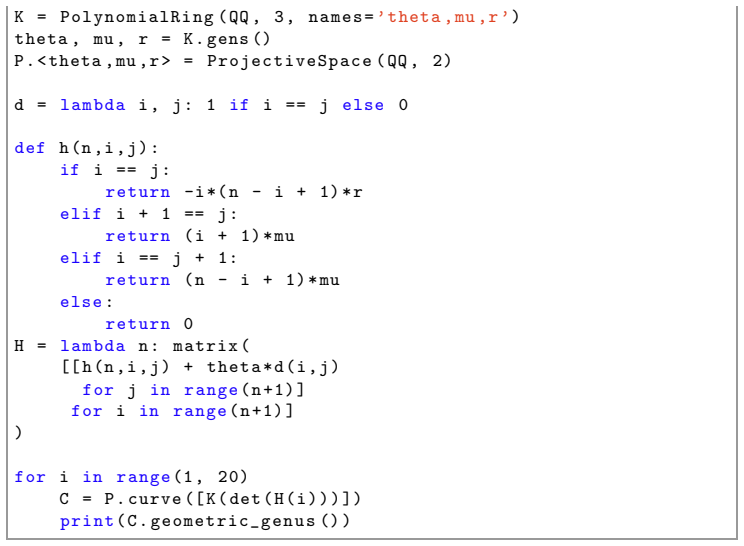
- [§1.2 and Figure 2] The displayed SageMath code contains the loop 'for i in range(1, 20)', which in Python computes l=1,...,19 only; this does not cover the stated verification for l <= 20 including g(Gamma_20)=81. The loop should read 'range(1, 21)' or the claim should be adjusted to l <= 19.
- [§4, Proposition 4.3] The text 'Leg l in N' should read 'Let l in N'; this appears to be a typographical error.
- [§1.3 and §5.1] There are several typographical errors that should be corrected: 'correspongding' in Section 1.3, 'idendical' in Proposition 5.5, and 'as l -> 0' in the proof of Corollary 1.19, which should read 'as omega -> 0'.
- [§5.1, Question 4] The notation 'hat L_± = Sigma_±' is introduced without recalling that hat L_± means the union hat L^even_± union hat L^odd_±; defining this near Question 4 would make the question unambiguous.
Circularity Check
No significant circularity: the four-component complexification theorem is supported by an independent irreducibility proof and cited prior correspondence theorems, with no fitted input or self-referential reduction.
full rationale
The paper's central chain is: Theorem 1.2 proves irreducibility of P_l by a Newton-diagram argument (Proposition 2.1, Corollary 2.2) that is self-contained and does not assume the target; Theorem 1.3 follows by a degree-two preimage argument. The application to phase-lock boundaries (Theorems 1.20 and 1.22) imports the correspondence between generalized simple intersections and polynomial solutions (Theorem 1.17, cited to [11,5]) and the real-simplicity theorem for H_l (Theorem 1.9, [11]), but these are prior results with stated assumptions that do not include the four-component conclusion, and they are not fitted to the data used here; under the rules they count as real independent evidence even though some coauthors overlap. The minimality assertion in Theorem 1.22 is virtually a consequence of the definitions of L̂odd(even)_±, but the substantive content of the theorem—irreducibility and distinctness of the four components—is proved through Propositions 2.7, 2.9, 2.10, and 2.13 via analytic germs, monodromy index parity, and the irreducibility of the spectral curves. Proposition 2.10's appeal to regularity 'as in Proposition 2.8' at growth points is under-detailed, since Proposition 2.8 is stated only for simple intersections, but this is an exposition gap, not a circular reduction: at a growth point the monodromy is the identity and the same transversality argument is available. No parameter is fitted and then renamed a prediction, and no uniqueness theorem is imported from the authors' prior work to forbid alternatives. I therefore find no circular step.
Assumptions & free parameters
assumptions (7)
- domain assumption Theorem 1.9 (Buchstaber-Tertychnyi): for mu != 0 the eigenvalues of H_l are real and simple, so P_l(lambda, mu^2) has l distinct real roots in lambda.
- domain assumption Theorem 1.17: generalized simple intersections in the axis Lambda_l correspond to real parameters for which Heun equation (1.1) has a polynomial solution.
- domain assumption Boundary components partial L_{s,+-} are graphs of analytic functions, growth points have abscissa sqrt(s^2 omega^2 + 1), and constrictions obey the restrictions stated in [19].
- domain assumption Proposition 2.4, cited from [26]: boundary orbits through +-pi/2 are 2 pi-periodic and invariant under the symmetry I.
- standard math Genus formula for an irreducible curve of bidegree (d1, d2) in P1 x P1: g = (d1 - 1)(d2 - 1) minus the sum of delta-invariants of singular points.
- standard math Newton-diagram behavior of products of analytic germs: the upper component of the Newton diagram of a product is the Minkowski sum of the corresponding components of the factors.
- domain assumption The SageMath and Singular computations of geometric genus for l up to 20 are correct.
Cite this review
Pith. "Pith review of On spectral curves and complexified boundaries of the phase-lock areas in a model of Josephson junction." pith.science (2026). https://pith.science/paper/K2A3JMOH
@misc{pith2026190808491,
  author       = {Pith},
  title        = {Pith review of: On spectral curves and complexified boundaries of the phase-lock areas in a model of Josephson junction},
  year         = {2026},
  howpublished = {\url{https://pith.science/paper/K2A3JMOH}},
  note         = {Machine review of arXiv:1908.08491}
}
abstract
The paper deals with a three-parameter family of special double confluent Heun equations that was introduced and studied by V.M.Buchstaber and S.I.Tertychnyi as an equivalent presentation of a model of overdamped Josephson junction in superconductivity. The parameters are $l,\lambda,\mu\in\mathbb R$. Buchstaber and Tertychnyi described those parameter values, for which the corresponding equation has a polynomial solution. They have shown that for $\mu\neq0$ this happens exactly when $l\in\mathbb N$ and the parameters $(\lambda,\mu)$ lie on an algebraic curve $\Gamma_l\subset\mathbb C^2_{(\lambda,\mu)}$ called the $l$-th spectral curve and defined as zero locus of determinant of a remarkable three-diagonal $l\times l$-matrix. They studied the real spectral curves and obtained important results with applications to phase-lock areas in model of Josephson junction, which is a family of dynamical systems on 2-torus. In the present paper we prove irreducibility of complex spectral curves. We also calculate their genera for $l\leqslant20$ and present a conjecture on general genus formula. We apply the irreducibility result to the phase-lock areas, which are those level sets of the rotation number function $\rho$ on the parameter space of the above-mentioned family of dynamical systems that have non-empty interiors. The family of their boundaries is a countable union of analytic surfaces. We show that, unexpectedly, its complexification is a complex analytic subset consisting of just four irreducible components, and we describe them. We present a Monotonicity Conjecture on the evolution of the phase-lock area portraits and a partial positive result towards its confirmation.
Figures

Figures from the paper (5 more)



Reference graph
Works this paper leans on
-
[1]
Arnold, V. I. Geometrical Methods in the Theory of Ordinary Dif- ferential Equations, Second edition. Grundlehren der Mathematischen Wissenschaften [Fundamental Principles of Mathematical S ciences], 250. Springer-Verlag, New York, 1988
work page 1988
-
[2]
Ordinary differential equations
Arnold, V.I.; Ilyashenko, Yu.S. Ordinary differential equations. Ency- clopaedia Math. Sci., 1 (1988), 1–148
work page 1988
-
[3]
Barone, A.; Paterno, G. Physics and Applications of the Josephson Effect, John Wiley and Sons, New York–Chichester–Brisbane–Toront o– Singapore, 1982
work page 1982
-
[4]
On determinants of modified Bessel functions and entire solutions of double confluent Heun equa tions
Buchstaber, V.M.; Glutsyuk, A.A. On determinants of modified Bessel functions and entire solutions of double confluent Heun equa tions. Non- linearity, 29 (2016), 3857–3870
work page 2016
-
[5]
Buchstaber, V.M.; Glutsyuk, A.A. On monodromy eigenfunctions of Heun equations and boundaries of phase-lock areas in a model of over- damped Josephson effect. Proc. Steklov Inst. Math., 297 (2017), 50–89
work page 2017
-
[6]
Electrodynamic prop- erties of a Josephson junction biased with a sequence of δ-function pulses
Buchstaber, V.M.; Karpov, O.V.; Tertychniy, S.I. Electrodynamic prop- erties of a Josephson junction biased with a sequence of δ-function pulses. J. Exper. Theoret. Phys., 93 (2001), No.6, 1280–1287. 47
work page 2001
-
[7]
Buchstaber, V.M.; Karpov, O.V.; Tertychnyi, S.I. On properties of the differential equation describing the dynamics of an overdam ped Josephson junction, Russian Math. Surveys, 59:2 (2004), 377–378
work page 2004
-
[8]
Peculiarities of dynamics of a Josephson junction shifted by a sinusoidal SHF current (in Russian)
Buchstaber, V.M.; Karpov, O.V.; and Tertychnyi, S.I. Peculiarities of dynamics of a Josephson junction shifted by a sinusoidal SHF current (in Russian). Radiotekhnika i Elektronika, 51:6 (2006), 757–762
work page 2006
Show all 39 references
-
[9]
The rotation number quantization effect , Theoret and Math
Buchstaber, V.M.; Karpov, O.V.; Tertychnyi, S.I. The rotation number quantization effect , Theoret and Math. Phys., 162 (2010), No. 2, 211–221
2010
-
[10]
The system on torus modeling the dynamics of Josephson junction, Russ
Buchstaber, V.M.; Karpov, O.V.; Tertychnyi, S.I. The system on torus modeling the dynamics of Josephson junction, Russ. Math. Surveys, 67 (2012), 178–180
2012
-
[11]
Explicit solution family for the equa- tion of the resistively shunted Josephson junction model
Buchstaber, V.M.; Tertychnyi, S.I. Explicit solution family for the equa- tion of the resistively shunted Josephson junction model. Theoret. and Math. Phys., 176 (2013), No.2, 965–986
2013
-
[12]
Holomorphic solutions of the double confluent Heun equation associated with the RSJ model of the J osephson junction
Buchstaber, V.M.; Tertychnyi, S.I. Holomorphic solutions of the double confluent Heun equation associated with the RSJ model of the J osephson junction. Theoret. and Math. Phys., 182:3 (2015), 329–355
2015
-
[13]
Automorphisms of solution space of special double confluent Heun equations, Funct
Buchstaber, V.M.; Tertychnyi, S.I. Automorphisms of solution space of special double confluent Heun equations, Funct. Anal. Appl., 50:3 (2016), 176–192
2016
-
[14]
Effect of ac impedance on dc voltage-current charac- teristics of superconductor weak-link junctions, J
McCumber, D.E. Effect of ac impedance on dc voltage-current charac- teristics of superconductor weak-link junctions, J. Appl. Phys., 39 (1968), No.7, 3113–3118
1968
-
[15]
The Geometry of syzygies
David Eisenbud, “The Geometry of syzygies” , Springer, 2005
2005
-
[16]
Foote, R.L., Geometry of the Prytz Planimeter, Reports on Math. Phys. 42:1/2 (1998), 249–271
1998
-
[17]
Tractrices, bicycle tire tracks, hatchet planimeters, and a 100-year-old conjecture, Amer
Foote, R.L.; Levi, M.; Tabachnikov, S. Tractrices, bicycle tire tracks, hatchet planimeters, and a 100-year-old conjecture, Amer. Math. Monthly, 103 (2013), 199–216
2013
-
[18]
Oscillation matrices and kernels and small vibrations of mechanical systems, Dept
Gantmakher, F.R.; Krein, M.G. Oscillation matrices and kernels and small vibrations of mechanical systems, Dept. Commerce USA. Joint Publ. Service (1961) (Translated from Russian.) 48
1961
-
[19]
On the adjacency quantization in an equation modeling the Jose phson effect, Funct
Glutsyuk, A.A.; Kleptsyn, V.A.; Filimonov, D.A.; Schu rov, I.V. On the adjacency quantization in an equation modeling the Jose phson effect, Funct. Analysis and Appl., 48 (2014), No.4, 272–285
2014
-
[20]
On constrictions of phase-lock areas in model of over- damped Josephson effect and transition matrix of the double- confluent Heun equation, J
Glutsyuk A. On constrictions of phase-lock areas in model of over- damped Josephson effect and transition matrix of the double- confluent Heun equation, J. Dyn. Control Syst. 25 (2019), Issue 3, 323–349
2019
-
[21]
Griffiths, Ph.; Harris, J., Principles of algebraic geometry, John Wiley & Sons, New York - Chichester - Brisbane - Toronto, 1978
1978
-
[22]
Dynamical systems
Ilyashenko, Yu.S. Lectures of the summer school “Dynamical systems”, Poprad, Slovak Republic, 2009
2009
-
[23]
Phase-lock effect for equations modeling resistively shunted Josephson junctio ns and for their perturbations, Funct
Ilyashenko, Yu.S.; Filimonov, D.A.; Ryzhov, D.A. Phase-lock effect for equations modeling resistively shunted Josephson junctio ns and for their perturbations, Funct. Analysis and its Appl. 45 (2011), No. 3, 192–203
2011
-
[24]
Three-diagonal matrices and their appli- cations
Ilyin, V.P.; Kuznetsov, Yu.I. Three-diagonal matrices and their appli- cations. Moscow, Nauka, 1985
1985
-
[25]
Possible new effects in superconductive tunnelling, Phys
Josephson, B.D. Possible new effects in superconductive tunnelling, Phys. Lett., 1 (1962), No. 7, 251–253
1962
-
[26]
Josephson effect and slow-fast systems
Kleptsyn, V.A.; Romaskevich, O.L.; Schurov, I.V. Josephson effect and slow-fast systems. [In Russian.] Nanostuctures. Mathematical physics and Modelling, 8 (2013), 31–46
2013
-
[27]
Asymptotic properties of Arnold tongues and Josephson effect, Mosc
Klimenko, A.V.; Romaskevich, O.L. Asymptotic properties of Arnold tongues and Josephson effect, Mosc. Math. J., 14:2 (2014), 367–384
2014
-
[28]
Systems with Josephson junctions: Basic Theory, Izdat
Likharev, K.K.; Ulrikh, B.T. Systems with Josephson junctions: Basic Theory, Izdat. MGU, Moscow, 1978
1978
-
[29]
On the approximate integration method due to Academician S
Luzin, N.N. On the approximate integration method due to Academician S. A. Chaplygin, Uspekhi Mat. Nauk, 6:6(46) (1951), 3–27
1951
-
[30]
Singular points of complex surfaces , Princeton University Press and University of Tokyo Press, Princeton, New Jersey, 1968
Milnor, J. Singular points of complex surfaces , Princeton University Press and University of Tokyo Press, Princeton, New Jersey, 1968
1968
-
[31]
Schmidt, V.V., Introduction to physics of superconductors (in Russian), MCCME, Moscow, 2000. 49
2000
-
[32]
Quantum coherent effects, phase transitions, and the dissipative dynamics of ultra small tunnel junction s, North- Holland, 1990
Sch¨ on, G.; Zaikin, A.D. Quantum coherent effects, phase transitions, and the dissipative dynamics of ultra small tunnel junction s, North- Holland, 1990
1990
-
[33]
J. P. Serre, Groupes alg´ ebriques et corps de classes , Hermann, Paris, 1959
1959
-
[34]
Effect of microwaves on Josephson currents in superconducting tunneling, Rev
Shapiro, S.; Janus, A.; Holly, S. Effect of microwaves on Josephson currents in superconducting tunneling, Rev. Mod. Phys., 36 (1964), 223– 225
1964
-
[35]
Yu.; Lay, W
Slavyanov, S. Yu.; Lay, W. Special Functions: a unified theory based on singularities Oxford University Press, 2000
2000
-
[36]
Stewart, W.C., Current-voltage characteristics of Josephson junctions. Appl. Phys. Lett., 12 (1968), No. 8, 277–280
1968
-
[37]
The modelling of a Josephson junction and Heun poly- nomials, Preprint https://arxiv.org/abs/math-ph/0601064
Tertychnyi, S.I. The modelling of a Josephson junction and Heun poly- nomials, Preprint https://arxiv.org/abs/math-ph/0601064
-
[38]
Complete description of determinantal representations of smooth irreducible curves
Vinnikov, V. Complete description of determinantal representations of smooth irreducible curves. Lin. Alg. Appl. 125 (1989), 103–140
1989
-
[39]
Self-adjoint determinantal representations of real plane curves
Vinnikov, V. Self-adjoint determinantal representations of real plane curves. Math. Annalen, 296:1 (1993), 453–479. 50
1993
Reviewed August 14, 2026 · model on record in the stance chip above.
Discussion (0). Continue with ORCID to comment.