REVIEW 2 major objections 5 minor 66 references
Message Passing for Track-Before-Detect
T0 review · 2 major / 5 minor · reviewed 2026-08-06 · deepseek-v4-flash
Pith's one-line read A detector-free tracker beats detect-then-track on weak targets
desk verdict Solid BP-TBD extension with a genuine modeling advance, but the 'detector-free' claim is undercut by MP-seeded track birth; needs a revised framing and TBD baselines before it can be called state-of-the-art. read the letter →
The pith
A machine-rendered reading of the paper's core claim, the machinery that carries it, and where it could break.
The reading
What carries the argument
The mechanism is a factor graph representation of the joint posterior of the kinematic states, Bernoulli-Gaussian signal-power states, and noise-power states. The measurement likelihood factorizes over dictionaries and snapshots, with each factor a zero-mean complex Gaussian whose covariance contains the sum of object contribution outer products plus noise; this covariance structure carries the correlation information. Belief propagation on this graph replaces intractable joint marginalization with local message updates, and moment matching collapses the Gaussian-mixture messages to single Gaussians, so each update costs O($M^{3}$) and the overall cost is O($M^{3}$ I J N_k), linear in the number of potential objects.
What would settle it
Run the proposed BP-TBD on the same synthetic radar scenario but initialize potential objects on all grid cells (full-grid birth) instead of only on matching-pursuit detections, and compare the GOSPA; if the full-grid version fails to track weak objects or is computationally prohibitive, the claim that the method is detector-free TBD is weakened.
Extended reading notes
Core claim
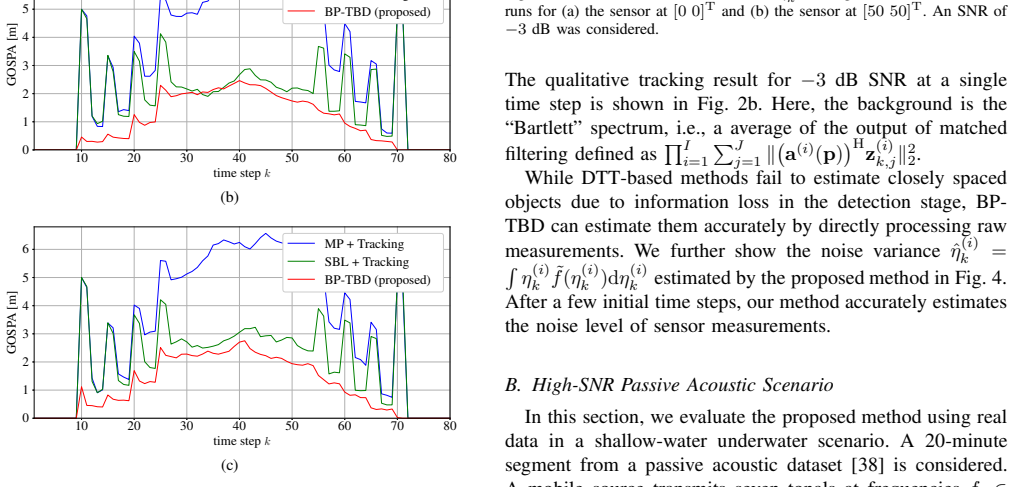
The paper's central claim is that a comprehensive superpositional measurement model accounting for correlated measurements, fluctuating complex amplitudes, unknown noise power, multiple snapshots, and multiple signal dictionaries can be paired with belief propagation to produce a scalable track-before-detect method that outperforms conventional detect-then-track approaches. The authors construct the joint posterior as a factor graph whose factors encode object dynamics, birth, signal-power states, and noise-power states, then compute marginal posteriors by iterated sum-product message passing. Intractable messages are approximated by particles or by single Gaussians obtained through moment matching, keeping the per-step cost linear in the number of potential objects, dictionaries, and snapshots. In experiments with synthetic LFMCW radar and real passive acoustic data, the method achieves lower GOSPA error than matching-pursuit and sparse-Bayesian-learning detectors paired with BP-based tracking.
Load-bearing premise
The experimental demonstrations initialize new potential objects only on grid cells where a matching-pursuit detector fires, so the claimed detector-free advantage is not actually tested for object birth in regions where that detector produces no detection.
Editorial extensions
If this is right
- TBD can operate directly on raw radar or sonar data with correlated channels, eliminating matched-filter preprocessing or decorrelation steps.
- Unknown noise power is estimated online, making the method adaptable to changing noise levels and colored noise, as shown by the noise amplification factor bη > 1.
- The multi-dictionary, multi-snapshot formulation makes the same method applicable to multi-sensor fusion, multi-frequency beamforming, and multi-waveform localization.
- Linear scaling in the number of potential objects, dictionaries, and snapshots allows the approach to scale to large surveillance regions.
Reading between the lines
- The experimental reliance on matching-pursuit detections for birth seeding means the practical gain may be limited to refining tracks after a conventional detector has already found a seed; a full-grid birth variant would be the true test of detector-free TBD.
- The same factor-graph and moment-matching machinery could extend to other superpositional sensing modalities, such as MIMO communications or distributed acoustic arrays, where correlation structure carries information.
- The Bernoulli-Gaussian amplitude model could be extended to other fluctuation statistics or to amplitude correlations across snapshots if future applications require it.
Signed reviews
Editorial analysis
A structured set of objections, weighed in public.
Referee Report
Summary. The paper proposes a track-before-detect (TBD) method for multi-object tracking based on a superpositional signal model that accounts for correlated sensor measurements, amplitude fluctuations (Swerling 1), and unknown noise power. The joint posterior is represented by a factor graph and solved with belief propagation, using particle representations and single-Gaussian moment matching for intractable messages. The method is evaluated on a synthetic multi-sensor radar scenario and two real passive-acoustic scenarios, comparing GOSPA against two detect-then-track baselines (MP+Tracking and SBL+Tracking). The paper claims that the proposed method 'eliminates the need for an object detector' and outperforms state-of-the-art conventional MOT methods.
Significance. If fully substantiated, the work would be a valuable contribution: it extends the superpositional signal model to multiple snapshots and dictionaries, explicitly handles correlated measurements without a conditional-independence assumption, and reports linear complexity in the number of potential objects. The real-data acoustic experiments are a useful addition to a literature dominated by synthetic studies. However, the central claim of detector-free TBD is not supported by the reported implementation, because track birth is seeded by a matching-pursuit detector rather than by the full-grid birth model. This issue is load-bearing and limits the significance of the experimental demonstration.
major comments (2)
- [IV-A (also IV-B and IV-C)] The implementation initializes new potential objects only on grid cells where the matching-pursuit detector fires, as stated: 'instead of initializing new POs for all grid cells, we only initialize new POs on cells with a MP detection.' This means the method still requires a frontend object detector for track initiation, contradicting the abstract's claim of 'eliminating the need for an object detector' and the introduction's 'without requiring a frontend object detector.' The full-grid birth model of Section II-C is described but never evaluated, so the experiments provide no evidence that the method can detect targets missed by the MP detector. The GOSPA comparison is therefore between two DTT-style variants (MP-seeded BP-TBD versus MP/SBL plus tracking) rather than TBD versus DTT. This is the central claim and it is not supported by the reported implementation.
- [III-C, Eqs. (12)-(14)] The covariance formulas used for the Gaussian-approximated messages are explicitly imported from previous work ('Based on derivations previously presented in [16], [22], [34]'), but no derivation or adaptation is provided for the new multi-snapshot, multi-dictionary, correlated-measurement model. Since these formulas are the core of the message computation, the paper should either (i) provide a derivation that shows how the correlated measurement model leads to these specific covariance expressions, or (ii) clearly delineate which aspects of the derivation are new. Without this, the novelty and correctness of the proposed inference method are difficult to assess.
minor comments (5)
- [II-A] The notation 'xk,n ∈ {1,...,Nk}' for the kinematic state is a typo; the state should be defined in the continuous state space, not as an index.
- [IV-A] The expected number of new objects is set to µB = 10−6, which is effectively zero; the paper should clarify whether the full birth model is active at all in the synthetic experiments, given that MP-seeded initialization is used instead.
- [IV-A (and IV-B, IV-C)] The mechanism for initializing MP-seeded POs is not specified: it is unclear whether the method uses the birth model's prior fB(x, γ) for those cells, and with what existence probability. This should be clarified to make the implementation reproducible.
- [IV-C] The per-PO DFT bin selection based on estimated range rate is a potentially information-discarding preprocessing step; the paper should discuss how this interacts with the claim of operating directly on raw sensor data without a frontend detector.
- [IV] The paper does not report the number of initialized POs or computational runtimes, making it difficult to verify the scalability claim in practice.
Circularity Check
No circular derivation; the detector-seeded birth implementation is a demonstration gap, not a circular step.
full rationale
The derivation chain in this paper is a standard sum-product belief-propagation construction over a factor graph: the measurement model (Eqs. 1-3), the state-transition and birth models (Sec. II-B, II-C), and the message update equations (Eqs. 5-11) are derived from explicit statistical assumptions, and no equation reduces to a fitted quantity or to a previously declared output. The moment-matching covariance approximations (Eqs. 12-17) are stated to be 'based on derivations previously presented in [16], [22], [34]'; two of these are the authors' own prior works, but they are published, checkable derivations with stated assumptions that do not themselves include the target result, so this self-citation is not circular in the load-bearing sense prohibited by the rules. The experimental comparison against MP+Tracking and SBL+Tracking uses independent baselines and an external metric (GOSPA). The one substantive weakness is that the experiments do not exercise the detector-free birth model of Section II-C: Sections IV-A, IV-B, and IV-C state, e.g., 'instead of initializing new POs for all grid cells, we only initialize new POs on cells with a MP detection,' so the implemented BP-TBD is a detector-seeded hybrid and the claim of eliminating the object detector is not fully demonstrated. That is a mismatch between the claim and the evaluated implementation, not an equation-level circular reduction, and therefore it does not increase the circularity score.
Assumptions & free parameters
free parameters (5)
- bη (noise amplification factor) =
1 (synthetic radar), 10 (high-SNR acoustic), 5 (low-SNR acoustic)
- cγ (signal-power gamma transition scale) =
10^3 (synthetic, low-SNR acoustic), 10^4 (high-SNR acoustic)
- cη (noise-power gamma transition scale) =
100 (synthetic, high-SNR acoustic), 10 (low-SNR acoustic)
- µB (expected number of new objects per time step) =
10^-6 (synthetic radar), 10^-4 (passive acoustic)
- ps, Tdec, Tpru (survival probability, declaration and pruning thresholds) =
ps=0.9 or 0.95, Tdec=0.5, Tpru=10^-2
assumptions (5)
- domain assumption Measurement vectors are a linear superposition of per-object contributions plus additive independent complex Gaussian noise (Eq. (2)).
- domain assumption Complex amplitudes are zero-mean circular Gaussian and independent across objects, snapshots, and dictionaries, with variance γ (fast-fluctuation model).
- domain assumption Measurement noise is complex Gaussian with covariance η I_M and independent across snapshots and dictionaries.
- domain assumption First-order Markov state transitions, gamma transition densities for signal and noise powers, and Poisson birth with at most one new object per grid cell.
- ad hoc to paper Moment matching of intractable Gaussian-mixture BP messages by a single Gaussian is sufficiently accurate for tracking.
Cite this review
Pith. "Pith review of Message Passing for Track-Before-Detect." pith.science (2026). https://pith.science/paper/K3ABZD6L
@misc{pith2026250618177,
  author       = {Pith},
  title        = {Pith review of: Message Passing for Track-Before-Detect},
  year         = {2026},
  howpublished = {\url{https://pith.science/paper/K3ABZD6L}},
  note         = {Machine review of arXiv:2506.18177}
}
read the original abstract
Accurately tracking an unknown and time-varying number of objects in complex environments is a significant challenge but a fundamental capability in a variety of applications, including applied ocean sciences, surveillance, autonomous driving, and wireless communications. Conventional Bayesian multiobject tracking (MOT) methods typically employ a detect-then-track (DTT) approach, where a frontend detector preprocesses raw sensor data to extract measurements for MOT. The irreversible nature of this preprocessing step can discard valuable object-related information, particularly impairing the ability to resolve weak or closely spaced objects. The track-before-detect (TBD) paradigm offers an alternative by operating directly on sensor data. However, existing TBD approaches introduce simplifications to facilitate the development of inference methods, such as assuming known signal amplitudes or conditional independence between sensor measurements given object states. These assumptions can lead to suboptimal performance and limit the applicability of the resulting TBD methods in realistic scenarios. This paper introduces a novel TBD method that is based on a comprehensive signal model for sensor data. The new model accounts for sensor data correlations and amplitude fluctuations, enabling the accurate representation of the physics of the data-generating process in TBD. The proposed model is suitable for a wide range of problems in active and passive radar, active and passive sonar, as well as integrated sensing and communication systems. Based on a factor graph representation of the new measurement model, a scalable belief propagation (BP) method is developed to perform efficient Bayesian inference. Experimental results, performed with both synthetic and real data, demonstrate that the proposed method outperforms state-of-the-art conventional MOT methods.
Figures


Figures from the paper (6 more)


Reference graph
Works this paper leans on
-
[16]
A BP method for t rack-before- detect,
M. Liang, T. Kropfreiter, and F. Meyer, “A BP method for t rack-before- detect,” IEEE Signal Process. Lett. , vol. 30, pp. 1137–1141, July 2023
work page 2023
-
[22]
Information e xchange track- before-detect multi-Bernoulli filter for superpositional sensors,
E. S. Davies and Á. F. García-Fernández, “Information e xchange track- before-detect multi-Bernoulli filter for superpositional sensors,” IEEE Trans. Signal Process. , vol. 72, pp. 607–621, Jan. 2024
work page 2024
-
[34]
M. Liang, E. Leitinger, and F. Meyer, “Direct multipath -based SLAM,” IEEE Trans. Signal Process. , vol. 73, pp. 2336–2352, Mar. 2025
work page 2025
-
[1]
Y . Bar-Shalom, P . K. Willett, and X. Tian, Tracking and Data Fusion: A Handbook of Algorithms . Storrs, CT: Y aakov Bar-Shalom, 2011
work page 2011
-
[2]
Mahler, Statistical Multisource-Multitarget Information Fusion
R. Mahler, Statistical Multisource-Multitarget Information Fusion . Nor- wood, MA: Artech House, 2007
work page 2007
-
[3]
Multiple hypothesis tracking for multi ple target tracking,
S. S. Blackman, “Multiple hypothesis tracking for multi ple target tracking,” IEEE Trans. Aerosp. Electron. Syst. , vol. 19, pp. 5–18, Jan. 2004
work page 2004
-
[4]
Marginal multi-Bernoulli filters: RFS d erivation of MHT, JIPDA and association-based MeMBer,
J. L. Williams, “Marginal multi-Bernoulli filters: RFS d erivation of MHT, JIPDA and association-based MeMBer,” IEEE Trans. Aerosp. Electron. Syst. , vol. 51, pp. 1664–1687, July 2015
work page 2015
-
[5]
A multisensor m ulti- Bernoulli filter,
A. A. Saucan, M. J. Coates, and M. Rabbat, “A multisensor m ulti- Bernoulli filter,” IEEE Trans. Signal Process. , vol. 65, pp. 5495–5509, Oct. 2017
work page 2017
Show all 66 references
-
[6]
Poisson multi-Bernoulli mixture filter: Direct derivatio n and implemen- tation,
Á. F. García-Fernández, J. L. Williams, K. Granström, an d L. Svensson, “Poisson multi-Bernoulli mixture filter: Direct derivatio n and implemen- tation,” IEEE Trans. Aerosp. Electron. Syst., vol. 54, pp. 1883–1901, Feb. 2018
1901
-
[7]
Mono-camera 3D multi-object tracking using deep learning detections and PMBM filtering,
S. Scheidegger, J. Benjaminsson, E. Rosenberg, A. Krish nan, and K. Granström, “Mono-camera 3D multi-object tracking using deep learning detections and PMBM filtering,” in Proc. IEEE IV-18, pp. 433– 440, June 2018
2018
-
[8]
Message passing algorithms for scalable mult itarget tracking,
F. Meyer, T. Kropfreiter, J. L. Williams, R. Lau, F. Hlawa tsch, P . Braca, and M. Z. Win, “Message passing algorithms for scalable mult itarget tracking,” Proc. IEEE , vol. 106, pp. 221–259, Feb. 2018
2018
-
[9]
Scalable detection and trac king of geometric extended objects,
F. Meyer and J. L. Williams, “Scalable detection and trac king of geometric extended objects,” IEEE Trans. Signal Process. , vol. 69, pp. 6283–6298, Oct. 2021
2021
-
[10]
A Bayesian approach to trac king multiple targets using sensor arrays and particle filters,
M. Orton and W. Fitzgerald, “A Bayesian approach to trac king multiple targets using sensor arrays and particle filters,” vol. 50, p p. 216–223, Feb. 2002
2002
-
[11]
Multitarget tracking of distributed targets using histogram-PMHT,
R. L. Streit, M. L. Graham, and M. J. Walsh, “Multitarget tracking of distributed targets using histogram-PMHT,” Digital Signal Processing , vol. 12, pp. 394–404, Nov. 2002
2002
-
[12]
Multitarget particle filter t rack before detect application,
Y . Boers and J. Driessen, “Multitarget particle filter t rack before detect application,” IEE Proc. Radar Sonar Navig. , vol. 151, pp. 351–357, Dec. 2004
2004
-
[13]
S. J. Davey and H. X. Gaetjens, Track-Before-Detect Using Expectation Maximisation. Singapore: Springer, 2018
2018
-
[14]
Neural enhanced belief propagat ion for multiobject tracking,
M. Liang and F. Meyer, “Neural enhanced belief propagat ion for multiobject tracking,” IEEE Trans. Signal Process. , vol. 72, pp. 15–30, Sept. 2023
2023
-
[15]
A multi-target track-before-de tect particle filter using superpositional data in non-Gaussian noise,
N. Ito and S. Godsill, “A multi-target track-before-de tect particle filter using superpositional data in non-Gaussian noise,” vol. 27 , pp. 1075– 1079, June 2020
2020
-
[17]
Joint dete ction and estimation of multiple objects from image observations,
B.-N. V o, B.-T. V o, N.-T. Pham, and D. Suter, “Joint dete ction and estimation of multiple objects from image observations,” IEEE Trans. Signal Process. , vol. 58, pp. 5129–5141, Oct. 2010
2010
-
[18]
A tutorial on Bernoulli filters: Theory, implementation and applications,
B. Ristic, B.-T. V o, B.-N. V o, and A. Farina, “A tutorial on Bernoulli filters: Theory, implementation and applications,” IEEE Trans. Signal Process., vol. 61, pp. 3406–3430, Apr. 2013
2013
-
[19]
Bernoulli track-before-detect filter for maritime radar,
B. Ristic, L. Rosenberg, D. Y . Kim, X. Wang, and J. Willia ms, “Bernoulli track-before-detect filter for maritime radar,” IET Radar , Sonar Navig. , vol. 14, pp. 356–363, Mar. 2020
2020
-
[20]
A scalabl e track-before- detect method with Poisson/multi-Bernoulli model,
T. Kropfreiter, J. L. Williams, and F. Meyer, “A scalabl e track-before- detect method with Poisson/multi-Bernoulli model,” in Proc. FUSION- 21, pp. 1–8, Nov. 2021
2021
-
[21]
A Bernou lli track- before-detect filter for interacting targets in maritime ra dar,
D. Y . Kim, B. Ristic, R. Guan, and L. Rosenberg, “A Bernou lli track- before-detect filter for interacting targets in maritime ra dar,” IEEE Trans. Aerosp. Electron. Syst. , vol. 57, pp. 1981–1991, June 2021
1981
-
[23]
A scal able algorithm for tracking an unknown number of targets using multiple sen sors,
F. Meyer, P . Braca, P . Willett, and F. Hlawatsch, “A scal able algorithm for tracking an unknown number of targets using multiple sen sors,” IEEE Trans. Signal Process. , vol. 65, pp. 3478–3493, July 2017
2017
-
[24]
A new architecture for ne ural enhanced multiobject tracking,
S. Wei, M. Liang, and F. Meyer, “A new architecture for ne ural enhanced multiobject tracking,” in Proc. FUSION-24, pp. 1–8, July 2024
2024
-
[25]
A tutorial on Bernoulli filters: Theory, implementation and applications,
B. Ristic, B.-T. V o, B.-N. V o, and A. Farina, “A tutorial on Bernoulli filters: Theory, implementation and applications,” IEEE Trans. Signal Process., vol. 61, no. 13, pp. 3406–3430, 2013
2013
-
[26]
A particle filter for track-bef ore-detect,
D. Salmond and H. Birch, “A particle filter for track-bef ore-detect,” in Proc. ACC-01, pp. 3755–3760, June 2001
2001
-
[27]
Long-time coher ent integration for low SNR target via particle filter in track-before-detec t,
O. Rabaste, C. Riché, and A. Lepoutre, “Long-time coher ent integration for low SNR target via particle filter in track-before-detec t,” in Proc. FUSION-12, pp. 127–134, July 2012
2012
-
[28]
Using phase to i m- prove track-before-detect,
S. J. Davey, M. G. Rutten, and B. Cheung, “Using phase to i m- prove track-before-detect,” IEEE Trans. Aerosp. Electron. Syst. , vol. 48, pp. 832–849, Jan. 2012
2012
-
[29]
Coherent track-before -detect with micro-Doppler signature estimation in array radars,
K. Kim, M. Üney, and B. Mulgrew, “Coherent track-before -detect with micro-Doppler signature estimation in array radars,” IET Radar , Sonar Navig., vol. 14, pp. 572–585, Mar. 2020
2020
-
[30]
Coher ent long-time integration and Bayesian detection with Bernoulli track-b efore-detect,
M. Üney, P . Horridge, B. Mulgrew, and S. Maskell, “Coher ent long-time integration and Bayesian detection with Bernoulli track-b efore-detect,” IEEE Signal Process. Lett. , vol. 30, pp. 239–243, Mar. 2023
2023
-
[31]
Sequen tial detection and estimation of multipath channel parameters using belie f propaga- tion,
X. Li, E. Leitinger, A. V enus, and F. Tufvesson, “Sequen tial detection and estimation of multipath channel parameters using belie f propaga- tion,” IEEE Trans. Wireless Commun. , vol. 21, pp. 8385–8402, Apr. 2022
2022
-
[32]
Multitarget l ikelihood com- putation for track-before-detect applications with ampli tude fluctuations of type Swerling 0, 1, and 3,
A. Lepoutre, O. Rabaste, and F. Le Gland, “Multitarget l ikelihood com- putation for track-before-detect applications with ampli tude fluctuations of type Swerling 0, 1, and 3,” IEEE Trans. Aerosp. Electron. Syst. , vol. 52, pp. 1089–1107, June 2016
2016
-
[33]
A belief propagat ion approach for direct multipath-based SLAM,
M. Liang, E. Leitinger, and F. Meyer, “A belief propagat ion approach for direct multipath-based SLAM,” in Proc. IEEE Asilomar-23, pp. 588– 593, Nov. 2023
2023
-
[35]
V ariational message passing-based multiobject tracking for MIMO-rada rs using raw sensor signals,
A. M. Westerkam, J. Möderl, E. Leitinger, and T. Pederse n, “V ariational message passing-based multiobject tracking for MIMO-rada rs using raw sensor signals,” arXiv preprint arXiv:2503.15246 , 2025
2025 arXiv
-
[36]
A passi ve, multi-static radar system,
S. Carson, D. Kilfoyle, M. Potter, and J. V ance, “A passi ve, multi-static radar system,” in Proc. IET RADAR-07 , pp. 1–4, Oct. 2007
2007
-
[37]
A block- sparse Bayesian learning algorithm with dictionary parame ter estimation for multi-sensor data fusion,
J. Möderl, A. M. Westerkam, A. V enus, and E. Leitinger, “ A block- sparse Bayesian learning algorithm with dictionary parame ter estimation for multi-sensor data fusion,” arXiv preprint arXiv:2503.12913 , 2025
2025
-
[38]
Detectab ility of low- level broad-band signals using adaptive matched-field proc essing with vertical aperture arrays,
N. Booth, A. Abawi, P . Schey, and W. Hodgkiss, “Detectab ility of low- level broad-band signals using adaptive matched-field proc essing with vertical aperture arrays,” IEEE J. Ocean. Eng. , vol. 25, pp. 296–313, July 2000
2000
-
[39]
Sparse Bayesian learning with multiple d ictionaries,
S. Nannuru, K. L. Gemba, P . Gerstoft, W. S. Hodgkiss, and C. F. Mecklenbräuker, “Sparse Bayesian learning with multiple d ictionaries,” Signal Processing, vol. 159, pp. 159–170, June 2019
2019
-
[40]
Improved targ et localization in multiwaveform multiband hybrid multistatic radar netwo rks,
M. Temiz, H. Griffiths, and M. A. Ritchie, “Improved targ et localization in multiwaveform multiband hybrid multistatic radar netwo rks,” IEEE Sensors J. , vol. 22, pp. 20785–20796, Nov. 2022
2022
-
[41]
Maximum likelihood detectio n and estima- tion of Bernoulli - Gaussian processes,
J. Kormylo and J. Mendel, “Maximum likelihood detectio n and estima- tion of Bernoulli - Gaussian processes,” IEEE Trans. Inf. Theory, vol. 28, pp. 482–488, May 1982
1982
-
[42]
V ariationa l Bayesian in- ference of line spectra,
M.-A. Badiu, T. L. Hansen, and B. H. Fleury, “V ariationa l Bayesian in- ference of line spectra,” IEEE Trans. Signal Process. , vol. 65, pp. 2247– 2261, Jan. 2017
2017
-
[43]
Superfast line spectral estimation,
T. L. Hansen, B. H. Fleury, and B. D. Rao, “Superfast line spectral estimation,” IEEE Trans. Signal Process. , vol. 66, pp. 2511–2526, Feb. 2018. 13
2018
-
[44]
Fact or graphs and the sum-product algorithm,
F. R. Kschischang, B. J. Frey, and H.-A. Loeliger, “Fact or graphs and the sum-product algorithm,” IEEE Trans. Inf. Theory , vol. 47, pp. 498–519, Feb. 2001
2001
-
[45]
An introduction to factor graphs,
H.-A. Loeliger, “An introduction to factor graphs,” IEEE Signal Process. Mag., vol. 21, pp. 28–41, Jan. 2004
2004
-
[46]
A tutorial on particle filters for online nonlinear/non-Gaussian Baye sian tracking,
M. S. Arulampalam, S. Maskell, N. Gordon, and T. Clapp, “ A tutorial on particle filters for online nonlinear/non-Gaussian Baye sian tracking,” IEEE Trans. Signal Process. , vol. 50, pp. 174–188, Feb. 2002
2002
-
[47]
Particle belief propagati on,
A. Ihler and D. McAllester, “Particle belief propagati on,” in Proc. AISTATS-09, vol. 5, pp. 256–263, Apr. 2009
2009
-
[48]
An approach of directly tracking multiple objects,
M. Liang and F. Meyer, “An approach of directly tracking multiple objects,” in Proc. IEEE Asilomar-24 , pp. 995–999, Oct. 2024
2024
-
[49]
M. I. Skolnik, Introduction to Radar Systems . New Y ork: Mcgraw-Hill, 3rd ed., 2002
2002
-
[50]
Multitask compressive s ensing,
S. Ji, D. Dunson, and L. Carin, “Multitask compressive s ensing,” IEEE Trans. Signal Process. , vol. 57, pp. 92–106, Sept. 2009
2009
-
[51]
Multimodal spar se Bayesian dictionary learning applied to multimodal data classificat ion,
I. Fedorov, B. D. Rao, and T. Q. Nguyen, “Multimodal spar se Bayesian dictionary learning applied to multimodal data classificat ion,” in Proc. ICASSP-17, pp. 2237–2241, Mar. 2017
2017
-
[52]
Multi- frequency sparse Bayesian learning for robust matched field processing,
K. L. Gemba, S. Nannuru, P . Gerstoft, and W. S. Hodgkiss, “Multi- frequency sparse Bayesian learning for robust matched field processing,” J. Acoust. Soc. Am. , vol. 141, pp. 3411–3420, May 2017
2017
-
[53]
Bar-Shalom, T
Y . Bar-Shalom, T. Kirubarajan, and X.-R. Li, Estimation with Applica- tions to Tracking and Navigation . New Y ork, NY: Wiley, 2002
2002
-
[54]
New prediction for extend ed targets with random matrices,
K. Granström and U. Orguner, “New prediction for extend ed targets with random matrices,” IEEE Trans. Aerosp. Electron. Syst. , vol. 50, pp. 1577–1589, July 2014
2014
-
[55]
Koller and N
D. Koller and N. Friedman, Probabilistic Graphical Models: Principles and Techniques. Cambridge, MA: MIT Press, 2009
2009
-
[56]
Richardson and R
T. Richardson and R. Urbanke, Modern Coding Theory . Cambridge University Press, 2008
2008
-
[57]
Cooperative local ization in wireless networks,
H. Wymeersch, J. Lien, and M. Z. Win, “Cooperative local ization in wireless networks,” Proc. IEEE , vol. 97, pp. 427–450, Feb. 2009
2009
-
[58]
A belief propagation algorithm for multipath-based S LAM,
E. Leitinger, F. Meyer, F. Hlawatsch, K. Witrisal, F. Tu fvesson, and M. Z. Win, “A belief propagation algorithm for multipath-based S LAM,” IEEE Trans. Wireless Commun. , vol. 18, pp. 5613–5629, Dec. 2019
2019
-
[59]
Levanon and E
N. Levanon and E. Mozeson, Radar signals. John Wiley & Sons, 2004
2004
-
[60]
Joint multitarget detection and tracking with mmWave radar,
J. Zhu, M. Xu, R. Guo, F. Wang, G. Zheng, and F. Qu, “Joint multitarget detection and tracking with mmWave radar,” arXiv preprint arXiv:2412.17211, 2024
2024 arXiv
-
[61]
Matching pursuits with time-fr equency dic- tionaries,
S. Mallat and Z. Zhang, “Matching pursuits with time-fr equency dic- tionaries,” IEEE Trans. Signal Process. , vol. 41, pp. 3397–3415, Dec. 1993
1993
-
[62]
Gen- eralized optimal sub-pattern assignment metric,
A. S. Rahmathullah, Á. F. García-Fernández, and L. Sven sson, “Gen- eralized optimal sub-pattern assignment metric,” in Proc. FUSION-17 , pp. 1–8, July 2017
2017
-
[63]
F. B. Jensen, W. A. Kuperman, M. B. Porter, H. Schmidt, an d A. Tolstoy, Computational ocean acoustics , vol. 2011. Springer, 2011
2011
-
[64]
The KRAKEN normal mode program,
M. B. Porter, “The KRAKEN normal mode program,” SACLANT Un- dersea Research Centre Memorandum (SM-245) and Naval Resea rch Laboratory Memorandum Report No. 6920 , 1991
1991
-
[65]
Mirages in shallow water matched field processing,
G. D’Spain, J. Murray, W. Hodgkiss, N. Booth, and P . Sche y, “Mirages in shallow water matched field processing,” J. Acoust. Soc. Am. , vol. 105, pp. 3245–3265, June 1999
1999
-
[66]
Range-coherent match ed field processing for low signal-to-noise ratio localization,
F. Hunter Akins and W. Kuperman, “Range-coherent match ed field processing for low signal-to-noise ratio localization,” J. Acoust. Soc. Am., vol. 150, pp. 270–280, July 2021
2021
Reviewed August 6, 2026 · model on record in the stance chip above.
Discussion (0). Continue with ORCID to comment.