REVIEW 2 major objections 4 minor 21 references
Crystallographic splitting theorem for band representations and fragile topological photonic crystals
T0 review · 2 major / 4 minor · reviewed 2026-08-14 · deepseek-v4-flash
Pith's one-line read The paper proves a crystallographic splitting theorem: a rank-$N$ band representation is exactly a sum of $N$ unit-rank, topologically trivial bands that space-group symmetries permute.
desk verdict The crystallographic splitting theorem is a solid, publishable result, but the general boundary-stability theorem rests on an unproved Q' completion step and should not anchor the broadest claims. read the letter →
The pith
A machine-rendered reading of the paper's core claim, the machinery that carries it, and where it could break.
The reading
What carries the argument
The load-bearing object is the symmetric Wannier splitting: a decomposition $P=\oplus_{j=1}^N P_j$ into unit-rank projectors that are analytic in $k$, have trivial first Chern class, and are permuted by $G$. The crystallographic splitting theorem states that such a splitting exists iff $P$ is a monomial band representation, i.e., a band representation induced from a monomial representation of a site stabilizer, equivalently a representation with a basis of complex permutation matrices. The proof organizes the unit-rank bands into space-group orbits, shows the number of Wannier centers divides the rank, and induces a Wannier basis from a single representative. Computationally, the paper constructs symmetric splittings by diagonalizing a projected symmetry operator or a projected position operator; the Zak phase of each unit-rank band then certifies the trivial Chern condition.
What would settle it
For a continuum periodic Schrödinger or photonic Hamiltonian whose lowest gapped two-band subspace is a band representation, compute the surface spectrum with all symmetry-allowed high-energy bands included; if any in-gap boundary state cannot be removed by a symmetry-preserving band deformation, the boundary stability criterion fails. The specific missing check is whether the required finite-rank, band-representable $Q'$ exists in such a continuum model.
Extended reading notes
Core claim
The central claim is the equivalence, for monomial band representations of crystallographic space groups (and their grey magnetic and double extensions), between being a rank-$N$ band representation and admitting a symmetric Wannier splitting. Explicitly, $P$ is a monomial band representation of $G$ iff $P=\oplus_{j=1}^N P_j$ with each $P_j$ an analytic projector with trivial first Chern class and with every $g\in G$ acting as a permutation on $\{P_j\}$. The theorem is proven for all integer-spin band representations of all space groups; in half-integer spin, the equivalence holds in two spatial dimensions and for all three-dimensional non-cubic double point groups, with double cubic point groups as the stated exceptions. From this, the paper derives that rotation-invariant topological crystalline insulators in class AI are fragile obstructed representations, that the filled bands of certain photonic crystals realize such fragile representations with removable boundary and domain-wall states, and that for space groups generated by time reversal and/or spatial inversion, the symmetric Wannier obstruction is equivalent to a nonzero Zak-phase winding.
Load-bearing premise
The proof that band-representable low-energy subspaces cannot have spectrally robust boundary states assumes that a finite-rank, analytic high-energy subspace $Q'$ transforming as a band representation can always be added to a continuum crystal; the paper asserts this because continuum descriptions have infinitely many bands, but does not prove it for a given Hamiltonian.
Editorial extensions
If this is right
- Band representability can be decided algorithmically: diagonalize a projected symmetry operator or projected position operator and check eigenvalue nondegeneracy and trivial first Chern class; no trial Wannier functions are needed.
- Rotation-symmetric topological crystalline insulators in Wigner-Dyson class AI are fragile: adding a single unit-rank band representation converts the obstructed filled band into a band representation.
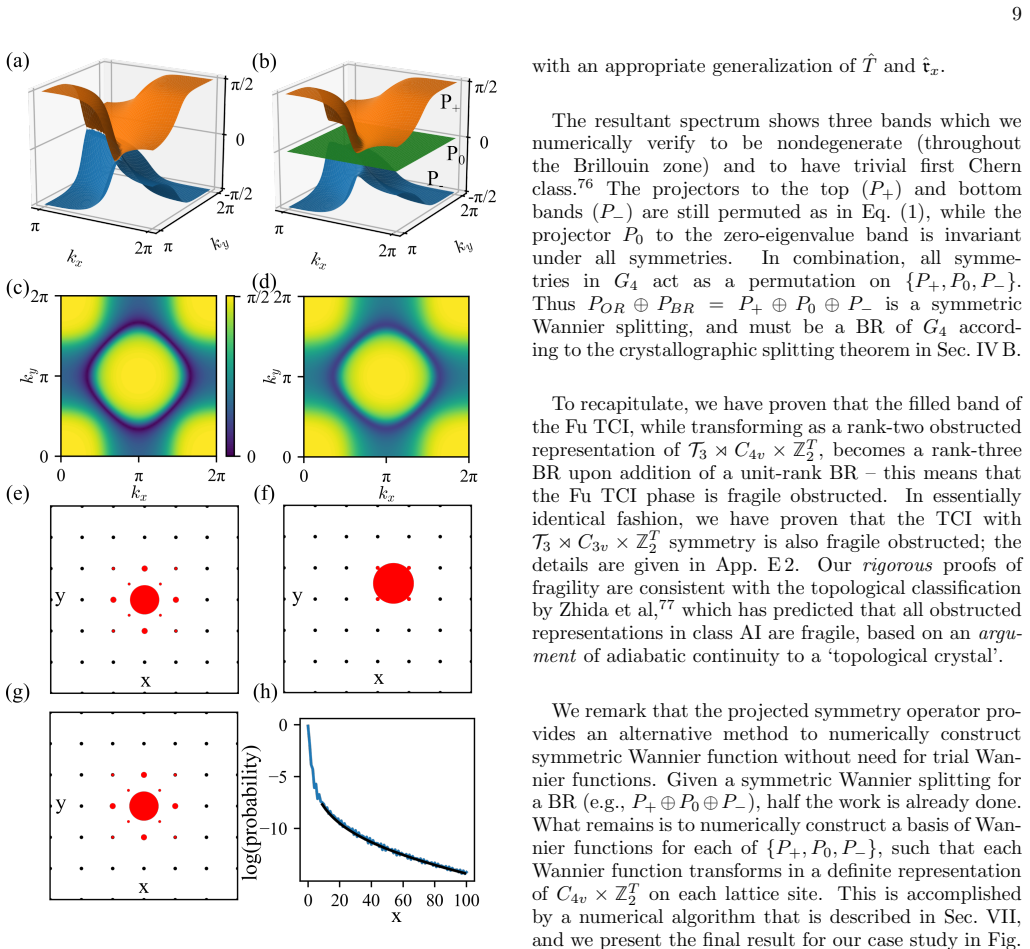
- The hexagonal photonic crystal built from split-ring resonators is a fragile obstructed representation in class AI, not a Kane-Mele-type AII insulator; its domain-wall Dirac states can be removed from the gap by symmetry-preserving deformations.
- Band representations are incompatible with spectrally robust boundary or domain-wall states: a band-representable low-energy subspace cannot protect in-gap boundary states against all symmetry-allowed couplings.
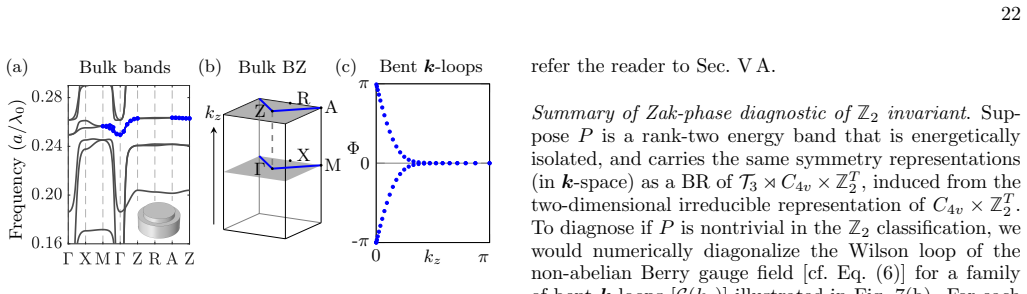
- For space groups generated by time reversal and/or spatial inversion, an obstructed representation is equivalent to a nontrivial Zak-phase winding; in particular, Kane-Mele $\mathbb{Z}_2$ order in class AII is proven equivalent to being an obstructed representation of $T^2\times \mathbb{Z}_4^T$.
Reading between the lines
- If the boundary stability criterion transfers to real crystals, the practical search for topological surface states should focus on low-energy subspaces that remain obstructed after adding all occupied elementary band representations; the paper notes that k-space symmetry representations alone are not an exhaustive diagnostic.
- The theorem suggests a computational pipeline for materials: compute the projector of a target band set, diagonalize projected symmetry operators, and read fragility directly from the Chern numbers of the resulting unit-rank bands, without Wannier interpolation.
- For the exceptional double cubic point groups, a natural extension is that the splitting should allow rank-two irreducible blocks rather than unit-rank bands; the paper leaves this as speculation.
Signed reviews
Editorial analysis
A structured set of objections, weighed in public.
Referee Report
Summary. The paper develops a 'crystallographic splitting theorem': a rank-N band representation of a (monomial) space group is equivalent to a splitting into N analytic, unit-rank bands with trivial first Chern class, on which the space group acts by permutations. The theorem is proved in Appendix C for integer-spin band representations, with stated exceptions for half-integer-spin cubic double space groups. The authors use the theorem to give proof methods for band representability, to prove fragility of certain rotation-invariant class-AI TCIs, to relate Zak-phase winding to Wannier obstructions, and to reclassify existing photonic crystals as fragile topological, including Yang et al.'s hexagonal crystal. They also state a general criterion that band-representable low-energy subspaces cannot host spectrally robust boundary or domain-wall states.
Significance. If the splitting theorem stands, it is a significant structural result: it reduces band-representability questions to unit-rank bundle computations and gives a rigorous bridge between Zak's real-space definition of band representations and modern topological band theory. The proof in Appendix C is detailed and appears internally consistent, and the use of Huppert's theorem and the unit-rank result of Ref. 78 gives the argument independent anchors. The applications are broad and falsifiable: the photonic classification of Yang et al.'s crystal is a concrete, checkable claim, and the numerical constructions of symmetric Wannier functions are reproducible from the stated parameters. The main weakness is that the general boundary-stability criterion in Sec. IX relies on an unproved existence lemma for a finite-rank band-representable complement Q', so the headline statement 'band representations are incompatible with robust boundary states' is not fully established as a theorem, although the specific numerical demonstrations in Secs. VIII may still be correct.
major comments (2)
- [Sec. IX B 1, Eq. (17)] The proof of the boundary stability criterion assumes a finite-rank, analytic projector Q' with I = P + Q + Q' that transforms as a band representation of G. The text asserts such bands 'always exist because we are approximating a continuum description of crystals,' but this is not a proof. A continuum Hamiltonian provides infinitely many high-energy bands, hence unbounded rank, and does not by itself guarantee that a finite subset in an energy window can be chosen to form a band representation; those bands could themselves be obstructed. What is needed is a completion lemma: for every finite-rank G-equivariant, band-representable P, there exists a finite-rank band-representable Q' such that P ⊕ Q' is isomorphic to a tightly-bound band representation. The symmetric tight-binding limit theorem and the universal G-bundle theorem supply a homotopy only when the ambient bundle is already band-representable. Because this step is load-bearing for the claimed incompatibility of band representations with spectrally robust boundary states, the general theorem as stated is not fully supported, although the specific numerical demonstrations in Figs. 8(d) and 9(d-e) are unaffected.
- [Sec. V C 1] The no-go theorem for Wigner-Dyson class AI ('there exists no obstructed representation of G3 = ZT2 × T2 in d = 2') is presented with a sketch rather than a proof. The argument that no symmetry-enforced degeneracy of the Zak phase exists, and that all winding numbers are therefore reducible to zero, is stated as 'applying this analysis,' but the underlying symmetry analysis of the Wilson loop is not given. Since this theorem is used to support the contrast between class AI and class AII and is a strong claim in its own right, it should either be proved in detail or explicitly labelled as a conjecture with the evidence summarized.
minor comments (4)
- [Sec. V B, proof of symmetric splitting lemma] The proof refers to 'Condition (iii)' twice, but the lemma states only conditions (i) and (ii); the intended reference appears to be condition (ii). Please correct the numbering.
- [Sec. VIII A] The sentence 'Then Φ1(0)≡Φ1(π) vs Φ1(0)⁄≡Φ1(kz) correspond respectively to the trivial vs nontrivial Z2 class' appears to contain a typo: the second comparison should presumably be Φ1(0) ≠ Φ1(π), not Φ1(0) ≠ Φ1(kz).
- [Sec. II] There is a typo in 'obstruction against time-reversal-symmetric Wannief functions'; 'Wannief' should be 'Wannier'. Similar minor typos occur elsewhere, such as 'elabroated' in Sec. IV D and 'an tight-binding' in Sec. IX A.
- [Sec. IX B 1] The discussion of the two mechanisms for symmetric tight-binding obstruction is useful, but the Hopf-insulator example is deferred to 'a later publication,' which makes the completeness of the taxonomy hard to assess. Please either provide the supporting calculation or state explicitly that this is a preview.
Circularity Check
No circularity: the central splitting theorem is proved from independent representation-theoretic and localization results; the unproved Q' complement is a caveat, not a circular reduction.
full rationale
The claimed derivation chain is not circular. The crystallographic splitting theorem (Sec. IV B) is not the definition of a band representation: it is proved in App. C by partitioning a hypothesized splitting into space-group orbits, using the independent unit-rank localization theorem (Ref. 78, itself relying on Panati's theorem) to obtain Wannier bases, and then inducing a monomial representation from the stabilizer of a single Wannier center; the non-monomial cubic double-group exceptions (Sec. IV C) show the equivalence is substantive rather than a restatement. The fragility proofs (Sec. III F, App. E) add a unit-rank BR that is a BR by the standard induced-representation definition, then verify analyticity, trivial Chern class, and the permutation condition numerically; the conclusion follows from the theorem, not from a fitted input. The photonic classification (Sec. VIII) uses the integer-spin basis distinction and computes a χ change at a k·p critical point; χ is a previously introduced invariant (Ref. 67), and the proof that χ=1 corresponds to fragile obstruction is supplied independently in App. E 2 by the explicit s-orbital addition, so the photonic result is not merely an imported self-citation. The main genuine caveat is in Sec. IX B 1: the boundary-stability proof requires a finite-rank analytic high-energy complement Q' that "transforms as a BR of G," justified only by "such bands always exist because we are approximating a continuum description of crystals." That is an unproved existence assumption, and the paper itself states the low-energy fragile-obstruction principle "remains an unproven principle," but this is not circular: the conclusion is conditional on Q', and Q' is not defined in terms of the boundary-state robustness it is used to exclude. I therefore find no step in which a prediction reduces by construction to its inputs.
Assumptions & free parameters
free parameters (2)
- TCI tight-binding parameters (hexagonal and tetragonal) =
e.g., on-site s energy -4.0, s-p hopping 0.375; Table II hoppings
- Exponential tail fit coefficients =
-2.45562, -0.0175546, 2.1928
assumptions (6)
- standard math Trivial first Chern class implies topological triviality as a complex vector bundle in d<=3
- standard math Oka-Grauert theorem: topologically trivial holomorphic vector bundles admit analytic frames
- standard math Universal G-bundle theorem
- standard math Huppert's theorem on monomial groups
- ad hoc to paper Existence of a high-energy band Q' that transforms as a BR of G
- domain assumption Integer-spin representation for photons, hence class AI
Cite this review
Pith. "Pith review of Crystallographic splitting theorem for band representations and fragile topological photonic crystals." pith.science (2026). https://pith.science/paper/K4JV4WRA
@misc{pith2026190808541,
  author       = {Pith},
  title        = {Pith review of: Crystallographic splitting theorem for band representations and fragile topological photonic crystals},
  year         = {2026},
  howpublished = {\url{https://pith.science/paper/K4JV4WRA}},
  note         = {Machine review of arXiv:1908.08541}
}
abstract
The fundamental building blocks in band theory are band representations (BRs): bands whose infinitely-numbered Wannier functions are generated (by action of a space group) from a finite number of symmetric Wannier functions centered on a point in space. This work aims to simplify questions on a multi-rank BR by splitting it into unit-rank bands, via the following crystallographic splitting theorem: being a rank-$N$ BR is equivalent to being splittable into a finite sum of bands indexed by $\{1,2,\ldots,N\}$, such that each band is spanned by a single, analytic Bloch function of $k$, and any symmetry in the space group acts by permuting $\{1,2,\ldots,N\}$. Applying this theorem, we develop computationally efficient methods to determine whether a given energy band (of a tight-binding or Schr\"odinger Hamiltonian) is a BR, and, if so, how to numerically construct the corresponding symmetric Wannier functions. Thus we prove that rotation-symmetric topological insulators in class AI are fragile, meaning that the obstruction to symmetric Wannier functions is removable by addition of BRs. An implication of fragility is that its boundary states, while robustly covering the bulk energy gap in finite-rank tight-binding models, are unstable if the Hilbert space is expanded to include all symmetry-allowed representations. These fragile insulators have photonic analogs that we identify; in particular, we prove that an existing photonic crystal built by Yang et al. [Nature 565, 622 (2019)] is fragile topological with removable surface states, which disproves a widespread perception of 'topologically-protected' surface states in time-reversal-invariant, gapped photonic/phononic crystals. Our theorem is finally applied to derive various symmetry obstructions on the Wannier functions of topological insulators, and to prove their equivalence with the nontrivial holonomy of Bloch functions.
Figures


Figures from the paper (8 more)




Reference graph
Works this paper leans on
-
[1]
The projected symmetry method We have exemplified the projected symmetry method for fragile obstructed insulators in Sec. III. Here we de- scribe our method in greater generality: suppose we are given a tight-binding Hamiltonian h(k) defined with re- spect to a L¨ owdin-orthonormalized178,179 basis of Wan- nier functions. h(k) is assumed to have the symmetr...
-
[2]
Since Pj is invariant under H [cf
Lemma on the group action on Wannier centers Since each of Pj is analytic with trivial first Chern class, it must be localizable, i.e., it has a Wannier representation – with a corresponding Wannier center that is uniquely determined modulo lattice translations. Since Pj is invariant under H [cf. Eq. (C2)], Pj must be a BR of H (according to the unit-rank ...
-
[3]
Inducing Wannier basis for single-orbit band Beginning from P1,1 that represents G1,1 [the stabi- lizer of P1,1 under G; cf. Eq. (C19)], we will deduce the existence of a one-dimensional Wannier representation of the site stabilizer G1,1,ϖ1 [cf. Eq. (C20) above and Eq. (C24) below]. This one-dimensional representation will be induced to an M-dimensional m...
-
[4]
V B that the splitting P = ⊕N j=1Px j into bands of the projected position operator [cf
Symmetric splitting by the projected position operator We have proven in Sec. V B that the splitting P = ⊕N j=1Px j into bands of the projected position operator [cf. Eqs. (9)-(10))] is symmetric with respect to certain two-space-dimensional space groups [satisfying conditions (i-ii) in Lemma 1 of Sec. V B]. In this section we will prove a statement in Le...
-
[5]
Fragility of tetragonal TCI Liang Fu’s tight-binding model53 for theT3 ⋊C4v×ZT 2 - symmetric TCI is spanned by two pairs of px,py orbitals in each unit cell. The reduced real-space coordinates of the two pairs of orbitals are (0 , 0, 0), in an orthog- onal basis of Bravais lattice vectors. To remove the symmetry obstruction of the filled rank-two band, a u...
-
[6]
Fragility of hexagonal TCI In Ref. 36, a T3 ⋊C3v× ZT 2 -symmetric topological in- sulator was proposed on a triangular Bravais lattice with primitive vectors: a1 = (1, 0, 0), a2 = (−1/2, √ 3/2, 0) and a3 = (0, 0, 1), and with the following tight-binding model Hamiltonian 42 H(k) =[5 2− cos(k1 + 2π/3)− cos(k2 + 2π/3)− cos(k1 +k2− 2π/3)− cos(k3)]Γ30 + { 0.3...
-
[7]
Huppert’s theorem for monomial groups, and two corollaries To prepare the reader for Huppert’s theorem, we briefly review the standard definitions of solvability, supersolvability and Sylow subgroups. A finite group G is solvable if there exists a series of normal groups, i.e., C1 =G0◁G 1◁G 2...◁G k =G (F1) for a k ≥ 1, such that Gj+1/Gj is abelian for all j...
-
[8]
Review of proper vs improper point groups Here, we elaborate on the sub-classification of point groups given in point (ii) of the outline of App. F; A review of crystallographic point groups [class (1)] is given here, with emphasis on its sub-classification into proper rotation groups [A], improper rotation groups with inversion symmetry [B], and improper r...
Show all 21 references
-
[9]
The 11 point groups constructed in this way are S2, C2h, C3i, C4h, C6h, D2h, D3d, D4h, D6h, Th and Oh
The direct-product structure reflects that inversion squares to identity and commutes with every point-group operation. The 11 point groups constructed in this way are S2, C2h, C3i, C4h, C6h, D2h, D3d, D4h, D6h, Th and Oh. Here, and throughout this work, we employ the standard ...
-
[10]
Review of the semi-direct product
Crystallographic point groups are monomial To show that crystallographic point groups [class (1)] are monomial, we will apply Altmann’s semidirect- product decomposition 183 of the crystallographic point groups. Review of the semi-direct product. N ⋊C is a group that is constr...
-
[11]
This two-fold rotational symmetry generates C′′ 2
(Incidentally, D2 ⋊C′ 3 =T are the orientation-preserving symmetries of a tetrahedron.) Finally, the cube has another two-fold rotational sym- metry with axis going through the center of the vertex (1, 1, 0). This two-fold rotational symmetry generates C′′ 2 . Altogether, the ...
-
[12]
F 1 to prove that all 27 noncubic double point groups [class (2)] are monomial
Noncubic double point groups are monomial In this section, we will apply Corollary 2 of App. F 1 to prove that all 27 noncubic double point groups [class (2)] are monomial. Given also that the five cubic double point groups are non-monomial [as proven in App. F 6], we conclude ...
-
[13]
F 4 b that allP in class (2)A are monomial; then, according to the Lemma for monomial direct-product groups in App
We have already proven in App. F 4 b that allP in class (2)A are monomial; then, according to the Lemma for monomial direct-product groups in App. B 4, ˜Pi = ˜P× Zi 2 must also be monomial. d. Proof for improper double point groups without inversion Of the ten improper double ...
-
[14]
Our proof relies on Wigner’s seminal result, 104 namely that all irreps ofPT =P× ZT 2 are induced from irreps of the crystallographic point group P
Grey magnetic point groups and grey magnetic double point groups are monomial Here we prove that all 32 grey magnetic point groups (denotedPT ), and all 27 grey magnetic noncubic double point groups ( ˜PT ) are monomial. Our proof relies on Wigner’s seminal result, 104 namely ...
-
[15]
˜T and ˜O are standard examples of non-monomial groups.188 Example of non-monomial irrep of double cubic point group ˜T
Double cubic point groups are non-monomial We will show that the double-group extensions of the cubic crystallographic point groups T,Td,Th,O,O h are non-monomial. ˜T and ˜O are standard examples of non-monomial groups.188 Example of non-monomial irrep of double cubic point gr...
-
[16]
In a basis where C′ 3 = e−πiσz/3 is diagonal, we find instead that C2 = e−πi(−σx+σy−σz)/(2 √
-
[17]
Of the three remaining double cubic point groups, two have the direct-product form: ˜Th = ˜T× Zi 2 and ˜Oh = ˜O× Zi
is not a complex permutation matrix. Of the three remaining double cubic point groups, two have the direct-product form: ˜Th = ˜T× Zi 2 and ˜Oh = ˜O× Zi
-
[18]
F 4.) Since ˜O and ˜T are non-monomial, it follows that ˜Oh and ˜Th must also be non-monomial, according to the Lemma for monomial direct-product groups in App
(The direct-product structure was ex- plained in App. F 4.) Since ˜O and ˜T are non-monomial, it follows that ˜Oh and ˜Th must also be non-monomial, according to the Lemma for monomial direct-product groups in App. B 4. Finally, to show that ˜Td is non-monomial, we will use th...
-
[19]
A 1 from the perspective of band theory
G-vector bundles and tight-binding lattice models We have heuristically introduced (complex) vector bundles in App. A 1 from the perspective of band theory. Here, we review some basic bundle notions from the mathematical perspective, and describe their application to tight-bin...
-
[20]
For simplicity, let us consider a rank-N BR(G, ϖ,D )
BRs and tightly-bound BRs as G-vector bundles We now discuss how BRs and tightly-bound BRs can be expressed as G-vector bundles. For simplicity, let us consider a rank-N BR(G, ϖ,D ). Then there always exists a basis {⃗Vn(k)}N n=1 of each fiber Ek that is analytic in k∈BZ (e.g. ...
-
[21]
Existence of symmetric tight-binding limit A BR and a tightly-bound BR with the same (G, ϖ,D )-action are G-isomorphic. Proof. Here we prove the more general claim that any two G-vector bundles E and E′ of the same rank and with the same ( G, ϖ,D )-action are G-isomorphic. In ...
1926 arXiv
Reviewed August 14, 2026 · model on record in the stance chip above.
Discussion (0). Continue with ORCID to comment.