The Eichler--Selberg trace formula for Hilbert cusp forms, the class numbers of quartic CM fields, and their distributions
Pith reviewed 2026-07-03 07:02 UTC · model grok-4.3
The pith
Generalized Hurwitz class numbers from quartic CM fields give an Eichler-Selberg trace formula for Hilbert cusp forms.
A machine-rendered reading of the paper's core claim, the machinery that carries it, and where it could break.
Core claim
Motivated by Su's Cohen-type Eisenstein series, we introduce generalized Hurwitz class numbers to totally real number fields. Using these, we establish an Eichler-Selberg trace formula for holomorphic Hilbert cusp forms over real quadratic fields of narrow class number one. The generalized Hurwitz class numbers in the formula are defined in terms of class numbers of quartic CM fields. We also study their distributions, prove class number relations, and compute traces numerically for specific quadratic fields.
What carries the argument
Generalized Hurwitz class numbers defined in terms of class numbers of quartic CM fields that enter the Eichler-Selberg trace formula for the space of holomorphic Hilbert cusp forms.
If this is right
- The trace formula expresses traces of Hecke operators explicitly in terms of these class numbers.
- Class number relations follow from the trace formula.
- The distribution of the generalized Hurwitz class numbers can be analyzed using the formula.
- Numerical values of traces can be computed for Q(sqrt(5)) and Q(sqrt(29)).
Where Pith is reading between the lines
- Similar generalizations might apply to totally real fields of higher degree.
- The quartic CM field connection may relate to other trace formulas or L-functions in arithmetic geometry.
- The numerical computations could inspire conjectures on the average size or asymptotic behavior of these class numbers.
Load-bearing premise
The generalized Hurwitz class numbers constructed from class numbers of quartic CM fields correctly encode the data required for the Eichler-Selberg trace formula to hold for holomorphic Hilbert cusp forms over the given real quadratic fields.
What would settle it
Computing the dimension or a Hecke trace directly from the definition of the space of Hilbert cusp forms for a specific discriminant and level, then comparing it to the sum over the generalized Hurwitz class numbers, would test the formula; disagreement would disprove it.
Figures
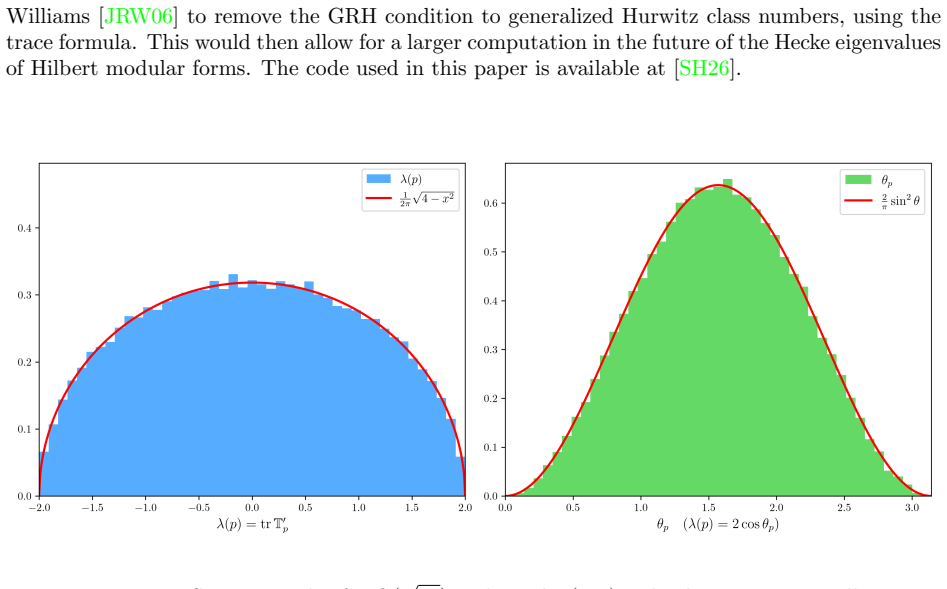
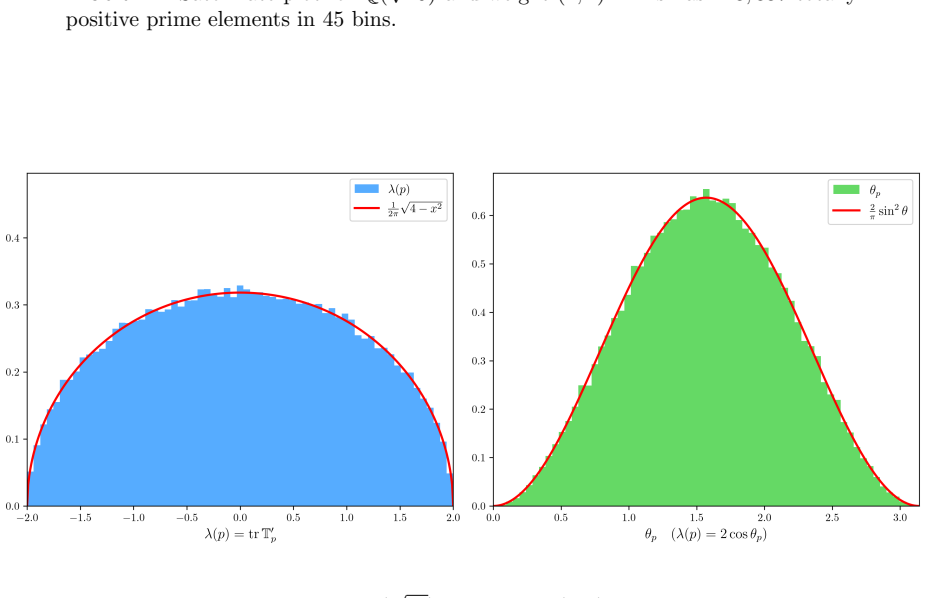
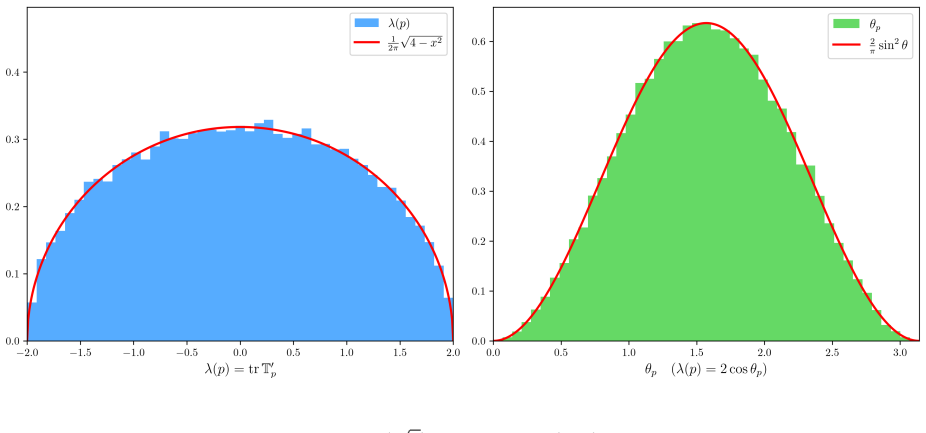
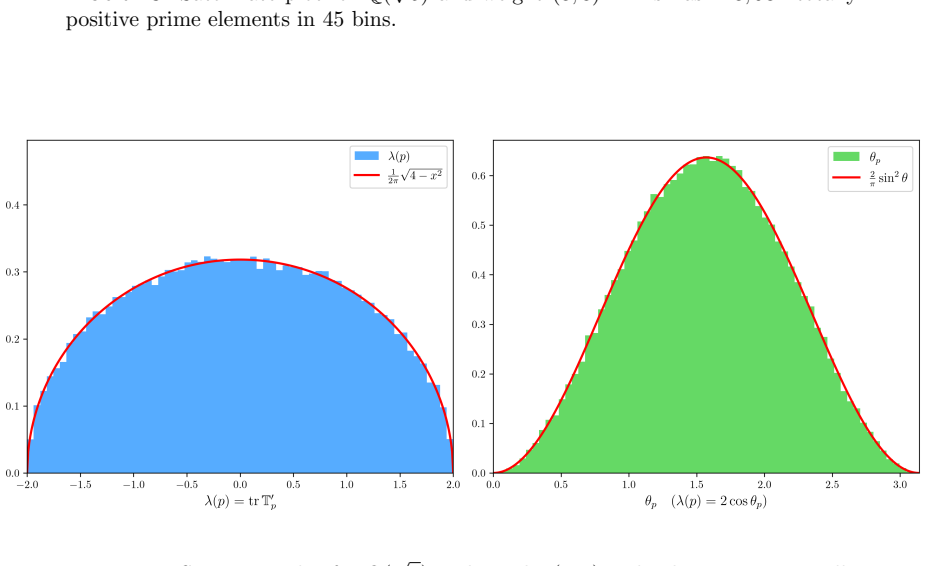
read the original abstract
Motivated by Su's construction of Cohen-type Eisenstein series of half-integral weight over totally real number fields \cite{Su16}, we introduce a generalization of Hurwitz class numbers to totally real number fields. Using these generalized Hurwitz class numbers, we establish an Eichler--Selberg trace formula for the space of holomorphic Hilbert cusp forms over real quadratic fields of narrow class number one. While the classical Hurwitz class numbers are defined in terms of class numbers of imaginary quadratic fields, the generalized Hurwitz class numbers appearing in our Eichler--Selberg trace formula are defined in terms of class numbers of quartic CM fields. For applications of this Eichler--Selberg trace formula, we study the distribution of the generalized Hurwitz class numbers, prove class number relations, and carry out numerical computations of traces of Hecke operators for $\mathbb{Q}(\sqrt{5})$ and $\mathbb{Q}(\sqrt{29})$.
Editorial analysis
A structured set of objections, weighed in public.
Referee Report
Summary. The manuscript introduces generalized Hurwitz class numbers for totally real number fields, defined via class numbers of associated quartic CM fields and motivated by Su's Cohen-type Eisenstein series. It establishes an Eichler-Selberg trace formula for the space of holomorphic Hilbert cusp forms over real quadratic fields of narrow class number one, expressed in terms of these generalized class numbers. Applications include the distribution of the generalized class numbers, proofs of class number relations, and numerical computations of Hecke traces for the fields Q(sqrt(5)) and Q(sqrt(29)).
Significance. If the derivation holds, the work supplies an explicit arithmetic expression for traces of Hecke operators on Hilbert cusp forms, directly tying them to class numbers of quartic CM fields. This extends the classical Eichler-Selberg formula in a coherent way and supplies concrete numerical checks together with distribution results. The construction is parameter-free once the generalized class numbers are fixed, and the restriction to narrow class number one is stated explicitly as the setting in which the formula is proved.
major comments (1)
- [§2] §2, Definition of generalized Hurwitz class numbers: the claim that these numbers correctly capture the arithmetic data for the trace formula rests on the construction via quartic CM fields; an explicit verification that the definition reduces to the classical Hurwitz class number when the base field is Q (or a direct comparison with the imaginary quadratic case) is needed to confirm consistency of the generalization.
minor comments (2)
- [Introduction] Introduction: a short paragraph recalling the statement of the classical Eichler-Selberg formula over Q would help orient readers before the generalization is presented.
- [§5] §5, numerical examples: the precision and method used to compute the class numbers of the quartic CM fields for the traces on Q(sqrt(5)) and Q(sqrt(29)) should be stated explicitly to ensure reproducibility.
Simulated Author's Rebuttal
We thank the referee for the positive assessment and the constructive comment on the definition of the generalized Hurwitz class numbers. We address the point below.
read point-by-point responses
-
Referee: [§2] §2, Definition of generalized Hurwitz class numbers: the claim that these numbers correctly capture the arithmetic data for the trace formula rests on the construction via quartic CM fields; an explicit verification that the definition reduces to the classical Hurwitz class number when the base field is Q (or a direct comparison with the imaginary quadratic case) is needed to confirm consistency of the generalization.
Authors: We agree that an explicit verification of the reduction to the classical case strengthens the consistency of the generalization. In the revised manuscript we will add a remark (or short computation) in §2 showing that when the totally real base field F is ℚ the associated quartic CM fields reduce to imaginary quadratic fields and the generalized Hurwitz class numbers coincide with the classical Hurwitz class numbers, following directly from the class-number definition. revision: yes
Circularity Check
No significant circularity identified
full rationale
The paper defines generalized Hurwitz class numbers in terms of class numbers of quartic CM fields (motivated by Su's prior Eisenstein series construction) and then proves an Eichler-Selberg trace formula expressed using those numbers for Hilbert cusp forms over narrow class number one real quadratic fields. No quoted equations or steps reduce the trace formula to the definition by construction, nor does any load-bearing premise rely on self-citation chains or fitted inputs renamed as predictions. The restriction to narrow class number one fields and the listed applications (distributions, relations, numerical traces) are presented as downstream consequences rather than foundational inputs. The derivation chain is therefore self-contained against external benchmarks.
Axiom & Free-Parameter Ledger
axioms (1)
- domain assumption The construction of generalized Hurwitz class numbers is valid when motivated by Su's half-integral weight Eisenstein series over totally real fields.
invented entities (1)
-
Generalized Hurwitz class numbers for totally real number fields
no independent evidence
Reference graph
Works this paper leans on
-
[1]
Hijikata, H. , title =. J. Math. Soc. Japan , issn =. 1974 , language =. doi:10.2969/jmsj/02610056 , keywords =
-
[2]
Okada, Kaoru , title =. Exp. Math. , issn =. 2002 , language =. doi:10.1080/10586458.2002.10504484 , keywords =
-
[3]
LuCaNT: LMFDB, computation, and number theory
Assaf, Eran and Babei, Angelica and Breen, Ben and Costa, Edgar and Duque-Rosero, Juanita and Horawa, Aleksander and Kieffer, Jean and Kulkarni, Avinash and Molnar, Grant and Schiavone, Sam and Voight, John , title =. LuCaNT: LMFDB, computation, and number theory. Conference, Institute for Computational and Experimental Research in Mathematics (ICERM), Pr...
-
[4]
Saito, Hiroshi , title =. J. Math. Kyoto Univ. , issn =. 1984 , language =. doi:10.1215/kjm/1250521332 , keywords =
-
[5]
and Ramachandran, Shantha and Williams, Hugh C
Jacobson, Michael J. and Ramachandran, Shantha and Williams, Hugh C. , title =. Algorithmic number theory. 7th international symposium, ANTS-VII, Berlin, Germany, July 23--28, 2006. Proceedings. , isbn =. 2006 , publisher =. doi:10.1007/11792086 , keywords =
-
[6]
Shintani, Takuro , title =. J. Fac. Sci., Univ. Tokyo, Sect. I A , issn =. 1976 , language =
1976
-
[7]
and Tsuzuki, Masao and Wakatsuki, Satoshi , title =
Kim, Henry H. and Tsuzuki, Masao and Wakatsuki, Satoshi , title =. Forum Math. , issn =. 2022 , language =. doi:10.1515/forum-2020-0251 , keywords =
-
[8]
Hoffmann, Werner and Wakatsuki, Satoshi , title =. 2018 , publisher =. doi:10.1090/memo/1224 , keywords =
-
[9]
, title =
Datskovsky, Boris A. , title =. A tribute to Emil Grosswald: number theory and related analysis , isbn =. 1993 , publisher =
1993
-
[10]
Clozel, Laurent and Delorme, Patrick , title =. Ann. Sci. 1990 , language =. doi:10.24033/asens.1602 , keywords =
-
[11]
1994 , PAGES =
Platonov, Vladimir and Rapinchuk, Andrei , TITLE =. 1994 , PAGES =
1994
-
[12]
Hurwitz, Adolf , TITLE =. Math. Ann. , FJOURNAL =. 1885 , NUMBER =. doi:10.1007/BF01446402 , URL =
-
[13]
Kronecker, L. , TITLE =. J. Reine Angew. Math. , FJOURNAL =. 1860 , PAGES =. doi:10.1515/crll.1860.57.248 , URL =
-
[14]
Zagier, Don , TITLE =. C. R. Acad. Sci. Paris S\'er. A-B , FJOURNAL =. 1975 , NUMBER =
1975
-
[15]
Eichler, M. , TITLE =. Math. Z. , FJOURNAL =. 1957 , PAGES =. doi:10.1007/BF01258863 , URL =
-
[16]
, TITLE =
Zagier, D. , TITLE =. Modular functions of one variable,. 1977 , ISBN =
1977
-
[17]
1976 , PAGES =
Lang, Serge , TITLE =. 1976 , PAGES =
1976
-
[18]
Hirzebruch, F. and Zagier, D. , TITLE =. Invent. Math. , FJOURNAL =. 1976 , PAGES =. doi:10.1007/BF01390005 , URL =
-
[19]
Louboutin, St\'ephane and Okazaki, Ryotaro , TITLE =. Acta Arith. , FJOURNAL =. 1994 , NUMBER =. doi:10.4064/aa-67-1-47-62 , URL =
-
[20]
1961 , PAGES =
Shimura, Goro and Taniyama, Yutaka , TITLE =. 1961 , PAGES =
1961
-
[21]
Streng, Marco , TITLE =. Math. Comp. , FJOURNAL =. 2014 , NUMBER =. doi:10.1090/S0025-5718-2013-02712-3 , URL =
-
[22]
The. The. 2026 , note =
2026
-
[23]
Prestel, Alexander , TITLE =. Math. Ann. , FJOURNAL =. 1968 , PAGES =. doi:10.1007/BF01350863 , URL =
-
[24]
Ishikawa, Hirofumi , TITLE =. J. Fac. Sci. Univ. Tokyo Sect. IA Math. , FJOURNAL =. 1974 , PAGES =
1974
-
[25]
Shimizu, Hideo , TITLE =. Ann. of Math. (2) , FJOURNAL =. 1965 , PAGES =. doi:10.2307/1970389 , URL =
-
[26]
Takase, Koichi , TITLE =. Manuscripta Math. , FJOURNAL =. 1986 , NUMBER =. doi:10.1007/BF01168682 , URL =
-
[27]
, TITLE =
Selberg, A. , TITLE =. J. Indian Math. Soc. (N.S.) , FJOURNAL =. 1956 , PAGES =
1956
-
[28]
Serre, Jean-Pierre , TITLE =. J. Amer. Math. Soc. , FJOURNAL =. 1997 , NUMBER =. doi:10.1090/S0894-0347-97-00220-8 , URL =
-
[29]
Shimizu, Hideo , TITLE =. Ann. of Math. (2) , FJOURNAL =. 1963 , PAGES =. doi:10.2307/1970201 , URL =
-
[30]
2004 , PAGES =
Bourbaki, Nicolas , TITLE =. 2004 , PAGES =
2004
-
[31]
Hiraga, Kaoru , title =. Duke Math. J. , issn =. 1996 , language =. doi:10.1215/S0012-7094-96-08507-5 , keywords =
-
[32]
, TITLE =
Garrett, Paul B. , TITLE =. 1990 , PAGES =
1990
-
[33]
Su, Ren-He , TITLE =. Int. J. Number Theory , FJOURNAL =. 2016 , NUMBER =. doi:10.1142/S1793042116500469 , URL =
-
[34]
Ishikawa, Hirofumi , TITLE =. Proc. Japan Acad. Ser. A Math. Sci. , FJOURNAL =. 1988 , NUMBER =
1988
-
[35]
Mertens, Michael H. , TITLE =. Adv. Math. , FJOURNAL =. 2016 , PAGES =. doi:10.1016/j.aim.2016.06.016 , URL =
-
[36]
Mertens, Michael H. , TITLE =. Res. Math. Sci. , FJOURNAL =. 2014 , PAGES =. doi:10.1186/2197-9847-1-6 , URL =
-
[37]
Eichler, Martin , TITLE =. J. Indian Math. Soc. (N.S.) , FJOURNAL =. 1955 , PAGES =
1955
-
[38]
Knightly, Andrew and Li, Charles , TITLE =. 2006 , PAGES =. doi:10.1090/surv/133 , URL =
-
[39]
Noncommutative geometry and number theory , SERIES =
Blasius, Don , TITLE =. Noncommutative geometry and number theory , SERIES =. 2006 , ISBN =. doi:10.1007/978-3-8348-0352-8\_2 , URL =
-
[40]
Sugiyama, Shingo and Tsuzuki, Masao , TITLE =. Ramanujan J. , FJOURNAL =. 2020 , NUMBER =. doi:10.1007/s11139-019-00146-z , URL =
-
[41]
Arthur, James , TITLE =. Invent. Math. , FJOURNAL =. 1989 , NUMBER =. doi:10.1007/BF01389042 , URL =
-
[42]
Algebraic number theory , Url =
Neukirch, J\"urgen , TITLE =. 1999 , PAGES =. doi:10.1007/978-3-662-03983-0 , URL =
-
[43]
S\'eminaire
Deligne, Pierre , TITLE =. S\'eminaire. 1971 , ISBN =
1971
-
[44]
Deligne, Pierre , TITLE =. Inst. Hautes \'Etudes Sci. Publ. Math. , FJOURNAL =. 1974 , PAGES =
1974
-
[45]
Cohen, Henri , TITLE =. Math. Ann. , FJOURNAL =. 1975 , NUMBER =. doi:10.1007/BF01436180 , URL =
-
[46]
PARI/GP version 2.17.3
The PARI Group. PARI/GP version 2.17.3
-
[47]
Barnet-Lamb, Thomas and Gee, Toby and Geraghty, David , TITLE =. J. Amer. Math. Soc. , FJOURNAL =. 2011 , NUMBER =. doi:10.1090/S0894-0347-2010-00689-3 , URL =
-
[48]
2026 , note =
Andrei Seymour-Howell , title =. 2026 , note =
2026
discussion (0)
Sign in with ORCID, Apple, or X to comment. Anyone can read and Pith papers without signing in.