REVIEW 4 major objections 6 minor 26 references
Sparse Representation Based Efficient Radiation Symmetry Analysis Method for Cylindrical Model of Inertial Confinement Fusion
T0 review · 4 major / 6 minor · reviewed 2026-08-14 · deepseek-v4-flash
Pith's one-line read The paper argues that solving roughly one-tenth of the nonlinear view-factor equations, sampled by Latin hypercube design and recovered with the CGSTP algorithm, reproduces the radiation flux accurately enough for ICF symmetry analysis.
desk verdict A credible algorithmic speedup for ICF flux evaluation, but the validation misses the actual symmetry metrics and the Jacobian/sparsity logic need work. read the letter →
The pith
A machine-rendered reading of the paper's core claim, the machinery that carries it, and where it could break.
The reading
What carries the argument
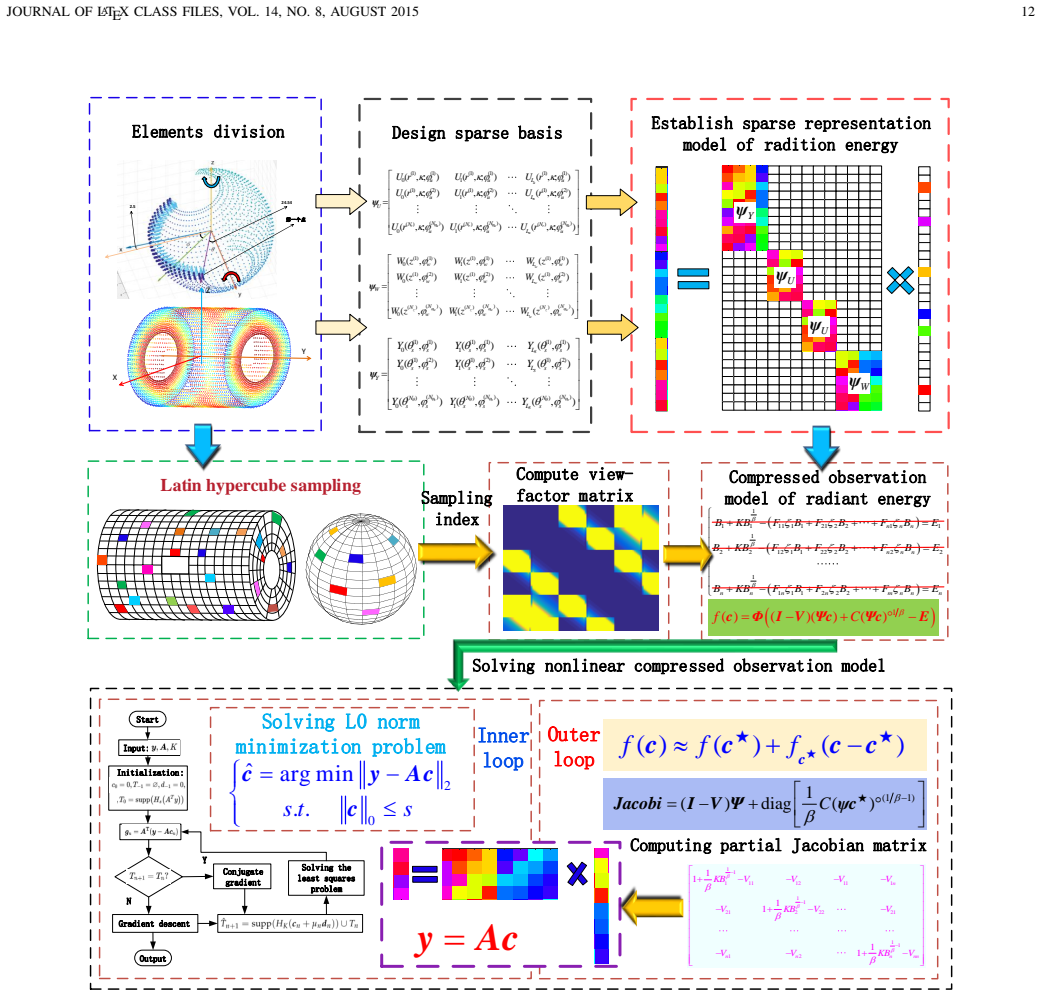
The load-bearing object is the sparse-coefficient reformulation of the nonlinear view-factor equation: $f(c)=(I-V)(\Psi c)+C(\Psi c)^{\circ 1/\beta}-E$, where $\Psi$ stacks the three polynomial bases and $c$ is the sparse coefficient vector. Linearizing by a first-order Taylor expansion gives a Jacobian-based compressed observation system $Ac=y$, and only rows of that system corresponding to Latin-hypercube-sampled mesh elements are formed. The CGSTP algorithm carries the reconstruction: it combines the conjugate-gradient search direction of CGIHT with the backtracking support-set update of Subspace Pursuit, so it needs only tens of iterations (27-38 in the tests) rather than hundreds. The sparsity levels $s_1\approx30$, $s_2\approx35$, $s_3\approx100$ determine the sampling budget and the input sparsity $K$.
What would settle it
Compute the full radiation flux for a new cylindrical target geometry not used in the paper, then run CGSTP using sampling budgets derived from the reported sparsity values $s_1\approx30$, $s_2\approx35$, $s_3\approx100$ without first solving the full model; if the recovered flux RMSE exceeds $10^{-3}$ or the iteration count grows sharply, the claim that these sparsity levels carry over to new models fails. A second check is to numerically estimate the restricted isometry constant of the sampled Jacobian $\Phi f_{c^\star}$; if $\delta_K$ is close to 1, the RIP-based recovery guarantee assumed by the method is not met.
Extended reading notes
Core claim
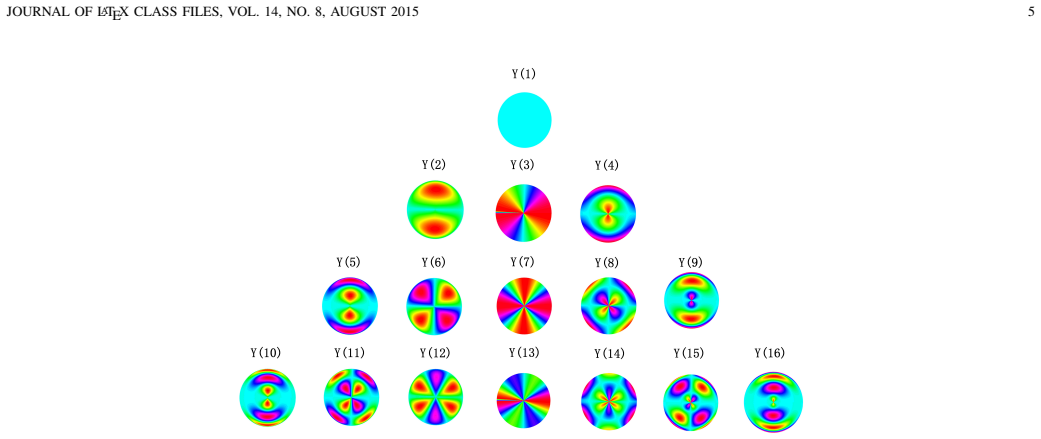
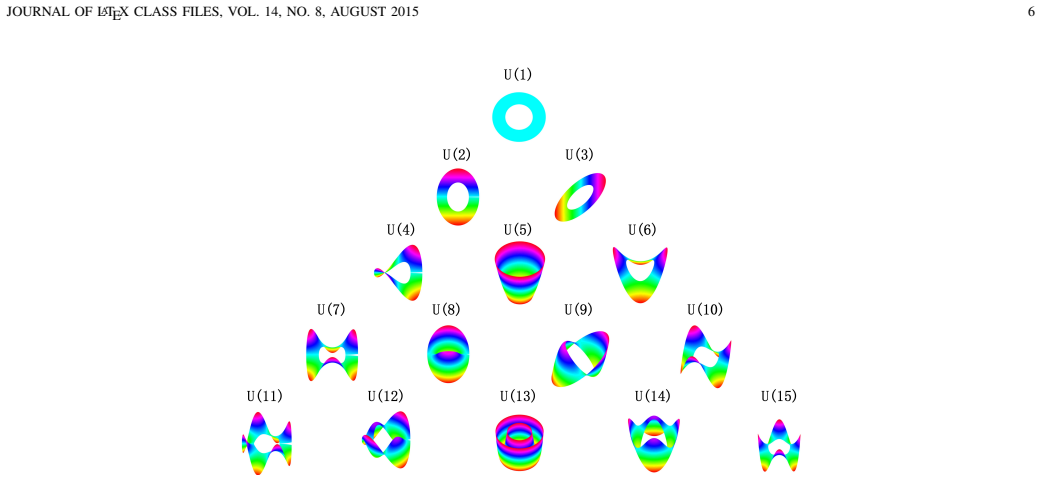
The central discovery is that the radiation flux distribution in a cylindrical hohlraum is compressible in a block basis made of spherical harmonics on the capsule, annular Zernike polynomials on the end faces, and Legendre-Fourier polynomials on the side wall, so the nonlinear energy balance equation can be rewritten as a sparse-coefficient system. The paper then shows experimentally that sampling about 8.7%, 2.3%, 3.9%, and 1.1% of the equations for four meshes with 9,776 to 82,944 elements, and solving the resulting underdetermined system with the proposed CGSTP algorithm, recovers the flux with RMSE below $10^{-3}$, which it states satisfies the accuracy requirement for radiation symmetry analysis. Because the sampled fraction shrinks as the mesh grows, the total computation time falls to roughly one tenth for the smallest model and about one eightieth for the largest, compared with a preconditioned conjugate-gradient method. The paper presents this as an efficiency result: the harder the full problem becomes, the larger the relative saving from compressed reconstruction.
Load-bearing premise
The whole method assumes the sparsity levels $s_1\approx30$, $s_2\approx35$, $s_3\approx100$ are known in advance, but the paper obtains them by first solving the full problem the method is meant to avoid; without those numbers, neither the sampling budget nor the $K$ input to CGSTP is determined.
Editorial extensions
If this is right
- For cylindrical hohlraum models, radiation symmetry analysis can be run at a fraction of the cost of full solves, with the speedup growing as the mesh is refined: the largest model needs only 1.1% of the equations and about 1.2% of the time.
- The CGSTP iteration count stays small, roughly 27 to 38, while IHT and CGIHT need hundreds of iterations, so the method's advantage is not merely fewer equations but also fewer expensive Jacobian updates.
- Recovered flux RMSE below $10^{-3}$ is presented as sufficient for symmetry evaluation, meaning the compressed solution can replace the full solve in preliminary target design loops.
- The same polynomial bases and sampling pipeline apply to any cylindrical-cavity target in the same geometry class, so design optimization over element size becomes cheaper.
Reading between the lines
- The paper determines the sparsity levels $s_1,s_2,s_3$ from the full solution it is trying to avoid; if those levels are stable across target geometries, the sampling budget could be fixed in advance and the method would become fully predictive, which the reported experiments do not yet show.
- One could test numerically whether the row-sampled Jacobian satisfies the Restricted Isometry Property; if it does, the recovery guarantees would rest on standard compressed-sensing theory, and if not, the reported accuracy would need another explanation.
- The same compressed framework would need a new sparse basis for non-cylindrical, free-form hohlraums; the cylindrical block basis does not automatically transfer.
- Because the recovered coefficients themselves are low-dimensional, one could use them directly to report asymmetry mode amplitudes, turning symmetry evaluation into a small-dimensional monitoring problem rather than a full-field comparison.
Signed reviews
Editorial analysis
A structured set of objections, weighed in public.
Referee Report
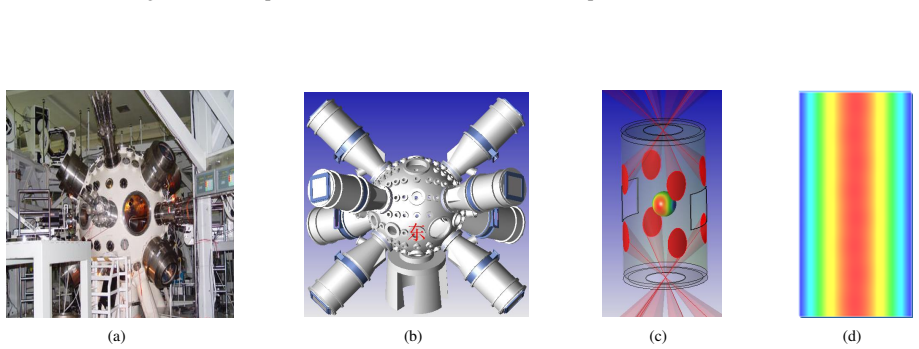
Summary. The paper proposes a compressed-sensing framework to accelerate the solution of the nonlinear view-factor (time-dependent energy balance) equations used to compute radiation flux in a cylindrical ICF hohlraum. Radiation flux on the capsule, end faces, and cylindrical wall is expanded in spherical harmonics, annular Zernike polynomials, and Legendre-Fourier polynomials, respectively. The authors then sample a small subset of mesh elements via Latin hypercube sampling, formulate a compressed observation model from a first-order Taylor expansion of the nonlinear equations, and recover the sparse coefficients using a new greedy algorithm called Conjugate Gradient Subspace Thresholding Pursuit (CGSTP). Experiments on four models (two per Shenguang-II and Shenguang-III configurations) compare CGSTP with Newton-Raphson, preconditioned conjugate gradient, IHT, and CGIHT, reporting computation-time reductions to roughly 1/10 to 1/80 of the standard approach while maintaining a root-mean-square error below 1e-3 in the reconstructed radiation flux.
Significance. If the claims are established, the method would offer a practical way to speed up radiation-symmetry evaluation in ICF target design, where repeated view-factor solves are a bottleneck. The paper's strengths are its explicit and well-structured algorithm (Algorithm 3), the extensive empirical comparison across four mesh resolutions, and the demonstration that computation time scales favorably as the mesh is refined. The speedup figures are plausible in that only a fraction of the view-factor matrix is assembled and solved. However, the significance is currently limited by several load-bearing issues: a dimensionally inconsistent Jacobian expression, an unverified Restricted Isometry Property assumption for the sampled Jacobian, a circular dependence of the sampling budget on a full reference solution, and the absence of the actual ICF symmetry metrics (e.g., P2/P0, P4/P0 on the capsule) that the paper states motivate the work. With corrections and additional validation, the contribution could be a useful CS application for computational physics.
major comments (4)
- [Section III.D, Eq. (32)] The Jacobian expression in Eq. (32) is dimensionally inconsistent. The first term, (I−V)Ψ, is N×L, while the second term, diag[(1/β)C(Ψc*)^(1/β−1)], is N×N, so the two cannot be added. The correct derivative of C(Ψc)^(1/β) with respect to c is (1/β)C diag((Ψc*)^(1/β−1)) Ψ, which is N×L. As written, Eqs. (33)–(35) are undefined and the compressed observation model A=Φf_c* is not properly derived. The authors must correct this and verify that the implementation uses the corrected Jacobian.
- [Section IV.A, Eq. (35)] The paper asserts that the row-sampled Jacobian satisfies the Restricted Isometry Property without proof or numerical verification. The measurement matrix is a row-selection operator applied to Φf_c*, and f_c* changes at every iteration of the nonlinear solver; standard RIP guarantees for partial orthogonal matrices do not directly apply to this composite and iteration-dependent matrix. The sample-size formula O(K log(N)) and the convergence arguments for CGSTP both rely on RIP, so the authors should either provide a theoretical justification specific to their A, compute restricted isometry constants numerically for the tested models, or clearly state that the RIP is an unverified assumption whose practical validity is only indirectly supported by the experiments.
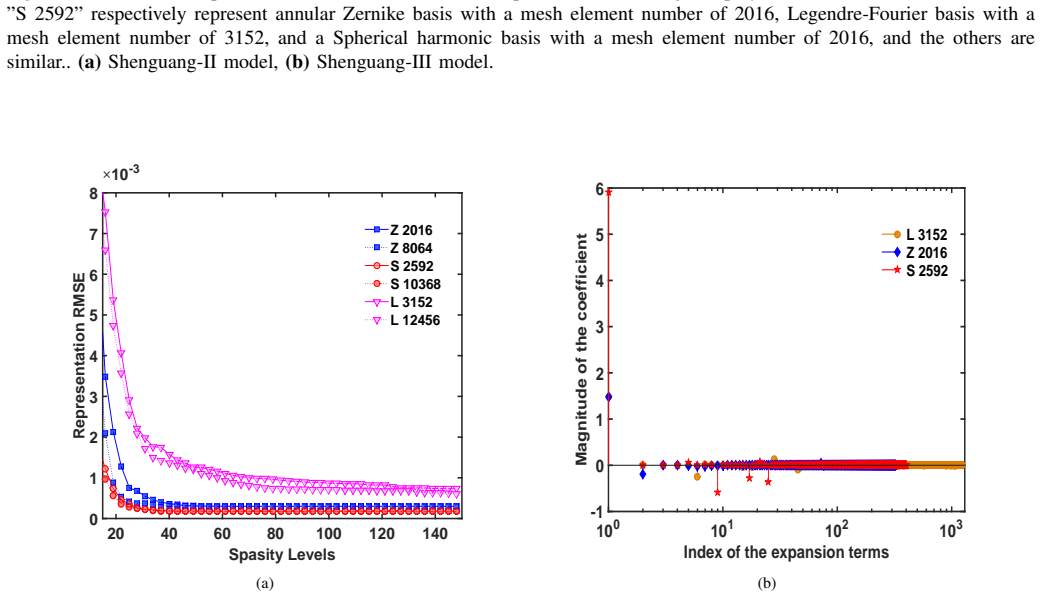
- [Section V.B, Figure 9 and Table III] The sparsity levels s1≈30, s2≈35, s3≈100 used to set the sampling budget are obtained by computing the full radiation flux, thresholding its expansion coefficients at 1e-3, and counting the survivors. The same full solution is then treated as the ground truth for evaluating the recovery. This is circular for the practical claim that the method avoids solving the full system: in a real application the sparsity levels and the truncation orders would be unknown. The authors should demonstrate that these sparsity levels are stable across different target geometries and laser configurations, or provide a practical procedure to estimate s without first solving the full problem, or at least quantify how sensitive the speedup and accuracy are to misspecified s.
- [Section V.C, Table VII and Conclusion] The validation reports only the global RMSE of the reconstructed radiation flux over all three surfaces. The paper's stated goal is radiation symmetry analysis for ICF, where the acceptance criterion is a drive asymmetry below 1–2% on the capsule (Section I). Table VII shows CGSTP RMSE values of 5–8×1e-4, which are about 100–140 times larger than the PCG reference (1.6–5.5×1e-6), and the assertion that 'this satisfies the radiation symmetry analysis' is not supported by any symmetry metric computed from the CGSTP-recovered capsule flux. Global RMSE can be dominated by high-order or wall-region errors. The authors should compute the low-order Legendre moments (e.g., P2/P0 and P4/P0) of the capsule flux from both the CGSTP and PCG solutions, for each model, and report the resulting asymmetry errors. Without such metrics, the central claim that the method achieves 'comparable accuracy' for ICF symmetry analysis is not established.
minor comments (6)
- [Throughout] There are many typographical and consistency errors: 'Newton-Rapshon' for 'Newton-Raphson', 'snesing matrix' for 'sensing matrix', 'CGHTP algorithm' for 'CGSTP algorithm' in Section IV.B.3, 'LT polynomials' for 'LF polynomials' in Section III.C, and inconsistent capitalization of 'Bs'/'BS'. The manuscript needs a careful proofreading pass.
- [Eq. (7)] The RIP definition in Eq. (7) bounds ||Ψc||2, but for the compressed sensing system A=ΦΨ the property should be stated for ||A c||2 = ||ΦΨc||2. As written, the definition does not match the measurement matrix discussion in the same subsection.
- [Section IV.B.1, Algorithm 1] The citation for the convergence of IHT appears as '[dd]' in the text; this should be replaced with the proper reference (Blumensath and Davies, 2008).
- [Table VI] The table title is 'Number of samples of four simulation models', but the table lists iteration counts. The title should read 'Number of iterations' to match the content.
- [Figure 10(b)] The quantities ΔTS1 and ΔTS2 are used in the caption and text but never defined. Please define them explicitly (e.g., iteration-time difference between CGSTP and CGIHT, and between CGSTP and IHT).
- [Table V] For the compressed sensing methods, the 'View-factor calculation time' column should clarify that only the view factors for the sampled rows are computed, and the sparse-basis calculation time is separated. This is important for interpreting the total-time comparison.
Circularity Check
Sparsity parameters s1≈30, s2≈35, s3≈100 are measured from the full radiation-flux solution and then used to set both the sampling budget and the CGSTP input K, so the reported acceleration is demonstrated with oracle knowledge rather than predicted.
-
fitted input called prediction
[Section V.B (Sparse representation error analysis), feeding Section V.A / Table III and Algorithm 3 input K]
"From Figure 9 (a) we can see that the number of the absolute value of coefficients larger than 10−3 over three sets of orthogonal bases are s1≈ 30, s2≈ 35 and s3≈ 100 respectively. ... The sampling number is estimated according to the formula s log(N). Taking the S21 model as an example, the sampling numbers of three radiation regions are calculated as 30×log(2592)≈ 102.4 (take 150), 35×log(2016) = 115.6 (take 150) and 100×log(3152) = 349.8 (take 400)."
The sparsity levels s1≈30, s2≈35, s3≈100 are obtained by computing the expansion coefficients of the full radiation flux and thresholding them (the Section V.B experiment uses 'the original flux and the recovered radiation flux' to determine these levels). These exact fitted values are then inserted into the sampling formula M = s·log(N) that generates Table III's sampling rates (8.7% down to 1.1%), and they are also the sparsity K required by the CGSTP algorithm in Eq. (36) and Algorithm 3. The paper's headline claim that solving about one tenth of the equations recovers the flux with comparable accuracy is therefore not an independent prediction: the sampling budget and the reconstruction sparsity are both supplied by the full solution of the very model the method is designed to avoid.
full rationale
The central claimed result—that solving only 8.7%–1.1% of the nonlinear view-factor equations with CGSTP reproduces the radiation flux accurately—is partially circular. In Section V.B the paper determines the sparsity levels s1≈30, s2≈35, s3≈100 by expanding the full radiation flux in the chosen polynomial bases and thresholding the expansion coefficients. Those same values are then used in Section V.A / Table III to fix the number of sampled equations via M = s·log(N), and they supply the K input of the CGSTP algorithm. Thus the sampling rates and the reported accuracy are not derived from the compressed model alone; they are conditioned on knowing the full solution's sparsity, which is the information the fast method is meant to avoid computing. This is a genuine fitted-input circularity in the validation, but it is not total: the CGSTP recovery itself, the sparsity of the physical flux, and the timing comparisons are real computations. No load-bearing self-citation chain was found; the orthogonal polynomial representations are standard mathematical constructions and the algorithm is benchmarked against IHT/CGIHT/PCG rather than being justified by a same-author uniqueness theorem. Separately, the paper's validation is further weakened by asserting 'The RMSE of CGSTP algorithm in calculating different models is less than 10−3, which satisfies the radiation symmetry analysis' without computing the actual ICF symmetry metrics (e.g., capsule P2/P0 or P4/P0 drive-asymmetry moments). That is a correctness/validation gap rather than a constructional circularity, but it reinforces the conclusion that the central claim is only partially established.
Assumptions & free parameters
free parameters (2)
- Sparsity levels s1, s2, s3 =
30, 35, 100
- Polynomial truncation orders =
400 (spherical harmonics), 325 (annular Zernike), 1225 (Legendre-Fourier)
assumptions (4)
- domain assumption The row-sampled Jacobian matrix A = Phi f_{c*} satisfies the Restricted Isometry Property with an adequate constant.
- domain assumption The radiation flux is sparse in the chosen polynomial basis with known sparsity K.
- domain assumption The first-order Taylor expansion of the nonlinear view-factor equation is adequate at each outer iteration.
- domain assumption The TDEBM view-factor model (Eqs. (1)-(4)) accurately represents the radiation flux.
Cite this review
Pith. "Pith review of Sparse Representation Based Efficient Radiation Symmetry Analysis Method for Cylindrical Model of Inertial Confinement Fusion." pith.science (2026). https://pith.science/paper/K54VWVNB
@misc{pith2026190806274,
  author       = {Pith},
  title        = {Pith review of: Sparse Representation Based Efficient Radiation Symmetry Analysis Method for Cylindrical Model of Inertial Confinement Fusion},
  year         = {2026},
  howpublished = {\url{https://pith.science/paper/K54VWVNB}},
  note         = {Machine review of arXiv:1908.06274}
}
read the original abstract
Radiation symmetry evaluation is critical to the laser driven Inertial Confinement Fusion (ICF), which is usually done by solving a view-factor equation model. The model is nonlinear, and the number of equations can be very large when the size of discrete mesh element is very small to achieve a prescribed accuracy, which may lead to an intensive equation solving process. In this paper, an efficient radiation symmetry analysis approach based on sparse representation is presented, in which, 1) the Spherical harmonics, annular Zernike polynomials and Legendre-Fourier polynomials are employed to sparsely represent the radiation flux on the capsule and cylindrical cavity, and the nonlinear energy equilibrium equations are transformed into the equations with sparse coefficients, which means there are many redundant equations, 2) only a few equations are selected to recover such sparse coefficients with Latin hypercube sampling, 3) a Conjugate Gradient Subspace Thresholding Pursuit (CGSTP) algorithm is then given to rapidly obtain such sparse coefficients equation with as few iterations as possible. Finally, the proposed method is validated with two experiment targets for Shenguang II and Shenguang III laser facility in China. The results show that only one tenth of computation time is required to solve one tenth of equations to achieve the radiation flux with comparable accuracy. Further more, the solution is much more efficient as the size of discrete mesh element decreases, in which, only 1.2\% computation time is required to obtain the accurate result.
Figures


Figures from the paper (9 more)




Reference graph
Works this paper leans on
-
[1]
Srivastava, M. K.; Vinod Kumar; S. V . G. Menon. Analytical axial view factors and thermal radiation distribution inside a cylindrical hohlraum. Phys. Plasmas 2000, 6, 2616-2621,
work page 2000
-
[2]
Lindl, J.. Development of the indirect-drive approach to inertial confinement fusion and the target physics basis for ignition and gain. Phys. Plasmas 1995, 11, 3933-4024,
work page 1995
-
[3]
LASNEX-A 2-D physics code for modelling ICF
Harte, J.A.; Alley, W.E.; Bailey, D.S.; et al. LASNEX-A 2-D physics code for modelling ICF. UCRL-LR-105821-96-4 1996, 150-164
work page 1996
-
[4]
Application of view-factor method in calculations of radiation transport in targets
Bazin, A.A.; Vatulin, V .V .; Dementyev, Y .A.; Mironova, V .F.; Skidan, G.I.; Tikhomirova, B.N.; et al. Application of view-factor method in calculations of radiation transport in targets. Instrum. Methods Phys. Res., Sect. A 1998, 1-2, 123-126
work page 1998
-
[5]
An improved version of the view factor method for simulating inertial confinement fusion hohlraums
Basko, M. An improved version of the view factor method for simulating inertial confinement fusion hohlraums. Phys. Plasmas 1996, 11, 4148-4155
work page 1996
-
[6]
Development of a time-dependent view factor code for studying radiation symmetry in ICF hohlraums
MacFarlane, J.J. Development of a time-dependent view factor code for studying radiation symmetry in ICF hohlraums. UWFDM-1061 1998, 1-53. JOURNAL OF LATEX CLASS FILES, VOL. 14, NO. 8, AUGUST 2015 17
work page 1998
-
[7]
Li, H.; Huang, Y .; Jiang, S.; Jing, L.; Ding, Y . An efficient computational approach for evaluating radiation flux for laser driven inertial confinement fusion targets. Comput. Phys. Commun. 2015, 193, 49-54
work page 2015
-
[8]
Li, H.; Huang, Y .; Jiang, S.; Jing, L.; Xia, H.; Huang, T.; Chen, X. A GPU based iteration approach to efficiently evaluate radiation symmetry for laser driven inertial confinement fusion. Appl. Math. Model. 2018, 59, 293-304
work page 2018
Show all 26 references
-
[9]
Compressed sensing: theory and application
Eldar, Y .; Kutinyok, G.. Compressed sensing: theory and application. Corr., 2011, 4, 1289-1306
2011
-
[10]
Compressed sensing
Donoho, D.L. Compressed sensing. IEEE Trans. Inf. Theory 2006, 4, 1289-1306
2006
-
[11]
Lustig, M.; Donoho, D.; Pauly, J. M. Sparse MRI: The application of compressed sensing for rapid MR imaging. Magn. Reson. Med. 2007, 6, 1182-1195
2007
-
[12]
The pros and cons of compressive sensing for wideband signal acquisition: noise folding versus dynamic range
Davenport, M.A.; Laska, J.N.; Treichler, J.R.; Baraniuk, R.G. The pros and cons of compressive sensing for wideband signal acquisition: noise folding versus dynamic range. IEEE Trans. Signal Process. 2012, 9, 4628-4642
2012
-
[13]
Designing Compressive Sensing DNA Microarrays
Sheikh, M.A.; Milenkovic, O.; Baraniuk, R.G. Designing Compressive Sensing DNA Microarrays. IEEE International Workshop on Computational Advances in Multi-sensor Adaptive Processing 2008, 141-144
2008
-
[14]
Compressive rendering: a rendering application of compressed sensing
Sen, P.; Darabi, S. Compressive rendering: a rendering application of compressed sensing. IEEE Trans. Vis. Comput. Graph. 2010, 4, 487-499
2010
-
[15]
Compressive analysis applied to radiation symmetry evaluation and optimization for laser-driven inertial confinement fusion
Huang, Y .; Jiang, S.; Li, H.; Wang, Q.; Chen, L. Compressive analysis applied to radiation symmetry evaluation and optimization for laser-driven inertial confinement fusion. Comput. Phys. Commun. 2014, 2, 459-471
2014
-
[16]
A unified modeling approach for physical experiment design and optimization in laser driven inertial confinement fusion
Li, H.; Huang, Y .; Jiang, S.; Jing, L.; Tianxuan, H.; Ding, Y . A unified modeling approach for physical experiment design and optimization in laser driven inertial confinement fusion. Fusion Eng. Des. 2015, 100, 596-607
2015
-
[17]
Iterative hard thresholding for compressed sensing
Blumensath, T.; Davies, M.E. Iterative hard thresholding for compressed sensing. Appl. Comput. Harmon. Anal. 2008, 3, 265-274
2008
-
[18]
Normalized iterative hard thresholding: guaranteed stability and performance
Blumensath, T.; Davies, M.E. Normalized iterative hard thresholding: guaranteed stability and performance. Appl. IEEE J. Sel. Top. Signal Process. 2010, 2, 298-309
2010
-
[19]
Conjugate gradient iterative hard thresholding: observed noise stability for compressed sensing
Blanchard, J.D.; Tanner, J.; Wei, K. Conjugate gradient iterative hard thresholding: observed noise stability for compressed sensing. IEEE Trans. Signal Process. 2015, 2, 528-537
2015
-
[20]
Subspace pursuit for compressive sensing signal reconstruction
Wei, D.; Milenkovic, O. Subspace pursuit for compressive sensing signal reconstruction. IEEE Trans. Inf. Theory. 2009, 5, 2230-2249
2009
-
[21]
Robust uncertainty principles: Exact signal reconstruction from highly incomplete frequency information
Emmanuel, C.; Romberg, J.; Tao, T. Robust uncertainty principles: Exact signal reconstruction from highly incomplete frequency information. 2004, arXiv preprint math/0409186
2004 arXiv
-
[22]
Zernike annular polynomials for imaging systems with annular pupils
Mahajan, V .N. Zernike annular polynomials for imaging systems with annular pupils. J. Opt. Soc. Am. A-Opt. Image Sci. Vis. 1981, 6, 75-85
1981
-
[23]
Mahajan, V .N.; J.A. Daz. Imaging characteristics of zernike and annular polynomial aberrations. Appl. Optics 2013, 10, 2062-2074
2013
-
[24]
Stitching interferometry for cylindrical optics with large angular aperture
Peng, J.; Xu, H.; Yu, Y .; Chen, M. Stitching interferometry for cylindrical optics with large angular aperture. Meas. Sci. Technol. 2015, 2, 025204
2015
-
[25]
A survey of nonlinear conjugate gradient methods
Hager, W.W.; Zhang, H.. A survey of nonlinear conjugate gradient methods. Pac. J. Optim. 2006, 1, 35-58,
2006
-
[26]
An introduction to matlab
Sobie, E.A. An introduction to matlab. Sci. Signal. 2011, 191, tr7
2011
Reviewed August 14, 2026 · model on record in the stance chip above.
Discussion (0). Continue with ORCID to comment.