REVIEW 4 major objections 5 minor 12 references
A novel algorithm for the decomposition of non-stationary multidimensional and multivariate signals
T0 review · 4 major / 5 minor · reviewed 2026-08-12 · deepseek-v4-flash
Pith's one-line read The paper introduces MdMvFIF, an algorithm that decomposes non-stationary signals varying over both space and time into separate spatial and temporal Intrinsic Mode Functions, allowing independent frequency filtering in each domain.
desk verdict A plausible spatiotemporal extension of fast iterative filtering with a real novelty—separate space and time filtering—but underspecified stopping criteria make the current version not fully reproducible. read the letter →
The pith
A machine-rendered reading of the paper's core claim, the machinery that carries it, and where it could break.
The reading
What carries the argument
The method's engine is the alternating inner-loop iteration $f_{k+1}=f_k - M(f_k)$, where the moving average $M$ is a convolution with a compactly supported, nonnegative, even Fokker-Planck filter. In space, the filter support $\hat{\Omega}$ is set to the minimum over all time steps of the adaptive support sizes used by FIF2; in time, the filter half-length $L$ is twice the average distance between successive extrema of the rotation angle $\tilde{\theta}(t)$ between consecutive multivariate signal vectors. All convolutions are evaluated in the frequency domain using the FFT, making each inner step cheap. The alternate extraction of space then time IMFs is the mechanism that keeps the two domains decoupled.
What would settle it
Run MdMvFIF on a synthetic signal with a known non-separable coupling, such as $f(v,t)=\sin(2\pi (v + ct))$ for a known speed $c$, and check whether the spatial IMF and temporal IMF together reproduce the signal without cross-contamination and without depending on the stopping threshold.
Extended reading notes
Core claim
The central claim is that a non-stationary signal $f(v,t)$ defined on space $v \in \mathbb{R}^n$ and time $t$ can be decomposed into separate spatial and temporal IMFs by alternating iterations: first filter in space with a multidimensional Fokker-Planck window whose support is the minimum over time of the adaptive FIF2 filter supports, then filter in time with a window whose length is set from the rotation angles of the multivariate vectors $f(\cdot,t)$. The alternating procedure is continued until no oscillations remain in either domain. Because the space and time filters are computed independently, the method can remove high-frequency content in time while keeping low-frequency structure in space, or the reverse, which earlier multidimensional EMD-based algorithms cannot do.
Load-bearing premise
The alternating space-then-time iteration is assumed to converge to a stable decomposition for any input, but no convergence proof, error bound, or explicit stopping threshold is given.
Editorial extensions
If this is right
- The algorithm can filter different frequency ranges in space and time independently, which earlier multidimensional EMD variants cannot do.
- Signals with non-stationary behaviour in both domains can be decomposed without a priori assumptions about the number of components or a chosen basis.
- The method applies to data of any spatial dimension, and its FFT-based convolutions keep each iteration efficient for large tensors.
- The demonstrated application to Earth's air temperature shows the method producing interpretable spatial and temporal IMFs from a real 3D dataset.
Reading between the lines
- The paper does not state it, but if the alternating iteration reliably converges, the same space-time separation could be applied to higher-dimensional data such as volumetric climate output or 4D microscopy, where filtering each axis independently would be valuable.
- A natural testable extension, not explored in the paper, is to apply MdMvFIF to signals with known separable components and measure the cross-talk between the extracted spatial and temporal IMFs.
- The rotation-angle rule for setting the temporal filter length could be transferred to other adaptive decomposition methods that currently rely on one-dimensional extrema statistics.
Signed reviews
Editorial analysis
A structured set of objections, weighed in public.
Referee Report
Summary. The paper introduces MdMvFIF, an extension of Fast Iterative Filtering for signals that vary simultaneously in space and time. The proposed algorithm alternately applies spatial FIF2-style filtering and temporal MvFIF-style filtering to extract spatial and temporal Intrinsic Mode Functions (IMFs), using FFT-based convolution and Fokker-Planck filters with adaptively computed support sizes. The method is demonstrated on two synthetic examples with known ground-truth components and on global daily air-temperature data. The authors claim that MdMvFIF is the first decomposition algorithm that treats time as a dimension separate from space, allowing independent frequency filtering in each domain.
Significance. If the algorithm is well-defined and its output is reliable, the paper addresses a real gap: prior multidimensional EMD-type methods treat time as an additional spatial dimension and therefore cannot independently filter frequency ranges in space and time. The conceptual separation of spatial and temporal IMFs is a useful contribution, and the synthetic examples suggest the method can recover known components. The paper also provides an online Matlab implementation, which is a positive step for reproducibility. However, the absence of a specified stopping criterion, the lack of convergence or error analysis, and the purely qualitative validation currently limit the significance of the claims.
major comments (4)
- [Section 2, Algorithm 1] The inner loops stop 'as soon as a prefixed threshold is reached' based on the relative change in f_k, but no threshold value, formula, or rule is given, and the supporting reference is incomplete ('[2, ?]'). As written, the output of Algorithm 1 is not well-defined: different thresholds will generally produce different IMF counts and waveforms. The authors must specify the stopping rule precisely, state the threshold used in all numerical experiments, and discuss sensitivity to that threshold.
- [Section 2, Algorithm 1] The outer while loop continues 'until there are no more oscillations left both in space and time', but the paper gives no operational definition of 'oscillations left' or of the detection procedure. Without a precise stopping condition for the outer loop, the total number of IMFs produced is ambiguous. Provide a concrete criterion (for example, a condition on the number of local extrema in each spatial slice and in each temporal series) and prove or at least verify experimentally that the outer loop terminates.
- [Section 2 and Section 1.1] No convergence or error analysis is provided for the alternating space-then-time inner loops. In particular, it is not shown that the iteration f_{k+1} = f_k - M(f_k) converges for the chosen filter supports (pΩ computed via Eq. (3) and L computed from θ̃(t) in Eq. (4)), nor that the result is independent of the space-then-time ordering. Because the central claim is that the algorithm extracts intrinsic components, the authors should either prove a convergence result under the stated assumptions on the Fokker-Planck filters or provide a numerical convergence study that demonstrates invariance of the extracted IMFs with respect to the stopping thresholds and the filtering order.
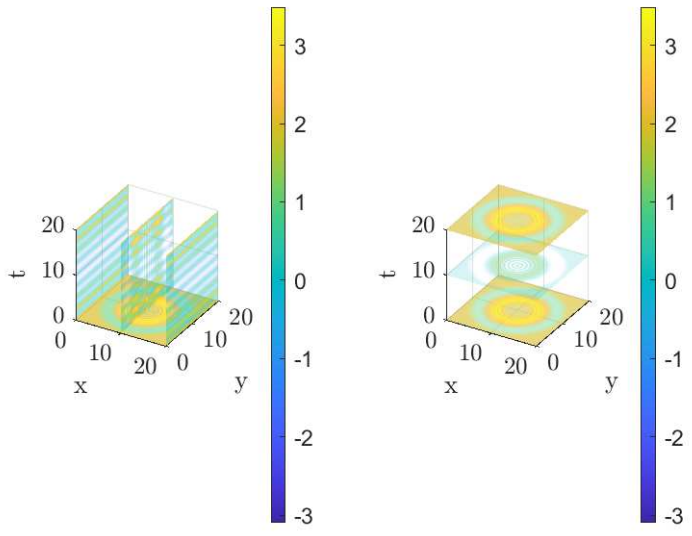
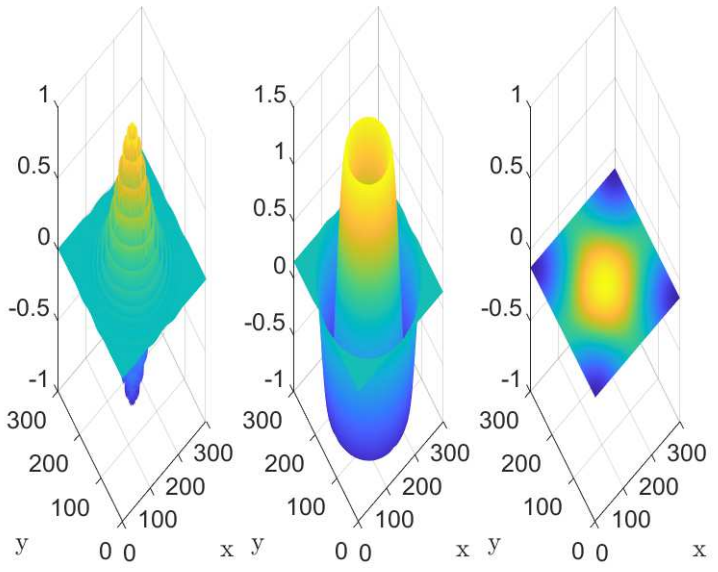
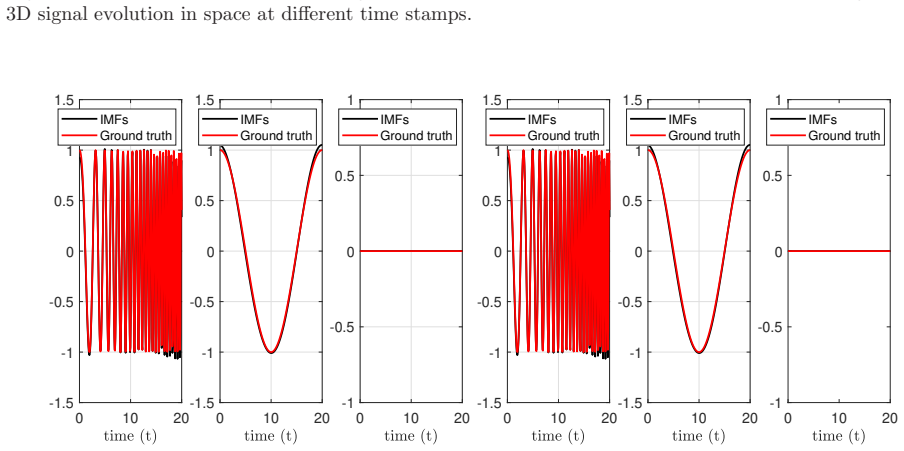
- [Section 3, Figures 5 and 10] The validation against ground truth is only visual; the paper reports no quantitative error metrics between the extracted and true spatial or temporal IMFs. This is load-bearing because the abstract and introduction claim that MdMvFIF is 'capable of extracting IMFs'. Add quantitative errors (for example, relative L2 errors, correlation coefficients, or instantaneous-frequency errors for each recovered IMF) and, where possible, compare with FIF2, Serial-EMD, or FA-MVEMD on the same synthetic examples.
minor comments (5)
- [Algorithm 1] The pseudocode uses inconsistent variable names: 'IMFss' and 'IMFst' should be unified into a single output structure, and the initialization 'IMFs = tu' appears to be a typographical artifact that should be replaced with the empty-set notation.
- [Section 2, Eq. (4)] The sentence describing f(v, t̃) as 'a vector in a R^{n+1} space' is misleading: the angle θ̃(t) is computed between spatial fields, i.e., vectors whose length is the number of spatial grid points, not vectors in R^{n+1}. Reword this passage to avoid confusion.
- [Section 2] The incomplete citation '[2, ?]' for the stopping criterion should be corrected to the appropriate reference (likely [2] or [3]).
- [Section 3] Figures 5 and 10 display differences between ground truth and recovered components, but no numerical scale or acceptable error level is discussed in the text; a sentence describing the magnitude of the residual errors would be helpful.
- [Section 1] The statement that IF is 'the only based on iteration, and therefore not requiring any a priori assumption on the signal' overstates the case, since the stopping criterion, the filter support rule, and the choice of filter all involve assumptions; please soften or qualify this claim.
Circularity Check
No significant circularity: the algorithm's output is validated against known ground truth and no prediction reduces to a fitted input.
full rationale
The paper proposes MdMvFIF as an algorithmic extension of previously published FIF variants and validates it on synthetic signals with known ground-truth components and on real geophysical data. No parameter is fitted to the target output, and no equation defining the method is equivalent to the claimed result. The self-citations to prior FIF, MvFIF, and FIF2 work are used as building blocks for the algorithm, not as a substitute for validation or as a forbidden uniqueness argument. The stopping criteria are indeed underspecified and lack convergence guarantees, but that is a correctness and well-definedness concern, not circularity: the method can be wrong or threshold-dependent without being self-referential. The numerical comparisons to ground truth are external benchmarks, so the central claim of extracting IMFs is not supported solely by definition or by self-citation. The incomplete reference '[2, ?]' is a citation defect, not a circular step. No circular step can be exhibited under the required standard of quoting a specific reduction or fitted-input-renamed-as-prediction.
Assumptions & free parameters
free parameters (2)
- Stopping criterion threshold
- Spatial filter support computation rule
assumptions (3)
- domain assumption The signal is periodic at its boundaries or pre-extended to be periodic.
- ad hoc to paper The alternating space then time filtering converges to meaningful IMFs for arbitrary input.
- domain assumption The rotation angle theta(t) in Equation (4) is well-defined for all t, i.e., all spatial frames have nonzero norm.
Cite this review
Pith. "Pith review of A novel algorithm for the decomposition of non-stationary multidimensional and multivariate signals." pith.science (2026). https://pith.science/paper/K5JRKUZQ
@misc{pith2026241200553,
  author       = {Pith},
  title        = {Pith review of: A novel algorithm for the decomposition of non-stationary multidimensional and multivariate signals},
  year         = {2026},
  howpublished = {\url{https://pith.science/paper/K5JRKUZQ}},
  note         = {Machine review of arXiv:2412.00553}
}
read the original abstract
The decomposition of a signal is a fundamental tool in many fields of research, including signal processing, geophysics, astrophysics, engineering, medicine, and many more. By breaking down complex signals into simpler oscillatory components we can enhance the understanding and processing of the data, unveiling hidden information contained in them. Traditional methods, such as Fourier analysis and wavelet transforms, which are effective in handling mono-dimensional stationary signals struggle with non-stationary data sets and they require, this is the case of the wavelet, the selection of predefined basis functions. In contrast, the Empirical Mode Decomposition (EMD) method and its variants, such as Iterative Filtering (IF), have emerged as effective nonlinear approaches, adapting to signals without any need for a priori assumptions. To accelerate these methods, the Fast Iterative Filtering (FIF) algorithm was developed, and further extensions, such as Multivariate FIF (MvFIF) and Multidimensional FIF (FIF2), have been proposed to handle higher-dimensional data. In this work, we introduce the Multidimensional and Multivariate Fast Iterative Filtering (MdMvFIF) technique, an innovative method that extends FIF to handle data that vary simultaneously in space and time. This new algorithm is capable of extracting Intrinsic Mode Functions (IMFs) from complex signals that vary in both space and time, overcoming limitations found in prior methods. The potentiality of the proposed method is demonstrated through applications to artificial and real-life signals, highlighting its versatility and effectiveness in decomposing multidimensional and multivariate nonstationary signals. The MdMvFIF method offers a powerful tool for advanced signal analysis across many scientific and engineering disciplines.
Figures


Figures from the paper (10 more)




Reference graph
Works this paper leans on
-
[1]
N. E. Huang, Z. Shen, S. R. Long, M. C. Wu, H. H. Shih, Q. Zheng, N.-C. Yen, C. C. Tung, and H. H. Liu. The empirical mode decomposition and the hilbert spectrum for n onlinear and non-stationary time series analysis. Proceedings of the Royal Society of London. Series A: mathem atical, physical and engineering sciences, 454(1971):903–995, 1998. 9 Figure 5...
work page 1971
-
[2]
L. Lin, Y. Wang, and H. Zhou. Iterative filtering as an alternative algorithm for empirical mode decomposition. Advances in Adaptive Data Analysis , 1(04):543–560, 2009
work page 2009
- [3]
-
[4]
A. Stallone, A. Cicone, and M. Materassi. New insights and best pr actices for the successful use of empirical mode decomposition, iterative filtering and derived algorith ms. Scientific Reports , 2020
work page 2020
-
[5]
A. Cicone and E. Pellegrino. Multivariate Fast Iterative Filtering fo r the Decomposition of Nonsta- tionary Signals. IEEE Transactions on Signal Processing , 70,:1521–1531, 2022
work page 2022
-
[6]
A. Cicone and H. Zhou. Multidimensional iterative filtering method f or the decomposition of high– dimensional non–stationary signals. Numerical Mathematics: Theory, Methods and Applications , 10(2):278–298, 2017
work page 2017
- [7]
-
[8]
J. Erazo-Aux, H. Loaiza-Correa, A.D. Restrepo-Giron, C. Ib arra-Castanedo, X. Maldague, Thermal imagery from composite material academic samples , Mendeley Data, V2, 2020 doi: 10.17632/v4knrwgj9y.2 10 0 10 20 0 5 10 15 20 -4.5 -4 -3.5 -3 -2.5 -2 -1.5 -1 -0.5 0 0.5 0 100 200 300 -2 -1.5 -1 -0.5 0 0.5 1 1.5 2 Figure 6: Example 2. Left panel: Signal at time ...
Show all 12 references
-
[9]
Sfarra, A
S. Sfarra, A. Cicone, B. Yousefi, S. Perilli, L. Robol, X.P.V . Maldague , Maximizing the detection of thermal imprints in civil engineering composi tes via numerical and thermographic results pre-processed by a groundbreaking mathematical approach , International Journal of T...
2022
-
[10]
Zhang, F
J. Zhang, F. Feng, P. Marti-Puig, C.F. Caiafa, Z. Sun,F. Duan , J. Sol ´ e-Casals, Serial- EMD: Fast empirical mode decomposition method for multi-di mensional signals based on serialization , Information Sciences, 581, 215–232, 2021
2021
-
[11]
Thirumalaisamy, P
M.R. Thirumalaisamy, P. J. Ansell , Fast and adaptive empirical mode decomposition for multidi - mensional, multivariate signals , IEEE Signal Processing Letters, 25 (10), 1550–1554, 2018
2018
-
[12]
Tshiangomba, G
R.K. Tshiangomba, G. Russo, Y. Ding, E. Pellegrino, H. Zhang , S. Sfarra, A. Cicone , Solar Loading Infrared Thermography Method for the Non-Inv asive Inspection of Movable Art: The Contribution of Multivariate Fast Iterative Filtering and Multidimensional Fast Iterative Filte...
2025
Reviewed August 12, 2026 · model on record in the stance chip above.
Discussion (0). Continue with ORCID to comment.