REVIEW 3 major objections 5 minor 67 references
Curriculum Multiple Shooting for Robust Training of Neural and Universal Differential Equations
T0 review · 3 major / 5 minor · reviewed 2026-08-07 · deepseek-v4-flash
Pith's one-line read Curriculum multiple shooting merges short training windows into the full trajectory, and the paper reports it makes neural, hybrid, and mechanistic ODE training faster, more stable, and better at extrapolation.
desk verdict Solid empirical paper on a genuinely useful training schedule, but the 'accelerates' claim needs a compute-matched comparison before it can stand. read the letter →
The pith
A machine-rendered reading of the paper's core claim, the machinery that carries it, and where it could break.
The reading
What carries the argument
The central object is the CMS schedule: at curriculum stage $s$ the window set is $W^{(s)} = \{[t_{i-1}, t_{i+s-1}]\}_{i=1}^{n_w - s + 1}$, so adjacent windows overlap and merge as $s$ grows, and at $s = n_w$ only the single window $[t_0, T]$ remains. The schedule converts the multiple-shooting objective, a sum of per-window data losses plus a continuity penalty on shared measurement points, into a curriculum whose final stage is the original single-shooting loss. This is what lets CMS offer short-horizon optimization early without ever losing sight of the full trajectory, and what reduces the role of the continuity penalty $\lambda_{\text{cont}}$.
What would settle it
Run CMS with the continuity penalty set to zero on an oscillatory model whose first windows each cover less than one full period, then compare how many of 1000 random initializations reach the same extrapolation error as single-shooting; if CMS systematically falls short, the claim that merging windows preserves alignment with the final objective fails.
Extended reading notes
Core claim
On the paper's own terms, the discovery is that curriculum learning and multiple shooting can be composed into one schedule that has the advantages of both. In multiple shooting the model is fit separately on fixed short windows and a continuity penalty tries to glue them together; in curriculum learning the model sees progressively longer prefixes of the time series. CMS instead defines stages in which the number of windows decreases by one, so adjacent windows merge into longer overlapping windows, and the final stage is exactly single-shooting on the full interval. The reported consequence is that CMS is consistently among the top performers on the NODE and UDE benchmarks, improves the number of converging runs on all eight mechanistic ODE benchmarks relative to single shooting, and is substantially less sensitive to the continuity penalty than plain multiple shooting. The paper also reports smoother early loss landscapes and smaller Hessian traces under CMS, which it interprets as the mechanism behind the improved training.
Load-bearing premise
The load-bearing premise is that the early multiple-shooting objectives, which see only short trajectory pieces, remain aligned with the final single-shooting objective, so that optimizing them sets up good parameters rather than leading the optimizer into a region that is hard to escape.
Editorial extensions
If this is right
- Practitioners fitting NODEs, UDEs, or mechanistic ODEs to noisy, sparse, partially observed data can use a single training strategy rather than choosing among curriculum learning, multiple shooting, or two-stage first-order-then-second-order schemes.
- Because CMS ends in the single-shooting objective, models trained with it are evaluated under the same loss used in standard parameter estimation, avoiding surrogate-objective mismatch at the final model.
- Stronger output regularization can be applied to UDEs to prevent the neural network from absorbing mechanistic dynamics; this is how the Lotka–Volterra UDE retained plausible mechanistic parameters.
- The benefits transfer across two gradient-computation schemes and two software ecosystems, suggesting the schedule itself, not an implementation detail, is what improves training.
- On eight real-data mechanistic ODE benchmarks, CMS increased the number of runs converging to the global optimum over single-shooting control by an average factor of 8.9.
Reading between the lines
- If the alignment explanation is right, CMS should show its largest advantage on oscillatory and multiscale dynamics, where short windows are least representative; testing CMS on a suite of high-dimensional, stiff oscillators would sharpen that prediction.
- The same merging schedule could be applied to discrete-time state-space models or to parameter estimation in systems biology, where multiple-shooting ideas already exist; the paper suggests this transfer but does not test it.
- A practical heuristic suggested by the results is to use plain curriculum learning when every early stage contains all observables and the dynamics are non-oscillatory, and CMS otherwise; the paper notes the first condition but stops short of recommending the rule.
Editorial analysis
A structured set of objections, weighed in public.
Referee Report
Summary. The paper introduces curriculum multiple shooting (CMS), a training strategy for neural ordinary differential equations (NODEs), universal differential equations (UDEs), and mechanistic ODE models. CMS combines multiple shooting with curriculum learning: it starts from a multiple-shooting objective with n_w windows and, over curriculum stages, progressively merges adjacent windows until the standard single-shooting objective is recovered. The method is evaluated on four NODE/UDE benchmarks (three simulated and real, fully and partially observed) and on eight real-data mechanistic ODE models from the PEtab collection. For each UDE/NODE benchmark, 100 random restarts are used, with median MSE and Wilcoxon/Holm-corrected significance tests; the mechanistic benchmarks use 1000 multistarts and report the number of runs converging to the global optimum. The paper also presents Hessian-trace and loss-landscape analyses to explain why CMS helps. The authors conclude that CMS accelerates and stabilises training convergence, outperforms state-of-the-art training strategies, and ranks among the best methods in generalisation.
Significance. If the reported results hold, CMS is a practically valuable training strategy for a class of models that is notoriously difficult to fit. The empirical evaluation is unusually thorough for this area: 100–1000 random multistarts per benchmark, statistical test corrections, sensitivity analyses, and a complementary Julia-based implementation checking robustness across software stacks and gradient schemes. The manuscript also provides code for all benchmarks, which aids reproducibility. The main caveat is that the central claim of 'accelerating' convergence is currently supported only by epoch-wise training curves, not by compute-matched comparisons; this is a load-bearing issue for the paper's practical message. The Discussion candidly acknowledges limitations in benchmark coverage, model dimensionality, and hyperparameter tuning burden, which I take as appropriate caveats. The generalization results, in which CMS consistently ranks among the best methods, are well supported by the data.
major comments (3)
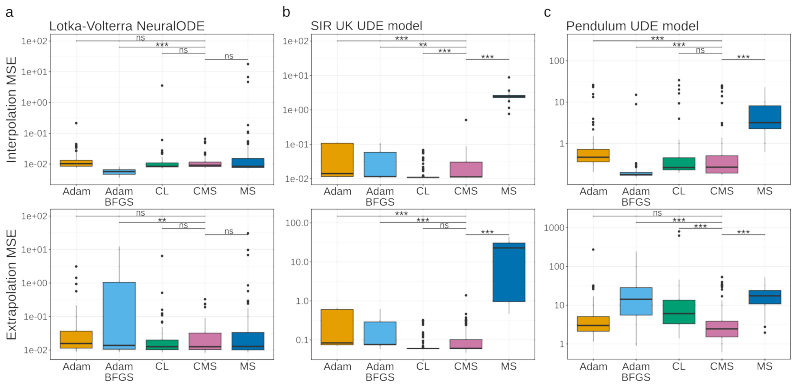
- [Sec. 5.3 / App. A.3 / App. C.4] The claim that CMS 'accelerates' training convergence is not established by the reported evidence. Fig. A.7 and Sec. 5.3 compare strategies at a fixed number of epochs, but an epoch of CMS is not computationally comparable to an epoch of single-shooting or CL: at stage s, CMS solves k^(s)=n_w-s+1 overlapping windows of combined length (n_w-s+1)sT/n_w, and with the default n_w=16 and the stage budget of Sec. 4.1 (first third of epochs across the first n_w-1 stages, remaining two-thirds on the final single-shooting stage), the total integration work per epoch is roughly 1.6–1.8 times that of single-shooting, before counting additional window-state parameters. No wall-clock time, total solver steps, or objective evaluations are reported for any strategy. Therefore the observation that CMS reaches low MSE in fewer epochs on 3/4 models (Fig. A.7) may reflect a larger per-epoch compute budget rather than a better optimization trajectory. Please provide a compute-matched comparison (wall-clock or total solver work) or revise the abstract and Sec. 5.3 to remove or substantially qualify the acceleration claim.
- [Abstract / Sec. 5.3] The abstract's statement that CMS 'outperforms state-of-the-art training strategies' overstates the reported results. On the Lotka–Volterra NODE and SIR UDE benchmarks, CMS is statistically tied with curriculum learning (Fig. 2a: 0.0126 vs. 0.0126, p=0.99; Fig. 2b: 0.0606 vs. 0.0605, p=0.47), and on the mechanistic ODE benchmarks CL is the best method on 3 of 8 models (Fig. 3b). The phrase 'ranks among the best methods in generalisation' is accurate, but 'outperforms' is not supported when a baseline performs equally well on several benchmarks. Please adjust the wording, for example to 'is competitive with or outperforms', to match the evidence.
- [Sec. 5.5 / Fig. 4] The Hessian-trace and loss-landscape analyses compare quantities computed on different objective functions (the multiple-shooting objective, the single-shooting objective, and stage-wise CMS objectives). Lower Hessian traces on a surrogate objective do not directly imply better conditioning of the final single-shooting objective, so the explanatory claim that CMS 'eases early-phase optimisation while remaining aligned with the single-shooting objective' is plausible but not proven by these diagnostics. Since this is presented as intuition rather than as a formal guarantee, I do not treat it as blocking, but the authors should explicitly acknowledge that the traces are not directly comparable across different objectives, and that the alignment is a design assumption supported only indirectly by the benchmark outcomes.
minor comments (5)
- [App. C.6.1] There is a duplicated sentence in the discussion of the SIR UDE output regularization: 'In the SIR UDE, the neural network is structurally restricted...' appears twice consecutively. Please remove the redundant sentence.
- [Table C.4] The caption of Table C.4 says 'for the MS strategy' but the table reports CMS hyperparameters; please correct the caption.
- [Sec. 5.2] The sentence 'MSE was reported at the end of training, with all strategies run for the same number of epochs per model' should be clarified to note that equal epoch budgets do not imply equal compute, especially for CMS and MS, which solve multiple overlapping windows per epoch.
- [App. A.3] Adam+BFGS is excluded from the training-trace comparison because traces could not be extracted from the Fides optimizer; this is a reasonable exclusion but should be noted as a limitation of the convergence analysis, since Adam+BFGS is shown elsewhere to overfit on several benchmarks.
- [Sec. 5.5] The statement 'Small, positive Hessian traces indicate good conditioning' could cite a reference or an experiment that calibrates the scale of Hessian traces for these problems; without such calibration, the median traces in Fig. 4 are mainly qualitative.
Circularity Check
No significant circularity: the central claim rests on external benchmark comparisons; self-citations are tooling rather than load-bearing evidence.
full rationale
The paper's central claim is an empirical benchmarking result, not a derivation from first principles. Curriculum multiple shooting is defined constructively (Algorithm 1 and Sec. 4): it starts from the multiple-shooting objective with n_w windows and merges adjacent windows at each curriculum stage, so that at stage s = n_w the objective reduces to the standard single-shooting objective (Eq. 2). This final-stage reduction is by construction, but it is the method's design rather than a circular prediction: the claimed benefits (faster and more stable convergence, better generalization) are evaluated on held-out validation splits (50/50 or 70/30) across simulated and real data, with hyperparameters tuned on training data. No fitted parameter is renamed as a prediction, and no benchmark result is derived from the method's own definition. The paper cites PEtab.jl [48] and Fides [54], both involving authors of the present work, but these citations are for software tooling and optimizer choice, not for evidence that CMS works; the mechanistic benchmarks use the external PEtab benchmark collection [27, 47] and real datasets. A separate fairness concern is that the 'accelerates' claim is supported mainly by epoch-wise MSE traces (Fig. A.7) without a compute-matched wall-clock or solver-cost comparison, so one CMS epoch may not be comparable to one single-shooting epoch. That is a correctness/fairness issue, not a circularity issue, and it does not make the generalization results depend on the method's own outputs. Overall, the derivation chain is self-contained and the central result has independent empirical content.
Assumptions & free parameters
free parameters (6)
- Initial number of windows n_w =
e.g., 16 for LV models, 8 for pendulum
- Continuity penalty lambda_cont =
range 0-10000 depending on model and strategy
- Learning rate eta =
0.005-0.05 depending on model
- Output regularization lambda_O =
0.0, 0.001, 1000, 5000 depending on model and strategy
- Epoch budget allocation =
first third to first n_w-1 stages, remaining two thirds to final single-shooting stage
- Initial window state value theta_u0,i =
0.01
assumptions (4)
- standard math Numerical ODE solvers (Tsit5, Rodas5P) with tight tolerances provide accurate solutions and gradients.
- domain assumption Training difficulty increases with time horizon.
- domain assumption The multiple-shooting objective with quadratic continuity penalty (Eq. 6) is a useful surrogate for single shooting.
- ad hoc to paper Fixed epoch-budget heuristic (first third for early stages, two thirds for final) and initial window state value 0.01 generalize.
Cite this review
Pith. "Pith review of Curriculum Multiple Shooting for Robust Training of Neural and Universal Differential Equations." pith.science (2026). https://pith.science/paper/K5KQL3RB
@misc{pith2026260805777,
  author       = {Pith},
  title        = {Pith review of: Curriculum Multiple Shooting for Robust Training of Neural and Universal Differential Equations},
  year         = {2026},
  howpublished = {\url{https://pith.science/paper/K5KQL3RB}},
  note         = {Machine review of arXiv:2608.05777}
}
read the original abstract
Neural ordinary differential equations (NODEs) and universal differential equations (UDEs) provide flexible and popular frameworks for learning interpretable dynamical systems from noisy time-series data. However, training these models remains challenging, and versatile methods that robustly handle sparse and noisy data as well as partially observed models are lacking. To address this, we introduce curriculum multiple shooting (CMS), a general-purpose training strategy for fitting ordinary differential equation (ODE) models to time-series data by integrating curriculum learning with multiple shooting. Across twelve benchmarks spanning simulated and real data, and covering NODEs, UDEs, and mechanistic ODEs, CMS accelerates and stabilises training convergence, outperforms state-of-the-art training strategies, and ranks among the best methods in generalisation. Finally, we discuss possible explanations for the strong performance of CMS in light of contemporary theories of what makes training on time-series challenging.
Figures


Figures from the paper (1 more)

Reference graph
Works this paper leans on
-
[1]
Ricky T. Q. Chen, Yulia Rubanova, Jesse Bettencourt, and David K Duvenaud. Neural Ordinary Differential Equations. InAdvances in Neural Information Processing Systems, volume 31. Curran Associates, Inc., 2018
2018
-
[2]
Jennifer Brucker, René Behmann, Wolfgang G. Bessler, and Rainer Gasper. Neural Ordinary Differential Equations for Grey-Box Modelling of Lithium-Ion Batteries on the Basis of an Equivalent Circuit Model.Energies, 15(7):2661, January 2022. ISSN 1996-1073. doi: 10.3390/ en15072661
work page 2022
-
[3]
Tongli Zhang, Ioannis P. Androulakis, Peter Bonate, Limei Cheng, Tomáš Helikar, Jaimit Parikh, Christopher Rackauckas, Kalyanasundaram Subramanian, Carolyn R. Cho, Ioannis P. Androulakis, Peter Bonate, Ivan Borisov, Gordon Broderick, Limei Cheng, Valeriu Damian, Rafael Dariolli, Oleg Demin, Nicholas Ellinwood, Dirk Fey, Abhishek Gulati, Tomas Helikar, Eri...
work page 2022
-
[4]
Bob Junyi Zou, Matthew E. Levine, Dessi P. Zaharieva, Ramesh Johari, and Emily B. Fox. Hybrid2 neural ODE causal modeling and an application to glycemic response. InProceedings of the 41st International Conference on Machine Learning, volume 235 ofICML’24, pages 62934–62963, Vienna, Austria, July 2024. JMLR.org
work page 2024
-
[5]
Universal Differential Equations for Scientific Machine Learning, November 2021
Christopher Rackauckas, Yingbo Ma, Julius Martensen, Collin Warner, Kirill Zubov, Rohit Supekar, Dominic Skinner, Ali Ramadhan, and Alan Edelman. Universal Differential Equations for Scientific Machine Learning, November 2021. arXiv:2001.04385 [cs]
arXiv 2021
-
[6]
Max de Rooij, Natal A. W. van Riel, and Shauna D. O’Donovan. Conditional universal differential equations capture population dynamics and interindividual variation in c-peptide production.npj Systems Biology and Applications, 11(1):84, July 2025. ISSN 2056-7189. doi: 10.1038/s41540-025-00570-6
-
[7]
Developing hybrid mechanistic and data-driven personalized prediction models for platelet dynamics
Marie Steinacker, Yuri Kheifetz, and Markus Scholz. Developing hybrid mechanistic and data-driven personalized prediction models for platelet dynamics, May 2025. arXiv:2505.21204 [cs]
work page Pith review arXiv 2025
-
[8]
Xiaojun Wu, MeiLu McDermott, and Adam L. MacLean. Data-driven model discovery and model selection for noisy biological systems.PLOS Computational Biology, 21(1):e1012762, January 2025. ISSN 1553-7358. doi: 10.1371/journal.pcbi.1012762
Show all 67 references
-
[9]
Inte- grating Expert ODEs into Neural ODEs: Pharmacology and Disease Progression
Zhaozhi Qian, William Zame, Lucas Fleuren, Paul Elbers, and Mihaela van der Schaar. Inte- grating Expert ODEs into Neural ODEs: Pharmacology and Disease Progression. InAdvances in Neural Information Processing Systems, volume 34, pages 11364–11383. Curran Associates, Inc., 2021
2021
-
[10]
Neural-ODE for pharmacokinetics modeling and its advantage to alternative machine learning models in predicting new dosing regimens.iScience, 24(7):102804, July 2021
James Lu, Kaiwen Deng, Xinyuan Zhang, Gengbo Liu, and Yuanfang Guan. Neural-ODE for pharmacokinetics modeling and its advantage to alternative machine learning models in predicting new dosing regimens.iScience, 24(7):102804, July 2021. ISSN 2589-0042. doi: 10.1016/j.isci.2021.102804
2021
-
[11]
Low- dimensional neural ODEs and their application in pharmacokinetics.Journal of Pharma- cokinetics and Pharmacodynamics, 51(2):123–140, April 2024
Dominic Stefan Bräm, Uri Nahum, Johannes Schropp, Marc Pfister, and Gilbert Koch. Low- dimensional neural ODEs and their application in pharmacokinetics.Journal of Pharma- cokinetics and Pharmacodynamics, 51(2):123–140, April 2024. ISSN 1573-8744. doi: 10.1007/s10928-023-09886-4. 11
2024 doi
-
[12]
A Machine Learning-Aided Global Diagnostic and Comparative Tool to Assess Effect of Quarantine Control in COVID-19 Spread
Raj Dandekar, Chris Rackauckas, and George Barbastathis. A Machine Learning-Aided Global Diagnostic and Comparative Tool to Assess Effect of Quarantine Control in COVID-19 Spread. Patterns, 1(9), December 2020. ISSN 2666-3899. doi: 10.1016/j.patter.2020.100145
2020
-
[13]
Singer, Seyed M
Yang Ye, Abhishek Pandey, Carolyn Bawden, Dewan Md Sumsuzzman, Rimpi Rajput, Affan Shoukat, Burton H. Singer, Seyed M. Moghadas, and Alison P. Galvani. Integrating artificial intelligence with mechanistic epidemiological modeling: a scoping review of opportunities and challeng...
2025 doi
-
[14]
Nguyen, Alan Edelman, Erin C
Sharv Murgai, Utkarsh Utkarsh, Kyle C. Nguyen, Alan Edelman, Erin C. S. Acquesta, and Christopher Vincent Rackauckas. ABM-UDE: Developing Surrogates for Epidemic Agent- Based Models via Scientific Machine Learning, February 2026. arXiv:2602.21588 [cs]
2026
-
[15]
NeuralFMU: Presenting a Workflow for Integrating Hybrid NeuralODEs into Real-World Applications.Electronics, 11(19):3202, January 2022
Tobias Thummerer, Johannes Stoljar, and Lars Mikelsons. NeuralFMU: Presenting a Workflow for Integrating Hybrid NeuralODEs into Real-World Applications.Electronics, 11(19):3202, January 2022. ISSN 2079-9292. doi: 10.3390/electronics11193202
2022 doi
-
[16]
Homotopy-based training of NeuralODEs for accurate dynamics discovery.Advances in Neural Information Processing Systems, 36:64725–64752, December 2023
Joon-Hyuk Ko, Hankyul Koh, Nojun Park, and Wonho Jhe. Homotopy-based training of NeuralODEs for accurate dynamics discovery.Advances in Neural Information Processing Systems, 36:64725–64752, December 2023
2023
-
[17]
Current state and open problems in universal differential equations for systems biology.npj Systems Biology and Applications, 11(1):101, August 2025
Maren Philipps, Nina Schmid, and Jan Hasenauer. Current state and open problems in universal differential equations for systems biology.npj Systems Biology and Applications, 11(1):101, August 2025. ISSN 2056-7189. doi: 10.1038/s41540-025-00550-w
2025 doi
-
[18]
Ode to an ODE
Krzysztof M Choromanski, Jared Quincy Davis, Valerii Likhosherstov, Xingyou Song, Jean- Jacques Slotine, Jacob Varley, Honglak Lee, Adrian Weller, and Vikas Sindhwani. Ode to an ODE. InAdvances in Neural Information Processing Systems, volume 33, pages 3338–3350. Curran Associ...
2020
-
[19]
How to Train Your Neural ODE: the World of Jacobian and Kinetic Regularization
Chris Finlay, Joern-Henrik Jacobsen, Levon Nurbekyan, and Adam Oberman. How to Train Your Neural ODE: the World of Jacobian and Kinetic Regularization. InProceedings of the 37th International Conference on Machine Learning, pages 3154–3164. PMLR, November 2020
2020
-
[20]
LyaNet: A Lyapunov Framework for Training Neural ODEs
Ivan Dario Jimenez Rodriguez, Aaron Ames, and Yisong Yue. LyaNet: A Lyapunov Framework for Training Neural ODEs. InProceedings of the 39th International Conference on Machine Learning, pages 18687–18703. PMLR, June 2022
2022
-
[21]
Non- Negative Universal Differential Equations With Applications in Systems Biology.IFAC- PapersOnLine, 58(23):25–30, January 2024
Maren Philipps, Antonia Körner, Jakob Vanhoefer, Dilan Pathirana, and Jan Hasenauer. Non- Negative Universal Differential Equations With Applications in Systems Biology.IFAC- PapersOnLine, 58(23):25–30, January 2024. ISSN 2405-8963. doi: 10.1016/j.ifacol.2024.10. 005
2024 doi
-
[22]
FxTS-Net: Fixed-time stable learning framework for Neural ODEs.Neural Networks, 185:107219, May 2025
Chaoyang Luo, Yan Zou, Wanying Li, and Nanjing Huang. FxTS-Net: Fixed-time stable learning framework for Neural ODEs.Neural Networks, 185:107219, May 2025. ISSN 0893-6080. doi: 10.1016/j.neunet.2025.107219
2025
-
[23]
Elisabeth Roesch, Christopher Rackauckas, and Michael P. H. Stumpf. Collocation based training of neural ordinary differential equations.Statistical Applications in Genetics and Molecular Biology, 20(2):37–49, April 2021. ISSN 1544-6115. doi: 10.1515/sagmb-2020-0025
2021 doi
-
[24]
Multiple Shooting for Training Neural Differential Equations on Time Series.IEEE Control Systems Letters, 6:1897–1902, 2022
Evren Mert Turan and Johannes Jäschke. Multiple Shooting for Training Neural Differential Equations on Time Series.IEEE Control Systems Letters, 6:1897–1902, 2022. ISSN 2475-1456. doi: 10.1109/LCSYS.2021.3135835
1902
-
[25]
DiffEqFlux.jl - A Julia Library for Neural Differential Equations, February 2019
Chris Rackauckas, Mike Innes, Yingbo Ma, Jesse Bettencourt, Lyndon White, and Vaibhav Dixit. DiffEqFlux.jl - A Julia Library for Neural Differential Equations, February 2019
2019
-
[26]
Hua Liang and Hulin Wu. Parameter Estimation for Differential Equation Models Using a Framework of Measurement Error in Regression Models.Journal of the American Statistical Association, 103(484):1570–1583, December 2008. ISSN 0162-1459, 1537-274X. doi: 10. 1198/016214508000000797. 12
2008
-
[27]
Benchmark problems for dynamic modeling of intracellular processes.Bioinformatics, 35(17):3073–3082, September 2019
Helge Hass, Carolin Loos, Elba Raimúndez-Álvarez, Jens Timmer, Jan Hasenauer, and Clemens Kreutz. Benchmark problems for dynamic modeling of intracellular processes.Bioinformatics, 35(17):3073–3082, September 2019. ISSN 1367-4803
2019
-
[28]
Augmented Neural ODEs
Emilien Dupont, Arnaud Doucet, and Yee Whye Teh. Augmented Neural ODEs. InAdvances in Neural Information Processing Systems, volume 32. Curran Associates, Inc., 2019
2019
-
[29]
Harms, Fabian J
Andreas Raue, Marcel Schilling, Julie Bachmann, Andrew Matteson, Max Schelke, Daniel Kaschek, Sabine Hug, Clemens Kreutz, Brian D. Harms, Fabian J. Theis, Ursula Klingmüller, and Jens Timmer. Lessons Learned from Quantitative Dynamical Modeling in Systems Biology. PLOS ONE, 8(...
2013 doi
-
[30]
H. G. Bock and K. J. Plitt. A Multiple Shooting Algorithm for Direct Solution of Optimal Control Problems*.IFAC Proceedings Volumes, 17(2):1603–1608, July 1984. ISSN 1474-6670. doi: 10.1016/S1474-6670(17)61205-9
1984 doi
-
[31]
Prediction error estimation methods.Circuits, Systems and Signal Processing, 21(1):11–21, January 2002
Lennart Ljung. Prediction error estimation methods.Circuits, Systems and Signal Processing, 21(1):11–21, January 2002. ISSN 1531-5878. doi: 10.1007/BF01211648
2002 doi
-
[32]
Henry D. I. Abarbanel, Daniel R. Creveling, Reza Farsian, and Mark Kostuk. Dynamical State and Parameter Estimation.SIAM Journal on Applied Dynamical Systems, 8(4):1341–1381, January 2009. doi: 10.1137/090749761
2009 doi
-
[33]
Augmenting physical models with deep networks for complex dynamics forecasting*.Journal of Statistical Mechanics: Theory and Experiment, 2021(12): 124012, December 2021
Yuan Yin, Vincent Le Guen, Jérémie Dona, Emmanuel de Bézenac, Ibrahim Ayed, Nicolas Thome, and Patrick Gallinari. Augmenting physical models with deep networks for complex dynamics forecasting*.Journal of Statistical Mechanics: Theory and Experiment, 2021(12): 124012, December...
2021 doi
-
[34]
Sparsity in Continuous-Depth Neural Networks.Advances in Neural Information Processing Systems, 35:901–914, December 2022
Hananeh Aliee, Till Richter, Mikhail Solonin, Ignacio Ibarra, Fabian Theis, and Niki Kilbertus. Sparsity in Continuous-Depth Neural Networks.Advances in Neural Information Processing Systems, 35:901–914, December 2022
2022
-
[35]
Hamiltonian Neural Networks
Samuel Greydanus, Misko Dzamba, and Jason Yosinski. Hamiltonian Neural Networks. In Advances in Neural Information Processing Systems, volume 32. Curran Associates, Inc., 2019
2019
-
[36]
Discretize-Optimize vs
Derek Onken and Lars Ruthotto. Discretize-Optimize vs. Optimize-Discretize for Time-Series Regression and Continuous Normalizing Flows, July 2020. arXiv:2005.13420 [cs]
2020 arXiv
-
[37]
Stiff neural ordinary differential equations.Chaos: An Interdisciplinary Journal of Nonlinear Science, 31 (9), September 2021
Suyong Kim, Weiqi Ji, Sili Deng, Yingbo Ma, and Christopher Rackauckas. Stiff neural ordinary differential equations.Chaos: An Interdisciplinary Journal of Nonlinear Science, 31 (9), September 2021. ISSN 1054-1500. doi: 10.1063/5.0060697
2021 doi
-
[38]
On Neural Differential Equations, February 2022
Patrick Kidger. On Neural Differential Equations, February 2022. arXiv:2202.02435 [cs]
2022 arXiv
-
[39]
Differentiable Programming for Differential Equations: A Review, October 2025
Facundo Sapienza, Jordi Bolibar, Frank Schäfer, Brian Groenke, Avik Pal, Victor Boussange, Patrick Heimbach, Giles Hooker, Fernando Pérez, Per-Olof Persson, and Christopher Rack- auckas. Differentiable Programming for Differential Equations: A Review, October 2025. arXiv:2406....
2025
-
[40]
Stable Long-Horizon Neural ODE Reduced-Order Mod- els via Learned Feedback for Biological Growth and Remodeling, April 2026
Joel Laudo and Adrian Buganza Tepole. Stable Long-Horizon Neural ODE Reduced-Order Mod- els via Learned Feedback for Biological Growth and Remodeling, April 2026. arXiv:2604.13820 [cs]
2026 arXiv
-
[41]
CRC Press, November 2001
Johan Gabrielsson and Daniel Weiner.Pharmacokinetic and Pharmacodynamic Data Analysis: Concepts and Applications, Third Edition. CRC Press, November 2001. ISBN 978-91-86274- 92-4
2001
-
[42]
Hernandez-Vargas
Benjamin Whipple and Esteban A. Hernandez-Vargas. Hybrid Neural Differential Equa- tions to Model Unknown Mechanisms and States in Biology, December 2024. Pages: 2024.12.08.627408 Section: New Results. 13
2024
-
[43]
Curriculum learning
Yoshua Bengio, Jérôme Louradour, Ronan Collobert, and Jason Weston. Curriculum learning. InProceedings of the 26th Annual International Conference on Machine Learning, ICML ’09, pages 41–48, New York, NY , USA, June 2009. Association for Computing Machinery. ISBN 978-1-60558-5...
2009
-
[44]
Curriculum Learning: A Survey.International Journal of Computer Vision, 130(6):1526–1565, June 2022
Petru Soviany, Radu Tudor Ionescu, Paolo Rota, and Nicu Sebe. Curriculum Learning: A Survey.International Journal of Computer Vision, 130(6):1526–1565, June 2022. ISSN 1573-1405. doi: 10.1007/s11263-022-01611-x
2022 doi
-
[45]
Ribeiro, Koen Tiels, Jack Umenberger, Thomas B
Antônio H. Ribeiro, Koen Tiels, Jack Umenberger, Thomas B. Schön, and Luis A. Aguirre. On the smoothness of nonlinear system identification.Automatica, 121:109158, November 2020. ISSN 0005-1098. doi: 10.1016/j.automatica.2020.109158
2020
-
[46]
Differentiable Multiple Shooting Layers
Stefano Massaroli, Michael Poli, Sho Sonoda, Taiji Suzuki, Jinkyoo Park, Atsushi Yamashita, and Hajime Asama. Differentiable Multiple Shooting Layers. InAdvances in Neural Information Processing Systems, volume 34, pages 16532–16544. Curran Associates, Inc., 2021
2021
-
[47]
Bergmann, Tacio Camba, Erika Dudkin, Janine Egert, Fabian Fröhlich, Lara Fuhrmann, Adrian L
Leonard Schmiester, Yannik Schälte, Frank T. Bergmann, Tacio Camba, Erika Dudkin, Janine Egert, Fabian Fröhlich, Lara Fuhrmann, Adrian L. Hauber, Svenja Kemmer, Polina Lakrisenko, Carolin Loos, Simon Merkt, Wolfgang Müller, Dilan Pathirana, Elba Raimúndez, Lukas Refisch, Marcu...
2021
-
[48]
PEtab.jl: advancing the efficiency and utility of dynamic modelling.Bioinformatics, 41(9):btaf497, September 2025
Sebastian Persson, Fabian Fröhlich, Stephan Grein, Torkel Loman, Damiano Ognissanti, Viktor Hasselgren, Jan Hasenauer, and Marija Cvijovic. PEtab.jl: advancing the efficiency and utility of dynamic modelling.Bioinformatics, 41(9):btaf497, September 2025. ISSN 1367-4811. doi: 1...
2025 doi
-
[49]
Jake Alan Pitt and Julio R. Banga. Parameter estimation in models of biological oscillators: an automated regularised estimation approach.BMC Bioinformatics, 20(1):82, February 2019. ISSN 1471-2105. doi: 10.1186/s12859-019-2630-y
2019 doi
-
[50]
Distilling Free-Form Natural Laws from Experimental Data
Michael Schmidt and Hod Lipson. Distilling Free-Form Natural Laws from Experimental Data. Science, 324(5923):81–85, April 2009. doi: 10.1126/science.1165893
2009 doi
-
[51]
A Simple Sequentially Rejective Multiple Test Procedure.Scandinavian Journal of Statistics, 6(2):65–70, 1979
Sture Holm. A Simple Sequentially Rejective Multiple Test Procedure.Scandinavian Journal of Statistics, 6(2):65–70, 1979. ISSN 0303-6898
1979
-
[52]
Kingma and Jimmy Ba
Diederik P. Kingma and Jimmy Ba. Adam: A Method for Stochastic Optimization, January
-
[53]
Challenges in Training PINNs: A Loss Landscape Perspective
Pratik Rathore, Weimu Lei, Zachary Frangella, Lu Lu, and Madeleine Udell. Challenges in Training PINNs: A Loss Landscape Perspective. InProceedings of the 41st International Conference on Machine Learning, pages 42159–42191. PMLR, July 2024
2024
-
[54]
Fabian Fröhlich and Peter K. Sorger. Fides: Reliable trust-region optimization for parameter estimation of ordinary differential equation models.PLOS Computational Biology, 18(7): e1010322, July 2022. ISSN 1553-7358. doi: 10.1371/journal.pcbi.1010322
2022 doi
-
[55]
Zhewei Yao, Amir Gholami, Kurt Keutzer, and Michael W. Mahoney. PyHessian: Neural Networks Through the Lens of the Hessian. In2020 IEEE International Conference on Big Data (Big Data), pages 581–590, December 2020. doi: 10.1109/BigData50022.2020.9378171
2020
-
[56]
Dissect- ing Neural ODEs
Stefano Massaroli, Michael Poli, Jinkyoo Park, Atsushi Yamashita, and Hajime Asama. Dissect- ing Neural ODEs. InAdvances in Neural Information Processing Systems, volume 33, pages 3952–3963. Curran Associates, Inc., 2020
2020
-
[57]
On the difficulty of training recurrent neural networks
Razvan Pascanu, Tomas Mikolov, and Yoshua Bengio. On the difficulty of training recurrent neural networks. InProceedings of the 30th International Conference on Machine Learning, pages 1310–1318. PMLR, May 2013. 14
2013
-
[58]
Visualizing the Loss Landscape of Neural Nets
Hao Li, Zheng Xu, Gavin Taylor, Christoph Studer, and Tom Goldstein. Visualizing the Loss Landscape of Neural Nets. InAdvances in Neural Information Processing Systems, volume 31. Curran Associates, Inc., 2018. URL https://proceedings.neurips.cc/paper/2018/ hash/a41b3bb3e6b050...
2018
-
[59]
Biologically informed NeuralODEs for genome-wide regulatory dynamics.Genome Biology, 25(1):127, May 2024
Intekhab Hossain, Viola Fanfani, Jonas Fischer, John Quackenbush, and Rebekka Burkholz. Biologically informed NeuralODEs for genome-wide regulatory dynamics.Genome Biology, 25(1):127, May 2024. ISSN 1474-760X. doi: 10.1186/s13059-024-03264-0
2024 doi
-
[60]
Till Richter, Weixu Wang, Alessandro Palma, and Fabian J. Theis. Generative models of cell dynamics: from Neural ODEs to flow matching.Communications Biology, 9(1):352, February
-
[61]
Forward-Mode Automatic Differentia- tion in Julia, July 2016
Jarrett Revels, Miles Lubin, and Theodore Papamarkou. Forward-Mode Automatic Differentia- tion in Julia, July 2016. arXiv:1607.07892 [cs]
2016 arXiv
-
[62]
Gutenkunst, Joshua J
Ryan N. Gutenkunst, Joshua J. Waterfall, Fergal P. Casey, Kevin S. Brown, Christopher R. Myers, and James P. Sethna. Universally Sloppy Parameter Sensitivities in Systems Biology Models.PLOS Computational Biology, 3(10):e189, 2007. ISSN 1553-7358. doi: 10.1371/ journal.pcbi.0030189
2007
-
[63]
Tsitouras
Ch. Tsitouras. Runge–Kutta pairs of order 5(4) satisfying only the first column simplifying assumption.Computers & Mathematics with Applications, 62(2):770–775, July 2011. ISSN 0898-1221. doi: 10.1016/j.camwa.2011.06.002
2011 doi
-
[64]
Construction of Rosenbrock–Wanner method Rodas5P and numerical bench- marks within the Julia Differential Equations package.BIT Numerical Mathematics, 63(2):27, April 2023
Gerd Steinebach. Construction of Rosenbrock–Wanner method Rodas5P and numerical bench- marks within the Julia Differential Equations package.BIT Numerical Mathematics, 63(2):27, April 2023. ISSN 1572-9125. doi: 10.1007/s10543-023-00967-x
2023 doi
-
[65]
Understanding the difficulty of training deep feedforward neural networks
Xavier Glorot and Yoshua Bengio. Understanding the difficulty of training deep feedforward neural networks. InProceedings of the Thirteenth International Conference on Artificial Intelligence and Statistics, pages 249–256. JMLR Workshop and Conference Proceedings, March 2010. ...
2010
-
[2017]
arXiv:1412.6980 [cs]
- [2026]
Reviewed August 7, 2026 · model on record in the stance chip above.
Discussion (0). Continue with ORCID to comment.