REVIEW 4 major objections 5 minor 19 references
Developing Combined Manipulation and Locomotion Skills with Interaction Representation and Skill Composition
T0 review · 4 major / 5 minor · reviewed 2026-08-04 · deepseek-v4-flash
Pith's one-line read A humanoid robot can learn, from scratch, to reach and grasp unseen objects and then stand up while holding them, by encoding hand-object geometry with harmonic weights and unlocking finger joints gradually.
desk verdict A solid, well-written robot-learning paper with a genuinely new representation and a surprising composition finding, but the headline grasp numbers rest on a success metric that is the same as the training rewards — treat the quantitative claims as provisional until an independent grasp test is added. read the letter →
The pith
A machine-rendered reading of the paper's core claim, the machinery that carries it, and where it could break.
The reading
What carries the argument
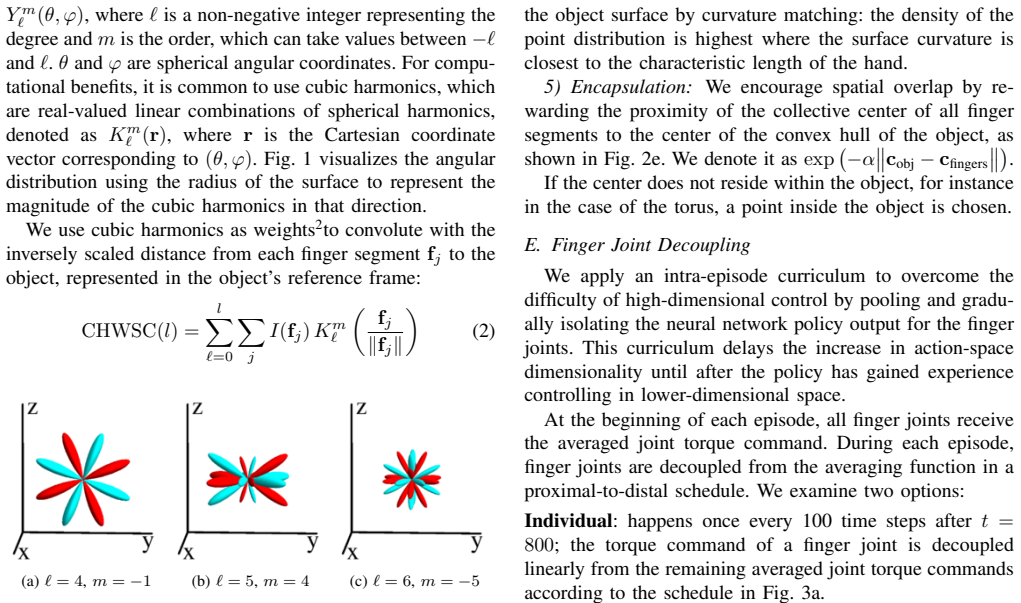
Cubic Harmonics Weighted Spatial Convolution (CHWSC): each finger segment's inversely scaled distance to the object is weighted by real-valued cubic-harmonic functions of the finger's direction, summed over fingers and harmonic degrees up to 6, to produce a low-dimensional, pre-computed observation vector. It captures both radial and angular distribution of fingers around the object without a learned neural encoder. The other central mechanism is an achievement-triggered reward graph with enforced and non-enforced achievement scores, which unlocks later milestones only after earlier ones are passed and maintains prerequisite milestones (like pre-grasping) while later ones are optimized.
What would settle it
Take the trained policy and run it on a physical robot or a high-fidelity dynamics simulator, then after a grasp is achieved, apply a vertical lift, horizontal shake, or an external perturbation and measure whether the object stays held. If a large fraction of objects that pass the three interaction scores are dropped or shifted by small disturbances, the success metric is not measuring grasp stability and the 93% claim is weakened.
Extended reading notes
Core claim
The central claim is that a hand-object interaction representation based on an inversely scaled distance field, convolved with cubic harmonics as angular weights, gives a reinforcement-learning policy enough spatial information to generalize grasping to unseen shapes after training on a single cube. A second claim is that an intra-episode curriculum which starts all finger joints at an averaged torque command and then gradually decouples them, proximal-to-distal, makes the high-dimensional 72-DoF control problem tractable. The paper also establishes that composing the grasping policy with a standing-up-and-walking policy requires the locomotion policy to have been trained on the same full hu
Load-bearing premise
A grasp counts as successful only when three hand-object proximity scores are satisfied, and those same scores are used as training rewards, so the reported 93% rate assumes the scores are a faithful proxy for a real grasp.
Editorial extensions
If this is right
- The grasping policy trained on a single cube generalizes to zero-shot grasping of spheres, cylinders, cuboids, tetrahedra, octahedra, and icosahedra with success rates between 93% and 98%.
- Ablations show that removing either CHWSC or the finger-joint decoupling curriculum drops grasp success to 0–7%, so both ingredients are necessary in this setup.
- Policy composition can be achieved without a separately trained meta-controller: a quantitative threshold on the final grasp milestone decides when the locomotion policy takes over body joints while the hand stays closed.
- Cross-embodiment transfer of skill policies is not automatic: a stand-up policy trained on a fingerless robot fails to compose with a grasping policy trained on the full robot, even though both succeed on their own embodiments.
- Higher-degree cubic harmonics (up to ℓ=6) monotonically improve grasp success, suggesting that richer angular detail in the interaction representation is directly useful to the learning agent.
Reading between the lines
- If the interaction scores faithfully reflect grasp stability, the same CHWSC representation could transfer to other manipulation skills such as in-hand rotation, tool use, or bimanual tasks, with only the score definitions adapted per hand.
- The 'phantom embodiment' result suggests a practical engineering rule for multi-skill robot learning: train every subtask on the final full morphology, even when a subtask seems independent of some body parts, because latent dynamics and observation statistics are shared.
- A natural extension would replace the fixed cubic-harmonic weights with learnable harmonic coefficients, which might improve generalization further or reduce the degree needed for success.
- Because the grasp success metric is computed from the same proxy scores used as training rewards, an independent physical evaluation (e.g., lifting or shaking the object) would be the decisive check on whether 93% reflects real, force-closure grasps.
Editorial analysis
A structured set of objections, weighed in public.
Referee Report
Summary. The paper proposes a developmental reinforcement-learning framework for a 72-DoF humanoid that learns whole-body reaching and grasping and then composes this skill with a separately trained stand-up-and-walk policy. The grasping policy uses an inversely scaled distance field (ISDF) and a cubic-harmonics-weighted spatial convolution (CHWSC) over finger segments, a proximal-to-distal intra-episode finger joint decoupling curriculum, and an achievement-triggered reward graph with enforced and non-enforced milestones. The composition module switches control from the grasping policy to the locomotion policy on the basis of hand-object interaction scores. Experiments in Isaac Gym report a 93% success rate for grasping unseen objects, ablations showing that CHWSC and finger decoupling are both necessary, and cross-embodiment results indicating that a stand-up policy trained without fingers fails when composed (31% vs. 96-100%).
Significance. If the quantitative claims are substantiated, the paper would make three useful contributions: a compact analytic interaction representation (CHWSC) that avoids learned perception encoders and large datasets, a curriculum for high-dimensional hand control, and a surprising negative result about cross-embodiment policy composition. The ablation design is systematic, the effect sizes are large, and the paper provides enough hyperparameters to reproduce the pipeline in principle. The central caveat is that the grasp-success metric is defined by the same proxy scores used as training rewards, so the headline numbers are not yet independently grounded.
major comments (4)
- [§V, Table I, Table VI] The definition of a successful grasp — passing finger-object proximity, object-finger proximity, and encapsulation scores — uses the same quantities that appear as milestone rewards in Table I (level-8 milestones with passing scores 70%, 50%, and 40%). The policy is trained to maximize these terms, so the reported success rates partly measure optimization of the training objective rather than physical grasping. The abstract's '93% zero-shot' and '96-100% standing while holding' claims rest on this criterion. I request an independent grasp assessment: lifting the object off the ground by a specified height, a shake test, or a force-closure/contact-wrench check in simulation. The stand-up-and-walk task is only a partial external check, and the manuscript does not state how 'object being grasped' is evaluated after the switch. Please also clarify whether the composition success rate require
- [§V, Tables IV-VI] All quantitative claims, especially the ablations (0% vs. 93%) and the zero-shot rates, are reported as single percentages without variance, confidence intervals, or the number of seeds. Given the stochasticity of PPO and the domain randomization used in training, the conclusion that CHWSC and finger decoupling are necessary could change with additional seeds. At minimum, report the mean and standard deviation over 3-5 seeds for the main conditions, or a significance test. This is particularly important for the 0% and 7% cells, where a single unlucky run would directly affect the central claim.
- [§III-C, Eq. (2)] Equation (2) sums over finger segments j and degree ℓ but not over the order m, even though the cubic harmonic is written as K_m^ℓ. The feature dimension 'CHWSC(6), 44×2' in Table II implies that all admissible cubic harmonics up to degree 6 are used (49 total minus the five excluded asymmetric terms). Please write the sum over all valid (ℓ, m) pairs and list which m values are included at each degree. As written, the representation cannot be reproduced from the formula alone.
- [Abstract, Table IV] The abstract's headline '93% zero-shot success rate' is not tied to a specific number in Table IV, which lists per-object rates between 93% and 98% and gives no aggregate. If 93% is the average, the cylinder rate, or the octahedron rate, this needs to be stated explicitly; otherwise the reader cannot verify the central claim. If the 93% instead refers to the training-object success in Table VI, then the phrase 'zero-shot' is misleading.
minor comments (5)
- [§I, footnote 1] The video link is only in a footnote and is not referenced anywhere in the main text; add a callout near the policy-composition description.
- [Fig. 5 caption/legend] The legend labels the dashed black line as 'Grasped' while the caption describes it as 'grasp success rate'; make the terminology consistent.
- [Table II] The table repeats 'Full 72 DoF' for both manipulation and locomotion; clarify which columns correspond to which policy and which observation vector the composition module actually uses.
- [Eq. (1)] Capping the ISDF at 1 for negative (inside-object) distances means penetration is not distinguished from surface contact; a sentence explaining this design choice would improve interpretability.
- [§III-F] The total-reward equation introduces the milestone level multiplier exponent w but its values are only given in Table I (w=2); consider stating explicitly that w=2 is used in all experiments.
Circularity Check
Grasp success is defined by the same proxy metrics used as training rewards, so the headline success rates are partially self-referential; the core representation and composition ablations are otherwise independent.
-
self definitional
[Section III-D / Table I vs. Section V / Table VI / Fig. 5 caption]
"To quantitatively evaluate grasp quality and provide dense reward to the learning agent, we define the following five metrics ... A successful grasp is defined as passing the finger-object proximity, object-finger proximity, and encapsulation scores."
The success thresholds are exactly the passing scores of milestone rewards in Table I: Finger-object proximity avg(I(f)) (passing 70%), Object-finger proximity avg_k(exp(-alpha min_j ||f_j - Omega_k||)) (50%), and Encapsulation exp(-alpha ||c_obj - c_fingers||) (40%). These are the same expressions used as dense rewards in the total reward r_t. Thus the 93% zero-shot rate and Table VI success rates report the fraction of episodes passing the policy's own training-reward thresholds; no independent force-closure, lift, shake, or contact-wrench test is reported. The evaluation metric is therefore defined by construction from the training objective.
-
fitted input called prediction
[Section III-G / Table V]
"After the object is grasped, indicated by passing the final milestone in the reward graph (% of finger segments in contact), the getting-up policy takes over control of body joints excluding the fingers, to allow the robot to get up and walk while holding the object in hand."
The handover to the stand-up policy is triggered by passing the 'percentage of finger segments in contact' milestone (level 9 in Table I, passing score 20%), which is itself part of the same achievement-triggered reward graph used to train the grasping policy. Table V's 'standing up and walking with object being grasped' therefore inherits the reward-proxy definition of grasp at handover time. The cross-embodiment contrast in Table V is still a real empirical comparison, but the 'object being grasped' component of the 96-100% rates is not independently verified; it is a threshold on the training reward.
full rationale
The clearest circularity is in the evaluation metrics: the paper defines grasp success by the same hand-object interaction scores (finger-object proximity, object-finger proximity, encapsulation) that it uses as milestone rewards in Table I, and the composed-task handover also relies on the reward-graph milestone '% of finger segments in contact'. Consequently the headline 93% zero-shot grasp success and the 96-100% stand-up-while-holding rates are, by construction, reports of how often the policy passes its own reward thresholds; there is no independent physical grasp validation. I do not find circularity in the methodological core: CHWSC is an explicitly chosen representation whose benefit is tested by ablations against unconvoluted/raw inputs; finger-joint decoupling is tested by ablations; and the cross-embodiment composition finding is an empirical ablation. The self-citation [2] for the achievement-triggered reward graph is a normal methodological inheritance, not a load-bearing uniqueness claim. Score 6: the central success claims reduce to the training-reward definition, but the representation and composition contributions still have independent empirical content.
Assumptions & free parameters
free parameters (6)
- alpha (ISDF curvature) =
not stated
- Milestone passing scores p_{i,j} =
Table I values (e.g., 85%, 75%, 20%)
- Milestone level multiplier exponent w =
2
- Finger decoupling schedule timings =
start t=800, decouple every 100 (individual) or 500 (group) steps
- Contact force threshold F_threshold =
not stated
- Maximum cubic harmonic degree and excluded terms =
L_max=6, with 5 asymmetry terms excluded
assumptions (6)
- domain assumption A clean signed distance field of the target object is available at every timestep for computing ISDF, CHWSC, and interaction scores.
- domain assumption Isaac Gym simulation faithfully models rigid-body dynamics, contacts, and grasp stability.
- ad hoc to paper Cubic harmonics up to degree 6 provide a sufficient angular representation of hand-object interaction.
- domain assumption PPO with a 4-layer MLP can represent the whole-body grasping policy.
- ad hoc to paper The developmental milestone ordering in the reward graph is a valid learning curriculum.
- domain assumption The finding that same-full-body training is necessary for composition generalizes beyond the tested robot model and policies.
invented entities (2)
-
CHWSC feature (cubic-harmonics-weighted spatial convolution of ISDF)
-
Enforced achievement score A^E
Cite this review
Pith. "Pith review of Developing Combined Manipulation and Locomotion Skills with Interaction Representation and Skill Composition." pith.science (2026). https://pith.science/paper/K6MSJKJV
@misc{pith2026260800208,
  author       = {Pith},
  title        = {Pith review of: Developing Combined Manipulation and Locomotion Skills with Interaction Representation and Skill Composition},
  year         = {2026},
  howpublished = {\url{https://pith.science/paper/K6MSJKJV}},
  note         = {Machine review of arXiv:2608.00208}
}
read the original abstract
This paper addresses how to enable a humanoid robot to learn motion policies based on developmental principles and combine policies to create more sophisticated and useful behaviors. Specifically, we present an approach to (1) learning a whole-body reaching and grasping policy and (2) combining it and a standing-up and walking policy to compose a more complex policy of manipulation and locomotion: grasping, standing up, and walking. In (1), our method draws inspiration from harmonic analysis and adopts cubic harmonics as weights to represent the hand-object spatial relationship via spatial convolution. Utilizing an intra-episode finger joint decoupling curriculum based on developmental principles, a robot can autonomously learn a generalizable grasping policy without relying on external datasets or pretrained models. In (2), our method combines the grasping policy with a separately learned getting-up policy by providing both policies with their respective observation vectors and using hand-object interaction scores to determine when each policy should control which robot joints. Our results show a 93% zero-shot success rate for grasping unseen objects and a 96-100% success rate for standing up while holding the object. Our work also demonstrates that combining different policies is only effective if each policy learning happens on the same whole humanoid body even if a policy (such as for locomotion) does not seem to need all the body parts (such as fingers).
Figures


Figures from the paper (2 more)


Reference graph
Works this paper leans on
-
[1]
Cangelosi and M
A. Cangelosi and M. Schlesinger,Developmental Robotics: From Babies to Robots. The MIT Press, 2015
2015
-
[2]
From rolling over to walking: Enabling humanoid robots to develop complex motor skills,
F. Meng and J. Xiao, “From rolling over to walking: Enabling humanoid robots to develop complex motor skills,”arXiv preprint arXiv:2303.02581, 2023
arXiv 2023
-
[3]
Piaget’s theory of intellectual develop- ment,
H. Ginsburg and S. Opper, “Piaget’s theory of intellectual develop- ment,” ser. The Prentice-Hall series in developmental psychology. Prentice-Hall, 1988
1988
-
[4]
A psychology based approach for longitudinal development in cognitive robotics,
J. Law, P. Shaw, K. Earland, M. Sheldon, and M. H. Lee, “A psychology based approach for longitudinal development in cognitive robotics,”Frontiers in Neurorobotics, vol. V olume 8 - 2014, 2014
2014
-
[5]
Learning and acting in peripersonal space: Moving, reaching, and grasping,
J. Juett and B. Kuipers, “Learning and acting in peripersonal space: Moving, reaching, and grasping,”Frontiers in Neurorobotics, vol. V olume 13 - 2019, 2019
2019
-
[6]
A robotic model of reaching and grasping development,
P. Savastano and S. Nolfi, “A robotic model of reaching and grasping development,”IEEE Transactions on Autonomous Mental Develop- ment, vol. 5, no. 4, pp. 326–336, 2013
2013
-
[7]
Representing robot ge- ometry as distance fields: Applications to whole-body manipulation,
Y . Li, Y . Zhang, A. Razmjoo, and S. Calinon, “Representing robot ge- ometry as distance fields: Applications to whole-body manipulation,” in2024 IEEE International Conference on Robotics and Automation (ICRA), 2024, pp. 15 351–15 357
2024
-
[8]
isdf: Real-time neural signed distance fields for robot perception,
J. Ortiz, A. Clegg, J. Dong, E. Sucar, D. Novotny, M. Zollhoefer, and M. Mukadam, “isdf: Real-time neural signed distance fields for robot perception,” inRobotics: Science and Systems, 2022
2022
Show all 19 references
-
[9]
Neural grasp distance fields for robot manipulation,
T. Weng, D. Held, F. Meier, and M. Mukadam, “Neural grasp distance fields for robot manipulation,”IEEE International Conference on Robotics and Automation (ICRA), 2023
2023
-
[10]
Spherical mapping for processing of 3d closed surfaces,
L. Shen and F. Makedon, “Spherical mapping for processing of 3d closed surfaces,”Image and Vision Computing, vol. 24, no. 7, pp. 743–761, 2006
2006
-
[11]
Noncollinear magnetic multipoles in collinear altermagnets,
L. Buiarelli, R. M. Fernandes, and T. Birol, “Noncollinear magnetic multipoles in collinear altermagnets,”Phys. Rev. B, vol. 112, p. 224442, Dec 2025
2025
-
[12]
Real-time path planning based on harmonic functions under a proper generalized decomposition-based framework,
N. Mont ´es, F. Chinesta, M. C. Mora, A. Falc ´o, L. Hilario, N. Rosillo, and E. Nadal, “Real-time path planning based on harmonic functions under a proper generalized decomposition-based framework,”Sensors (Basel, Switzerland), vol. 21, 2021
2021
-
[13]
Robot navigation in complex workspaces using harmonic maps,
P. Vlantis, C. Vrohidis, C. P. Bechlioulis, and K. J. Kyriakopoulos, “Robot navigation in complex workspaces using harmonic maps,” in2018 IEEE International Conference on Robotics and Automation (ICRA), 2018, pp. 1726–1731
2018
-
[14]
Dynamics harmonic analysis of robotic systems: Application in data-driven Koopman modelling,
D. Ordo ˜nez Apraez, V . Kostic, G. Turrisi, P. Novelli, C. Mastalli, C. Semini, and M. Pontil, “Dynamics harmonic analysis of robotic systems: Application in data-driven Koopman modelling,” inProceed- ings of the 6th Annual Learning for Dynamics & Control Conference, ser. Pro...
2024
-
[15]
Skillblender: Towards versatile humanoid whole-body loco-manipulation via skill blending,
Y . Kuang, H. Geng, A. Elhafsi, T.-D. Do, P. Abbeel, J. Malik, M. Pavone, and Y . Wang, “Skillblender: Towards versatile humanoid whole-body loco-manipulation via skill blending,”arXiv preprint arXiv:2506.09366, 2025
2025 arXiv
-
[16]
Multi-expert synthesis for versatile locomotion and manipulation skills,
K. Yuan and Z. Li, “Multi-expert synthesis for versatile locomotion and manipulation skills,”Frontiers in Robotics and AI, vol. V olume 9 - 2022, 2022
2022
-
[17]
Isaac gym: High performance gpu-based physics simulation for robot learning,
V . Makoviychuk, L. Wawrzyniak, Y . Guo, M. Lu, K. Storey, M. Mack- lin,et al., “Isaac gym: High performance gpu-based physics simulation for robot learning,” 2021
2021
-
[18]
Proximal policy optimization algorithms,
J. Schulman, F. Wolski, P. Dhariwal, A. Radford, and O. Klimov, “Proximal policy optimization algorithms,” 2017
2017
-
[19]
Kinectfusion: real-time 3d reconstruction and interaction using a moving depth camera,
S. Izadi, D. Kim, O. Hilliges, D. Molyneaux, R. Newcombe, P. Kohli, J. Shotton, S. Hodges, D. Freeman, A. Davison, and A. Fitzgibbon, “Kinectfusion: real-time 3d reconstruction and interaction using a moving depth camera,” inProceedings of the 24th Annual ACM Symposium on User...
2011
Reviewed August 4, 2026 · model on record in the stance chip above.
Discussion (0). Sign in to comment.