REVIEW 2 major objections 4 minor 15 references
Geometric Equations for Matroid Varieties
T0 review · 2 major / 4 minor · reviewed 2026-08-14 · deepseek-v4-flash
Pith's one-line read Classical incidence theorems produce explicit extra equations for matroid varieties.
desk verdict Solid new equations for matroid varieties via Pascal and rational normal curves, but the Cayley-Bacharach family has a real gap in the nontriviality proof. read the letter →
The pith
A machine-rendered reading of the paper's core claim, the machinery that carries it, and where it could break.
The reading
What carries the argument
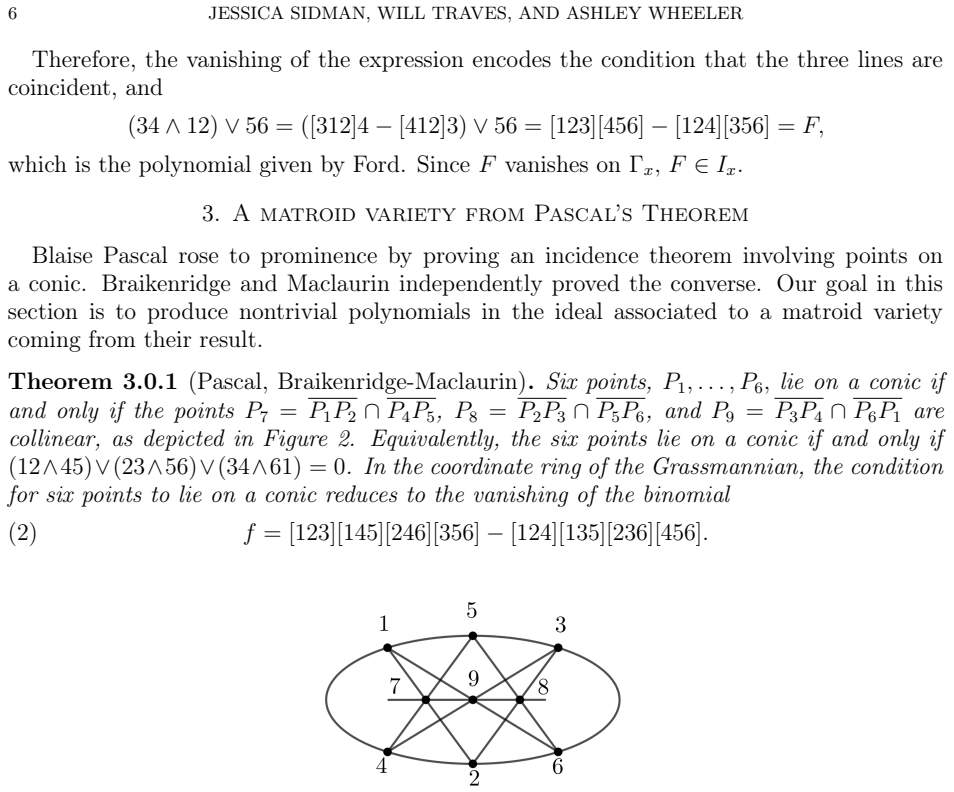
The load-bearing mechanism is the Grassmann-Cayley algebra on the bracket coordinates of the Grassmannian, used to turn an incidence theorem into a polynomial that vanishes on a matroid variety. In the Pascal case the conic condition is expressed by $[123][145][246][356]-[124][135][236][456]$, and the equivalent collinearity of the three diagonal points is $(12\wedge45)\vee(23\wedge56)\vee(34\wedge61)=0$; replacing a meet by a point in this factorization produces the cubics and quadratics. For the Cayley-Bacharach family, the mechanism is the determinant of the evaluation matrix of all degree $d$ monomials at the chosen points, which is a bracket polynomial of degree $\binom{d+2}{3}$ and vanishes exactly when the points lie on a degree $d$ curve.
What would settle it
Take $k=4$, choose explicit rational lines $L_i$ and $M_i$ so that the 16 points of $C\cap D$ have only the prescribed collinear triples, and form the ideal $N_{16}$ generated by the corresponding nonbasis brackets. Compute the degree-10 determinant bracket polynomial from Lemma 4.3.3 for the selected 10 residual points and check, by Gröbner basis computation over $\mathbb{Q}$, whether it lies in $N_{16}$ or in the saturation by the product of basis brackets. If it lies in $N_{16}$, the nontriviality claim for the $k=4$ case fails.
Extended reading notes
Core claim
The paper's central discovery is that the defining ideal $I_x$ of a matroid variety can be strictly larger than the ideal $N_x$ generated by the brackets of its nonbases, and that the extra elements can be read off from projective incidences. For the Pascal matroid, six points on a conic together with the three intersection points of opposite sides that Pascal's theorem forces to be collinear, the ideal contains at least one quartic, three independent cubics, and three independent quadratics outside $N_x$. The quartic is the bracket translation of the conic condition, and the lower-degree polynomials come from replacing pieces of its Grassmann-Cayley factorization by single points. Feeding the same translation mechanism with the Cayley-Bacharach theorem gives an infinite family: for every $k \ge 3$, the matroid variety of $k^2$ points obtained from two arrangements of $k$ lines contains a nontrivial bracket polynomial of degree $\binom{k+1}{3}$.
Load-bearing premise
The construction for each $k\ge3$ starts from an unstated generic choice of lines so that the $k^2$ intersection points have exactly the prescribed collinear triples, and then moves two points so that the nonbasis brackets still vanish while the selected points no longer lie on a degree $k-1$ curve; that generic existence is asserted rather than demonstrated.
Editorial extensions
If this is right
- For the Pascal configuration, the defining ideal contains low-degree elements outside the nonbasis bracket ideal, so the matroid variety is not cut out by nonbasis brackets alone.
- Any set of six or more distinct points on a nondegenerate conic yields independent nontrivial quartics, cubics, and quadratics in the ideal of the associated matroid variety.
- The higher-dimensional analogue for rational normal curves produces nontrivial quartics in every projective dimension, generalizing the plane conic construction.
- For every $k \ge 3$, there is a matroid variety whose defining ideal contains a nontrivial bracket polynomial of degree $\binom{k+1}{3}$, constructed from $k^2$ points in a Cayley-Bacharach arrangement.
- The examples occupy a middle ground between positroids, where the two ideals coincide, and arbitrary matroids, where the defining ideal can be essentially uncomputable.
Reading between the lines
- The zero-column witnesses used throughout suggest a general recipe: if a bracket polynomial has a Cayley factorization, degenerating the auxiliary points to zero may certify that it is not in $N_x$; a formal criterion of this kind would turn the examples into a membership test.
- A natural extension is to feed other classical incidence theorems, such as higher-dimensional Pascal variants or Miquel-type configurations, through the same Grassmann-Cayley translation and look for degree patterns in the resulting nontrivial polynomials.
- The degree $\binom{k+1}{3}$ growth suggests that for these matroids the generator degrees of the saturation $(N_x:J_x^\infty)$ grow cubically in $k$, which could inform the general degree bound asked for in the paper.
Signed reviews
Editorial analysis
A structured set of objections, weighed in public.
Referee Report
Summary. The paper studies the ideals I_x of matroid varieties V_x, the Zariski closures of matroid strata in Grassmannians, and seeks explicit elements of I_x that do not lie in the bracket ideal N_x generated by nonbasis brackets. The authors use the Grassmann-Cayley algebra and classical projective geometry, specifically Pascal's theorem, the Braikenridge-Maclaurin theorem, Caminata-Schaffler's generalization, and the Cayley-Bacharach theorem, to construct such nontrivial polynomials. After setting up matroid varieties and the Grassmann-Cayley algebra, the paper proves for the Pascal matroid on nine points that the defining ideal contains a quartic, three cubics, and three quadrics outside N_Pascal (Theorem 3.0.2). It then extends this result to configurations of points on a conic (Theorem 4.1.1), to rational normal curves in higher dimensions (Theorem 4.2.2), and to Cayley-Bacharach configurations of k^2 points in the plane (Theorem 4.3.4). The paper also gives a computational verification of Ford's description of the ideal in the Sturmfels seven-point example (Theorem 2.1.8).
Significance. The paper makes a useful contribution by demonstrating a geometric, Grassmann-Cayley-based method for producing explicit nontrivial equations of matroid varieties, a class of ideals about which little is known. The arguments in the Pascal case are elegant and convincing: the explicit configurations used to prove nontriviality are concrete and avoid heavy computation. The paper also clearly identifies the gap between N_x and I_x and shows how incidence geometry can fill it. If the Cayley-Bacharach construction in Section 4.3 can be made rigorous, the paper would provide a systematic infinite family of rank-3 matroids with N_x strictly contained in I_x, which is a substantial strengthening of the current state of knowledge. The reproducible Macaulay2 computation in Theorem 2.1.8, once the relevant scripts are provided, would be a further asset.
major comments (2)
- [4.3, Theorem 4.3.4] The proof of Theorem 4.3.4 does not justify the assertion that the two moved points can be chosen so that the selected set no longer lies on a degree k-1 curve. Let S be the selected residual points and let T = S \ {A,B}, where A and B are the two selected points on the line l_i. Since |T| = (k+1 choose 2) - 2 and the space of degree k-1 plane curves has dimension (k+1 choose 2), the space V_T of degree k-1 curves through T has vector-space dimension at least 2. If dim V_T is at least 3, then for every choice of moved points q1 and q2 there is a degree k-1 curve through T union {q1,q2}, because two point conditions on a projective space of dimension at least 2 always have a common solution; hence f(y)=0 for every deformation, contradicting the claimed nontriviality. Even when dim V_T = 2, one must prove that T is not contained in a degree k-2 curve; otherwise the union of that curve with the line through q1 and q2 is a degree k-1 curve through T union {q1,q2} for every q1,q2. The paper establishes neither the dimension bound dim V_T = 2 nor the non-containment in a degree k-2 curve, so the constructed y is not shown to satisfy f(y) != 0.
- [4.3, Theorem 4.3.4] The proof assumes the existence of a selected set S with the needed genericity properties. It says only that one picks (k+1 choose 2) residual points with exactly two on one line l_i, but it does not show that such a choice can be made so that T = S \ {A,B} imposes (k+1 choose 2) - 2 independent conditions on degree k-1 curves and avoids lying on a degree k-2 curve. Since all residual points lie on a fixed degree k-1 curve supplied by the Cayley-Bacharach theorem, this is a nontrivial genericity statement. The proof must either prove the existence of such an S or restrict the construction to cases where it can be verified; otherwise the deformation argument for nontriviality is incomplete.
minor comments (4)
- [3, Theorem 3.0.2] In the independence argument for the quadrics, the phrase 'independent of the other two quartics' should read 'independent of the other two quadrics'; the same wording appears in the final sentence of the proof.
- [2.1, Theorem 2.1.8] The Macaulay2 computations supporting Theorem 2.1.8 are not reproducible from the manuscript as submitted, because no scripts, logs, or code are provided. Since this result is an auxiliary verification of Ford's description and is not used in the main constructions, I regard this as a presentation issue, but the authors should consider making the computation available.
- [4.2, Theorem 4.2.1] In the statement of Theorem 4.2.1 and in Equation (4), the notation H_lambda is used both for the (d-2)-plane spanned by the points j1,...,j_{d-2} and for the extensor representing it; please clarify the convention.
- [4.3, Example 4.3.5] The count (4 choose 2)(3 choose 2)(3 choose 2) = 54 in Example 4.3.5 is not fully derived; a sentence explaining how the binomial factors arise would help the reader understand the source of the 54 polynomials.
Circularity Check
No significant circularity; the derivation is self-contained against classical incidence theorems and independent witness checks.
full rationale
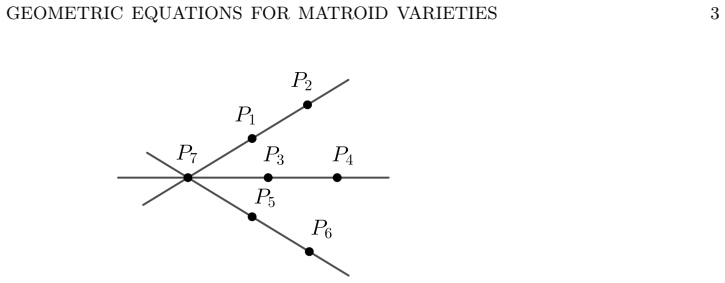
Walked the claimed derivation chain. The nontrivial polynomials are constructed from external classical theorems (Pascal/Braikenridge-Maclaurin, Caminata-Schaffler, Cayley-Bacharach) and direct Grassmann-Cayley bracket computations. The proof that each polynomial lies in the matroid-variety ideal follows from the configuration's incidence geometry, and nontriviality is checked by explicit witness configurations y in V(N_x) with f(y) != 0, which is a valid independent criterion per Remark 2.1.7. No parameter is fitted to a subset of data and then renamed a prediction; no input is defined in terms of the output. Self-citations to Traves [13] and Sidman-Traves [10] are background or standard published theorems with independent proofs, not load-bearing uniqueness claims used to force the conclusion. The one questionable passage is in the proof of Theorem 4.3.4: 'working over an infinite field also guarantees we can move the two points so that our chosen set ... no longer lies on a curve of degree k-1' is asserted without demonstration. This is a potential correctness gap, because the deformation may fail to break the polynomial f, but it is not a circularity: it is not equivalent by construction to f being in I_k2 or to the vanishing of the N_k2 brackets. Therefore no circular step is present. Score 0.
Assumptions & free parameters
assumptions (5)
- standard math Pascal-Braikenridge-Maclaurin theorem
- domain assumption Cayley-Bacharach theorem as stated in Traves [13]
- domain assumption Caminata-Schaffler theorem on rational normal curves
- standard math First Fundamental Theorem of Invariant Theory
- standard math Hilbert's Nullstellensatz
Cite this review
Pith. "Pith review of Geometric Equations for Matroid Varieties." pith.science (2026). https://pith.science/paper/KAWLA7OC
@misc{pith2026190801233,
  author       = {Pith},
  title        = {Pith review of: Geometric Equations for Matroid Varieties},
  year         = {2026},
  howpublished = {\url{https://pith.science/paper/KAWLA7OC}},
  note         = {Machine review of arXiv:1908.01233}
}
abstract
Each point $x$ in Gr$(r,n)$ corresponds to an $r \times n$ matrix $A_x$ which gives rise to a matroid $M_x$ on its columns. Gel'fand, Goresky, MacPherson, and Serganova showed that the sets $\{y \in \mathrm{Gr}(r,n) | M_y = M_x\}$ form a stratification of Gr$(r,n)$ with many beautiful properties. However, results of Mn\"ev and Sturmfels show that these strata can be quite complicated, and in particular may have arbitrary singularities. We study the ideals $I_x$ of matroid varieties, the Zariski closures of these strata. We construct several classes of examples based on theorems from projective geometry and describe how the Grassmann-Cayley algebra may be used to derive non-trivial elements of $I_x$ geometrically when the combinatorics of the matroid is sufficiently rich.
Figures

Figures from the paper (1 more)

Reference graph
Works this paper leans on
-
[1]
Alessio Caminata and Luca Schaffler,A Pascal’s theorem for rational normal curves, arXiv e-prints (2019Mar), arXiv:1903.00460, available at1903.00460
work page Pith review arXiv 1903
-
[2]
David Eisenbud, Mark Green, and Joe Harris,Cayley-Bacharach theorems and conjectures, Bull. Amer. Math. Soc. (N.S.)33 (1996), no. 3, 295–324. MR1376653 (97a:14059)
work page 1996
-
[3]
Algebraic Combin.41 (2015), no
Nicolas Ford,The expected codimension of a matroid variety, J. Algebraic Combin.41 (2015), no. 1, 29–47
work page 2015
-
[4]
I. M. Gel′ fand, R. M. Goresky, R. D. MacPherson, and V. V. Serganova,Combinatorial geometries, convex polyhedra, and Schubert cells, Adv. in Math.63 (1987), no. 3, 301–316
work page 1987
-
[5]
Grayson and Michael E
Daniel R. Grayson and Michael E. Stillman,Macaulay2, a software system for research in algebraic geometry
-
[6]
Speyer,Positroid varieties: juggling and geometry, Compos
Allen Knutson, Thomas Lam, and David E. Speyer,Positroid varieties: juggling and geometry, Compos. Math. 149 (2013), no. 10, 1710–1752
work page 2013
-
[7]
N. E. Mnëv,Varieties of combinatorial types of projective configurations and convex polyhedra, Dokl. Akad. Nauk SSSR283 (1985), no. 6, 1312–1314
work page 1985
-
[8]
Qingchun Ren, Jürgen Richter-Gebert, and Bernd Sturmfels,Cayley-Bacharach formulas, Amer. Math. Monthly 122 (2015), no. 9, 845–854
work page 2015
Show all 15 references
-
[9]
A guided tour through real and complex geometry
Jürgen Richter-Gebert,Perspectives on projective geometry, Springer, Heidelberg, 2011. A guided tour through real and complex geometry
2011
-
[10]
Jessica Sidman and William Traves,Special positions of frameworks and the Grassmann-Cayley algebra, Handbook of geometric constraint systems principles, 2019, pp. 85–106
2019
-
[11]
White, Adv
Bernd Sturmfels, On the matroid stratification of Grassmann varieties, specialization of coordinates, and a problem of N. White, Adv. Math.75 (1989), no. 2, 202–211
1989
-
[12]
, Algorithms in invariant theory, Texts and Monographs in Symbolic Computation, Springer- Verlag, Vienna, 1993
1993
-
[13]
Will Traves,From Pascal’s theorem tod-constructible curves, Amer. Math. Monthly120 (2013), no. 10, 901–915
2013
-
[14]
White,The bracket ring of a combinatorial geometry
Neil L. White,The bracket ring of a combinatorial geometry. I, Trans. Amer. Math. Soc.202 (1975), 79–95
1975
-
[15]
, The bracket ring of a combinatorial geometry. II. Unimodular geometries, Trans. Amer. Math. Soc. 214 (1975), 233–248. GEOMETRIC EQUATIONS FOR MATROID V ARIETIES 13 Mount Holyoke College, South Hadley, MA 01075 E-mail address: jsidman@mtholyoke.edu United States Na v al Acade...
1975
Reviewed August 14, 2026 · model on record in the stance chip above.
Discussion (0). Continue with ORCID to comment.