REVIEW 3 major objections 5 minor 61 references
Abundant Water from Early Supernovae at Cosmic Dawn
T0 review · 3 major / 5 minor · reviewed 2026-08-10 · deepseek-v4-flash
Pith's one-line read The paper argues that the first water in the Universe formed inside dense, self-gravitating cores of Population III supernova ejecta at redshift $z \sim 20$, with core mass fractions within a factor of a few of today's Solar System value.
desk verdict Plausible first full-cosmological-simulation case for dense-core water formation in Pop III SN remnants, but two runs and no convergence tests make the 'most primeval halos' claim a stretch. read the letter →
The pith
A machine-rendered reading of the paper's core claim, the machinery that carries it, and where it could break.
The reading
What carries the argument
The load-bearing object is the dense, self-gravitating cloud core that forms in (or survives in) the supernova remnant, combined with the high-density gas-phase chemistry $\mathrm{O} + \mathrm{H}_2 \rightarrow \mathrm{OH} + \mathrm{H}$ and $\mathrm{OH} + \mathrm{H}_2 \rightarrow \mathrm{H}_2\mathrm{O} + \mathrm{H}$. Above densities near $10^{10}\,\mathrm{cm}^{-3}$, three-body formation of H$_2$ rapidly molecularizes the core and drives water production; dust cooling then lets the core collapse further, pushing water mass fractions toward $10^{-4}$. This machinery explains why both the sharp late-time rise in water mass and the localization of water production in the halo coincide with the dense cores.
What would settle it
A convergence study of the same two explosions with varying resolution and initial turbulent seeds, or a survey of many Population III progenitor masses, would settle the argument: if dense water-rich cores fail to appear in most runs, or if their water mass fractions drop by orders of magnitude, then the claim that primordial supernova cores were the first water factories would not generalize. Observationally, a null detection of the predicted far-infrared-pumped water lines or 22 GHz maser background from $z \gtrsim 15$ halos would also weaken the claim that such cores were common.
Extended reading notes
Core claim
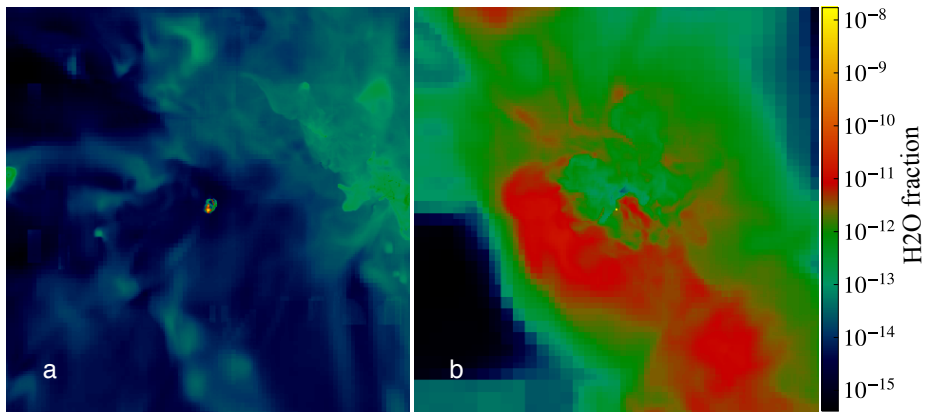
On the paper's own terms, the discovery is that primordial supernovae were water factories concentrated in dense cloud cores, not in the diffuse remnant gas. In the 200 solar-mass pair-instability explosion, a turbulent density fluctuation in gas enriched to $Z = 0.04\,Z_\odot$ collapses within about 3 Myr into a 35 solar-mass core at central density $6 \times 10^{14}\,\mathrm{cm}^{-3}$, holding $9 \times 10^{-3}$ solar masses of water at a mass fraction of $10^{-4}$. In the 13 solar-mass core-collapse explosion, a pre-existing clump that survives both the star's radiation and the shock is mixed to $Z \sim 10^{-4}\,Z_\odot$ and collapses over roughly 90 Myr into a 1627 solar-mass core with a water mass fraction of $4 \times 10^{-7}$. The water forms through the two-step path $\mathrm{O} + \mathrm{H}_2 \rightarrow \mathrm{OH} + \mathrm{H}$ and $\mathrm{OH} + \mathrm{H}_2 \rightarrow \mathrm{H}_2\mathrm{O} + \mathrm{H}$; in the pair-instability core, H$_2$O/O exceeds unity above $10^{10}\,\mathrm{cm}^{-3}$, so most oxygen goes to water rather than O$_2$. Diffuse gas in the halos reaches only $10^{-14}$ to $10^{-10}$ water fractions, underscoring that the cores dominate.
Load-bearing premise
The broad conclusion rests on the assumption that the two dense clumps produced in two single simulations—one a pre-existing cloud struck by the supernova, one a fluctuation stirred up by the explosion—are typical outcomes in most primeval halos rather than rare coincidences.
Editorial extensions
If this is right
- Water existed in the Universe 100–200 million years after the Big Bang, before the first galaxies had assembled.
- Dense supernova-remnant cores are plausible sites of protoplanetary disk formation, so planet formation could have begun at low metallicity with significant water present.
- Diffuse water from these remnants was incorporated into the first galaxies, making water a key constituent of early galactic gas.
- Redshifted water emission from $z \gtrsim 15$ halos could appear as a cosmic line background detectable by future radio arrays.
Reading between the lines
- [Editorial inference] If dense water-rich cores are typical outcomes, the low-metallicity tail of exoplanet demographics may include water-rich worlds around second-generation stars, and surveys of ancient metal-poor stars could look for their imprint.
- [Editorial inference] The same clumping that shelters water would also shelter dust from reverse-shock sputtering, which would raise the dust yields currently assumed in models of early galaxy enrichment.
- [Editorial inference] Expanding the two-explosion study into a population synthesis across the Population III initial mass function would convert the 'first water' claim into a testable prediction for how often such cores form.
Editorial analysis
A structured set of objections, weighed in public.
Referee Report
Summary. The paper presents Enzo adaptive mesh refinement cosmological simulations of a 13 Msun core-collapse supernova and a 200 Msun pair-instability supernova from Pop III progenitors, coupled to a nonequilibrium chemical network that includes water formation, dust chemistry, and gas-grain processes. The authors find that diffuse water vapor forms throughout both halos with mass fractions of 10^-14 to 10^-10, but that the total water mass is dominated by two dense, self-gravitating clumps, one in each remnant, which reach water mass fractions of 4e-7 in the CC SN core and ~1e-4 in the PI SN core. They conclude that the first water in the Universe formed in Pop III supernovae at z~20 and that water was likely a key constituent of the first galaxies. The Methods section details the 89-reaction network, the dust model with eight species, the radiation transport, and the simulation setup, and data and code availability are provided.
Significance. If the dense-core mechanism is robust, this is an important result for early-universe astrochemistry, the origin of water, and the low-metallicity pathway to planet formation. The paper's strengths include a sophisticated chemical model with explicit dust cooling, a physical treatment of the cosmological environment, and honest discussion of several limitations. The authors also make falsifiable observational predictions (ALMA line detectability at z>15, a possible global maser background) and provide public simulation data and code, which strengthens the paper's value. The main weakness is that the central claims about the ubiquity and dominance of dense-core water formation rest on only two simulations, one per progenitor mass, with no convergence tests and no sampling of initial conditions or random seeds; this limits the generality of the conclusions as currently stated.
major comments (3)
- [Water Synthesis and Methods] The central claim that dense cores are the primary water factories in primordial supernova remnants rests on exactly two simulations, one 13 Msun CC SN and one 200 Msun PI SN, with no resolution or convergence study presented in Methods. The PI core emerges from a single turbulent fluctuation in one 3D realization (Extended Data Fig. 3), and the CC core is a pre-existing clump whose survival depends on its initial position 30 pc from the progenitor (Extended Data Figs. 1 and 2). Because the headline result—orders-of-magnitude water-mass increase driven by these cores—could be a rare or numerically fragile outcome, the paper needs either resolution/convergence tests at the quoted maximum resolutions (2063 AU and 2.1 AU) or an explicit demonstration that these outcomes are typical across seeds, explosion energies, and densities. As written, the two simulations establish existence but not the 'likely a key constituent' generalization.
- [Discussion and Conclusion] The sentence claiming that 'similarities in explosion dynamics would have produced dense clumps across a wide range of energies, progenitor masses and halo masses' is an extrapolation not supported by the evidence in the paper. Only one CC and one PI case are shown, both in trapped H II regions, and no parametric study is performed. This extrapolation is load-bearing because the diffuse water mass fractions (10^-14 to 10^-10) are two to four orders of magnitude lower than those in the dense cores; if such cores are rare, the conclusion that water was a key constituent of the first galaxies breaks down. The claim should be either backed by additional runs (or at least a semi-analytic criterion calibrated to these simulations) or restricted to the two simulated halos.
- [Methods: water chemistry and omitted pathways] The paper omits water photodissociation reactions and cosmic-ray-driven H3O+ pathways, arguing that no other stars are present and that the CR background is negligible. While the authors state this makes their water masses conservative, the net effect is not quantified: photodissociation could destroy water in the diffuse gas and even in the outer parts of cores once the cores form stars or if UV escapes anisotropically, and dust shielding is only invoked qualitatively. Given that the 'key constituent' claim depends on the survival of water over cosmic time, a quantitative estimate of the competing effects (e.g., a post-processing calculation of water destruction by the first stars in the halo) is needed to support the conclusions.
minor comments (5)
- [Abstract] The phrase 'the first water in the Universe formed in Pop III core-collapse and pair-instability supernovae' is stronger than what the simulations demonstrate; they show water forming in two halos at z~20. Please either soften to 'among the first water' or add a statement about why these are necessarily the earliest sites.
- [Methods] There is a typo in the Methods section: 'simualtions' should be 'simulations'.
- [Extended Data Figure 7] The caption says water mass fractions 'level of' at ~10^-4; this should be 'level off'.
- [Figure 3] The y-axis label uses 'MO •' which should be typeset as 'M_sun' for consistency with the text.
- [Methods] In the description of the PI SN run, 'until the halo grew to a a little above 10^7 M_sun' contains a duplicated article; it should read 'to a little above'.
Circularity Check
No significant circularity: water mass fractions and dense-core masses are emergent outputs of Enzo hydrodynamics plus published reaction rates and dust models, with no fitted parameter renamed as a prediction.
full rationale
The paper's central result—that water forms primarily in dense, self-gravitating ejecta cores in Pop III core-collapse and pair-instability supernovae—is an output of the simulations, not an input. The water chemistry network (49 primordial and 40 metal/molecular reactions) is adopted from Omukai et al. (2005), Chiaki et al. (2015), and Chiaki & Wise (2019), with SN energies, nucleosynthetic yields, and dust yields taken from external stellar evolution and dust nucleation calculations. The explosion energies and yields are not tuned to reproduce the reported water masses, and the dense cores are not inserted by hand: the CC SN core is described as a pre-existing clump that survives and is enriched by the explosion, while the PI SN core emerges from a turbulent density fluctuation in the 3D remnant. The text states that CC SN water fractions are 'consistent with those in one-zone models at similar metallicities and densities' (Bialy et al. 2015), which is a consistency check against independent calculations rather than a fit. The self-citations in the paper (e.g., Latif et al. 2022, Latif & Schleicher 2020) are used as cosmological context or as prior simulations of enrichment and star formation, not as the source of the water-formation claim. Limitations such as the absence of photodissociation, cosmic rays, and the lower-limit nature of the dust masses affect the magnitude of the results but do not make any derived quantity equal to an input by construction. The lack of convergence tests and the extrapolation from two single-realization runs to 'most primeval halos' are legitimate scientific-robustness concerns, but they are not circularity: the simulations are self-contained calculations against external benchmarks, and the headline water mass fractions are not forced by any fitted parameter or self-citation chain.
Assumptions & free parameters
free parameters (2)
- LW background intensity in PI SN run =
100 J21
- Adopted dust yields from Nozawa et al. (2007) at ambient density 1 cm^-3 =
varies by dust species
assumptions (3)
- domain assumption Single star per halo assumption
- domain assumption Negligible cosmic-ray flux at z~20
- domain assumption Dust yields from 1D SN models are lower limits because 3D clumping shields dust
Cite this review
Pith. "Pith review of Abundant Water from Early Supernovae at Cosmic Dawn." pith.science (2026). https://pith.science/paper/KCD3BZI5
@misc{pith2026250102051,
  author       = {Pith},
  title        = {Pith review of: Abundant Water from Early Supernovae at Cosmic Dawn},
  year         = {2026},
  howpublished = {\url{https://pith.science/paper/KCD3BZI5}},
  note         = {Machine review of arXiv:2501.02051}
}
abstract
Primordial (or Pop III) supernovae were the first nucleosynthetic engines in the Universe, forging the heavy elements required for the later formation of planets and life. Water, in particular, is thought to be crucial to the cosmic origins of life as we understand it, and recent models have shown that water can form in low-metallicity gas like that present at high redshifts. Here we present numerical simulations that show that the first water in the Universe formed in Pop III core-collapse and pair-instability supernovae at redshifts $z \sim$ 20. The primary sites of water production in these remnants are dense molecular cloud cores, which in some cases were enriched with primordial water to mass fractions that were only a factor of a few below those in the Solar System today. These dense, dusty cores are also likely candidates for protoplanetary disk formation. Besides revealing that a primary ingredient for life was already in place in the Universe 100 - 200 Myr after the Big Bang, our simulations show that water was likely a key constituent of the first galaxies.
Figures


Figures from the paper (2 more)


Reference graph
Works this paper leans on
-
[1]
Joggerst, C. C. et al. The Nucleosynthetic Imprint of 15-40 M ⊙ Primordial Supernovae on Metal-Poor Stars. Astrophys. J. 709, 11–26 (2010). 0907.3885
work page Pith review arXiv 2010
-
[2]
Heger, A. & Woosley, S. E. Nucleosynthesis and Evolution of Massive Metal-Free Stars. Astrophys. J. 724, 341–373 (2010). 0803.3161
arXiv 2010
-
[3]
Whalen, D. J. et al. Seeing the First Supernovae at the Edge of the Universe with JWST. Astrophys. J. 762, L6 (2013). 1209.3457
work page Pith review arXiv 2013
-
[4]
Bryan, G. L. et al. ENZO: An Adaptive Mesh Refinement Code for Astrophysics. Astro- phys. J. Suppl. 211, 19 (2014). 1307.2265
arXiv 2014
-
[5]
Rakavy, G. & Shaviv, G. Instabilities in Highly Evolved Stellar Models. Astrophys. J. 148, 803–+ (1967)
work page 1967
- [6]
-
[7]
Yoshii, Y .et al. Potential Signature of Population III Pair-instability Supernova Ejecta in the BLR Gas of the Most Distant Quasar at z = 7.54.Astrophys. J.937, 61 (2022). 2207.11909
work page Pith review arXiv 2022
-
[8]
Xing, Q.-F. et al. A metal-poor star with abundances from a pair-instability supernova.Nature 618, 712–715 (2023)
work page 2023
Show all 61 references
-
[9]
& Norman, M
Whalen, D., Abel, T. & Norman, M. L. Radiation Hydrodynamic Evolution of Primordial H II Regions. Astrophys. J. 610, 14–22 (2004). arXiv:astro-ph/0310283
2004 arXiv
-
[10]
& Umemura, M
Kitayama, T., Yoshida, N., Susa, H. & Umemura, M. The Structure and Evolution of Early Cosmological H II Regions. Astrophys. J. 613, 631–645 (2004). arXiv:astro-ph/ 0406280
2004
-
[11]
Abel, T., Wise, J. H. & Bryan, G. L. The H II Region of a Primordial Star. Astrophys. J. 659, L87–L90 (2007). arXiv:astro-ph/0606019
2007 arXiv
-
[12]
S., Safranek-Shrader, C., Gnat, O., Milosavljevi ´c, M
Ritter, J. S., Safranek-Shrader, C., Gnat, O., Milosavljevi ´c, M. & Bromm, V . Confined Popu- lation III Enrichment and the Prospects for Prompt Second-generation Star Formation. Astro- phys. J. 761, 56 (2012). 1203.2957
2012 arXiv
-
[13]
& Loeb, A
Bialy, S., Sternberg, A. & Loeb, A. Water Formation During the Epoch of First Metal Enrich- ment. Astrophys. J. 804, L29 (2015). 1503.03475
2015 arXiv
-
[14]
& Yoshida, N
Kitayama, T. & Yoshida, N. Supernova Explosions in the Early Universe: Evolution of Ra- diative Remnants and the Halo Destruction Efficiency. Astrophys. J. 630, 675–688 (2005). arXiv:astro-ph/0505368
2005 arXiv
-
[15]
Whalen, D., van Veelen, B., O’Shea, B. W. & Norman, M. L. The Destruction of Cosmological Minihalos by Primordial Supernovae. Astrophys. J. 682, 49–67 (2008). 0801.3698
2008 arXiv
-
[16]
S., Safranek-Shrader, C., Milosavljevi ´c, M
Sluder, A., Ritter, J. S., Safranek-Shrader, C., Milosavljevi ´c, M. & Bromm, V . Abundance anomalies in metal-poor stars from Population III supernova ejecta hydrodynamics. Mon. Not. Royal Astron. Soc. 456, 1410–1423 (2016). 1505.07126
2016 arXiv
-
[17]
Magg, M. et al. A minimum dilution scenario for supernovae and consequences for extremely metal-poor stars. Mon. Not. Royal Astron. Soc. 498, 3703–3712 (2020). 2006.12517
2020 arXiv
-
[18]
Magg, M. et al. Metal Mixing in Minihalos: The Descendants of Pair-instability Supernovae. Astrophys. J. 929, 119 (2022). 2110.15372
2022 arXiv
-
[19]
Latif, M. A. & Schleicher, D. Formation of Population II Star Clusters in the Aftermath of a Pair Instability Supernova. Astrophys. J. 902, L31 (2020). 2007.13213
2020 arXiv
-
[20]
D., Wise, J
Smith, B. D., Wise, J. H., O’Shea, B. W., Norman, M. L. & Khochfar, S. The first Population II stars formed in externally enriched mini-haloes.Mon. Not. Royal Astron. Soc.452, 2822–2836 (2015). 1504.07639. 5
2015 arXiv
-
[21]
S., Safranek-Shrader, C., Milosavljevi ´c, M
Ritter, J. S., Safranek-Shrader, C., Milosavljevi ´c, M. & Bromm, V . Towards ab initio ex- tremely metal-poor stars. Mon. Not. Royal Astron. Soc. 463, 3354–3364 (2016). 1605. 07236
2016
-
[22]
& Wise, J
Chiaki, G. & Wise, J. H. Seeding the second star: enrichment from population III, dust evolution, and cloud collapse. Mon. Not. Royal Astron. Soc. 482, 3933–3949 (2019). 1808. 09515
2019
-
[23]
Greif, T. H. et al. Simulations on a Moving Mesh: The Clustered Formation of Population III Protostars. Astrophys. J. 737, 75 (2011). 1101.5491
2011 arXiv
-
[24]
& Omukai, K
Sugimura, K., Matsumoto, T., Hosokawa, T., Hirano, S. & Omukai, K. The Birth of a Massive First-star Binary. Astrophys. J. 892, L14 (2020). 2002.00012
2020 arXiv
-
[25]
& Sugimura, K
Park, J., Ricotti, M. & Sugimura, K. Population III star formation in an X-ray background - I. Critical halo mass of formation and total mass in stars. Mon. Not. Royal Astron. Soc. 508, 6176–6192 (2021). 2107.07883
2021 arXiv
-
[26]
A., Whalen, D
Latif, M. A., Whalen, D. & Khochfar, S. The Birth Mass Function of Population III Stars. Astrophys. J. 925, 28 (2022). 2109.10655
2022 arXiv
-
[27]
& Schneider, R
Chon, S., Hosokawa, T., Omukai, K. & Schneider, R. Impact of radiative feedback on the initial mass function of metal-poor stars.Mon. Not. Royal Astron. Soc.530, 2453–2474 (2024). 2312.13339
2024 arXiv
-
[28]
Jarugula, S. et al. Molecular Line Observations in Two Dusty Star-forming Galaxies at z = 6.9. Astrophys. J. 921, 97 (2021). 2108.11319
2021 arXiv
-
[29]
C., Maiolino, R., Caselli, P
Jones, G. C., Maiolino, R., Caselli, P. & Carniani, S. Detection of a high-redshift molecular outflow in a primeval hyperstarburst galaxy.Astro. Astrophys.632, L7 (2019). 1911.09967
2019 arXiv
-
[30]
Matsukoba, R., Tanaka, K. E. I., Omukai, K., V orobyov, E. I. & Hosokawa, T. Protostellar-disc fragmentation across all metallicities. Mon. Not. Royal Astron. Soc. 515, 5506–5522 (2022). 2206.03497
2022 arXiv
-
[31]
& Dayal, P
Boettner, C., Viswanathan, A. & Dayal, P. Exoplanets Across Galactic Stellar Populations with PLATO: Estimating Exoplanet Yields Around FGK Stars for the Thin Disk, Thick Disk and Stellar Halo. arXiv e-prints arXiv:2407.15917 (2024). 2407.15917
2024 arXiv
-
[32]
F., Whitmire, D
Kasting, J. F., Whitmire, D. P. & Reynolds, R. T. Habitable Zones around Main Sequence Stars. Icarus 101, 108–128 (1993)
1993
-
[33]
Krijt, S. et al. Chemical Habitability: Supply and Retention of Life’s Essential Elements During Planet Formation. In Inutsuka, S., Aikawa, Y ., Muto, T., Tomida, K. & Tamura, M. (eds.) Protostars and Planets VII, vol. 534 of Astronomical Society of the Pacific Conference Seri...
2023
-
[34]
Valle, G., Dell’Omodarme, M., Prada Moroni, P. G. & Degl’Innocenti, S. Evolution of the habitable zone of low-mass stars. Detailed stellar models and analytical relationships for dif- ferent masses and chemical compositions. Astro. Astrophys.567, A133 (2014). 1405.7486
2014 arXiv
-
[35]
Jeon, M. et al. The First Galaxies: Assembly with Black Hole Feedback. Astrophys. J. 754, 34 (2012). 1111.6305
2012 arXiv
-
[36]
H., Turk, M
Wise, J. H., Turk, M. J., Norman, M. L. & Abel, T. The Birth of a Galaxy: Primordial Metal Enrichment and Stellar Populations. Astrophys. J. 745, 50 (2012). 1011.2632
2012 arXiv
-
[37]
W., Wise, J
O’Shea, B. W., Wise, J. H., Xu, H. & Norman, M. L. Probing the Ultraviolet Luminosity Function of the Earliest Galaxies with the Renaissance Simulations. Astrophys. J. 807, L12 (2015). 1503.01110
2015 arXiv
-
[38]
A., Whalen, D
Latif, M. A., Whalen, D. J., Khochfar, S., Herrington, N. P. & Woods, T. E. Turbulent cold flows gave birth to the first quasars. Nature 607, 48–51 (2022). 2207.05093. 7 H2O fraction ab Figure 2: Water vapor in primordial halos. 1 kpc images of water vapor in the 13 M⊙ CC SN a...
2022 arXiv
-
[40]
Efstathiou, G., Davis, M., White, S. D. M. & Frenk, C. S. Numerical techniques for large cosmological N-body simulations. Astrophys. J. Suppl. 57, 241–260 (1985)
1985
-
[41]
Couchman, H. M. P. Mesh-refined P3M - A fast adaptive N-body algorithm. Astrophys. J. 368, L23–L26 (1991)
1991
-
[42]
Wise, J. H. & Abel, T. ENZO+MORAY: radiation hydrodynamics adaptive mesh refinement simulations with adaptive ray tracing. Mon. Not. Royal Astron. Soc. 414, 3458–3491 (2011). 1012.2865
2011 arXiv
-
[43]
& Colella, P
Woodward, P. & Colella, P. The numerical simulation of two-dimensional fluid flow with strong shocks. Journal of Computational Physics 54, 115–173 (1984)
1984
-
[44]
L., Norman, M
Bryan, G. L., Norman, M. L., Stone, J. M., Cen, R. & Ostriker, J. P. A piecewise parabolic method for cosmological hydrodynamics. Computer Physics Communications 89, 149–168 (1995)
1995
-
[45]
F., Spruce, M
Toro, E. F., Spruce, M. & Speares, W. Restoration of the contact surface in the HLL-Riemann solver. Shock Waves 4, 25–34 (1994)
1994
-
[46]
Smith, B. D. et al. GRACKLE: a chemistry and cooling library for astrophysics. Mon. Not. Royal Astron. Soc. 466, 2217–2234 (2017). 1610.09591. 13
2017 arXiv
-
[47]
& Hirano, S
Chiaki, G., Susa, H. & Hirano, S. Metal-poor star formation triggered by the feedback effects from Pop III stars. Mon. Not. Royal Astron. Soc. 475, 4378–4395 (2018). 1801.01583
2018 arXiv
-
[48]
& Ferrara, A
Omukai, K., Tsuribe, T., Schneider, R. & Ferrara, A. Thermal and Fragmentation Properties of Star-forming Clouds in Low-Metallicity Environments. Astrophys. J. 626, 627–643 (2005). astro-ph/0503010
2005 arXiv
-
[49]
Chiaki, G. et al. Supernova dust formation and the grain growth in the early universe: the critical metallicity for low-mass star formation. Mon. Not. Royal Astron. Soc.446, 2659–2672 (2015). 1410.8384
2015 arXiv
-
[50]
& Shull, J
Santoro, F. & Shull, J. M. Critical Metallicity and Fine-Structure Emission of Primordial Gas Enriched by the First Stars. Astrophys. J. 643, 26–37 (2006). arXiv:astro-ph/ 0509101
2006
-
[51]
Neufeld, D. A. & Kaufman, M. J. Radiative Cooling of Warm Molecular Gas. Astrophys. J. 418, 263 (1993)
1993
-
[52]
A., Lepp, S
Neufeld, D. A., Lepp, S. & Melnick, G. J. Thermal Balance in Dense Molecular Clouds: Ra- diative Cooling Rates and Emission-Line Luminosities. Astrophys. J. Suppl. 100, 132 (1995)
1995
-
[53]
& Yoshida, N
Omukai, K., Hosokawa, T. & Yoshida, N. Low-metallicity Star Formation: Prestellar Collapse and Protostellar Accretion in the Spherical Symmetry. Astrophys. J. 722, 1793–1815 (2010). 1008.4262
2010 arXiv
-
[54]
& Sternberg, A
Bialy, S. & Sternberg, A. CO/H 2, C/CO, OH/CO, and OH/O 2 in dense interstellar gas: from high ionization to low metallicity. Mon. Not. Royal Astron. Soc. 450, 4424–4445 (2015). 1409.6724
2015 arXiv
-
[55]
& Nomoto, K
Nozawa, T., Kozasa, T., Umeda, H., Maeda, K. & Nomoto, K. Dust in the Early Universe: Dust Formation in the Ejecta of Population III Supernovae.Astrophys. J.598, 785–803 (2003). astro-ph/0307108
2003 arXiv
-
[56]
Nozawa, T. et al. Evolution of Dust in Primordial Supernova Remnants: Can Dust Grains Formed in the Ejecta Survive and Be Injected into the Early Interstellar Medium?Astrophys. J. 666, 955–966 (2007). 0706.0383
2007 arXiv
-
[57]
Pollack, J. B. et al. Composition and Radiative Properties of Grains in Molecular Clouds and Accretion Disks. Astrophys. J. 421, 615 (1994)
1994
-
[58]
& Schneider, R
Bianchi, S. & Schneider, R. Dust formation and survival in supernova ejecta. Mon. Not. Royal Astron. Soc. 378, 973–982 (2007). 0704.0586
2007 arXiv
-
[59]
D., Dwek, E., Mac Low, M.-M
Slavin, J. D., Dwek, E., Mac Low, M.-M. & Hill, A. S. The Dynamics, Destruction, and Survival of Supernova-formed Dust Grains. Astrophys. J. 902, 135 (2020). 2009.01895. 14
2020 arXiv
-
[60]
& Abel, T
Hahn, O. & Abel, T. Multi-scale initial conditions for cosmological simulations. Mon. Not. Royal Astron. Soc. 415, 2101–2121 (2011). 1103.6031
2011 arXiv
-
[61]
Planck 2015 results
Planck Collaboration et al. Planck 2015 results. XIII. Cosmological parameters. Astro. Astro- phys. 594, A13 (2016). 1502.01589
2016 arXiv
-
[62]
& Woosley, S
Heger, A. & Woosley, S. E. The Nucleosynthetic Signature of Population III. Astrophys. J. 567, 532–543 (2002). arXiv:astro-ph/0107037. Acknowledgements MAL was supported by UAEU UPAR grant No. 31S390. CJ was supported by STFC grants ST/S505651/1 and ST/T506345/1. The Enzo simu...
2002 arXiv
Reviewed August 10, 2026 · model on record in the stance chip above.
Discussion (0). Continue with ORCID to comment.