REVIEW 5 major objections 8 minor 37 references
Towards Operational Conversational Intelligence: A Speech Intelligence Framework
T0 review · 5 major / 8 minor · reviewed 2026-07-31 · grok-4.5
Pith's one-line read Splitting speech enhancement from transcription fixes speaker labeling on noisy body-worn camera audio.
desk verdict Sensible dual-path BWC pipeline write-up with honest ablations, but the abstract overclaims: WER gets worse, gains are tiny on ~31 min of mixed YouTube audio that is only partly real BWC, and everything was tuned on that same set. read the letter →
The pith
A machine-rendered reading of the paper's core claim, the machinery that carries it, and where it could break.
The reading
What carries the argument
The dual-path architecture built around the Enhancement Trap: aggressive neural denoising helps speaker embeddings and clustering but harms modern ASR, so the two tasks receive different front-ends, share a common probability-guided VAD timeline, and are fused by deterministic maximum temporal overlap at the word level.
What would settle it
Run the same dual-path stack and the single-path baseline on a larger held-out corpus of genuine multi-hour police body-worn camera audio with independent annotations; if speaker confusion, word attribution error, and timeline accuracy no longer improve (or WER rises unacceptably), the central design claim fails.
Extended reading notes
Core claim
Task-specific acoustic conditioning—DeepFilterNet enhancement only on the diarization path and loudness normalization only on the ASR path—together with probability-guided VAD segmentation and maximum-overlap word attribution, improves speaker diarization, transcription usability, and word-level speaker attribution under challenging body-worn camera conditions compared with a shared single-path baseline.
Load-bearing premise
That results on an author-curated set of eight short public clips totaling about half an hour, only some of which are true body-worn cameras, stand in for real operational police BWC performance.
Editorial extensions
If this is right
- Operational review tools can keep aggressive denoising for who-spoke-when without paying a transcription penalty.
- Word-level speaker-attributed transcripts become a stable intermediate for later LLM post-correction, role labeling, and incident summarization.
- Individual stages (VAD, embeddings, ASR, fusion) can be swapped without redesigning the whole pipeline.
- Future multi-view or domain-adapted speaker encoders can plug into the diarization path alone.
Reading between the lines
- The same Enhancement Trap likely appears in other far-field noisy domains (bodycams, body mics, courtroom, emergency radio), so dual-path conditioning may be a general recipe, not only a BWC trick.
- Because fusion is purely temporal and deterministic, residual errors are almost entirely upstream VAD/diarization boundary errors—suggesting the next biggest gain is better speech activity under overlap, not a smarter assigner.
- A public standardized BWC conversational benchmark would immediately test whether the reported gains generalize beyond the eight-clip set.
Editorial analysis
A structured set of objections, weighed in public.
Referee Report
Summary. The manuscript presents a dual-path pipeline for speaker-attributed transcription of body-worn camera (BWC) audio: a diarization branch (DeepFilterNet enhancement → probability-guided Pyannote VAD post-processing → Oracle-VAD-grounded NeMo MSDD with TitaNet embeddings) and an ASR branch (BS.1770 loudness normalization → WhisperX Large-v3 with forced alignment), fused by deterministic maximum-temporal-overlap word-level speaker attribution. The empirical motivation is an observed "Enhancement Trap": neural enhancement helps diarization but hurts Whisper ASR, justifying asymmetric conditioning. Evaluation is on an author-curated, author-annotated corpus of 8 public YouTube recordings (~31.5 min, 484 reference words), of which roughly half are not BWC audio (Commons debate, studio interview, parliamentary debate). Relative to a single-path baseline (Table 8), the proposed system reduces speaker confusion (0.0949→0.0771) and improves Speaker Accuracy (0.8981→0.9027) and Timeline Accuracy (0.6646→0.7053), while WER degrades (0.2968→0.3244) and DER, VAD F1 are essentially unchanged.
Significance. If the central claim holds, the paper contributes a useful engineering finding — the ASR/diarization enhancement trade-off is real and under-appreciated, and the dual-path remedy is simple, deterministic, and cheap to adopt. Strengths that deserve explicit credit: (i) the fusion algorithm is parameter-free and deterministic (max temporal overlap with a stated fallback), which aids reproducibility; (ii) the architecture is modular with auditable intermediate artifacts and stage-wise metrics (VAD, DER, WER, attribution), which is good practice; (iii) Appendix B reports ablations, including configurations that outperform the final system on some metrics, which is more honest than typical reporting; (iv) the probability-guided min-cut splitting is a concrete, well-specified algorithmic detail (Eq. for t*, Stages 1–5). However, the evidential base is thin: 31.5 minutes, 484 reference words, no confidence intervals, no per-recording breakdown, and a corpus half of which is studio/professional-microphone audio. As it stands, the work is a promising system note rather than a validated claim about operational BWC performance.
major comments (5)
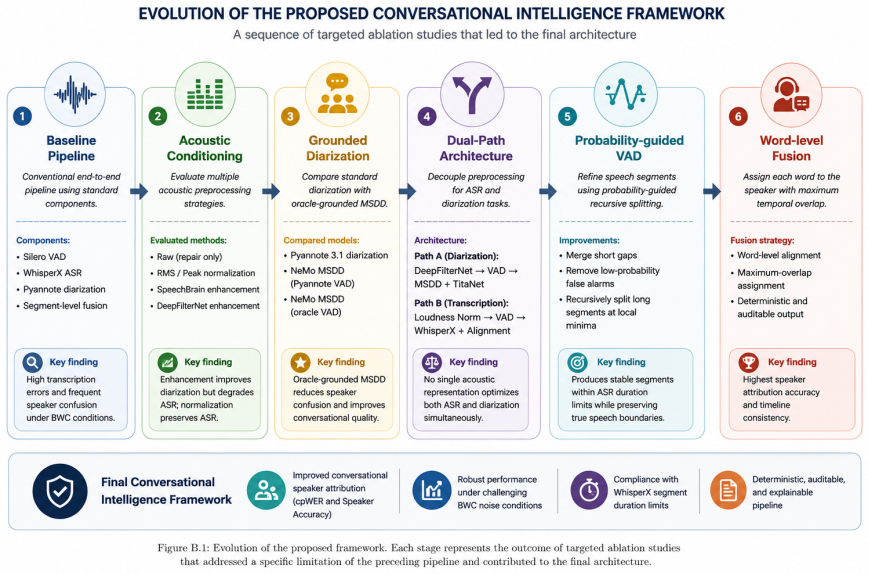
- [§5 / Table 8; Abstract] Table 8 vs. Abstract/§7: the paper's own headline comparison shows WER degrading from 0.2968 (baseline) to 0.3244 (proposed), yet the abstract claims the framework 'improve[s] speaker diarization, transcription, and word-level speaker attribution,' and §5.2/§7 repeat that the design improves transcription. On the transcription axis the central claim is contradicted by the authors' own numbers. Note also that Table 9 (Appendix B.2) reports a loudness-normalization configuration at WER 0.2975 and the Pyannote baseline in Table 11 at DER 0.411 — both better than the corresponding final-system figures (0.3244 and 0.4471). The authors must either (a) restate the claim accurately (the framework trades a modest WER increase for reduced speaker confusion and better timeline accuracy) and justify why that trade is desirable, or (b) provide evidence that the WER delta is not significant. As writte
- [§3.2 (Tables 1–2); §5.1.4 (Table 6); Table 8] The entire empirical case — main results (Tables 3–6), baseline comparison (Table 8), and every ablation (Tables 9–12) — rests on 8 recordings totaling 31 min 31 s with 484 reference words (Table 5). The reported gains are small in absolute terms: Speaker Accuracy 0.8981→0.9027 corresponds to roughly 2 of 484 words changing label; speaker confusion 0.0949→0.0771 is ~34 s of audio; DER 0.4516→0.4471 is ~8 s. No confidence intervals, no per-recording breakdown, and no significance testing are reported, so it is impossible to tell whether these deltas exceed what a single clip flipping would produce. At minimum the paper needs per-recording result tables and bootstrap CIs (or an equivalent resampling analysis) for Tables 6 and 8; without them the claim that the improvements are real rather than noise is unsupported.
- [§3.2, Table 2] Table 2 shows that only about 4 of 8 recordings are genuine BWC audio; the Dennis Skinner, Piers Morgan, and UK Parliament clips use professional/studio microphones, and the 'Karen Has A Problem' clip is a phone camera. All headline metrics are pooled across this mixture, so easy studio speech can mask flat or negative results on actual BWC audio — precisely the operational condition in the title and abstract. Since the corpus is small, reporting the BWC-only subset separately is cheap and should be mandatory; if the dual-path gains concentrate in the studio clips, the motivation for the architecture (the Enhancement Trap under BWC noise) is undermined rather than supported.
- [Appendix B (B.1–B.5); §5.1] Architecture selection and all hyperparameters (150 ms merge, 100 ms removal, 15–30 s split window, 28 s final-merge cap, 2 s merge gaps, −20 LUFS target) were tuned on the same 8 clips used for evaluation, and Appendix B documents that the final architecture was chosen by comparing candidate configurations on this corpus. This is adaptive analysis on the test set: the reported deltas may be selection artifacts rather than properties of the dual-path design. The paper should either (a) acknowledge this explicitly and reframe the results as a development-set study, or (b) add a held-out evaluation (even a small one, e.g., a few additional BWC videos not used during development). Option (b) is strongly preferable given that the central claim is comparative.
- [Appendix A (Table 8) vs. Appendix B.2/B.4 (Tables 9, 11)] There is a numerical inconsistency across the diarization ablations that needs reconciliation. Table 8 reports baseline DER 0.4516 (Pyannote 3.1 single-path), while Table 11 reports a 'Pyannote baseline' DER of 0.411, and Table 9 reports 0.4114 for loudness normalization. The footnotes state these are 'separate controlled experimental settings,' but the differences between these settings are never specified, so the reader cannot determine which numbers are comparable. Since Table 11 is the load-bearing evidence for choosing MSDD over Pyannote (confusion 0.110→0.078 at the cost of DER 0.411→0.449), the experimental conditions behind each row of Tables 9–11 must be stated precisely (preprocessing, VAD, and evaluation subset), or the ablations cannot be interpreted.
minor comments (8)
- [§5.1.4] Speaker Accuracy (§5.1.4) is defined 'after optimal one-to-one speaker mapping,' but the mapping procedure (e.g., Hungarian algorithm on the word-level confusion matrix) is never specified; this matters for reproducibility of the headline metric.
- [§5.1.4] Timeline Accuracy uses exact match of active-speaker sets at 10 ms frames; with overlapping speech this is a very strict criterion. Please state how overlap frames are annotated in the reference and whether a tolerance (e.g., the standard 250 ms diarization collar) is applied anywhere in DER/VAD scoring.
- [§3.1; §4] The paper claims a 'reproducible' and 'auditable' framework, but no code, annotation files, or corpus links (beyond the YouTube provenance in Table 2) appear to be released. Given the author-annotated ground truth, releasing the RTTM/transcript annotations and evaluation scripts would substantially strengthen the paper and address several concerns above.
- [§5.1.2] DER of ~45% and JER of 0.84 (Table 4) are very poor in absolute terms; the Discussion should be more candid that end-to-end performance is far from operational usability, especially since Miss+FA (not confusion) dominate.
- [§4.3, footnote 1] Terminology: 'Oracle RTTM' (§4.3) is potentially confusing since in the diarization literature 'oracle VAD' usually means ground-truth speech boundaries; here it means system-generated boundaries fed via oracle_vad=True. The footnote helps, but consider renaming to 'external-VAD' throughout.
- [§4, Figure 2; Table 3] Figure 2 is referenced but the description of information flow (shared VAD after branch-specific conditioning) is ambiguous about whether VAD is run twice (once per branch, as Table 3's two columns suggest) or once on a shared signal; §4.1 says both branches 'employ the proposed VAD pipeline' after conditioning, i.e., twice — please make this explicit and clarify what 'common temporal grounding' means if the two VAD outputs differ (Table 3 shows they do, slightly).
- [Throughout] Typos/formatting: 'Enhancement T rap' (§3.3, §5.2), missing spaces in several places ('adual-path', 'frameworkthat'), and the affiliations/date (July 2026) should be checked.
- [§2] §2 claims no open-source framework integrates these components for BWC audio; please cite and contrast with WhisperX's own diarization mode and NeMo's end-to-end speaker-attributed ASR examples to make the novelty statement precise.
Circularity Check
No derivation circularity: empirical systems pipeline with external ground-truth metrics; design choices are not self-defining predictions.
full rationale
This is an engineering/systems paper, not a first-principles derivation. The dual-path conditioning, probability-guided VAD splits, MSDD+TitaNet diarization, WhisperX ASR, and maximum-overlap fusion are proposed methods whose outputs are scored against manually annotated transcripts and RTTM references (Tables 3–6, 8). Speaker Accuracy, WER, DER, and Timeline Accuracy are standard external comparisons, not quantities forced by the definitions of the hyperparameters or fusion rule. Max-overlap attribution (Section 4.5) is a deterministic post-hoc assignment rule, not a claim that a fitted parameter predicts a related observable by construction. Citations (Whisper, WhisperX, Pyannote, NeMo MSDD, TitaNet, DeepFilterNet, ITU-R BS.1770) are third-party components; there is no load-bearing self-citation chain or author-imported uniqueness theorem. Naming the observed ASR–enhancement tradeoff the “Enhancement Trap” is descriptive labeling of ablation outcomes (Appendix B.2), not renaming a known law as a derived result. Ablating and selecting architecture/hyperparameters on the same 8-clip evaluation set is a serious generalization/validity concern, but it is not circularity under the stated criteria: the reported metrics do not reduce algebraically or by definition to the inputs. Score 0.
Assumptions & free parameters
free parameters (9)
- VAD adjacent-merge silence threshold =
150 ms
- Short-segment removal threshold =
100 ms
- WhisperX max segment / split search window =
max 30 s; window 15–30 s
- Final merge max duration and gap =
gap 150 ms; max 28 s
- Diarization same-speaker merge gap =
2 s
- Word-turn merge gap for attribution =
2 s
- LUFS target loudness =
−20 LUFS
- Pyannote onset/offset/hysteresis thresholds =
unspecified (model defaults)
- Nearest-segment fallback tolerance for non-overlapping words =
unspecified
assumptions (6)
- domain assumption Aggressive neural enhancement helps speaker embeddings/VAD but harms Whisper-class ASR on BWC-like audio (Enhancement Trap), so dual-path conditioning is required.
- domain assumption Pretrained DeepFilterNet, Pyannote VAD, TitaNet, NeMo MSDD, and Whisper Large-v3 transfer adequately to operational BWC without domain fine-tuning.
- domain assumption Maximum temporal overlap (with nearest-segment fallback) is a sufficient deterministic rule for word-level speaker attribution.
- ad hoc to paper Author-curated public YouTube clips with manual speaker-aware transcripts are an adequate proxy for operational police BWC evaluation.
- domain assumption Externally supplied Pyannote speech boundaries (NeMo oracle_vad mode) are preferable to MSDD’s internal VAD for common temporal grounding.
- standard math Standard evaluation definitions DER = Miss+FA+Confusion, WER = (S+D+I)/N, and speaker accuracy after optimal one-to-one mapping are the right success criteria.
invented entities (2)
-
Enhancement Trap (named phenomenon)
-
Probability-guided recursive min-cut VAD post-processing pipeline
Cite this review
Pith. "Pith review of Towards Operational Conversational Intelligence: A Speech Intelligence Framework." pith.science (2026). https://pith.science/paper/KD2CDDPI
@misc{pith2026260724958,
  author       = {Pith},
  title        = {Pith review of: Towards Operational Conversational Intelligence: A Speech Intelligence Framework},
  year         = {2026},
  howpublished = {\url{https://pith.science/paper/KD2CDDPI}},
  note         = {Machine review of arXiv:2607.24958}
}
read the original abstract
Body-worn camera (BWC) audio presents unique challenges including high ambient noise, variable recording conditions, and multiple overlapping speakers that make automated transcription and speaker labeling challenging. We propose a dual-path conversational intelligence framework that preprocesses raw BWC audio, separates the processing pipeline into a diarization branch and an ASR branch, and fuses their outputs. The diarization branch uses a denoising front-end (DeepFilterNet), voice activity detection (VAD), and NVIDIA's Multi-Scale Speaker Diarization Decoder (MSDD) with TitaNet embeddings. The transcription branch uses loudness normalization and WhisperX (Large-v3) with forced alignment and probability-guided speech segmentation. Finally, word-level speaker attribution is performed by assigning each recognized word to the speaker segment with the greatest temporal overlap. We evaluate the proposed framework on a curated body-worn camera dataset constructed from publicly available U.S. and U.K. police body-worn camera recordings. Experimental results demonstrate that task-specific acoustic conditioning and probability-guided speech segmentation improve speaker diarization, transcription, and word-level speaker attribution under challenging body-worn camera recording conditions. The proposed modular architecture provides an extensible foundation for future speaker-aware conversational intelligence systems.
Figures


Figures from the paper (1 more)
Reference graph
Works this paper leans on
-
[1]
Body-worn cameras in law enforcement agencies, 2016,
S. S. Hyland, “Body-worn cameras in law enforcement agencies, 2016,” Bureau of Justice Statistics, U.S. Department of Justice, Office of Justice Programs, Tech. Rep. NCJ 251775, Nov
2016
-
[2]
Video data analysis and police body-worn camera footage,
N. I. of Justice, “Video data analysis and police body-worn camera footage,” 2023, national Institute of Justice Resource. [Online]. Available: https://nij.ojp.gov/library/publications/ video-data-analysis-and-police-body-worn-camera-footage
2023
-
[3]
Video data analysis and police body-worn camera footage,
J. D. McCluskey and C. D. Uchida, “Video data analysis and police body-worn camera footage,” Sociological Methods & Research, vol. 52, no. 3, pp. 1120–1154, 2023
2023
-
[4]
An investigation into the reliability of speaker recognition schemes: Analysing the impact of environmental factors utilising deep learning techniques,
O. R. Khazaleh and L. A. Khrais, “An investigation into the reliability of speaker recognition schemes: Analysing the impact of environmental factors utilising deep learning techniques,” Journal of Engineering and Applied Science, vol. 71, no. 13, 2024
2024
-
[5]
Physical task stress and speaker variability in voice quality,
K. W. Godin and J. H. L. Hansen, “Physical task stress and speaker variability in voice quality,” EURASIP Journal on Audio, Speech, and Music Processing, vol. 2015, no. 1, 2015
2015
-
[6]
Impact of overlapping speech detection on speaker diarization for broadcast news and debates,
D. Charlet, C. Barras, and J. Liénard, “Impact of overlapping speech detection on speaker diarization for broadcast news and debates,” inProceedings of the IEEE International Conference on Acoustics, Speech and Signal Processing (ICASSP), 2013, pp. 7707–7711
2013
-
[7]
Robust speech recognition via large-scale weak supervision,
A. Radford, J. W. Kim, T. Xu, G. Brockman, C. McLeavey, and I. Sutskever, “Robust speech recognition via large-scale weak supervision,”arXiv preprint arXiv:2212.04356, 2022. [Online]. Available: https://arxiv.org/abs/2212.04356
arXiv 2022
-
[8]
Whisperx: Time-accurate speech transcription of long-form audio,
M. Bain, J. Huh, T. Han, and A. Zisserman, “Whisperx: Time-accurate speech transcription of long-form audio,” inProceedings of INTERSPEECH, 2023, pp. 4489–4493
2023
Show all 37 references
-
[9]
pyannote.audio: Neural building blocks for speaker diarization,
H. Bredin, R. Yin, J. M. Coria, G. Gelly, P. Korshunov, M. Lavechin, D. Fustes, H. Titeux, W. Bouaziz, and M.-P. Gill, “pyannote.audio: Neural building blocks for speaker diarization,” in Proceedings of the IEEE International Conference on Acoustics, Speech and Signal Processi...
2020
-
[10]
Multi-scale speaker diarization with dynamic scale weighting,
T. J. Park, N. R. Koluguri, J. Balam, and B. Ginsburg, “Multi-scale speaker diarization with dynamic scale weighting,” inProceedings of INTERSPEECH, 2022, pp. 5518–5522
2022
-
[11]
Librispeech: An asr corpus based on public domain audio books,
V. Panayotov, G. Chen, D. Povey, and S. Khudanpur, “Librispeech: An asr corpus based on public domain audio books,” inProceedings of the IEEE International Conference on Acoustics, Speech and Signal Processing (ICASSP), 2015, pp. 5206–5210
2015
-
[12]
The ami meeting corpus: A pre-announcement,
J. Carletta, S. Ashby, S. Bourbanet al., “The ami meeting corpus: A pre-announcement,” in Machine Learning for Multimodal Interaction, 2005
2005
-
[13]
Callhome american english speech,
Linguistic Data Consortium, “Callhome american english speech,” 1997, lDC97S42
1997
-
[14]
Spot the conversation: Speaker diarisation in the wild,
J. S. Chung, J. Huh, A. Nagrani, T. Afouras, and A. Zisserman, “Spot the conversation: Speaker diarisation in the wild,” inProceedings of INTERSPEECH, 2020, pp. 299–303
2020
-
[15]
Aishell-4: An open source dataset for speech enhancement, separation, recognition and speaker diarization in conference scenario,
Y. Fu, L. Cheng, S. Lv, Y. Jv, Y. Kong, Z. Chen, Y. Hu, L. Xie, J. Wu, H. Bu, X. Xu, J. Du, and J. Chen, “Aishell-4: An open source dataset for speech enhancement, separation, recognition and speaker diarization in conference scenario,” inProceedings of INTERSPEECH, 2021, pp. ...
2021
-
[16]
Iemocap: Interactive emotional dyadic motion capture database,
C. Busso, M. Bulut, C.-C. Lee, A. Kazemzadeh, E. Mower, S. Kim, J. N. Chang, S. Lee, and S. Narayanan, “Iemocap: Interactive emotional dyadic motion capture database,” inProceedings of the International Conference on Language Resources and Evaluation (LREC), 2008, pp. 2222–2229
2008
-
[17]
Building naturalistic emotionally balanced speech corpus by retrieving emotional speech from existing podcast recordings,
R. Lotfian and C. Busso, “Building naturalistic emotionally balanced speech corpus by retrieving emotional speech from existing podcast recordings,”IEEE Transactions on Affective Computing, vol. 10, no. 4, pp. 471–483, 2019
2019
-
[18]
Meld: A multimodal multi-party dataset for emotion recognition in conversations,
S. Poria, D. Hazarika, N. Majumder, G. Naik, E. Cambria, and R. Mihalcea, “Meld: A multimodal multi-party dataset for emotion recognition in conversations,” inProceedings of the 57th Annual Meeting of the Association for Computational Linguistics (ACL), 2019, pp. 527–536
2019
-
[19]
Body-worn camera video releases,
U.S. Customs and Border Protection, “Body-worn camera video releases,” https://www.cbp.gov/ newsroom/accountability-and-transparency/body-worn-camera-video-releases, 2024, accessed: 2026-07-14
2024
-
[20]
Deepfilternet: A low complexity speech enhancement framework for full-band audio based on deep filtering,
H. Schröter, A. N. Escalante-B., T. Rosenkranz, and A. Maier, “Deepfilternet: A low complexity speech enhancement framework for full-band audio based on deep filtering,” inProceedings of the IEEE International Conference on Acoustics, Speech and Signal Processing (ICASSP), 202...
2022
-
[21]
Titanet: Neural model for speaker representation with 1d depth-wise separable convolutions and global context,
N. R. Koluguri, T. Park, and B. Ginsburg, “Titanet: Neural model for speaker representation with 1d depth-wise separable convolutions and global context,” inProceedings of the IEEE International Conference on Acoustics, Speech and Signal Processing (ICASSP), 2022, pp. 6962–6966
2022
-
[22]
X-vectors: Robust dnn embeddings for speaker recognition,
D. Snyder, D. Garcia-Romero, G. Sell, D. Povey, and S. Khudanpur, “X-vectors: Robust dnn embeddings for speaker recognition,” inProceedings of the IEEE International Conference on Acoustics, Speech and Signal Processing (ICASSP), 2018, pp. 5329–5333
2018
-
[23]
Recommendation itu-r bs.1770-4: Algorithms to measure audio programme loudness and true-peak audio level,
International Telecommunication Union, “Recommendation itu-r bs.1770-4: Algorithms to measure audio programme loudness and true-peak audio level,” 2015
2015
-
[24]
Diarizationlm: Speaker diarization post-processing with large language models,
Q. Wang, Y. Huang, G. Zhao, E. Clark, W. Xia, and H. Liao, “Diarizationlm: Speaker diarization post-processing with large language models,” inProceedings of INTERSPEECH, 2024, pp. 3754–3758
2024
-
[25]
Enhancing speaker diarization with large language models: A contextual beam search approach,
T. J. Park, K. Dhawan, N. R. Koluguri, and J. Balam, “Enhancing speaker diarization with large language models: A contextual beam search approach,” inProceedings of the IEEE International Conference on Acoustics, Speech and Signal Processing (ICASSP), 2024
2024
-
[26]
The sound of healthcare: Improving medical transcription asr accuracy with large language models,
A. Adedeji, S. Joshi, and B. Doohan, “The sound of healthcare: Improving medical transcription asr accuracy with large language models,”arXiv preprint arXiv:2402.07658, 2024
2024 arXiv
-
[27]
Multi-view self-attention based transformer for speaker recognition,
R. Wang, J. Ao, L. Zhou, S. Liu, Z. Wei, T. Ko, Q. Li, and Y. Zhang, “Multi-view self-attention based transformer for speaker recognition,” inProceedings of the IEEE International Conference on Acoustics, Speech and Signal Processing (ICASSP), 2022, pp. 6732–6736
2022
-
[28]
Ad- vancing speaker embedding learning: Wespeaker toolkit for research and production,
H. Wang, C. Liang, S. Wang, Z. Chen, B. Zhang, X. Xiang, Y. Deng, and Y. Qian, “Ad- vancing speaker embedding learning: Wespeaker toolkit for research and production,”Speech Communication, vol. 162, p. 103104, 2024. 25
2024
-
[29]
Arcface: Additive angular margin loss for deep face recognition,
J. Deng, J. Guo, N. Xue, and S. Zafeiriou, “Arcface: Additive angular margin loss for deep face recognition,” inProceedings of the IEEE/CVF Conference on Computer Vision and Pattern Recognition (CVPR), 2019, pp. 4690–4699
2019
-
[30]
Facenet: A unified embedding for face recognition and clustering,
F. Schroff, D. Kalenichenko, and J. Philbin, “Facenet: A unified embedding for face recognition and clustering,” inProceedings of the IEEE Conference on Computer Vision and Pattern Recognition (CVPR), 2015, pp. 815–823
2015
-
[31]
A discriminative feature learning approach for deep face recognition,
Y. Wen, K. Zhang, Z. Li, and Y. Qiao, “A discriminative feature learning approach for deep face recognition,” inEuropean Conference on Computer Vision (ECCV), 2016, pp. 499–515. 26 A Baseline Pipeline Comparison To place the proposed framework in context, we compare it with th...
2016
-
[33]
Acoustic conditioning.Initial experiments evaluated several preprocessing strategies, includ- ing conventional normalization techniques, DeepFilterNet-based enhancement, and SpeechBrain enhancement, in order to determine their respective effects on automatic speech recognition...
-
[34]
Speaker diarization.The performance of conventional Pyannote-based diarization was subsequently compared with Oracle-grounded NeMo Multi-Scale Speaker Diarization Decoder (MSDD), thereby isolating the effect of externally supplied speech boundaries
-
[35]
Dual-path processing.The conflicting behaviour observed between speech enhancement and transcription motivated the introduction of separate processing branches for automatic speech recognition and speaker diarization
-
[36]
Probability-guided speech segmentation.The final architectural refinement introduced probability-guided recursive segment splitting, allowing the temporal segmentation produced by Pyannote to satisfy WhisperX duration constraints while preserving low-confidence transition regions
-
[37]
Full DeepFilterNet pipeline
Speaker attribution.A deterministic word-level maximum-overlap fusion strategy was introduced to generate the final speaker-attributed conversational transcript, replacing earlier segment-level speaker assignment strategies explored during development. Collectively, these stud...
-
[2018]
Available: https://bjs.ojp.gov/content/pub/pdf/bwclea16.pdf
[Online]. Available: https://bjs.ojp.gov/content/pub/pdf/bwclea16.pdf
Reviewed July 31, 2026 · model on record in the stance chip above.
Discussion (0). Continue with ORCID to comment.