REVIEW 4 major objections 5 minor 153 references
Efficiently Manipulating Clutter via Learning and Search-Based Reasoning
T0 review · 4 major / 5 minor · reviewed 2026-08-15 · deepseek-v4-flash
Pith's one-line read The dissertation argues that a learned push predictor combined with multi-step tree search solves clutter removal, object retrieval, and tabletop rearrangement with fewer actions and substantially less planning time.
desk verdict A competent dissertation that compiles five prior papers; useful as a readable summary of the author's line of work, but the claims about generality and speedups overstate what the evidence supports. read the letter →
The pith
A machine-rendered reading of the paper's core claim, the machinery that carries it, and where it could break.
The reading
What carries the argument
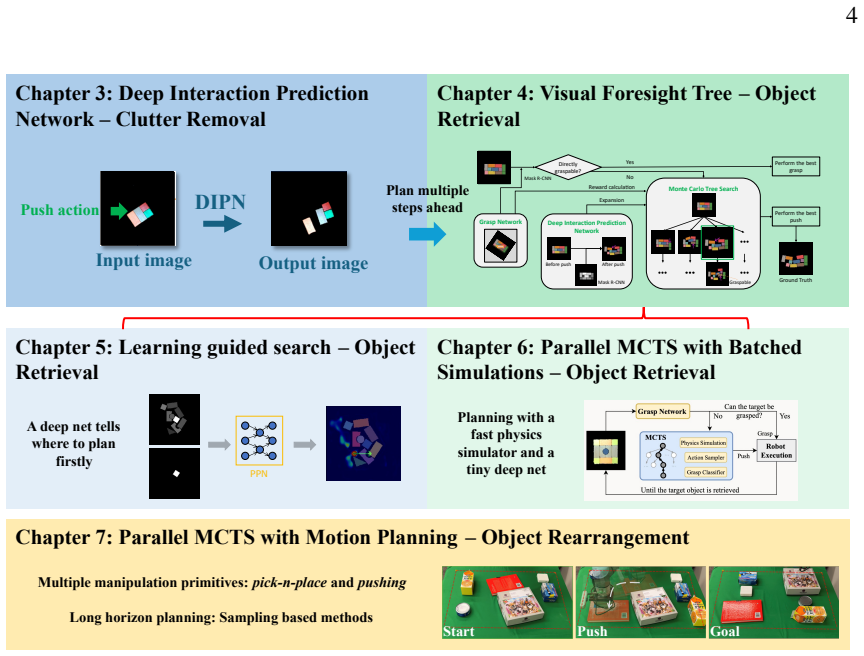
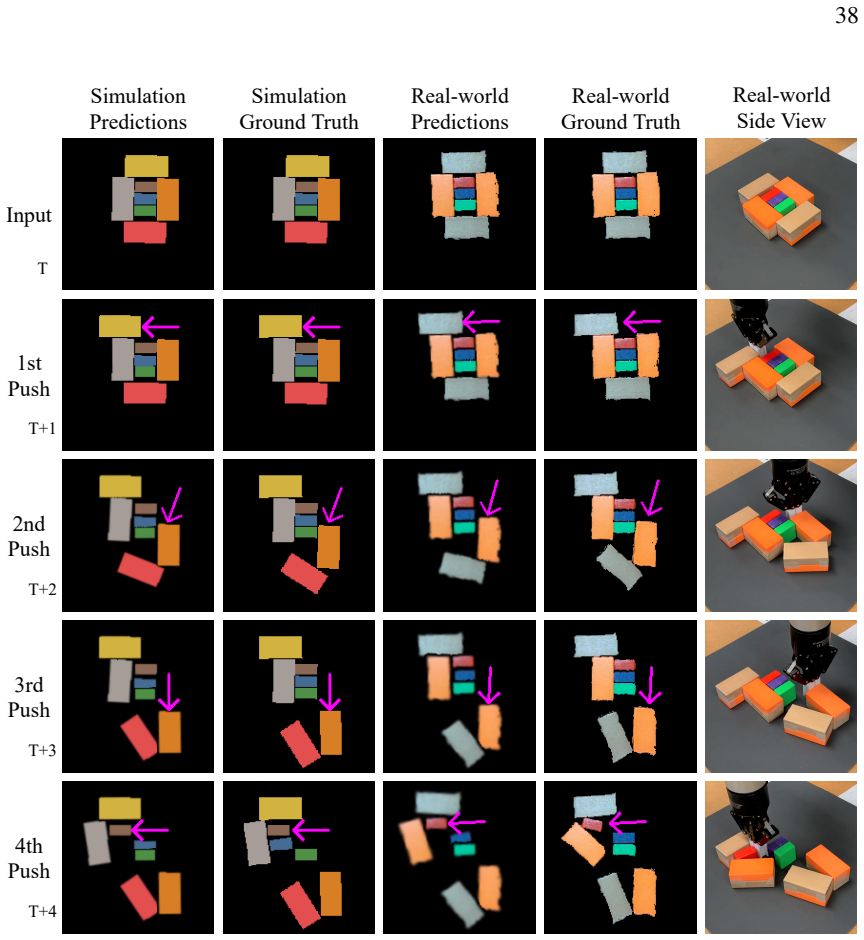
The central mechanism is the learned forward model used as the transition function of a tree search. DIPN takes the current image, per-object masks, and a candidate push, and outputs a predicted translation and rotation for each object, then re-renders those movements into a synthetic post-push image. That image is scored by a grasp network, allowing the search to evaluate whether a push brings the target closer to graspable. Around this core, the thesis layers three search-side mechanisms: Visual Foresight Trees run MCTS with DIPN as the simulator; MORE uses the search's own Q-values as self-supervised labels to train a fast push-policy network (PPN) that guides later searches; and PMBS parallelizes MCTS by batching thousands of independent physics simulations on a GPU, using virtual loss to keep parallel selections from duplicating each other. The final chapter generalizes the same search architecture to actions that mix pick-and-place and push.
What would settle it
Run the same pipeline on a test set where objects have substantially different mass, friction, or deformability (for example cloth or crumpled paper) and where the target needs more than four pushes; if completion rates drop well below the 100% reported for wood blocks, the learned forward model and simulation-transfer assumptions are the weak link.
Extended reading notes
Core claim
On the paper's own terms, the central discovery is that object-interaction prediction and tree search are complementary: DIPN supplies a fast and legible model of push outcomes (over 90% average IoU on single-push prediction), and MCTS supplies the multi-step reasoning that turns those predictions into a minimal sequence of pushes before a grasp. The dissertation demonstrates the combination in escalating settings: clutter removal (DIPN+GN reaches 100% completion on hard instances in simulation), object retrieval (Visual Foresight Trees use 2.45 actions on average on 22 hard cases; MORE cuts planning time while matching solution quality; PMBS achieves over a 30x speedup with better solution quality than serial MCTS), and tabletop rearrangement with mixed push and pick-n-place primitives (PMMR completes 98% of simulated and 96.4% of real-robot cases). Real-robot tests are reported as transferring from simulation with minimal loss.
Load-bearing premise
The load-bearing premise is that the hand-built wood-block test cases and the physics simulator used for training and planning represent the real robot's world closely enough that actions chosen in simulation transfer to physical execution without modification.
Editorial extensions
If this is right
- A robot can defer grasping until several pushes have created clearance, replacing greedy push-or-grasp decisions with planned sequences.
- Because the forward model is learned from data rather than hand-tuned physics parameters, the same pipeline can transfer to new objects and to a physical robot with modest retraining.
- Parallel batched simulation turns search from a minutes-per-decision bottleneck into a few-seconds-per-decision operation, making the approach viable in percept-plan-act loops.
- Once a search policy is distilled into a fast push-policy network, planning cost falls further without sacrificing the number of actions used to complete a task.
Reading between the lines
- Beyond the paper: if forward-model accuracy is the binding constraint, replacing the learned predictor with a differentiable simulator or training on more diverse object properties should extend the same search recipe to deformable and articulated objects.
- Beyond the paper: the 30x speedup suggests that search-based manipulation planning is hardware-limited rather than algorithm-limited; as GPU simulation grows cheaper, the same algorithm should scale to re-planning in dynamic scenes.
- Beyond the paper: MORE's search-then-distill loop could be iterated indefinitely, using a bootstrapped policy to make search deeper and generate better training labels; a direct test would measure solution quality as a function of the number of search-and-train rounds.
Signed reviews
Editorial analysis
A structured set of objections, weighed in public.
Referee Report
Summary. The dissertation develops a sequence of algorithms for robotic manipulation in clutter, centered on integrating learned push prediction with search-based planning: DIPN for single-step push outcome prediction, VFT (an MCTS-DIPN hybrid) for object retrieval, MORE for self-supervised learning-guided MCTS, PMBS for GPU-parallel MCTS with batched rigid-body simulations, and HBFS/PMMR for multi-primitive tabletop rearrangement. The central claims are that DIPN achieves over 90% IoU accuracy in push prediction, that the integrated systems attain 100% completion on challenging retrieval scenarios with fewer actions than prior baselines, and that PMBS attains over 30x planning speedups while maintaining or improving solution quality. Evaluation is performed in PyBullet, CoppeliaSim, and Isaac Gym, and on a UR5e with a Robotiq 2F-85 gripper and a RealSense camera.
Significance. If the stated results hold, the thesis demonstrates a credible route to combining learned interaction models with look-ahead search for long-horizon manipulation planning, and the PMBS framework addresses a genuine computational bottleneck in MCTS-based planning. The work includes commendable elements: fully self-supervised data collection for the perception and prediction networks, detailed pseudo-code, extensive ablation studies, and real-robot experiments that go beyond the simulation benchmarks. However, the headline comparisons and the generalization claims need to be substantially tightened before the contributions can be accepted at face value. In particular, the 'over 30x speedup' claim rests on an apples-to-oranges comparison across different time budgets, and the baseline comparisons rely on numbers quoted from prior papers under different experimental setups.
major comments (4)
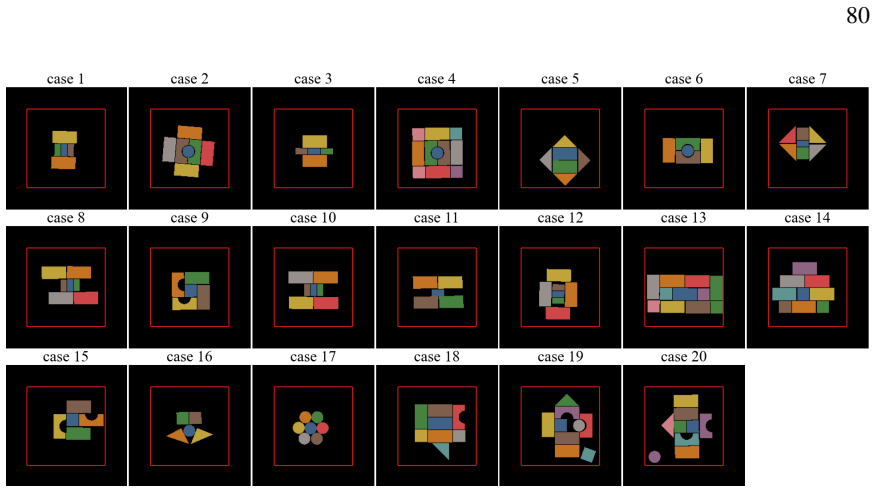
- [§4.4.1, Table 4.1, Figure 4.5] The test-case counts are internally inconsistent. Section 4.4.1 states that the test set includes 'the full set of 14 test cases from [48]' plus 18 hand-designed cases (32 total), yet Figure 4.5 and Table 4.1 report on '10 test cases from [48]', and the text later says the harder set contains '18 manually designed instances and 4 cases from [48]' (22 total). Because Tables 4.1 and 5.2 compare against go-PGN results quoted from [48], the reader cannot determine whether the comparison is on the same cases. Please reconcile these counts and specify exactly which cases were used for each comparison.
- [§6.4.1, Figure 6.8] The 'over 30x speedup' claim in the abstract and Chapter 6 is not supported by the experimental design as reported. The 855/28 = 30x figure compares PMBS with a 15-second budget (28s mean planning time) to serial MCTS with a 480-second budget (855s mean planning time). At matched time budgets, Table 6.1 reports 35s versus 301s for PMBS-60 versus MCTS-60, an 8.6x speedup. The 30x claim therefore conflates different operating points and should either be reported as a matched-solution-quality comparison at different budgets or be replaced with the matched-budget number.
- [§6.4.2, Appendix A] The claim of 'minimal sim-to-real performance loss' is based on only six hand-selected cases with known object models and pose estimation (Table 6.2), and the two appendix case studies are anecdotal, with one showing a case where 'the simulator does not provide accurate physics'. Since the dissertation's broader framing claims applicability to 'unstructured real-world settings' (Chapter 1 and Chapter 8), the generalization claim is load-bearing and is not established. Please either provide a quantitative evaluation across a more diverse set of objects, frictions, and arrangements, or explicitly narrow the scope of the conclusions to the tested regime.
- [§4.4.3, §5.4.1] The comparisons to gc-VPG and go-PGN rely on results quoted from [48] rather than local reimplementation, under experimental differences that include a 13cm versus 5cm effective push distance, a different gripper (RD2 versus 2F-85), and a different simulator (CoppeliaSim versus PyBullet). The statement that these differences 'do not provide our algorithm an unfair advantage' is not supported by any sensitivity analysis. Because the state-of-the-art claim depends on these numbers, please either reimplement the baselines locally or provide a quantitative discussion of how the setup differences could bias the comparison.
minor comments (5)
- [Table 6.1] The header says 'Time budgets are limited up to 60 seconds', yet the PMBS-60 (c=0) row reports a planning time of 113 seconds. Please clarify whether the budget applies per decision step or per episode, and explain why the mean planning time can exceed the stated budget.
- [Tables 3.1, 4.1-4.4, 5.1-5.3, 6.1-6.2] Most aggregate tables report only mean values without variance or confidence intervals. Given that the accompanying figures show nontrivial trial-to-trial variability, please add error bars, standard deviations, or per-trial data for the key metrics.
- [§4.4.1, §6.3.2] The grasp threshold is set to 0.8 in simulation and 0.7 in the real experiments in Chapter 4, and the grasp classifier threshold R*_c is set to 0.9 in Chapter 6. The sensitivity of the results to these hand-picked thresholds is not analyzed. A brief threshold sensitivity study would strengthen the reproducibility of the results.
- [§7.4.3, Table 7.3] The footnote states that robot time is 'recorded only for successful cases', which makes the comparison between PMMR-40 and HBFS on execution time hard to interpret. Please report the number of successful trials behind each mean and, ideally, the distribution of execution times.
- [§6.1] The introduction to Chapter 6 refers to 'MoJuCo' where the intended simulator name is 'MuJoCo'. Please correct this typo.
Circularity Check
No significant circularity: the dissertation's predictions and planning claims are validated against independent simulation and real-robot outcomes, not against their own inputs.
full rationale
The derivation chain is empirical rather than definitional. DIPN is trained on random-push data and evaluated by IoU against ground-truth post-push states (Section 3.4.1); GN is trained on grasp success/failure and used only as a reward estimator, with final task success measured by completion, grasp success, and action efficiency (Section 3.4.3). VFT uses the learned DIPN as a transition model inside MCTS, but terminal rewards come from GN on predicted states and are back-propagated; the benchmark cases are independent hand-designed arrangements (Figure 4.4). Chapter 5's PPN is a student network trained on MCTS Q-values and then used as a search prior; this is self-distillation, not circular reduction, because the reported metrics (number of actions, planning time, completion, grasp success) are evaluated by executing or simulating the resulting actions and are not equal to PPN's training labels by construction. PMBS speedups are wall-clock comparisons against a serial MCTS baseline using identical hardware, with solution quality measured by external simulation and robot execution. The only self-citations are to the author's own prior chapters, but those chapters are reproduced in the dissertation and the claims do not rest on an unverified uniqueness theorem or on a fitted parameter being renamed as a prediction. Acknowledged limitations (known object models, wood-block test corpus, small sim-to-real gap) are generality concerns, not circularity.
Assumptions & free parameters
free parameters (7)
- Discount factor gamma =
0.9 (Ch3), 0.8 (Ch4, Ch6), 0.5 (Ch5), 0.9 (Ch7)
- Grasp threshold R*_g =
0.8 simulation, 0.7 real (Ch4); 0.7 (Ch3)
- MCTS iteration budget Nmax =
150 (Ch4), 300 (Ch5 data collection), 50 (Ch5 eval), 10 (Ch5 real), 60s (Ch6), 40s (Ch7)
- Push distance =
5 cm effective (Ch4), 10 cm (Ch5), 5 cm (Ch6), 7.4 cm training (Ch4)
- UCB exploration constant C =
2 (Ch4, Ch5), 0.3 (Ch6), 1.5 (Ch7)
- Top-m rollouts m =
3 (Ch4), 10 (Ch5), 100 (Ch7)
- Reward shaping parameters (ro, Rg, beta, gamma) =
ro=0.7, Rg=2roN, beta=0.5, gamma=0.9 (Ch7)
assumptions (5)
- domain assumption Objects are rigid and manipulation primitives are quasi-static.
- domain assumption Simulation (PyBullet, Isaac Gym) and learned models transfer to the real robot with negligible sim-to-real gap.
- domain assumption Object models and poses are known for planning.
- ad hoc to paper Hand-designed test cases are representative of the target tasks.
- standard math Standard supervised learning assumptions (i.i.d. training data, generalization to test scenes).
Cite this review
Pith. "Pith review of Efficiently Manipulating Clutter via Learning and Search-Based Reasoning." pith.science (2026). https://pith.science/paper/KDVZMJAH
@misc{pith2026250508853,
  author       = {Pith},
  title        = {Pith review of: Efficiently Manipulating Clutter via Learning and Search-Based Reasoning},
  year         = {2026},
  howpublished = {\url{https://pith.science/paper/KDVZMJAH}},
  note         = {Machine review of arXiv:2505.08853}
}
read the original abstract
This thesis presents novel algorithms to advance robotic object rearrangement, a critical task for autonomous systems in applications like warehouse automation and household assistance. Addressing challenges of high-dimensional planning, complex object interactions, and computational demands, our work integrates deep learning for interaction prediction, tree search for action sequencing, and parallelized computation for efficiency. Key contributions include the Deep Interaction Prediction Network (DIPN) for accurate push motion forecasting (over 90% accuracy), its synergistic integration with Monte Carlo Tree Search (MCTS) for effective non-prehensile object retrieval (100% completion in specific challenging scenarios), and the Parallel MCTS with Batched Simulations (PMBS) framework, which achieves substantial planning speed-up while maintaining or improving solution quality. The research further explores combining diverse manipulation primitives, validated extensively through simulated and real-world experiments.
Figures


Figures from the paper (90 more)















Reference graph
Works this paper leans on
-
[48]
Efficient learning of goal-oriented push-grasping synergy in clutter,
K. Xu, H. Yu, Q. Lai, Y. Wang, and R. Xiong, “Efficient learning of goal-oriented push-grasping synergy in clutter,” IEEE Robotics and Automation Letters, vol. 6, no. 4, pp. 6337–6344, 2021
2021
-
[1]
Toward robotic manipulation,
M. T. Mason, “Toward robotic manipulation,”Annual Review of Control, Robotics, and Autonomous Systems, vol. 1, no. 1, pp. 1–28, 2018
2018
-
[2]
Robotized and automated warehouse systems: Review and recent developments,
K. Azadeh, R. De Koster, and D. Roy, “Robotized and automated warehouse systems: Review and recent developments,”Transportation Science, vol. 53, no. 4, pp. 917– 945, 2019
2019
-
[3]
Medical robotics and computer-integrated surgery,
R. H. Taylor, A. Menciassi, G. Fichtinger, P. Fiorini, and P. Dario, “Medical robotics and computer-integrated surgery,” Springer handbook of robotics, pp. 1657–1684, 2016
2016
-
[4]
Progress and prospects of the human–robot collaboration,
A. Ajoudani, A. M. Zanchettin, S. Ivaldi, A. Albu-Sch ¨affer, K. Kosuge, and O. Khatib, “Progress and prospects of the human–robot collaboration,” Autonomous robots, vol. 42, pp. 957–975, 2018
2018
-
[5]
Cooperative search and rescue with a team of mobile robots,
J. S. Jennings, G. Whelan, and W. F. Evans, “Cooperative search and rescue with a team of mobile robots,” in 1997 8th International Conference on Advanced Robotics. Proceedings. ICAR’97, IEEE, 1997, pp. 193–200
1997
-
[6]
Dex-net 3.0: Computing robust vacuum suction grasp targets in point clouds using a new analytic model and deep learning,
J. Mahler, M. Matl, X. Liu, A. Li, D. Gealy, and K. Goldberg, “Dex-net 3.0: Computing robust vacuum suction grasp targets in point clouds using a new analytic model and deep learning,” in 2018 IEEE International Conference on robotics and automation (ICRA), IEEE, 2018, pp. 5620–5627
2018
-
[7]
Fusebot: Rf-visual mechanical search,
T. Boroushaki, L. Dodds, N. Naeem, and F. Adib, “Fusebot: Rf-visual mechanical search,” Robotics: Science and Systems 2022, 2022
2022
Show all 153 references
-
[8]
Dealing with difficult instances of object rearrange- ment.,
A. Krontiris and K. E. Bekris, “Dealing with difficult instances of object rearrange- ment.,” in Robotics: Science and Systems, vol. 1123, 2015
2015
-
[9]
Dynamic grasp and trajectory planning for moving objects,
N. Marturi, M. Kopicki, A. Rastegarpanah, et al., “Dynamic grasp and trajectory planning for moving objects,”Autonomous Robots, vol. 43, pp. 1241–1256, 2019
2019
-
[10]
Learning dexterous in-hand manipulation,
O. M. Andrychowicz, B. Baker, M. Chociej, et al., “Learning dexterous in-hand manipulation,” The International Journal of Robotics Research , vol. 39, no. 1, pp. 3–20, 2020
2020
-
[11]
From caging to grasping,
A. Rodriguez, M. T. Mason, and S. Ferry, “From caging to grasping,” The Interna- tional Journal of Robotics Research, vol. 31, no. 7, pp. 886–900, 2012. 111
2012
-
[12]
Dipn: Deep interaction prediction network with application to clutter removal,
B. Huang, S. D. Han, A. Boularias, and J. Yu, “Dipn: Deep interaction prediction network with application to clutter removal,” in2021 IEEE International Conference on Robotics and Automation (ICRA), IEEE, 2021, pp. 4694–4701
2021
-
[14]
Toward optimal tabletop rearrangement with multiple manipulation primitives,
B. Huang, X. Zhang, and J. Yu, “Toward optimal tabletop rearrangement with multiple manipulation primitives,” in 2024 IEEE International Conference on Robotics and Automation (ICRA), IEEE, 2024, pp. 10 860–10 866
2024
-
[15]
Lgmcts: Language-guided monte- carlo tree search for executable semantic object rearrangement,
H. Chang, K. Gao, K. Boyalakuntla, et al., “Lgmcts: Language-guided monte- carlo tree search for executable semantic object rearrangement,” in2024 IEEE/RSJ International Conference on Intelligent Robots and Systems (IROS), IEEE, 2024, pp. 13 607–13 612
2024
-
[16]
Visual foresight trees for ob- ject retrieval from clutter with nonprehensile rearrangement,
B. Huang, S. D. Han, J. Yu, and A. Boularias, “Visual foresight trees for ob- ject retrieval from clutter with nonprehensile rearrangement,” IEEE Robotics and Automation Letters, vol. 7, no. 1, pp. 231–238, 2021
2021
-
[17]
Toward fully automated metal recycling using computer vision and non-prehensile manipulation,
S. D. Han, B. Huang, S. Ding, et al., “Toward fully automated metal recycling using computer vision and non-prehensile manipulation,” in 2021 IEEE 17th International Conference on Automation Science and Engineering (CASE), IEEE, 2021, pp. 891– 898
2021
-
[18]
Fast high-quality tabletop rearrangement in bounded workspace,
K. Gao, D. Lau, B. Huang, K. E. Bekris, and J. Yu, “Fast high-quality tabletop rearrangement in bounded workspace,” in2022 International Conference on Robotics and Automation (ICRA), IEEE, 2022, pp. 1961–1967
2022
-
[19]
Interleaving monte carlo tree search and self-supervised learning for object retrieval in clutter,
B. Huang, T. Guo, A. Boularias, and J. Yu, “Interleaving monte carlo tree search and self-supervised learning for object retrieval in clutter,” in 2022 International Conference on Robotics and Automation (ICRA), IEEE, 2022, pp. 625–632
2022
-
[20]
Stackelberg strategic guidance for hetero- geneous robots collaboration,
Y. Zhao, B. Huang, J. Yu, and Q. Zhu, “Stackelberg strategic guidance for hetero- geneous robots collaboration,” in 2022 International Conference on Robotics and Automation (ICRA), IEEE, 2022, pp. 4922–4928
2022
-
[21]
Parallel monte carlo tree search with batched rigid-body simulations for speeding up long-horizon episodic robot planning,
B. Huang, A. Boularias, and J. Yu, “Parallel monte carlo tree search with batched rigid-body simulations for speeding up long-horizon episodic robot planning,” in 2022 IEEE/RSJ International Conference on Intelligent Robots and Systems (IROS), IEEE, 2022, pp. 1153–1160. 112
2022
-
[22]
Earl: Eye-on-hand reinforcement learner for dynamic grasping with active pose estimation,
B. Huang, J. Yu, and S. Jain, “Earl: Eye-on-hand reinforcement learner for dynamic grasping with active pose estimation,” in 2023 IEEE/RSJ International Conference on Intelligent Robots and Systems (IROS), IEEE, 2023, pp. 2963–2970
2023
-
[23]
Learning generalizable pivoting skills,
X. Zhang, S. Jain, B. Huang, M. Tomizuka, and D. Romeres, “Learning generalizable pivoting skills,” in2023 IEEE International Conference on Robotics and Automation (ICRA), IEEE, 2023, pp. 5865–5871
2023
-
[24]
Robotic grasping and contact: A review,
A. Bicchi and V. Kumar, “Robotic grasping and contact: A review,” inProceedings 2000 ICRA. Millennium conference. IEEE international conference on robotics and automation. Symposia proceedings (Cat. No. 00CH37065), IEEE, vol. 1, 2000, pp. 348–353
2000
-
[25]
A probabilistic data-driven model for planar pushing,
M. Bauza and A. Rodriguez, “A probabilistic data-driven model for planar pushing,” in 2017 IEEE International Conference on Robotics and Automation (ICRA), IEEE, 2017, pp. 3008–3015
2017
-
[26]
Towards robust product packing with a minimalistic end-effector,
R. Shome, W. N. Tang, C. Song, et al., “Towards robust product packing with a minimalistic end-effector,” in 2019 International Conference on Robotics and Automation (ICRA), IEEE, 2019, pp. 9007–9013
2019
-
[27]
Learning synergies between pushing and grasping with self-supervised deep reinforcement learning,
A. Zeng, S. Song, S. Welker, J. Lee, A. Rodriguez, and T. Funkhouser, “Learning synergies between pushing and grasping with self-supervised deep reinforcement learning,” in 2018 IEEE/RSJ International Conference on Intelligent Robots and Systems (IROS), IEEE, 2018, pp. 4238–4245
2018
-
[28]
Pre-grasp sliding manipulation of thin objects using soft, compliant, or underactuated hands,
K. Hang, A. S. Morgan, and A. M. Dollar, “Pre-grasp sliding manipulation of thin objects using soft, compliant, or underactuated hands,” IEEE Robotics and Automation Letters, vol. 4, no. 2, pp. 662–669, 2019
2019
-
[29]
Object search by manipulation,
M. R. Dogar, M. C. Koval, A. Tallavajhula, and S. S. Srinivasa, “Object search by manipulation,” Autonomous Robots, vol. 36, pp. 153–167, 2014
2014
-
[30]
Robust planar dynamic pivoting by regulating inertial and grip forces,
Y. Hou, Z. Jia, A. M. Johnson, and M. T. Mason, “Robust planar dynamic pivoting by regulating inertial and grip forces,” in Algorithmic Foundations of Robotics XII: Proceedings of the Twelfth Workshop on the Algorithmic Foundations of Robotics, Springer, 2020, pp. 464–479
2020
-
[31]
Manipulation of unknown objects via contact configuration regulation,
N. Doshi, O. Taylor, and A. Rodriguez, “Manipulation of unknown objects via contact configuration regulation,” in 2022 International Conference on Robotics and Automation (ICRA), IEEE, 2022, pp. 2693–2699
2022
-
[32]
Data-driven grasp synthesis—a survey,
J. Bohg, A. Morales, T. Asfour, and D. Kragic, “Data-driven grasp synthesis—a survey,” IEEE Transactions on robotics, vol. 30, no. 2, pp. 289–309, 2013. 113
2013
-
[33]
Learning a dictionary of prototypical grasp-predicting parts from grasping experience,
R. Detry, C. H. Ek, M. Madry, and D. Kragic, “Learning a dictionary of prototypical grasp-predicting parts from grasping experience,” in 2013 IEEE International Conference on Robotics and Automation, IEEE, 2013, pp. 601–608
2013
-
[34]
Deep learning for detecting robotic grasps,
I. Lenz, H. Lee, and A. Saxena, “Deep learning for detecting robotic grasps,”The International Journal of Robotics Research, vol. 34, no. 4-5, pp. 705–724, 2015
2015
-
[35]
Leveraging big data for grasp planning,
D. Kappler, J. Bohg, and S. Schaal, “Leveraging big data for grasp planning,” in 2015 IEEE international conference on robotics and automation (ICRA) , IEEE, 2015, pp. 4304–4311
2015
-
[36]
Learning 6-dof grasping interaction via deep 3d geometry-aware representations,
X. Yan, J. Hsu, M. Khansari,et al., “Learning 6-dof grasping interaction via deep 3d geometry-aware representations,” in Proceedings of IEEE International Conference on Robotics and Automation (ICRA 2018), 2018
2018
-
[37]
6-dof graspnet: Variational grasp generation for object manipulation,
A. Mousavian, C. Eppner, and D. Fox, “6-dof graspnet: Variational grasp generation for object manipulation,” in Proceedings of the IEEE/CVF international conference on computer vision, 2019, pp. 2901–2910
2019
-
[38]
Pointnetgpd: Detecting grasp configurations from point sets,
H. Liang, X. Ma, S. Li, et al., “Pointnetgpd: Detecting grasp configurations from point sets,” in 2019 International Conference on Robotics and Automation (ICRA), IEEE, 2019, pp. 3629–3635
2019
-
[39]
Using geometry to detect grasp poses in 3d point clouds,
A. Ten Pas and R. Platt, “Using geometry to detect grasp poses in 3d point clouds,” Robotics Research: Volume 1, pp. 307–324, 2018
2018
-
[40]
Supersizing self-supervision: Learning to grasp from 50k tries and 700 robot hours,
L. Pinto and A. Gupta, “Supersizing self-supervision: Learning to grasp from 50k tries and 700 robot hours,” in 2016 IEEE international conference on robotics and automation (ICRA), IEEE, 2016, pp. 3406–3413
2016
-
[41]
Learning deep policies for robot bin picking by simulating robust grasping sequences,
J. Mahler and K. Goldberg, “Learning deep policies for robot bin picking by simulating robust grasping sequences,” in Conference on robot learning, PMLR, 2017, pp. 515–524
2017
-
[42]
Graspnet-1billion: A large-scale bench- mark for general object grasping,
H.-S. Fang, C. Wang, M. Gou, and C. Lu, “Graspnet-1billion: A large-scale bench- mark for general object grasping,” in Proceedings of the IEEE/CVF Conference on Computer Vision and Pattern Recognition, 2020, pp. 11 444–11 453
2020
-
[43]
Efficient optimization for autonomous robotic manipulation of natural objects,
A. Boularias, J. Bagnell, and A. Stentz, “Efficient optimization for autonomous robotic manipulation of natural objects,” in Proceedings of the AAAI Conference on Artificial Intelligence, vol. 28, 2014
2014
-
[44]
Catgrasp: Learning category-level task-relevant grasping in clutter from simulation,
B. Wen, W. Lian, K. Bekris, and S. Schaal, “Catgrasp: Learning category-level task-relevant grasping in clutter from simulation,” in 2022 International Conference on Robotics and Automation (ICRA), IEEE, 2022, pp. 6401–6408. 114
2022
-
[45]
Dex-net 2.0: Deep learning to plan robust grasps with synthetic point clouds and analytic grasp metrics,
J. Mahler, J. Liang, S. Niyaz, et al., “Dex-net 2.0: Deep learning to plan robust grasps with synthetic point clouds and analytic grasp metrics,” arXiv preprint arXiv:1703.09312, 2017
2017 arXiv
-
[46]
Learning ambidextrous robot grasping policies,
J. Mahler, M. Matl, V. Satish,et al., “Learning ambidextrous robot grasping policies,” Science Robotics, vol. 4, no. 26, eaau4984, 2019
2019
-
[47]
Deep reinforcement learning for robotic pushing and picking in cluttered environment,
Y. Deng, X. Guo, Y. Wei,et al., “Deep reinforcement learning for robotic pushing and picking in cluttered environment,” in 2019 IEEE/RSJ International Conference on Intelligent Robots and Systems (IROS), Ieee, 2019, pp. 619–626
2019
-
[49]
Let’s push things forward: A survey on robot pushing,
J. St¨ uber, C. Zito, and R. Stolkin, “Let’s push things forward: A survey on robot pushing,” Frontiers in Robotics and AI, vol. 7, p. 8, 2020
2020
-
[50]
Estimating the friction parameters of pushed objects,
K. M. Lynch, “Estimating the friction parameters of pushed objects,” inProceedings of 1993 IEEE/RSJ International Conference on Intelligent Robots and Systems (IROS’93), IEEE, vol. 1, 1993, pp. 186–193
1993
-
[51]
Mechanics and planning of manipulator pushing operations,
M. T. Mason, “Mechanics and planning of manipulator pushing operations,” The International Journal of Robotics Research, vol. 5, no. 3, pp. 53–71, 1986
1986
-
[52]
Stable pushing: Mechanics, controllability, and planning,
K. M. Lynch and M. T. Mason, “Stable pushing: Mechanics, controllability, and planning,” The international journal of robotics research, vol. 15, no. 6, pp. 533–556, 1996
1996
-
[53]
Dynamic nonprehensile manipulation: Controllabil- ity, planning, and experiments,
K. M. Lynch and M. T. Mason, “Dynamic nonprehensile manipulation: Controllabil- ity, planning, and experiments,” The International Journal of Robotics Research, vol. 18, no. 1, pp. 64–92, 1999
1999
-
[54]
Posing polygonal objects in the plane by pushing,
S. Akella and M. T. Mason, “Posing polygonal objects in the plane by pushing,”The International Journal of Robotics Research, vol. 17, no. 1, pp. 70–88, 1998
1998
-
[55]
On the scope of quasi-static pushing,
M. T. Mason, “On the scope of quasi-static pushing,” inInternational Symposium on Robotics Research, 1986, 1986, pp. 229–233
1986
-
[56]
Indentification of the center of friction from pushing an object by a mobile robot,
T. Yoshikawa and M. Kurisu, “Indentification of the center of friction from pushing an object by a mobile robot,” in Proceedings IROS’91: IEEE/RSJ International Workshop on Intelligent Robots and Systems’ 91, IEEE, 1991, pp. 449–454. 115
1991
-
[57]
Practical force-motion models for sliding manipulation,
R. D. Howe and M. R. Cutkosky, “Practical force-motion models for sliding manipulation,” The International Journal of Robotics Research , vol. 15, no. 6, pp. 557–572, 1996
1996
-
[58]
A convex polynomial force- motion model for planar sliding: Identification and application,
J. Zhou, R. Paolini, J. A. Bagnell, and M. T. Mason, “A convex polynomial force- motion model for planar sliding: Identification and application,” in 2016 IEEE International Conference on Robotics and Automation (ICRA), IEEE, 2016, pp. 372– 377
2016
-
[59]
A convex polynomial model for planar sliding mechanics: Theory, application, and experimental validation,
J. Zhou, M. T. Mason, R. Paolini, and D. Bagnell, “A convex polynomial model for planar sliding mechanics: Theory, application, and experimental validation,” The International Journal of Robotics Research, vol. 37, no. 2-3, pp. 249–265, 2018
2018
-
[60]
Pushing revisited: Differential flatness, trajectory planning, and stabilization,
J. Zhou, Y. Hou, and M. T. Mason, “Pushing revisited: Differential flatness, trajectory planning, and stabilization,”The International Journal of Robotics Research, vol. 38, no. 12-13, pp. 1477–1489, 2019
2019
-
[61]
A framework for push-grasping in clutter.,
M. R. Dogar and S. S. Srinivasa, “A framework for push-grasping in clutter.,” in Robotics: Science and systems, vol. 2, 2011
2011
-
[62]
Unsupervised learning for physical interaction through video prediction,
C. Finn, I. Goodfellow, and S. Levine, “Unsupervised learning for physical interaction through video prediction,” in Advances in neural information processing systems, 2016, pp. 64–72
2016
-
[63]
Se3-nets: Learning rigid body motion using deep neural networks,
A. Byravan and D. Fox, “Se3-nets: Learning rigid body motion using deep neural networks,” in 2017 IEEE International Conference on Robotics and Automation (ICRA), IEEE, 2017, pp. 173–180
2017
-
[64]
Visual interaction networks: Learning a physics simulator from video,
N. Watters, D. Zoran, T. Weber, P. Battaglia, R. Pascanu, and A. Tacchetti, “Visual interaction networks: Learning a physics simulator from video,” in Advances in neural information processing systems, 2017, pp. 4539–4547
2017
-
[65]
Learning contact-rich manipulation skills with guided policy search,
L. Sergey, N. Wagener, and P. Abbeel, “Learning contact-rich manipulation skills with guided policy search,” in Proceedings of the 2015 IEEE International Conference on Robotics and Automation (ICRA), Seattle, WA, USA, 2015, pp. 26–30
2015
-
[66]
End-to-end training of deep visuomotor policies,
S. Levine, C. Finn, T. Darrell, and P. Abbeel, “End-to-end training of deep visuomotor policies,” Journal of Machine Learning Research, vol. 17, no. 39, pp. 1–40, 2016
2016
-
[67]
Deep visual foresight for planning robot motion,
C. Finn and S. Levine, “Deep visual foresight for planning robot motion,” in2017 IEEE International Conference on Robotics and Automation (ICRA), IEEE, 2017, pp. 2786–2793. 116
2017
-
[68]
Deep predictive policy training using reinforcement learning,
A. Ghadirzadeh, A. Maki, D. Kragic, and M. Bj ¨orkman, “Deep predictive policy training using reinforcement learning,” in 2017 IEEE/RSJ International Conference on Intelligent Robots and Systems (IROS), IEEE, 2017, pp. 2351–2358
2017
-
[69]
Push-grasping with dexterous hands: Mechanics and a method,
M. R. Dogar and S. S. Srinivasa, “Push-grasping with dexterous hands: Mechanics and a method,” in 2010 IEEE/RSJ International Conference on Intelligent Robots and Systems, IEEE, 2010, pp. 2123–2130
2010
-
[70]
Physics-based grasp planning through clutter.,
M. R. Dogar, K. Hsiao, M. T. Ciocarlie, and S. S. Srinivasa, “Physics-based grasp planning through clutter.,” in Robotics: Science and systems, vol. 8, 2012, pp. 57–64
2012
-
[71]
Pregrasp manipulation as trajectory optimization.,
J. E. King, M. Klingensmith, C. M. Dellin,et al., “Pregrasp manipulation as trajectory optimization.,” in Robotics: Science and Systems, Berlin, 2013
2013
-
[72]
Interactive singulation of objects from a pile,
L. Chang, J. R. Smith, and D. Fox, “Interactive singulation of objects from a pile,” in 2012 IEEE International Conference on Robotics and Automation, IEEE, 2012, pp. 3875–3882
2012
-
[73]
Learning to singulate objects using a push proposal network,
A. Eitel, N. Hauff, and W. Burgard, “Learning to singulate objects using a push proposal network,” in Robotics Research: The 18th International Symposium ISRR, Springer, 2020, pp. 405–419
2020
-
[74]
Linear push policies to increase grasp access for robot bin picking,
M. Danielczuk, J. Mahler, C. Correa, and K. Goldberg, “Linear push policies to increase grasp access for robot bin picking,” in 2018 IEEE 14th international conference on automation science and engineering (CASE), IEEE, 2018, pp. 1249– 1256
2018
-
[75]
Learning collabo- rative pushing and grasping policies in dense clutter,
B. Tang, M. Corsaro, G. Konidaris, S. Nikolaidis, and S. Tellex, “Learning collabo- rative pushing and grasping policies in dense clutter,” in2021 IEEE International Conference on Robotics and Automation (ICRA), IEEE, 2021, pp. 6177–6184
2021
-
[76]
Online planning for target object search in clutter under partial observability,
Y. Xiao, S. Katt, A. ten Pas, S. Chen, and C. Amato, “Online planning for target object search in clutter under partial observability,” in2019 International Conference on Robotics and Automation (ICRA), IEEE, 2019, pp. 8241–8247
2019
-
[77]
Mechanical search: Multi-step retrieval of a target object occluded by clutter,
M. Danielczuk, A. Kurenkov, A. Balakrishna, et al., “Mechanical search: Multi-step retrieval of a target object occluded by clutter,” in2019 International Conference on Robotics and Automation (ICRA), IEEE, 2019, pp. 1614–1621
2019
-
[78]
Visuomotor mechanical search: Learning to retrieve target objects in clutter,
A. Kurenkov, J. Taglic, R. Kulkarni,et al., “Visuomotor mechanical search: Learning to retrieve target objects in clutter,” in IEEE/RSJ Int. Conference. on Intelligent Robots and Systems (IROS), 2020
2020
-
[79]
Multi-object rearrangement with monte carlo tree search: A case study on planar nonprehensile sorting,
H. Song, J. A. Haustein, W. Yuan,et al., “Multi-object rearrangement with monte carlo tree search: A case study on planar nonprehensile sorting,” in 2020 IEEE/RSJ 117 international conference on intelligent robots and systems (IROS) , IEEE, 2020, pp. 9433–9440
2020
-
[80]
High-quality tabletop rearrangement with overhand grasps: Hardness results and fast methods,
S. D. Han, N. M. Stiffler, A. Krontiris, K. E. Bekris, and J. Yu, “High-quality tabletop rearrangement with overhand grasps: Hardness results and fast methods,” in Robotics: Sciences and Systems, 2017
2017
-
[81]
Complexity results and fast methods for optimal tabletop rearrangement with overhand grasps,
S. D. Han, N. M. Stiffler, A. Krontiris, K. E. Bekris, and J. Yu, “Complexity results and fast methods for optimal tabletop rearrangement with overhand grasps,” The International Journal of Robotics Research, vol. 37, no. 13-14, pp. 1775–1795, 2018
2018
-
[82]
On minimizing the number of running buffers for tabletop rearrangement,
K. Gao, S. W. Feng, and J. Yu, “On minimizing the number of running buffers for tabletop rearrangement,” in Robotics: Sciences and Systems, 2021
2021
-
[83]
Rearrangement on lattices with swaps: Optimality structures and efficient algorithms,
J. Yu, “Rearrangement on lattices with swaps: Optimality structures and efficient algorithms,” in Robotics: Sciences and Systems, 2021
2021
-
[84]
Rearrangement on lattices with pick-n-swaps: Optimality structures and efficient algorithms,
J. Yu, “Rearrangement on lattices with pick-n-swaps: Optimality structures and efficient algorithms,” The International Journal of Robotics Research, vol. 42, no. 10, pp. 957–973, 2023
2023
-
[85]
Minimizing running buffers for tabletop ob- ject rearrangement: Complexity, fast algorithms, and applications,
K. Gao, S. W. Feng, B. Huang, and J. Yu, “Minimizing running buffers for tabletop ob- ject rearrangement: Complexity, fast algorithms, and applications,”The International Journal of Robotics Research, vol. 42, no. 10, pp. 755–776, 2023
2023
-
[86]
Selective object rearrangement in clutter,
B. Tang and G. S. Sukhatme, “Selective object rearrangement in clutter,” inConfer- ence on Robot Learning, PMLR, 2023, pp. 1001–1010
2023
-
[87]
Coordination of two robotic manipulators for object retrieval in clutter,
J. Ahn, C. Kim, and C. Nam, “Coordination of two robotic manipulators for object retrieval in clutter,” in 2022 International Conference on Robotics and Automation (ICRA), IEEE, 2022, pp. 1039–1045
2022
-
[88]
Randomized physics-based motion planning for grasping in cluttered and uncertain environments,
M. Moll, L. Kavraki, J. Rosell,et al., “Randomized physics-based motion planning for grasping in cluttered and uncertain environments,” IEEE Robotics and Automation Letters, vol. 3, no. 2, pp. 712–719, 2017
2017
-
[89]
Efficient and high-quality prehensile rear- rangement in cluttered and confined spaces,
R. Wang, Y. Miao, and K. E. Bekris, “Efficient and high-quality prehensile rear- rangement in cluttered and confined spaces,” in 2022 International Conference on Robotics and Automation (ICRA), IEEE, 2022, pp. 1968–1975
2022
-
[90]
Hierarchical task and motion planning in the now,
L. P. Kaelbling and T. Lozano-P´erez, “Hierarchical task and motion planning in the now,” in 2011 IEEE International Conference on Robotics and Automation, IEEE, 2011, pp. 1470–1477. 118
2011
-
[91]
Combined task and motion planning through an extensible planner-independent interface layer,
S. Srivastava, E. Fang, L. Riano, R. Chitnis, S. Russell, and P. Abbeel, “Combined task and motion planning through an extensible planner-independent interface layer,” in 2014 IEEE international conference on robotics and automation (ICRA), IEEE, 2014, pp. 639–646
2014
-
[92]
Logic-geometric programming: An optimization-based approach to combined task and motion planning.,
M. Toussaint, “Logic-geometric programming: An optimization-based approach to combined task and motion planning.,” in IJCAI, 2015, pp. 1930–1936
2015
-
[93]
Incremental task and motion planning: A constraint-based approach.,
N. T. Dantam, Z. K. Kingston, S. Chaudhuri, and L. E. Kavraki, “Incremental task and motion planning: A constraint-based approach.,” in Robotics: Science and systems, Ann Arbor, MI, USA, vol. 12, 2016, p. 00 052
2016
-
[94]
Pddlstream: Integrating symbolic planners and blackbox samplers via optimistic adaptive planning,
C. R. Garrett, T. Lozano-P ´erez, and L. P. Kaelbling, “Pddlstream: Integrating symbolic planners and blackbox samplers via optimistic adaptive planning,” in Proceedings of the international conference on automated planning and scheduling, vol. 30, 2020, pp. 440–448
2020
-
[95]
Object-centric task and motion planning in dynamic environments,
T. Migimatsu and J. Bohg, “Object-centric task and motion planning in dynamic environments,” IEEE Robotics and Automation Letters, vol. 5, no. 2, pp. 844–851, 2020
2020
-
[96]
Guided search for task and motion plans using learned heuristics,
R. Chitnis, D. Hadfield-Menell, A. Gupta, et al., “Guided search for task and motion plans using learned heuristics,” in 2016 IEEE International Conference on Robotics and Automation (ICRA), IEEE, 2016, pp. 447–454
2016
-
[97]
Learning to guide task and motion planning using score-space representation,
B. Kim, Z. Wang, L. P. Kaelbling, and T. Lozano-P´erez, “Learning to guide task and motion planning using score-space representation,” The International Journal of Robotics Research, vol. 38, no. 7, pp. 793–812, 2019
2019
-
[98]
Deep visual reasoning: Learning to predict action sequences for task and motion planning from an initial scene image,
D. Driess, J.-S. Ha, and M. Toussaint, “Deep visual reasoning: Learning to predict action sequences for task and motion planning from an initial scene image,”arXiv preprint arXiv:2006.05398, 2020
2006 arXiv
-
[99]
Learning feasibility for task and motion planning in tabletop environments,
A. M. Wells, N. T. Dantam, A. Shrivastava, and L. E. Kavraki, “Learning feasibility for task and motion planning in tabletop environments,” IEEE robotics and automation letters, vol. 4(2), pp. 1255–1262, 2019
2019
-
[100]
Learning goal-oriented non-prehensile pushing in cluttered scenes,
N. Dengler, D. Großklaus, and M. Bennewitz, “Learning goal-oriented non-prehensile pushing in cluttered scenes,” in 2022 IEEE/RSJ International Conference on Intelli- gent Robots and Systems (IROS), IEEE, 2022, pp. 1116–1122
2022
-
[101]
Mask r-cnn,
K. He, G. Gkioxari, P. Doll´ar, and R. Girshick, “Mask r-cnn,” in Proceedings of the IEEE international conference on computer vision, 2017, pp. 2961–2969. 119
2017
-
[102]
Feature pyramid networks for object detection,
T. Lin, P. Doll´ar, R. B. Girshick, K. He, B. Hariharan, and S. J. Belongie, “Feature pyramid networks for object detection,”CoRR, vol. abs/1612.03144, 2016. arXiv: 1612.03144
2016 arXiv
-
[103]
Learning to see before learning to act: Visual pre-training for manipulation,
L. Yen-Chen, A. Zeng, S. Song, P. Isola, and T. -Y. Lin, “Learning to see before learning to act: Visual pre-training for manipulation,” in 2020 IEEE International Conference on Robotics and Automation (ICRA), IEEE, 2020, pp. 7286–7293
2020
-
[104]
V-rep: A versatile and scalable robot simulation framework,
E. Rohmer, S. P. Singh, and M. Freese, “V-rep: A versatile and scalable robot simulation framework,” in2013 IEEE/RSJ International Conference on Intelligent Robots and Systems, IEEE, 2013, pp. 1321–1326
2013
-
[105]
Dream to control: Learning behaviors by latent imagination,
D. Hafner, T. Lillicrap, J. Ba, and M. Norouzi, “Dream to control: Learning behaviors by latent imagination,” in International Conference on Learning Representations, 2020
2020
-
[106]
Visual foresight: Model-based deep reinforcement learning for vision-based robotic control,
F. Ebert, C. Finn, S. Dasari, A. Xie, A. X. Lee, and S. Levine, “Visual foresight: Model-based deep reinforcement learning for vision-based robotic control,” CoRR, vol. abs/1812.00568, 2018. arXiv: 1812.00568
2018 arXiv
-
[107]
Randomized physics-based motion planning for grasping in cluttered and uncertain environments,
Muhayyuddin, M. Moll, L. Kavraki, and J. Rosell, “Randomized physics-based motion planning for grasping in cluttered and uncertain environments,” IEEE Robotics and Automation Letters, vol. 3, no. 2, pp. 712–719, Apr. 2018
2018
-
[108]
Human-level control through deep reinforcement learning,
V. Mnih, K. Kavukcuoglu, D. Silver, et al., “Human-level control through deep reinforcement learning,” nature, vol. 518, no. 7540, pp. 529–533, 2015
2015
-
[109]
Hindsight experience replay,
M. Andrychowicz, F. Wolski, A. Ray,et al., “Hindsight experience replay,”Advances in neural information processing systems, vol. 30, 2017
2017
-
[110]
Deep residual learning for image recognition,
K. He, X. Zhang, S. Ren, and J. Sun, “Deep residual learning for image recognition,” in Proceedings of the IEEE conference on computer vision and pattern recognition, 2016, pp. 770–778
2016
-
[111]
A survey of monte carlo tree search methods,
C. B. Browne, E. Powley, D. Whitehouse,et al., “A survey of monte carlo tree search methods,” IEEE Transactions on Computational Intelligence and AI in Games, vol. 4, no. 1, pp. 1–43, 2012
2012
-
[112]
Sgdr: Stochastic gradient descent with warm restarts,
I. Loshchilov and F. Hutter, “Sgdr: Stochastic gradient descent with warm restarts,” arXiv preprint arXiv:1608.03983, 2016
2016 arXiv
-
[113]
Hindsight experience replay,
M. Andrychowicz, F. Wolski, A. Ray, et al., “Hindsight experience replay,” in Advances in Neural Information Processing Systems, I. Guyon, U. V. Luxburg, S. Bengio, et al., Eds., vol. 30, 2017. 120
2017
-
[114]
Coumans and Y
E. Coumans and Y. Bai, Pybullet, a python module for physics simulation for games, robotics and machine learning, http://pybullet.org, 2016–2019
2016
-
[115]
Mastering atari, go, chess and shogi by planning with a learned model,
J. Schrittwieser, I. Antonoglou, T. Hubert, et al., “Mastering atari, go, chess and shogi by planning with a learned model,” Nature, vol. 588, no. 7839, pp. 604–609, 2020
2020
-
[116]
Kahneman, Thinking, fast and slow
D. Kahneman, Thinking, fast and slow. Macmillan, 2011
2011
-
[117]
The consciousness prior,
Y. Bengio, “The consciousness prior,” arXiv preprint arXiv:1709.08568, 2017
2017 arXiv
-
[118]
R. S. Sutton and A. G. Barto, Reinforcement learning: An introduction. MIT press, 2018
2018
-
[119]
A general reinforcement learning algorithm that masters chess, shogi, and go through self-play,
D. Silver, T. Hubert, J. Schrittwieser, et al., “A general reinforcement learning algorithm that masters chess, shogi, and go through self-play,” Science, vol. 362, no. 6419, pp. 1140–1144, 2018
2018
-
[120]
Multi-object rearrangement with monte carlo tree search: A case study on planar nonprehensile sorting,
H. Song, J. A. Haustein, W. Yuan, et al. , “Multi-object rearrangement with monte carlo tree search: A case study on planar nonprehensile sorting,” CoRR, vol. abs/1912.07024, 2019. arXiv: 1912.07024
1912 arXiv
-
[121]
Regularizing trajectory optimization with denoising autoencoders,
R. Boney, N. Di Palo, M. Berglund, et al., “Regularizing trajectory optimization with denoising autoencoders,” Advances in Neural Information Processing Systems, vol. 32, pp. 2859–2869, 2019
2019
-
[122]
Efficient selectivity and backup operators in monte-carlo tree search,
R. Coulom, “Efficient selectivity and backup operators in monte-carlo tree search,” in International conference on computers and games, Springer, 2006, pp. 72–83
2006
-
[123]
Pytorch: An imperative style, high-performance deep learning library,
A. Paszke, S. Gross, F. Massa,et al., “Pytorch: An imperative style, high-performance deep learning library,” in Advances in Neural Information Processing Systems 32, H. Wallach, H. Larochelle, A. Beygelzimer, F. d’ Alch´e-Buc, E. Fox, and R. Garnett, Eds., Curran Associates, ...
2019
-
[124]
Combining q-learning and search with amortized value estimates,
J. B. Hamrick, V. Bapst, A. Sanchez-Gonzalez,et al., “Combining q-learning and search with amortized value estimates,” in International Conference on Learning Representations ICLR, 2019
2019
-
[125]
Coumans and Y
E. Coumans and Y. Bai, Pybullet, a python module for physics simulation for games, robotics and machine learning, http://pybullet.org, 2016–2021
2016
-
[126]
Se (3)-tracknet: Data-driven 6d pose tracking by calibrating image residuals in synthetic domains,
B. Wen, C. Mitash, B. Ren, and K. E. Bekris, “Se (3)-tracknet: Data-driven 6d pose tracking by calibrating image residuals in synthetic domains,” in 2020 IEEE/RSJ International Conference on Intelligent Robots and Systems (IROS), IEEE, 2020, pp. 10 367–10 373. 121
2020
-
[127]
Bundletrack: 6d pose tracking for novel objects without instance or category-level 3d models,
B. Wen and K. Bekris, “Bundletrack: 6d pose tracking for novel objects without instance or category-level 3d models,” in 2021 IEEE/RSJ International Conference on Intelligent Robots and Systems (IROS), IEEE, 2021, pp. 8067–8074
2021
-
[128]
Scene-level pose estimation for multiple instances of densely packed objects,
C. Mitash, B. Wen, K. Bekris, and A. Boularias, “Scene-level pose estimation for multiple instances of densely packed objects,” in Conference on Robot Learning, PMLR, 2020, pp. 1133–1145
2020
-
[129]
Learning agile robotic locomotion skills by imitating animals,
X. B. Peng, E. Coumans, T. Zhang, T.-W. E. Lee, J. Tan, and S. Levine, “Learning agile robotic locomotion skills by imitating animals,” in Robotics: Science and Systems, Jul. 2020
2020
-
[130]
Learning agile and dynamic motor skills for legged robots,
J. Hwangbo, J. Lee, A. Dosovitskiy,et al., “Learning agile and dynamic motor skills for legged robots,” Science Robotics, vol. 4, no. 26, eaau5872, 2019
2019
-
[131]
RMA: Rapid Motor Adaptation for Legged Robots,
A. Kumar, Z. Fu, D. Pathak, and J. Malik, “RMA: Rapid Motor Adaptation for Legged Robots,” in Proceedings of Robotics: Science and Systems , Virtual, Jul. 2021
2021
-
[132]
Imagenet classification with deep convolutional neural networks,
A. Krizhevsky, I. Sutskever, and G. E. Hinton, “Imagenet classification with deep convolutional neural networks,”Advances in neural information processing systems, vol. 25, 2012
2012
-
[133]
Playing atari with deep reinforcement learning,
V. Mnih, K. Kavukcuoglu, D. Silver,et al., “Playing atari with deep reinforcement learning,” arXiv preprint arXiv:1312.5602, 2013
2013 arXiv
-
[134]
MuJoCo: A physics engine for model-based control,
E. Todorov, T. Erez, and Y. Tassa, “MuJoCo: A physics engine for model-based control,” in 2012 IEEE/RSJ international conference on intelligent robots and systems, IEEE, 2012, pp. 5026–5033
2012
-
[135]
Isaac gym: High performance gpu-based physics simulation for robot learning,
V. Makoviychuk, L. Wawrzyniak, Y. Guo,et al., “Isaac gym: High performance gpu-based physics simulation for robot learning,” arXiv preprint arXiv:2108.10470, 2021
2021 arXiv
-
[136]
C. D. Freeman, E. Frey, A. Raichuk, S. Girgin, I. Mordatch, and O. Bachem, Brax - a differentiable physics engine for large scale rigid body simulation, version 0.0.10, 2021
2021
-
[137]
Mastering chess and shogi by self-play with a general reinforcement learning algorithm,
D. Silver, T. Hubert, J. Schrittwieser, et al., “Mastering chess and shogi by self-play with a general reinforcement learning algorithm,” arXiv preprint arXiv:1712.01815, 2017
2017 arXiv
-
[138]
Finite-time analysis of the multiarmed bandit problem,
P. Auer, N. Cesa-Bianchi, and P. Fischer, “Finite-time analysis of the multiarmed bandit problem,” Machine learning, vol. 47, no. 2, pp. 235–256, 2002. 122
2002
-
[139]
Bandit based monte-carlo planning,
L. Kocsis and C. Szepesv ´ari, “Bandit based monte-carlo planning,” in European conference on machine learning, Springer, 2006, pp. 282–293
2006
-
[140]
Efficientnet: Rethinking model scaling for convolutional neural networks,
M. Tan and Q. Le, “Efficientnet: Rethinking model scaling for convolutional neural networks,” inInternational conference on machine learning, PMLR, 2019, pp. 6105– 6114
2019
-
[141]
Parallel monte-carlo tree search,
G. M.-B. Chaslot, M. H. Winands, and H. Herik, “Parallel monte-carlo tree search,” in International Conference on Computers and Games, Springer, 2008, pp. 60–71
2008
-
[142]
Watch the unobserved: A simple approach to parallelizing monte carlo tree search,
A. Liu, J. Chen, M. Yu, Y. Zhai, X. Zhou, and J. Liu, “Watch the unobserved: A simple approach to parallelizing monte carlo tree search,” inInternational Conference on Learning Representations, 2020
2020
-
[143]
Practical massively parallel monte-carlo tree search applied to molecular design,
X. Yang, T. Aasawat, and K. Yoshizoe, “Practical massively parallel monte-carlo tree search applied to molecular design,” in International Conference on Learning Representations, 2021
2021
-
[144]
Analytic inverse kinematics for the universal robots ur-5/ur-10 arms,
K. P. Hawkins, “Analytic inverse kinematics for the universal robots ur-5/ur-10 arms,” Georgia Institute of Technology, Tech. Rep., 2013
2013
-
[145]
Team rubot’s experiences and lessons from the ariac,
S. W. Feng, T. Guo, K. E. Bekris, and J. Yu, “Team rubot’s experiences and lessons from the ariac,”Robotics and computer-integrated manufacturing, vol. 70, p. 102 126, 2021
2021
-
[146]
Mastering the game of go with deep neural networks and tree search,
D. Silver, A. Huang, C. J. Maddison, et al., “Mastering the game of go with deep neural networks and tree search,” nature, vol. 529, no. 7587, pp. 484–489, 2016
2016
-
[147]
Monte-carlo tree search for efficient visually guided rearrangement planning,
Y. Labb´e, S. Zagoruyko, I. Kalevatykh, et al., “Monte-carlo tree search for efficient visually guided rearrangement planning,” IEEE Robotics and Automation Letters, vol. 5, no. 2, pp. 3715–3722, 2020
2020
-
[148]
Effectively rearranging heterogeneous objects on cluttered tabletops,
K. Gao, J. Yu, T. S. Punjabi, and J. Yu, “Effectively rearranging heterogeneous objects on cluttered tabletops,” in 2023 IEEE/RSJ International Conference on Intelligent Robots and Systems (IROS), IEEE, 2023, pp. 2057–2064
2023
-
[149]
Rrt-connect: An efficient approach to single-query path planning,
J. Kuffner and S. LaValle, “Rrt-connect: An efficient approach to single-query path planning,” in Proceedings 2000 ICRA. Millennium Conference. IEEE Inter- national Conference on Robotics and Automation. Symposia Proceedings (Cat. No.00CH37065), vol. 2, 2000, 995–1001 vol.2
2000
-
[150]
A randomized approach to robot path planning based on lazy evaluation,
R. Bohlin and L. E. Kavraki, “A randomized approach to robot path planning based on lazy evaluation,” COMBINATORIAL OPTIMIZATION-DORDRECHT-, vol. 9, no. 1, pp. 221–249, 2001. 123
2001
-
[151]
Hierarchical policy with deep- reinforcement learning for nonprehensile multiobject rearrangement,
F. Bai, F. Meng, J. Liu, J. Wang, and M. Q.-H. Meng, “Hierarchical policy with deep- reinforcement learning for nonprehensile multiobject rearrangement,”Biomimetic Intelligence and Robotics, vol. 2, no. 3, p. 100 047, 2022
2022
-
[152]
Pybullet, a python module for physics simulation for games, robotics and machine learning,
E. Coumans and Y. Bai, “Pybullet, a python module for physics simulation for games, robotics and machine learning,” 2016
2016
-
[153]
Segment anything,
A. Kirillov, E. Mintun, N. Ravi, et al., “Segment anything,” in Proceedings of the IEEE/CVF international conference on computer vision, 2023, pp. 4015–4026
2023
-
[154]
The OpenCV Library,
G. Bradski, “The OpenCV Library,” Dr. Dobb’s Journal of Software Tools, 2000
2000
Reviewed August 15, 2026 · model on record in the stance chip above.
Discussion (0). Continue with ORCID to comment.