REVIEW 2 major objections 5 minor 34 references
Phase-separated symmetry-breaking vortex-lattice in a binary Bose-Einstein condensate
T0 review · 2 major / 5 minor · reviewed 2026-08-14 · deepseek-v4-flash
Pith's one-line read This paper claims that rapidly rotating binary Bose-Einstein condensates with equal intra-species repulsion and strong inter-species repulsion settle into two completely separated, mirror-image semicircular vortex lattices, spontaneously…
desk verdict Useful new geometry for phase-separated vortex lattices, but the ground-state claim outruns the evidence. read the letter →
The pith
A machine-rendered reading of the paper's core claim, the machinery that carries it, and where it could break.
The reading
What carries the argument
The load-bearing object is the coupled quasi-two-dimensional Gross-Pitaevskii system in the rotating frame, Eqs. (6)-(7), derived from the 3D rotating-frame equations by integrating out the tightly confined z-direction, together with its energy functional (9). The vortex lattices are stationary states of this functional, found by imaginary-time propagation with a random-phase-modulated initial state using a split-step Crank-Nicolson scheme. Two inequalities organize the physics: the uniform-mixture phase-separation condition $g_1g_2/g_{12}^2<1$ (Eq. 1), and the numerically refined critical value $g_{12}^c\approx \sqrt{g_1 g_2}$ that separates fully separated vortex-lattice states from stripe/sheet structures. The parity-conjugate semicircular geometry for $g_1=g_2$ is the signature that spontaneous symmetry breaking has occurred.
What would settle it
Compute the rotating-frame energy (9) of the semicircular phase-separated state and of a rotationally symmetric annular phase-separated state (or an overlapping vortex lattice) at the same parameters, e.g., $g_1=g_2=1000$, $g_{12}=2000$, $\Omega=0.6$; the central claim fails if the symmetric or overlapping configuration has lower energy. Experimentally, image both components after a rapid rotation ramp: for $g_1=g_2$ the two density profiles should be exact mirror images with no overlap, and any significant deviation would falsify the predicted parity-conjugate ground state.
Extended reading notes
Core claim
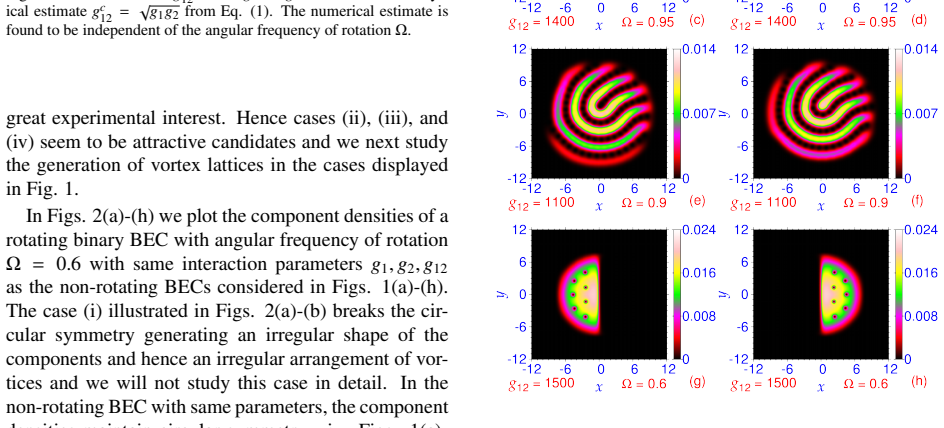
The central discovery is that complete spatial separation of the two condensate components survives rapid rotation and organizes each component's vortices into its own lattice, with zero overlap between the vortex patterns. When $g_1=g_2$ and $g_{12}$ is sufficiently large, the ground state consists of two semicircular condensates, one the parity conjugate of the other, each carrying a triangular vortex lattice; when $g_1$ and $g_2$ are close but unequal, phase separation is still complete but the two lattices have different shapes and vortex counts. The paper further identifies a numerical critical inter-species strength $g_{12}^c$, independent of angular frequency $\Omega$ and close to $\sqrt{g_1 g_2}$, above which fully separated vortex lattices form; below it, stripe or sheet structures appear instead. The symmetric separated state is found to be dynamically stable under real-time evolution after a small change in $\Omega$, while the asymmetric state is only weakly stable.
Load-bearing premise
The picture rests on the assumption that the imaginary-time simulation, started from a random-phase wavefunction, converges to the true global ground state of the rotating-frame energy, so the mirrored semicircular states are genuine ground states rather than metastable local minima; the paper does not compare their energy against rotationally symmetric or overlapping configurations.
Editorial extensions
If this is right
- For $g_1=g_2$ and $g_{12}$ above the numerical critical value, the two vortex lattices occupy disjoint semicircular domains that are parity conjugates, so vortices of one component never overlap the other component's density.
- When $g_1$ and $g_2$ are close but unequal, phase separation remains complete but the two lattices have different shapes and, at higher rotation, different vortex counts (e.g., 21 = 11 + 10 at $\Omega=0.7$ for $g_1=1000$, $g_2=900$).
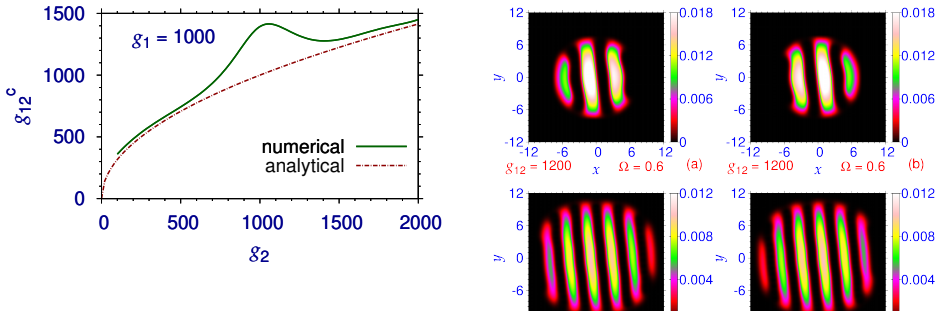
- The numerical critical inter-species strength for fully phase-separated vortex lattices is independent of rotation frequency $\Omega$ and is well approximated by $\sqrt{g_1g_2}$, refining the uniform-mixture criterion $g_1g_2/g_{12}^2<1$.
- The symmetric phase-separated vortex lattice survives real-time evolution for 200 time units under a small change in $\Omega$ (0.88 to 0.89), indicating dynamical stability; the asymmetric lattice is only weakly stable.
- Below the critical $g_{12}$, rotating binary condensates form stripe or sheet structures rather than separated vortex lattices, so the fully separated regime is a distinct phase accessible by tuning scattering lengths via Feshbach resonance.
Reading between the lines
- The mirror-image geometry suggests a concrete mechanism: with equal self-repulsion, swapping the two components is an exact symmetry of the energy, so a straight interface through the trap center costs the same energy for either assignment; the simulations realize this as two parity-conjugate semicircles.
- The claimed $\Omega$-independence of $g_{12}^c$ is a testable prediction: measuring the onset of complete phase separation in a rotating binary condensate across a range of rotation frequencies should produce a flat critical curve, while a strong $\Omega$-dependence would mean rotation renormalizes the effective inter-species coupling beyond the mean-field picture.
- The parity-conjugate relationship offers a built-in experimental calibration: at $g_1=g_2$, any imaging asymmetry between the two components can be separated from real physics because the ground state itself should be exactly mirror-symmetric.
- The same non-overlap property should allow direct experimental counting of vortices in each component, turning vortex-lattice geometry into a sensitive probe of the ratio $g_{12}^2/(g_1 g_2)$.
Signed reviews
Editorial analysis
A structured set of objections, weighed in public.
Referee Report
Summary. The paper studies a rapidly rotating, harmonically trapped quasi-2D binary Bose-Einstein condensate with repulsive intra- and inter-species interactions, described by the coupled Gross-Pitaevskii equations (6) and (7). Using imaginary-time propagation from a localized random-phase initial state, the author reports that for sufficiently strong inter-species repulsion the two condensates phase-separate into non-overlapping regions, each carrying a vortex lattice. For equal intra-species interactions (g1 = g2 = 1000, g12 = 2000) the two domains are parity-conjugate semicircles with triangular vortex lattices; for nearly equal interactions (g1 = 1000, g2 = 900, g12 = 2000) the separation is complete but the shapes differ. The paper also computes a numerical critical inter-species coupling, compares it with the uniform-mixture threshold sqrt(g1 g2), and demonstrates dynamical stability of the symmetric case by real-time evolution.
Significance. If the ground-state claim is substantiated, the finding is significant: completely non-overlapping vortex lattices would directly address the experimental difficulty of observing vortices in overlapping binary condensates, and the predicted parity-conjugate semicircular shapes provide a clear signature of spontaneous rotational symmetry breaking. The paper has concrete strengths: the numerical method is explicitly specified, the vortex identification is checked through phase winding (Fig. 7), the symmetrical case is tested by long real-time propagation (Fig. 9), and the analytical threshold sqrt(g1 g2) is used as a benchmark rather than fitted. The central weakness is that the global-minimum status of the reported states is asserted rather than demonstrated, which matters because the abstract frames the result as spontaneous symmetry breaking of the ground state.
major comments (2)
- [Sec. III, paragraph before Fig. 5] The statement 'The fully phase-separated states are the ground states for all Ω' is not supported by any energy comparison. The manuscript nowhere compares the energy of the semicircular phase-separated state with (i) a rotationally symmetric core-shell configuration, (ii) an overlapping binary vortex lattice, or (iii) the stripe/sheet states that the paper itself identifies as the ground state for g12 = 1100 (Fig. 2(g)-(h), and the sentence 'The fully phase-separated states in this case ... are excited states of higher energy'). Because the energy functional (9) is nonconvex, convergence of imaginary-time propagation from a single localized random-phase initial state is a local descent and does not by itself establish global minimality. This issue is load-bearing: the abstract's 'spontaneous symmetry breaking' and the ground-state phrasing depend on the semicircular states being true ground states, not merely stable excited states. Please provide energy differences, or at least total energies from Eq. (9), for the phase-separated state against these competitors at representative Ω and g12, and state explicitly for which parameter range the phase-separated state is the lowest-energy state.
- [Sec. III, Fig. 3] The 'numerically computed gc12' plotted in Fig. 3 is never operationally defined. The text states that for g12 larger than the numerical gc12 a phase-separated vortex lattice is obtained, but the reader is not told what observable distinguishes a phase-separated vortex lattice from a stripe/sheet state, what tolerance is used, or how the critical value is extracted from the numerical runs. In addition, the claim that 'The numerical critical value gc12 is found to be independent of Ω (< 1)' is asserted without showing results for more than one Ω; the figure itself displays only Ω = 0.6. These details matter because the paper's parameter-domain recommendation (Sec. IV, g1g2/g12^2 ⪅ 0.75) and the phase-separation criterion rest on this numerical curve. Please specify the extraction criterion, the convergence criterion, and provide the Ω-dependence data or qualify the claim.
minor comments (5)
- [Fig. 4 caption] The caption entries 'g12−1200' and 'g12−1400' should presumably read 'g12 = 1200' and 'g12 = 1400'; the printed minus sign is confusing.
- [Sec. I] The phrase 'arranged usually in a Abrikosov triangular lattice' should read 'arranged usually in an Abrikosov triangular lattice'.
- [Sec. IV] The statement that the asymmetric vortex lattice is 'only weakly stable' is not supported by any displayed data; either provide the corresponding real-time evolution or soften the claim.
- [Figs. 6 and 8] The overlaid contour plots of the two components would benefit from a legend, color definition, or explicit labeling of which grayscale/contour level corresponds to component 1 and component 2.
- [Eq. (1)] The displayed condition appears typeset as 'g1g2/g2 12 < 1'; the intended condition is g12^2 > g1 g2. Please ensure the equation is unambiguous in the final version.
Circularity Check
No circularity: the vortex-lattice shapes emerge from direct GP simulations, the analytical phase-separation threshold is an external benchmark, and the self-cited solver programs are method-level tools that do not encode the predicted result.
full rationale
The paper's central claim is that rapidly rotating quasi-2D binary BECs with equal or nearly equal intra-species repulsion and strong inter-species repulsion form completely phase-separated, parity-conjugate semicircular vortex lattices that spontaneously break the rotational symmetry of the trap. This is a numerical result obtained by imaginary-time propagation of the coupled Gross-Pitaevskii equations (6)-(7), which minimize the rotating-frame energy functional (9). No parameter is fitted to force the semicircular shape: the reported shapes, vortex counts, and parity relation are outputs of the simulation, not inputs. The analytical threshold g_c^12 = sqrt(g1 g2) quoted from Eq. (1) is imported from external Ref. [26] and used only as a comparison benchmark for the numerically determined critical coupling; it does not generate the predicted vortex-lattice geometry. The self-citations to Refs. [27], [32], and [34] concern the numerical Crank-Nicolson/OMP solver programs; these are method-level tools and do not themselves assert or encode the semicircular phase-separated vortex-lattice result. The statement 'The fully phase-separated states are the ground states for all Omega' is under-supported because no direct energy comparison against rotationally symmetric, overlapping, or stripe/sheet competitor states is shown; however, that is a validation gap rather than a circular reduction. There is no equation in the paper that defines the predicted state in terms of the ground-state claim, and no fitted parameter is renamed as a prediction. Hence, applying the hard rule that circularity must be exhibited as a specific reduction by construction, no circular step is found.
Assumptions & free parameters
free parameters (3)
- g1 and g2 (dimensionless intra-species interaction strengths) =
g1 = 1000; g2 = 700, 900, or 1000
- g12 = g21 (dimensionless inter-species interaction strength) =
1100 or 2000
- Omega (angular frequency of rotation in units of trap frequency) =
0.52 to 0.95
assumptions (6)
- domain assumption Mean-field Gross-Pitaevskii description is valid for the ultra-dilute weakly interacting condensates considered.
- domain assumption Quasi-2D reduction: the z-dependence factorizes as a Gaussian phi_i(r,t) = psi_i(rho,t) Phi(z) and can be integrated out.
- domain assumption The homogeneous-species phase-separation condition g1*g2 < g12^2 (Eq. 1) transfers approximately to the trapped quasi-2D rotating system.
- domain assumption Imaginary-time propagation from a random-phase initial state converges to the ground state of the rotating-frame energy functional (9).
- domain assumption Equal atomic masses and equal particle numbers for the two species.
- domain assumption The split time-step Crank-Nicolson discretization with space step 0.05 and time steps 0.0002/0.0001 resolves vortex cores and phase-separation interfaces.
Cite this review
Pith. "Pith review of Phase-separated symmetry-breaking vortex-lattice in a binary Bose-Einstein condensate." pith.science (2026). https://pith.science/paper/KE5IKWHW
@misc{pith2026190807848,
  author       = {Pith},
  title        = {Pith review of: Phase-separated symmetry-breaking vortex-lattice in a binary Bose-Einstein condensate},
  year         = {2026},
  howpublished = {\url{https://pith.science/paper/KE5IKWHW}},
  note         = {Machine review of arXiv:1908.07848}
}
read the original abstract
We study spontaneous-symmetry-breaking circularly-asymmetric phase separation of vortex lattices in a rapidly rotating harmonically-trapped quasi-two-dimensional (quasi-2D) binary Bose-Einstein condensate (BEC) with repulsive inter- and intra-species interactions. The phase separated vortex lattices of the components appear in different regions of space with no overlap between the vortices of the two components, which will permit an efficient experimental observation of such vortices and accurate study of the effect of atomic interaction on such vortex lattice. Such phase separation takes place when the intra-species interaction energies of the two components are equal or nearly equal with relatively strong inter-species repulsion. When the intra-species energies are equal, the two phase-separated vortex lattices have identical semicircular shapes with one being the parity conjugate of the other. When the intra-species energies are nearly equal, the phase separation is also complete but the vortex lattices have different shapes. We demonstrate our claim with a numerical solution of the mean-field Gross-Pitaevskii equation for a rapidly rotating quasi-2D binary BEC.
Figures

Figures from the paper (3 more)


Reference graph
Works this paper leans on
-
[1]
M. H. Anderson, J. R. Ensher, M. R. Matthews, C. E. Wieman, and E. A. Cornell, Science 269 (1995) 198
work page 1995
-
[2]
K. B. Davis, M. -O. Mewes, M. R. Andrews, N. J. van Druten, D. S. Durfee, D. M. Kurn, and W. Ketterle, Phys. Rev. Lett. 75 (1995) 3969
work page 1995
-
[3]
K. W. Madison, F. Chevy, W. Wohlleben, and J. Dalibard, Phys. Rev. Lett. 84 (2000) 806; M. R. Matthews, B. P. Anderson, P. C. Haljan, D. S. Hall, M. J. Holland, J. E. Williams, C. E. Wieman, and E. A. Cornell, Phys. Rev. Lett. 83 (1999) 3358
work page 2000
-
[4]
J. R. Abo-Shaeer, C. Raman, J. M. V ogels, and W. Ketterle, Sci- ence 292 (2001) 476; P. C. Haljan, B. P. Anderson, I. Coddington, and E. A. Cornell, Phys. Rev. Lett. 86 (2001) 2922. 8
work page 2001
-
[5]
E. B. Sonin, Dynamics of Quantised Vortices in Superfluids (Cambridge University Press, Cambridge, 2016)
work page 2016
-
[6]
A. L. Fetter, Rev. Mod. Phys. 81 (2009) 647
work page 2009
-
[7]
A. A. Abrikosov, Zh. Eksp. Teor. Fiz. 32 (1957) 1442; [Eng. Transla. Sov. Phys.-JETP 5 (1957) 1174.]
work page 1957
-
[8]
V . Schweikhard, I. Coddington, P. Engels, S. Tung, E. A. Cor- nell, Phys. Rev. Lett. 93 (2004) 210403
work page 2004
Show all 34 references
-
[9]
D. S. Hall, M. R. Matthews, J. R. Ensher, C. E. Wieman, E. A. Cornell, Phys. Rev. Lett. 81 (1998) 1539
1998
-
[10]
H. Wang, J. Sci. Comput. 38 (2009) 149; Y . Zhanga, W. Bao, H. Li, Physica D 234 (2007) 49; C.-H. Hsueh, T.-L. Horng, S.-C. Gou, W. C. Wu, Phys. Rev. A 84 (2011) 023610; Q. Zhao, Int. J. Mod. Phys. B 33 (2019) 1950080; X.-F. Zhang, L. Wen, C.-Q. Dai, R.-F. Dong, H.-F. Jiang, H...
2009
-
[11]
Mason, A
P. Mason, A. Aftalion, Phys. Rev. A 84 (2011) 033611; A. Aftalion, P. Mason, J. Wei, Phys. Rev. A 85 (2012) 033614
2011
-
[12]
S. K. Adhikari, L. Salasnich, Scientific Rep. 8 (2018) 8825
2018
-
[13]
S. K. Adhikari, J. Phys.: Condens. Matter 31 (2019) 275401
2019
-
[14]
R. K. Kumar, L. Tomio, B. A. Malomed, A. Gammal, Phys. Rev. A 96 (2017) 063624; R. K. Kumar, L. Tomio, A. Gammal, Phys. Rev. A 99 (2019) 043606; N. Ghazanfari, A. Keles ¸, M.¨O. Oktel, Phys. Rev. A 89 (2014) 025601
2017
-
[15]
Kasamatsu, K
K. Kasamatsu, K. Sakashita, Phys. Rev. A 97 (2018) 053622
2018
-
[16]
A. E. Leanhardt, Y . Shin, D. Kielpinski, D. E. Pritchard, W. Ketterle, Phys. Rev. Lett. 90 (2003) 140403
2003
-
[17]
Su, C.-H
S.-W. Su, C.-H. Hsueh, I.-Kang Liu, T.-L. Horng, Y .-C. Tsai, S.-C. Gou, W. M. Liu, Phys. Rev. A 84 (2011) 023601
2011
-
[18]
Cipriani, M
M. Cipriani, M. Nitta, Phys. Rev. Lett. 111 (2013) 170401
2013
-
[19]
S. K. Adhikari, Commun. Nonlinear Sci. Numer. Simulat. 71 (2019) 212
2019
-
[20]
E. J. Mueller, T. -L. Ho, Phys. Rev. Lett. 88 (2002) 180403
2002
-
[21]
Barnett, G
R. Barnett, G. Refael, M. A Porter, H. P. Buchler, New J. Phys. 10 (2008) 043030; Z. Chen, Y . Li, N. P Proukakis, B. A Malomed, New J. Phys. 21 (2019) 073058
2008
-
[22]
R. Wei, E. Mueller, Phys. Rev. A 84 (2011) 063611
2011
-
[23]
Kuopanportti, J
P. Kuopanportti, J. A. M. Huhtam ¨aki, M. M ¨ott¨onen, Phys. Rev. A 85 (2012) 043613
2012
-
[24]
Kasamatsu, M
K. Kasamatsu, M. Tsubota, Phys. Rev. A 79 (2009) 023606; K. Kasamatsu, M. Tsubota, M. Ueda, Phys. Rev. Lett. 91 (2003) 150406
2009
-
[25]
Kasamatsu, M
K. Kasamatsu, M. Tsubota, M. Ueda, Int. J. Mod. Phys. B 19 (2005) 1835
2005
-
[26]
Mineev, Zh
See, for example, V .P. Mineev, Zh. Eksp. Teor. Fiz. 67 (1974) 263; [Eng. Transla. V .P. Mineev, Sov. Phys.-JETP 40 (1975) 132]; E. Timmermans, Phys. Rev. Lett. 81 (1998) 5718; K. L. Lee, N. B. Jorgensen, I-K. Liu, L. Wacker, J. J. Arlt, N. P. Proukakis, Phys. Rev. A 94 (2016) 013602
1974
-
[27]
Muruganandam, S
P. Muruganandam, S. K. Adhikari, Comput. Phys. Commun. 180 (2009) 1888; D. Vudragovi´c, I. Vidanovi´c, A. Balaˇz, P. Muruganandam, S. K. Adhikari, Comput. Phys. Commun. 183 (2012) 2021
2009
-
[28]
L. D. Landau, E. M. Lifshitz, Mechanics (Pergamon Press, Ox- ford, 1960), section 39
1960
-
[29]
A. L. Fetter, B. Jackson, S. Stringari, Phys. Rev. A 71 (2005) 013605
2005
-
[30]
Salasnich, A
L. Salasnich, A. Parola, L. Reatto, Phys. Rev. A 65 (2002) 043614
2002
-
[32]
L. E. Young-S., P. Muruganandam, S. K. Adhikari, V . Lon ˇcar, D. Vudragovi´c, A. Balaˇz, Comput. Phys. Commun. 220 (2017) 503; L. E. Young-S., D. Vudragovi ´c, P. Muruganandam, S. K. Ad- hikari, A. Balaˇz, Comput. Phys. Commun. 204 (2016) 209; B. Satari´c, V . Slavnic, A. Bel...
2017
-
[33]
Muruganandam, S
P. Muruganandam, S. K. Adhikari, J. Phys. B 36 (2003) 2501
2003
-
[34]
Kishor Kumar, V
R. Kishor Kumar, V . Lonˇcar, P. Muruganandam, S. K. Adhikari, A. Balaˇz, Comput. Phys. Commun. 240 (2019) 74
2019
-
[35]
Inouye, M
S. Inouye, M. R. Andrews, J. Stenger, H.-J. Miesner, D. M. Stamper-Kurn, W. Ketterle, Nature 392 (1998) 151. 9
1998
Reviewed August 14, 2026 · model on record in the stance chip above.
Discussion (0). Continue with ORCID to comment.