REVIEW 4 major objections 5 minor 6 references
More Than Efficiency: Embedding Compression Improves Domain Adaptation in Dense Retrieval
T0 review · 4 major / 5 minor · reviewed 2026-08-03 · deepseek-v4-flash
Pith's one-line read This paper shows that a zero-training PCA compression of query embeddings improves dense retrieval quality in 75.4% of model-dataset pairs, rivaling adaptation methods that require fine-tuning.
desk verdict Query-only PCA compression is a real, cheap domain-adaptation trick, but the headline 75.4% is in-sample, threshold-free, and based on favorable dataset selection. read the letter →
The pith
A machine-rendered reading of the paper's core claim, the machinery that carries it, and where it could break.
The reading
What carries the argument
The central object is the PCA projection matrix W, the top d' eigenvectors of the covariance of mean-centered target-domain query embeddings. The method subtracts the mean and multiplies every query and document embedding by W, mapping both into the subspace of largest query variance. The enabling fact is the steep, power-law-like decay of the eigenvalue spectrum: most variance concentrates in a few leading components, so truncation removes low-variance directions that carry source-domain artifacts rather than target signal. The retention ratio r = d'/d controls the trade-off; the paper's default is r = 0.9.
What would settle it
Recompute the headline results with PCA fitted on a held-out portion of each dataset's queries (e.g., the 3-fold protocol in Appendix B applied to all 14 datasets and all 9 models). If the average success rate drops from 75.4% to near the random-compression success rate (roughly 25%), the in-sample fit is driving the reported gains, and the method is not a reliable out-of-sample adaptation tool.
Extended reading notes
Core claim
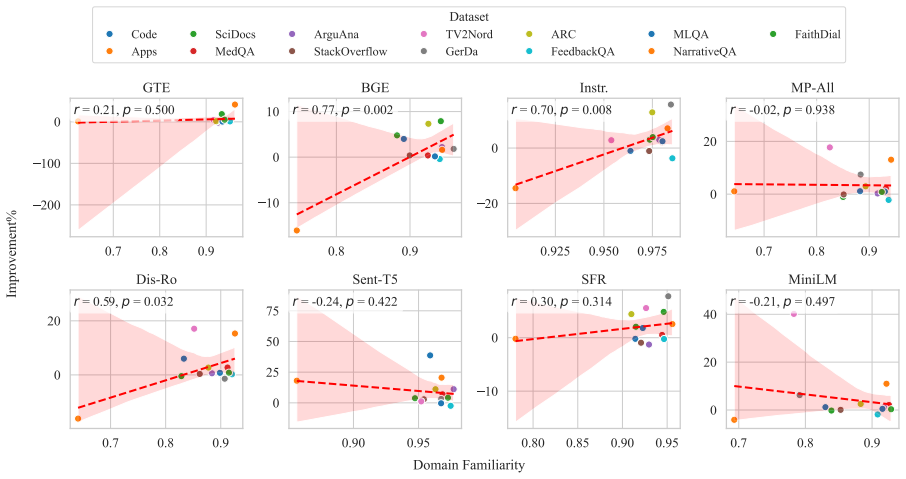
The discovery is that dimensionality reduction via PCA, normally used only to speed up retrieval, can also improve retrieval accuracy when the projection is learned from the target domain's queries. Across 126 model–dataset combinations spanning nine pretrained retrievers and fourteen retrieval datasets, query-only PCA compression improves NDCG@10 in 95 cases (75.4%), while query+document compression improves only 71 (56.3%). The gains are not an artifact of random dimension removal: a random-compression baseline rarely helps. In a direct comparison with a pseudo-labeling plus product-quantization adaptation pipeline, PCA matches or beats the pipeline on most shared datasets at zero training
Load-bearing premise
The headline 75.4% success rate is computed by fitting PCA on the exact query embeddings that are then used for evaluation; if this in-sample fit inflates the measured gains, the method's practical value as an out-of-sample adaptation technique is lower than claimed.
Editorial extensions
If this is right
- Fitting PCA on target-domain query embeddings and projecting both queries and documents into the top 90% of variance improves NDCG@10 in 75.4% of 126 model–dataset pairs, without any training or labels.
- Query-only compression is more consistently effective than query+document compression (75.4% vs 56.3%), indicating that the query distribution carries the task-discriminative signal for adaptation.
- The gains are not from random dimension removal: a random-compression baseline rarely helps, confirming that variance-based selection is the operative mechanism.
- On structured or hierarchical query domains, improvements can be very large, while on typical datasets most regressions are within 4%—so moderate compression (50–90% retention) is a safe default.
- Against a state-of-the-art compressive adaptation pipeline, PCA matches or beats it on most shared datasets while using no GPU training effort.
Reading between the lines
- If the mechanism is that query distributions are low-dimensional and structured, then non-linear dimensionality reduction (e.g., autoencoders or manifold learning) might extend the gains further—an avenue the paper leaves open.
- The finding that query-only beats query+document suggests a design rule for retrieval systems: keep query-side statistics separate from corpus-side statistics when adapting; this could inform whitening, normalization, or query-side fine-tuning strategies.
- Because the headline 75.4% is computed in-sample (PCA fit on the evaluation queries), a practical deployment would need to fit PCA on a separate historical query log; the 3-fold cross-validation reported for 9 datasets suggests the signal generalizes, but the in-sample number is likely optimistic.
- A testable extension: measure whether the power-law eigenvalue decay predicts per-dataset gains; if yes, practitioners could decide a priori whether PCA compression will help by checking the spectrum of their query embeddings.
Editorial analysis
A structured set of objections, weighed in public.
Referee Report
Summary. The paper proposes applying PCA to dense query and/or document embeddings as a training-free domain adaptation step. It evaluates Query Compression and Query+Document Compression across 9 retrievers and 14 MTEB datasets, reporting NDCG@10 changes over uncompressed embeddings. The main empirical claim is that Query Compression improves NDCG@10 in 75.4% of 126 model–dataset pairs, is more consistent than Query+Document Compression (56.3%), and can be competitive with a GPL-based adaptation pipeline. Additional analyses cover retention-ratio trade-offs, a 'domain familiarity' correlation, a random compression control, and a 3-fold cross-validation appendix.
Significance. If the finding holds out-of-sample, the paper identifies a surprisingly simple and cheap adaptation mechanism with practical value: no labels, no training, and a potential drop-in preprocessing step. The study is broad in coverage (9 models × 14 datasets) and includes a sensible random-compression control as well as cross-validation on a subset of datasets. However, the headline success rate is computed in-sample, and the evaluation lacks significance tests or confidence intervals. As it stands, the evidence supports an interesting phenomenon but not yet the strong 'domain adaptation' framing advertised in the title and abstract.
major comments (4)
- [§4 Algorithm 1 / §6.1 Table 1 / Appendix B] The headline 75.4% success rate is computed by fitting PCA on the full query set Q and then evaluating on the same queries (a transductive protocol). This measures fit to the evaluation queries, not adaptation to unseen queries. Appendix B's 3-fold CV covers only 9 of the 14 datasets (Table 4 omits Code, GerDa, ARC, FeedbackQA, and FaithDial) and reports point estimates without confidence intervals or significance tests. Please either run a full out-of-sample evaluation on all 14 datasets, report CIs, or explicitly reframe the central claim as transductive and demote the out-of-sample claim.
- [§6.1 Table 1 / Table 9] The binary success criterion counts any positive NDCG@10 delta as success. Many counted successes are sub-1-point (e.g., StackOverflow+MiniLM +0.1, MLQA+GTE +0.6, FaithDial+MiniLM +0.3). The random-compression control in Table 9 produces positive deltas of comparable magnitude on unstable datasets (SpartQA +3.03 and +14.56; NarrativeQA +2.68). Without significance tests or a noise-floor threshold, the 'effectively improve' claim is not established for those pairs. Report paired significance tests (e.g., bootstrap or permutation) and the proportion of successes that exceed a meaningful effect size.
- [§5 Datasets / Appendix E] The 14-dataset selection excludes 11 low-query datasets whose Query Compression success rate is 58.6% (58/99 in Table 10's Summary rows). Excluding them on the basis of query count changes the aggregate success rate from 75.4% to roughly 68%. The paper needs a principled inclusion criterion rather than a post hoc filter, or it should report both numbers and discuss the discrepancy. This directly affects the majority-claim in the abstract.
- [§6.3 Table 3] The comparison with IDA does not report the PCA configuration used for the Tas-B encoder (retention ratio, query-only vs query+document, number of folds), nor whether the same query/document splits and evaluation script are used as in IDA. Since the section claims PCA 'outperforms' GPL+JPQ and GPL+BPR, the comparison must be apples-to-apples; otherwise the claim should be softened or moved to a clearly labeled pilot result.
minor comments (5)
- [Appendix A] Typo: 'Kolmogovrov-Smirnov' should be 'Kolmogorov-Smirnov'.
- [Figure 5] The axis label reads 'FD' but the metric is defined as DF in Eq. (6). Use consistent notation.
- [§6.1] The sentence 'All models, except for SFR, achieve improvements in 10 to 11 datasets' is inconsistent with Table 1: GTE and Sent-T5 show 12/14. Please correct.
- [Appendix B / Table 4] State explicitly why Code, GerDa, ARC, FeedbackQA, and FaithDial are absent from the cross-validation table. The current text says 'for each dataset' but reports only 9.
- [Appendix F] The dataset order in Tables 12–13 differs from Table 1 (Apps and Code are swapped near the end). Aligning the row order would make cross-referencing easier.
Circularity Check
No significant circularity: the PCA-improvement claim is an empirical measurement, not a derivation, and the paper includes out-of-sample checks.
full rationale
The paper's central claim is that PCA compression of query embeddings improves NDCG@10 in 75.4% of model-dataset pairs. This is an empirical result, not a derivation. Although Algorithm 1 fits PCA on the same query set used for evaluation, this does not make the result circular by construction: PCA is unsupervised (no relevance labels are used), the projection is not optimized to maximize NDCG@10, and the retrieval scores are measured on document rankings rather than derived from the PCA objective. Appendix B explicitly addresses the transductive concern with a 3-fold cross-validation on 9 datasets and reports substantially consistent gains, and Appendix D's random-compression baseline provides an external control showing that PCA gains are not merely a random-dimensionality-removal artifact. No load-bearing step reduces to a self-citation, an imported uniqueness theorem, a fitted parameter renamed as a prediction, or an ansatz smuggled in via citation. The paper's limitations (e.g., need for sufficient unlabeled samples, model-dependent retention ratio) are acknowledged and do not indicate circularity.
Assumptions & free parameters
free parameters (3)
- retention_ratio r =
0.9 (default); explored 0.05-1.0
- domain_familiarity sample sizes (m,n) =
m=10 queries, n=3 paraphrases
- power-law tail threshold k_min =
chosen automatically
assumptions (6)
- standard math PCA/SVD eigenvalue decomposition is valid and well-conditioned
- domain assumption Pretrained dense retrievers encode sufficient domain-relevant information in their embeddings
- domain assumption High-variance directions of query embeddings correspond to domain-relevant semantic axes, while low-variance components are noise or source-domain artifacts
- domain assumption Unlabeled target-domain query/document collections are available at adaptation time
- standard math MTEB NDCG@10 reflects retrieval quality for the target domain
- ad hoc to paper The 14 selected datasets are representative of domain adaptation scenarios
invented entities (1)
-
Domain Familiarity (DF) metric
Cite this review
Pith. "Pith review of More Than Efficiency: Embedding Compression Improves Domain Adaptation in Dense Retrieval." pith.science (2026). https://pith.science/paper/KEHXG5EK
@misc{pith2026260113525,
  author       = {Pith},
  title        = {Pith review of: More Than Efficiency: Embedding Compression Improves Domain Adaptation in Dense Retrieval},
  year         = {2026},
  howpublished = {\url{https://pith.science/paper/KEHXG5EK}},
  note         = {Machine review of arXiv:2601.13525}
}
read the original abstract
Dense retrievers powered by pretrained embeddings are widely used for document retrieval but struggle in specialized domains due to the mismatches between the training and target domain distributions. Domain adaptation typically requires costly annotation and retraining of query-document pairs. In this work, we revisit an overlooked alternative: applying PCA to domain embeddings to derive lower-dimensional representations that preserve domain-relevant features while discarding non-discriminative components. Though traditionally used for efficiency, we demonstrate that this simple embedding compression can effectively improve retrieval performance. Evaluated across 9 retrievers and 14 MTEB datasets, PCA applied solely to query embeddings improves NDCG@10 in 75.4% of model-dataset pairs, offering a simple and lightweight method for domain adaptation.
Figures


Figures from the paper (2 more)

Reference graph
Works this paper leans on
-
[6]
Efficient passage retrieval with hashing for open-domain question answering. InProceedings of the 59th Annual Meeting of the Association for Computational Linguistics and the 11th International Joint Conference on Natural Language Processing (Volume 2: Short Papers), pages 979–986, Online. Association for Computational Linguistics. Weixiang Yan, Yuchen Ti...
arXiv 2023
-
[2018]
Retrieval of the best counterargument without prior topic knowledge. InProceedings of the 56th Annual Meeting of the Association for Computational Linguistics (Volume 1: Long Papers), pages 241–251, Melbourne, Australia. Association for Computational Linguistics. David Wadden, Shanchuan Lin, Kyle Lo, Lucy Lu Wang, Madeleine van Zuylen, Arman Cohan, and Ha...
arXiv 2020
-
[2020]
Aaron Clauset, Cosma Rohilla Shalizi, and Mark EJ Newman
Image retrieval based on deep feature extrac- tion and reduction with improved cnn and pca.Jour- nal of Information Hiding and Privacy Protection, 2(2):67. Aaron Clauset, Cosma Rohilla Shalizi, and Mark EJ Newman. 2009. Power-law distributions in empirical data.SIAM review, 51(4):661–703. Arman Cohan, Sergey Feldman, Iz Beltagy, Doug Downey, and Daniel We...
arXiv 2009
-
[2021]
CoSQA: 20,000+ web queries for code search and question answering. InProceedings of the 59th Annual Meeting of the Association for Computational Linguistics and the 11th International Joint Confer- ence on Natural Language Processing (Volume 1: Long Papers), pages 5690–5700, Online. Association for Computational Linguistics. Vladimir Karpukhin, Barlas Ogu...
2020
-
[2023]
Ms-shift: An analysis of ms marco distribution shifts on neural retrieval. InAdvances in Information Retrieval: 45th European Conference on Information Retrieval, ECIR 2023, Dublin, Ireland, April 2–6, 2023, Proceedings, Part I, page 636–652, Berlin, Heidelberg. Springer-Verlag. Xueguang Ma, Minghan Li, Kai Sun, Ji Xin, and Jimmy Lin. 2021. Simple and eff...
arXiv 2023
-
[2024]
Chemteb: Chemical text embedding bench- mark, an overview of embedding models perfor- mance & efficiency on a specific domain.arXiv preprint arXiv:2412.00532. Tomáš Koˇciský, Jonathan Schwarz, Phil Blunsom, Chris Dyer, Karl Moritz Hermann, Gábor Melis, and Ed- ward Grefenstette. 2018. The NarrativeQA reading comprehension challenge.Transactions of the Ass...
arXiv 2018
Reviewed August 3, 2026 · model on record in the stance chip above.
Discussion (0). Continue with ORCID to comment.