REVIEW 3 major objections 5 minor 15 references
Girth conditions and Rota's basis conjecture
T0 review · 3 major / 5 minor · reviewed 2026-08-14 · deepseek-v4-flash
Pith's one-line read High-girth, low-overlap matroids admit n-o(n) disjoint rainbow bases, bringing Rota's basis conjecture within o(n) of full strength.
desk verdict The disjoint case is a solid extension of Geelen–Humphries, but the overlapping case as written does not go through: Lemma 4.2 is omitted, (A) misapplies Lemma 4.3, and reference [14] likely supersedes the main asymptotic claim. read the letter →
The pith
A machine-rendered reading of the paper's core claim, the machinery that carries it, and where it could break.
The reading
What carries the argument
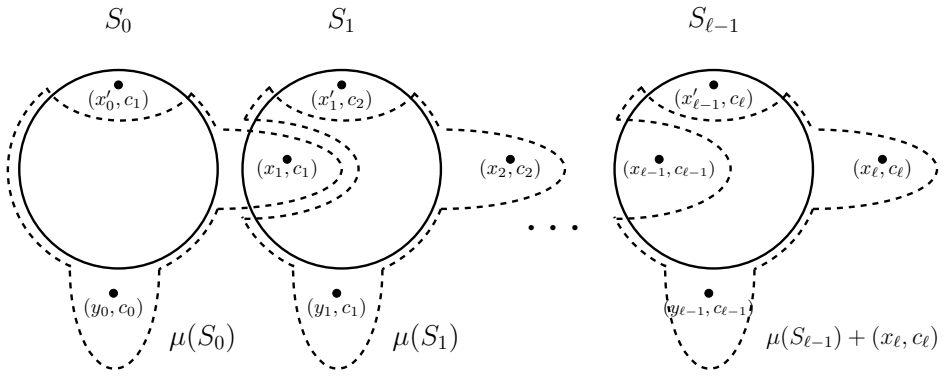
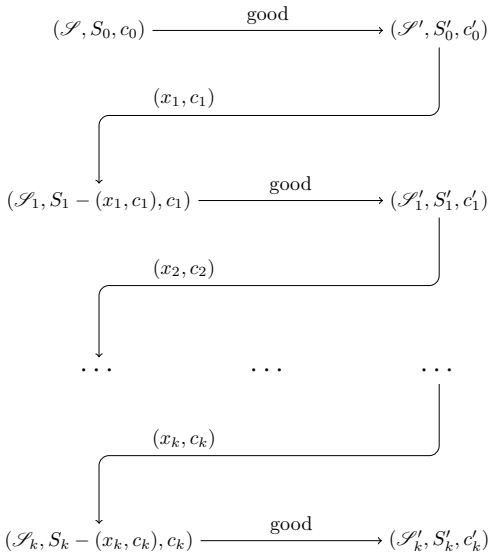
The load-bearing objects are roots and cascades. A root is (S,S,b), where S is a collection of disjoint rainbow independent sets, S is one member, and b is a colour absent from S; elements of S are swappable if they can be exchanged for an unused element of colour b, and addable if they can enter S with at most such an exchange. A root cascade is a chain of roots in which a cascadable element from the next set triggers a swap and shifts the missing colour along the chain; Observation 2.3 says that in a maximal collection every intermediate set in the cascade must be a rainbow base. The signature τ(S)=(τ_1,...,τ_n) counting sets by size, ordered lexicographically from largest downward, is the maximality device that makes the contradiction: an improvement in signature is impossible, so a shortage of rainbow bases must instead produce many cascadable elements concentrated in one set. For overlapping bases, the new operation transforms a bad root into a good root through a graph whose vertices are coloured elements and whose levels grow by a factor α/κ; a good root is one with an unused colour-b element outside the ground set of S, which restores the lower bound on swappable elements. Lemma 4.2, stated without proof, is the assertion that this good-root cascade finds k cascadable elements under the same parameter conditions as the disjoint lemma.
What would settle it
Exhibit a matroid of rank n with girth at least n-o(√n) and a κ-overlapping base sequence, κ=o(√n), for which the maximum number of disjoint rainbow bases is strictly below n-(2κ(n)+2β(n)+1)^2-β(n)-2; equivalently, give a concrete instance where the conclusion of Lemma 4.2 fails while its hypotheses hold, since Theorem 1.3 is derived from that lemma.
Extended reading notes
Core claim
The paper's central claim is Theorem 1.3: for a rank-n matroid M with girth g ≥ n-β(n)+1 and a κ-overlapping base sequence B, provided n > 2((2κ(n)+2β(n)+1)^2+β(n)), the largest set of disjoint rainbow bases satisfies t(B) ≥ n - (2κ(n)+2β(n)+1)^2 - β(n) - 2. When both β(n) and κ(n) are o(√n), this is t(B) ≥ n - o(n). The proof works at the level of collections of disjoint rainbow independent sets ordered by their signature, counting how many sets of each size they contain. Any collection that is maximal in this order cannot be improved, so the assumption that rainbow bases are missing forces a root cascade containing many cascadable elements; girth then supplies enough swappable elements to contradict maximality. In the overlapping case the paper inserts a repair step, the good root, which uses a colour-exchange graph to find an unused element outside the ground set of the chosen set, restoring the girth-based count.
Load-bearing premise
In the overlapping case, everything depends on Lemma 4.2, which asserts that when a κ-overlapping sequence has fewer rainbow bases than the target, some maximal or submaximal collection contains a good-root cascade with at least k cascadable elements; the paper states that its proof is the same as the disjoint Lemma 2.6 and omits it, so the step from disjoint to overlapping is not independently verified.
Editorial extensions
If this is right
- If Theorem 1.3 is correct, Rota's basis conjecture holds asymptotically for every rank-n matroid with girth n-o(√n) and overlap o(√n): the number of disjoint rainbow bases is n-o(n).
- The error term is explicit: t(B) ≥ n - (2κ(n)+2β(n)+1)^2 - β(n) - 2, so any improvement in the overlap or girth slack shrinks the missing bases quadratically.
- The good-root repair step means that even when some bases overlap heavily, a bad root can be replaced by a good one as long as the overlap κ is below the slack α, so the obstruction to improving a collection is confined to sets whose elements are reused many times.
- In the disjoint case, Theorem 1.2 gives the concrete bound t(B) ≥ n - 4β(n)^2 - 7β(n) - 4 whenever n ≥ 4β^2+7β+5, showing the same method works without the overlap repair.
Reading between the lines
- A natural next question, suggested by the quadratic dependence on (2κ+2β+1)^2, is whether the o(n) loss can be upgraded to O(√n) or removed entirely; the current theorem likely reflects the method's cost rather than a true obstruction.
- The good-root level-expansion argument appears transferable to other rainbow decomposition problems in which each ground-set element is assigned to a bounded number of colour classes, since the only matroid input used is that recolouring preserves independence.
- A testable small case is rank n=5 or 6 with β and κ chosen near the boundary of the theorem: exhaustive computation of t(B) would show whether the constant (2κ+2β+1)^2 is tight or merely an artifact of the proof.
Signed reviews
Editorial analysis
A structured set of objections, weighed in public.
Referee Report
Summary. The paper studies lower bounds on the number t(B) of disjoint rainbow bases in a rank-n matroid, under the assumptions of large girth and bounded overlap of the base sequence. Theorem 1.2 gives t(B) ≥ n - 4β(n)^2 - 7β(n) - 4 for disjoint base sequences when the girth is at least n - β(n) + 1. Theorem 1.3 claims the asymptotically optimal t(B) ≥ n - (2κ+2β+1)^2 - β - 2 = n - o(n) when the girth is n - β(n) + 1 with β,κ = o(√n) and the base sequence is κ-overlapping. The proof adapts the cascade machinery of Bucić et al., introducing 'good roots' and 'good root cascades' to handle overlapping bases. Section 2 develops root cascades and proves a concentration lemma (Lemma 2.6) in the disjoint case. Section 3 proves Theorem 1.2. Section 4 introduces the good-root transformation and states Lemma 4.2, whose proof is omitted, and then proves Theorem 1.3 via a contradiction argument (parts (A), (B), (C)).
Significance. If the results were correct, Theorem 1.3 would be a substantial advance for Rota's basis conjecture, showing that a near-complete set of disjoint rainbow bases exists for matroids of near-maximal girth and sublinear overlap, and would significantly extend the Geelen--Humphries paving-matroid result. The cascade idea is well chosen, and the disjoint-case proof (Section 3) is a coherent, quantitative improvement in its own right. The paper is carefully structured and makes falsifiable, explicit bounds. However, the central overlapping-case result rests on two substantial unproven or misapplied steps, so the main advertised theorem is not established as written.
major comments (3)
- [Section 4.2, Lemma 4.2] Lemma 4.2 is the only bridge from the disjoint case to the κ-overlapping case, yet its proof is omitted with the remark that it is 'essentially the same' as Lemma 2.6. This is not a routine adaptation. The good-root transformation of Section 4.1 changes the colour data of the collection (while preserving ground sets), so the collection S in Lemma 4.2 is not necessarily the same kind of collection as in Lemma 2.6, and the disjointness of B is used in the proof of Lemma 2.6 in the averaging step and in the invocation of Lemma 2.4, whose proof is also left to the reader. Since part (B) of the proof of Theorem 1.3 relies on Lemma 4.2 to produce the collection with q good-cascadable elements, Theorem 1.3 is not established without a full proof of this lemma.
- [Section 4.3, part (A)] The proof of part (A) misapplies Lemma 4.3. Lemma 4.3 states that if |CASCgood(S0,...,Sk−1) ∩ S| = q for a single set S that is the terminal set of a cascade, then for every other set S′ one has |S ∩ S′| ≥ q − 2β. In part (A), however, the proof feeds in q_S = |R ∩ S|, where R is the union of addable elements from q different good-root cascades (one for each (x_i,c_i)). The hypotheses of Lemma 4.3 are not satisfied for this q_S, so the inequality |S ∩ S′| ≥ q_S − 2β does not follow. The subsequent chain leading to q(n − β − q^2) < κn + 2β(n − α) is therefore unsupported.
- [Section 4.3, part (A), display near (A)] Even if Lemma 4.3 were applicable, the displayed chain contains an additional unjustified step: the passage from the lower bound on ∑ |R ∩ S′| over S′ in S − {S0,...,Sk} to the lower bound on ∑ q_S after removing one additional set S′ drops the term |R ∩ S′| without accounting for it in the inequality. The displayed inequality '≥ q(n − β − q^2) − 2β(n − α − q)' is obtained as if the removed set contributed nothing, and the paper does not explain why the removed set has empty intersection with R or why its contribution can be ignored. Together with the misapplication of Lemma 4.3, this makes part (A) invalid as written.
minor comments (5)
- [Section 1, definition of κ-overlapping] The phrase 'κκκ-overlapping' appears in the introduction in a way that suggests a typographical artifact; it should read 'κ-overlapping'.
- [Section 2.2, Lemma 2.2] Lemma 2.2 is stated without proof or reference. If it is a standard matroid exchange lemma, a proof or citation would help the reader; if it is new, it needs a proof.
- [Section 2.3, proof of Observation 2.3] The proof of Observation 2.3 writes expressions like τn(S_i) where S_i is a set, but the signature τ is defined for collections. The intended meaning is presumably the signature of the collection obtained by a replacement operation; please clarify.
- [Section 4.1, Lemma 4.1] The proof of Lemma 4.1 would be clearer if it explicitly separated the count of coloured elements in the union ∪UN_c(S) from the count of distinct ground elements, which is where the κ-overlapping condition is used.
- [Section 4.3, proof of Lemma 4.3] In the proof of Lemma 4.3, the notation S' is used both for a set in the collection and for a modified collection; this makes the construction of T hard to follow. Please disambiguate.
Circularity Check
No significant circularity; the proof is self-contained, with unproved lemmas and proof gaps but no reduction of conclusions to inputs.
full rationale
I found no circularity in the claimed derivation. Theorems 1.2 and 1.3 are matroid-theoretic arguments built from the stated girth hypothesis, the kappa-overlap condition, and cascade lemmas adapted from the external work of Bucic, Kwan, Pokrovskiy, and Sudakov. No parameter is fitted to the target quantity, and the lower bound on t(B) is not inserted as an input. The principal concern in the paper is Lemma 4.2, whose proof is omitted with the statement that it is essentially the same as Lemma 2.6, together with Lemma 2.4 whose proof is also left to the reader. These are missing proofs or verification gaps, not circular reductions: an unproved lemma is an assumption in the argument, but it is not a case of defining or fitting X in terms of Y. Similarly, the apparent mismatch in part (A), where Lemma 4.3 is applied to quantities q_S = |R intersect S| that are not shown to be CASCgood counts, is a potential correctness gap rather than circularity. The only self-citation in the paper, reference [7], is a contextual survey of Alon-Tarsi results and is not load-bearing for the main theorem. Therefore the circularity score is 0.
Assumptions & free parameters
assumptions (3)
- standard math Strong basis exchange: for any two bases S and B_c, there exists an injection φ_c: S → B_c such that S - x + φ_c(x) is a base for each x ∈ S.
- domain assumption g(M) ≥ n - β(n) + 1.
- domain assumption No ground element belongs to more than κ(n) bases of B.
Cite this review
Pith. "Pith review of Girth conditions and Rota's basis conjecture." pith.science (2026). https://pith.science/paper/KFCLJGKW
@misc{pith2026190801216,
  author       = {Pith},
  title        = {Pith review of: Girth conditions and Rota's basis conjecture},
  year         = {2026},
  howpublished = {\url{https://pith.science/paper/KFCLJGKW}},
  note         = {Machine review of arXiv:1908.01216}
}
abstract
Rota's basis conjecture (RBC) states that given a collection $\mathcal{B}$ of $n$ bases in a matroid $M$ of rank $n$, one can always find $n$ disjoint rainbow bases with respect to $\mathcal{B}$. In this paper, we show that if $M$ has girth at least $n-o(\sqrt{n})$, and no element of $M$ belongs to more than $o(\sqrt{n})$ bases in $\mathcal{B}$, then one can find at least $n - o(n)$ disjoint rainbow bases with respect to $\mathcal{B}$. This result can be seen as an extension of the work of Geelen and Humphries, who proved RBC in the case where $M$ is paving, and $\mathcal{B}$ is a pairwise disjoint collection. We make extensive use of the cascade idea introduced by Buci\'c et al.
Figures
Reference graph
Works this paper leans on
-
[14]
A. Pokrovskiy. Rota’s basis conjecture holds asymptotically. arXiv:2008.06045v1, 2020
arXiv 2008
-
[1]
N. Alon and M. Tarsi. Colorings and orientations of graphs. Combinatorica, 12(2):125–134, 1992
work page 1992
-
[2]
M. Buci´ c, M. Kwan, A. Pokrovskiy, and B. Sudakov. Halfway to Rota’s Basis Conjecture. International Mathematics Research Notices , 02 2020. rnaa004
work page 2020
-
[3]
W. Chan. An exchange property of matroid. Discrete Math., 146(1-3):299–302, 1995
work page 1995
-
[4]
M. Cheung. Computational proof of Rota’s basis conjecture fo r matroids of rank 4. educ.jmu.edu/~duceyje/undergrad/2012/mike.pdf, 2012. unpublished
work page 2012
-
[5]
S. Dong and J. Geelen. Improved Bounds for Rota’s Basis Conjec ture. Combinatorica, 39(2):265–272, 2019
work page 2019
-
[6]
A. A. Drisko. On the number of even and odd Latin squares of ord er p + 1. Adv. Math., 128(1):20–35, 1997
work page 1997
-
[7]
B. Friedman and S. McGuinness. The Alon-Tarsi conjecture: a p erspective on the main results. Discrete Math., 342(8):2234–2253, 2019
work page 2019
Show all 15 references
-
[8]
Geelen and P
J. Geelen and P. J. Humphries. Rota’s basis conjecture for pavin g matroids. SIAM J. Discrete Math. , 20(4):1042–1045, 2006
2006
-
[9]
Geelen and K
J. Geelen and K. Webb. On Rota’s basis conjecture. SIAM J. Discrete Math. , 21(3):802–804, 2007
2007
-
[10]
D. G. Glynn. The conjectures of Alon-Tarsi and Rota in dimensio n prime minus one. SIAM J. Discrete Math., 24(2):394–399, 2010
2010
-
[11]
Huang and G.-C
R. Huang and G.-C. Rota. On the relations of various conjectur es on Latin squares and straightening coefficients. Discrete Math., 128(1-3):225–236, 1994
1994
-
[12]
S. Onn. A colorful determinantal identity, a conjecture of Ro ta, and Latin squares. Amer. Math. Monthly, 104(2):156–159, 1997
1997
-
[13]
J. Oxley. Matroid theory, volume 21 of Oxford Graduate Texts in Mathematics . Oxford University Press, Oxford, second edition, 2011. 13
2011
-
[15]
M. Wild. On Rota’s problem about n bases in a rank n matroid. Adv. Math. , 108(2):336–345, 1994. 14
1994
Reviewed August 14, 2026 · model on record in the stance chip above.
Discussion (0). Continue with ORCID to comment.