Ordinal Imitative Dynamics
Pith reviewed 2026-05-24 23:51 UTC · model grok-4.3
The pith
An imitate-the-better-realization rule eliminates iteratively strictly dominated pure strategies and stabilizes strict equilibria in population games.
A machine-rendered reading of the paper's core claim, the machinery that carries it, and where it could break.
Core claim
Under the imitate the better realization (IBR) rule, the resulting ordinal mean dynamics eliminates iteratively strictly dominated pure strategies and renders strict equilibria locally stable, despite lacking Nash stationarity and payoff monotonicity.
What carries the argument
The imitate the better realization (IBR) rule, under which agents imitate the strategy of a randomly chosen opponent if the opponent's realized payoff is higher than their own.
If this is right
- Pure strategies iteratively strictly dominated by pure strategies are eliminated.
- Strict equilibria are locally stable.
- The dynamics is topologically equivalent to replicator dynamics in trivial cases.
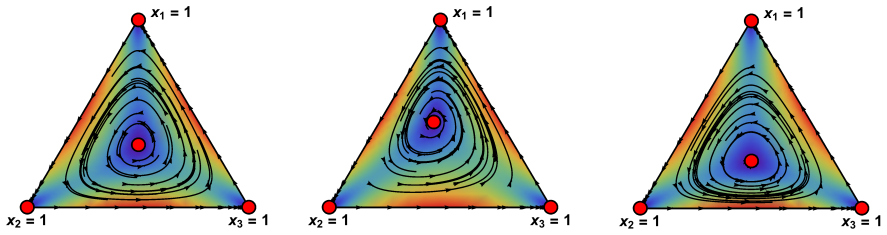
- In Rock-Paper-Scissors games the dynamics exhibits the same types of behavior as replicator dynamics but the partitions of the game set do not coincide.
- In other cases the IBR dynamics exhibits behaviors impossible under the replicator dynamics.
Where Pith is reading between the lines
- The rule might produce different long-run predictions than replicator dynamics in games with cycles or multiple equilibria.
- Laboratory experiments with human subjects given only pairwise payoff observations could test whether dominated strategies disappear at the predicted rate.
Load-bearing premise
The population is large, matching is random, and agents observe only realized payoffs of a single randomly chosen opponent.
What would settle it
A simulation or experiment showing that an iteratively strictly dominated strategy persists in the population under the IBR rule, or that a strict equilibrium is unstable.
Figures




read the original abstract
This paper introduces an evolutionary dynamics based on imitate the better realization (IBR) rule. Under this rule, agents in a population game imitate the strategy of a randomly chosen opponent whenever the opponent`s realized payoff is higher than their own. Such behavior generates an ordinal mean dynamics which is polynomial in strategy utilization frequencies. We demonstrate that while the dynamics does not possess Nash stationarity or payoff monotonicity, under it pure strategies iteratively strictly dominated by pure strategies are eliminated and strict equilibria are locally stable. We investigate the relationship between the dynamics based on the IBR rule and the replicator dynamics. In trivial cases, the two dynamics are topologically equivalent. In Rock-Paper-Scissors games we conjecture that both dynamics exhibit the same types of behavior, but the partitions of the game set do not coincide. In other cases, the IBR dynamics exhibits behaviors that are impossible under the replicator dynamics.
Editorial analysis
A structured set of objections, weighed in public.
Referee Report
Summary. The paper introduces an evolutionary dynamics based on the imitate-the-better-realization (IBR) rule in large-population random-matching games. Agents imitate a randomly sampled opponent's strategy only when the opponent's realized payoff exceeds their own, yielding an ordinal polynomial mean dynamics in strategy frequencies. The central claims are that this dynamics eliminates pure strategies that are iteratively strictly dominated by pure strategies and locally stabilizes strict equilibria, even though it lacks Nash stationarity and payoff monotonicity. The paper further compares the IBR dynamics to the replicator dynamics, establishing topological equivalence in trivial cases, conjecturing matching qualitative behavior (but non-coincident partitions) in Rock-Paper-Scissors, and exhibiting behaviors impossible under replicator dynamics in other games.
Significance. If the derivations hold, the result is significant because it enlarges the class of dynamics known to satisfy iterative dominance elimination and local stability of strict equilibria without requiring payoff monotonicity or Nash stationarity. The polynomial, ordinal character of the IBR flow is a clean, parameter-free construction that directly inherits these properties from the imitation rule. Explicit comparison with the replicator dynamics, including the RPS conjecture and the identification of non-replicator behaviors, supplies concrete, falsifiable distinctions that strengthen the contribution.
minor comments (3)
- [Abstract] The abstract states the main claims but does not reference the specific propositions or theorems that establish elimination and stability; adding such pointers would improve readability.
- Notation for the mean dynamics (e.g., the precise form of the polynomial vector field) should be introduced with an explicit equation number in the main text to facilitate later references.
- The RPS conjecture is presented without a precise statement of the partition of the game set; a short formal conjecture statement would clarify the claim.
Simulated Author's Rebuttal
We thank the referee for the positive and constructive report, including the accurate summary of the paper's contributions and the recommendation for minor revision. We appreciate the recognition of the significance of the IBR dynamics results on iterative dominance elimination and local stability of strict equilibria without Nash stationarity or payoff monotonicity.
Circularity Check
No significant circularity detected
full rationale
The paper first defines the IBR rule and the resulting ordinal mean dynamics explicitly in terms of strategy frequencies and realized payoffs. It then asserts that this dynamics eliminates iteratively strictly dominated pure strategies and locally stabilizes strict equilibria. These properties are presented as consequences of the definition rather than inputs to it. No parameters are fitted, no self-citations supply load-bearing uniqueness theorems, and no ansatz or renaming reduces the central claims to the input definition by construction. The comparison to replicator dynamics is an external investigation, not a circular reduction. The derivation chain is therefore self-contained.
Axiom & Free-Parameter Ledger
axioms (1)
- domain assumption Agents imitate the strategy of a randomly chosen opponent when that opponent's realized payoff exceeds their own.
Lean theorems connected to this paper
-
IndisputableMonolith/Cost/FunctionalEquation.leanwashburn_uniqueness_aczel unclear?
unclearRelation between the paper passage and the cited Recognition theorem.
Such behavior generates an ordinal mean dynamics which is polynomial in strategy utilization frequencies. We demonstrate that while the dynamics does not possess Nash stationarity or payoff monotonicity, under it pure strategies iteratively strictly dominated by pure strategies are eliminated and strict equilibria are locally stable.
-
IndisputableMonolith/Foundation/ArithmeticFromLogic.leanLogicNat recovery and embed_strictMono unclear?
unclearRelation between the paper passage and the cited Recognition theorem.
the IBR dynamics is a quartic polynomial in n variables
What do these tags mean?
- matches
- The paper's claim is directly supported by a theorem in the formal canon.
- supports
- The theorem supports part of the paper's argument, but the paper may add assumptions or extra steps.
- extends
- The paper goes beyond the formal theorem; the theorem is a base layer rather than the whole result.
- uses
- The paper appears to rely on the theorem as machinery.
- contradicts
- The paper's claim conflicts with a theorem or certificate in the canon.
- unclear
- Pith found a possible connection, but the passage is too broad, indirect, or ambiguous to say the theorem truly supports the claim.
Reference graph
Works this paper leans on
-
[1]
Bena¨ım, M. and Weibull, J. W. (2003). Deterministic approximation of stochastic evolution in games. Econometrica, 71:873–903. Bj¨ornerstedt, J. and Weibull, J. W. (1996). Nash equilibrium and evolution by imitation. In
work page 2003
-
[2]
Helbing, D. (1992). A mathematical model for behavioral changes by pair interactions. In
work page 1992
-
[3]
Hofbauer, J. (1995). Imitation dynamics for games. Unpublished manuscript, University of Vienna
work page 1995
-
[4]
Hofbauer, J. and Sandholm, W. H. (2011). Survival of dominated strategies under evolu- tionary dynamics. Theoretical Economics, 6:341–377
work page 2011
-
[5]
Izquierdo, L. R., Izquierdo, S. S., and Sandholm, W. H. (2018). Evodyn-3s: A mathe- matica computable document to analyse evolutionary dynamics in 3-strategy games. Unpublished manuscript
work page 2018
-
[6]
Izquierdo, S. S. and Izquierdo, L. R. (2013). Stochastic approximation to understand simple simulation models. Journal of Statistical Physics, 151(1):254–276
work page 2013
-
[7]
Nachbar, J. H. (1990). ’Evolutionary’ selection dynamics in games: Convergence and limit properties. International Journal of Game Theory, 19:59–89
work page 1990
-
[8]
Samuelson, L. and Zhang, J. (1992). Evolutionary stability in asymmetric games. Journal of Economic Theory, 57:363–391
work page 1992
-
[9]
Sandholm, W. H. (2010). Population Games and Evolutionary Dynamics . Cambridge: MIT Press
work page 2010
-
[10]
Schlag, K. H. (1998). Why imitate, and if so, how? A boundedly rational approach to multi-armed bandits. Journal of Economic Theory, 78:130–156
work page 1998
-
[11]
Viossat, Y. (2015). Evolutionary dynamics and dominated strategies. Economic Theory Bulletin, 3:91–113
work page 2015
-
[12]
Weibull, J. W. (1995). Evolutionary Game Theory. MIT Press, Cambridge
work page 1995
-
[13]
Zeeman, E. C. (1980). Population dynamics from game theory. In Nitecki, Z. and Robin- son, C., editors, Global Theory of Dynamical Systems , pages 471–497, Berlin, Heidelberg. Springer Berlin Heidelberg. 23
work page 1980
discussion (0)
Sign in with ORCID, Apple, or X to comment. Anyone can read and Pith papers without signing in.