REVIEW 4 major objections 5 minor 12 references
AMON: TeV Gamma and Neutrino Coincidence Alerts from HAWC and IceCube subthreshold data
T0 review · 4 major / 5 minor · reviewed 2026-08-14 · deepseek-v4-flash
Pith's one-line read This paper reports that AMON is ready to issue real-time coincidence alerts from HAWC gamma-ray hotspots and IceCube neutrinos, with a median delay of six hours, localization near 0.2 degrees, and a false-alarm rate of one per year.
desk verdict Useful AMON methods proceedings with a clean FAR calibration and an honest null result; the abstract's real-time readiness claim is ahead of the body's future-tense outlook. read the letter →
The pith
A machine-rendered reading of the paper's core claim, the machinery that carries it, and where it could break.
The reading
What carries the argument
The machinery is a joint-likelihood ranking statistic built on Fisher's method. For a candidate coincidence, the statistic is $\chi^2_{6+2n_\nu} = -2\ln[p_\lambda p_{\mathrm{HAWC}} p_{\mathrm{cluster}} \prod_i p_{\mathrm{IC},i}]$, where $p_\lambda$ comes from a maximum-likelihood fit for the best overlap position of the HAWC hotspot and IceCube event uncertainties on the sphere, $p_{\mathrm{HAWC}}$ is the probability that the hotspot is a background fluctuation, $p_{\mathrm{cluster}}$ is the probability of seeing the observed number of neutrinos within the HAWC transit time from background, and each $p_{\mathrm{IC},i}$ is the background probability of an IceCube track event. The $\chi^2$ value is converted to a p-value with $6+2n_\nu$ degrees of freedom and then to $\chi'{}^2 = -\log p$, the number used to rank coincidences. The false-alarm-rate curve built from right-ascension-scrambled data converts this ranking into an alert threshold.
What would settle it
Recompute the false-alarm-rate curve using a background ensemble that preserves each detector's real sky-exposure pattern, for example by scrambling event times rather than coordinates, and compare the ranking-statistic value that gives one false alarm per year. If that threshold moves away from 7.3 by more than the statistical uncertainty of the scrambled sample, the alert calibration and its quoted rate are wrong.
Extended reading notes
Core claim
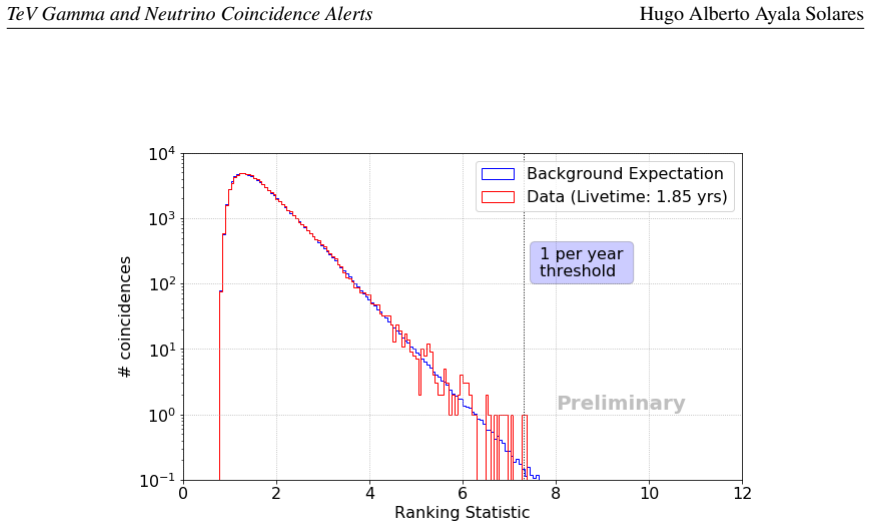
The central working claim is that a joint-likelihood search combining subthreshold HAWC hotspots and IceCube through-going muon-neutrino track events can be run in real time as an AMON alert stream. The analysis ranks coincidences by Fisher's method, combining a spatial-overlap likelihood and background probabilities for the gamma-ray excess and each neutrino, with degrees of freedom adjusted for the number of neutrinos found inside the HAWC transit window and a 3.5-degree search radius. Scrambling right ascension in the archived two-year dataset yields a false-alarm-rate curve; a ranking statistic of 7.3 corresponds to one alert per year. Unblinding 1.85 years of livetime produces one coincidence at 7.34 and a near-miss at 7.27, matching the background expectation. The paper concludes that the method is ready to broadcast alerts with median six-hour delay, roughly 0.2-degree combined localization, and a public alert threshold set at a one-per-year false alarm rate.
Load-bearing premise
The false-alarm calibration assumes that randomly shuffling the east-west sky positions of the events, while keeping their north-south positions, produces a faithful picture of random coincidences; if either telescope's sky exposure depends on east-west position, the one-per-year alert threshold could be wrong.
Editorial extensions
If this is right
- If the system runs as calibrated, AMON will broadcast a HAWC-plus-IceCube coincidence alert with a median delay of six hours, short enough for a full HAWC transit to pass but still timely for deep follow-up by optical, X-ray, and very-high-energy instruments.
- Alerts will carry a combined localization of about 0.2 degrees at 1-sigma for a 2D Gaussian, making them suitable for pointed electromagnetic follow-up.
- With a one-per-year false alarm rate, essentially every issued alert should be treated as a real multimessenger candidate worth immediate observation.
- The single candidate above threshold in 1.85 years of livetime is consistent with the expected background, so the first alerts are a calibrated stream rather than claimed detections.
- The same pipeline can be extended to search for sources of ultra-high-energy cosmic rays by combining neutrino alerts with data from additional observatories.
Reading between the lines
- The paper does not raise the option of requiring multiple neutrinos inside the transit window; doing so with the same ranking statistic would trade alert rate for purity and could be calibrated against the identical scrambled-background ensemble.
- If either near-threshold coincidence at ranking 7.34 or 7.27 is later tied to a flaring blazar or radio galaxy, the archival test would retroactively become a multimessenger discovery, because both are consistent with background by the paper's own numbers.
- One extension the paper leaves implicit is using the calibrated false-alarm rate as a prior when combining these alerts with gravitational-wave or other multimessenger triggers to prioritize follow-up observations.
Signed reviews
Editorial analysis
A structured set of objections, weighed in public.
Referee Report
Summary. The paper reports an AMON joint-likelihood analysis that searches for coincidences between HAWC 'hotspot' gamma-ray excesses observed during a transit and IceCube through-going muon neutrino events. The selection requires temporal overlap with the HAWC transit and an angular separation below 3.5 degrees; a Fisher-style ranking statistic combines the spatial, spectral, and temporal p-values. The false alarm rate is calibrated with right-ascension-scrambled data corresponding to about 729 years, and a threshold ranking statistic of 7.3 gives one false alarm per year. Applied to 1.85 years of archival livetime from 2016-2017, the analysis finds one coincidence with ranking statistic 7.34 and one close to threshold at 7.27. The conclusions describe the method as a basis for a future real-time search, while the abstract states that AMON is ready to produce real-time alerts with a median delay of six hours.
Significance. The analysis addresses a timely and important problem: finding sub-threshold multimessenger coincidences between TeV gamma rays and neutrinos. Its strengths are clear: the false-alarm calibration uses a large scrambled background sample equivalent to 729 years, the ranking statistic combines relevant information through a standard Fisher-type method, and the archival search yields two interesting candidate events whose sky maps are shown. If the claimed real-time alert system were actually operational, this would be a valuable contribution to the multimessenger follow-up ecosystem. However, the body of the paper establishes only an offline archival search, not an operating alert pipeline. The unblinded result is also a weak validation because the threshold is chosen to enforce the false alarm rate rather than used as an independent prediction. With appropriate revisions that scope the claims to the offline analysis and quantify the calibration uncertainties, the method itself is a useful template for subthreshold coincidence searches.
major comments (4)
- [Abstract; Section 6] The abstract states 'AMON is ready to produce real-time coincidence alerts' and gives a 'median anticipated delay of six hours,' but Section 6 describes the real-time search only in the future tense: 'This method will serve as a base for a real-time search for multimessenger sources of neutrinos... The search would consist of sending alerts...' The paper presents no running online pipeline, no end-to-end latency measurement, no alert-distribution test through GCN, and no live data-quality monitoring. The six-hour delay is labeled 'anticipated,' not measured. This discrepancy is load-bearing because the title and abstract promise an operational alert system, whereas the analysis demonstrates only an offline archival search. Please either present evidence of the operational system or revise the abstract and conclusions to state that the real-time implementation is planned.
- [Section 4, Fig. 1] The false alarm rate curve in Fig. 1 is shown without statistical uncertainties. With about 729 years of scrambled data, the Poisson uncertainty on the FAR at one per year is roughly 4%, but in the high-ranking-statistic tail the effective number of trials is much smaller and the uncertainty is correspondingly larger. Because the alert threshold of 7.3 is derived from this curve, the curve should include confidence bands, and the text should state the number of independent scrambles and how trials are handled. Without this, the one-per-year FAR and the threshold are not fully quantified.
- [Section 4] The RA-scrambling procedure assumes that each detector's acceptance is effectively uniform in right ascension. The text says 'The scrambling consisted on randomly permuting the right ascension information of the events. Parameters that are declination dependent were kept together with their respective declination.' If HAWC's transit pattern or IceCube's seasonal or Earth-blocking effects create RA-dependent acceptance, the scrambled background could bias the false alarm rate. Please state explicitly why the RA-uniform assumption holds, and ideally validate the calibration by comparing with an alternative scrambling (for example, a full time-shift or time-randomization).
- [Section 5, Fig. 2] The comparison between the unblinded ranking-statistic distribution and the scrambled background in Fig. 2 is only qualitative. The observation of one event above the threshold in 1.85 years is consistent with the calibrated rate of one per year, but because the threshold was chosen to enforce that rate, this single event does not independently validate the analysis or indicate a signal. The paper should include a quantitative goodness-of-fit test for the distribution and should report the expected number of events above threshold for the actual livetime as an explicit check.
minor comments (5)
- [Section 1] The Introduction contains a typo: 'The purpose of the this analysis' should read 'The purpose of this analysis.'
- [Section 2] The IceCube paragraph says 'The parameters consists of' and should be 'The parameters consist of.' In addition, 'signal acceptance' is listed as an input but is never defined; please define it.
- [Section 4] The text refers to the 'Galactic Coordinates Network [10],' but the referenced network is the GRB Coordinates Network (GCN); please correct the name.
- [Section 3, Eq. (3.1)] The definition of the ranking statistic should state explicitly the null distributions and the number of degrees of freedom, including the formula for p_cluster, which is described only in words.
- [References] Reference [6] is incomplete: 'arXiv:180' does not identify the paper. Please provide the full arXiv identifier or journal reference.
Circularity Check
No significant circularity: the FAR threshold is an operational calibration fixed before unblinding, and the observed candidate is not used to fit any parameter.
full rationale
The paper's derivation chain is not circular. The ranking statistic (Eq. 3.1) combines p-values supplied by HAWC and IceCube; the AMON-internal p_lambda is a likelihood overlap measure, not a fit to the coincidence outcome. The false-alarm-rate curve in Sec. 4 is built from RA-scrambled data and is used only to choose a threshold (7.3) corresponding to 1 event/yr. This threshold is fixed before the unblinding in Sec. 5, so the one candidate at 7.34 and the near-threshold event at 7.27 are not themselves inputs to the calibration; at most they provide a low-statistics consistency check. No fitted physical constant is renamed as a prediction. The references to prior AMON papers ([5], [6]) are descriptive infrastructure citations and carry no load-bearing mathematical content. The abstract's claim that AMON is 'ready to produce real-time coincidence alerts' is not demonstrated by the paper, and Sec. 6 describes the real-time search in future tense; however, that is an internal-support/correctness issue, not a circularity. Therefore no step in the derivation reduces to its own input by construction.
Assumptions & free parameters
free parameters (3)
- HAWC hotspot significance threshold =
>2.75 sigma
- Angular separation cut =
3.5 degrees
- Ranking statistic alert threshold =
7.3
assumptions (4)
- standard math Fisher's method requires independent p-values across the combined terms.
- domain assumption Randomly permuting right ascension while keeping declination-dependent parameters yields a valid background ensemble.
- domain assumption Spatial uncertainties of HAWC hotspots and IceCube tracks are Gaussian on the sphere.
- domain assumption IceCube and HAWC background p-values are independent under the null hypothesis.
Cite this review
Pith. "Pith review of AMON: TeV Gamma and Neutrino Coincidence Alerts from HAWC and IceCube subthreshold data." pith.science (2026). https://pith.science/paper/KFZKF7YZ
@misc{pith2026190805990,
  author       = {Pith},
  title        = {Pith review of: AMON: TeV Gamma and Neutrino Coincidence Alerts from HAWC and IceCube subthreshold data},
  year         = {2026},
  howpublished = {\url{https://pith.science/paper/KFZKF7YZ}},
  note         = {Machine review of arXiv:1908.05990}
}
abstract
The era of multimessenger astrophysics has arrived with the simultaneous operation of large cosmic-ray, gamma-ray, neutrino, and gravitational-wave observatories. In just the past two years, an electromagnetic (EM) counterpart was detected for a gravitational wave event, and evidence for an EM counterpart of high energy neutrinos has been identified. These measurements have had a major impact on our view of the non-thermal universe, but understanding cosmic accelerators require a substantial increase in the number of multimessenger observations. The Astrophysical Multimessenger Observatory Network (AMON) is designed for high-statistics searches of sub-threshold transient alerts from gamma-ray and neutrino detectors. Within AMON, we have implemented a joint-likelihood analysis of TeV gamma-ray measurements from the High Altitude Water Cherenkov (HAWC) Observatory and neutrinos from the IceCube Neutrino Observatory. AMON is ready to produce real-time coincidence alerts using HAWC "hotspots" and IceCube astrophysical neutrino events. These alerts will be distributed to AMON follow-up partners with a median anticipated delay of six hours, which corresponds to a full transit in the field of view of HAWC. The alerts will have an angular resolution of ${\sim}0.2^{\circ}$, making them well-suited for deep electromagnetic follow-up observations.
Figures


Reference graph
Works this paper leans on
-
[1]
write newline
" write newline "" before.all 'output.state := FUNCTION blank.sep after.quote 'output.state := FUNCTION fin.entry output.state after.quoted.block = 'skip 'add.period if write newline FUNCTION new.block output.state before.all = 'skip output.state after.quote = after.quoted.block 'output.state := after.block 'output.state := if if FUNCTION new.sentence out...
-
[2]
L. S. Collaboration, V. Collaboration, et al., Multi-messenger Observations of a Binary Neutron Star Merger, ApJL, 848, 59, 2017
work page 2017
-
[3]
IceCube Collaboration, Fermi-LAT, MAGIC, et al., Multimessenger observations of a flaring blazar coincident with high-energy neutrino IceCube-170922A, Science, 361, 8, 2018
work page 2018
-
[4]
U., et al., Observation of the Crab Nebula with the HAWC Gamma-Ray Observatory, ApJ, 843, 39, 2017
Abeysekara, A. U., et al., Observation of the Crab Nebula with the HAWC Gamma-Ray Observatory, ApJ, 843, 39, 2017
work page 2017
-
[5]
IceCube Collaboration, M. G. Aartsen et al. , The IceCube Neutrino Observatory: Instrumentation and Online Systems, JINST, 12 , (2017), P03012
work page 2017
-
[6]
Smith, et al., The Astrophysical Multimessenger Observatory Network (AMON), Astro
M. Smith, et al., The Astrophysical Multimessenger Observatory Network (AMON), Astro. Part. 45, 56, 2013
work page 2013
-
[7]
H. A. Ayala Solares, et al., The Astrophysical Multimessenger Observatory Network (AMON), arXiv:180, 2018
work page 2018
-
[8]
Blanco , C. and Hooper , D., High-energy gamma rays and neutrinos from nearby radio galaxies , JCAPP, 2017, 12, 2017
work page 2017
Show all 12 references
-
[9]
HAWC Collaboration, Extended gamma-ray sources around pulsars constrain the origin of the positron flux at Earth, Science, 358, 911-914 (2017)
2017
-
[10]
and Oikonomou , F
Murase , K. and Oikonomou , F. and Petropoulou , M, Blazar Flares as an Origin of High-energy Cosmic Neutrinos?, ApJ, 865, 2, 2018
2018
-
[11]
AMON website http://amon.psu.edu/ http://amon.psu.edu/
-
[12]
GRB Coordinates Network website https://gcn.gsfc.nasa.gov/ https://gcn.gsfc.nasa.gov/
Reviewed August 14, 2026 · model on record in the stance chip above.
Discussion (0). Continue with ORCID to comment.