REVIEW 3 major objections 5 minor 7 references
A Parametric Bootstrap for the Mean Measure of Divergence
T0 review · 3 major / 5 minor · reviewed 2026-08-14 · deepseek-v4-flash
Pith's one-line read Replace the theoretical variance in the MMD with a bootstrapped spread so sparse skeletal samples still yield trustworthy population distances.
desk verdict A serious but invalid proposal: the paper substitutes the standard error of the sample standard deviation for the true variance, which makes the bootstrap correction vanish and inflates every distance. read the letter →
The pith
A machine-rendered reading of the paper's core claim, the machinery that carries it, and where it could break.
The reading
What carries the argument
The machinery is the parametric bootstrap of Eqs. (4)-(7): for each population-trait pair, draw $N_{\mu i}$ values from $N(0,\sigma_{\mu i})$, compute their sample standard deviation $\sigma^*_{\mu i}$, repeat $B$ times, and take $S_{\mu i}$ to be the standard deviation of the collection of $\sigma^*$ values. That single number carries the argument: it is plugged into both the bias subtraction in $MMD_B$ and the denominator $\sigma_B$ of the standardized distance. The distributional input that makes the procedure 'parametric' is the normality of the Anscombe-transformed angle, with variance fixed by the trait count alone.
What would settle it
Simulate two populations with identical true trait probabilities and small $N$, compute $stMMD_B$ many times, and check whether values above $2$ occur in about 5 percent of replicates; a systematic departure would show the substitution is miscalibrated.
Extended reading notes
Core claim
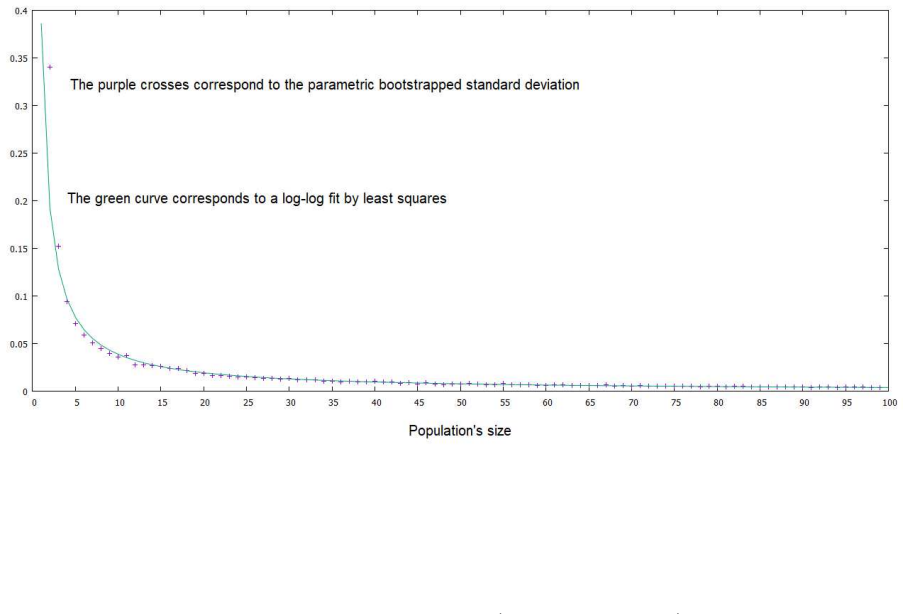
The central claim is that the bootstrapped quantity $S_{\mu i}$, defined as the standard deviation, over $B$ resamples, of the sample standard deviations of synthetic $\hat\theta$ draws, is the correct variance correction for the MMD. Replacing $\sigma_{\mu i}=1/\sqrt{N_{\mu i}+1/2}$ by $S_{\mu i}$ in the MMD formula yields a bootstrapped distance $MMD_B$ and a standardized version $stMMD_B$ whose significance can be read from $\chi^2$ or normal cutoffs. The paper shows numerically that $S$ falls as $A/N^\beta$ with $\beta \approx 1$, so small populations and traits with low measurement coverage receive the largest corrections. In well-represented data the bootstrapped distance matrix is nearly a rescaling of the original, preserving cluster and ordination results; in poorly represented data the ranking changes, and the paper treats the bootstrapped matrix as the accurate one.
Load-bearing premise
The method stands or falls on the claim that $S_{\mu i}$, the spread of bootstrapped sample standard deviations, is the right replacement for the theoretical standard deviation in the MMD formula.
Editorial extensions
If this is right
- Anthropologists with skeletal samples of a few dozen individuals, or with many unmeasurable traits, can compute $MMD_B$ with $B=500$ and report distances that are comparable across studies.
- When the relative error $E \lesssim 10\%$, users can trust the original distance ranking and the UPGMA/nMDS results built from it, since bootstrapping only rescales the entries.
- When $E > 10\%$, the original ranking is unreliable and the bootstrapped matrix should be used instead.
- Populations with small net size or with information fraction $T_\mu < 0.5$ receive the largest corrections, so apparent closeness to other groups may disappear after bootstrapping.
Reading between the lines
- Read as an inference: the paper's own fit $S \approx A/N$ means $S^2$ is smaller than $\sigma^2$ by an extra factor of $1/N$, so for moderately large samples the bias subtraction in $MMD_B$ is negligible; the dominant effect of the bootstrap is to shrink the denominator $\sigma_B$, which inflates $stMMD_B$ and explains the very large distances in the tables.
- Read as an inference: a more direct correction would use the known sampling distribution of the sample standard deviation from a normal sample, which could be written in closed form and compared with $S$ to test whether the bootstrap is necessary.
- Read as an inference: the $E=10\%$ threshold is a heuristic on the distance matrix; it could be recalibrated by simulation for a given number of traits and sample sizes, or replaced by a formal test of rank preservation.
- Read as an inference: the same resampling logic transfers to other variance-stabilized angular transformations for binomial counts, where the analogous known variance would define the parametric bootstrap.
Signed reviews
Editorial analysis
A structured set of objections, weighed in public.
Referee Report
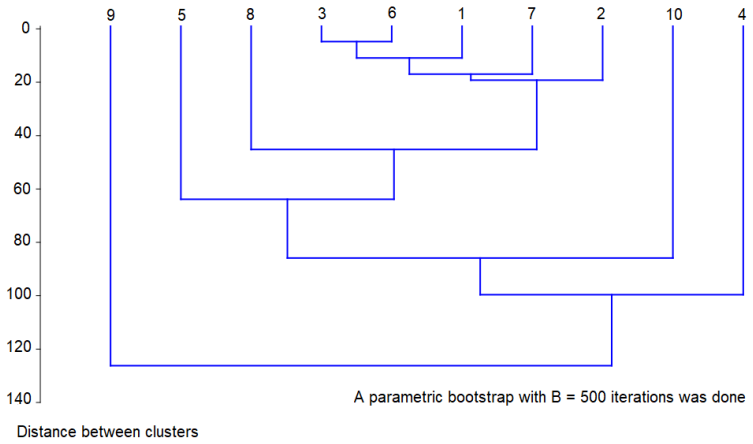
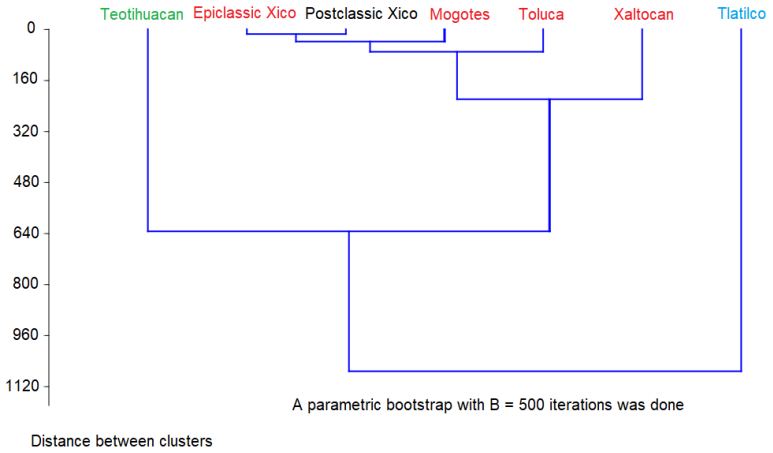
Summary. The paper proposes a parametric bootstrap procedure for the Mean Measure of Divergence (MMD), a biodistance measure used in anthropology with non-metric traits. The authors use the Anscombe transformation, which stabilizes the variance so that each trait estimate is approximately N(0, sigma^2) with sigma^2 = 1/(N + 1/2). The proposed bootstrap, described in Section 2, repeatedly draws normal samples of size N, computes the sample standard deviation sigma*, and then takes S, the standard deviation of these sigma* values across B bootstrap repetitions (Eq. 7). The bootstrap-corrected distance MMDB subtracts S^2 terms, and the standardized stMMDB divides by a sigma_B built from S^2. The paper applies the method to artificial data with good and poor statistical representativeness and to real anthropological data, showing that the bootstrap changes dendrograms when the relative error E (Eq. 12) exceeds 10%. The authors conclude that the parametric bootstrap is a powerful tool for small or poorly represented samples.
Significance. If the proposed bootstrap correction were valid, it would provide a practical tool for biodistance analysis with small samples, a common situation in anthropology and paleoanthropology. The paper clearly states the Anscombe-based null distribution, explicitly defines the bootstrap algorithm, and identifies the standard MMD and stMMD formulas. However, the central methodological step, replacing the known variance parameter sigma^2 by the square of the bootstrapped standard deviation S, is internally inconsistent with the paper's own asymptotic analysis in Section 4. Since S scales as O(1/N) while the required variance is O(1/N), the correction removes a term of the wrong order, leaving the proposed stMMDB systematically inflated. The reported extreme stMMDB values and the claim that all real-data distances are significant at alpha <= 10^-17 are artifacts of this miscalibration. The paper provides no simulation or theoretical check of the null distribution of stMMDB, which is essential for a procedure that claims to test statistical representativeness.
major comments (3)
- [Section 2, Eqs. (4)-(7)] Equation (7) defines S as the standard deviation, across B bootstrap repetitions, of the sample standard deviations sigma*_mu i computed from N(0, sigma_mu i) samples. This quantity estimates the standard error of the estimated standard deviation, not the variance parameter sigma^2_mu i. For normal data with true sigma, Var(sigma*) is approximately sigma^2 / (2(N-1)), so S is of order sigma / sqrt(N) ~ 1/N, and S^2 is of order 1/N^2. In contrast, the correction term that must be subtracted in the MMD is sigma^2_mu i = 1/(N_mu i + 1/2), which is of order 1/N. Substituting S^2 for sigma^2 therefore removes a term much smaller than the dominant sampling noise. Under the null, E[(theta_mu i - theta_nu i)^2] = sigma^2_mu i + sigma^2_nu i, so E[MMDB] is not zero but systematically positive, and stMMDB cannot be approximately N(0,1).
- [Section 4, Eq. (9)] Section 4 itself confirms the problem. Equation (9) reports a least-squares fit S_ls = A / N^beta with beta = 1.0028, and the text states S is of order O(1/N). Thus S^2 is of order O(1/N^2), whereas the true variance of theta is of order O(1/N). This is not a minor mismatch in constants: the bootstrap procedure substitutes a quantity of the wrong asymptotic order into the variance correction. The paper never verifies the null distribution of stMMDB against the known N(0,1) benchmark given in Section 1, and the claimed correction therefore lacks any statistical justification.
- [Section 7 and Tables S3, S6, S9] The bootstrapped distance matrices contain stMMDB values exceeding 1000 in the artificial data and values like 3950.88 in the real-data matrix (Table S9). These enormous values are a direct consequence of dividing by sigma_B, which is constructed from S^2 terms of order N^-2 and is therefore much smaller than the true standard deviation of the MMD. The assertion in Section 7 that all distances after bootstrap are statistically representative at alpha <= 10^-17 is an artifact of this miscalibration, not a meaningful test result. Without a simulation study that checks the empirical null distribution of stMMDB, the procedure's stated property of yielding significance levels is unsupported.
minor comments (5)
- [Section 1] The text before Eq. (2) refers to the 'standardized MMS biodistance'; this should read 'standardized MMD biodistance'.
- [Section 1] There is a typo 'Is is important' in the paragraph after the MMD variance formula; it should be 'It is important'.
- [Section 2] The phrase 're-sampling the standard deviation sigma_mu i through N(0, sigma_mu i)' is ambiguous. The procedure actually draws theta-star values from N(0, sigma_mu i) and computes their sample standard deviation; rephrasing would improve clarity.
- [Section 4] The asymptotic notation in the line 'sigma* is approximately O(1/sqrt(N)) sigma' is imprecise. The intended statement should be that the standard error of sigma* is O(1/N), not that sigma* itself is O(1/N) as written later.
- [Supplementary Material] Tables S3, S6, and S9 are printed in a truncated format (only the upper-left block is shown for S3, for example). Full matrices are needed to reproduce the reported E values and dendrogram comparisons.
Circularity Check
The bootstrap 'correction' is definitionally miscalibrated: Eq. (7)'s S is the standard error of the estimated standard deviation, not an estimate of sigma, so S^2 is O(N^-2) and the inflated stMMDB significance is built into the definition.
-
self definitional
[Sec. 2, Eqs. (4)-(7) and the subsequent unnumbered MMDB, sigma_B, stMMDB definitions; Sec. 4 Eq. (9)]
"The bootstrapped value S_mu_i of sigma_mu_i is then given by S_mu_i = sqrt(1/(B-1) sum_{b=1}^B {sigma*_mu_i^(b) - mean_sigma*_mu_i}^2), (7) ... Now, a bootstrapped MMD_B biodistance may be calculated through MMDB(mu,nu) = 1/M sum_{i=1}^M {(theta_mu_i - theta_nu_i)^2 - S^2_mu_i - S^2_nu_i}, with its corresponding standard deviation sigma_B(mu,nu) = sqrt(2/M^2 sum_{i=1}^M {S^2_mu_i + S^2_nu_i}^2), and the standardized MMDB stMMDB(mu,nu) = MMDB(mu,nu)/sigma_B(mu,nu)."
Eq. (7) defines S_mu_i as the standard deviation of bootstrapped sample standard deviations sigma*_mu_i, i.e. the standard error of an estimated sigma, not an estimate of sigma or sigma^2. MMD_B then subtracts S^2_mu_i + S^2_nu_i as if they were the true variance corrections, and sigma_B is built from those same S^2 terms. Under the paper's own normal model, spread(sigma*) is about sigma/sqrt(2N), so S is O(1/N) and S^2 is O(1/N^2), while the true variance being corrected is sigma^2 = 1/(N+1/2) = O(1/N). Under the null E[(theta_mu_i - theta_nu_i)^2] = sigma^2_mu_i + sigma^2_nu_i, so E[MMDB] is about true variance - O(N^-2), and stMMDB = MMDB/sigma_B is O(N), not N(0,1).
full rationale
The paper's central derivation chain is self-contained in the sense that no external benchmark is used, but that self-containment is the problem. The key move is to call the quantity defined in Eq. (7) 'the bootstrapped value of sigma_mu_i' and then to use its square as the variance correction in MMD_B. Algebraically, however, Eq. (7) is the standard deviation across bootstrap repetitions of the sample standard deviations sigma*, so it is the standard error of an estimated standard deviation. For the paper's own normal model this makes S of order 1/N and S^2 of order 1/N^2, whereas the variance of the Anscombe-transformed trait is of order 1/N. The resulting stMMDB therefore has a positive mean of order N under the null and cannot be approximately N(0,1); its huge values and the reported alpha < 10^-17 levels are forced by the chosen normalization. The paper's Section 4 fit, S = A/N^beta with beta approximately 1, already contains the same fact, but the paper does not use it to check the null distribution of stMMDB against the known benchmark in Eq. (2). No load-bearing self-citation was found: the Meza-Penaloza and Zertuche (2019) citation only reports prior use of the same procedure and the remaining citations are to the external MMD literature, so the circularity score reflects the definitional construction of the correction, not author self-citation.
Assumptions & free parameters
free parameters (1)
- B (number of bootstrap iterations) =
500 (hand-chosen)
assumptions (3)
- domain assumption theta_mu_i approximately follows N(0, sigma_mu_i) under the null hypothesis.
- domain assumption The MMD formula and its variance under the null are valid as given.
- ad hoc to paper S^2, the variance of the bootstrapped sample standard deviation, is the correct variance correction for the MMD.
Cite this review
Pith. "Pith review of A Parametric Bootstrap for the Mean Measure of Divergence." pith.science (2026). https://pith.science/paper/KGB2PYTL
@misc{pith2026190807514,
  author       = {Pith},
  title        = {Pith review of: A Parametric Bootstrap for the Mean Measure of Divergence},
  year         = {2026},
  howpublished = {\url{https://pith.science/paper/KGB2PYTL}},
  note         = {Machine review of arXiv:1908.07514}
}
abstract
For more than $50$ years the {\it Mean Measure of Divergence} (MMD) has been one of the most prominent tools used in anthropology for the study of non-metric traits. However, one of the problems, in anthropology including palaeoanthropology (more often there), is the lack of big enough samples or the existence of samples without sufficiently measured traits. Since 1969, with the advent of bootstrapping techniques, this issue has been tackled successfully in many different ways. Here, we present a parametric bootstrap technique based on the fact that the transformed $ \theta $, obtained from the Anscombe transformation to stabilize the variance, nearly follows a normal distribution with zero mean and variance $ \sigma^2 = 1 / (N + 1/2) $, where $ N $ is the size of the measured trait. When the probabilistic distribution is known, parametric procedures offer more powerful results than non-parametric ones. We profit from knowing the probabilistic distribution of $ \theta $ to develop a parametric bootstrapping method. We explain it carefully with mathematical support. We give examples, both with artificial data and with real ones. Our results show that this parametric bootstrap procedure is a powerful tool to study samples with scarcity of data.
Figures


Figures from the paper (5 more)



Reference graph
Works this paper leans on
-
[1]
Anscombe F. J. (1948). The transformation of Poisson, binomial, a nd negative-binomial data. Biometrika, 35(3-4), 246-254. Ansorge H. (2001). Assessing non-metric skeleton characters a s a mor- phological tool. Zoology, 104, 268-277. Ansorge H., Ranyuk M., Kauhala K., Kowalczyk R., & Stier N. (2009). Raccoon dog, Nyctereutes procyonoides, populations in t...
work page 1948
-
[3]
W., Cheverud J
McGrath, J. W., Cheverud J. M., & Buikstra J. E. (1984). Genetic correlations between sides and heritability of asymmetry for nonme tric traits in rhesus macaques on Cayo Santiago. Am J Phys Anthropol, 64(4) 401-411. Meza-Pe˜ naloza, A., & Zertuche, F. (2019, April). Comparison by N on- Metric Traits of Xaltocans Shrine vs. Teotihuacan in Mexico. In C. Mo...
1984
-
[23]
Freeman, M.F., Tukey, J.W. (1950). Transformations related to th e angular and square root. Ann Math Stat, 21, 607-611. Green, R.F., & Suchey, J. M. (1976). The use of inverse sine transf or- mations in the analysis of non-metric cranial data. Am J Phys Anthro - pol, 45, 61-68. 19 Grewal, M. S. (1962). The rate of genetic divergence in the C57BL strain of...
work page 1950
-
[45]
23 Trimble, M., & Praderi, R. (2008). Assessment of nonmetric skull characters of the Franciscana (Pontoporia blainvillei) in determining population differences. Aquatic Mammals, 34(3),
work page 2008
-
[80]
Sjøvold, T. (1977). Non-metrical divergence between skeletal p opu- lations: the theoretical foundation and biological importance of CA B Smith’s mean measure of divergence. Ossa, 4(1), 1-133. de Souza, P., & Houghton, P. (1977). The mean measure of diverge nce and the use of non-metric data in the estimation of biological distanc es. J Archaeol Sci, 4(2)...
work page 1977
-
[274]
Williams, F. L. E., & Cofran, Z. (2016). Postnatal craniofacial on- togeny in neandertals and modern humans. American journal of ph ys- ical anthropology, 159(3), 394-409. 24 Figures Figure
work page 2016
-
[338]
Verna, E., Piercecchi-Marti, M.D., Chaumoitre, K., Bartoli, C., Leonet ti, G., & Adalian, P. (2013). Discrete traits of the sternum and ribs: a u se- ful contribution to identification in forensic anthropology and medic ine. J Forensic Sci, 58(3), 571-577. Villmoare, B. (2005). Metric and non-metric randomization methods , geographic variation, and the sin...
work page 2013
Reviewed August 14, 2026 · model on record in the stance chip above.
Discussion (0). Continue with ORCID to comment.