REVIEW 3 major objections 4 minor 20 references
Studying Wythoff and Zometool Constructions using Maple
T0 review · 3 major / 4 minor · reviewed 2026-08-14 · deepseek-v4-flash
Pith's one-line read The paper claims that a Maple package can generate Wythoff polytopes in any dimension and certify Zometool constructibility by comparing edge lengths to the Zometool strut set.
desk verdict Genuine software contribution with an incomplete constructibility test: edge-length matching alone doesn't certify Zometool constructibility. read the letter →
The pith
A machine-rendered reading of the paper's core claim, the machinery that carries it, and where it could break.
The reading
What carries the argument
The working machinery is the Wythoff construction read off decorated Coxeter diagrams: a finite reflection group acting on $\mathbb{R}^n$ is drawn as a graph whose nodes are mirrors, and marking which mirrors fix the seed point determines a uniform polytope as the convex hull of that point's orbit. The package recursively computes vertices, edges, and cells from the diagram data. For Zometool constructibility, the load-bearing object is the Zometool strut-length set: all strut lengths are normalized and compared to this set, and matching edge lengths are taken as proof of constructibility. Around this, Maple's computational geometry routines convert skeletons to cell lists, and projection routines (orthogonal, stereographic, Coxeter-plane) feed the constructibility test.
What would settle it
Find any polyhedron whose edge lengths all lie in the Zometool strut set but whose vertex figures require an angle that appears in no Zometool node; if the package certifies it constructible and no assembly of real Zometool pieces can realize it, then edge-length compatibility alone is not sufficient for constructibility.
Extended reading notes
Core claim
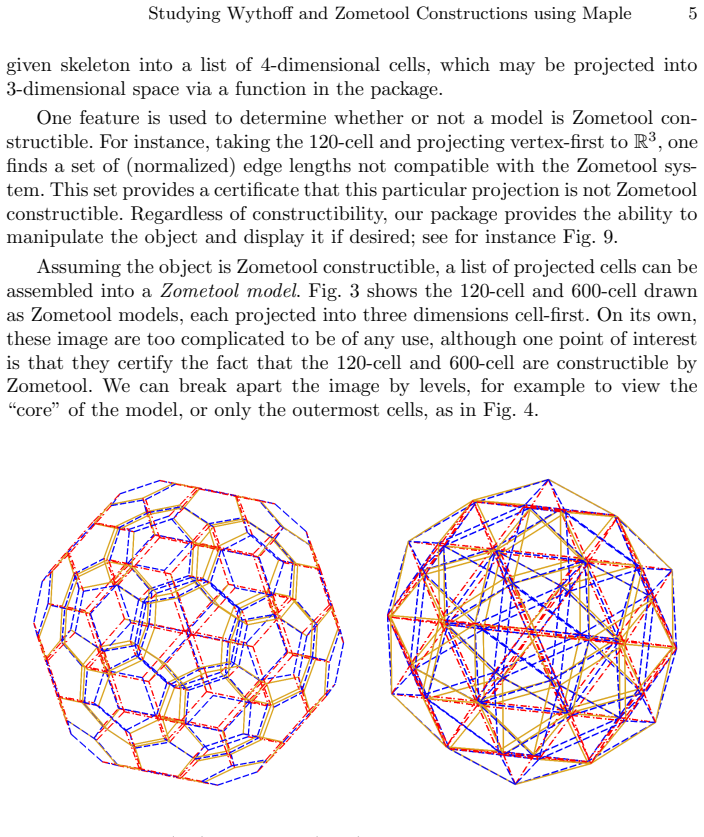
The central discovery is that the classical Wythoff construction, encoded by decorated Coxeter diagrams, can be implemented in Maple for arbitrary dimension, and that Zometool constructibility of a projected polytope can be settled by comparing normalized edge lengths to the finite set of Zometool strut lengths. The implementation covers all Wythoffian polytopes except snubs, yielding 11 of the 13 Archimedean solids and 45 of the 47 non-prismatic convex uniform 4-polytopes. On the Zometool side, the package certifies, for instance, that cell-first projections of the 120-cell and 600-cell are constructible, while the vertex-first projection of the 120-cell is not, and it computes exact parts lists such as 7200 balls, 2880 red struts of two lengths, 3600 blue struts, and 4800 yellow struts for the omnitruncated 120-cell.
Load-bearing premise
The constructibility test treats a structure as Zometool constructible whenever its normalized edge lengths all belong to the Zometool strut set, without checking that the angles between struts at each vertex can be realized by an actual Zometool connector.
Editorial extensions
If this is right
- For every non-snub Wythoffian polytope in the covered Coxeter families, the package produces vertex, edge, and cell data, then tests Zometool constructibility in the same run, so the full catalog of constructible projections can be generated mechanically.
- Layer-by-layer decomposition turns the 21,360-piece omnitruncated 120-cell model into a sequence of subassemblies, each small enough to be built and inspected on its own.
- Exact parts lists (7200 balls and 14,160 struts in prescribed color counts) allow the package's output to be checked against published Zometool construction lists.
- Coxeter-plane projections provide views of the 4-dimensional structure that are unavailable in the 3D projections used for Zometool building.
Reading between the lines
- The paper's criterion checks only edge lengths; a stricter test would also verify that every angle between struts at a vertex belongs to the finite set of angles realized by Zometool nodes, which would make a constructibility certificate more convincing.
- Because snub polytopes arise from omnitruncated ones by vertex alternation, the package's Wythoff machinery could likely be extended to cover the four missing cases: snub cube, snub dodecahedron, snub 24-cell, and grand antiprism.
- If the non-constructibility certificate (the unmatched edge-length set) were emitted in a machine-checkable format, package verdicts could double as formal proofs, a property toward which Maple's symbolic output already gestures.
Signed reviews
Editorial analysis
A structured set of objections, weighed in public.
Referee Report
Summary. The paper describes a Maple package for working with Wythoff (reflection-generated) polytopes and Zometool models. The package has four advertised purposes: deciding Zometool constructibility, manipulating Zometool objects and planning construction, generating Wythoff polytopes from decorated Coxeter diagrams, and projecting polytopes onto Coxeter planes. The authors illustrate the package on the 120-cell, 600-cell, and omnitruncated 120-cell, including layer-by-layer visual construction plans, filtered submodels, and parts lists. The code is made available through a git repository. The central claims are that the package automates the Wythoff construction for all nonsnub Wythoffian polytopes and that it can decide whether a projected polytope is constructible in Zometool.
Significance. If the constructibility decision is made correct, this is a useful computational and visual tool: it extends KaleidoTile to higher dimensions, supplies a source of Wythoff polytopes, and gives concrete support for large Zometool projects such as the omnitruncated 120-cell. The paper's strengths include the direct, parameter-free computation of vertices and edges from Coxeter data, the availability of source code, and the impressive concrete examples with parts lists. The physical constructions and renderings of the 120-cell and 600-cell are convincing evidence for those specific models. However, the advertised general decision procedure for Zometool constructibility is not justified in the manuscript, and this is the main issue blocking the paper's central claim.
major comments (3)
- [Section 3] The constructibility test described in Section 3 appears to rely only on the multiset of normalized edge lengths. This is a necessary condition for Zometool constructibility, but not a sufficient one: in Zometool, every strut must lie along one of the finitely many directions in the Zome zone set, and the incident directions at each vertex must be compatible with an actual Zometool hub. A polyhedral graph whose edge lengths all match Zometool strut lengths can be rotated continuously, and only finitely many orientations place all edges along Zome zones; a length-only checker would declare every orientation constructible. The paper gives no theorem, code-level argument, or verification that edge-length compatibility implies the existence of a direction-compatible embedding. The negative example of the vertex-first 120-cell projection is valid as a necessary-condition certificate, and the physically built 120-cell and 600-cell are strong evidence for those particular models, but the abstract and Section 1 advertise a general decision procedure, and that claim is not established by the text.
- [Section 1] The introduction states that Maple's symbolic nature allows the program's output to be taken as a formal proof of constructibility or non-constructibility. For the non-constructible direction, a certificate based on a necessary condition (edge-length incompatibility) can indeed be formal. For the constructible direction, no formal certificate is described: showing that edge lengths belong to the Zometool set does not prove that the edges can be simultaneously routed through Zometool hubs with correct directions. The paper should either provide a precise definition of the constructibility criterion used by the code, including the finite set of allowed hub directions, or restrict the claims to a weaker 'edge-length compatible' notion.
- [Section 3, parts lists] The parts-list computation for the omnitruncated 120-cell is presented as a way to 'verify entries in Richter's list,' but no comparison with a specific published list is shown. As written, this claim is not checkable from the paper. A small table comparing the package's counts with Richter's counts for the same projection would make this verification concrete.
minor comments (4)
- [Section 2] The text near the Coxeter diagram examples says 'This configuration is illustrated by the Coxeter diagram 5 .' The diagram itself appears to be missing in the extracted text. In the published version, please ensure the diagram is legible and that the associated notation is defined, since the whole Wythoff construction section relies on reading decorated Coxeter diagrams.
- [Throughout] The spelling of Wythoff's name is inconsistent: the title and body use 'Wythoff,' while reference [20] is listed as 'Wijthoff.' Please standardize the spelling to the historically conventional 'Wythoff' and correct the reference.
- [Section 3] The figure captions use dashed, solid, and alternating dash-dot lines to indicate blue, yellow, and red struts, but the convention is not stated in the main text near Figure 3. A sentence in Section 3 explaining the line-style-to-color mapping would improve readability.
- [Section 3] The paper states that the package can be used to 'determine how to best build a given structure,' but the notion of 'best' is not defined. If this means fewest pieces, fewest layers, or some other criterion, that should be stated explicitly.
Circularity Check
No significant circularity: the paper's claims are computational implementations of independent geometric theory and external Zometool constraints.
full rationale
The paper is a software-description and computational-report paper. The Wythoff construction is implemented from standard external Coxeter theory, including Coxeter's classification of finite reflection groups and the Champagne–Kjiri–Patera–Sharp decorated-diagram algorithm, and the resulting polytopes are then projected and tested against the Zometool strut system. Constructibility checks compare normalized model edge lengths against the Zometool strut length set, which is an external constraint supplied by the physical system, not a quantity derived from the paper's conclusions. Parts lists are computed directly from the model's cell geometry and strut counts. The paper introduces no fitted parameters, makes no prediction that is equivalent by construction to an input, and relies on no load-bearing self-citation: the cited prior work is standard mathematics and external software references. The only substantive concern, flagged explicitly here, is that the Section 3 constructibility test appears to check edge-length compatibility rather than also verifying that every edge lies along one of the finitely many allowed Zometool hub directions; that is a potential correctness or limitation issue, not a circularity, because the edge-length multiset is not by definition the same as Zometool constructibility. The physically built 120-cell and 600-cell examples provide independent external benchmarks for those specific models. No circular step can be exhibited from the paper's own equations or citations, so the appropriate score is 0.
Assumptions & free parameters
assumptions (2)
- standard math Coxeter's classification of finite reflection groups (Theorem 2) is assumed.
- domain assumption The convex hull and cell computations from Maple's ComputationalGeometry package are correct.
Cite this review
Pith. "Pith review of Studying Wythoff and Zometool Constructions using Maple." pith.science (2026). https://pith.science/paper/KGG3F4WA
@misc{pith2026190807153,
  author       = {Pith},
  title        = {Pith review of: Studying Wythoff and Zometool Constructions using Maple},
  year         = {2026},
  howpublished = {\url{https://pith.science/paper/KGG3F4WA}},
  note         = {Machine review of arXiv:1908.07153}
}
read the original abstract
We describe a Maple package that serves at least four purposes. First, one can use it to compute whether or not a given polyhedral structure is Zometool constructible. Second, one can use it to manipulate Zometool objects, for example to determine how to best build a given structure. Third, the package allows for an easy computation of the polytopes obtained by the kaleiodoscopic construction called the Wythoff construction. This feature provides a source of multiple examples. Fourth, the package allows the projection on Coxeter planes
Figures


Figures from the paper (8 more)


Reference graph
Works this paper leans on
-
[14]
Richter, D.A.: H(4)-polychora with Zome, http://homepages.wmich.edu/ ~drichter/h4polychorazome.htm
-
[15]
Richter, D.A.: Two results concerning the Zome model of the 600-cell. In: Sarhangi, R., Moody, R.V. (eds.) Renaissance Banff: Mathematics, Music, Art, Culture. pp. 419–426. Bridges Conference, Southwestern College, Winfield, Kansas (2005), http://archive.bridgesmathart.org/2005/bridges2005-419.html
work page 2005
-
[1]
A (not so brief) history of Zometool, https://www.zometool.com/about-us/ 10 B. Charbonneau and S. Whitehead
-
[2]
Champagne, B., Kjiri, M., Patera, J., Sharp, R.T.: Description of reflection- generated polytopes using decorated Coxeter diagrams. Canadian J. Physics 73, 566–584 (1995). https://doi.org/10.1139/p95-084
-
[3]
Chuang, C., Jin, B.Y.: Construction of Sierpi´ nski superfullerenes with the aid of Zome geometry: Application to beaded molecules. In: Hart, G.W., Sarhangi, R. (eds.) Proceedings of Bridges 2013: Mathematics, Music, Art, Architecture, Culture. pp. 495–498. Tessellations Publishing, Phoenix, Arizona (2013), http: //archive.bridgesmathart.org/2013/bridges2...
work page 2013
-
[4]
Annals of Mathematics 35(3), 588–621 (1934), http://www.jstor.org/stable/1968753
Coxeter, H.S.M.: Discrete groups generated by reflections. Annals of Mathematics 35(3), 588–621 (1934), http://www.jstor.org/stable/1968753
-
[5]
Coxeter, H.S.M.: The complete enumeration of finite groups of the form r2 i = ( rirj)kij = 1. J. London Math. Soc., (1) 10, 21–25 (1935). https://doi.org/10.1112/jlms/s1-10.37.21
-
[6]
Coxeter, H.S.M.: Wythoff’s Construction for Uniform Polytopes. Proc. London Math. Soc. (2) 38, 327–339 (1935). https://doi.org/10.1112/plms/s2-38.1.327
Show all 20 references
-
[7]
Dover Publications Inc., New York, third edn
Coxeter, H.S.M.: Regular polytopes. Dover Publications Inc., New York, third edn. (1973)
1973
-
[8]
In: Proceed- ings of the Colloquium on Convexity, Copenhagen, 1965
Conway, J.H., Guy, M.J.T.: Four-dimensional Archimedean polytopes. In: Proceed- ings of the Colloquium on Convexity, Copenhagen, 1965. Københavns Universitets Matematiske Institut, Copenhagen, Denmark (1965)
1965
-
[9]
Hall, B.: Lie groups, Lie algebras, and representations, Graduate Texts in Mathe- matics, vol. 222. Springer, Cham, second edn. (2015). https://doi.org/10.1007/978- 3-319-13467-3, an elementary introduction
2015 doi
-
[10]
Hall, B.C.: The geometry of root systems: an exploration in the Zometool system, https://www3.nd.edu/~bhall/book/lie.htm
-
[11]
Proceedings of International Society of Art, Math, and Architecture 2007 (2007), http://www
Hart, G.W.: Barn raisings of four-dimensional polytope projections. Proceedings of International Society of Art, Math, and Architecture 2007 (2007), http://www. georgehart.com/zome-polytopes-ISAMA07/hart-zome-polytopes.pdf
2007
-
[12]
Key Curriculum Press (2001)
Hart, G.W., Picciotto, H.: Zome geometry: Hands-on learning with Zome models. Key Curriculum Press (2001)
2001
-
[13]
In: Sarhangi, R., Barrallo, J
Hildebrandt, P.: Zome workshop. In: Sarhangi, R., Barrallo, J. (eds.) Bridges Donostia: Mathematics, Music, Art, Architecture, Culture. pp. 459–464. Tar- quin Publications, London (2007), http://archive.bridgesmathart.org/2007/ bridges2007-459.html
2007
-
[16]
In: Sarhangi, R., Sharp, J
Richter, D.A., Vorthmann, S.: Green quaternions, tenacious symmetry, and octahe- dreal Zome. In: Sarhangi, R., Sharp, J. (eds.) Bridges London: Mathematics, Mu- sic, Art, Architecture, Culture. pp. 429–436. Tarquin Publications, London (2006), http://archive.bridgesmathart.org...
2006
-
[17]
In: Torrence, E., Torrence, B., S´ equin, C., McKenna, D., Fenyvesi, K., Sarhangi, R
V¨ or¨ os, L.: A Zometool model of the b-dna. In: Torrence, E., Torrence, B., S´ equin, C., McKenna, D., Fenyvesi, K., Sarhangi, R. (eds.) Proceedings of Bridges 2016: Mathematics, Music, Art, Architecture, Education, Culture. pp. 435–438. Tessel- lations Publishing, Phoenix, ...
2016
-
[18]
Vorthmann, S.: vZome, software available at http://vzome.com/home/ Studying Wythoff and Zometool Constructions using Maple 11
-
[19]
Weeks, J.: KaleidoTile, software available at http://geometrygames.org/ KaleidoTile/index.html.en
-
[20]
Koninklijke Nederlandse Akademie van Wetenschappen Proceedings Series B Physical Sciences 20, 966–970 (1918)
Wijthoff, W.A.: A relation between the polytopes of the C600-family. Koninklijke Nederlandse Akademie van Wetenschappen Proceedings Series B Physical Sciences 20, 966–970 (1918)
1918
Reviewed August 14, 2026 · model on record in the stance chip above.
Discussion (0). Continue with ORCID to comment.