Extremal Matchings and Height Functions
Pith reviewed 2026-06-27 12:17 UTC · model grok-4.3
The pith
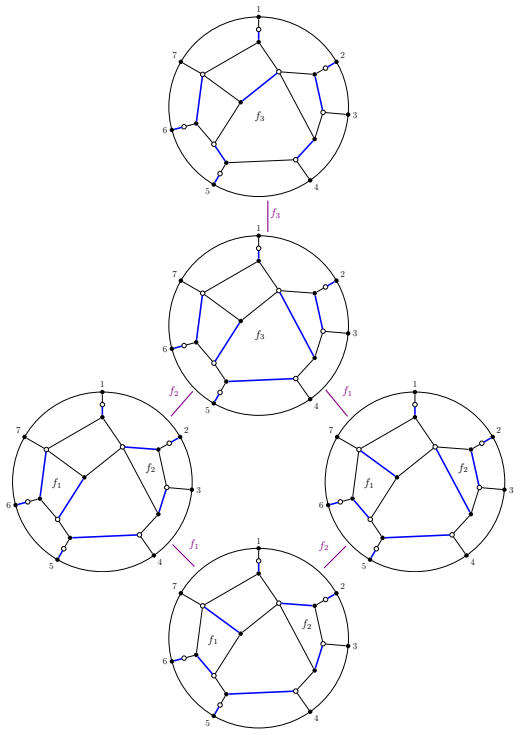
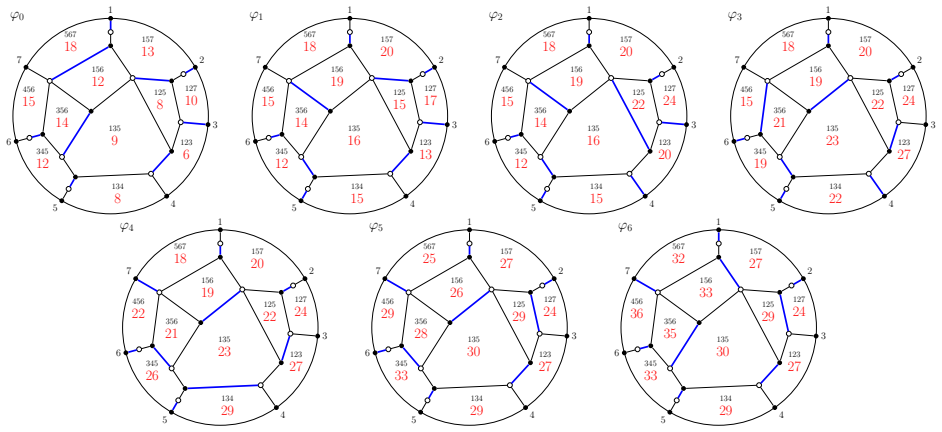
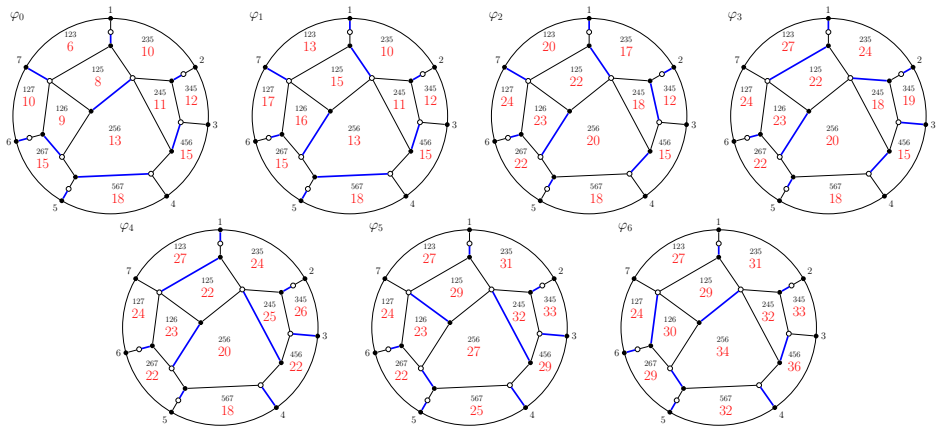
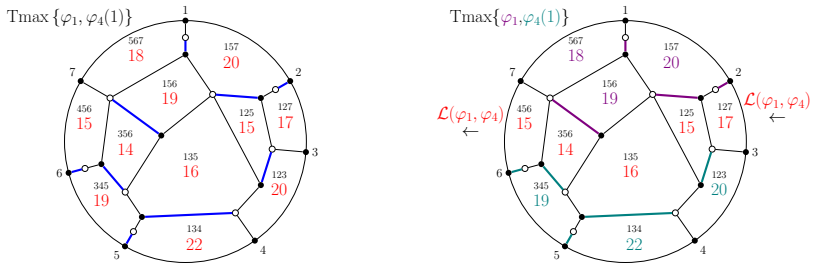
Almost perfect matchings on plabic graphs admit an explicit height-function construction of their extremal elements for any boundary condition.
A machine-rendered reading of the paper's core claim, the machinery that carries it, and where it could break.
Core claim
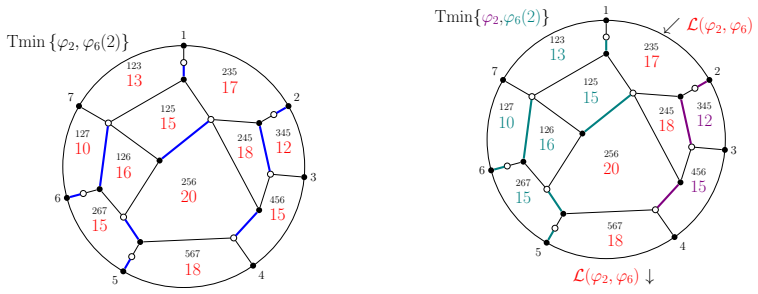
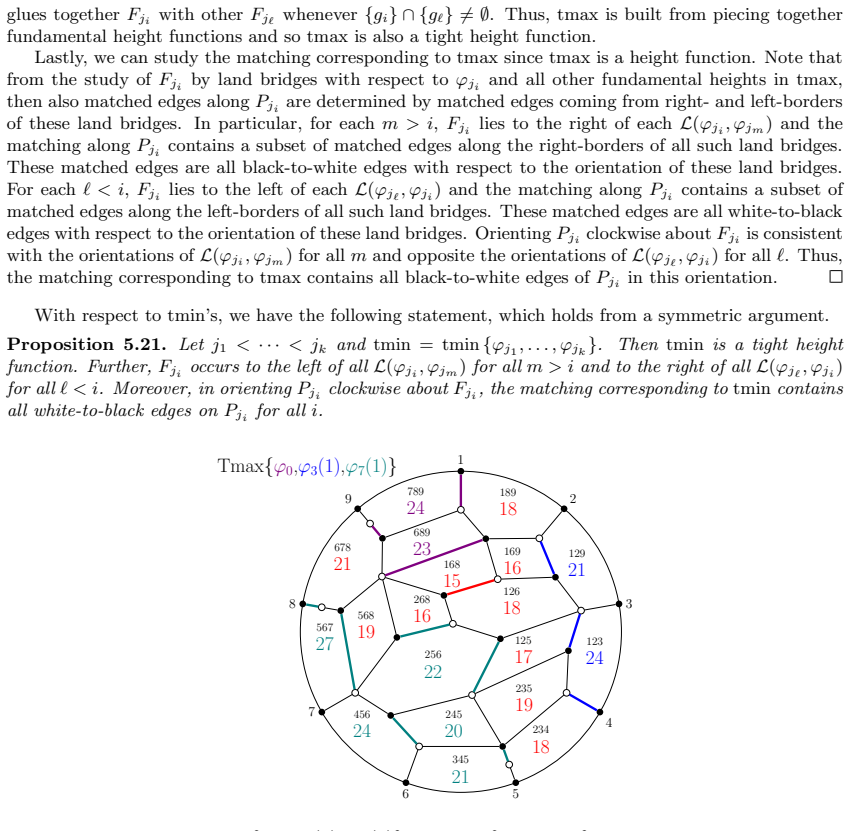
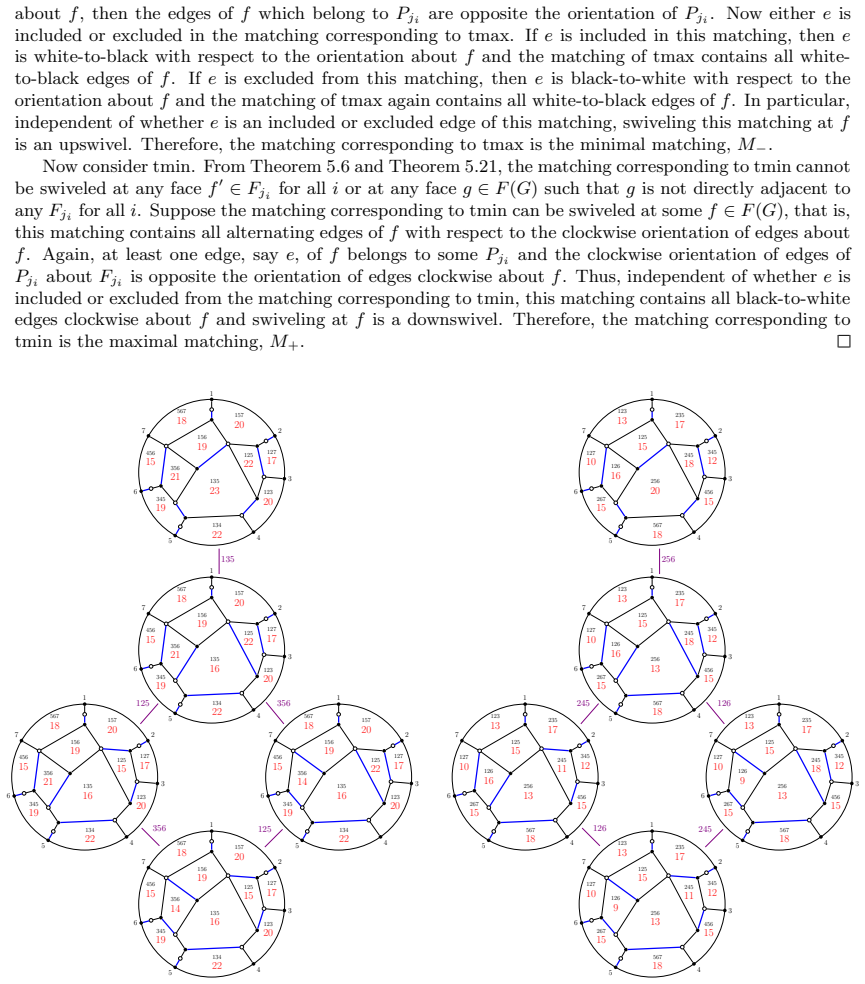
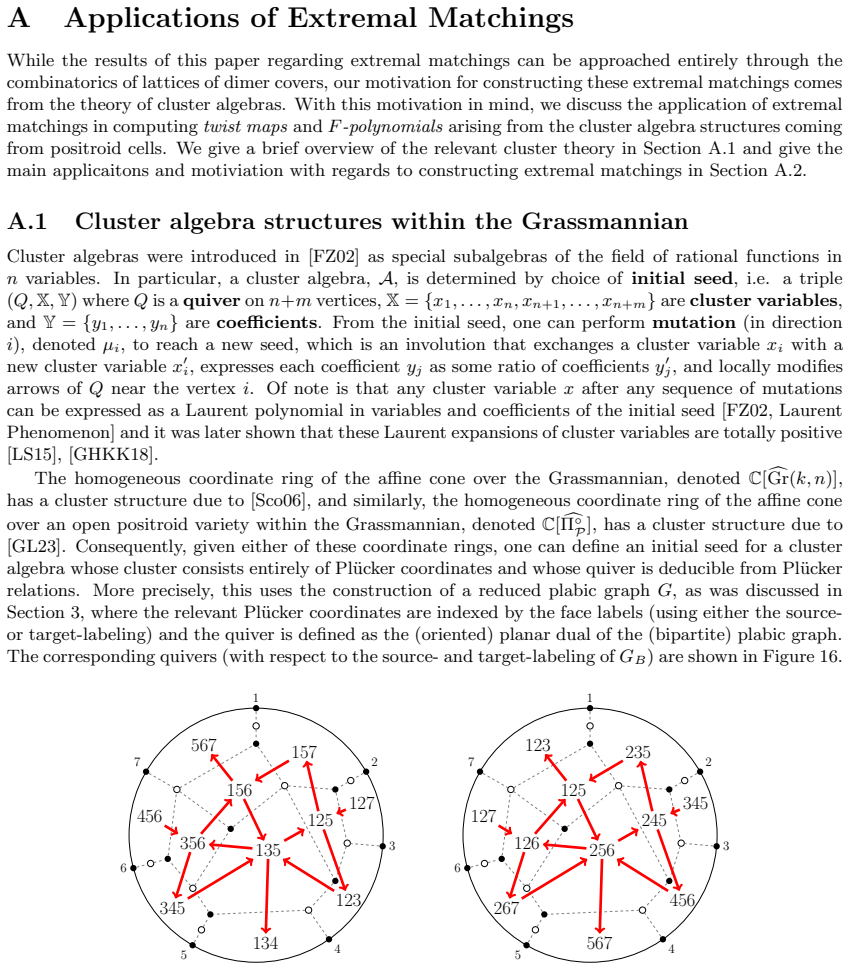
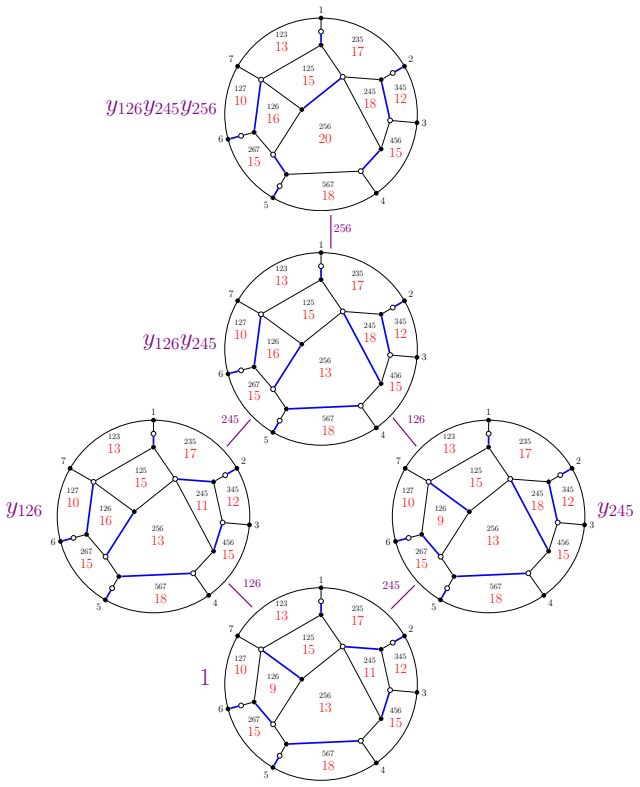
The authors give an explicit construction of extremal matchings in terms of height functions and demonstrate that this construction yields all possible boundary conditions of an almost perfect matching.
What carries the argument
Height functions that assign integer values to the faces of the embedded plabic graph and thereby select the edges of an extremal almost perfect matching.
If this is right
- Every boundary condition on an almost perfect matching arises from some height-function labeling.
- The extremal elements of the lattice are realized uniformly by the same height-function rule.
- The construction does not require the boundary condition to coincide with a positroid face label.
Where Pith is reading between the lines
- The uniform construction might let one generate the full lattice without first fixing a boundary condition.
- Similar height-function rules could be tested on other planar bipartite graphs that carry distributive lattices on their matchings.
Load-bearing premise
The distributive lattice structure already known for almost perfect matchings with fixed boundary condition stays compatible with the new height-function labeling no matter which boundary condition is chosen.
What would settle it
A concrete counterexample would be any plabic graph together with a boundary condition for which the height-function construction fails to recover the top or bottom element of the lattice.
Figures
read the original abstract
This paper studies a lattice structure for almost perfect matchings on certain planar, bipartite (plabic) graphs embedded in a disk. Postnikov's boundary measurement map, and subsequent related work, yielded that plabic graphs parameterize positroid cells within the totally nonnegative Grassmannian with the map itself given in terms of almost perfect matchings with fixed boundary condition. For finite planar bipartite graphs, Propp introduced a distributive lattice structure on their set of perfect matchings. Subsequently Muller--Speyer, provided this distributive lattice structure on the aforementioned almost perfect matchings with fixed boundary condition. Their work also identified the extremal matchings of this lattice for boundary conditions that coincide with face labels of the plabic graph given by the positroid structure. We extend this by giving an explicit construction of extremal matchings in terms of height functions and show that all possible boundary conditions of an almost perfect matching can be obtained within this construction.
Editorial analysis
A structured set of objections, weighed in public.
Referee Report
Summary. The paper extends the distributive lattice on almost perfect matchings of plabic graphs with fixed boundary conditions (Muller-Speyer) by supplying an explicit height-function construction of the extremal elements and proving that every possible boundary condition arises inside this construction.
Significance. If correct, the explicit height-function realization supplies a concrete, computable description of extremal matchings for arbitrary boundaries, strengthening the link between the lattice structure and the boundary-measurement parametrization of positroid cells.
minor comments (2)
- [Abstract] Abstract states the existence of an explicit construction but supplies neither the definition of the height function nor a proof outline; a one-sentence description of the labeling rule would make the central claim immediately verifiable from the abstract.
- The compatibility of the new height-function labeling with the Muller-Speyer partial order for non-fixed boundaries is asserted but not isolated as a separate lemma; a short dedicated paragraph or proposition would clarify the logical structure.
Simulated Author's Rebuttal
We thank the referee for their positive summary of the manuscript and for recommending minor revision. The report contains no specific major comments to address.
Circularity Check
No significant circularity; construction extends external lattice result
full rationale
The paper's core contribution is an explicit height-function construction for extremal almost perfect matchings that recovers arbitrary boundary conditions. It invokes the distributive lattice structure only from the cited Muller-Speyer work on the fixed-boundary case, treating that lattice as an independent external input rather than deriving or re-proving it internally. No equations reduce a claimed prediction to a fitted parameter by construction, no uniqueness theorem is imported from the authors' own prior work, and no ansatz is smuggled via self-citation. The derivation chain therefore remains self-contained against the external benchmark.
Axiom & Free-Parameter Ledger
Reference graph
Works this paper leans on
-
[1]
Twists of Pl
Marsh, Bethany R and Scott, Jeanne S , journal=. Twists of Pl. 2016 , publisher=
2016
-
[2]
Fomin, Sergey and Zelevinsky, Andrei , TITLE =. J. Amer. Math. Soc. , FJOURNAL =. 2002 , NUMBER =. doi:10.1090/S0894-0347-01-00385-X , URL =
-
[3]
Lee, Kyungyong and Schiffler, Ralf , TITLE =. Ann. of Math. (2) , FJOURNAL =. 2015 , NUMBER =. doi:10.4007/annals.2015.182.1.2 , URL =
-
[4]
Scott, Joshua S. , TITLE =. Proc. London Math. Soc. (3) , FJOURNAL =. 2006 , NUMBER =. doi:10.1112/S0024611505015571 , URL =
-
[5]
2006 , eprint=
Total positivity, Grassmannians, and networks , author=. 2006 , eprint=
2006
-
[6]
Electron
Propp, Jim , TITLE =. Electron. J. Combin. , FJOURNAL =. 2025 , NUMBER =
2025
-
[7]
Musiker, Gregg and Schiffler, Ralf and Williams, Lauren , TITLE =. Adv. Math. , FJOURNAL =. 2011 , NUMBER =. doi:10.1016/j.aim.2011.04.018 , URL =
-
[8]
Elkin, Moriah and Musiker, Gregg and Wright, Kayla , TITLE =. Algebr. Comb. , FJOURNAL =. 2024 , NUMBER =. doi:10.5802/alco.376 , URL =
-
[9]
Muller, Greg and Speyer, David E. , TITLE =. Proc. Lond. Math. Soc. (3) , FJOURNAL =. 2017 , NUMBER =. doi:10.1112/plms.12056 , URL =
-
[10]
Musiker, Gregg and Wright, Kayla , TITLE =. Electron. J. Combin. , FJOURNAL =. 2023 , NUMBER =. doi:10.37236/10437 , URL =
-
[11]
Farrell, Libby and Musiker, Gregg and Wright, Kayla , TITLE =. Electron. J. Combin. , FJOURNAL =. 2024 , NUMBER =. doi:10.37236/12070 , URL =
-
[12]
2024 , eprint=
Dimer face polynomials in knot theory and cluster algebras , author=. 2024 , eprint=
2024
-
[13]
Cluster algebras from surfaces:
Ralf Schiffler , year=. Cluster algebras from surfaces:
-
[14]
Chapters 1-3 , author=
Introduction to Cluster Algebras. Chapters 1-3 , author=. 2024 , eprint=
2024
-
[15]
Chapters 4-5 , author=
Introduction to Cluster Algebras. Chapters 4-5 , author=. 2021 , eprint=
2021
-
[16]
Chapter 6 , author=
Introduction to Cluster Algebras. Chapter 6 , author=. 2021 , eprint=
2021
-
[17]
Chapter 7 , author=
Introduction to Cluster Algebras. Chapter 7 , author=. 2025 , eprint=
2025
-
[18]
Fomin, Sergey and Zelevinsky, Andrei , TITLE =. Invent. Math. , FJOURNAL =. 2003 , NUMBER =. doi:10.1007/s00222-003-0302-y , URL =
-
[19]
Fomin, Sergey and Zelevinsky, Andrei , TITLE =. Compos. Math. , FJOURNAL =. 2007 , NUMBER =. doi:10.1112/S0010437X06002521 , URL =
-
[20]
Berenstein, Arkady and Fomin, Sergey and Zelevinsky, Andrei , TITLE =. Duke Math. J. , FJOURNAL =. 2005 , NUMBER =. doi:10.1215/S0012-7094-04-12611-9 , URL =
-
[21]
Knutson, Allen and Lam, Thomas and Speyer, David E. , TITLE =. Compos. Math. , FJOURNAL =. 2013 , NUMBER =. doi:10.1112/S0010437X13007240 , URL =
-
[22]
Oh, Suho , TITLE =. J. Combin. Theory Ser. A , FJOURNAL =. 2011 , NUMBER =. doi:10.1016/j.jcta.2011.06.006 , URL =
-
[23]
Fomin, Sergey and Zelevinsky, Andrei , TITLE =. Ann. of Math. (2) , FJOURNAL =. 2003 , NUMBER =. doi:10.4007/annals.2003.158.977 , URL =
-
[24]
Galashin, Pavel and Lam, Thomas , TITLE =. Ann. Sci. \'Ec. Norm. Sup\'er. (4) , FJOURNAL =. 2023 , NUMBER =. doi:10.24033/asens.2545 , URL =
-
[25]
Schiffler, Ralf , TITLE =. J. Algebraic Combin. , FJOURNAL =. 2008 , NUMBER =. doi:10.1007/s10801-007-0071-6 , URL =
-
[26]
Fomin, Sergey and Shapiro, Michael and Thurston, Dylan , TITLE =. Acta Math. , FJOURNAL =. 2008 , NUMBER =. doi:10.1007/s11511-008-0030-7 , URL =
-
[27]
Lam, Thomas , TITLE =. J. Lond. Math. Soc. (2) , FJOURNAL =. 2015 , NUMBER =. doi:10.1112/jlms/jdv039 , URL =
-
[28]
Gross, Mark and Hacking, Paul and Keel, Sean and Kontsevich, Maxim , TITLE =. J. Amer. Math. Soc. , FJOURNAL =. 2018 , NUMBER =. doi:10.1090/jams/890 , URL =
-
[29]
Kodama, Yuji and Williams, Lauren , TITLE =. Invent. Math. , FJOURNAL =. 2014 , NUMBER =. doi:10.1007/s00222-014-0506-3 , URL =
-
[30]
Current developments in mathematics 2014 , PAGES =
Lam, Thomas , TITLE =. Current developments in mathematics 2014 , PAGES =. 2016 , ISBN =
2014
-
[31]
Postnikov, Alexander and Speyer, David and Williams, Lauren , TITLE =. J. Algebraic Combin. , FJOURNAL =. 2009 , NUMBER =. doi:10.1007/s10801-008-0160-1 , URL =
-
[32]
Talaska, Kelli , TITLE =. Int. Math. Res. Not. IMRN , FJOURNAL =. 2008 , PAGES =. doi:10.1093/imrn/rnn081 , URL =
-
[33]
Kenyon, Richard W. and Wilson, David B. , TITLE =. Trans. Amer. Math. Soc. , FJOURNAL =. 2011 , NUMBER =. doi:10.1090/S0002-9947-2010-04964-5 , URL =
-
[34]
Kenyon, Richard and Ovenhouse, Nicholas , TITLE =. Trans. Amer. Math. Soc. , FJOURNAL =. 2025 , NUMBER =. doi:10.1090/tran/9436 , URL =
-
[35]
Thurston, William P. , TITLE =. Amer. Math. Monthly , FJOURNAL =. 1990 , NUMBER =. doi:10.2307/2324578 , URL =
-
[36]
Oh, Suho and Postnikov, Alexander and Speyer, David E. , TITLE =. Proc. Lond. Math. Soc. (3) , FJOURNAL =. 2015 , NUMBER =. doi:10.1112/plms/pdu052 , URL =
-
[37]
Scott, Josh , TITLE =. J. Algebra , FJOURNAL =. 2005 , NUMBER =. doi:10.1016/j.jalgebra.2001.12.001 , URL =
-
[38]
Berenstein, Arkady and Fomin, Sergey and Zelevinsky, Andrei , TITLE =. Adv. Math. , FJOURNAL =. 1996 , NUMBER =. doi:10.1006/aima.1996.0057 , URL =
-
[39]
Banaian, Esther and Catania, Elise and Gaetz, Christian and Moore, Miranda and Musiker, Gregg and Wright, Kayla , TITLE =. J. Algebra , FJOURNAL =. 2026 , PAGES =. doi:10.1016/j.jalgebra.2026.03.019 , URL =
-
[40]
Casals, Roger and Gorsky, Eugene and Gorsky, Mikhail and Le, Ian and Shen, Linhui and Simental, Jos\'e , TITLE =. J. Amer. Math. Soc. , FJOURNAL =. 2025 , NUMBER =. doi:10.1090/jams/1048 , URL =
-
[41]
Galashin, Pavel and Lam, Thomas and Sherman-Bennett, Melissa , TITLE =. Invent. Math. , FJOURNAL =. 2026 , NUMBER =. doi:10.1007/s00222-025-01390-5 , URL =
-
[42]
2024 , eprint=
Braid variety cluster structures, I: 3D plabic graphs , author=. 2024 , eprint=
2024
-
[43]
Leclerc, B. , TITLE =. Adv. Math. , FJOURNAL =. 2016 , PAGES =. doi:10.1016/j.aim.2016.03.018 , URL =
-
[44]
2022 , eprint=
Cluster algebras associated with open Richardson varieties: an algorithm to compute initial seeds , author=. 2022 , eprint=
2022
-
[45]
2019 , PAGES =
Ingermanson, Grace , TITLE =. 2019 , PAGES =
2019
-
[46]
Serhiyenko, Khrystyna and Sherman-Bennett, Melissa , TITLE =. Adv. Math. , FJOURNAL =. 2024 , PAGES =. doi:10.1016/j.aim.2024.109698 , URL =
-
[47]
2022 , eprint=
The twist for Richardson varieties , author=. 2022 , eprint=
2022
-
[48]
Minimal Matchings From Height Functions , journal=
Anderson,Nickolas , year=. Minimal Matchings From Height Functions , journal=
discussion (0)
Sign in with ORCID, Apple, or X to comment. Anyone can read and Pith papers without signing in.