REVIEW 4 major objections 5 minor 15 references
Cooperative Grasping and Transportation using Multi-agent Reinforcement Learning with Ternary Force Representation
T0 review · 4 major / 5 minor · reviewed 2026-08-12 · deepseek-v4-flash
Pith's one-line read A ternary force discretization lets two robots keep coordinating despite changes in grip force, object shape, and size.
desk verdict Solid simulation evidence for a simple ternary force trick, but the real-robot claims overstate what the data show. read the letter →
The pith
A machine-rendered reading of the paper's core claim, the machinery that carries it, and where it could break.
The reading
What carries the argument
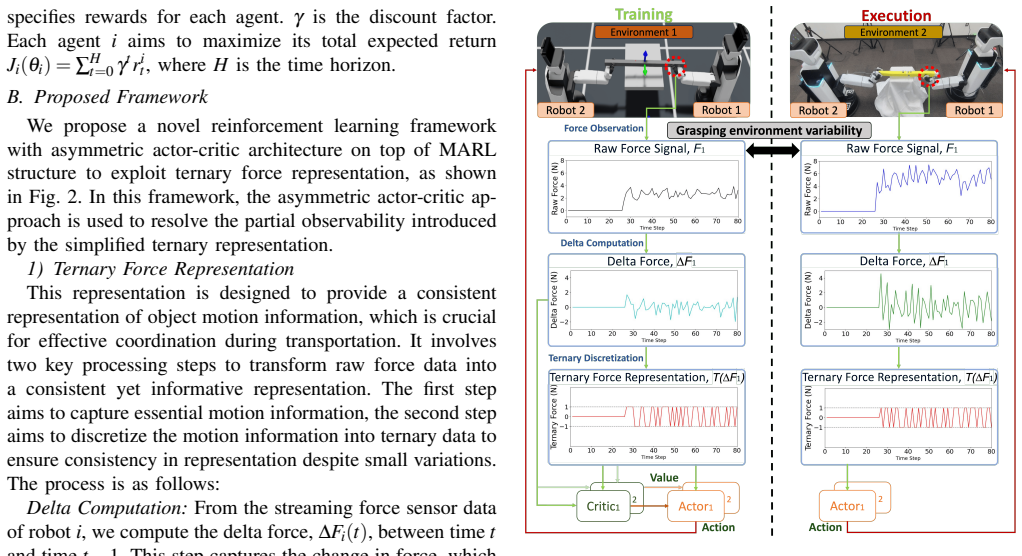
The ternary force representation is the central object: it is the sign of the change in gripper force between consecutive timesteps, taking values $-1$, $0$, or $1$ according to whether the force decreased, stayed the same, or increased. It carries the robustness argument by removing dependence on force magnitude and sensor scale. The supporting mechanism is the asymmetric actor-critic, where the actor observes only $T(\Delta F_i(t))$ during execution but the critic additionally sees $\Delta F_i(t)$ during training, supplying the magnitude information needed for credit assignment and mitigating the partial observability introduced by discretization.
What would settle it
Record the ternary observations while replaying the trained policy under a much wider set of contact changes than the paper tests, such as grasping force scaled by 0.25 or 4, a deformable object, or a shifted grasp pose; if the mean and variance of the ternary distribution shift as much as the raw force distribution does, the consistency claim is falsified. A quicker check is to artificially flip the ternary signs during execution and see whether transport success collapses, which would show that the coordination depends on sign accuracy rather than magnitude robustness.
Extended reading notes
Core claim
The discovery is that discretizing the delta force $\Delta F_i(t)=F_i(t)-F_i(t-1)$ into $\{-1,0,1\}$ by sign preserves the motion-relevant information for cooperative transport while discarding the magnitudes that depend on grip force, contact area, and object geometry. Using this ternary force as the actor's observation, with the critic given both the ternary and the pre-discretization delta force, the trained policies achieve object transport errors close to the raw-force baseline in simulation and succeed on real two-robot transfers under a different sensor model and different object sizes. The authors show quantitatively that raw force observations have noticeably different mean and variance under different grasping forces, while the ternary representation's distribution changes little, which they identify as the mechanism behind the robustness.
Load-bearing premise
The load-bearing premise is that the distribution of ternary force observations seen during simulation training matches the real world closely enough that a simulation-trained policy acts within its learned distribution on physical robots despite different sensors, friction, and control frequency.
Editorial extensions
If this is right
- A force-only coordination signal can replace explicit communication for cooperative transport, removing failure modes from communication delays and interruptions.
- The same simulation-trained policy can be deployed on a physical robot pair without retraining, even though the real sensor has a different scale, noise, and bias than the simulation sensor.
- Changes to grasping force within a factor of two and changes from a rectangular to a cylindrical grasping geometry keep success rates substantially above a raw-force baseline.
- Real-robot transport remains functional when the object cross-section changes from 4 cm by 4 cm to 3 cm by 3 cm, although final position error grows relative to simulation.
- Because only ternary values are used at execution, the method does not need to maintain calibrated absolute force magnitudes across different contact conditions.
Reading between the lines
- The sign-based discretization is a generic scale-invariance trick: it could be applied to any tactile or force feature stream to build coordination signals insensitive to sensor calibration, a generalization the paper does not claim.
- The framework's robustness should depend mainly on whether the sign of the delta force flips under new conditions; a natural stress test would be to vary control frequency or add sensor noise until signs flip and measure the resulting success-rate cliff.
- The two-robot setting is the basic case; if the representation is truly consistent, extending to more robots with pairwise force observations should behave similarly, but that scaling remains untested.
- The paper does not vary the discretization levels; testing two-level or four-level representations would reveal the trade-off between information content and robustness that the ternary choice optimizes.
Editorial analysis
A structured set of objections, weighed in public.
Referee Report
Summary. The paper addresses cooperative grasping and transportation by two robots using force feedback as implicit communication. It introduces a ternary force representation obtained by discretizing the change in gripper force between consecutive time steps into {-1, 0, 1}, and trains MAPPO policies with an asymmetric actor-critic in which the actor observes only the ternary force while the critic also sees the pre-discretization delta force. The authors evaluate the method in Isaac Sim against raw-force, no-force, and ternary-only baselines under variations in grasping force and object geometry, and deploy the simulation-trained policy on two HSRs with GelSight sensors to test object-size variations and sim2real transfer. They report that the proposed representation preserves success under force scaling while raw-force policies degrade, and that the real robots can grasp and transport objects, though with larger position errors than in simulation.
Significance. If the results hold, the ternary representation is an elegant and inexpensive way to make force-based implicit communication invariant to sensor scaling and contact-geometry changes, and the asymmetric actor-critic is a sensible way to mitigate the resulting partial observability. The simulation study is well designed: it compares several baselines, uses 100 test episodes, reports five training seeds, and tests held-out force scales and object geometries. The real-robot deployment is a genuine effort to test sim2real transfer. However, the real-robot evidence as reported does not meet the paper's own success criterion, so the strength of the sim2real claim is currently limited.
major comments (4)
- [V-B, Table V] The real-robot experiments are not successes by the paper's own metric. Section IV-B defines a successful task as a final Euclidean distance between object and target under 6 cm. Table V reports mean final position errors of 22.67 cm and 30.88 cm, i.e., 3.8 and 5.1 times the success threshold, with variances of 65.32 and 57.19 across five trials. The abstract and Section V-B state that robots "successfully grasp and transport the object to the target position," but the quantitative data show the object did not reach the target in the reported trials. This internal inconsistency affects the load-bearing sim2real claim; the authors should report the percentage of trials satisfying the 6 cm criterion, clearly justify any different success metric used for the real-robot experiments, and adjust the claims accordingly.
- [V-B, Raw Force baseline] The comparison with Raw Force on real robots is only qualitative: the authors write that the raw-force-trained robots "only hovered around the object without ever grasping it," with no position-error data, no success counts, and no number of trials. Since the central claim is that the ternary representation is more robust than raw force, the real-robot section should provide the same quantitative outcome measures for the baseline; otherwise the comparative robustness claim rests only on simulation.
- [III-B.1] The definition of the ternary representation does not specify the threshold that separates 0 from ±1. Raw force signals from real sensors are noisy, so without an explicit deadband the claim that the representation is consistent under small variations is not well-defined. The paper should state the threshold used (or the quantization rule) and ideally provide a sensitivity analysis, since this discretization is the core mechanism of the method.
- [V-B, Table V] The five-trial sample size and the large variances make the real-robot means statistically fragile. With variances of 65.32 and 57.19 over five trials, the standard errors are about 3.6 cm and 3.4 cm respectively, and no confidence intervals or per-trial values are provided, so the difference between the two object sizes is not interpretable as evidence of robustness to object-size variation.
minor comments (5)
- [Fig. 2 caption] The caption contains a typo: "Asysmetric" should be "Asymmetric".
- [IV-D.2.a, Table III] Table III reports force-observation statistics for grasping force scales 1 and 2, but the success-rate table includes scale 0.5; including the 0.5 case would make the consistency argument more complete.
- [V-A and Fig. 5 caption] The text and Table V describe object cross-sections of 4×4 cm and 3×3 cm, while the Fig. 5 caption says a "4 cm-sized object"; please use consistent dimensional notation.
- [IV-B] The phrase "force signals (without randomization)" is unclear; specify whether sensor noise was disabled or not randomized during training, since this matters for the sim2real discussion.
- [I and VII] The abstract and conclusion claim robustness to object size based on the real-robot experiment, but only two sizes and five trials are reported; the generalization claim should be tempered or supported with more conditions.
Circularity Check
No significant circularity: the paper's robustness claims rest on held-out simulation and real-robot tests, and the only self-citation is background material.
full rationale
The paper does not derive its robustness claim from a fitted parameter, a definitional equivalence, or a self-citation chain. The ternary force representation is a designed preprocessing step: it computes the delta force between consecutive time steps and discretizes it to {-1, 0, 1}. The invariance of the sign of a positively scaled force is inherent to that definition, but the paper does not present this invariance as a derived prediction; it is the proposed mechanism. The load-bearing claims are empirical and tested on variations held out from training: grasping-force scaling factors of 0.5 and 2 (Table II), a cylindrical object geometry not seen in training (Table IV), and direct deployment of a simulation-trained policy on real robots (Table V and Fig. 5). These evaluations are not fitted to the test conditions, and the real-robot results are measured rather than assumed. The only self-citation, reference [6], appears in the related-work discussion of pushing-strategy MARL and is not load-bearing for the method, experiments, or conclusions. The Discussion section candidly reports the sim2real gap, including the lower real-robot control frequency (around 30 Hz versus 100 Hz) and unintended yaw rotation from the real HSR's omnidirectional mechanism, which further indicates that the real-robot outcome is an honest measurement rather than a constructed result. Any overstatement of real-robot success relative to the paper's own 6 cm success threshold is a correctness or reporting concern, not a circularity concern.
Assumptions & free parameters
free parameters (2)
- Reward weights w1-w6 =
3.0, 4.0, 7.5, 9.5, 20, 3.0
- Ternary zero-threshold =
Not reported
assumptions (4)
- domain assumption Force sensor readings at the gripper fingers encode sufficient information about the other agent's actions and the object's motion for coordination.
- domain assumption Isaac Sim dynamics and contact models are an adequate approximation of the real HSRs for zero-shot policy transfer.
- standard math Standard Dec-POMDP and discounted-return RL assumptions hold.
- ad hoc to paper The reward weights w1...w6 are an appropriate shaping of the true task objective.
Cite this review
Pith. "Pith review of Cooperative Grasping and Transportation using Multi-agent Reinforcement Learning with Ternary Force Representation." pith.science (2026). https://pith.science/paper/KGRH7OBW
@misc{pith2026241113942,
  author       = {Pith},
  title        = {Pith review of: Cooperative Grasping and Transportation using Multi-agent Reinforcement Learning with Ternary Force Representation},
  year         = {2026},
  howpublished = {\url{https://pith.science/paper/KGRH7OBW}},
  note         = {Machine review of arXiv:2411.13942}
}
read the original abstract
Cooperative grasping and transportation require effective coordination to complete the task. This study focuses on the approach leveraging force-sensing feedback, where robots use sensors to detect forces applied by others on an object to achieve coordination. Unlike explicit communication, it avoids delays and interruptions; however, force-sensing is highly sensitive and prone to interference from variations in grasping environment, such as changes in grasping force, grasping pose, object size and geometry, which can interfere with force signals, subsequently undermining coordination. We propose multi-agent reinforcement learning (MARL) with ternary force representation, a force representation that maintains consistent representation against variations in grasping environment. The simulation and real-world experiments demonstrate the robustness of the proposed method to changes in grasping force, object size and geometry as well as inherent sim2real gap.
Figures


Figures from the paper (1 more)

Reference graph
Works this paper leans on
-
[1]
Kinematic multi-robot manipulation with no communication using force feedback,
Z. Wang and M. Schwager, “Kinematic multi-robot manipulation with no communication using force feedback,” in IEEE International Conference on Robotics and Automation (ICRA) , 2016, pp. 427–432
work page 2016
-
[2]
Cooperative manipulation exploiting only implicit communication,
A. Tsiamis, C. K. Verginis, C. P. Bechlioulis, and K. J. Kyriakopoulos, “Cooperative manipulation exploiting only implicit communication,” in IEEE/RSJ International Conference on Intelligent Robots and Systems (IROS), 2015, pp. 864–869
work page 2015
-
[3]
A collaborative control method of dual-arm robots based on deep reinforcement learning,
L. Liu, Q. Liu, Y . Song, B. Pang, X. Yuan, and Q. Xu, “A collaborative control method of dual-arm robots based on deep reinforcement learning,” Applied Sciences , vol. 11, no. 4, 2021
work page 2021
-
[4]
The surprising effectiveness of PPO in cooperative multi-agent games,
C. Yu, A. Velu, E. Vinitsky, J. Gao, Y . Wang, A. Bayen, and Y . Wu, “The surprising effectiveness of PPO in cooperative multi-agent games,” in Conference on Neural Information Processing Systems (NeurIPS), vol. 35, 2022
work page 2022
-
[5]
Occlusion-based cooperative transport with a swarm of miniature mobile robots,
J. Chen, M. Gauci, W. Li, A. Kolling, and R. Groß, “Occlusion-based cooperative transport with a swarm of miniature mobile robots,” IEEE Transactions on Robotics , vol. 31, no. 2, pp. 307–321, 2015
2015
-
[6]
K. Shibata, T. Jimbo, and T. Matsubara, “Deep reinforcement learning of event-triggered communication and consensus-based control for distributed cooperative transport,” Robotics and Autonomous Systems , vol. 159, p. 104307, 2023
work page 2023
-
[7]
Cooperative object trans- portation by multiple humanoid robots,
M.-H. Wu, A. Konno, and M. Uchiyama, “Cooperative object trans- portation by multiple humanoid robots,” in IEEE/SICE International Symposium on System Integration (SII) , 2011, pp. 779–784
work page 2011
-
[8]
The need for combining implicit and explicit communication in cooperative robotic systems,
N. Gildert, A. G. Millard, A. Pomfret, and J. Timmis, “The need for combining implicit and explicit communication in cooperative robotic systems,” Frontiers in Robotics and AI , vol. 5, 2018
work page 2018
Show all 15 references
-
[9]
Implicit and explicit communication in decentralized control,
P. Grover and A. Sahai, “Implicit and explicit communication in decentralized control,” in 48th Annual Allerton Conference on Com- munication, Control, and Computing , 2010, pp. 278–285
2010
-
[10]
How can we understand multi-robot systems? a user study to compare implicit and explicit communication modalities,
V . Villani, C. Vercellino, and L. Sabattini, “How can we understand multi-robot systems? a user study to compare implicit and explicit communication modalities,” in Distributed Autonomous Robotic Sys- tems, 2024, pp. 1–13
2024
-
[11]
A review of safe reinforcement learning: Methods, theory and applications,
S. Gu, L. Yang, Y . Du, G. Chen, F. Walter, J. Wang, and A. Knoll, “A review of safe reinforcement learning: Methods, theory and applications,” IEEE Transactions on Pattern Analysis and Machine Intelligence, 2024
2024
-
[12]
Multi-agent deep reinforcement learning for multi-robot applications: A survey,
J. Orr and A. Dutta, “Multi-agent deep reinforcement learning for multi-robot applications: A survey,” Sensors, vol. 23, no. 7, 2023
2023
-
[13]
Decentralized multi-agent reinforcement learning with global state prediction,
J. Bloom, P. Paliwal, A. Mukherjee, and C. Pinciroli, “Decentralized multi-agent reinforcement learning with global state prediction,” in IEEE/RSJ International Conference on Intelligent Robots and Systems (IROS), 2023, pp. 8854–8861
2023
-
[14]
Asymmetric actor critic for image-based robot learning,
L. Pinto, M. Andrychowicz, P. Welinder, W. Zaremba, and P. Abbeel, “Asymmetric actor critic for image-based robot learning,” in Robotics: Science and Systems (RSS) , 2018
2018
-
[15]
Towards closing the sim-to-real gap in collaborative multi-robot deep rein- forcement learning,
W. Zhao, J. P. Queralta, L. Qingqing, and T. Westerlund, “Towards closing the sim-to-real gap in collaborative multi-robot deep rein- forcement learning,” in 5th International Conference on Robotics and Automation Engineering (ICRAE) , 2020, pp. 7–12
2020
Reviewed August 12, 2026 · model on record in the stance chip above.
Discussion (0). Continue with ORCID to comment.