REVIEW 3 major objections 7 minor 27 references
A conformally mapped numerical wave tank supporting piston and flap wavemakers
T0 review · 3 major / 7 minor · reviewed 2026-08-15 · deepseek-v4-flash
Pith's one-line read This paper claims that a double-layered conformal mapping, extended with piston and flap wavemaker maps, gives the first complete conformal-mapping-based numerical representation of a two-dimensional wave flume.
desk verdict A genuinely useful extension of conformal-mapped wave models to piston and flap wavemakers, with solid validation and a few overbroad claims that need tempering. read the letter →
The pith
A machine-rendered reading of the paper's core claim, the machinery that carries it, and where it could break.
The reading
What carries the argument
The engine is two nested conformal maps, $z=\bar f(\bar z,t)$ and $\bar z=\bar{\bar f}(\bar{\bar z},t)$, which send the moving wavemaker and bed to fixed straight lines and the free surface to a horizontal line in a rectangle. This leaves only surface dynamics to be integrated explicitly, while the fluid interior and all solid boundaries are handled analytically. The harmonic-extension work is carried by the projection kernels $[\mathcal{C}_h*\mu]$ and $[\mathcal{S}_h*\mu]$ of Eq. (8), which convert boundary data into the complex potential and back out map velocities; wall impermeability is enforced by horizontal mirroring of the domain. Piston motion enters through the dilation map (Eq. 21), flap motion through the iterated kernel map (Eqs. 25–28), and the wall condition through the background potential $\bar W$ of Eq. (29).
What would settle it
Run the same wavemaker signal in a flume at two different widths while keeping depth and paddle geometry fixed; if the phase-resolved surface elevation at 90 meters differs between the two runs, the two-dimensional conformal model cannot be the full description, whereas identical signals would support its phase-resolved claim.
Extended reading notes
Core claim
The paper's central claim is that a double-layered conformal mapping—first straightening the prescribed wavemaker, bed, and walls into an intermediate plane, then mapping the free surface to a fixed rectangle—can incorporate piston and flap wavemakers exactly. For a piston, the map is a time-dependent dilation about the far corner (Eq. 21); for a flap, the map is built from rotated projection kernels with an iterated displacement (Eqs. 25–28) and repositioned so the waterline meets the paddle face. A precomputed background potential (Eq. 29) enforces impermeability along the paddle and walls. The result, the author argues, is the first conformal-mapping-based numerical representation of a complete wave flume. The paper demonstrates exactly satisfied kinematic conditions at the wavemaker, return flow matching the Stokes-drift/mass-conservation value, and agreement with experiments on phase velocity, spurious-wave amplitudes, spectral evolution, and wave-height distributions at a measurement station 90 meters from the wavemaker.
Load-bearing premise
Everything rests on the real flow being two-dimensional, incompressible, inviscid, and irrotational, so that conformal mapping represents the flume exactly; the paper's own measurements show three-dimensional sloshing at the far station, which would degrade phase-resolved accuracy.
Editorial extensions
If this is right
- Replaying an experimentally recorded wavemaker signal in the simulation yields phase-resolved surface elevation that tracks the measured harp signals at 90 meters for moderate wave steepness.
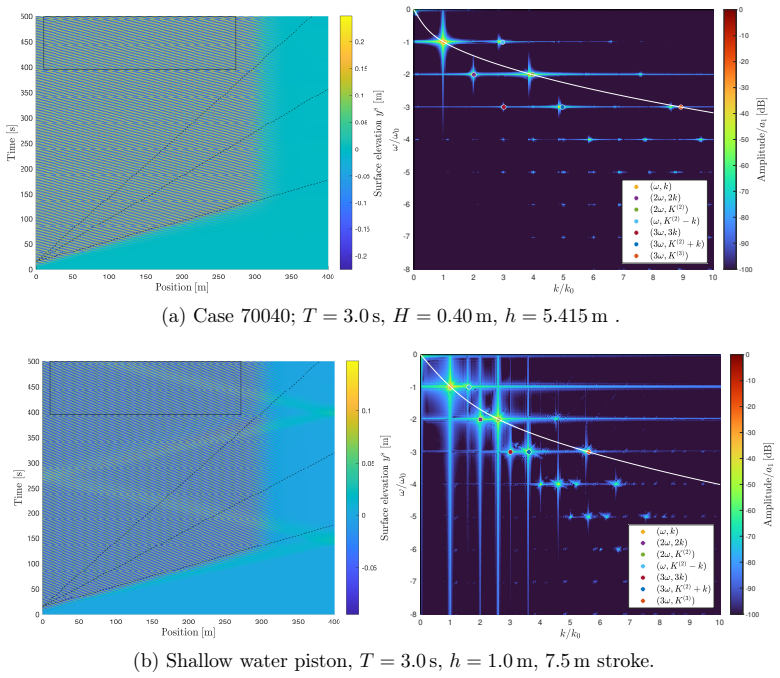
- The model captures the amplitude and arrival of second- and third-order spurious waves, and it reproduces the suppression of those waves when Schäffer's second-order correction is applied to the paddle signal.
- The simulated wave spectrum at the measurement location, including its evolution along the flume, matches the measured spectrum, while linear wavemaker theory does not capture that evolution.
- Beyond real-time computation for most tested periods means calibration iterations can be run numerically before physical tests, cutting laboratory time.
- Wave height statistics at the measurement gauge follow the experimental distributions up to the sample-limited tail, supporting the model's use for statistical wave characterization.
Reading between the lines
- Editorial inference: the same mapping construction could be adapted to other wavemaker geometries—multi-hinged paddles, directional wavemakers, or absorbing wavemakers—turning the method into a general testbed for wavemaker theory rather than a two-case construction.
- Editorial inference: the unexplained small phase shifts at 90 meters could be tested by varying the flume width; if the shifts scale with width, they are three-dimensional in origin, and if not, a missing two-dimensional mechanism such as a wall boundary-layer current is implicated.
- Editorial inference: because the model runs beyond real time and preserves full nonlinearity, it could generate the many synthetic realizations needed to estimate extreme wave-height statistics for a specific flume, complementing limited physical ensembles.
- Editorial inference: the Schwarz-Christoffel flap variant of Appendix A, which avoids the Gibbs noise of the kernel map at the hinge, could extend reliable flap angles beyond the roughly 35-degree convergence limit noted for the projection-kernel iteration.
Signed reviews
Editorial analysis
A structured set of objections, weighed in public.
Referee Report
Summary. The paper extends a double-layered conformal mapping method for two-dimensional potential-flow water waves so that it can represent piston- and flap-type wavemakers as moving boundaries in a numerical wave tank. It gives explicit conformal maps for piston motion (Eq. 21) and flap motion (Eqs. 25-28), a background potential satisfying the wall conditions (Eq. 29), and validates the resulting model against exact steady wave solutions, second-order wavemaker theory, return-flow predictions, and laboratory experiments in a towing tank. The paper claims that this provides, for the first time based on conformal mapping, a complete numerical representation of wave flumes, that the model reproduces spurious waves and spectral evolution, and that it runs faster than real time except for the shortest tested periods.
Significance. If the technical content is sound, this is a useful contribution to numerical wave tank methodology. The conformal mapping construction avoids discretizing the interior and solid boundaries, the free surface is treated nonlinearly without order truncation, and the wavemaker kinematics are satisfied by construction. The kinematic condition checks in Fig. 6, the comparison with SSGW phase velocities in Fig. 7, and the spectral and statistical comparisons in Figs. 15-18 are valuable demonstrations, and the inclusion of code listings is a practical strength. However, the central claim of a 'complete numerical representation of wave flumes' is broader than what the two-dimensional model and the presented validation can support, and one validation formula appears to be in error. These issues are local and fixable, so the paper merits revision rather than rejection.
major comments (3)
- [§5, Eq. (34)] The return-flow formula appears to under-predict the depth-averaged Stokes drift by a factor of two. For a monochromatic wave the depth-integrated Stokes transport is (1/2)|a|^2 ω coth(kh), so mass conservation in a closed tank gives U0 = −(1/(2h))|a|^2 ω coth(kh) = −g k |a|^2/(2hω). Equation (34) has g/(4h) instead. Unless a_n is defined with a non-standard amplitude convention, which is not stated, the comparison in Fig. 8 uses a target that is a factor of two too small and cannot serve as a quantitative validation of return flow. Please correct Eq. (34) or define the amplitude convention precisely and recompute the comparison.
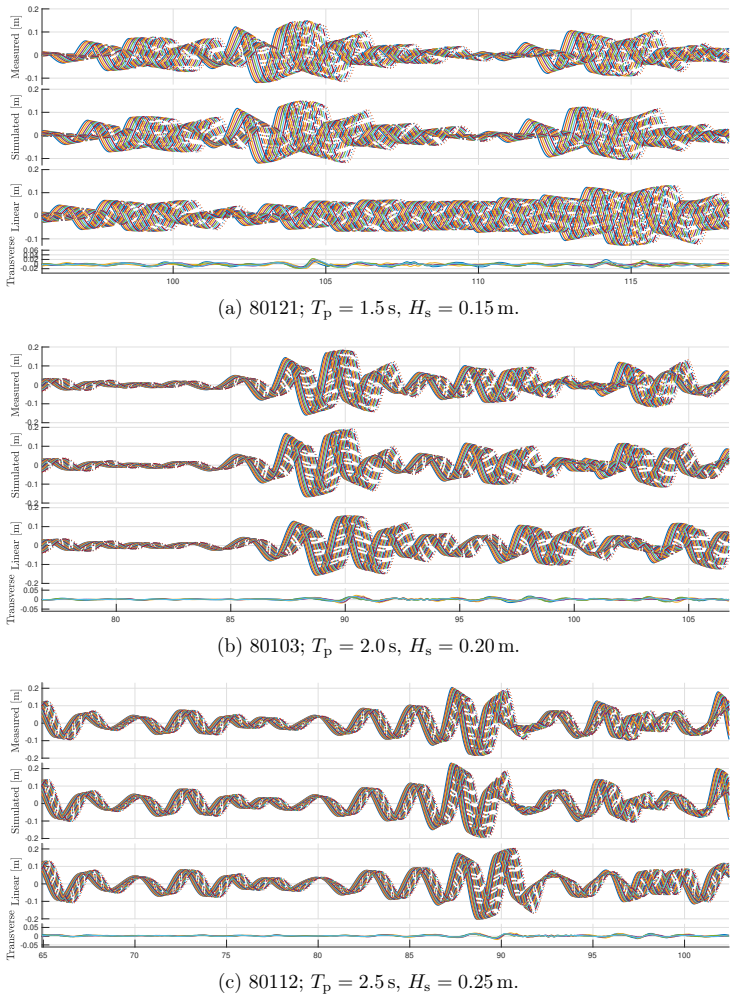
- [Abstract; §§6.2-6.3; §7] The abstract's claim of a 'complete numerical representation of wave flumes' and §8's statement that phase-resolved signals agree 'even at considerable distances' are stronger than the evidence supports. Section 6.2 attributes observed phase shifts and energy discrepancies to 'three-dimensional effects and the excitation of transverse sloshing modes', §6.3 invokes three-dimensional effects, paddle gaps, and measurement inaccuracies to explain missing energy, and §7 concedes that the model 'lacks three-dimensional effects' and questions whether 'exact phase-resolved predictions' are attainable. The bottom panels of Figs. 12 and 13 show transverse-gauge deviations of order 0.05-0.1 m against wave heights of 0.15-0.3 m. The demonstrated capabilities are spectral and statistical fidelity in a two-dimensional setting; the 'complete' and phase-resolved wording should be qualified accordingly.
- [§6.1, Fig. 9] A substantial part of the validation is not independently checkable. The text states that third-order spurious-wave predictions are included 'using the author's own, as yet unpublished, extensive wavemaker theory', and the return-flow comparison in Fig. 8 relies on Akselsen (2025b). Since the paper's central claims include accurate reproduction of wavemaker characteristics and spurious waves, the third-order comparison in Fig. 9 and the return-flow target in Fig. 8 function as validation against the author's own constructions. Please include a derivation or a citable reference for the third-order theory, or restrict the relevant validation claims to the parts that do not depend on it.
minor comments (7)
- [§2.2, Eq. (15)] The sentence preceding Eq. (15), 'which is to eb evaluated', contains a typo and should read 'which is to be evaluated'.
- [Figure 7 caption] The caption contains 'Sokes' second definition' and should read 'Stokes' second definition'.
- [Affiliation] The affiliation line lists 'Trønderlag'; the correct Norwegian county name is 'Trøndelag'.
- [§6.1, paragraph after Fig. 9] The phrase 'three-multidimensional effects' is likely a typo for 'three-dimensional effects'.
- [§6.3, paragraph after Fig. 14] The sentence 'Simulated wavemaker motions are identical to those applied during the Identical wavemaker motions are applied...' is grammatically broken and appears to be a duplicated partial sentence.
- [Appendix B, Listing 2] In the MATLAB code, the line 'nx = size(nu,1);' uses the variable 'nu', whereas the function argument is named 'mu'; this would cause an error when the function is called.
- [Figure 5 caption] The caption lists the third panel angle as 30 degrees twice; please confirm whether the third panel is meant to be -30 degrees.
Circularity Check
Minor by-construction kinematic check and auxiliary self-citations, but the central wavemaker model is validated against external experiments and SSGW.
-
self definitional
[Section 5, first paragraph, Figure 6]
"We begin by validating the kinematic wavemaker boundary condition, which, by design, should be exactly satisfied. Figure 6 confirms this, showing examples from both the piston mapping in section 3, and the flap mapping in section 4."
The kinematic condition is not an independent prediction: Eq. (6) is imposed by construction through the mapping and the background potential, and the maps (21)-(29) are designed to satisfy it. The figure therefore checks that the implementation is consistent with its own defining equations (a code verification), rather than testing the model against new physics. The text explicitly concedes the outcome is guaranteed ('by design'). This is a tautological validation step, though it is not used as evidence for the central experimental claims.
full rationale
The central derivation of the wavemaker mappings is self-contained: Eqs. (21)-(29) are constructed from the model in Section 2 and validated against external experiments (SINTEF tank) and independent SSGW exact solutions. The return-flow comparison (Eq. 34) cites the author's own Akselsen (2025b), but that formula is parameter-free, analytically derived from mass conservation and Schäffer theory, and is not fitted to the simulation; the self-citation is therefore auxiliary, not load-bearing. The third-order wavemaker theory used in Figure 9 is unpublished and self-referential, but the same figure contains experimental amplitudes as external corroboration, so the central spurious-wave claim does not reduce to the self-citation. The only genuine by-construction item is the kinematic boundary-condition check (Figure 6), which the paper itself describes as guaranteed by design; it is an implementation consistency test, not an independent prediction. No parameter is fitted and no predicted quantity is defined in terms of the target output, so the overall circularity is low.
Assumptions & free parameters
free parameters (2)
- Modal damping coefficient r and cutoff wavenumber kd =
r=0.01 with kd=0.5 kmax for gentle cases; r=0.25 with kd=0.25 kmax for the steep case 80084
- Numerical beach absorption intensity nu_0 and length L_b =
not specified
assumptions (6)
- domain assumption The fluid is incompressible, inviscid, and irrotational, so a velocity potential exists and Laplace's equation holds.
- standard math Conformal mappings preserve harmonicity of the velocity potential.
- domain assumption The kinematic boundary condition can be written as particle impermeability: a particle on the boundary remains on it (Eq. 1).
- domain assumption The free surface pressure is zero, expressed through the Bernoulli equation (Eq. 15).
- ad hoc to paper The split of the total potential into w plus W is arbitrary and does not affect the physical result.
- standard math The projection kernels (8) with mirroring (16) correctly enforce wall conditions on a discrete Fourier grid.
Cite this review
Pith. "Pith review of A conformally mapped numerical wave tank supporting piston and flap wavemakers." pith.science (2026). https://pith.science/paper/KGSXUHSZ
@misc{pith2026250513154,
  author       = {Pith},
  title        = {Pith review of: A conformally mapped numerical wave tank supporting piston and flap wavemakers},
  year         = {2026},
  howpublished = {\url{https://pith.science/paper/KGSXUHSZ}},
  note         = {Machine review of arXiv:2505.13154}
}
read the original abstract
This paper advances the development of the conformally mapped model for accurate simulation of two-dimensional water waves, here with emphasis on mapping boundaries that represent piston- and flap-type wavemakers. With this, a complete numerical representation of wave flumes is provided -- the first of its kind based on conformal mapping. The model is validated both theoretically and experimentally, with special attention devoted to wavemaker characteristics and the generation of spurious waves. It is further demonstrated that the method accurately predicts the spectral evolutions of generated wave fields. The model is computationally efficient, with beyond real-time computation but for the smallest tested periods, making it ideal for numerical wave calibration and for replicating experiments.
Figures


Figures from the paper (15 more)





Reference graph
Works this paper leans on
-
[1]
A. H. Akselsen. A precise conformally mapped method for water waves in complex transient environments. Journal of Computational Physics, page 113848, 2025 a
work page 2025
-
[2]
A. H. Akselsen. Second-order theory for multi-hinged directional wavemakers, 2025 b . URL https://doi.org/10.48550/arXiv.2502.09586. Under review in Coast.\ Eng
work page Pith review arXiv doi:10.48550/arxiv.2502.09586 2025
-
[3]
Bonnefoy, D
F. Bonnefoy, D. Le Touz \'e , and P. Ferrant. A fully-spectral 3D time-domain model for second-order simulation of wavetank experiments. P art A : F ormulation, implementation and numerical properties. Applied Ocean Research, 28 0 (1): 0 33--43, 2006
2006
-
[4]
Bonnefoy, G
F. Bonnefoy, G. Ducrozet, D. Le Touz \'e , and P. Ferrant. Time domain simulation of nonlinear water waves using spectral methods. In Advances in numerical simulation of nonlinear water waves, pages 129--164. World Scientific, 2010
2010
-
[5]
D. Chalikov. Freak waves: Their occurrence and probability. Physics of Fluids, 21 0 (7): 0 076602, 07 2009. ISSN 1070-6631. doi:10.1063/1.3175713. URL https://doi.org/10.1063/1.3175713
-
[6]
Chalikov
D. Chalikov. Numerical modeling of sea waves. Izvestiya, Atmospheric and Oceanic Physics, 56: 0 312--323, 2020
2020
-
[7]
Chalikov and D
D. Chalikov and D. Sheinin. Numerical modeling of surface waves based on principal equations of potential wave dynamics. US Department of Commerce, National Oceanic and Atmospheric Administration National Weather Service, 1996
1996
-
[8]
Chalikov and D
D. Chalikov and D. Sheinin. Modeling extreme waves based on equations of potential flow with a free surface. Journal of Computational Physics, 210 0 (1): 0 247--273, 2005
2005
Show all 27 references
-
[9]
D. V. Chalikov. Numerical modeling of sea waves. Springer, 2016
2016
-
[10]
Clamond and D
D. Clamond and D. Dutykh. Accurate fast computation of steady two-dimensional surface gravity waves in arbitrary depth. Journal of Fluid Mechanics, 844: 0 491--518, 2018
2018
-
[11]
Ducrozet, F
G. Ducrozet, F. Bonnefoy, N. Mori, M. Fink, and A. Chabchoub. Experimental reconstruction of extreme sea waves by time reversal principle. Journal of Fluid Mechanics, 884: 0 A20, 2020. doi:10.1017/jfm.2019.939
2020 doi
-
[12]
A. I. Dyachenko, E. A. Kuznetsov, M. Spector, and V. E. Zakharov. Analytical description of the free surface dynamics of an ideal fluid (canonical formalism and conformal mapping). Physics Letters A, 221 0 (1-2): 0 73--79, 1996
1996
-
[13]
S. A. Dyachenko. On the dynamics of a free surface of an ideal fluid in a bounded domain in the presence of surface tension. Journal of Fluid Mechanics, 860: 0 408--418, 2019. doi:10.1017/jfm.2018.885
2019 doi
-
[14]
Gramstad, T
O. Gramstad, T. B. Johannessen, and G. Lian. Long-term analysis of wave-induced loads using high order spectral method and direct sampling of extreme wave events. Marine Structures, 91: 0 103473, 2023
2023
-
[15]
Houtani, T
H. Houtani, T. Waseda, W. Fujimoto, K. Kiyomatsu, and K. Tanizawa. Generation of a spatially periodic directional wave field in a rectangular wave basin based on higher-order spectral simulation. Ocean Engineering, 169: 0 428--441, 2018
2018
-
[16]
H. Lamb. Hydrodynamics, 1932
1932
-
[17]
M. S. Longuet-Higgins and O. M. Phillips. Phase velocity effects in tertiary wave interactions. Journal of Fluid Mechanics, 12 0 (3): 0 333--336, 1962
1962
-
[18]
E. P. Mansard and E. Funke. The measurement of incident and reflected spectra using a least squares method. In Coastal Engineering 1980, pages 154--172. 1980
1980
-
[19]
McLean, Y
J. McLean, Y. Ma, D. Martin, P. Saffman, and H. Yuen. Three-dimensional instability of finite-amplitude water waves. Physical Review Letters, 46 0 (13): 0 817, 1981
1981
-
[20]
Milne-Thomson
L. Milne-Thomson. Theoretical hydrodynamics, 1962
1962
-
[21]
V. Ruban. Water waves over a strongly undulating bottom. Physical Review E—Statistical, Nonlinear, and Soft Matter Physics, 70 0 (6): 0 066302, 2004
2004
-
[22]
V. P. Ruban. Water waves over a time-dependent bottom: Exact description for 2d potential flows. Physics Letters A, 340 0 (1-4): 0 194--200, 2005
2005
-
[23]
H. A. Sch \"a ffer. Second-order wavemaker theory for irregular waves. Ocean Engineering, 23 0 (1): 0 47--88, 1996. doi:10.1016/0029-8018(95)00013-B
1996 doi
-
[24]
Viotti, D
C. Viotti, D. Dutykh, and F. Dias. The conformal-mapping method for surface gravity waves in the presence of variable bathymetry and mean current. Procedia IUTAM, 11: 0 110--118, 2014
2014
-
[25]
B. J. West, K. A. Brueckner, R. S. Janda, D. M. Milder, and R. L. Milton. A new numerical method for surface hydrodynamics. Journal of Geophysical Research: Oceans, 92 0 (C11): 0 11803--11824, 1987
1987
-
[26]
V. E. Zakharov, A. I. Dyachenko, and O. A. Vasilyev. New method for numerical simulation of a nonstationary potential flow of incompressible fluid with a free surface. European Journal of Mechanics-B/Fluids, 21 0 (3): 0 283--291, 2002
2002
-
[27]
V. E. Zakharov, A. I. Dyachenko, and A. O. Prokofiev. Freak waves as nonlinear stage of stokes wave modulation instability. European Journal of Mechanics-B/Fluids, 25 0 (5): 0 677--692, 2006
2006
Reviewed August 15, 2026 · model on record in the stance chip above.
Discussion (0). Continue with ORCID to comment.