Inverse-Scattering Reconstruction of Inflation from Scalar and Tensor Primordial Spectra
Pith reviewed 2026-06-27 21:18 UTC · model grok-4.3
The pith
Inverse scattering reconstructs inflationary potentials directly from scalar and tensor primordial spectra.
A machine-rendered reading of the paper's core claim, the machinery that carries it, and where it could break.
Core claim
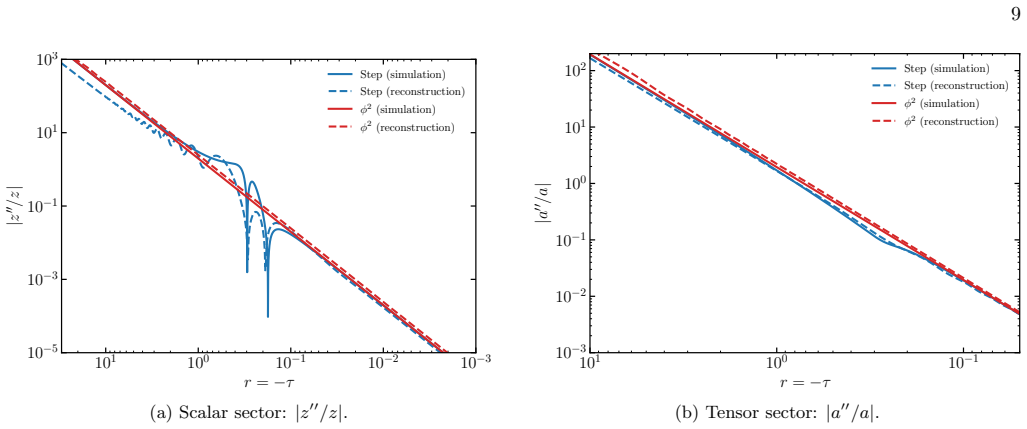
By treating the Mukhanov-Sasaki equation as a Schrödinger-like equation, the Bunch-Davies condition corresponds to the Jost solution, and the freeze-out amplitude is captured by the Jost function. The scalar and tensor spectra are then written in terms of these functions, yielding an inverse-scattering formula for the tensor-to-scalar ratio as their ratio. Tests on quadratic and step potentials show that the reconstructed potentials match the dominant behavior of z''/z and a''/a.
What carries the argument
The Jost function, which encodes the freeze-out amplitude of the growing mode in the scattering formulation of the perturbation equations.
If this is right
- The tensor-to-scalar ratio equals a ratio of Jost amplitudes from the scalar and tensor channels.
- Reconstruction via the Born approximation recovers the main features of smooth slow-roll potentials.
- Sharp features in the spectra lead to localized discrepancies in the reconstructed scalar potential.
- The method connects spectral features directly to scattering off the effective potential.
Where Pith is reading between the lines
- This framework could be applied to observed CMB data to infer potential steps or other transient violations of slow roll.
- Extensions might include higher-order scattering terms beyond the Born approximation for stronger features.
- Similar scattering methods could apply to other cosmological perturbation equations involving mode freezing.
Load-bearing premise
The Bunch-Davies initial condition can be identified with the asymptotic Jost solution on the half-line.
What would settle it
Compute the reconstructed effective potential from the exact power spectra of a quadratic inflation model and check whether it matches the known z''/z to within the expected Born approximation error.
Figures
read the original abstract
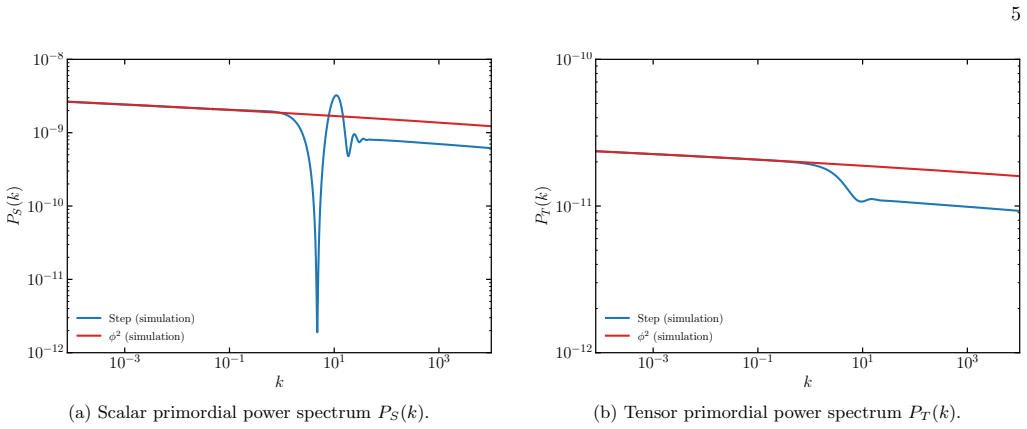
We develop an inverse-scattering framework to reconstruct the effective inflationary potentials governing scalar and tensor perturbations. By recasting the Mukhanov--Sasaki equation as a Schr\"odinger-like problem on the half-line, we identify the Bunch--Davies initial condition with the asymptotic Jost solution and show that the freeze-out amplitude of the growing mode is encoded in the corresponding Jost function. This allows the scalar and tensor primordial power spectra to be written in terms of $F^{(s)}_{\nu_s-\frac12}(k)$ and $F^{(t)}_{\nu_t-\frac12}(k)$, respectively, and leads to an inverse-scattering expression for the tensor-to-scalar ratio as a ratio of Jost amplitudes. We then test the reconstruction in the large-$k$ regime using the Born approximation, where the Marchenko equation becomes linear. As benchmarks, we consider a smooth quadratic potential and a step potential that transiently violates slow roll and generates localized features in the primordial spectra. The reconstructed effective potentials reproduce the dominant behavior of $z^{\prime\prime}/z$ and $a^{\prime\prime}/a$ for smooth slow-roll evolution, while localized discrepancies arise in the scalar sector when sharp features induce stronger scattering. Our results show that inverse scattering provides a physically transparent method for connecting features in the primordial spectra to the underlying inflationary dynamics, and that the Jost function acts as a sensitive diagnostic of departures from canonical slow-roll evolution.
Editorial analysis
A structured set of objections, weighed in public.
Referee Report
Summary. The manuscript develops an inverse-scattering framework to reconstruct effective inflationary potentials for scalar and tensor modes. By recasting the Mukhanov-Sasaki equation as a half-line Schrödinger problem and identifying Bunch-Davies modes with asymptotic Jost solutions, the scalar and tensor power spectra are expressed in terms of the Jost functions F^{(s)}_{ν_s−1/2}(k) and F^{(t)}_{ν_t−1/2}(k). This yields an inverse-scattering formula for the tensor-to-scalar ratio as a ratio of Jost amplitudes. The approach is tested in the large-k regime via the Born approximation (linear Marchenko equation) on a smooth quadratic potential and a step potential that transiently violates slow roll, with the reconstructed z''/z and a''/a reproducing dominant slow-roll behavior while showing localized discrepancies for sharp features.
Significance. If the central mapping and reconstruction hold, the work supplies a physically transparent link between features in the primordial spectra and the underlying dynamics, with the Jost function positioned as a diagnostic for departures from canonical slow-roll. The dual treatment of scalar and tensor sectors and the use of standard quantum-mechanical scattering tools in a cosmological setting are strengths. The Born-approximation benchmarks demonstrate feasibility for smooth cases, though quantitative validation would strengthen the claim of utility for precision data analysis.
major comments (2)
- Abstract and benchmark section: the claim that the reconstructed potentials reproduce the dominant behavior of z''/z and a''/a is supported only by qualitative description; no quantitative error metrics (e.g., integrated squared difference or pointwise relative error between reconstructed and input potentials) are reported, which is load-bearing for assessing accuracy when sharp features induce stronger scattering.
- Born-approximation paragraph: the validity range of the linear Marchenko equation (Born approx) for the large-k regime is invoked without stated bounds on the potential strength or explicit comparison to the full nonlinear solution, undermining the benchmark results for the step-potential case where scattering is stronger.
minor comments (2)
- Notation: the precise definition of the indices ν_s and ν_t (and their relation to the slow-roll parameters) should be stated explicitly when first introducing F^{(s)}_{ν_s−1/2}(k) and F^{(t)}_{ν_t−1/2}(k).
- The manuscript would benefit from a short table or figure caption clarifying which quantities are reconstructed versus input for each benchmark potential.
Simulated Author's Rebuttal
We thank the referee for their careful reading and constructive comments, which help clarify the presentation of our inverse-scattering framework. We address the major comments point-by-point below.
read point-by-point responses
-
Referee: Abstract and benchmark section: the claim that the reconstructed potentials reproduce the dominant behavior of z''/z and a''/a is supported only by qualitative description; no quantitative error metrics (e.g., integrated squared difference or pointwise relative error between reconstructed and input potentials) are reported, which is load-bearing for assessing accuracy when sharp features induce stronger scattering.
Authors: We agree that quantitative metrics would strengthen the assessment of reconstruction accuracy. In the revised manuscript we will add integrated squared differences and pointwise relative errors between the reconstructed and input z''/z and a''/a for both the quadratic and step-potential benchmarks. These additions will quantify the localized discrepancies noted for the step potential. revision: yes
-
Referee: Born-approximation paragraph: the validity range of the linear Marchenko equation (Born approx) for the large-k regime is invoked without stated bounds on the potential strength or explicit comparison to the full nonlinear solution, undermining the benchmark results for the step-potential case where scattering is stronger.
Authors: We will add an explicit discussion of the validity range of the Born approximation in the large-k regime, including standard bounds on potential strength derived from scattering theory. A direct numerical comparison to the full nonlinear Marchenko solution lies outside the scope of the present work, which focuses on the linear regime; we will note this limitation while clarifying that the approximation remains appropriate for the smooth and mildly featured cases examined. revision: partial
Circularity Check
No significant circularity detected
full rationale
The paper recasts the Mukhanov-Sasaki equation as a half-line Schrödinger problem using standard inverse scattering methods, identifying Bunch-Davies modes with asymptotic Jost solutions and expressing power spectra via Jost functions F. This mapping is a direct mathematical equivalence applied to the known equation, not a self-definition or fitted input renamed as prediction. The inverse-scattering formula for the tensor-to-scalar ratio follows from the same recasting. Benchmarks on quadratic and step potentials test reproduction of known z''/z and a''/a behavior in the Born approximation without reducing to self-referential fits. No load-bearing self-citations or uniqueness theorems from prior author work are invoked in the provided text; the derivation is self-contained against external benchmarks.
Axiom & Free-Parameter Ledger
axioms (1)
- domain assumption The Mukhanov-Sasaki equation can be recast as a Schrödinger-like problem on the half-line with Bunch-Davies conditions identified as asymptotic Jost solutions
Reference graph
Works this paper leans on
-
[1]
Scalar modes We now specialize in scalar perturbations. During slow-roll inflation, and neglecting higher-order contribu- tionsO(ϵ 2, η2), using the scalar Mukhanov variablez= a ˙ϕ H and using the relationsϵ ′ =ηHϵandH ′ =H 2(1−ϵ) the effective scalar potential becomes z′′ z = 1 τ 2 2 + 3ϵ+ 3 2 η (45) withν s, in Eq. (41), is approximately constant during...
-
[2]
In this sec- tor, the Mukhanov–Sasaki equation is governed by the effective potentiala ′′/a, rather than by the scalar com- binationz ′′/z
Tensorial modes We now specialize to tensor perturbations. In this sec- tor, the Mukhanov–Sasaki equation is governed by the effective potentiala ′′/a, rather than by the scalar com- binationz ′′/z. Therefore, tensor modes probe directly the background expansion history. During slow-roll infla- tion, and neglecting higher-order contributionsO(ϵ 2, η2), ta...
-
[3]
Using the inverse-scattering expressions for the scalar and tensor power spectra, Eqs
Tensor-to-scalar ratio The tensor-to-scalar ratio is defined as the ratio be- tween the tensor and scalar primordial power spectra, r(k)≡ Pt(k) Ps(k) .(51) This quantity provides a direct measure of the relative amplitude of primordial gravitational waves with respect to scalar curvature perturbations and constitutes one of the primary observational probe...
-
[4]
V. F. Mukhanov, Gravitational Instability of the Uni- verse Filled with a Scalar Field, JETP Lett.41, 493 (1985)
1985
-
[5]
Sasaki, Large Scale Quantum Fluctuations in the In- flationary Universe, Prog
M. Sasaki, Large Scale Quantum Fluctuations in the In- flationary Universe, Prog. Theor. Phys.76, 1036 (1986)
1986
-
[6]
B. A. Bassett, S. Tsujikawa, and D. Wands, Inflation dynamics and reheating, Rev. Mod. Phys.78, 537 (2006), arXiv:astro-ph/0507632
Pith/arXiv arXiv 2006
- [7]
-
[8]
J. M. Maldacena, Non-Gaussian features of primordial fluctuations in single field inflationary models, JHEP05, 013, arXiv:astro-ph/0210603
-
[9]
Akramiet al.(Planck), Planck 2018 results
Y. Akramiet al.(Planck), Planck 2018 results. X. Con- straints on inflation, Astron. Astrophys.641, A10 (2020), arXiv:1807.06211 [astro-ph.CO]
Pith/arXiv arXiv 2018
-
[10]
M. Forconi, W. Giar` e, E. Di Valentino, and A. Melchiorri, Cosmological constraints on slow roll inflation: An up- date, Phys. Rev. D104, 103528 (2021), arXiv:2110.01695 [astro-ph.CO]
arXiv 2021
-
[11]
Wang, Inflation 2024, arXiv preprint (2024), arXiv:2407.03577 [astro-ph.CO]
D. Wang, Inflation 2024, arXiv preprint (2024), arXiv:2407.03577 [astro-ph.CO]
arXiv 2024
- [12]
-
[13]
J. A. Vazquez, M. Bridges, M. P. Hobson, and A. N. Lasenby, Model selection applied to reconstruction of the Primordial Power Spectrum, JCAP06, 006, arXiv:1203.1252 [astro-ph.CO]
- [14]
-
[15]
N. Kogo, M. Sasaki, and J. Yokoyama, Reconstructing the primordial spectrum with CMB temperature and po- larization, Phys. Rev. D70, 103001 (2004), arXiv:astro- ph/0409052
arXiv 2004
-
[16]
P. Hunt and S. Sarkar, Reconstruction of the primordial power spectrum of curvature perturbations using mul- tiple data sets, JCAP01, 025, arXiv:1308.2317 [astro- ph.CO]
-
[17]
D. K. Hazra, A. Shafieloo, G. F. Smoot, and A. A. Starobinsky, Primordial features and Planck polariza- tion, JCAP09, 009, arXiv:1605.02106 [astro-ph.CO]
-
[18]
M. Aich, D. K. Hazra, L. Sriramkumar, and T. Souradeep, Oscillations in the inflaton potential: 12 Complete numerical treatment and comparison with the recent and forthcoming CMB datasets, Phys. Rev. D87, 083526 (2013), arXiv:1106.2798 [astro-ph.CO]
Pith/arXiv arXiv 2013
-
[19]
Z.-K. Guo, D. J. Schwarz, and Y.-Z. Zhang, Reconstruc- tion of the primordial power spectrum from CMB data, JCAP08, 031, arXiv:1105.5916 [astro-ph.CO]
-
[20]
S. L. Bridle, A. M. Lewis, J. Weller, and G. Efstathiou, Reconstructing the primordial power spectrum, Mon. Not. Roy. Astron. Soc.342, L72 (2003), arXiv:astro- ph/0302306
arXiv 2003
-
[21]
C. Gauthier and M. Bucher, Reconstructing the primor- dial power spectrum from the CMB, JCAP10, 050, arXiv:1209.2147 [astro-ph.CO]
-
[22]
P. A. R. Adeet al.(Planck), Planck 2013 results. XXII. Constraints on inflation, Astron. Astrophys.571, A22 (2014), arXiv:1303.5082 [astro-ph.CO]
Pith/arXiv arXiv 2013
-
[23]
P. A. R. Adeet al.(Planck), Planck 2015 results. XX. Constraints on inflation, Astron. Astrophys.594, A20 (2016), arXiv:1502.02114 [astro-ph.CO]
Pith/arXiv arXiv 2015
-
[24]
G. Aslanyan, L. C. Price, K. N. Abazajian, and R. Eas- ther, The Knotted Sky I: Planck constraints on the pri- mordial power spectrum, JCAP08, 052, arXiv:1403.5849 [astro-ph.CO]
-
[25]
F. Finelliet al.(CORE), Exploring cosmic origins with CORE: Inflation, JCAP04, 016, arXiv:1612.08270 [astro-ph.CO]
-
[26]
A. Shafieloo and T. Souradeep, Primordial power spec- trum from WMAP, Phys. Rev. D70, 043523 (2004), arXiv:astro-ph/0312174
Pith/arXiv arXiv 2004
-
[27]
D. K. Hazra, A. Shafieloo, and T. Souradeep, Pri- mordial power spectrum from Planck, JCAP11, 011, arXiv:1406.4827 [astro-ph.CO]
-
[28]
K. Kadota, S. Dodelson, W. Hu, and E. D. Stewart, Pre- cision of inflaton potential reconstruction from CMB us- ing the general slow-roll approximation, Phys. Rev. D72, 023510 (2005), arXiv:astro-ph/0505158
Pith/arXiv arXiv 2005
-
[29]
C. Dvorkin and W. Hu, Generalized Slow Roll for Large Power Spectrum Features, Phys. Rev. D81, 023518 (2010), arXiv:0910.2237 [astro-ph.CO]
Pith/arXiv arXiv 2010
-
[30]
Hu, Generalized Slow Roll for Non-Canonical Kinetic Terms, Phys
W. Hu, Generalized Slow Roll for Non-Canonical Kinetic Terms, Phys. Rev. D84, 027303 (2011), arXiv:1104.4500 [astro-ph.CO]
Pith/arXiv arXiv 2011
-
[31]
S. M. Leach, Measuring the primordial power spec- trum: Principal component analysis of the cosmic mi- crowave background, Mon. Not. Roy. Astron. Soc.372, 646 (2006), arXiv:astro-ph/0506390
Pith/arXiv arXiv 2006
-
[32]
C. Dvorkin and W. Hu, CMB Constraints on Principal Components of the Inflaton Potential, Phys. Rev. D82, 043513 (2010), arXiv:1007.0215 [astro-ph.CO]
Pith/arXiv arXiv 2010
-
[33]
C. Dvorkin and W. Hu, Complete WMAP Constraints on Bandlimited Inflationary Features, Phys. Rev. D84, 063515 (2011), arXiv:1106.4016 [astro-ph.CO]
Pith/arXiv arXiv 2011
-
[34]
J. M. Cline and L. Hoi, Inflationary potential reconstruc- tion for a wmap running power spectrum, JCAP06, 007, arXiv:astro-ph/0603403
-
[35]
R. Bean, D. J. H. Chung, and G. Geshnizjani, Recon- structing a general inflationary action, Phys. Rev. D78, 023517 (2008), arXiv:0801.0742 [astro-ph]
Pith/arXiv arXiv 2008
-
[36]
A. Durakovic, P. Hunt, S. P. Patil, and S. Sarkar, Recon- structing the EFT of Inflation from Cosmological Data, SciPost Phys.7, 049 (2019), arXiv:1904.00991 [astro- ph.CO]
arXiv 2019
-
[37]
A. Kogutet al., The Primordial Inflation Explorer (PIXIE): A Nulling Polarimeter for Cosmic Mi- crowave Background Observations, JCAP07, 025, arXiv:1105.2044 [astro-ph.CO]
Pith/arXiv arXiv 2044
-
[38]
P. Andr´ eet al.(PRISM), PRISM (Polarized Radiation Imaging and Spectroscopy Mission): An Extended White Paper, JCAP02, 006, arXiv:1310.1554 [astro-ph.CO]
-
[39]
J. Chluba and R. A. Sunyaev, The evolution of CMB spectral distortions in the early Universe, Mon. Not. Roy. Astron. Soc.419, 1294 (2012), arXiv:1109.6552 [astro- ph.CO]
Pith/arXiv arXiv 2012
-
[40]
J. Chluba, R. Khatri, and R. A. Sunyaev, CMB at 2x2 order: The dissipation of primordial acoustic waves and the observable part of the associated energy release, Mon. Not. Roy. Astron. Soc.425, 1129 (2012), arXiv:1202.0057 [astro-ph.CO]
Pith/arXiv arXiv 2012
-
[41]
R. Khatri and R. A. Sunyaev, Forecasts for CMBµ andi-type spectral distortion constraints on the pri- mordial power spectrum on scales 8≲k≲10 4M pc−1 with the future Pixie-like experiments, JCAP06, 026, arXiv:1303.7212 [astro-ph.CO]
-
[42]
M. H. Abitbol, J. Chluba, J. C. Hill, and B. R. John- son, Prospects for Measuring Cosmic Microwave Back- ground Spectral Distortions in the Presence of Fore- grounds, Mon. Not. Roy. Astron. Soc.471, 1126 (2017), arXiv:1705.01534 [astro-ph.CO]
Pith/arXiv arXiv 2017
-
[43]
J. Chlubaet al., New horizons in cosmology with spectral distortions of the cosmic microwave background, Exper. Astron.51, 1515 (2021), arXiv:1909.01593 [astro-ph.CO]
arXiv 2021
-
[44]
R. G. Newton,Inverse Schr¨ odinger scattering in three dimensions(Springer Science & Business Media, 2012)
2012
-
[45]
Chadan and P
K. Chadan and P. C. Sabatier,Inverse problems in quan- tum scattering theory(Springer Science & Business Me- dia, 2012)
2012
-
[46]
Wang,Seismic inversion: Theory and applications (John Wiley & Sons, 2016)
Y. Wang,Seismic inversion: Theory and applications (John Wiley & Sons, 2016)
2016
- [47]
-
[48]
J. Mastache, F. Zago, and A. Kosowsky, Inflationary Dynamics Reconstruction via Inverse-Scattering Theory, Phys. Rev. D95, 063511 (2017), arXiv:1611.03957 [astro- ph.CO]
Pith/arXiv arXiv 2017
-
[49]
A. A. Starobinsky, Spectrum of adiabatic perturbations in the universe when there are singularities in the infla- tion potential, JETP Lett.55, 489 (1992)
1992
-
[50]
J. A. Adams, B. Cresswell, and R. Easther, Inflationary perturbations from a potential with a step, Phys. Rev. D 64, 123514 (2001), arXiv:astro-ph/0102236
Pith/arXiv arXiv 2001
-
[51]
G. A. Palma, D. Sapone, and S. Sypsas, Constraints on inflation with LSS surveys: features in the primordial power spectrum, JCAP06, 004, arXiv:1710.02570 [astro- ph.CO]
-
[52]
E. Silverstein and A. Westphal, Monodromy in the CMB: Gravity Waves and String Inflation, Phys. Rev. D78, 106003 (2008), arXiv:0803.3085 [hep-th]
Pith/arXiv arXiv 2008
-
[53]
L. McAllister, E. Silverstein, and A. Westphal, Grav- ity Waves and Linear Inflation from Axion Monodromy, Phys. Rev. D82, 046003 (2010), arXiv:0808.0706 [hep- th]
Pith/arXiv arXiv 2010
-
[54]
R. Flauger, L. McAllister, E. Pajer, A. Westphal, and G. Xu, Oscillations in the CMB from Axion Monodromy Inflation, JCAP06, 009, arXiv:0907.2916 [hep-th]
-
[55]
R. Flauger, L. McAllister, E. Silverstein, and A. West- phal, Drifting Oscillations in Axion Monodromy, JCAP 13 10, 055, arXiv:1412.1814 [hep-th]
-
[56]
E. Silverstein and D. Tong, Scalar speed limits and cos- mology: Acceleration from D-cceleration, Phys. Rev. D 70, 103505 (2004), arXiv:hep-th/0310221
Pith/arXiv arXiv 2004
-
[57]
R. P. Woodard, The Case for Nonlocal Modifications of Gravity, Universe4, 88 (2018), arXiv:1807.01791 [gr-qc]
Pith/arXiv arXiv 2018
-
[58]
D. J. Brooker, N. C. Tsamis, and R. P. Woodard, Ana- lytic approximation for the primordial spectra of single scalar potential models and its use in their reconstruc- tion, Phys. Rev. D96, 103531 (2017), arXiv:1708.03253 [gr-qc]
Pith/arXiv arXiv 2017
-
[59]
D. J. Brooker, N. C. Tsamis, and R. P. Woodard, From Non-trivial Geometries to Power Spectra and Vice Versa, JCAP04, 003, arXiv:1712.03462 [gr-qc]
-
[60]
Z.-G. Liu, J. Zhang, and Y.-S. Piao, Phantom Inflation with A Steplike Potential, Phys. Lett. B697, 407 (2011), arXiv:1012.0673 [gr-qc]
Pith/arXiv arXiv 2011
-
[61]
Z.-G. Liu and Y.-S. Piao, Phantom Inflation in Little Rip, Phys. Lett. B713, 53 (2012), arXiv:1203.4901 [gr-qc]
Pith/arXiv arXiv 2012
-
[62]
T. S. Bunch and P. C. W. Davies, Quantum Field Theory in de Sitter Space: Renormalization by Point Splitting, Proc. Roy. Soc. Lond. A360, 117 (1978)
1978
discussion (0)
Sign in with ORCID, Apple, or X to comment. Anyone can read and Pith papers without signing in.