REVIEW 2 major objections 6 minor 2 cited by
Methods for pitch analysis in contemporary popular music: Vitalic's use of tones that do not operate on the principle of acoustic resonance
T0 review · 2 major / 6 minor · reviewed 2026-08-07 · deepseek-v4-flash
Pith's one-line read In Vitalic's 'No Fun', a single inharmonic tone can evoke two simultaneous melodies because perceived pitches come from selected partials rather than the fundamental.
desk verdict A useful descriptive study with a novel typology and a striking 'No Fun' example, but the single-tone two-melody claim is under-evidenced and the pitch labels need controlled listening. read the letter →
The pith
A machine-rendered reading of the paper's core claim, the machinery that carries it, and where it could break.
The reading
What carries the argument
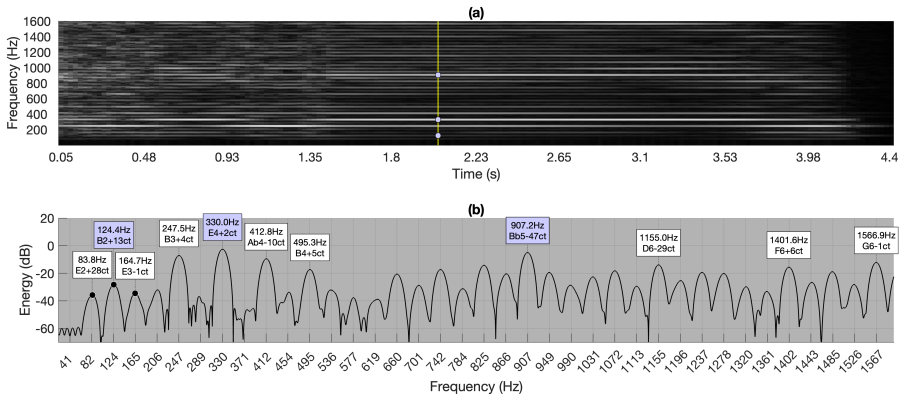
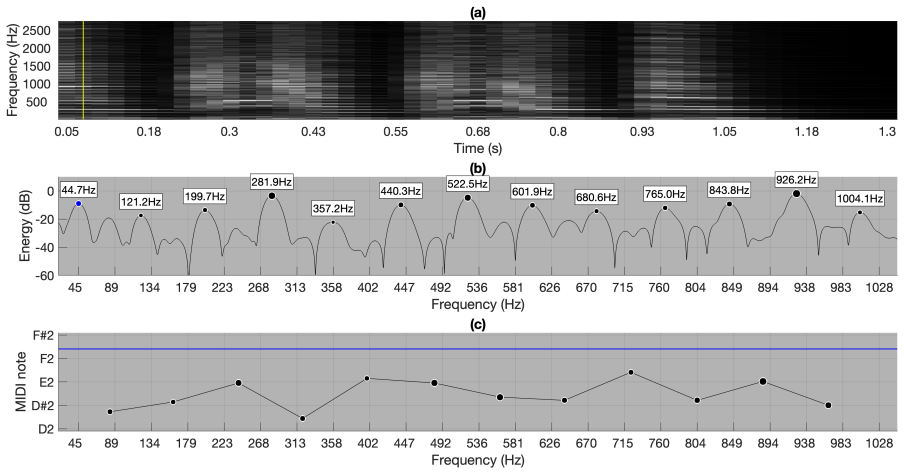
The central object is the complex tone defined as an ensemble of discrete partials that share a common fate, analyzed not by its fundamental or autocorrelation but by the frequency difference between consecutive partials. The paper argues that this difference, not the highest autocorrelation peak, is the quantity that matches perceived pitch in inharmonic material: for a tone whose overtones are multiples of 246.94 Hz while the f0 stays at 220 Hz, listeners hear A3 and B3 simultaneously, while the autocorrelation peak falls near A#3, which nobody hears. Pitch-bearing elements are then individually audible partials or partial subsets whose frequencies approximate a harmonic series. Three inharmonic layouts are defined: type 1, shifted residue, where overtones are displaced by a fixed frequency; type 2, stretched or compressed tones, where all adjacent-partial differences are larger or smaller than the fundamental (with 'No Fun' read as a shifted tone of this kind); and type 3, noisy harmonicity, where peaks loosely align with multiples of the fundamental while the deviations look random. Equal-loudness weighting and source separation prepare the spectra; the stable inter-partial difference is what lets partial-position shifts and amplitude changes be heard as melodic motion.
What would settle it
Run a controlled pitch-matching test on the isolated 'No Fun' synthesizer notes: if trained listeners do not hear the two transcribed melodic lines, or if removing only the 363.4 Hz partial weakens the F#4 percept as much as removing the whole subset (363.4, 727.5, 1128.4, 1454.7 Hz), then the partial-subset account is wrong.
Extended reading notes
Core claim
The paper's central discovery is that in Vitalic's music, perceived pitches from quasi-harmonic tones may not correspond to the tone's fundamental frequency, and a single quasi-harmonic tone may convey more than one pitch at once. The main synthesizer part of 'No Fun' is analyzed as a sequence of shifted type-2 tones whose frequency difference between consecutive partials remains stable, close to A1, throughout the extract; melodic movement is produced by shifts in the partial lattice and by selective amplification of partials. The paper isolates one note and shows, through filtering, that attenuating the F#4 partial subset (363.4, 727.5, 1128.4 and 1454.7 Hz) weakens the F#4 percept more than attenuating only the 363.4 Hz partial, indicating that the pitch is carried by a subset of partials, not just by the lowest one. It then classifies Vitalic's inharmonic tones into three types——shifted residue, stretched or compressed tones, and noisy harmonicity——and reports that none follow the piano-string inharmonicity model. Examples outside Vitalic's catalog (TR-808 presets, a distorted power chord, a Primaal bass track) show the same behaviors, so the phenomenon is presented as a general feature of contemporary popular music production rather than an isolated curiosity.
Load-bearing premise
Everything rests on the informal, author-approved hearing that the transcribed pitches (for example Gb2/Gb3/Db4 in 'Cosmic Renegade' and F#4 in 'No Fun') are actually the pitches listeners perceive; the paper states that formally linking tones to perceived pitches is beyond its scope, so if a controlled listening test contradicted those labels, the central claim would lose its evidence.
Editorial extensions
If this is right
- Standard f0-based pitch trackers will misreport or miss melodic content in passages like the 'No Fun' synthesizer part; the useful signal quantity is the frequency difference between consecutive partials, together with the positions and amplitudes of individual partials.
- Automatic transcription and music information retrieval must decide which partial subset to treat as 'the note', because a single tone can legitimately carry two notes at once.
- In this repertoire, partial amplitudes affect both timbre and pitch, so the pitch/timbre boundary is not a sharp line; descriptors of timbre that exclude pitch are incomplete.
- Producers can use the number of perceivable pitches per tone and the uncertainty of those pitches as compositional parameters, as Vitalic reports doing.
- The three-type typology of inharmonic layouts gives a transferable vocabulary for analyzing non-resonant synthesized sounds in popular music beyond Vitalic's own catalog.
Reading between the lines
- A testable consequence the paper does not develop: an algorithm that tracks the stable inter-partial difference as a carrier and then reads amplitude peaks should be able to recover both 'No Fun' melodic lines from the single-tone audio stream.
- Because the paper reports that the salience of overtones depends on the listening system (D6 appears on one laptop but not on headphones), the same audio file may genuinely contain two differently salient melodies; listener-dependent pitch salience could be formalized as a map over partial subsets.
- The examples from TR-808-style patches and distorted power chords suggest a broader style-level claim: some widely used electronic and rock sounds have upper partials loud enough to act as melody carriers, which would shift how we explain hooks and basslines in those genres. The paper only suggests this; it does not prove it.
Editorial analysis
A structured set of objections, weighed in public.
Referee Report
Summary. The paper examines pitch analysis for electronic music, focusing on Vitalic's 'No Fun'. It claims that the main synthesizer part consists of a sequence of single inharmonic tones whose partials are regularly spaced, and that these single tones evoke two simultaneous melodic lines through subsets of partials rather than through the fundamental. The manuscript presents STFT-based analyses of several Vitalic tracks, a typology of inharmonic tones (shifted residue, stretched/compressed/shifted, noisy harmonicity), a comparison with piano-string inharmonicity, and analogous examples from TR-808 patches, distorted power chords, and a Primaal bass track. The authors argue that such tones break the usual assumption that perceived pitch is tied to f0, and they propose a simplified spectral-modeling approach using frequency differences between consecutive partials. Supplementary audio and visualizations are provided for many of the analyses.
Significance. The paper's central observation—that synthesized tones with regularly spaced inharmonic partials can produce multiple perceptible pitches unrelated to the nominal f0, and that in 'No Fun' this may create two simultaneous melodic lines—is musically and perceptually interesting. If established, it would be a useful caution for MIR and music-cognition research, since standard f0-based pitch trackers would misdescribe such passages. The paper ships extensive supplementary materials with synchronized audio and STFT figures, which is a real strength, and the typology in Section 4 is a practical starting point for discussing inharmonic synth tones. The main weakness is evidential: the perceptual-pitch labels are based on informal listening and artist approval, and the 'single tone' grouping of partials in 'No Fun' is not independently verified. The paper also makes a methodologically valuable point that autocorrelation-based pitch estimation can fail for inharmonic tones, although the supporting listening test is reported too briefly.
major comments (2)
- [Section 5, Figures 9 and 11] The claim that a single tone in the 'No Fun' main synthesizer conveys two simultaneous melodic lines rests on an untested grouping of spectral peaks into one perceptual object. Under the paper's own definition, a tone is an ensemble of partials sharing common fate (Section 2.2), but Section 5 never shows common fate for the red and yellow partial subsets. The evidence offered—a constant median frequency difference between consecutive partials near A1 (Figure 9) and quasi-harmonic subsets (Figure 11)—is also exactly what would be observed if two interleaved harmonic or quasi-harmonic tones with fundamentals separated by one octave sounded simultaneously: the union of harmonic series at f0 and 2f0 produces peaks at multiples of f0 with constant differences, and amplitude weighting can make alternating peaks prominent. The source-separation step in Section 2.4 cannot disambiguate these cases because the 'other' stem can contain several simultaneous synth voices. To support the 'single tone, two melodies' interpretation, the authors should demonstrate common fate through onset/offset coincidence and amplitude covariance of the partials, or run a listening experiment that distinguishes the single-tone interpretation from two interleaved voices. Otherwise the conclusion in Section 3 should be softened to an untested hypothesis.
- [Sections 5.3 and 2.7] The manuscript itself states that 'formally linking the tones to perceived pitches is beyond the scope of this paper' (Section 5.3). The perceived-pitch labels in Figures 1, 3, 4, and 11 come from informal listening by the authors and the artist, and the artist reviewed and approved all results (Section 2.7). The only controlled listening test, in Section 2.3 and Figure 2, uses synthetic stimuli and does not test the actual 'No Fun' excerpts or the partial-subset melodies. Because the central claim of the paper concerns perceived pitches, the perceptual evidence is load-bearing and currently under-specified. A controlled identification or discrimination test using the original audio, or at least re-synthesized versions of the proposed partial subsets, is needed before the two-melodies claim can be regarded as established.
minor comments (6)
- [Section 7] In the first sentence of Section 7, 'TheFrenchelectronicmusicproducerVitalic' should be corrected to 'The French electronic music producer Vitalic'.
- [Section 2.3] The listening test reporting in Section 2.3 is too terse: the sentence describing 'nineteen out of twenty participants' should state the number and type of stimuli, the trial design, participant training, and whether responses were forced-choice, so that the result is reproducible.
- [Figure 1 caption] The phrase '27 first partials' should be 'first 27 partials'.
- [Section 2.2, item 4] The claim that the regularity of partial positions 'is a result of preset selection during production' is presented as a factual remark by the artist; it would be helpful to mark this explicitly as a personal communication and, if possible, provide a preset name or screenshot in the supplementary material.
- [Section 4.4] The piano inharmonicity fit in Section 4.4 does not report the fitting procedure, the data points used, or any goodness-of-fit measure; adding this information would strengthen the claim that none of the Vitalic tones comply with the piano-string model.
- [Figure 10] The criterion for identifying 'missing peaks' (dotted black lines) in Figure 10 is not defined; please state the rule used to decide that a peak is missing and how its position is estimated.
Circularity Check
No circularity: the paper's claims are descriptive spectral and listening observations, with no fitted parameter reused as a prediction and no load-bearing self-citation.
full rationale
The central claims are empirical descriptions of measured spectra, source-separated audio, and informal listening results, not derivations from fitted parameters. The only fitted quantity, the piano inharmonicity coefficient B in Section 4.4, is used as an auxiliary comparison baseline and is not reused to predict any pitch. The 'single tone conveys multiple pitches' claim rests on the paper's explicit common-fate definition of a tone in Section 2.2, not on a definition that presupposes the conclusion; whether that grouping is adequately demonstrated is an evidence-quality/correctness concern, not a circularity. Section 5.3 candidly states that formally linking tones to perceived pitches is beyond the paper's scope, which further indicates that no derived prediction is being disguised as an output. The self-citations (Deruty et al. 2022; Deruty and Grachten 2022) are contextual references in Section 6.3 and are not load-bearing. The artist's co-authorship and approval disclosed in Section 2.7 are relevant to potential bias but do not make the argument circular. No step reduces to its own input by construction.
Assumptions & free parameters
free parameters (1)
- Inharmonicity coefficient B =
0.00022
assumptions (5)
- domain assumption A tone is defined by common fate of partials: partials that start and stop together belong to one sound.
- domain assumption Spectral modeling with equal-loudness weighting approximates pitch perception better than raw spectra, and frequency difference between partials outranks autocorrelation for inharmonic tones.
- domain assumption X-UMX source separation yields stems accurate enough for partial tracking.
- domain assumption The least-deviating harmonic series defines f0 for inharmonic tones.
- ad hoc to paper The regularity constraint on peak detection does not force the regular spacing that is later reported.
Cite this review
Pith. "Pith review of Methods for pitch analysis in contemporary popular music: Vitalic's use of tones that do not operate on the principle of acoustic resonance." pith.science (2026). https://pith.science/paper/KHCPQGNE
@misc{pith2026250607207,
  author       = {Pith},
  title        = {Pith review of: Methods for pitch analysis in contemporary popular music: Vitalic's use of tones that do not operate on the principle of acoustic resonance},
  year         = {2026},
  howpublished = {\url{https://pith.science/paper/KHCPQGNE}},
  note         = {Machine review of arXiv:2506.07207}
}
read the original abstract
Vitalic is an electronic music producer who has been active since 2001. Vitalic's 2005 track "No Fun" features a main synthesiser part built from a sequence of single inharmonic tones that evoke two simultaneous melodies. This part serves as a starting point for examining Vitalic's use of tones that do not operate on the principle of acoustic resonance. The study considers tones that evoke two or more simultaneous pitches and examines various inharmonic partial layouts. Examples outside Vitalic's music are also provided to suggest that similar tone properties can be found elsewhere in contemporary popular music.
Figures


Figures from the paper (11 more)


Forward citations
Cited by 2 Pith papers
-
Methods for pitch analysis in contemporary popular music: multiple pitches from harmonic tones in Vitalic's music
Single quasi-harmonic tones in Vitalic's electronic music are perceived by listeners as carrying multiple simultaneous pitches, an effect the paper argues producers use deliberately.
-
Evolving music theory for emerging musical languages
Pitch in electronic music is better understood as a listener-dependent perceptual construct than an objective property of the sound.
Reference graph
Works this paper leans on
-
[1]
Acoustical Society of American Standards . Timbre, 2024. https://asastandards.org/terms/timbre/
work page 2024
-
[2]
Albert S. Bregman and Pierre A. Ahad. Demonstrations to Accompany Bregman's Auditory Scene Analysis. Cambridge, MA, and London: MIT Press, 1996. \ ://themusiclab.github.io/bregman-archive/snd/ASA-Demo-Booklet9V4.pdf
work page 1996
-
[3]
808 bass and beyond: Evolution of an iconic sound, 2019
Gavin Burke. 808 bass and beyond: Evolution of an iconic sound, 2019. \ ://futureaudioworkshop.com/808-bass-and-beyond-part-i/
work page 2019
-
[4]
Roland TR808 Rhythm Composer (Retro)
Chris Carter. Roland TR808 Rhythm Composer (Retro) . Sound on Sound, May 1997. \ ://www.soundonsound.com/reviews/roland-tr808
work page 1997
-
[5]
Geeta Dayal. Roland TR-808 . In Grove Music Online. Oxford Music Online, Jan 2014. \ ://doi.org/10.1093/gmo/9781561592630.article.A2257229
arXiv 2014
-
[6]
Egbert De Boer. Pitch of inharmonic signals. Nature, 178 0 (4532): 0 535--536, 1956. \ ://www.nature.com/articles/178535a0
work page 1956
-
[7]
`` M elatonin'': A case study on AI -induced musical style
Emmanuel Deruty and Maarten Grachten. `` M elatonin'': A case study on AI -induced musical style. In Proceedings of the 3rd Conference on AI Music Creativity . AIMC, September 2022. \ ://doi.org/10.5281/zenodo.7088302
-
[8]
On the development and practice of AI technology for contemporary popular music production
Emmanuel Deruty, Maarten Grachten, Stefan Lattner, Javier Nistal, and Cyran Aouameur. On the development and practice of AI technology for contemporary popular music production. Transactions of the International Society for Music Information Retrieval, 5 0 (1), 2022. \ ://transactions.ismir.net/articles/10.5334/tismir.100
Show all 52 references
-
[9]
Traditional machine learning for pitch detection
Thomas Drugman, Goeric Huybrechts, Viacheslav Klimkov, and Alexis Moinet. Traditional machine learning for pitch detection. IEEE Signal Processing Letters, 25 0 (11): 0 1745--1749, 2018. \ ://doi.org/10.1109/LSP.2018.2874155
2018
-
[10]
808 (documentary film), 2015
Alexander Dunn. 808 (documentary film), 2015. https://youtu.be/KClqn0oN1lY
2015
-
[11]
Normal vibration frequencies of a stiff piano string
Harvey Fletcher. Normal vibration frequencies of a stiff piano string. The Journal of the Acoustical Society of America, 36 0 (1): 0 203--209, 1964. https://doi.org/10.1121/1.1918933
1964 doi
-
[12]
Loudness, its definition, measurement and calculation
Harvey Fletcher and Wilden A Munson. Loudness, its definition, measurement and calculation. Bell System Technical Journal, 12 0 (4): 0 377--430, 1933. \ ://doi.org/10.1002/j.1538-7305.1933.tb00403.x
1933
-
[13]
An optimum processor theory for the central formation of the pitch of complex tones
Julius L Goldstein. An optimum processor theory for the central formation of the pitch of complex tones. The Journal of the Acoustical Society of America, 54 0 (6): 0 1496--1516, 1973. \ ://doi.org/10.1121/1.1914448
1973 doi
-
[14]
On the sensations of tone as a physiological basis for the theory of music
Hermann Ludwig Ferdinand von Helmholtz. On the sensations of tone as a physiological basis for the theory of music. Longmans, Green, and Co., 1885. Translated by Alexander John Ellis. \ ://archive.org/details/onsensationsofto00helmrich
-
[15]
Hyper music, 2024
Hyper Music . Hyper music, 2024. https://www.hyper-music.com/
2024
-
[16]
Normal equal-loudness level contours-ISO 226: 2023
ISO. Normal equal-loudness level contours-ISO 226: 2023 . Standard, International Organization for Standardization, Geneva, Switzerland, 2023. https://www.iso.org/standard/83117.html
2023
-
[17]
a rvel \
Hanna J \"a rvel \"a inen, Vesa V \"a lim \"a ki, and Matti Karjalainen. Audibility of inharmonicity in string instrument sounds, and implications to digital sound synthesis. In Proceedings of the 25th International Computer Music Conference, ICMC 1999, Beijing, China, 1999. \...
1999
-
[18]
a rvel \
Hanna J \"a rvel \"a inen, Tony S Verma, and Vesa V \"a lim \"a ki. The effect of inharmonicity on pitch in string instrument sounds. In Proceedings of the 26th International Computer Music Conference, ICMC 2000, Berlin, Germany, 2000. http://hdl.handle.net/2027/spo.bbp2372.2000.176
2000
-
[19]
The timbre model
Kristoffer Jensen. The timbre model. Journal of the Acoustical Society of America, 112 0 (5): 0 2238--2238, 2002. https://www.musanim.com/pdf/JensenTimbreModel.pdf
2002
-
[20]
Crepe: A convolutional representation for pitch estimation
Jong Wook Kim, Justin Salamon, Peter Li, and Juan Pablo Bello. Crepe: A convolutional representation for pitch estimation. In 2018 IEEE International Conference on Acoustics, Speech and Signal Processing (ICASSP), pages 161--165. IEEE, 2018. https://doi.org/10.1109/ICASSP.2018.8461329
2018
-
[21]
What is an 808? 7 ways to make huge 808 kicks, Sep
Alex Lavoie. What is an 808? 7 ways to make huge 808 kicks, Sep. 2020. \ ://blog.landr.com/what-is-an-808/
2020
-
[22]
A duplex theory of pitch perception
Joseph Carl Robnett Licklider. A duplex theory of pitch perception. The Journal of the Acoustical Society of America, 23 0 (1, Supplement): 0 147--147, 1951. https://doi.org/10.1121/1.1917296
1951 doi
-
[23]
Approximate note transcription for the improved identification of difficult chords
Matthias Mauch and Simon Dixon. Approximate note transcription for the improved identification of difficult chords. In Proceedings of the 11th International Society for Music Information Retrieval Conference , pages 135--140. ISMIR, September 2010. https://doi.org/10.5281/zeno...
2010 doi
-
[24]
Harmonie Universelle
Marin Mersenne. Harmonie Universelle. Paris: chez S\'ebastien Cramoisy, 1636. \ ://imslp.org/wiki/Harmonie_universelle_(Mersenne,_Marin)
-
[25]
Roland TR-808 Rhythm Composer , 2003
Owen Meyers. Roland TR-808 Rhythm Composer , 2003. \ ://www.academia.edu/download/105429503/tr_808.pdf
2003
-
[26]
An introduction to the psychology of hearing
Brian CJ Moore. An introduction to the psychology of hearing. Emerald Group Publishing Limited, 2012. ISBN 9780125056274
2012
-
[27]
Thresholds for hearing mistuned partials as separate tones in harmonic complexes
Brian CJ Moore, Brian R Glasberg, and Robert W Peters. Thresholds for hearing mistuned partials as separate tones in harmonic complexes. The Journal of the Acoustical Society of America, 80 0 (2): 0 479--483, 1986. https://doi.org/10.1121/1.394043
1986 doi
-
[28]
Vitalic biography
Heather Phares. Vitalic biography. Allmusic.com, 2024. \ ://www.allmusic.com/artist/vitalic-mn0000220024#biography
2024
-
[29]
A comparative performance study of several pitch detection algorithms
Lawrence Rabiner, Md Cheng, A Rosenberg, and C McGonegal. A comparative performance study of several pitch detection algorithms. IEEE Transactions on Acoustics, Speech, and Signal Processing, 24 0 (5): 0 399--418, 1976. https://doi.org/10.1109/TASSP.1976.1162846
1976
-
[30]
The perception of musical tones
Rudolf Rasch and Reinier Plomp. The perception of musical tones. In Diana Deutsch, editor, The Psychology of Music, pages 89--112. Academic Press, 1982. \ ://doi.org/10.1016/B978-012213564-4/50005-6
1982 doi
-
[31]
String inharmonicity and piano tuning
Rudolf A Rasch and Vincent Heetvelt. String inharmonicity and piano tuning. Music Perception, 3 0 (2): 0 171--189, 1985. https://doi.org/10.2307/40285331
1985 doi
-
[32]
A re-determination of the equal-loudness relations for pure tones
Derek W Robinson and R So Dadson. A re-determination of the equal-loudness relations for pure tones. British Journal of Applied Physics, 7 0 (5): 0 166, 1956. https://doi.org/10.1088/0508-3443/7/5/302
1956 doi
-
[33]
The residue, a new component in subjective sound analysis
John F Schouten. The residue, a new component in subjective sound analysis. In Proceedings of the Koninklijke Nederlandse Akademie van Wetenschappen, 1940, volume 43, pages 356--365. North Holland Publ. Co.: Amsterdam, 1940. https://dwc.knaw.nl/DL/publications/PU00017418.pdf
1940
-
[34]
Observations on the vibrations of piano strings
OH Schuck and RW Young. Observations on the vibrations of piano strings. The Journal of the Acoustical Society of America, 15 0 (1): 0 1--11, 1943. https://doi.org/10.1121/1.1916221
1943 doi
-
[35]
Evaluation of different loudness models with music and speech material
Esben Skovenborg and Soren H Nielsen. Evaluation of different loudness models with music and speech material. In Audio Engineering Society Convention 117. Audio Engineering Society, 2004. \ ://aes2.org/publications/elibrary-page/?id=12891
2004
-
[36]
Open-unmix-a reference implementation for music source separation
Fabian-Robert St \"o ter, Stefan Uhlich, Antoine Liutkus, and Yuki Mitsufuji. Open-unmix-a reference implementation for music source separation. Journal of Open Source Software, 4 0 (41): 0 1667, 2019. https://doi.org/10.21105/joss.01667
2019 doi
-
[37]
The Ohm-Seebeck dispute , Hermann von Helmholtz , and the origins of physiological acoustics
R Steven Turner. The Ohm-Seebeck dispute , Hermann von Helmholtz , and the origins of physiological acoustics. The British Journal for the History of Science, 10 0 (1): 0 1--24, 1977. \ ://www.jstor.org/stable/pdf/4025578.pdf
1977
-
[38]
No fun [song]
Vitalic. No fun [song]. Album: OK Cowboy, 2005 a . Record Label: Different Records / PIAS. \ ://youtu.be/f8K7Pbxhgps
2005
-
[39]
Poney part 1 [song]
Vitalic. Poney part 1 [song]. Album: OK Cowboy, 2005 b . Record Label: Different Records / PIAS. https://youtu.be/9jj4kf7SleA
2005
-
[40]
Station MIR 2099 [song]
Vitalic. Station MIR 2099 [song]. Album: Flashmob, 2009. Record Label: Different Records / PIAS. https://youtu.be/RVX-J1yt_vA
2009
-
[41]
La mort sur le dance floor [song]
Vitalic. La mort sur le dance floor [song]. Album: Rave Age, 2012 a . Record Label: Different Records / PIAS. https://youtu.be/jhsIyAVz1eI
2012
-
[42]
Next I 'm ready [song]
Vitalic. Next I 'm ready [song]. Album: Rave Age, 2012 b . Record Label: Different Records / PIAS. https://youtu.be/FhOfNgDNia8
2012
-
[43]
Eternity [song]
Vitalic. Eternity [song]. Album: Voyager, 2017 a . Record Label: Clivage Music / Universal. \ ://youtu.be/u9U_xOIdz_s
2017
-
[44]
Nozomi [song]
Vitalic. Nozomi [song]. Album: Voyager, 2017 b . Record Label: Clivage Music / Universal. \ ://youtu.be/CzHfyOGWDSA
2017
-
[45]
Use it or lose it [song]
Vitalic. Use it or lose it [song]. Album: Voyager, 2017 c . Record Label: Clivage Music / Universal. https://youtu.be/J4IEHrFI07w
2017
-
[46]
Cosmic renegade [song]
Vitalic. Cosmic renegade [song]. Album: Dissid nce (Episode 1), 2022 a . Record Label: Clivage Music. https://youtu.be/Mis0A-ZAVwM
2022
-
[47]
Sirens [song]
Vitalic. Sirens [song]. Album: Dissid nce (Episode 2), 2022 b . Record Label: Clivage Music. \ ://youtu.be/_z49a3bhXT8
2022
-
[48]
And it goes like [song]
Vitalic . And it goes like [song]. Album: Confess EP, 2023. Record Label: Citizen Records / Virgin Music France. https://youtu.be/n97mOW3d1n8
2023
-
[49]
A physically-informed, circuit-bendable, digital model of the Roland TR-808 bass drum circuit
Kurt James Werner, Jonathan S Abel, and Julius O Smith III. A physically-informed, circuit-bendable, digital model of the Roland TR-808 bass drum circuit. In Proceedings of the 17th International Conference on Digital Audio Effects (DAFx-14) , pages 159--166. International Aud...
2014
-
[50]
Wertheimer
M. Wertheimer. Laws of organization in perceptual forms. In W. D. Ellis, editor, A Source Book of Gestalt Psychology, pages 71--88. Kegan Paul, Trench, Trubner & Company, 1938. \ ://doi.org/10.1037/11496-005
1938 doi
-
[51]
Pitch perception
William A Yost. Pitch perception. Attention, Perception, & Psychophysics, 71 0 (8): 0 1701--1715, 2009. https://doi.org/10.3758/APP.71.8.1701
2009 doi
-
[52]
Inharmonicity of plain wire piano strings
Robert W Young. Inharmonicity of plain wire piano strings. The Journal of the Acoustical Society of America, 24 0 (3): 0 267--273, 1952. https://doi.org/10.1121/1.1906888
1952 doi
Reviewed August 7, 2026 · model on record in the stance chip above.
Discussion (0). Sign in to comment.