REVIEW 2 major objections 1 minor 57 references
Choosing A Headline Estimand from Matching, DID, and Hybrid Designs: A Minimax-Regret Approach
T0 review · 2 major / 1 minor · reviewed 2026-06-26 · grok-4.3
Pith's one-line read When matching, DID, and DIDM estimands can be ordered with the hybrid in the middle, DIDM minimizes maximum regret and should be reported as the headline estimate.
desk verdict The paper uses minimax regret to recommend the hybrid DIDM as headline when estimands are ordered with it between matching and DID. read the letter →
The pith
A machine-rendered reading of the paper's core claim, the machinery that carries it, and where it could break.
The reading
What carries the argument
The ordering condition that places the hybrid DIDM estimand strictly between the matching and difference-in-differences estimands, which then selects DIDM under the minimax-regret criterion.
What would settle it
A data-generating process or empirical application in which the matching estimate, the DID estimate, and the DIDM estimate violate the bracketing order with DIDM in the middle.
Extended reading notes
Core claim
We give conditions under which the corresponding estimands are ordered, with DIDM bracketed between matching and DID. This makes DIDM the minimax-regret choice among the three under a broad class of loss functions. We recommend reporting DIDM as the headline estimate, with matching and DID as bounds.
Load-bearing premise
Conditions exist under which the three estimands are ordered so that the hybrid lies between matching and difference-in-differences.
Editorial extensions
If this is right
- DIDM should be presented as the headline estimate in applications that satisfy the ordering conditions.
- Matching and DID estimates function as explicit bounds around the headline number.
- The minimax-regret justification applies across a broad class of loss functions.
- The recommendation supplies a default reporting rule when the three identifying assumptions are non-nested.
Reading between the lines
- Applied researchers could check whether their data satisfy the ordering conditions before adopting the hybrid as headline.
- The same bracketing logic might be examined for other combinations of estimators that use lagged outcomes.
- The bounds could be used to conduct a simple form of sensitivity analysis around the headline number.
Signed reviews
Editorial analysis
A structured set of objections, weighed in public.
Referee Report
Summary. The paper claims that under conditions where the estimands from matching (M), difference-in-differences (DID), and the hybrid DIDM are ordered with DIDM bracketed between M and DID, DIDM is the minimax-regret choice among the three for a broad class of loss functions. It recommends reporting DIDM as the headline estimate, with M and DID serving as bounds, and illustrates the approach in applications.
Significance. If the ordering conditions and minimax-regret mapping hold, the paper supplies a decision-theoretic rationale for selecting among non-nested identifying assumptions in panel-data causal inference, a frequent practical problem. The explicit recommendation to report bounds alongside the headline estimate is a concrete, usable contribution.
major comments (2)
- [Abstract and theoretical results] Abstract, paragraph 2 and the theoretical section stating the ordering conditions: the claim that 'we give conditions under which the corresponding estimands are ordered, with DIDM bracketed between matching and DID' is asserted without derivation of the ordering from the identifying assumptions or verification against concrete DGPs. This is load-bearing because the minimax-regret justification and the headline recommendation collapse if the ordering fails to hold.
- [Applications] Applications section: the manuscript does not report the realized values of the three estimands or test whether DIDM lies between M and DID in the data, leaving it impossible to confirm that the minimax-regret recommendation applies to the illustrated cases.
minor comments (1)
- [Notation and setup] The notation for the hybrid estimator (DIDM) is introduced without an explicit equation reference in the main text, which would aid readability.
Simulated Author's Rebuttal
We thank the referee for the detailed and constructive report. The two major comments identify places where the manuscript can be strengthened by making derivations and empirical checks more explicit. We address each point below and will incorporate the suggested changes.
read point-by-point responses
-
Referee: [Abstract and theoretical results] Abstract, paragraph 2 and the theoretical section stating the ordering conditions: the claim that 'we give conditions under which the corresponding estimands are ordered, with DIDM bracketed between matching and DID' is asserted without derivation of the ordering from the identifying assumptions or verification against concrete DGPs. This is load-bearing because the minimax-regret justification and the headline recommendation collapse if the ordering fails to hold.
Authors: We agree that the link between the identifying assumptions and the ordering of the three estimands should be derived explicitly rather than stated. In the revised manuscript we will add a short subsection (new Theorem 1 and proof) that starts from the standard parallel-trends and conditional-independence assumptions and shows the resulting inequality DIDM ∈ [min(M,DID), max(M,DID)]. We will also include a small Monte Carlo exercise with concrete DGPs that satisfy or violate the assumptions, confirming when the bracketed ordering holds. These additions directly address the load-bearing concern. revision: yes
-
Referee: [Applications] Applications section: the manuscript does not report the realized values of the three estimands or test whether DIDM lies between M and DID in the data, leaving it impossible to confirm that the minimax-regret recommendation applies to the illustrated cases.
Authors: We accept this point. The revised applications section will include a table (or inline text) that reports the three point estimates for each empirical example together with a direct check of whether DIDM lies between M and DID. When the ordering holds we will note that the minimax-regret rationale applies; when it does not we will discuss the implications for the headline recommendation. This change makes the empirical illustrations self-contained and verifiable. revision: yes
Circularity Check
No circularity; ordering conditions and minimax-regret application are derived independently
full rationale
The paper states conditions under which estimands from matching, DID, and DIDM are ordered (with DIDM between the others) and concludes that DIDM is minimax-regret optimal for a broad loss class. This is a standard theoretical derivation resting on external properties of loss functions and the stated ordering, not on any reduction of the result to fitted inputs, self-definitions, or self-citation chains. No load-bearing step in the abstract or described argument reduces by construction to the paper's own inputs. The recommendation follows directly from the derived ordering rather than being presupposed.
Assumptions & free parameters
assumptions (1)
- domain assumption Estimands from matching, DID, and DIDM can be ordered with DIDM between the other two under stated conditions
Cite this review
Pith. "Pith review of Choosing A Headline Estimand from Matching, DID, and Hybrid Designs: A Minimax-Regret Approach." pith.science (2026). https://pith.science/paper/KHN4TAHC
@misc{pith2026260620435,
  author       = {Pith},
  title        = {Pith review of: Choosing A Headline Estimand from Matching, DID, and Hybrid Designs: A Minimax-Regret Approach},
  year         = {2026},
  howpublished = {\url{https://pith.science/paper/KHN4TAHC}},
  note         = {Machine review of arXiv:2606.20435}
}
read the original abstract
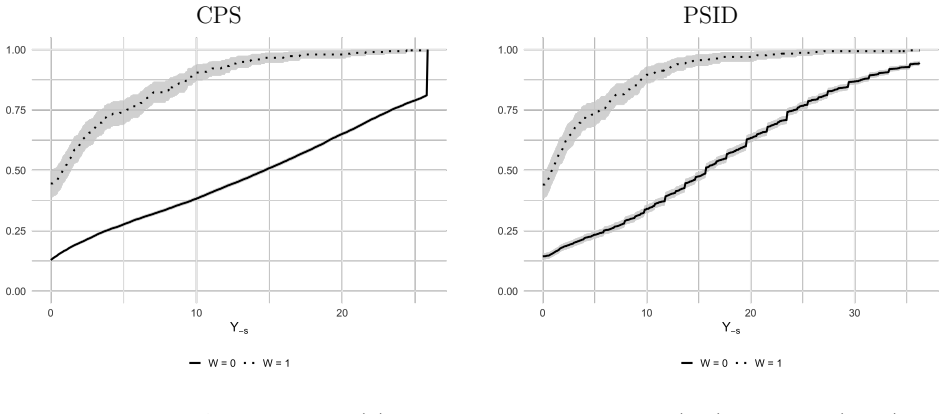
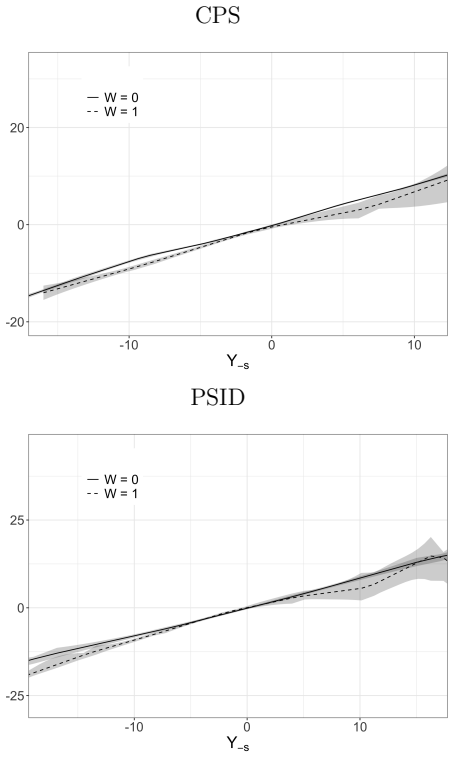
Researchers using panel data to estimate causal effects routinely choose among three approaches to using past outcomes: difference-in-differences (DID), conditioning on lagged outcomes (matching, M), and a hybrid that does both (DIDM). The corresponding identifying assumptions are non-nested, leaving little guidance on which to report. We give conditions under which the corresponding estimands are ordered, with DIDM bracketed between matching and DID. This makes DIDM the minimax-regret choice among the three under a broad class of loss functions. We recommend reporting DIDM as the headline estimate, with matching and DID as bounds. We illustrate in applications.
Figures


Figures from the paper (9 more)




Reference graph
Works this paper leans on
-
[1]
Abadie, A. (2005). Semiparametric difference-in-differences estimators. Review of Economic Studies , 72(1):1--19
2005
-
[2]
Acemoglu, D., Naidu, S., Restrepo, P., and Robinson, J. A. (2019). Democracy does cause growth. Journal of Political Economy , 127(1):47--100
2019
-
[3]
and Shapiro, J
Andrews, I. and Shapiro, J. M. (2024). Communicating scientific uncertainty via approximate posteriors. Technical report, National Bureau of Economic Research
2024
-
[4]
Angrist, J., Hull, P., and Walters, C. R. (2022). Methods for measuring school effectiveness. NBER Working Paper 30803, National Bureau of Economic Research, Cambridge, MA
2022
-
[5]
D., Hull, P
Angrist, J. D., Hull, P. D., Pathak, P. A., and Walters, C. R. (2017). Leveraging lotteries for school value-added: Testing and estimation. Quarterly Journal of Economics , 132(2):871--919
2017
-
[6]
D., Hull, P
Angrist, J. D., Hull, P. D., and Walters, C. R. (2023). Methods for measuring school effectiveness. In Hanushek, E. A., Machin, S. J., and Woessmann, L., editors, Handbook of the Economics of Education, Volume 7 , pages 1--60. Elsevier
2023
-
[7]
Angrist, J. D. and Pischke, J.-S. (2009). Mostly Harmless Econometrics: An Empiricist's Companion . Princeton University Press
2009
-
[8]
Arranz, J. M. and Garc \'i a-Serrano, C. (2025). Assessing the impact of an increase in the minimum wage on household income and poverty. Social Science Research , 127:103143
2025
Show all 57 references
-
[9]
Ashenfelter, O. (1978). Estimating the effect of training programs on earnings. Review of Economics and Statistics , 60(1):47--57
1978
-
[10]
Athey, S., Chetty, R., and Imbens, G. (2025). The experimental selection correction estimator: Using experiments to remove biases in observational estimates. Technical report, National Bureau of Economic Research
2025
-
[11]
Bach, L., Bozio, A., Guillouzouic, A., and Malgouyres, C. (2023). Dividend taxes and the allocation of capital: Comment. American Economic Review , 113(7):2048--2052
2023
-
[12]
Bertrand, M., Duflo, E., and Mullainathan, S. (2004). How much should we trust differences-in-differences estimates? The Quarterly journal of economics , 119(1):249--275
2004
-
[13]
and Matray, A
Boissel, C. and Matray, A. (2022). Retracted by the authors: Dividend taxes and the allocation of capital. American Economic Review , 112(9):2884--2920. Retracted
2022
-
[14]
and Sant'Anna, P
Callaway, B. and Sant'Anna, P. H. (2018). Difference-in-differences with multiple time periods and an application on the minimum wage and employment. arXiv preprint arXiv:1803.09015
2018
-
[15]
D., Farrell, M
Cattaneo, M. D., Farrell, M. H., and Feng, Y. (2019). lspartition: Partitioning-based least squares regression. arXiv preprint arXiv:1906.00202
2019
-
[16]
Cengiz, D., Dube, A., Lindner, A., and Zipperer, B. (2019). The effect of minimum wages on low-wage jobs. Quarterly Journal of Economics , 134(3):1405--1454
2019
-
[17]
Chab \'e -Ferret, S. (2017). Should we combine difference in differences with conditioning on pre-treatment outcomes?
2017
-
[18]
B., Katz, L
Chetty, R., Diamond, R., Foster, T. B., Katz, L. F., Porter, S., Staiger, M., and Tach, L. (2026). Creating high-opportunity neighborhoods: Evidence from the hope vi program. Technical report, National Bureau of Economic Research
2026
-
[19]
N., and Rockoff, J
Chetty, R., Friedman, J. N., and Rockoff, J. E. (2014a). Measuring the impacts of teachers i: Evaluating bias in teacher value-added estimates. American Economic Review , 104(9):2593--2632
-
[20]
N., and Rockoff, J
Chetty, R., Friedman, J. N., and Rockoff, J. E. (2014b). Measuring the impacts of teachers ii: Teacher value-added and student outcomes in adulthood. American economic review , 104(9):2633--2679
-
[21]
Couch, K. A. and Placzek, D. W. (2010). Earnings losses of displaced workers revisited. American Economic Review , 100(1):572--589
2010
-
[22]
Currie, J., Kleven, H., and Zwiers, E. (2020). Technology and big data are changing economics: Mining text to track methods. AEA Papers and Proceedings , 110:42--48
2020
-
[23]
Daw, J. R. and Hatfield, L. A. (2018). Matching and regression to the mean in difference-in-differences analysis. Health services research , 53(6):4138--4156
2018
-
[24]
and d’Haultfoeuille, X
De Chaisemartin, C. and d’Haultfoeuille, X. (2020). Two-way fixed effects estimators with heterogeneous treatment effects. American Economic Review , 110(9):2964--2996
2020
-
[25]
and d’Haultfoeuille, X
De Chaisemartin, C. and d’Haultfoeuille, X. (2023). Two-way fixed effects and differences-in-differences with heterogeneous treatment effects: A survey. Econometrics Journal , 26(3):C1--C30
2023
-
[26]
Dehejia, R. (2005). Practical propensity score matching: a reply to smith and todd. Journal of Econometrics , 125(1-2):355--364
2005
-
[27]
Dehejia, R. H. and Wahba, S. (1999). Causal effects in nonexperimental studies: Reevaluating the evaluation of training programs. Journal of the American statistical Association , 94(448):1053--1062
1999
-
[28]
Dehejia, R. H. and Wahba, S. (2002). Propensity score-matching methods for nonexperimental causal studies. Review of Economics and statistics , 84(1):151--161
2002
-
[29]
and Li, F
Ding, P. and Li, F. (2019). A bracketing relationship between difference-in-differences and lagged-dependent-variable adjustment. Political Analysis , 27(4):605--615
2019
-
[30]
and Imbens, G
Doudchenko, N. and Imbens, G. W. (2016). Balancing, regression, difference-in-differences and synthetic control methods: A synthesis. Technical report, National Bureau of Economic Research
2016
-
[31]
Dube, A., Girardi, D., Jorda, O., and Taylor, A. M. (2023). A local projections approach to difference-in-differences event studies. Technical report, National Bureau of Economic Research
2023
-
[32]
Goldsmith-Pinkham, P. (2024). Tracking the credibility revolution across fields. arXiv preprint arXiv:2405.20604
2024
-
[33]
and Lochner, B
Hafner, L. and Lochner, B. (2022). Do minimum wages improve self-rated health? evidence from a natural experiment. Empirical Economics , 62(6):2989--3014
2022
-
[34]
J., Ichimura, H., Smith, J
Heckman, J. J., Ichimura, H., Smith, J. A., and Todd, P. E. (1998a). Characterizing selection bias using experimental data. Econometrica , 66(5):1017--1098
-
[35]
J., Ichimura, H., and Todd, P
Heckman, J. J., Ichimura, H., and Todd, P. (1998b). Matching as an econometric evaluation estimator. Review of Economic Studies , 65(2):261--294
-
[36]
J., Ichimura, H., and Todd, P
Heckman, J. J., Ichimura, H., and Todd, P. E. (1997). Matching as an econometric evaluation estimator: Evidence from evaluating a job training programme. The review of economic studies , 64(4):605--654
1997
-
[37]
Heckman, J. J. and Smith, J. A. (1999). The pre-programme earnings dip and the determinants of participation in a social programme: Implications for simple programme evaluation strategies. The Economic Journal , 109(457):313--348
1999
-
[38]
Hyslop, D. R. and Townsend, W. (2017). The longer term impacts of job displacement on labour market outcomes. Motu Working Paper 17-12, Motu Economic and Public Policy Research, Wellington, New Zealand
2017
-
[39]
Hyslop, D. R. and Townsend, W. (2019). The longer-term impacts of job displacement on labour market outcomes in new zealand. Australian Economic Review , 52(2):158--177
2019
-
[40]
F., and Trenkle, S
Illing, H., Schmieder, J. F., and Trenkle, S. (2024). The gender gap in earnings losses after job displacement. Journal of the European Economic Association , 22(5):2108--2147
2024
-
[41]
S., and Wang, E
Imai, K., Kim, I. S., and Wang, E. H. (2023). Matching methods for causal inference with time-series cross-sectional data. American Journal of Political Science , 67(3):587--605
2023
-
[42]
S., LaLonde, R
Jacobson, L. S., LaLonde, R. J., and Sullivan, D. G. (1993). Earnings losses of displaced workers. American Economic Review , 83(4):685--709
1993
-
[43]
and Lewandowski, P
Kami \'n ska, A. and Lewandowski, P. (2015). The effects of minimum wage on a labour market with high temporary employment. IBS Working Paper 07/2015, Institute for Structural Research (IBS), Warsaw
2015
-
[44]
Kane, T. J. and Staiger, D. O. (2008). Estimating teacher impacts on student achievement: An experimental evaluation. Working Paper 14607, National Bureau of Economic Research
2008
-
[45]
Lachowska, M., Mas, A., and Woodbury, S. A. (2020). Sources of displaced workers' long-term earnings losses. American Economic Review , 110(10):3231--3266
2020
-
[46]
LaLonde, R. J. (1986). Evaluating the econometric evaluations of training programs with experimental data. American Economic Review , pages 604--620
1986
-
[47]
Lenhart, O. (2017a). Do higher minimum wages benefit health? evidence from the UK . Journal of Policy Analysis and Management , 36(4):828--852
-
[48]
Lenhart, O. (2017b). The impact of minimum wages on population health: Evidence from 24 OECD countries. European Journal of Health Economics , 18(8):1031--1039
-
[49]
P., Smith, J
McCall, B. P., Smith, J. A., and Wunsch, C. (2016). Government-sponsored vocational education for adults. In Hanushek, E. A., Machin, S., and Woessmann, L., editors, Handbook of the Economics of Education , volume 5, pages 479--652. Elsevier
2016
-
[50]
G., Hanushek, E
Rivkin, S. G., Hanushek, E. A., and Kain, J. F. (2005). Teachers, schools, and academic achievement. Econometrica , 73(2):417--458
2005
-
[51]
H., Bilinski, A., and Poe, J
Roth, J., Sant’Anna, P. H., Bilinski, A., and Poe, J. (2023). What’s trending in difference-in-differences? a synthesis of the recent econometrics literature. Journal of Econometrics , 235(2):2218--2244
2023
-
[52]
Rothstein, J. (2010). Teacher quality in educational production: Tracking, decay, and student achievement. Quarterly Journal of Economics , 125(1):175--214
2010
-
[53]
F., Von Wachter, T., and Heining, J
Schmieder, J. F., Von Wachter, T., and Heining, J. (2023). The costs of job displacement over the business cycle and its sources: evidence from germany. American Economic Review , 113(5):1208--1254
2023
-
[54]
and Shanthikumar, J
Shaked, M. and Shanthikumar, J. G. (2007). Stochastic Orders . Springer Series in Statistics. Springer, New York
2007
-
[55]
Smith, J. A. and Todd, P. E. (2005). Does matching overcome lalonde's critique of nonexperimental estimators? Journal of econometrics , 125(1-2):305--353
2005
-
[56]
Song, K. (2014). Point decisions for interval--identified parameters. Econometric Theory , 30(2):334--356
2014
-
[57]
Staiger, D. O. and Rockoff, J. E. (2010). Searching for effective teachers with imperfect information. Journal of Economic Perspectives , 24(3):97--118
2010
Reviewed June 26, 2026 · model on record in the stance chip above.
Discussion (0). Continue with ORCID to comment.