REVIEW 4 major objections 6 minor 44 references
A Generative Model-Free Form Deformation Approach for the Generation of Mesh Motions with Applications to PDE
T0 review · 4 major / 6 minor · reviewed 2026-08-02 · deepseek-v4-flash
Pith's one-line read The paper establishes that any smooth genus-0 surface deformation can be approximated arbitrarily well by the time-one map of an ODE with free-form-deformation drift, and that the resulting latent representation speeds up reduced-order PDE
desk verdict Solid theory, overstated numerics: the ODE–FFD deformation framework is a genuine new tool, but the generative model's benefits are not isolated from plain dimensionality reduction. read the letter →
The pith
A machine-rendered reading of the paper's core claim, the machinery that carries it, and where it could break.
The reading
What carries the argument
The central object is the FFD-ODE system ẋ = F_{α(t)}(x), where F is the trivariate Bernstein polynomial interpolation of the time-dependent control displacements α(t), with boundary control components fixed to zero so the cube's boundary is invariant. Three tools carry the argument: Bernstein polynomial universality to approximate the diffeotopy's velocity field, Grönwall's inequality to bound the resulting flow error, and a coercivity estimate for the pulled-back Gram matrix M_α(t) = ∫ B(y_α(t,x)) B(y_α(t,x))ᵀ dx, whose minimal eigenvalue is bounded below explicitly; this last estimate is what gives the reverse Lipschitz inequality and the bijection.
What would settle it
For m=n=o=2 and a smooth control α, compute the smallest eigenvalue of the pulled-back Gram matrix M_α(t) at t=1/2 and compare it with the constant exp(-2√3 ¯m ∥α∥_L1) / [(2m+1)(2m choose m)(2n+1)(2n choose n)(2o+1)(2o choose o)]; if the eigenvalue falls below this bound, Theorem 4's reverse inequality is violated and the claimed bijection would need revisiting.
Extended reading notes
Core claim
Deformations between genus-0 meshes of different connectivity can be encoded as the flow of an ODE whose drift is a time-dependent Free Form Deformation field; this encoding is universal in the Chamfer metric, and the map from control trajectories to flows is a bijection with quantitative Lipschitz equivalences. The universality proof extends the surface isotopy to a compactly supported diffeotopy of the cube, approximates the diffeotopy's velocity field by Bernstein polynomials, and applies Grönwall's inequality to transfer the field error to the flow. The bijection proof relies on a coercivity estimate for the Gram matrix of the Bernstein basis pulled back by the flow; the minimal eigenval
Load-bearing premise
The universality proof assumes the Bernstein approximant of the diffeotopy's velocity field, with coefficients sampled at the control lattice, has exactly zero boundary control components while retaining sup-norm accuracy; this holds if the field vanishes on the boundary, but a fully detailed proof of the coefficient constraint is not given, and the numerical results depend on the unverified assumption that fixed-boundary 5×5×5 control lattices produce stable, non-degenerate
Editorial extensions
If this is right
- Any smooth deformation of a genus-0 shape can be represented, to arbitrary Chamfer accuracy, by a low-dimensional ODE control, making mesh morphing independent of matching mesh graphs.
- Because the control-to-flow map is a bijection with two-sided Lipschitz bounds, dimension reduction (POD) in control space is faithful and cannot generate spurious deformation fields.
- Reduced-order models built on the generative latent space achieve 30–40% lower leave-one-out errors on quantity-of-interest prediction than ROMs on raw FFD-ODE controls, in both incompressible and hypersonic benchmarks.
- The FFD-ODE formulation gives injective, topology-preserving deformations by construction, which keeps moving meshes valid during PDE solution.
- The generative prior regularizes the inverse deformation problem: an unconstrained 10-dimensional drag-minimization converges in about 5 seconds, while a constrained raw-control optimization stalls at 1000 iterations and takes about 3 hours.
Reading between the lines
- The same diffeotopy-extension argument should extend to any pair of diffeomorphic surfaces, not only genus-0, whenever the ambient isotopy is supported inside the cube; the genus-0 restriction appears to come from the chosen isotopy theorem, not from the ODE-FFD mechanism itself.
- The explicit coercivity constant in the reverse Lipschitz bound suggests a computable criterion for how many POD modes are needed to guarantee a given deformation accuracy, turning the qualitative bijection into a practical mode-selection rule.
- Because the velocity field is linear in the controls, the forward map from α to the flow is well-suited to differentiable programming and adjoint-based optimal control, which could accelerate the initial trajectory-fitting stage beyond the forward–backward sweep used here.
- The generative prior's strong regularization effect on drag optimization hints that the same latent representation could regularize other ill-posed inverse shape problems, such as aerodynamic shape optimization or medical image registration, where mesh validity is the bottleneck.
Editorial analysis
A structured set of objections, weighed in public.
Referee Report
Summary. The paper introduces FFD-ODE, a framework for deforming genus-0 surfaces by modelling the deformation as the time-1 map of an ODE whose drift is a time-dependent Free Form Deformation (FFD). The main theoretical contribution is Theorem 2, which claims universal approximation of smooth genus-0 surface deformations in Chamfer distance using FFD-ODE flows with boundary-anchored control coefficients. The proof combines Bernstein polynomial universality, Hirsch's diffeotopy extension, and Grönwall's inequality. The paper also proves quantitative Lipschitz-type equivalences between control trajectories and their flows (Theorems 3–4), which are used to justify POD reduction of the control space. A generative model based on POD and STARFlow is then introduced to produce a low-dimensional latent parametrisation of deformation trajectories. The method is tested on two CFD benchmarks: incompressible flow past a deforming Stanford Bunny (FEniCSx) and hypersonic flow past a deforming sphere (OpenFOAM). Reduced-order models (KNN, GPR, RF) are trained either on the original high-dimensional FFD-ODE control trajectories or on the STARFlow latent variables, and their leave-one-out cross-validation errors are compared.
Significance. If the claims hold, the paper makes a useful theoretical contribution: it rigorously connects classical FFD-based geometric morphing with ODE flows, proving an expressivity guarantee for genus-0 surfaces and providing quantitative bounds that justify model-order reduction in the control space. The bi-Lipschitz bounds of Theorems 3–4 are valuable and appear essentially correct. The numerical section, however, does not establish the paper's central practical claim that the generative model improves ROM accuracy: the comparison conflates dimensionality reduction with the specific STARFlow generative mechanism. The reported accuracy gains and speed-ups are also overstated relative to the tables and the optimisation setup. These issues are fixable with additional baseline experiments and more careful reporting, so the paper warrants a major revision rather than rejection.
major comments (4)
- [Section 5, Tables 1–4] The central numerical claim — that ROMs trained on STARFlow latent variables are more accurate than ROMs trained on FFD-ODE control trajectories — is confounded by dimensionality. The FFD-ODE ROMs receive the full 375-dimensional control trajectories, while the GEN ROMs receive 10-dimensional STARFlow latents. Any dimensionality reduction, including plain linear POD, is expected to improve LOOCV accuracy of non-intrusive ROMs on a small dataset. To attribute the improvement to the generative model, the authors must add a baseline consisting of ROMs trained on the first D=10 POD coefficients of the same FFD-ODE trajectories, without the autoencoder or STARFlow. Without this baseline, the statement in Section 5 that the lower errors reflect 'the reduced parametrisation afforded by the generative model' is unsupported.
- [Section 6 (Conclusion)] The conclusion claims a '30–40% reduction in error' relative to classical high-dimensional parametrisations. The largest reduction in Tables 1–4 is about 28% (Table 2, RF L1: 0.1354 to 0.0979, a 27.7% reduction). Several entries are far smaller (e.g., Table 3, GPR L2: 0.1620 to 0.1540, about 4.9%). The stated range is not supported by the reported numbers and should be corrected.
- [Section 5.2 and Figure 14] The claimed '3600× speed-up' is not a fair comparison. The STARFlow-based optimisation is reported to converge in 394 iterations and about 5 seconds, while the FFD-ODE-based optimisation is truncated at its maximum of 1000 iterations without convergence after about 3 hours. These are not equivalent termination conditions. Moreover, 3 hours divided by 5 seconds is approximately 2160×, not 3600×. The authors should report time-to-convergence under the same stopping criterion, or at least report per-iteration costs and clearly state that the baseline did not converge.
- [Section 3.1, after Theorem 4] The text states: 'This result implies that there is a bijection between a control-points trajectory α∈V and its corresponding solution y∈W.' Theorem 4 provides injectivity and a quantitative lower bound, but it does not establish surjectivity onto the full space W. If the intended meaning is a bijection between V and the image {y_α : α∈V}, this is tautological and should be stated as such; if surjectivity onto W is claimed, it requires proof. The injectivity part is sufficient for the POD argument and should be phrased accordingly.
minor comments (6)
- [Appendix A, proof of Theorem 2] The final line asserts that because g is supported in (0,1)^3, the Bernstein coefficients at boundary lattice points are zero. This is correct if 'supported' is understood as compact support away from the boundary, but the proof should state that the lattice resolution is chosen so that every boundary knot lies outside the support of g. Without that explicit statement, the step reads as an assertion rather than a derivation.
- [Section 1.2] Typo: 'The main differences are the differences are that' should be 'The main differences are that'.
- [Section 3.1] Typo: 'Our objective is to demonstrate that is to show that' should be 'Our objective is to show that'.
- [Section 4.1, governing equations] The initial condition is written as u(0,x)=0 only on ∂Ω(0), which is insufficient for the incompressible Navier–Stokes equations. It should likely be u(0,x)=0 for x∈Ω(0) or a suitable divergence-free initial field; please clarify.
- [Section 4] The text says 'the number of control points is set to 4 along each spatial axis' but later refers to '5×5×5 velocity fields of control points'. Clarify whether 4 is the polynomial degree (giving 5 control points per axis) or the number of control points. The notation m,n,o in Section 2 suggests degree, but the wording is ambiguous.
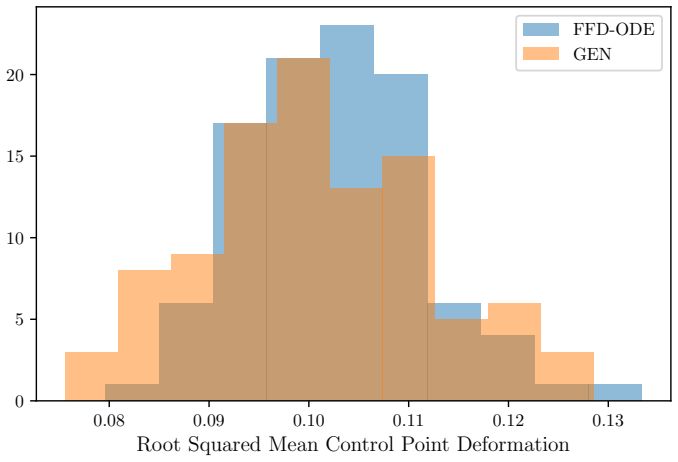
- [Tables 1–4] No measure of variability (e.g., repeated training with different splits, or error bars) is reported. With 100 samples and default Scikit-Learn hyperparameters, some of the differences (especially in Table 3) may not be statistically meaningful; a paired test or repeated CV would strengthen the comparison.
Circularity Check
No significant circularity: the universal-approximation and bijection results are self-contained derivations from external classical results; the generative-model comparison is a statistical evaluation rather than a definitional reduction.
full rationale
The derivation chain is not circular. Theorem 2 is proved from classical Bernstein approximation (Theorem 1, ref. [37]) plus Hirsch's ambient-isotopy extension theorem (ref. [43]); the boundary-coefficient condition α_ijk=0 follows because the Bernstein coefficients evaluate g at boundary knots, where g vanishes due to the support of the diffeotopy in (0,1)^3. This is a mathematical consequence, not an imported assumption. Theorems 3 and 4 are proved from elementary Bernstein-basis inequalities, Proposition 1, and the external Lyche-Scherer eigenvalue bound (ref. [44]); they do not assume the POD conclusion they are used to justify. The POD and STARFlow sections apply standard dimension reduction and an external normalizing-flow architecture (refs. [12, 13]). The authors' own prior works (refs. [5, 6]) appear only as motivating citations and do not carry the load of any theorem. The numerical ROM comparisons and QoI-distribution checks evaluate a fitted generative model against the distribution it was trained on; the reported accuracy gains would be strengthened by a POD-only baseline, and the '30-40%' and '3600x' statements somewhat overstate the tabulated results, but these are statistical/comparison concerns, not circular reductions. No equation in the paper is equivalent to its own input by construction.
Assumptions & free parameters
free parameters (5)
- Regularization parameter ρ in the control-trajectory optimization
- POD retained modes M = 80 =
80
- Autoencoder latent dimension D = 10 =
10
- FFD control lattice resolution (4 along each spatial axis / 5×5×5 grids) =
5x5x5
- Optimization constraint thresholds (||α(i)−α(i−1)|| ≤ 0.01, RMS bound 1.65) =
0.01 / 1.65
assumptions (6)
- standard math Hirsch's isotopy-extension theorem: any two closed genus-0 surfaces in (0,1)^3 admit a diffeotopy of R^3 supported in (0,1)^3 connecting them.
- standard math Classical Bernstein uniform approximation of continuous functions on the cube by FFD maps (Theorem 1, cited to [37]).
- standard math Minimum eigenvalue of the univariate Bernstein mass matrix is 1/[(2m+1) C(2m,m)].
- ad hoc to paper Unproven step in Theorem 2's proof: the Bernstein-FFD approximation of the supported vector field g can be chosen with exactly zero coefficients at boundary lattice indices while preserving sup-norm accuracy.
- domain assumption In the fluid benchmarks, the FFD-ODE velocity field restricted to the box boundary is identically zero, so the deforming domain remains inside the box.
- domain assumption The flow of a time-dependent polynomial vector field is a C¹ diffeomorphism of the cube, giving guaranteed injectivity of the mesh deformation.
Cite this review
Pith. "Pith review of A Generative Model-Free Form Deformation Approach for the Generation of Mesh Motions with Applications to PDE." pith.science (2026). https://pith.science/paper/KIFH34LX
@misc{pith2026260713202,
  author       = {Pith},
  title        = {Pith review of: A Generative Model-Free Form Deformation Approach for the Generation of Mesh Motions with Applications to PDE},
  year         = {2026},
  howpublished = {\url{https://pith.science/paper/KIFH34LX}},
  note         = {Machine review of arXiv:2607.13202}
}
read the original abstract
We introduce a topology-agnostic framework for matching deformations of three-dimensional shapes with non-isomorphic mesh graphs by modelling the deformation as the flow of an Ordinary Differential Equation (ODE). The velocity field is parameterised by a time-dependent Free Form Deformation (FFD), expressed through displacements of a coarse control lattice, yielding a smooth and low-dimensional representation that decouples the deformation model from the discretisation of the source and target surfaces. Under mild regularity assumptions, we prove that the induced ODE map is a universal approximator (in the sup norm) for mappings between genus-0 surfaces, providing a theoretical expressivity guarantee. To further compress the representation and enable probabilistic inference, we couple the ODE--FFD model with a flow-based generative approach in the TarFlow framework, learning a compact latent parametrisation over time series of FFD maps. The resulting method supports efficient sampling and optimisation of plausible deformation trajectories while preserving mesh quality, and it enables scalable reduced-order modelling. Experiments on deforming-body flow benchmarks demonstrate improved accuracy and computational efficiency of reduced-order models constructed from the learned latent dynamics.
Figures


Figures from the paper (11 more)




Reference graph
Works this paper leans on
-
[1]
Hull Shape Design Optimization with Parameter Space and Model Reductions, and Self-Learning Mesh Morphing
Nicola Demo, Marco Tezzele, Andrea Mola, and Gianluigi Rozza. Hull Shape Design Optimization with Parameter Space and Model Reductions, and Self-Learning Mesh Morphing. Journal of Marine Science and Engineering, 9(2):185, February 2021
2021
-
[2]
Marsden, and Simone Deparis
Riccardo Tenderini, Luca Pegolotti, Fanwei Kong, Stefano Pagani, Francesco Regazzoni, Alison L. Marsden, and Simone Deparis. Deformable registration and generative modelling of aortic anatomies by auto-decoders and neural ODEs. npj Biological Physics and Mechanics, 2(1):26, December 2025
2025
-
[3]
A hybrid reduced-order model for segregated fluid-structure interaction solvers in an ALE approach at high Reynolds number
Valentin Nkana Ngan, Giovanni Stabile, Andrea Mola, and Gianluigi Rozza. A hybrid reduced-order model for segregated fluid-structure interaction solvers in an ALE approach at high Reynolds number. Computers & Mathematics with Applications, 180:299–321, February 2025
2025
-
[4]
Sederberg and Scott R
Thomas W. Sederberg and Scott R. Parry. Free-form deformation of solid geometric models. ACM SIGGRAPH Computer Graphics, 20(4):151–160, 1986
1986
-
[5]
Generative models for the deformation of industrial shapes with linear geo- metric constraints: Model order and parameter space reductions
Guglielmo Padula, Francesco Romor, Giovanni Stabile, and Gianluigi Rozza. Generative models for the deformation of industrial shapes with linear geo- metric constraints: Model order and parameter space reductions. Computer Methods in Applied Mechanics and Engineering, 423:116823, 2024
2024
-
[6]
Generative Models for Param- eter Space Reduction applied to Reduced Order Modelling, June 2025
Guglielmo Padula and Gianluigi Rozza. Generative Models for Param- eter Space Reduction applied to Reduced Order Modelling, June 2025. arXiv:2506.09721
arXiv 2025
-
[7]
Salmoiraghi, A
F. Salmoiraghi, A. Scardigli, H. Telib, and G. Rozza. Free-form deforma- tion, mesh morphing and reduced-order methods: enablers for efficient aero- dynamic shape optimisation. International Journal of Computational Fluid Dynamics, 32(4-5):233–247, May 2018
2018
-
[8]
Fluid-structure Interactions, volume 118
Thomas Richter. Fluid-structure Interactions, volume 118. Springer Inter- national Publishing, 2017
2017
Show all 44 references
-
[9]
Exact and Approximate Controllability for Distributed Parameter Systems
Roland Glowinski, Jacques-Louis Lions, and Jiwen He. Exact and Approximate Controllability for Distributed Parameter Systems. Cambridge University Press, March 2008. 35
2008
-
[10]
G. Cybenko. Approximation by superpositions of a sigmoidal function. Mathematics of Control, Signals, and Systems, 2(4):303–314, December 1989
1989
-
[11]
Approximation capabilities of multilayer feedforward networks
Kurt Hornik. Approximation capabilities of multilayer feedforward networks. Neural Networks, 4(2):251–257, 1991
1991
-
[12]
STARFlow: Scaling Latent Normalizing Flows for High- resolution Image Synthesis, June 2025
Jiatao Gu, Tianrong Chen, David Berthelot, Huangjie Zheng, Yuyang Wang, Ruixiang Zhang, Laurent Dinh, Miguel Angel Bautista, Josh Susskind, and Shuangfei Zhai. STARFlow: Scaling Latent Normalizing Flows for High- resolution Image Synthesis, June 2025. arXiv:2506.06276
2025 arXiv
-
[13]
Normalizing Flows are Capable Generative Mod- els, June 2025
Shuangfei Zhai, Ruixiang Zhang, Preetum Nakkiran, David Berthelot, Ji- atao Gu, Huangjie Zheng, Tianrong Chen, Miguel Angel Bautista, Navdeep Jaitly, and Josh Susskind. Normalizing Flows are Capable Generative Mod- els, June 2025. arXiv:2412.06329
2025 arXiv
-
[14]
Brooks and Thomas J
Alexander N. Brooks and Thomas J. R. Hughes. Streamline upwind/Petrov- Galerkin formulations for convection dominated flows with particular em- phasis on the incompressible Navier-Stokes equations. Computer Methods in Applied Mechanics and Engineering, 32(1-3):199–259, September 1982
1982
-
[15]
Baratta, Joseph P
Igor A. Baratta, Joseph P. Dean, Jørgen S. Dokken, Michal Habera, Jack S. Hale, Chris N. Richardson, Marie E. Rognes, Matthew W. Scroggs, Nathan ORCID icon Sime, and Garth N. Wells. DOLFINx: The next generation FEniCS problem solving environment. DOLFINx: The next generation F...
2023
-
[16]
Scroggs, Igor A
Matthew W. Scroggs, Igor A. Baratta, Chris N. Richardson, and Garth N. Wells. Basix: a runtime finite element basis evaluation library. Journal of Open Source Software, 7(73):3982, May 2022
2022
-
[17]
Alnæs, Anders Logg, Kristian B
Martin S. Alnæs, Anders Logg, Kristian B. Ølgaard, Marie E. Rognes, and Garth N. Wells. Unified form language. ACM Transactions on Mathematical Software, 40(2):1–37, February 2014
2014
-
[18]
Zippered polygon meshes from range images
Greg Turk and Marc Levoy. Zippered polygon meshes from range images. In Proceedings of the 21st annual conference on Computer graphics and interactive techniques - SIGGRAPH ’94, pages 311–318, Not Known, 1994. ACM Press. 36
1994
-
[19]
H. G. Weller, G. Tabor, H. Jasak, and C. Fureby. A tensorial approach to computational continuum mechanics using object-oriented techniques. Computers in Physics, 12(6):620–631, November 1998
1998
-
[20]
Anderson
John D. Anderson. Hypersonic and High-Temperature Gas Dynamics, Third Edition. American Institute of Aeronautics and Astronautics, Inc., March 2019
2019
-
[21]
Reduced Basis Methods for Partial Differential Equations, volume 92
Alfio Quarteroni, Andrea Manzoni, and Federico Negri. Reduced Basis Methods for Partial Differential Equations, volume 92. Springer Interna- tional Publishing, 2016
2016
-
[22]
Willcox and J
K. Willcox and J. Peraire. Balanced Model Reduction via the Proper Or- thogonal Decomposition. AIAA Journal, 40(11):2323–2330, November 2002
2002
-
[23]
Mesh Deformation Approaches – A Survey
Selim Mm and Koomullil Rp. Mesh Deformation Approaches – A Survey. Journal of Physical Mathematics, 7(2), 2016
2016
-
[24]
Auto-Encoding Variational Bayes, 2013
Diederik P Kingma and Max Welling. Auto-Encoding Variational Bayes, 2013
2013
-
[25]
Variational Inference with Normaliz- ing Flows
Danilo Rezende and Shakir Mohamed. Variational Inference with Normaliz- ing Flows. In Proceedings of the 32nd International Conference on Machine Learning, pages 1530–1538. PMLR, June 2015
2015
-
[26]
Generative ad- versarial networks
Ian Goodfellow, Jean Pouget-Abadie, Mehdi Mirza, Bing Xu, David Warde- Farley, Sherjil Ozair, Aaron Courville, and Yoshua Bengio. Generative ad- versarial networks. Commun. ACM, 63(11):139–144, October 2020
2020
-
[27]
Denoising Diffusion Proba- bilistic Models
Jonathan Ho, Ajay Jain, and Pieter Abbeel. Denoising Diffusion Proba- bilistic Models. In Advances in Neural Information Processing Systems, volume 33, pages 6840–6851. Curran Associates, Inc., 2020
2020
-
[28]
ShapeFusion: A 3D Diffusion Model for Localized Shape Editing
Rolandos Alexandros Potamias, Michail Tarasiou, Stylianos Ploumpis, and Stefanos Zafeiriou. ShapeFusion: A 3D Diffusion Model for Localized Shape Editing. In Aleˇ s Leonardis, Elisa Ricci, Stefan Roth, Olga Russakovsky, Torsten Sattler, and G¨ ul Varol, editors, Computer Visio...
2024
-
[29]
OctFusion: Octree-based Diffusion Models for 3D Shape Generation
Bojun Xiong, Si-Tong Wei, Xin-Yang Zheng, Yan-Pei Cao, Zhouhui Lian, and Peng-Shuai Wang. OctFusion: Octree-based Diffusion Models for 3D Shape Generation. Computer Graphics Forum, 44(5):e70198, August 2025. 37
2025
-
[30]
Recent Advances on Machine Learning for Computational Fluid Dynamics: A Survey, August
Haixin Wang, Yadi Cao, Zijie Huang, Yuxuan Liu, Peiyan Hu, Xiao Luo, Zezheng Song, Wanjia Zhao, Jilin Liu, Jinan Sun, Shikun Zhang, Long Wei, Yue Wang, Tailin Wu, Zhi-Ming Ma, and Yizhou Sun. Recent Advances on Machine Learning for Computational Fluid Dynamics: A Survey, August
-
[31]
Diffusion Models for 3D Generation: A Survey
Chen Wang, Hao-Yang Peng, Ying-Tian Liu, Jiatao Gu, and Shi-Min Hu. Diffusion Models for 3D Generation: A Survey. Computational Visual Media, 11(1):1–28, 2025
2025
-
[32]
Chapelier, R
M. Chapelier, R. Bouclier, and J.-C. Passieux. Free-Form Deformation Digital Image Correlation (FFD-DIC): A non-invasive spline regularization for arbitrary finite element measurements. Computer Methods in Applied Mechanics and Engineering, 384:113992, 2021
2021
-
[33]
Efficient musculoskeletal annotation using free-form deformation
Norio Fukuda, Shoji Konda, Jun Umehara, and Masaya Hirashima. Efficient musculoskeletal annotation using free-form deformation. Scientific Reports, 14(1):16077, 2024
2024
-
[34]
A Novel body-fitted free form deformation method for hull form optimization
Xinwang Liu, Zitong Rong, Lei Yuan, Xiaohang Ji, Luyao Wang, and Xu Sun. A Novel body-fitted free form deformation method for hull form optimization. Ocean Engineering, 342:122786, 2025
2025
-
[35]
A Physics-Informed Deep Learning Deformable Medical Image Registration Method Based on Neural ODEs
Amirhossein Amiri-Hezaveh, Shelly Tan, Qing Deng, David Umulis, Lau- ren Cunniff, Johannes Weickenmeier, and Adrian Buganza Tepole. A Physics-Informed Deep Learning Deformable Medical Image Registration Method Based on Neural ODEs. International Journal of Computer Vision, 133...
2025
-
[36]
Elasticity-based morphing technique and application to reduced-order modeling
Abbas Kabalan, Fabien Casenave, Felipe Bordeu, Virginie Ehrlacher, and Alexandre Ern. Elasticity-based morphing technique and application to reduced-order modeling. Applied Mathematical Modelling, 141:115929, May 2025
2025
-
[37]
On Multivariate Bern- stein Polynomials
Mama Foupouagnigni and Merlin Mouafo Wouodji´ e. On Multivariate Bern- stein Polynomials. Mathematics, 8(9):1397, August 2020
2020
-
[38]
A condition for isotopic approx- imation
Fr´ ed´ eric Chazal and David Cohen-Steiner. A condition for isotopic approx- imation. Graphical Models, 67(5):390–404, September 2005
2005
-
[39]
Hans P. Geering. Optimal Control with Engineering Applications. Springer Berlin Heidelberg, Berlin, Heidelberg, 2007. 38
2007
-
[40]
Rozza, D
G. Rozza, D. B. P. Huynh, and A. T. Patera. Reduced Basis Approximation and a Posteriori Error Estimation for Affinely Parametrized Elliptic Coer- cive Partial Differential Equations. Archives of Computational Methods in Engineering, 15(3):229–275, 2008
2008
-
[41]
Pedregosa, G
F. Pedregosa, G. Varoquaux, A. Gramfort, V. Michel, B. Thirion, O. Grisel, M. Blondel, P. Prettenhofer, R. Weiss, V. Dubourg, J. Vanderplas, A. Pas- sos, D. Cournapeau, M. Brucher, M. Perrot, and E. Duchesnay. Scikit- learn: Machine Learning in Python. Journal of Machine Learn...
2011
-
[42]
Byrd, Mary E
Richard H. Byrd, Mary E. Hribar, and Jorge Nocedal. An Interior Point Algorithm for Large-Scale Nonlinear Programming. SIAM Journal on Optimization, 9(4):877–900, January 1999
1999
-
[43]
Morris W. Hirsch. Differential Topology, volume 33. Springer New York, 1976
1976
-
[44]
On the p-norm condition number of the mul- tivariate triangular Bernstein basis
Tom Lyche and Karl Scherer. On the p-norm condition number of the mul- tivariate triangular Bernstein basis. Journal of Computational and Applied Mathematics, 119(1-2):259–273, July 2000. 39 A Proof of Theorem 2 Proof.By [38], there exists a diffeomorphism fromS 1 toS 2 that i...
2000
Reviewed August 2, 2026 · model on record in the stance chip above.
Discussion (0). Sign in to comment.