REVIEW 2 major objections 5 minor 18 references
Performance Limits of FRIS Systems in Nakagami-$m$ Fading
T0 review · 2 major / 5 minor · reviewed 2026-07-10 · glm-5.2
Pith's one-line read First strict lower bounds on outage probability for FRIS under correlated Nakagami-m fading
desk verdict First strict OP lower bounds for FRIS under correlated Nakagami-m fading, but the extension to non-integer m has a real gap in the correlated case read the letter →
The pith
A machine-rendered reading of the paper's core claim, the machinery that carries it, and where it could break.
The reading
What carries the argument
The argument rests on three pieces: (1) a weighted Cauchy-Schwarz inequality that upper-bounds the squared cascaded channel S^2 by a product T_w = A_w * B_w, where A_w and B_w are weighted sums of squared fading envelopes; (2) a Gaussian-sum representation of integer-m Nakagami envelopes that converts each weighted sum into a sum of quadratic forms in correlated complex Gaussian vectors, which via eigenvalue decomposition become sums of independent Gamma random variables; and (3) the Moschopoulos Gamma-sum representation and a product-of-Gammas CDF formula that together yield the distribution of T_w as a double infinite series with nonnegative coefficients, so that any finite truncation is a
What would settle it
A scenario in which the finite-truncation lower bound (22) exceeds the true outage probability measured by Monte Carlo simulation, which would violate the inequality chain S^2 <= T_w => F_{T_w} <= F_{S^2}.
Extended reading notes
Core claim
The weighted Cauchy-Schwarz inequality, applied to the FRIS cascaded channel S = sum of X_l * Y_l with weights w_l = sqrt(Omega_X,l / Omega_Y,l), produces an upper bound T_w = A_w * B_w whose CDF provides a rigorous lower bound on outage probability. By representing Nakagami-m envelopes as norms of sums of correlated complex Gaussians, the bound's distribution reduces to the product of two sums of independent Gamma random variables, whose CDF is expressible as a convergent double infinite series of Meijer G-functions with provable truncation error.
Load-bearing premise
The Gaussian-sum representation of Nakagami-m envelopes is constructed for integer values of the fading parameter m, but the paper claims validity for arbitrary positive real m without rigorously deriving the extension beyond the integer case.
Editorial extensions
If this is right
- The bound provides system designers with a guaranteed worst-case outage floor for FRIS deployments under spatial correlation, usable without Monte Carlo simulation for any number of active elements.
- The correlation-aware element selection strategy (stencil-based decorrelation threshold) can be directly evaluated against the bound to quantify how much diversity gain is lost to residual spatial correlation.
- The i.i.d. simplification to a single Meijer G-function offers a compact benchmark against which the cost of spatial correlation can be measured as the gap between the correlated bound (22) and the i.i.d. bound (23).
- The framework extends naturally to other cascaded-channel architectures where the effective gain has a sum-of-products structure, including multi-RIS relaying and distributed MIMO surfaces.
Reading between the lines
- The Gaussian-sum representation in Eq. (7) is constructed for integer fading parameters m_X, m_Y. The paper asserts extension to arbitrary positive real m via the Moschopoulos representation, but the quadratic-form derivation and eigenvalue decomposition that produce the Gamma sums rely on the integer-m structure. Whether the non-integer case follows by analytic continuation or requires a separate
- The bound's tightness in the high-SNR regime, where it reportedly outperforms CLT approximations, suggests that the Cauchy-Schwarz upper bound T_w may be asymptotically tight in the distributional tail. A formal asymptotic analysis of the ratio S^2 / T_w as the SNR grows could establish whether the bound becomes exact in the high-SNR limit.
- The truncation order zeta = 5000 used in the numerical results is described as sufficient but not necessary. The convergence rate of the Moschopoulos series depends on the spread of the eigenvalue ratios, so scenarios with strong spatial correlation (highly disparate eigenvalues) may require substantially more terms, potentially limiting real-time use of the bound in highly correlated deployments.
Editorial analysis
A structured set of objections, weighed in public.
Referee Report
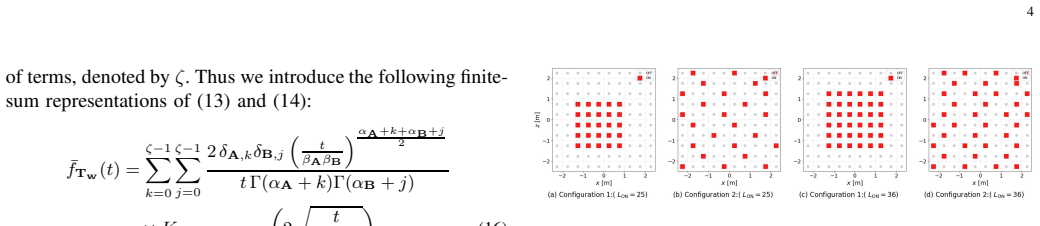
Summary. The manuscript develops an analytical framework for fluid reconfigurable intelligent surface (FRIS)-assisted wireless systems over arbitrarily correlated Nakagami-$m$ fading channels. The key technical contributions are: (i) a physically consistent correlation model for Nakagami-$m$ fading based on correlated complex Gaussian multipath clusters; (ii) a weighted Cauchy-Schwarz (WCS) framework yielding an upper bound $T_w$ on the squared effective cascaded channel $S^2$; (iii) exact statistical characterizations (PDF/CDF) of $T_w$ via Gamma-mixture representations and Moschopoulos-type series; and (iv) rigorous finite-truncation lower bounds on the outage probability (OP), given in closed form by Eq. (22) for the correlated case and Eq. (23) for the i.i.d. case. Numerical results validate the bounds against Monte Carlo simulations and benchmark CLT/Gamma approximations.
Significance. The paper addresses a genuine gap in the FRIS literature: existing works predominantly rely on CLT or moment-matched approximations under Rayleigh fading, which do not provide rigorous performance guarantees. The derivation of strict OP lower bounds under correlated Nakagami-$m$ fading is a well-motivated and non-trivial contribution. The WCS framework combined with the eigenvalue decomposition of quadratic forms in correlated Gaussian vectors is an elegant and technically sound approach. The truncation error bound in Eq. (19) is a notable strength, providing a provable accuracy guarantee for the infinite-series representations. The i.i.d. closed-form result in Eq. (23) is clean and useful. These are falsifiable, parameter-bound results that advance the analytical foundations of FRIS systems.
major comments (2)
- Section III-B, Eq. (7) and the final paragraph of Section III-D: The central derivation of the correlated-case OP bound (Eq. 22) relies on the Gaussian-sum representation of Nakagami-$m$ envelopes in Eq. (7), which is structurally restricted to integer values of $m_X$ and $m_Y$. The eigenvalue decomposition in Eq. (11) and the quadratic forms in Eqs. (9)-(10) depend on this construction. However, the final paragraph of Section III-D asserts that the results 'remain valid for general Nakagami-$m$ fading with arbitrary positive real parameters $m_X, m_Y > 0$, since the analysis ultimately relies on the Moschopoulos Gamma-sum representation.' This assertion contains a logical gap: Moschopoulos's theorem characterizes the distribution of a sum of independent Gamma variables with arbitrary real shapes, but the paper only establishes that $A^*_w$ and $B^*_w$ decompose into such sums (with the
- Section III-D, Eq. (22): The claim that Eq. (22) provides a rigorous lower bound for the OP under 'arbitrarily correlated Nakagami-$m$ fading' is, as derived, limited to integer $m$. The extension to non-integer $m$ in the correlated case is not rigorously established within the manuscript. The authors should either (a) explicitly restrict the claimed validity of Eq. (22) to integer $m$ in the correlated case, or (b) provide a rigorous derivation showing that the quadratic-form decomposition and eigenvalue-based correlation capture hold for non-integer $m$. The i.i.d. case (Eq. 23) is unaffected by this issue.
minor comments (5)
- Section III-C, Eqs. (13)-(17): The double infinite series representations for the PDF and CDF of $T_w$ involve Meijer G-functions and modified Bessel functions. While the truncation bound in Eq. (19) is valuable, the authors state that $zeta=5000$ is used to ensure $epsilon_zeta(t) le 10^{-3}$. It would be helpful to comment on the computational cost of evaluating Eq. (22) with such a large truncation order and whether more efficient evaluation methods exist.
- Section IV: The numerical results use $m_X=2$ and $m_Y=3$, both integers. To support the claim of validity for arbitrary positive real $m$, numerical validation with at least one non-integer $m$ value (e.g., $m=1.5$ or $m=2.7$) would strengthen the paper, provided the derivation is extended or the claim is appropriately scoped.
- Section II-A: The correlation threshold $tau=0.4$ is used in the numerical results. A brief discussion on how sensitive the OP performance is to the choice of $tau$ would provide additional insight into the practical design of FRIS activation patterns.
- Figures 2 and 3: The legend entries contain OCR-like artifacts (e.g., 'Anal.tical', 'Con igu)ation'). These should be corrected for clarity.
- Section III-B, Eq. (8): The expression for the envelope correlation coefficient $rho_{r,s}$ involves the Gauss hypergeometric function. It would assist the reader to briefly state the range of $rho_{r,s}$ (e.g., $[0,1]$) and confirm that the model can produce the full range of correlation strengths.
Circularity Check
No significant circularity: the OP lower bound is derived from standard external mathematical results (Cauchy-Schwarz, Moschopoulos, Meijer-G) and does not reduce to its inputs by construction.
full rationale
The paper's central claim—strict lower bounds on outage probability (Eq. 22) for FRIS systems under correlated Nakagami-m fading—is derived through a chain that is not circular. The weighted Cauchy-Schwarz inequality (Eq. 5-6) produces an upper bound T_w on S^2 using a deterministic surrogate minimization, which is a genuine mathematical inequality, not a definition of T_w in terms of the target OP. The correlated Nakagami-m model (Eq. 7-8) uses a standard Gaussian-sum representation with an externally derived correlation coefficient formula from [15] (de Souza and Yacoub, a different author group). The quadratic-form decomposition (Eq. 9-11) and the Moschopoulos Gamma-sum representation [17] are external, parameter-free mathematical results. The CDF of the product of independent Gamma variables [18, Proposition 2] is also external. The self-citation to [14] (for the element-selection stencil) is not load-bearing for the OP bound derivation itself—it only defines the geometry. The bound in Eq. (22) arises from the monotonicity of the CDF applied to S^2 ≤ T_w, combined with a finite-truncation of an infinite series with a provable error bound (Eq. 19). No step in this chain reduces to fitting a parameter to the target quantity and then 'predicting' it. The integer-m restriction in Eq. (7) and the asserted extension to non-integer m is a correctness/generality concern, not a circularity issue—the derivation for integer m is self-contained and the bound is a genuine mathematical consequence of the stated assumptions. The numerical validation against Monte Carlo simulations uses independently generated random variables, not fitted quantities. Score 1 reflects one minor self-citation ([14]) that is not load-bearing for the central mathematical result.
Assumptions & free parameters
free parameters (4)
- Truncation order ζ =
5000
- Correlation threshold τ =
0.4
- Fading parameters mX, mY =
2, 3
- Path-loss exponents ηX, ηY =
2.2, 2.2
assumptions (4)
- domain assumption Nakagami-m envelopes can be represented as sums of squared magnitudes of correlated complex Gaussian random variables for integer m (Eq. 7).
- standard math The Moschopoulos Gamma-sum representation holds for arbitrary positive real shape parameters.
- domain assumption The Jakes isotropic scattering model for spatial correlation.
- domain assumption The weighted Cauchy-Schwarz inequality provides a tight enough upper bound on S^2 to yield useful OP lower bounds.
Cite this review
Pith. "Pith review of Performance Limits of FRIS Systems in Nakagami-$m$ Fading." pith.science (2026). https://pith.science/paper/KJ6PGL7I
@misc{pith2026260706861,
  author       = {Pith},
  title        = {Pith review of: Performance Limits of FRIS Systems in Nakagami-$m$ Fading},
  year         = {2026},
  howpublished = {\url{https://pith.science/paper/KJ6PGL7I}},
  note         = {Machine review of arXiv:2607.06861}
}
abstract
Fluid reconfigurable intelligent surfaces (FRIS) have recently emerged as a promising technology for enhancing wireless link reliability through spatial decorrelation. However, their performance analysis remains challenging due to the sum-product structure of the cascaded channel. This letter develops a rigorous analytical framework for FRIS-assisted wireless systems over arbitrarily correlated Nakagami-$m$ fading channels. Specifically, we introduce a physically consistent correlation model for Nakagami-$m$ fading and derive tractable statistical characterizations for the cascaded channel. These results lead to rigorous lower bounds for the outage probability (OP), with a simplified expression also obtained for the independent and identically distributed case. To the best of our knowledge, these are the first strict OP lower bounds reported for an FRIS-aided wireless system under arbitrarily correlated Nakagami-$m$ fading. CLT- and Gamma-based approximations are included as benchmark methods. Notably, the numerical results show that the proposed OP bound not only provides rigorous performance guarantees but also yields a noticeably tighter OP characterization than the CLT approximation in the high-SNR regime.
Figures


Reference graph
Works this paper leans on
-
[1]
K.-K. Wong, A. Shojaeifard, K.-F. Tong, and Y . Zhang, “Fl uid antenna systems,” IEEE Trans. Wireless Commun., vol. 20, no. 3, pp. 1950–1962, Nov. 2021
work page 1950
-
[2]
W. K. New, K.-K. Wong, H. Xu, C. Wang, F. R. Ghadi, J. Zhang, J. Rao, R. Murch, P . Ram´ ırez-Espinosa, D. Morales-Jimenez , C.-B. Chae, and K.-F. Tong, “A tutorial on fluid antenna system for 6 G networks: Encompassing communication theory, optimizati on methods and hardware designs,” IEEE Commun. Surv. Tutor , vol. 27, no. 4, pp. 2325–2377, Nov. 2025
work page 2025
-
[3]
W.-J. Lu, C.-X. He, Y . Zhu, K.-F. Tong, K.-K. Wong, H. Shin , and T. J. Cui, “Fluid antennas: Reshaping intrinsic properties for fl exible radiation characteristics in intelligent wireless networks,” IEEE Commun Mag. , vol. 63, no. 5, pp. 40–45, Mar. 2025
work page 2025
-
[4]
A contemporary surve y on fluid antenna systems: Fundamentals and networking persp ectives,
H. Hong, K.-K. Wong, C.-B. Chae, H. Xu, X. Guo, F. R. Ghadi, Y . Chen, Y . Xu, B. Liu, K.-F. Tong, and Y . Zhang, “A contemporary surve y on fluid antenna systems: Fundamentals and networking persp ectives,” IEEE Trans. Netw. Sci. Eng. , vol. 13, pp. 2305–2328, Sep 2026
work page 2026
-
[5]
A First Look at the Performance Enhancement Potential of Fluid Reconfigurable Intelligent Surface
A. Salem, K.-K. Wong, G. Alexandropoulos, C.-B. Chae, an d R. Murch, “A first look at the performance enhancement potent ial of fluid reconfigurable intelligent surface,” 2025. [Online ]. Available: https://arxiv.org/abs/2502.17116
work page Pith review arXiv 2025
-
[6]
H. Xiao, X. Hu, K.-K. Wong, H. Hong, G. C. Alexandropoulos , and C.- B. Chae, “Fluid reconfigurable intelligent surfaces: Joint on-off selection and beamforming with discrete phase shifts,” IEEE Wireless Commun. Lett., vol. 14, no. 10, pp. 3124–3128, Jul. 2025
work page 2025
-
[7]
Coverage analysis and optimization of fires- assisted NOMA and OMA systems,
F. R. Ghadi, K.-K. Wong, M. Kaveh, H. Hong, C.-B. Chae, and L. Hanzo, “Coverage analysis and optimization of fires- assisted NOMA and OMA systems,” 2025. [Online]. Available: https://arxiv.org/abs/2511.01111
-
[8]
Physical layer security over fluid rec onfigurable intelligent surface-assisted communication systems,
M. Kaveh, F. Rostami Ghadi, F. Hernando-Gallego, D. Mart ´ ın, K.-K. Wong, and R. J¨ antti, “Physical layer security over fluid rec onfigurable intelligent surface-assisted communication systems,” IEEE Wirel. Com- mun., vol. 15, pp. 1697–1701, Jan 2026
work page 2026
Show all 18 references
-
[9]
Secrecy performance analysis of RIS-aided fluid a ntenna systems,
F. R. Ghadi, K.-K. Wong, M. Kaveh, F. J. Lopez-Martinez, W . K. New, and H. Xu, “Secrecy performance analysis of RIS-aided fluid a ntenna systems,” in IEEE Wireless. Commun. Netw. Conf. WCNC , May 2025, pp. 1–6
2025
-
[10]
On performance of RIS-aided fluid antenna systems ,
F. Rostami Ghadi, K.-K. Wong, W. K. New, H. Xu, R. Murch, a nd Y . Zhang, “On performance of RIS-aided fluid antenna systems ,” IEEE Wireless Commun. Lett. , vol. 13, no. 8, pp. 2175–2179, May 2024
2024
-
[11]
Performance analysis of wireless communic ation systems assisted by fluid reconfigurable intelligent surfac es,
F. R. Ghadi, K.-K. Wong, F. J. L ´ opez-Mart´ ınez, G. C. Alexandropoulos, and C.-B. Chae, “Performance analysis of wireless communic ation systems assisted by fluid reconfigurable intelligent surfac es,” IEEE Wireless Commun. Lett. , pp. 1–1, Sep. 2025
2025
-
[12]
Performance analysis of fluid reconfigu rable intelli- gent surface over covert communications,
F. R. Ghadi, M. Kaveh, H. Hong, K.-K. Wong, R. J¨ antti, an d F. J. L ´ opez-Mart´ ınez, “Performance analysis of fluid reconfigu rable intelli- gent surface over covert communications,” in Proc. 4th Int. Conf. 6G Netw. (6GNet), Paris, France, Dec. 2025, pp. 82–86
2025
-
[13]
En hanced channel characterization for RIS-aided systems over Nakag ami-m fading channels,
F. D. A. Garc´ ıa, F. d. P . Calmon, and J. C. S. S. Filho, “En hanced channel characterization for RIS-aided systems over Nakag ami-m fading channels,” IEEE Trans. V eh. Technol., vol. 75, no. 4, pp. 6207–6223, Apr. 2026
2026
-
[14]
Exact statistical characterization and p erformance analysis of fluid reconfigurable intelligent surfaces,
M. K. et al., “Exact statistical characterization and p erformance analysis of fluid reconfigurable intelligent surfaces,” 2026. [Onlin e]. Available: https://arxiv.org/abs/2603.28974
2026
-
[15]
Bivariate Nakagami- m distri- bution with arbitrary correlation and fading parameters,
R. A. A. de Souza and M. D. Y acoub, “Bivariate Nakagami- m distri- bution with arbitrary correlation and fading parameters,” IEEE Trans. Wireless Commun., vol. 7, no. 12, pp. 5227–5232, Dec. 2008
2008
-
[16]
Statistical distributions o f hermitian quadratic forms in complex gaussian variables,
K. Biyari and W. Lindsey, “Statistical distributions o f hermitian quadratic forms in complex gaussian variables,” IEEE Transactions on Information Theory , vol. 39, no. 3, pp. 1076–1082, 1993
1993
-
[17]
The distribution of the sum of inde pendent Gamma random variables,
P . G. Moschopoulos, “The distribution of the sum of inde pendent Gamma random variables,” Ann. Inst. Statist. Math. (Part A) , vol. 37, p. 541–544, 1985
1985
-
[18]
α -F Mixture and α -G Mixture: Unifying composite fading models,
F. D. A. Garc´ ıa, M. Daoud Y acoub, F. A. P . de Figueiredo, and R. Adriano Amaral de Souza, “ α -F Mixture and α -G Mixture: Unifying composite fading models,” IEEE Trans. Commun. , vol. 74, pp. 6059– 6074, Mar. 2026
2026
Reviewed July 10, 2026 · model on record in the stance chip above.
Discussion (0). Continue with ORCID to comment.