Indication for Decreasing Dispersion Measure in the Population of Repeating Fast Radio Bursts and Connection to Young Supernova Remnant Expansion
Pith reviewed 2026-06-26 06:59 UTC · model grok-4.3
The pith
Repeating fast radio bursts more commonly exhibit decreasing dispersion measure trends.
A machine-rendered reading of the paper's core claim, the machinery that carries it, and where it could break.
Core claim
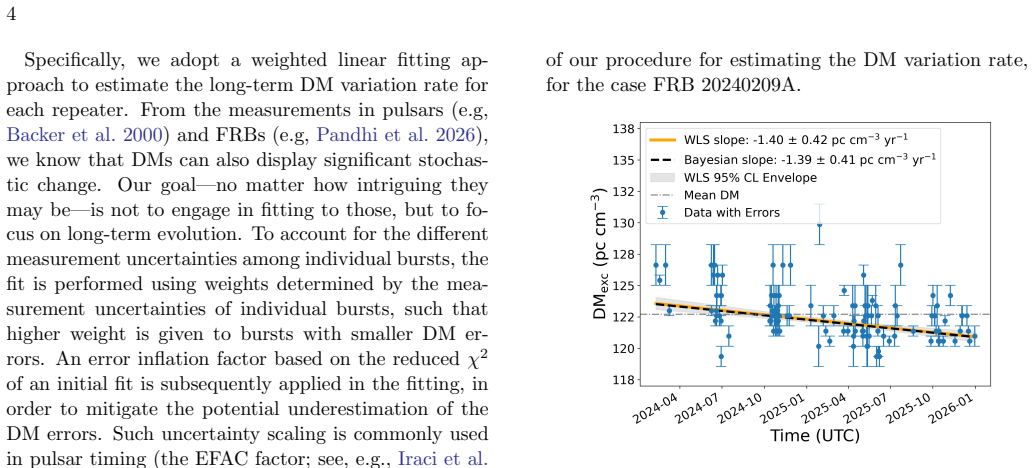
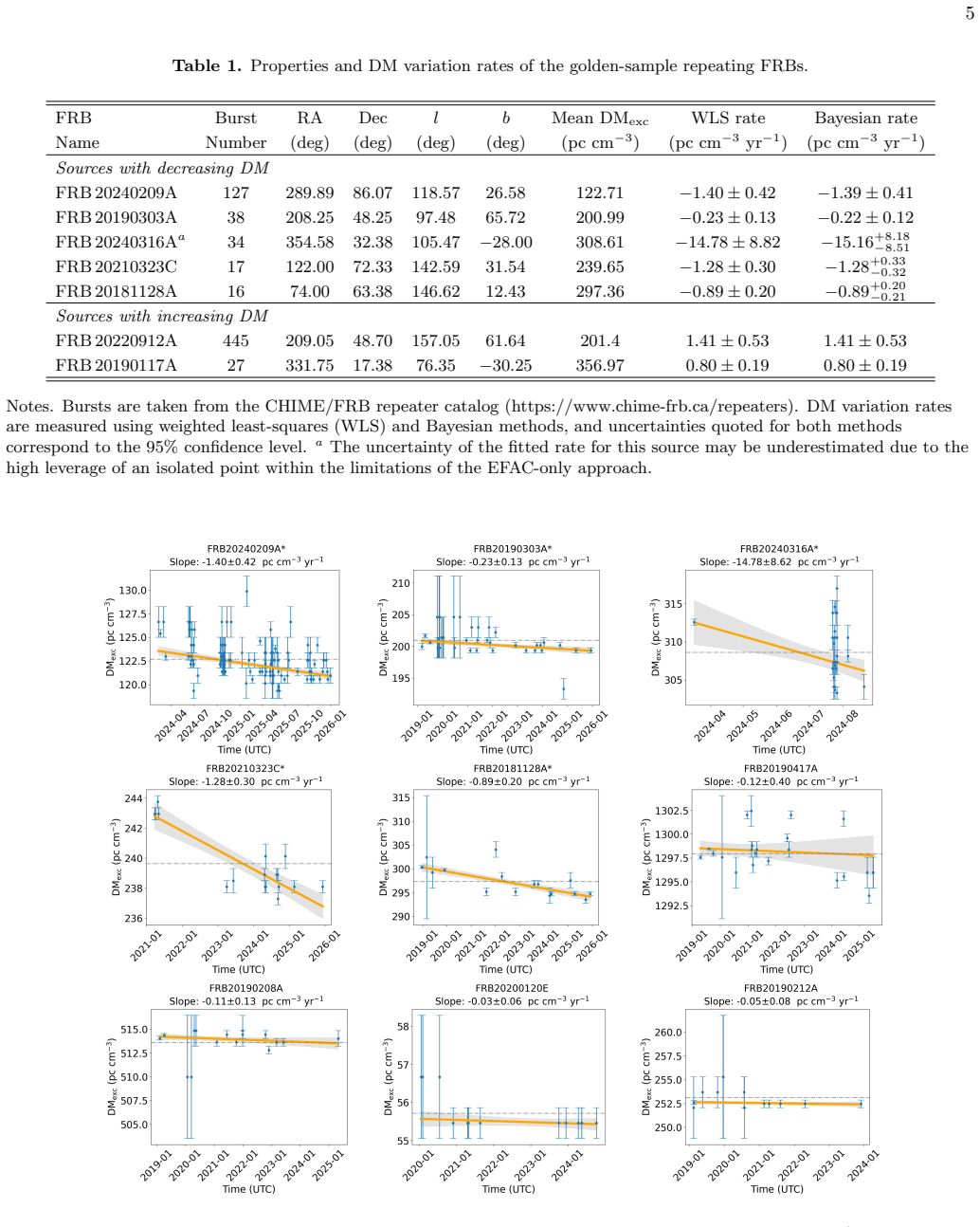
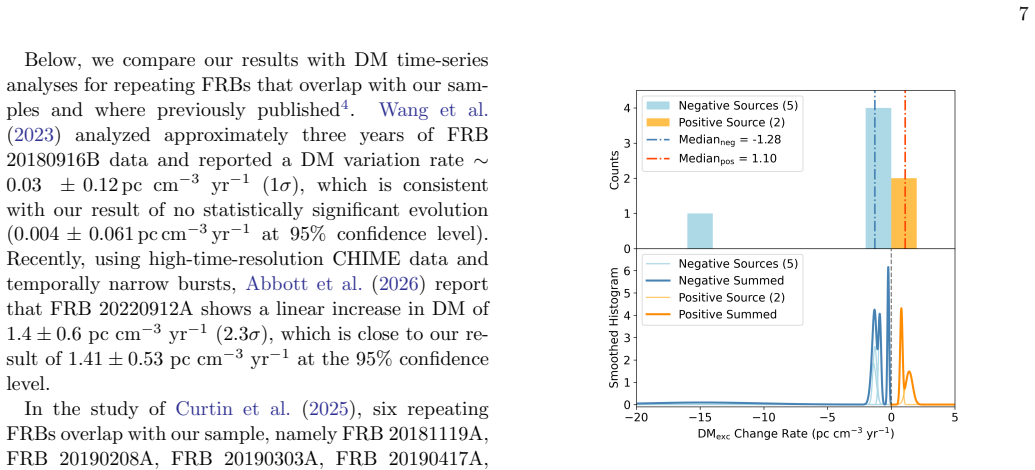
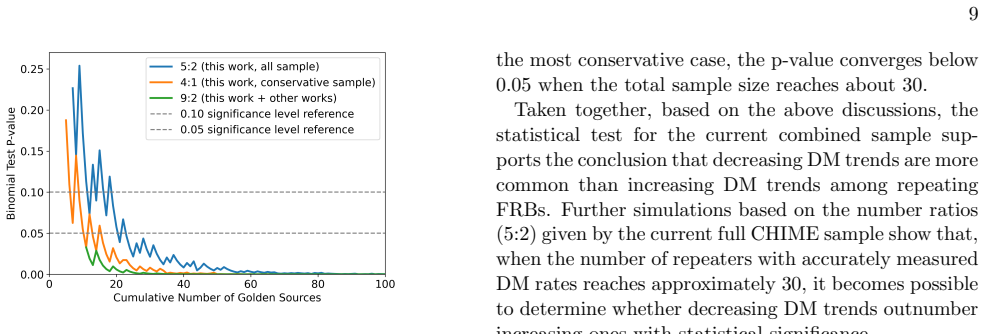
The current combined sample of repeating FRBs with reported DM change rates gives a p-value of 0.033 in a binomial test, supporting that decreasing DM trends are more common than increasing ones in the repeating FRB population. This is consistent with the local electron density around repeaters generally decreasing with time, for example due to expansion of a young supernova remnant.
What carries the argument
Binomial test under the null hypothesis that decreasing and increasing DM variation trends have equal probabilities, applied to the golden sample of seven sources plus literature data.
Load-bearing premise
The binomial test treats each source as equally likely to show either trend under the null hypothesis, assuming no selection effects from detection thresholds or varying monitoring durations.
What would settle it
Finding that the number of repeating FRBs with increasing DM trends equals or surpasses those with decreasing trends in an expanded sample would undermine the claimed preference for decreasing trends.
Figures

read the original abstract
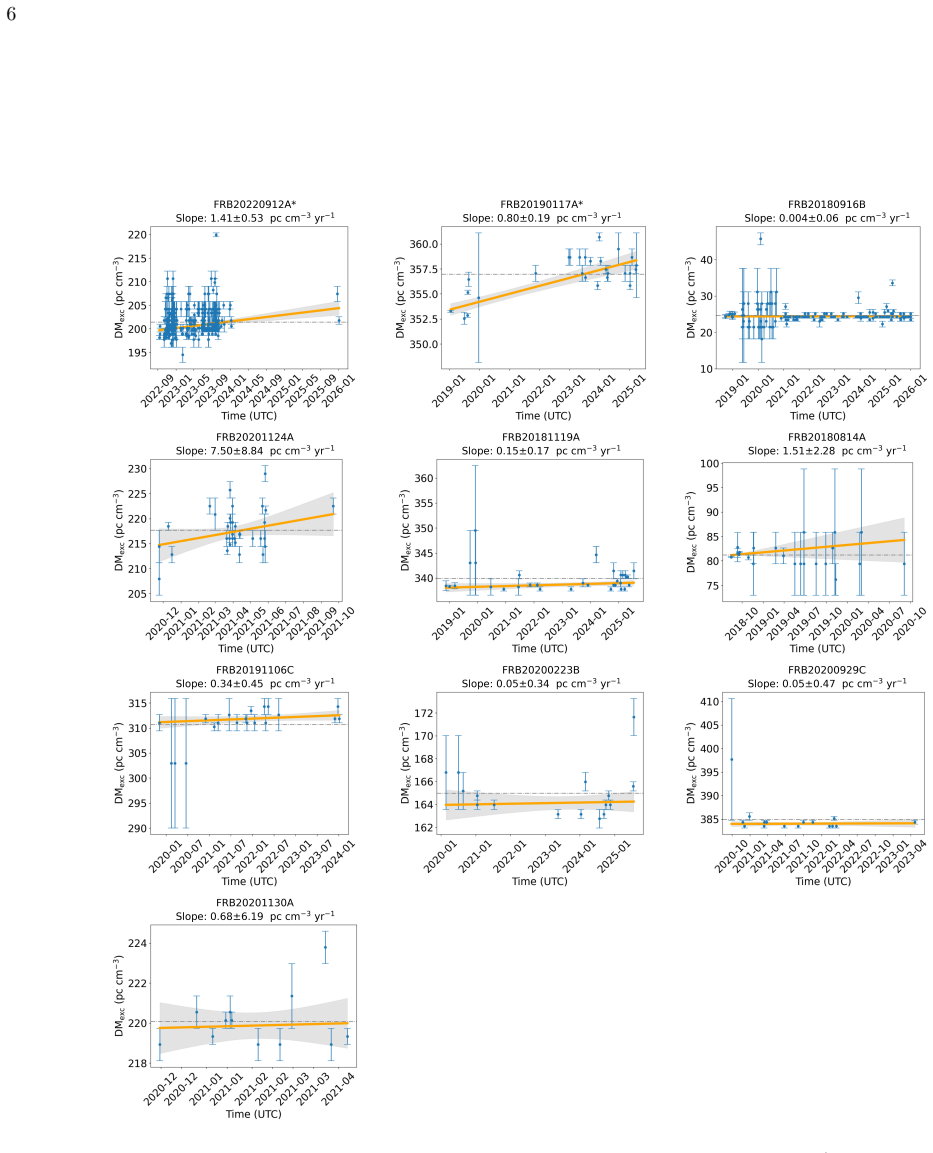
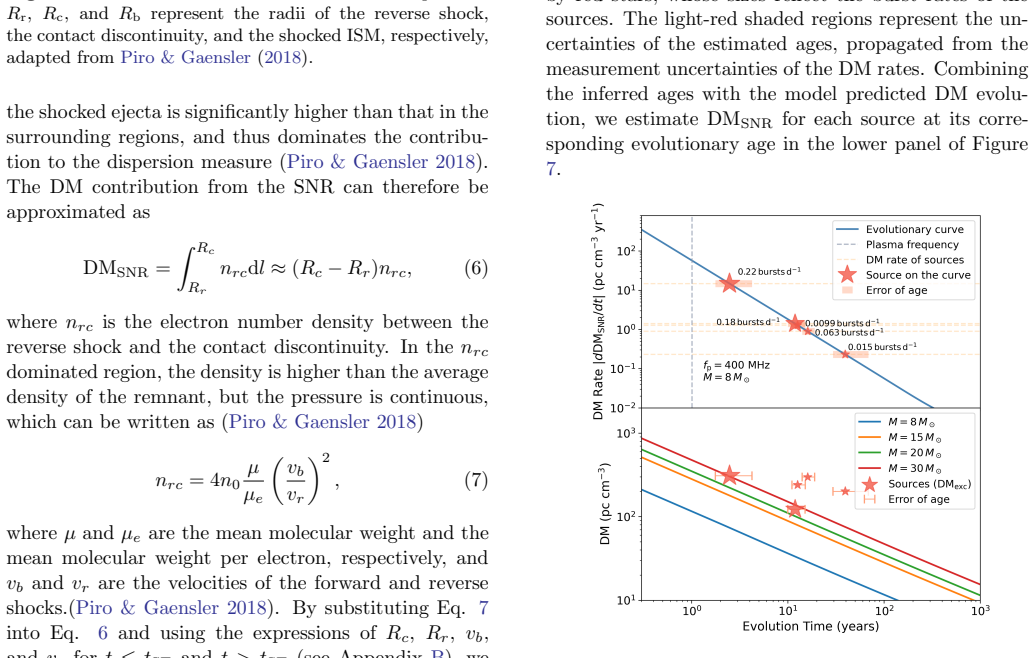
Fast Radio Bursts (FRBs) are millisecond-duration, highly energetic radio transients of uncertain origin. Repeating FRBs provide an excellent population for investigating their nature, particularly through studies of parameter evolution. Out of the 63 repeaters monitored by CHIME, we select the 19 sources with more than ten detected bursts, and examine their long-term dispersion measure (DM) evolution. Seven sources show statistically significant DM evolution and are classified as the golden sample. Of these, five exhibit a decreasing DM trend and two shows an increasing trend. We then perform a binomial test under the null hypothesis that decreasing and increasing DM variation trends have equal probabilities. The current combined sample, including our golden sample and additional repeaters with reported DM change rate from the literature, gives a p-value of 0.033, supporting that decreasing DM trends are more common in the repeating FRB population. This statistical result is consistent with scenarios in that the local electron density around repeaters generally decreases with time, for example due to expansion of a young supernova remnant (SNR). Finally, within the SNR expansion model, we provide an illustrative estimate of the SNR contributions to the DM for different ejecta masses.
Editorial analysis
A structured set of objections, weighed in public.
Referee Report
Summary. The manuscript examines long-term dispersion measure (DM) evolution in repeating fast radio bursts (FRBs) using CHIME data on 19 sources with more than ten bursts. Seven sources show statistically significant DM evolution, with five decreasing and two increasing. A binomial test on the combined sample (CHIME golden sample plus literature sources) yields p=0.033, interpreted as evidence that decreasing DM trends are more common. This is linked to possible young supernova remnant (SNR) expansion, with illustrative estimates of SNR DM contributions for different ejecta masses.
Significance. If the statistical finding is robust after addressing selection effects, it would suggest that local electron densities around repeating FRBs tend to decrease over time, providing support for progenitor models involving young SNRs. The work identifies a 'golden sample' from systematic CHIME monitoring and combines it with literature values, offering a population-level view. The SNR connection is presented as illustrative rather than a quantitative fit to the data.
major comments (2)
- [Statistical analysis of DM trends] Binomial test on combined sample: the p=0.033 result (abstract and statistical analysis) treats the seven CHIME golden-sample sources plus literature repeaters as i.i.d. draws with equal probability of increasing or decreasing DM under the null. Literature sources enter only when DM change rates are reported, violating this assumption via potential publication/selection bias toward decreasing trends consistent with the SNR scenario. The CHIME-only subset alone yields p≈0.23 and does not support the claim.
- [Sample selection and golden sample] Golden-sample definition and multiple testing: the seven sources are selected post-hoc for statistically significant DM evolution among the 19 with >10 bursts (abstract). No correction for multiple testing across the initial 19 sources or for varying monitoring durations is described, rendering the binomial test sensitive to these choices and the small N=7.
minor comments (2)
- [Abstract] Abstract: 'two shows an increasing trend' contains a subject-verb agreement error and should read 'two show an increasing trend'.
- [SNR expansion model] SNR model section: the illustrative DM estimates depend on the free parameter 'ejecta mass'; state explicitly how the quoted DM contributions vary with this parameter and whether they can be falsified against the observed rates.
Simulated Author's Rebuttal
We thank the referee for the careful and constructive review. We address the two major comments point by point below, acknowledging where the concerns are valid and outlining the changes we will implement.
read point-by-point responses
-
Referee: [Statistical analysis of DM trends] Binomial test on combined sample: the p=0.033 result (abstract and statistical analysis) treats the seven CHIME golden-sample sources plus literature repeaters as i.i.d. draws with equal probability of increasing or decreasing DM under the null. Literature sources enter only when DM change rates are reported, violating this assumption via potential publication/selection bias toward decreasing trends consistent with the SNR scenario. The CHIME-only subset alone yields p≈0.23 and does not support the claim.
Authors: We agree that combining the CHIME golden sample with literature sources risks publication bias, since literature values are included only when DM evolution rates have been reported. The CHIME-only binomial test indeed yields p≈0.23 and does not reach conventional significance. In the revised manuscript we will designate the CHIME golden sample as the primary analysis, report its binomial test result explicitly in the abstract and main text, and move the combined-sample result to a supplementary discussion that clearly states the selection limitations. We will also add a dedicated paragraph on possible biases in the literature compilation. revision: yes
-
Referee: [Sample selection and golden sample] Golden-sample definition and multiple testing: the seven sources are selected post-hoc for statistically significant DM evolution among the 19 with >10 bursts (abstract). No correction for multiple testing across the initial 19 sources or for varying monitoring durations is described, rendering the binomial test sensitive to these choices and the small N=7.
Authors: The golden sample is defined by the presence of statistically significant DM evolution within the 19 sources that have >10 bursts. We did not apply a multiple-testing correction to the initial search for significant trends. We accept that this choice, together with the small number of sources showing evolution (N=7), makes the binomial test sensitive to the adopted significance threshold and monitoring lengths. In revision we will add an explicit discussion of multiple-testing considerations, present the trend directions for all 19 sources as a robustness check, and note the limited sample size as a caveat on the strength of the population-level conclusion. revision: yes
Circularity Check
No circularity: binomial test is a direct count statistic on observed trends; SNR link is interpretive consistency only
full rationale
The paper's central step is selecting 19 CHIME repeaters, identifying 7 with significant DM evolution (5 decreasing, 2 increasing), then applying a standard binomial test under a 50/50 null to the combined sample (including literature sources) to obtain p=0.033. This is a straightforward statistical summary of the direction counts and does not reduce to the input data by construction, nor does it involve any fitted parameter renamed as a prediction. The SNR expansion scenario is explicitly offered only as one consistent interpretation, not as a model whose equations or parameters are derived from or forced by the same counts. No self-citations, uniqueness theorems, or ansatzes appear in the derivation chain. The analysis therefore remains self-contained against external benchmarks.
Axiom & Free-Parameter Ledger
free parameters (1)
- ejecta mass in SNR model
axioms (1)
- domain assumption Under the null, decreasing and increasing DM trends are equally probable for each source.
Reference graph
Works this paper leans on
-
[1]
Radio Monitoring Campaign of Active Repeater FRB 20220912A with CHIME
Abbott, T. C., Pearlman, A. B., Kaspi, V. M., et al. 2026, arXiv e-prints, arXiv:2604.09098, doi: 10.48550/arXiv.2604.09098
work page internal anchor Pith review Pith/arXiv arXiv doi:10.48550/arxiv.2604.09098 2026
-
[2]
Backer, D. C., Wong, T., & Valanju, J. 2000, The Astrophysical Journal, 543, 740, doi: 10.1086/317150 14
-
[3]
2022, Science, 378, abj3043, doi: 10.1126/science.abj3043
Bailes, M. 2022, Science, 378, abj3043, doi: 10.1126/science.abj3043
-
[4]
V., van Leeuwen, J., Maan, Y., et al
Bilous, A. V., van Leeuwen, J., Maan, Y., et al. 2025, A&A, 696, A194, doi: 10.1051/0004-6361/202451413
-
[5]
Bochenek, C. D., Ravi, V., Belov, K. V., et al. 2020, Nature, 587, 59, doi: 10.1038/s41586-020-2872-x
-
[6]
2024, Nature, 632, 1014, doi: 10.1038/s41586-024-07782-6
Bruni, G., Piro, L., Yang, Y.-P., et al. 2024, Nature, 632, 1014, doi: 10.1038/s41586-024-07782-6
-
[7]
Bruni, G., Piro, L., Yang, Y. P., et al. 2025, A&A, 695, L12, doi: 10.1051/0004-6361/202453233
-
[8]
Chatterjee, S., Law, C. J., Wharton, R. S., et al. 2017, Nature, 541, 58, doi: 10.1038/nature20797 CHIME/FRB Collaboration, Amiri, M., Bandura, K., et al. 2018, ApJ, 863, 48, doi: 10.3847/1538-4357/aad188 CHIME/FRB Collaboration, Andersen, B. C., Bandura, K. M., et al. 2020a, Nature, 587, 54, doi: 10.1038/s41586-020-2863-y CHIME/FRB Collaboration, Amiri, ...
-
[9]
Connor, L., Ravi, V., Sharma, K., et al. 2025, Nature Astronomy, 9, 1226, doi: 10.1038/s41550-025-02566-y
-
[10]
M., Shin, K., Pleunis, Z., et al
Cook, A. M., Shin, K., Pleunis, Z., et al. 2026, arXiv e-prints, arXiv:2605.08410. https://arxiv.org/abs/2605.08410
Pith/arXiv arXiv 2026
-
[11]
Cordes, J. M., & Chatterjee, S. 2019, ARA&A, 57, 417, doi: 10.1146/annurev-astro-091918-104501
-
[12]
Cui, X.-H., James, C. W., Li, D., & Zhang, C.-M. 2025, ApJ, 982, 158, doi: 10.3847/1538-4357/adbbcb
-
[13]
Cui, X.-H., Zhang, C.-M., Wang, S.-Q., et al. 2021, MNRAS, 500, 3275, doi: 10.1093/mnras/staa3351
-
[14]
2022, Ap&SS, 367, 66, doi: 10.1007/s10509-022-04093-y
Cui, X.-H., Zhang, C.-M., Li, D., et al. 2022, Ap&SS, 367, 66, doi: 10.1007/s10509-022-04093-y
-
[15]
Curtin, A. P., Sand, K. R., Pleunis, Z., et al. 2025, ApJ, 992, 206, doi: 10.3847/1538-4357/adf844
-
[16]
2026, ApJ, 1004, 179, doi: 10.3847/1538-4357/ae731b
Feng, Y., Zhou, D., Zhang, Y., et al. 2026, ApJ, 1004, 179, doi: 10.3847/1538-4357/ae731b
-
[17]
Feng, Y., Li, D., Yang, Y.-P., et al. 2022, Science, 375, 1266, doi: 10.1126/science.abl7759
-
[18]
Fonseca, E., Andersen, B. C., Bhardwaj, M., et al. 2020, ApJL, 891, L6, doi: 10.3847/2041-8213/ab7208
-
[19]
Frail, D. A., Goss, W. M., & Whiteoak, J. B. Z. 1994, ApJ, 437, 781, doi: 10.1086/175038
-
[20]
Frank, J., King, A., & Raine, D. J. 2002, Accretion Power in Astrophysics: Third Edition FRB Collaboration, Abbott, T., Andersen, B. C., et al. 2026, arXiv e-prints, arXiv:2601.09399, doi: 10.48550/arXiv.2601.09399
-
[21]
Gardenier, D. W., Connor, L., van Leeuwen, J., Oostrum, L. C., & Petroff, E. 2021, A&A, 647, A30, doi: 10.1051/0004-6361/202039626
-
[22]
2024, A&A, 692, A170, doi: 10.1051/0004-6361/202450740
Iraci, F., Chalumeau, A., Tiburzi, C., et al. 2024, A&A, 692, A170, doi: 10.1051/0004-6361/202450740
-
[23]
James, C. W., Prochaska, J. X., Macquart, J. P., et al. 2022, MNRAS, 509, 4775, doi: 10.1093/mnras/stab3051
-
[24]
2017, ApJ, 837, 84, doi: 10.3847/1538-4357/aa618e
Janka, H.-T. 2017, ApJ, 837, 84, doi: 10.3847/1538-4357/aa618e
-
[25]
Kumar, P., Luo, R., Price, D. C., et al. 2023, MNRAS, 526, 3652, doi: 10.1093/mnras/stad2969
-
[26]
Kuzmin, A., Losovsky, B. Y., Jordan, C. A., & Smith, F. G. 2008, A&A, 483, 13, doi: 10.1051/0004-6361:20079211
-
[27]
2024, ApJL, 967, L44, doi: 10.3847/2041-8213/ad4ae8
Lan, H.-T., Zhao, Z.-Y., Wei, Y.-J., & Wang, F.-Y. 2024, ApJL, 967, L44, doi: 10.3847/2041-8213/ad4ae8
-
[28]
2018, IEEE Microwave Magazine, 19, 112, doi: 10.1109/MMM.2018.2802178
Li, D., Wang, P., Qian, L., et al. 2018, IEEE Microwave Magazine, 19, 112, doi: 10.1109/MMM.2018.2802178
-
[29]
Li, D., Wang, P., Zhu, W. W., et al. 2021, Nature, 598, 267, doi: 10.1038/s41586-021-03878-5
-
[30]
Li, Y., Zhang, S. B., Yang, Y. P., et al. 2026, Science, 391, 280, doi: 10.1126/science.adq3225
-
[31]
2024, ApJ, 975, 75, doi: 10.3847/1538-4357/ad779d
Lin, H.-H., Scholz, P., Ng, C., et al. 2024, ApJ, 975, 75, doi: 10.3847/1538-4357/ad779d
-
[32]
2012, Handbook of Pulsar Astronomy
Lorimer, D., & Kramer, M. 2012, Handbook of Pulsar Astronomy
2012
-
[33]
A Bright Millisecond Radio Burst of Extragalactic Origin.Science2007,318, 777
Lorimer, D. R., Bailes, M., McLaughlin, M. A., Narkevic, D. J., & Crawford, F. 2007, Science, 318, 777, doi: 10.1126/science.1147532
-
[34]
Luo, R., Lee, K., Lorimer, D. R., & Zhang, B. 2018, MNRAS, 481, 2320, doi: 10.1093/mnras/sty2364
-
[35]
Macquart, J. P., & Ekers, R. 2018, MNRAS, 480, 4211, doi: 10.1093/mnras/sty2083
-
[36]
Macquart, J. P., Prochaska, J. X., McQuinn, M., et al. 2020, Nature, 581, 391, doi: 10.1038/s41586-020-2300-2
-
[37]
McKee, C. F., & Truelove, J. K. 1995, PhR, 256, 157, doi: 10.1016/0370-1573(94)00106-D
-
[38]
McKee, J. W., Lyne, A. G., Stappers, B. W., Bassa, C. G., & Jordan, C. A. 2018, MNRAS, 479, 4216, doi: 10.1093/mnras/sty1727
-
[39]
Michilli, D., Seymour, A., Hessels, J. W. T., et al. 2018, Nature, 553, 182, doi: 10.1038/nature25149
-
[40]
Moroianu, A. M., Bhandari, S., Drout, M. R., et al. 2025, arXiv e-prints, arXiv:2509.05174, doi: 10.48550/arXiv.2509.05174
-
[41]
2011, International Journal of Modern Physics D, 20, 989, doi: 10.1142/S0218271811019335
Nan, R., Li, D., Jin, C., et al. 2011, International Journal of Modern Physics D, 20, 989, doi: 10.1142/S0218271811019335
-
[42]
Niu, C. H., Aggarwal, K., Li, D., et al. 2022, Nature, 606, 873, doi: 10.1038/s41586-022-04755-5 15
-
[43]
Niu, C.-H., Li, D., Yang, Y.-P., et al. 2025, Science Bulletin, doi: https://doi.org/10.1016/j.scib.2025.11.023
-
[44]
C., Maan, Y., van Leeuwen, J., et al
Oostrum, L. C., Maan, Y., van Leeuwen, J., et al. 2020, A&A, 635, A61, doi: 10.1051/0004-6361/201937422
-
[45]
2026, ApJL, 1000, L53, doi: 10.3847/2041-8213/ae52f8
Pandhi, A., Nimmo, K., Andrew, S., et al. 2026, ApJL, 1000, L53, doi: 10.3847/2041-8213/ae52f8
-
[46]
Petroff, E., Hessels, J. W. T., & Lorimer, D. R. 2022, A&A Rv, 30, 2, doi: 10.1007/s00159-022-00139-w
-
[47]
Shannon, R. M. 2013, MNRAS, 435, 1610, doi: 10.1093/mnras/stt1401
-
[48]
Piro, A. L., & Gaensler, B. M. 2018, ApJ, 861, 150, doi: 10.3847/1538-4357/aac9bc
-
[49]
Rajwade, K. M., Mickaliger, M. B., Stappers, B. W., et al. 2020, MNRAS, 495, 3551, doi: 10.1093/mnras/staa1237
-
[50]
Ravi, V., Law, C. J., Li, D., et al. 2022, MNRAS, 513, 982, doi: 10.1093/mnras/stac465
-
[51]
Sedov, L. I. 1946, Journal of Applied Mathematics and Mechanics, 10, 241
1946
-
[52]
2017, ApJ, 849, 87, doi: 10.3847/1538-4357/aa932c
Shang, L.-H., Zhang, C.-M., Li, D., et al. 2017, ApJ, 849, 87, doi: 10.3847/1538-4357/aa932c
-
[53]
Snelders, M. P., Hessels, J. W. T., Huang, J., et al. 2025, arXiv e-prints, arXiv:2510.11352, doi: 10.48550/arXiv.2510.11352
-
[54]
M., Connor, L., & van Leeuwen, J
Straal, S. M., Connor, L., & van Leeuwen, J. 2020, A&A, 634, A105, doi: 10.1051/0004-6361/201833376
-
[55]
1950, Proceedings of the Royal Society of London Series A, 201, 159, doi: 10.1098/rspa.1950.0049
Taylor, G. 1950, Proceedings of the Royal Society of London Series A, 201, 159, doi: 10.1098/rspa.1950.0049
-
[56]
Uttarkar, P. A., Shannon, R. M., Gourdji, K., et al. 2026, MNRAS, 545, staf1997, doi: 10.1093/mnras/staf1997
-
[57]
Wang, F. Y., Zhang, G. Q., Dai, Z. G., & Cheng, K. S. 2022, Nature Communications, 13, 4382, doi: 10.1038/s41467-022-31923-y
-
[58]
Wang, P., Zhang, J. S., Yang, Y. P., et al. 2025, arXiv e-prints, arXiv:2507.15790, doi: 10.48550/arXiv.2507.15790
-
[59]
Wang, Y., & van Leeuwen, J. 2024, A&A, 690, A377, doi: 10.1051/0004-6361/202450673
-
[60]
2023, MNRAS, 524, 569, doi: 10.1093/mnras/stad1922
Wang, Y.-B., Kurban, A., Zhou, X., Yu, Y.-W., & Wang, N. 2023, MNRAS, 524, 569, doi: 10.1093/mnras/stad1922
-
[61]
Xu, H., Niu, J. R., Chen, P., et al. 2022, Nature, 609, 685, doi: 10.1038/s41586-022-05071-8
-
[62]
2017, ApJ, 847, 22, doi: 10.3847/1538-4357/aa8721
Yang, Y.-P., & Zhang, B. 2017, ApJ, 847, 22, doi: 10.3847/1538-4357/aa8721
-
[63]
Yao, J. M., Manchester, R. N., & Wang, N. 2017, ApJ, 835, 29, doi: 10.3847/1538-4357/835/1/29
-
[64]
The physics of fast radio bursts.Rev
Zhang, B. 2023, Reviews of Modern Physics, 95, 035005, doi: 10.1103/RevModPhys.95.035005
-
[65]
2026, ApJ, 996, 4, doi: 10.3847/1538-4357/ae20f6
Zhang, J.-h., Niu, C.-H., Zhu, Y.-h., et al. 2026, ApJ, 996, 4, doi: 10.3847/1538-4357/ae20f6
-
[66]
Zhang, J.-S., Wang, T.-C., Wang, P., et al. 2025, arXiv e-prints, arXiv:2507.14707, doi: 10.48550/arXiv.2507.14707
-
[67]
2022, Research in Astronomy and Astrophysics, 22, 124002, doi: 10.1088/1674-4527/ac98f7
Zhang, Y.-K., Wang, P., Feng, Y., et al. 2022, Research in Astronomy and Astrophysics, 22, 124002, doi: 10.1088/1674-4527/ac98f7
-
[68]
Zhang, Y.-K., Li, D., Zhang, B., et al. 2023, ApJ, 955, 142, doi: 10.3847/1538-4357/aced0b
discussion (0)
Sign in with ORCID, Apple, or X to comment. Anyone can read and Pith papers without signing in.