Correlating Quasi-Optical Coupling Efficiency with Measured Receiver Noise Temperature in Metalens Coupled THz HEB Mixer
Pith reviewed 2026-06-26 23:24 UTC · model grok-4.3
The pith
Calculated metalens coupling efficiency correlates directly with measured double-sideband noise temperatures in a THz HEB receiver when benchmarked against a conventional elliptical silicon lens.
A machine-rendered reading of the paper's core claim, the machinery that carries it, and where it could break.
Core claim
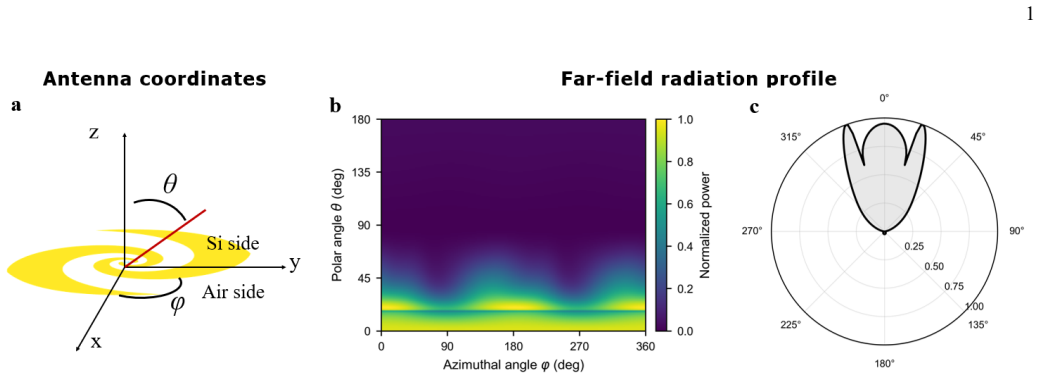
By combining the angular radiation profile of the spiral antenna with the deflection-angle-dependent focusing efficiency of the metalens obtained from numerical simulations using spherical-coordinate vectorial integration, the calculated coupling efficiency is directly correlated with experimentally measured double-side-band receiver noise temperatures through comparison with a conventional elliptical Si lens measured under the same receiver configuration. The analysis establishes a quantitative relationship between metalens focusing efficiency, antenna coupling, and receiver noise temperature, providing guidance for optimizing metalens design and improving the overall performance of metalen
What carries the argument
Spherical-coordinate vectorial integration of the antenna radiation profile with the metalens deflection-angle-dependent focusing efficiency
If this is right
- The coupling calculation supplies a predictive tool for how changes in metalens design will affect measured noise temperature.
- Metalens performance can be evaluated quantitatively against ideal refractive optics in the same receiver configuration.
- The method yields concrete guidance for adjusting metalens parameters to reduce noise temperature in THz heterodyne systems.
Where Pith is reading between the lines
- The same integration approach could be tested on metalenses designed for neighboring THz frequencies to check consistency of the correlation.
- Accounting for fabrication variations in the metalens would be a natural next step to tighten the link between simulation and measured noise temperature.
- The framework suggests that deflection-angle effects may limit planar optics in other high-frequency antenna-coupled detectors beyond this specific 1.63 THz case.
Load-bearing premise
Numerical simulations of the metalens deflection-angle-dependent focusing efficiency accurately represent the fabricated device when integrated with the real antenna and HEB mixer.
What would settle it
A direct measurement of receiver noise temperature with the metalens that deviates from the value predicted by the calculated coupling efficiency relative to the elliptical lens result under the same conditions.
Figures
read the original abstract
Quasi-optical coupling serves as the critical interface in terahertz (THz) heterodyne receiver systems, enabling efficient transfer of incident radiation to superconducting hot-electron bolometer (HEB) mixers through a focusing element and a planar microwave antenna. With recent advances in nanofabrication, planar dielectric metalenses have emerged as promising alternatives to conventional refractive optics due to their compactness and scalability. However, unlike conventional elliptical silicon lenses that are often treated as nearly ideal optical components, the focusing efficiency of metalenses is strongly dependent on the local deflection angle across the aperture, creating an urgent need to quantitatively understand the coupling between a dielectric metalens and a planar antenna. In this work, we present a quasi-optical coupling analysis between a planar Si metalens and a logarithmic spiral antenna integrated with a THz superconducting NbN HEB mixer operating at 1.63 THz using a spherical-coordinate vectorial integration. By combining the angular radiation profile of the spiral antenna with the deflection-angle-dependent focusing efficiency of the metalens obtained from numerical simulations, the calculated coupling efficiency is directly correlated with experimentally measured double-side-band receiver noise temperatures through comparison with a conventional elliptical Si lens measured under the same receiver configuration. The analysis establishes a quantitative relationship between metalens focusing efficiency, antenna coupling, and receiver noise temperature, providing guidance for optimizing metalens design and improving the overall performance of metalens-integrated THz heterodyne receivers.
Editorial analysis
A structured set of objections, weighed in public.
Referee Report
Summary. The manuscript presents a quasi-optical analysis of coupling between a planar Si metalens and a logarithmic spiral antenna integrated with an NbN HEB mixer at 1.63 THz. Using spherical-coordinate vectorial integration of the antenna's angular radiation profile with the metalens's deflection-angle-dependent focusing efficiency (obtained from numerical simulations), the authors compute a coupling efficiency and correlate it with measured double-sideband receiver noise temperatures by direct comparison to a conventional elliptical Si lens measured in the same receiver configuration.
Significance. If the reported correlation is robust, the work supplies a practical quantitative link between metalens design parameters (via angle-dependent efficiency) and system-level noise performance, which is useful for compact THz heterodyne receiver optimization. The vectorial integration approach and side-by-side reference-lens comparison are standard and appropriate strengths of the validation workflow.
major comments (2)
- Abstract (and method description): the central claim of a direct correlation between simulated coupling efficiency and measured DSB noise temperature is presented without error bars on either quantity, without explicit data-exclusion criteria, and without any quantitative fit statistics (e.g., R², slope, or p-value). This omission makes the strength of the numerical-to-experimental link impossible to evaluate from the provided information.
- Method section (paragraph on simulation-to-fabrication link): the deflection-angle-dependent focusing efficiency is taken from numerical simulations and assumed to represent the fabricated metalens when integrated with the real antenna and HEB; no fabrication tolerance analysis, post-fabrication verification measurement, or sensitivity study is described to support this assumption.
minor comments (2)
- Notation: the term 'coupling efficiency' is used both for the vectorially integrated quantity and for the metalens focusing efficiency; a single consistent symbol or explicit distinction would improve clarity.
- Figure captions: the abstract references a comparison under 'the same receiver configuration,' but the corresponding figure or table should explicitly list the shared parameters (e.g., bias, LO power, temperature) to allow independent assessment.
Simulated Author's Rebuttal
We thank the referee for the detailed and constructive review. The comments highlight important aspects of how the correlation is presented and the assumptions in the simulation-to-experiment link. We address each point below and indicate planned revisions.
read point-by-point responses
-
Referee: Abstract (and method description): the central claim of a direct correlation between simulated coupling efficiency and measured DSB noise temperature is presented without error bars on either quantity, without explicit data-exclusion criteria, and without any quantitative fit statistics (e.g., R², slope, or p-value). This omission makes the strength of the numerical-to-experimental link impossible to evaluate from the provided information.
Authors: We agree that the absence of error bars, explicit exclusion criteria, and fit statistics limits evaluation of the correlation strength. The dataset comprises noise-temperature measurements on multiple metalens variants plus the elliptical reference lens under identical conditions. We will revise the abstract and methods to report estimated uncertainties derived from repeated Y-factor measurements, state that no data points were excluded beyond standard checks for known equipment artifacts, and include a linear regression with R² and slope to quantify the relationship. revision: yes
-
Referee: Method section (paragraph on simulation-to-fabrication link): the deflection-angle-dependent focusing efficiency is taken from numerical simulations and assumed to represent the fabricated metalens when integrated with the real antenna and HEB; no fabrication tolerance analysis, post-fabrication verification measurement, or sensitivity study is described to support this assumption.
Authors: The comment is valid; the manuscript relies on the simulated angle-dependent efficiency without supporting tolerance or verification data. We will add a short sensitivity analysis in the methods section that perturbs the efficiency curves by the estimated fabrication uncertainty (±5 % in local transmission) and shows the resulting range in calculated coupling efficiency. A full post-fabrication optical characterization or comprehensive tolerance study was not performed and is noted as future work. revision: partial
Circularity Check
No significant circularity in derivation chain
full rationale
The paper derives coupling efficiency from independent inputs: measured angular radiation profile of the spiral antenna combined via spherical-coordinate vectorial integration with deflection-angle-dependent focusing efficiency obtained from numerical simulations of the metalens. This computed efficiency is then compared to separate experimental DSB noise temperature measurements for the metalens versus a reference elliptical lens under identical conditions. No step reduces a reported prediction or correlation to a fitted parameter by construction, nor relies on self-citation chains or ansatzes that smuggle in the target result. The workflow is a standard quasi-optical validation with external experimental benchmarks.
Axiom & Free-Parameter Ledger
Reference graph
Works this paper leans on
-
[1]
Superconducting detectors and mixers for millimeter and submillimeter astrophysics,
J. Zmuidzinas and P. L. Richards, “Superconducting detectors and mixers for millimeter and submillimeter astrophysics,” Proc. IEEE, vol. 92, no. 10, pp. 1597– 1616, Oct. 2004, doi: 10.1109/JPROC.2004.833670. 4
-
[2]
C. K. Walker, Terahertz astronomy, First issued in paperback. in Physics. Boca Raton London New York: CRC Press, Taylor & Francis Group, 2019
2019
-
[3]
Quantum detection at millimeter wavelengths,
J. R. Tucker and M. J. Feldman, “Quantum detection at millimeter wavelengths,” Rev. Mod. Phys., vol. 57, no. 4, pp. 1055–1113, Oct. 1985, doi: 10.1103/RevModPhys.57.1055
-
[4]
GREAT: the SOFIA high- frequency heterodyne instrument,
S. Heyminck, U. U. Graf, R. Gü sten, J. Stutzki, H. W. Hübers, and P. Hartogh, “GREAT: the SOFIA high- frequency heterodyne instrument,” A&A, vol. 542, p. L1, Jun. 2012, doi: 10.1051/0004-6361/201218811
-
[5]
Double-slot antennas on extended hemispherical and elliptical silicon dielectric lenses,
D. F. Filipovic, S. S. Gearhart, and G. M. Rebeiz, “Double-slot antennas on extended hemispherical and elliptical silicon dielectric lenses,” IEEE Trans. Microwave Theory Techn., vol. 41, no. 10, pp. 1738– 1749, Oct. 1993, doi: 10.1109/22.247919
-
[6]
Terahertz heterodyne receiver based on a quantum cascade laser and a superconducting bolometer,
J. R. Gao et al., “Terahertz heterodyne receiver based on a quantum cascade laser and a superconducting bolometer,” Applied Physics Letters, vol. 86, no. 24, p. 244104, Jun. 2005, doi: 10.1063/1.1949724
-
[7]
Terahertz Performance of Integrated Lens Antennas With a Hot-Electron Bolometer,
A. D. Semenov et al., “Terahertz Performance of Integrated Lens Antennas With a Hot-Electron Bolometer,” IEEE Trans. Microwave Theory Techn., vol. 55, no. 2, pp. 239–247, Feb. 2007, doi: 10.1109/TMTT.2006.889153
-
[8]
Lens‐coupled folded‐dipole antennas for terahertz detection and imaging,
S. M. Rahman, Z. Jiang, H. (Grace) Xing, P. Fay, and L. Liu, “Lens‐coupled folded‐dipole antennas for terahertz detection and imaging,” IET Microwaves Antenna & Prop, vol. 9, no. 11, pp. 1213–1220, Aug. 2015, doi: 10.1049/iet-map.2014.0415
-
[9]
Terahertz Heterodyne Receivers,
H.-W. Hubers, “Terahertz Heterodyne Receivers,” IEEE J. Select. Topics Quantum Electron., vol. 14, no. 2, pp. 378–391, 2008, doi: 10.1109/JSTQE.2007.913964
-
[10]
Hot-electron bolometer terahertz mixers for the Herschel Space Observatory,
S. Cherednichenko, V. Drakinskiy, T. Berg, P. Khosropanah, and E. Kollberg, “Hot-electron bolometer terahertz mixers for the Herschel Space Observatory,” Review of Scientific Instruments, vol. 79, no. 3, p. 034501, Mar. 2008, doi: 10.1063/1.2890099
-
[11]
A 4.7 THz HEB/QCL heterodyne receiver for STO-2,
D. J. Hayton et al., “A 4.7 THz HEB/QCL heterodyne receiver for STO-2,” in 2014 39th International Conference on Infrared, Millimeter, and Terahertz waves (IRMMW-THz), Tucson, AZ, USA: IEEE, Sep. 2014, pp. 1–2. doi: 10.1109/IRMMW- THz.2014.6956203
-
[12]
J. R. G. Silva et al., “4 × 2 Hot electron bolometer mixer arrays for detection at 1.4, 1.9, and 4.7 THz for the balloon-borne terahertz observatory GUSTO,” J. Astron. Telesc. Instrum. Syst., vol. 11, no. 01, Jan. 2025, doi: 10.1117/1.JATIS.11.1.016001
-
[13]
OSAS-B: A Balloon-Borne Terahertz Spectrometer for Atomic Oxygen in the Upper Atmosphere,
M. Wienold et al., “OSAS-B: A Balloon-Borne Terahertz Spectrometer for Atomic Oxygen in the Upper Atmosphere,” IEEE Trans. THz Sci. Technol., vol. 14, no. 3, pp. 327–335, May 2024, doi: 10.1109/tthz.2024.3363135
-
[14]
Beam Waist Properties of Spiral Antenna Coupled HEB Mixers at Supra-THz Frequencies,
J. R. Gaspar Silva et al., “Beam Waist Properties of Spiral Antenna Coupled HEB Mixers at Supra-THz Frequencies,” IEEE Trans. THz Sci. Technol., vol. 13, no. 2, pp. 167–177, Mar. 2023, doi: 10.1109/TTHZ.2022.3230742
-
[15]
Antenna Coupled MKID Performance Verification at 850 GHz for Large Format Astrophysics Arrays,
L. Ferrari et al., “Antenna Coupled MKID Performance Verification at 850 GHz for Large Format Astrophysics Arrays,” IEEE Trans. THz Sci. Technol., vol. 8, no. 1, pp. 127–139, Jan. 2018, doi: 10.1109/TTHZ.2017.2764378
-
[16]
Metalens-coupled terahertz NbN hot electron bolometer mixer,
D. Ren et al., “Metalens-coupled terahertz NbN hot electron bolometer mixer,” Jul. 22, 2025, arXiv: arXiv:2507.16868. doi: 10.48550/arXiv.2507.16868
-
[17]
Reduced Noise Temperatures of a THz NbN Hot Electron Bolometer Mixer,
B. Mirzaei, J. R. G. Silva, W.-J. Vreeling, W. M. Laauwen, D. Ren, and J.-R. Gao, “Reduced Noise Temperatures of a THz NbN Hot Electron Bolometer Mixer,” IEEE Trans. THz Sci. Technol., vol. 15, no. 1, pp. 91–99, Jan. 2025, doi: 10.1109/TTHZ.2024.3475010
-
[18]
High-NA achromatic metalenses by inverse design,
H. Chung and O. D. Miller, “High-NA achromatic metalenses by inverse design,” Opt. Express, vol. 28, no. 5, p. 6945, Mar. 2020, doi: 10.1364/OE.385440
-
[19]
Consensus statement on Brillouin light scattering microscopy of biological materials,
R. Menon and B. Sensale-Rodriguez, “Inconsistencies of metalens performance and comparison with conventional diffractive optics,” Nat. Photon., vol. 17, no. 11, pp. 923–924, Nov. 2023, doi: 10.1038/s41566- 023-01306-w
-
[20]
Taflove and S
A. Taflove and S. C. Hagness, Computational electrodynamics: the finite-difference time-domain method, 3rd ed. in Artech House antennas and propagation library. Boston: Artech House, 2005
2005
-
[21]
Oskooi, David Roundy, Mihai Ibanescu, Peter Bermel, J
A. F. Oskooi, D. Roundy, M. Ibanescu, P. Bermel, J. D. Joannopoulos, and S. G. Johnson, “Meep: A flexible free-software package for electromagnetic simulations by the FDTD method,” Computer Physics Communications, vol. 181, no. 3, pp. 687–702, Mar. 2010, doi: 10.1016/j.cpc.2009.11.008
-
[22]
D. A. B. Miller, “Why optics needs thickness,” Science, vol. 379, no. 6627, pp. 41–45, Jan. 2023, doi: 10.1126/science.ade3395
-
[23]
Metalenses at visible wavelengths: past, present, perspectives,
P. Lalanne and P. Chavel, “Metalenses at visible wavelengths: past, present, perspectives,” Laser & Photonics Reviews, vol. 11, no. 3, p. 1600295, May 2017, doi: 10.1002/lpor.201600295
-
[24]
W. Ji et al., “Recent advances in metasurface design and quantum optics applications with machine learning, physics-informed neural networks, and topology optimization methods,” Light Sci Appl, vol. 12, no. 1, p. 169, Jul. 2023, doi: 10.1038/s41377-023-01218-y
discussion (0)
Sign in with ORCID, Apple, or X to comment. Anyone can read and Pith papers without signing in.