REVIEW 3 major objections 5 minor 72 references
Leveraging Discriminative Latent Representations for Conditioning GAN-Based Speech Enhancement
T0 review · 3 major / 5 minor · reviewed 2026-08-05 · deepseek-v4-flash
Pith's one-line read A GAN for speech enhancement that is conditioned on latent features from a pre-trained discriminative denoiser outperforms end-to-end and cascade GANs, most clearly in very low SNR conditions.
desk verdict Genuine extension of the authors' latent-conditioning idea, with a mostly solid low-SNR result, but the 'consistently outperforms' claim is contradicted by their own tables and must be scoped. read the letter →
The pith
A machine-rendered reading of the paper's core claim, the machinery that carries it, and where it could break.
The reading
What carries the argument
The load-bearing mechanism is masked multi-head attention fusion between the generator's own latent features G_L and the discriminative latent codes D_L. The generator features serve as queries; the transformed discriminative features, aligned in time by linear interpolation and in dimension by a learnable block-diagonal projection, serve as keys and values. A fixed 20-frame lookahead mask lets the generator borrow future discriminative context while preserving a causal-ish structure. The attention output is concatenated with G_L to form the conditioned latent Z_L that the decoder turns into an estimated time-frequency mask. FiLM-based skip connections and a multi-scale STFT discriminator wi
What would settle it
Run a MUSHRA-style listening test with a larger set of high-SNR and real-recorded samples, presenting the clean reference alongside DisCoGAN output; if listeners do not prefer DisCoGAN over clean speech where DNSMOS gives it a higher score than clean (4.12 vs 4.01), the metric-leniency explanation is confirmed. Alternatively, add artificially hallucinated high-frequency content to clean speech and check whether DNSMOS or SCOREQ rise; if they do, those metrics are demonstrably rewarding hallucination.
Extended reading notes
Core claim
The central claim is that latent representations from a pretrained discriminative speech-enhancement encoder are generic, effective conditioning features for a GAN-based generator. The generator estimates clean speech as s_hat = G_theta(x, D_L), where D_L is the frozen encoder's bottleneck output; the encoder's decoder is discarded. DisCoGAN consistently outperforms existing methods in low-SNR scenarios, and matches or beats generative baselines in high-SNR conditions and on real recordings. Ablations show the gain comes from the pretrained discriminative latent features, not from added encoder complexity: an end-to-end variant trained from scratch performs on par with its unconditioned coun
Load-bearing premise
The claimed wins on real recordings and high-SNR conditions rest on DNN-based quality metrics (DNSMOS, SCOREQ) that the paper itself shows can rate generated speech above the clean reference; if those metrics reward plausible but hallucinated high-frequency content, the advantages may be metric bias rather than audible improvement, and the listening test covers only twelve low-SNR examples.
Editorial extensions
If this is right
- Low-SNR GAN enhancement can be improved without adding inference latency: the discriminative decoder is discarded and the encoder runs in parallel with the generator.
- Two-stage GAN-first and GAN-last cascades become unnecessary; a single conditioned generator outperforms both cascade orders on the reported metrics.
- Any pretrained discriminative SE encoder can serve as the conditioning front-end; all four tested backbones (DCCRN, DDAEC, TaylorSENet, GCRN) improve the GAN over its unconditioned baseline.
- The conditioning tolerates small causal delays and SNR mismatch, so the front-end does not need perfect frame-level alignment with the generator.
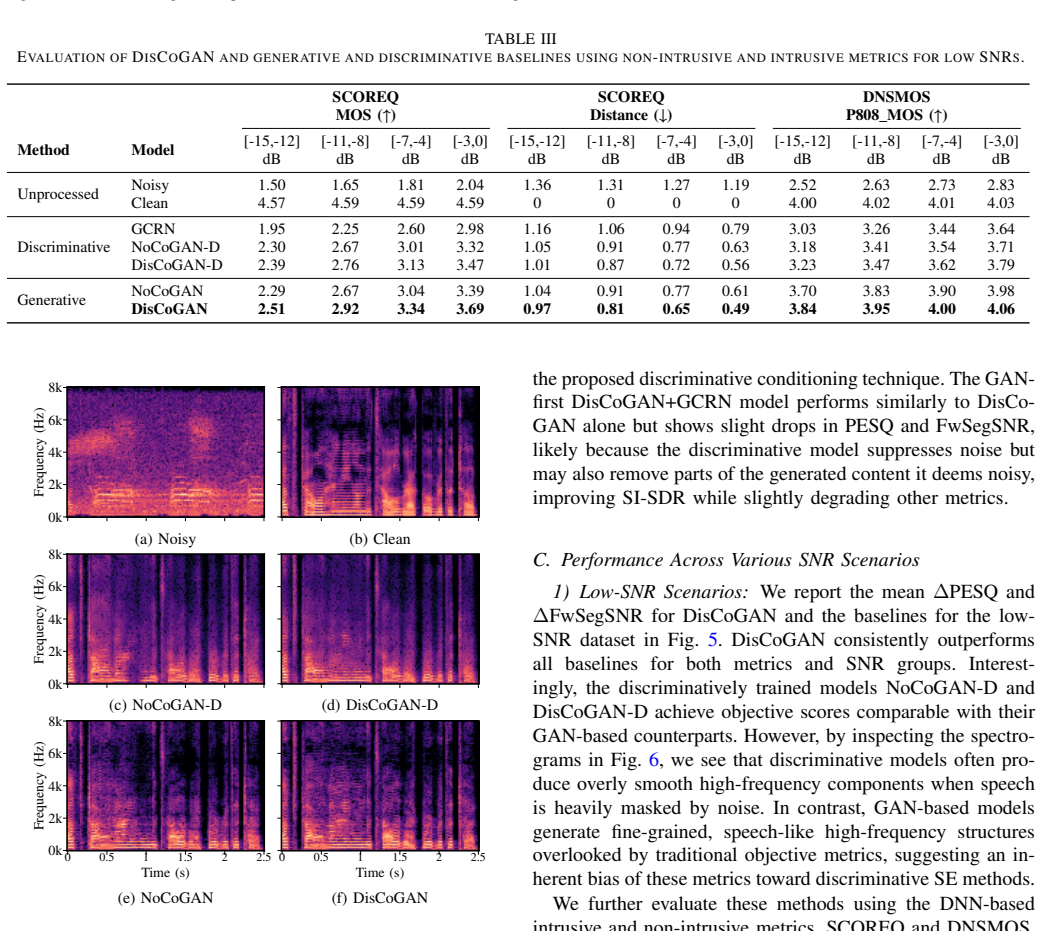
- The results expose a limitation of DNN-based quality metrics in generative SE, since GAN output can score at or above the clean reference on DNSMOS and SCOREQ.
Reading between the lines
- The same frozen-encoder conditioning idea could be dropped into diffusion- or flow-based speech enhancement generators, where low-SNR reconstruction is also hard; the paper only tests GANs.
- The correlation analysis suggests D_L encodes a usable SNR and noise-state signal; one could train the conditioning model to make that explicit and use it to gate generator strength.
- In a deployed streaming system, the 20-frame lookahead plus tolerance to causal shifts means the discriminative encoder could run on a delayed, lower-rate feature stream to save compute.
- The metric-leniency finding implies objective SE benchmarks should include human ratings or calibrated metrics before claiming perceptual gains at high SNR.
Editorial analysis
A structured set of objections, weighed in public.
Referee Report
Summary. The paper proposes DisCoGAN, a GAN-based speech enhancement method that conditions the generator on latent features extracted from a frozen discriminative speech enhancement encoder. The generator uses a time-frequency SEANet-style architecture with FiLM conditioning and a masked multi-head attention mechanism that injects the discriminative latent representation. The authors compare DisCoGAN against end-to-end GANs, GAN-first and GAN-last two-stage systems, discriminative baselines, and diffusion baselines on synthetic low-SNR data, VB-DMD, DNS non-reverberant data, and DNS real recordings, using intrusive metrics, DNSMOS/SCOREQ, ASR word/character error rates, and a MUSHRA-style listening test. Ablations address the contribution of discriminative conditioning, FiLM conditioning, and skip connections, as well as robustness to conditioning SNR mismatch and temporal misalignment. The central empirical claim is that discriminative latent conditioning improves GAN-based enhancement in very low SNR conditions while remaining competitive or superior at higher SNRs and on real data.
Significance. If scoped properly, the contribution is useful: the idea of using frozen discriminative latent features as a generic conditioning signal for a GAN generator is plausible, and the E2E DisCoGAN control in Sec. VI-A is a strong experimental design that helps rule out the explanation that gains come simply from added encoder complexity. The comparison across E2E, GAN-first, GAN-last, and discriminative architectures under a common low-SNR testbed is also valuable, as is the temporal-misalignment analysis in Sec. VI-F3. However, the paper's headline claim that DisCoGAN 'consistently outperforms existing methods' is contradicted by the paper's own reported results in Tables IV, VI, and VII. The central mechanism is not invalidated, but the claims must be scoped and the empirical support needs statistical substantiation before the results can be taken at face value.
major comments (3)
- [Abstract; Sec. I; Sec. VI-C1, Table IV] The unconditional claim that DisCoGAN 'consistently outperforms existing methods' is contradicted by the paper's own results. In Table IV, at the [-15,-12] dB SNR group, DisCoGAN has WER/CER 104/96, worse than the discriminative NoCoGAN-D (87/75) and DisCoGAN-D (91/82); the text itself concedes that 'discriminative models outperform generative ones' in this regime. In Table VI, DisCoGAN trained on VB-DMD has PESQ 3.08, below MetricGAN+ (3.13). In Table VII, DisCoGAN scores 3.32 SIG and 2.98 OVRL, below SGMSE+ (3.42 and 3.04). The abstract and introduction must be revised to scope the claim to the specific metrics and conditions where the advantage holds, e.g., low-SNR PESQ/FwSegSNR/DNSMOS/SCOREQ and 'competitive or superior' elsewhere. As written, the central takeaway misrepresents the paper's own evidence.
- [Sec. V-C, Sec. VI-E, Tables II-III, Fig. 7] All objective results are reported as point means without error bars, confidence intervals, or significance tests. For example, Table II reports mean PESQ improvements of 1.22 (DisCoGAN) vs 1.18 (DisCoGAN+GCRN), and Table VI reports PESQ 3.08 vs 2.93 for SGMSE+; without variance or paired tests, it is not possible to determine whether these differences are reliable. The listening test (Sec. VI-E, Fig. 7) uses only 12 low-SNR examples and 14 participants, and no statistical test is reported despite overlapping confidence intervals being visually plausible. Given that the central contribution is empirical, the authors should report at least standard errors and, for key comparisons, appropriate significance tests or effect sizes. This is load-bearing for the 'consistently outperforms' claim.
- [Sec. V-C, Sec. VI-C1, Table V; Sec. VI-D, Table VII] The paper's real-world and high-SNR superiority claims rely heavily on DNN-based non-intrusive metrics, DNSMOS and SCOREQ, which the paper itself shows can rate GAN output above the clean reference (e.g., DNSMOS 4.12 vs 4.01 for clean speech in Sec. VI-C1, and DNSMOS 4.06 vs 4.03 in Table III). This raises the possibility that the claimed advantages on real recordings and high-SNR conditions reflect metric bias toward hallucinated high-frequency content rather than audible improvement. Since the listening test covers only low-SNR examples, the real-recording and high-SNR claims need either human evaluation on those conditions or additional analysis of hallucination/distortion. This is a correctness-risk concern, not a claim that the results are wrong.
minor comments (5)
- [Sec. IV-A3, Eq. (14)] The notation for the block-diagonal projection is confusing: Wd is stated as blockdiag(Wd,...,Wd) in R^{T dd x T dg} and Bd in R^{T dg}, but then the text says 'for simplicity, we assume T=1'. Please rewrite with clear dimensions and avoid using T both as time length and as a matrix-shaping placeholder.
- [References] References [70] and [72] appear to be the same paper (Welker, Richter, and Gerkmann, 'Speech enhancement with score-based generative models in the complex STFT domain', INTERSPEECH 2022). Please consolidate the duplicate.
- [Sec. VI-C1] The phrase 'at very low SNRs (−10 dB)' is imprecise: the evaluation uses SNR groups such as [−15,−12] dB. Please specify the group or state 'below about −10 dB' for clarity.
- [Sec. VI-A, Fig. 4] Minor typos: 'extraced' in the Fig. 4 caption and 'halucinated content' in Sec. VI-C1 should be corrected.
- [Sec. VI-A] The sentence 'The DCCRN model outperforms other discriminative models with PESQ improvements of 0.88, 0.71, 0.55, and 0.40 across decreasing SNR intervals' is ambiguous: it is not clear whether these numbers are DisCoGAN(DCCRN) improvements or DCCRN baseline improvements. Please clarify.
Circularity Check
No meaningful circularity; the central DisCoGAN result is an externally benchmarked empirical comparison.
full rationale
The paper is empirical rather than derivational. The proposed method is defined by s_hat = G_theta(x, D_L) with D_L taken from a frozen pretrained discriminative encoder, and the training losses in Eqs. (4)-(10) are standard reconstruction, adversarial, and feature-matching losses. No equation in the paper reduces to a fitted value or to the target metric by construction. The conditioning features are extracted from discriminative models trained on a low-SNR training set, but the main low-SNR evaluation uses different noises (ESC-50) and the VB-DMD and DNS tests use unseen speakers/conditions, so the comparison is not a re-test of the training fit. The comparison against E2E DisCoGAN (GCRN), where the encoder is trained from scratch jointly with the generator, is a genuine control rather than a circular step. Self-citations [16] and [37] motivate the approach and the hypothesis that two-stage methods are suboptimal at very low SNR, but the central claim is supported by benchmark tables, ablation results, and a listening test, not by those citations alone. The paper's own tables contradict the broad 'consistently outperforms' phrasing in specific cells (WER at [-15,-12] dB, VB-DMD PESQ, real-recording SIG/OVRL), but that is a correctness/scoping issue, not circularity. The text also explicitly flags metric leniency for DNSMOS/SCOREQ and possible ASR hallucination effects, which are honest limitations. No load-bearing argument reduces to its own inputs or to an unverified self-citation chain.
Assumptions & free parameters
free parameters (4)
- Loss weights lambda_t, lambda_f, lambda_adv, lambda_feat =
1.0, 1.0, 1/9, 100/9
- Attention lookahead L =
20 frames
- Generator STFT resolution =
FFT 512, window 512, hop 160
- Generative latent dimension d_g =
128
assumptions (4)
- domain assumption Additive signal model x = s + v
- domain assumption Bottleneck features of a discriminative SE model trained on low-SNR data are informative conditioning for a GAN
- domain assumption Objective metrics (PESQ, DNSMOS, SCOREQ, SI-SDR) are valid proxies for perceptual quality
- domain assumption Training on DNS Challenge mixtures transfers to the curated ESC-50 low-SNR test set
Cite this review
Pith. "Pith review of Leveraging Discriminative Latent Representations for Conditioning GAN-Based Speech Enhancement." pith.science (2026). https://pith.science/paper/KK35C6OR
@misc{pith2026250820859,
  author       = {Pith},
  title        = {Pith review of: Leveraging Discriminative Latent Representations for Conditioning GAN-Based Speech Enhancement},
  year         = {2026},
  howpublished = {\url{https://pith.science/paper/KK35C6OR}},
  note         = {Machine review of arXiv:2508.20859}
}
read the original abstract
Generative speech enhancement methods based on generative adversarial networks (GANs) and diffusion models have shown promising results in various speech enhancement tasks. However, their performance in very low signal-to-noise ratio (SNR) scenarios remains under-explored and limited, as these conditions pose significant challenges to both discriminative and generative state-of-the-art methods. To address this, we propose a method that leverages latent features extracted from discriminative speech enhancement models as generic conditioning features to improve GAN-based speech enhancement. The proposed method, referred to as DisCoGAN, demonstrates performance improvements over baseline models, particularly in low-SNR scenarios, while also maintaining competitive or superior performance in high-SNR conditions and on real-world recordings. We also conduct a comprehensive evaluation of conventional GAN-based architectures, including GANs trained end-to-end, GANs as a first processing stage, and post-filtering GANs, as well as discriminative models under low-SNR conditions. We show that DisCoGAN consistently outperforms existing methods. Finally, we present an ablation study that investigates the contributions of individual components within DisCoGAN and analyzes the impact of the discriminative conditioning method on overall performance.
Figures


Figures from the paper (5 more)




Reference graph
Works this paper leans on
-
[1]
Suppression of acoustic noise in speech using spectral subtraction,
S. Boll, “Suppression of acoustic noise in speech using spectral subtraction,” IEEE Trans. Acoust., Speech, Signal Process. , vol. 27, pp. 113–120, 2003
work page 2003
-
[2]
K. Paliwal, B. Schwerin, and K. W ´ojcicki, “Speech enhancement using a minimum mean-square error short-time spectral modulation magnitude estimator,” Speech Commun., vol. 54, pp. 282–305, 2012
work page 2012
-
[3]
Noise spectrum estimation in adverse environments: Im- proved minima controlled recursive averaging,
I. Cohen, “Noise spectrum estimation in adverse environments: Im- proved minima controlled recursive averaging,” IEEE Trans. Audio, Speech, Language Process., vol. 11, pp. 466–475, 2003
work page 2003
-
[4]
Speech enhancement for non-stationary noise environments,
I. Cohen and B. Berdugo, “Speech enhancement for non-stationary noise environments,” Signal Process., vol. 81, pp. 2403–2418, 2001
work page 2001
-
[5]
DCCRN: Deep complex convolution recurrent network for phase-aware speech enhancement,
Y . Hu, Y . Liu, S. Lv, M. Xing, S. Zhang, Y . Fu, J. Wu, B. Zhang, and L. Xie, “DCCRN: Deep complex convolution recurrent network for phase-aware speech enhancement,” in Proc. INTERSPEECH, 2021
work page 2021
-
[6]
A mask free neural network for monaural speech enhancement,
L. Liu, H. Guan, J. Ma, W. Dai, G. Wang, and S. Ding, “A mask free neural network for monaural speech enhancement,” in Proc. INTERSPEECH, 2023
work page 2023
-
[7]
DeepFil- ternet2: Towards real-time speech enhancement on embedded devices for full-band audio,
H. Schr ¨oter, A. Maier, A. N. Escalante-B., and T. Rosenkranz, “DeepFil- ternet2: Towards real-time speech enhancement on embedded devices for full-band audio,” in Proc. Int. Workshop Acoust. Signal Enhanc. , 2022
work page 2022
-
[8]
Real-time denoising and dereverberation with tiny recurrent U-Net,
H.-S. Choi, S. Park, J. H. Lee, H. Heo, D. Jeon, and K. Lee, “Real-time denoising and dereverberation with tiny recurrent U-Net,” in Proc. IEEE Int. Conf. Acoust., Speech, Signal Process. , 2021
work page 2021
Show all 72 references
-
[9]
FRCRN: Boosting feature representation using frequency recurrence for monaural speech enhancement,
S. Zhao, B. Ma, K. N. Watcharasupat, and W.-S. Gan, “FRCRN: Boosting feature representation using frequency recurrence for monaural speech enhancement,” in Proc. IEEE Int. Conf. Acoust., Speech, Signal Process., 2022
2022
-
[10]
Ultra low complexity deep learning based noise suppression,
S. S. Shetu, S. Chakrabarty, O. Thiergart, and E. Mabande, “Ultra low complexity deep learning based noise suppression,” in Proc. IEEE Int. Conf. Acoust., Speech, Signal Process. , 2024
2024
-
[11]
Supervised speech separation based on deep learning: An overview,
D. Wang and J. Chen, “Supervised speech separation based on deep learning: An overview,” IEEE/ACM Trans. Audio, Speech, Language Process., vol. 26, pp. 1702–1726, 2018
2018
-
[12]
Tasnet: time-domain audio separation network for real-time, single-channel speech separation,
Y . Luo and N. Mesgarani, “Tasnet: time-domain audio separation network for real-time, single-channel speech separation,” in Proc. IEEE Int. Conf. Acoust., Speech, Signal Process. , 2018
2018
-
[13]
The InterSpeech 2020 deep noise suppression challenge: Datasets, subjective testing framework, and challenge results,
C. K. A. Reddy, V . Gopal, R. Cutler, E. Beyrami, R. Cheng, H. Dubey, S. Matusevych, R. Aichner, A. Aazami, S. Braun, et al., “The InterSpeech 2020 deep noise suppression challenge: Datasets, subjective testing framework, and challenge results,” in Proc. INTERSPEECH , 2020
2020
-
[14]
Investigat- ing RNN-based speech enhancement methods for noise-robust text-to- speech,
C. V . Botinhao, X. Wang, S. Takaki, and J. Yamagishi, “Investigat- ing RNN-based speech enhancement methods for noise-robust text-to- speech,” in Proc. INTERSPEECH, 2016
2016
-
[15]
Masking and inpainting: A two-stage speech enhancement approach for low SNR and non-stationary noise,
X. Hao, X. Su, S. Wen, Z. Wang, Y . Pan, F. Bao, and W. Chen, “Masking and inpainting: A two-stage speech enhancement approach for low SNR and non-stationary noise,” in Proc. IEEE Int. Conf. Acoust., Speech, Signal Process., 2020
2020
-
[16]
Comparative analysis of discriminative deep learning-based noise reduction methods in low SNR scenarios,
S. S. Shetu, E. A. P. Habets, and A. Brendel, “Comparative analysis of discriminative deep learning-based noise reduction methods in low SNR scenarios,” in Proc. Int. Workshop Acoust. Signal Enhanc. , 2024, pp. 36–40
2024
-
[17]
SEGAN: Speech enhancement generative adversarial network,
S. Pascual, A. Bonafonte, and J. Serra, “SEGAN: Speech enhancement generative adversarial network,” in Proc. INTERSPEECH, 2017
2017
-
[18]
MetricGAN+: An improved version of MetricGAN for speech enhancement,
S.-W. Fu, C. Yu, T. Hsieh, P. Plantinga, M. Ravanelli, X. Lu, and Y . Tsao, “MetricGAN+: An improved version of MetricGAN for speech enhancement,” in Proc. INTERSPEECH, 2021
2021
-
[19]
CMGAN: Conformer-based metric GAN for speech enhancement,
R. Cao, S. Abdulatif, and B. Yang, “CMGAN: Conformer-based metric GAN for speech enhancement,” in Proc. INTERSPEECH, 2022
2022
-
[20]
SEFGAN: Harvesting the power of normalizing flows and GANs for efficient high-quality speech enhancement,
M. Strauss, N. Pia, N. K. S. Rao, and B. Edler, “SEFGAN: Harvesting the power of normalizing flows and GANs for efficient high-quality speech enhancement,” in Proc. IEEE Workshop Appl. Signal Process. Audio Acoust., 2023
2023
-
[21]
TFDense-GAN: a generative adversarial network for single-channel speech enhancement,
H. Chen, J. Zhang, Y . Fu, X. Zhou, R. Wang, Y . Xu, and D. Ke, “TFDense-GAN: a generative adversarial network for single-channel speech enhancement,” EURASIP J. Adv. Signal Process. , vol. 2025, pp. 10, 2025
2025
-
[22]
A comprehensive review on generative models for speech enhancement,
N. Elgiriyewithana and ND Kodikara, “A comprehensive review on generative models for speech enhancement,” in Proc. Int. Conf. Robot. Autom. Artif. Intell. , 2024, pp. 236–252
2024
-
[23]
Speech enhancement and dereverberation with diffusion-based genera- tive models,
J. Richter, S. Welker, J.-M. Lemercier, B. Lay, and T. Gerkmann, “Speech enhancement and dereverberation with diffusion-based genera- tive models,” IEEE/ACM Trans. Audio, Speech, Language Process. , pp. 2351–2364, 2023
2023
-
[24]
Conditional diffusion probabilistic model for speech enhancement,
Y .-J. Lu, Z.-Q. Wang, S. Watanabe, A. Richard, C. Yu, and Y . Tsao, “Conditional diffusion probabilistic model for speech enhancement,” in Proc. IEEE Int. Conf. Acoust., Speech, Signal Process. , 2022
2022
-
[25]
StoRM: A diffusion-based stochastic regeneration model for speech enhancement and dereverberation,
J.-M. Lemercier, J. Richter, S. Welker, and T. Gerkmann, “StoRM: A diffusion-based stochastic regeneration model for speech enhancement and dereverberation,” IEEE/ACM Trans. Audio, Speech, Language Process., vol. 31, pp. 2724–2737, 2023
2023
-
[26]
Cold diffusion for speech enhancement,
H. Yen, F. Germain, G. Wichern, and J. Le Roux, “Cold diffusion for speech enhancement,” in Proc. IEEE Int. Conf. Acoust., Speech, Signal Process., 2023, pp. 1–5
2023
-
[27]
Conditional latent diffusion-based speech enhancement via dual context learning,
S. Zhao, Z. Pan, K. Zhou, Y . Ma, C. Zhang, and B. Ma, “Conditional latent diffusion-based speech enhancement via dual context learning,” in Proc. IEEE Int. Conf. Acoust., Speech, Signal Process. , 2025
2025
-
[28]
Universal score- based speech enhancement with high content preservation,
R. Scheibler, Y . Fujita, Y . Shirahata, and T. Komatsu, “Universal score- based speech enhancement with high content preservation,” in Proc. INTERSPEECH, 2024, pp. 1165–1169
2024
-
[29]
Cross-domain diffusion based speech enhance- ment for very noisy speech,
H. Wang and D. Wang, “Cross-domain diffusion based speech enhance- ment for very noisy speech,” in Proc. IEEE Int. Conf. Acoust., Speech, Signal Process., 2023, pp. 1–5
2023
-
[30]
ICASSP 2024 speech signal improvement challenge,
N.-C. Ristea, A. Saabas, R. Cutler, B. Naderi, S. Braun, and S. Branets, “ICASSP 2024 speech signal improvement challenge,” in Proc. IEEE Int. Conf. Acoust., Speech, Signal Process. , 2024
2024
-
[31]
General speech restoration using two-stage generative adversarial networks,
Q. Hu, T. Tan, M. Tang, Y . Hu, C. Zhu, and J. Lu, “General speech restoration using two-stage generative adversarial networks,” in Proc. IEEE Int. Conf. Acoust., Speech, Signal Process. , 2024
2024
-
[32]
KS-Net: Multi-band joint speech restoration and enhancement network,
G. Yu, R. Han, C. Xu, H. Zhao, N. Li, C. Zhang, X. Zheng, C. Zhou, Q. Huang, and B. Yu, “KS-Net: Multi-band joint speech restoration and enhancement network,” in Proc. IEEE Int. Conf. Acoust., Speech, Signal Process., 2024
2024
-
[33]
Renet: A time-frequency domain general speech restoration network,
F. Hao, H. Zhang, L. Dai, X. Luo, X. Li, and C. Zheng, “Renet: A time-frequency domain general speech restoration network,” in Proc. IEEE Int. Conf. Acoust., Speech, Signal Process. , 2024. 13
2024
-
[34]
Generative adversarial network-based postfilter for STFT spectrograms,
T. Kaneko, S. Takaki, H. Kameoka, and J. Yamagishi, “Generative adversarial network-based postfilter for STFT spectrograms,” in Proc. INTERSPEECH, 2017
2017
-
[35]
PostGAN: A gan-based post-processor to enhance the quality of coded speech,
S. Korse, N. Pia, K. Gupta, and G. Fuchs, “PostGAN: A gan-based post-processor to enhance the quality of coded speech,” in Proc. IEEE Int. Conf. Acoust., Speech, Signal Process. , 2022, pp. 831–835
2022
-
[36]
DeepFilterGAN: A full-band real-time speech enhancement system with GAN-based stochastic regeneration,
S. Serbest, T. Stojkovic, M. Cernak, and A. Harper, “DeepFilterGAN: A full-band real-time speech enhancement system with GAN-based stochastic regeneration,” arXiv preprint arXiv:2505.23515 , 2025
2025 arXiv
-
[37]
GAN-based speech enhancement for low SNR using latent feature conditioning,
S. S. Shetu, E. A. P. Habets, and A. Brendel, “GAN-based speech enhancement for low SNR using latent feature conditioning,” in Proc. IEEE Int. Conf. Acoust., Speech, Signal Process. , 2025, pp. 1–5
2025
-
[38]
SEANet: A multi- modal speech enhancement network,
M. Tagliasacchi, Y . Li, K. Misiunas, and D. Roblek, “SEANet: A multi- modal speech enhancement network,” in Proc. INTERSPEECH, 2020
2020
-
[39]
FunCodec: A fundamental, reproducible and integrable open-source toolkit for neural speech codec,
Z. Du, S. Zhang, K. Hu, and S. Zheng, “FunCodec: A fundamental, reproducible and integrable open-source toolkit for neural speech codec,” in Proc. IEEE Int. Conf. Acoust., Speech, Signal Process. , 2023
2023
-
[40]
Image-to-image translation with conditional adversarial networks,
P. Isola, J.-Y . Zhu, T. Zhou, and A. A Efros, “Image-to-image translation with conditional adversarial networks,” in Proc. IEEE Conf. Comput. Vis. Pattern Recognit., 2017, pp. 1125–1134
2017
-
[41]
MetricGAN: Generative adversarial networks based black-box metric scores optimization for speech enhancement,
S.-W. Fu, C.-F. Liao, Y . Tsao, and S.-D. Lin, “MetricGAN: Generative adversarial networks based black-box metric scores optimization for speech enhancement,” in Proc. Int. Conf. Mach. Learn. (ICML) , 2019, pp. 2031–2041
2019
-
[42]
Generative adversarial network-based postfilter for sta- tistical parametric speech synthesis,
T. Kaneko, H. Kameoka, N. Hojo, Y . Ijima, K. Hiramatsu, and K. Kashino, “Generative adversarial network-based postfilter for sta- tistical parametric speech synthesis,” in Proc. IEEE Int. Conf. Acoust., Speech, Signal Process. , 2017, pp. 4910–4914
2017
-
[43]
Improving the naturalness of synthesized spectrograms for TTS using ganbased post-processing,
P. Sani, J. Bauer, F. Zalkow, E. A. P. Habets, and C. Dittmar, “Improving the naturalness of synthesized spectrograms for TTS using ganbased post-processing,” in Proc. ITG Speech Commun. Conf. , 2023
2023
-
[44]
Goodfellow, Y
I. Goodfellow, Y . Bengio, and A. Courville, Deep learning, vol. 1, MIT press Cambridge, 2016
2016
-
[45]
FiLM: Visual reasoning with a general conditioning layer,
E. Perez, F. Strub, H. de Vries, V . Dumoulin, and A. Courville, “FiLM: Visual reasoning with a general conditioning layer,” in Proc. AAAI Conf. Artif. Intell., 2018
2018
-
[46]
S. C. Chapra, R. P. Canale, et al., Numerical methods for engineers , vol. 1221, Mcgraw-hill New York, 2011
2011
-
[47]
Attention is all you need,
A. Vaswani, “Attention is all you need,” in Proc. Adv. Neural Inf. Process. Syst., 2017
2017
-
[48]
Densely connected neural network with dilated convolutions for real-time speech enhancement in the time domain,
A. Pandey and D. Wang, “Densely connected neural network with dilated convolutions for real-time speech enhancement in the time domain,” in Proc. IEEE Int. Conf. Acoust., Speech, Signal Process. , 2020
2020
-
[49]
Taylor, can you hear me now? a Taylor-unfolding framework for monaural speech enhancement,
A. Li, S. You, G. Yu, C. Zheng, and X. Li, “Taylor, can you hear me now? a Taylor-unfolding framework for monaural speech enhancement,” in Proc. Int. Joint Conf. Artif. Intell. , 2022
2022
-
[50]
Learning complex spectral mapping with gated convolutional recurrent networks for monaural speech enhancement,
K. Tan and D. Wang, “Learning complex spectral mapping with gated convolutional recurrent networks for monaural speech enhancement,” IEEE/ACM Trans. Audio, Speech, Language Process. , vol. 28, pp. 380– 390, 2019
2019
-
[51]
Conditional image generation with pixelcnn decoders,
A. Van den Oord, N. Kalchbrenner, L. Espeholt, O. Vinyals, A. Graves, et al., “Conditional image generation with pixelcnn decoders,” in Proc. Adv. Neural Inf. Process. Syst. , 2016
2016
-
[52]
High fidelity neural audio compression,
A. D ´efoss´ez, J. Copet, G. Synnaeve, and Y . Adi, “High fidelity neural audio compression,” Trans. Mach. Learn. Res. , 2023
2023
-
[53]
The diverse environments multi- channel acoustic noise database (demand): A database of multichannel environmental noise recordings,
J. Thiemann, N. Ito, and E. Vincent, “The diverse environments multi- channel acoustic noise database (demand): A database of multichannel environmental noise recordings,” in Proc. Meet. Acoust. , 2013
2013
-
[54]
ESC: Dataset for environmental sound classification,
K. J. Piczak, “ESC: Dataset for environmental sound classification,” in Proc. ACM Int. Conf. Multimedia , 2015
2015
-
[55]
A pitch tracking corpus with evaluation on multipitch tracking scenario,
G. Pirker, M. Wohlmayr, S. Petrik, and F. Pernkopf, “A pitch tracking corpus with evaluation on multipitch tracking scenario,” in Proc. INTERSPEECH, 2011
2011
-
[56]
Perceptual evaluation of speech quality (PESQ)-a new method for speech quality assessment of telephone networks and codecs,
A. W. Rix, J. G. Beerends, M. P. Hollier, and A. P. Hekstra, “Perceptual evaluation of speech quality (PESQ)-a new method for speech quality assessment of telephone networks and codecs,” in Proc. IEEE Int. Conf. Acoust., Speech, Signal Process. , 2001
2001
-
[57]
Objective measures for predicting speech intelligibility in noisy conditions based on new band-importance functions,
J. Ma, Y . Hu, and P. C. Loizou, “Objective measures for predicting speech intelligibility in noisy conditions based on new band-importance functions,” J. Acoust. Soc. Am. , vol. 125, pp. 3387–3405, 2009
2009
-
[58]
SDR–half- baked or well done?,
J. Le Roux, S. Wisdom, H. Erdogan, and J. R. Hershey, “SDR–half- baked or well done?,” in Proc. IEEE Int. Conf. Acoust., Speech, Signal Process., 2019
2019
-
[59]
Robust speech recognition via large-scale weak supervi- sion,
A. Radford, J. W. Kim, T. Xu, G. Brockman, C. McLeavey, and I. Sutskever, “Robust speech recognition via large-scale weak supervi- sion,” in Proc. Int. Conf. Mach. Learn. (ICML), 2023, pp. 28492–28518
2023
-
[60]
From WER and RIL to MER and WIL: Improved evaluation measures for connected speech recognition.,
A. C. Morris, V . Maier, and P. D. Green, “From WER and RIL to MER and WIL: Improved evaluation measures for connected speech recognition.,” in Proc. INTERSPEECH, 2004
2004
-
[61]
DNSMOS: A non-intrusive perceptual objective speech quality metric to evaluate noise suppressors,
C. K. A. Reddy, V . Gopal, and R. Cutler, “DNSMOS: A non-intrusive perceptual objective speech quality metric to evaluate noise suppressors,” in Proc. IEEE Int. Conf. Acoust., Speech, Signal Process. , 2021
2021
-
[62]
An open source implementation of ITU-T recommendation p. 808 with validation,
B. Naderi and R. Cutler, “An open source implementation of ITU-T recommendation p. 808 with validation,” Proc. INTERSPEECH, 2020
2020
-
[63]
DNSMOS P. 835: A non- intrusive perceptual objective speech quality metric to evaluate noise suppressors,
C. K. A. Reddy, V . Gopal, and R. Cutler, “DNSMOS P. 835: A non- intrusive perceptual objective speech quality metric to evaluate noise suppressors,” in Proc. IEEE Int. Conf. Acoust., Speech, Signal Process. , 2022
2022
-
[64]
P. 835: Subjective test methodology for evaluating speech communication systems that include noise suppression algorithm,
ITU-T, “P. 835: Subjective test methodology for evaluating speech communication systems that include noise suppression algorithm,” ITU, Geneva, 2003
2003
-
[65]
SCOREQ: Speech quality assessment with contrastive regression,
A. Ragano, J. Skoglund, and A. Hines, “SCOREQ: Speech quality assessment with contrastive regression,” Proc. Adv. Neural Inf. Process. Syst., 2024
2024
-
[66]
Evaluation of objective quality measures for speech enhancement,
Y . Hu and P. C. Loizou, “Evaluation of objective quality measures for speech enhancement,” IEEE Trans. Audio, Speech, Language Process. , vol. 16, pp. 229–238, 2008
2008
-
[67]
Method for the subjective assessment of intermediate quality level of audio systems,
ITU-R, “Method for the subjective assessment of intermediate quality level of audio systems,” ITU, Geneva, vol. 2, 2014
2014
-
[68]
webMUSHRA—a comprehensive framework for web-based listening tests,
M. Schoeffler, S. Bartoschek, F.-R. St ¨oter, M. Roess, S. Westphal, B. Edler, and J. Herre, “webMUSHRA—a comprehensive framework for web-based listening tests,” J. Open Res. Softw. , vol. 6, 2018
2018
-
[69]
HiFi-GAN: High-fidelity denoising and dereverberation based on speech deep features in adversarial net- works,
J. Su, Z. Jin, and A. Finkelstein, “HiFi-GAN: High-fidelity denoising and dereverberation based on speech deep features in adversarial net- works,” Proc. INTERSPEECH, 2020
2020
-
[70]
Speech enhancement with score-based generative models in the complex STFT domain,
S. Welker, J. Richter, and T. Gerkmann, “Speech enhancement with score-based generative models in the complex STFT domain,” Proc. INTERSPEECH, 2022
2022
-
[71]
A recurrent variational autoencoder for speech enhancement,
S. Leglaive, X. Alameda-Pineda, L. Girin, and R. Horaud, “A recurrent variational autoencoder for speech enhancement,” in Proc. IEEE Int. Conf. Acoust., Speech, Signal Process. , 2020
2020
-
[72]
Speech enhancement with score-based generative models in the complex STFT domain,
S. Welker, J. Richter, and T. Gerkmann, “Speech enhancement with score-based generative models in the complex STFT domain,” in Proc. INTERSPEECH, 2022, pp. 2928–2932
2022
Reviewed August 5, 2026 · model on record in the stance chip above.
Discussion (0). Continue with ORCID to comment.