REVIEW 4 major objections 5 minor 1 cited by
Sublinear Morse Geodesics and First Passage Percolation
T0 review · 4 major / 5 minor · reviewed 2026-08-06 · deepseek-v4-flash
Pith's one-line read A sublinearly Morse geodesic line guarantees a bi-infinite geodesic after random edge percolation.
desk verdict The claimed generalization of BT17 is plausible and the middle-recurrence section is a useful new tool, but the proof of the main theorem has a load-bearing gap in the upper-bound estimate that needs to be fixed before the result is established. read the letter →
The pith
A machine-rendered reading of the paper's core claim, the machinery that carries it, and where it could break.
The reading
What carries the argument
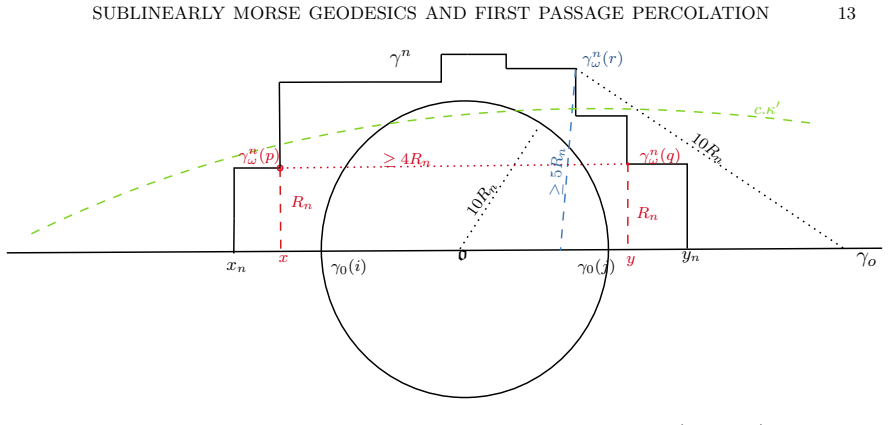
The load-bearing object is the middle-recurrence property of sublinearly Morse geodesic lines. A line is middle recurrent if any path whose endpoints lie on the line and whose length is at most $C$ times the endpoint distance must pass through a sublinear neighborhood of the middle third of the segment of the line between its endpoints. Proposition 3.5 proves that sublinearly Morse lines have this property, and Lemma 3.7 converts it into a superlinear lower bound on the length of any quasi-geodesic that runs outside a growing linear neighborhood of the line. That divergence estimate is what contradicts the almost sure linear upper and lower bounds for passage times of long paths, forcing the random geodesics to stay in a bounded set.
What would settle it
Find an infinite bounded-degree graph with a sublinearly Morse bi-infinite geodesic line and a sequence of paths whose endpoints lie on the line, whose length is at most $C$ times the endpoint distance, and which stay outside every sublinear neighborhood of the middle third of the line segment; this would refute Proposition 3.5 and remove the engine of Theorem A's proof. A finite computation on a candidate graph could search for such paths.
Extended reading notes
Core claim
The central claim is Theorem A: for an infinite connected bounded-degree graph $X$ and i.i.d. edge weights with $\mathbb{E}\omega_e < \infty$ and $\nu(\{0\})=0$, if $X$ contains a sublinearly Morse bi-infinite quasi-geodesic line, then for almost every $\omega$ there is a bi-infinite geodesic line in $X_\omega$. The proof actually produces the line within a finite distance of the basepoint, with the distance depending on the environment. This is established by taking $\omega$-geodesics between pairs of points on the initial line at distance $n$ on either side of the basepoint, showing these random geodesics cannot escape to infinity because their $\omega$-length would then have to grow both at least as fast as a superlinear function of $n$ and at most linearly in $n$; the contradiction forces them to accumulate, and Arzelà–Ascoli yields the limiting bi-infinite geodesic.
Load-bearing premise
The proof of the middle-recurrence proposition assumes, without proof, that in the contradiction setup the distances from the basepoint to the two endpoints of each escaping path grow at comparable linear rates; if that fails, the estimates that produce the contradiction no longer follow.
Editorial extensions
If this is right
- If the theorem is correct, any infinite bounded-degree graph with a sublinearly Morse bi-infinite line has an almost-sure bi-infinite geodesic in every i.i.d. positive weight environment with finite mean and no zero atom.
- The bi-infinite geodesic can be chosen to lie within a bounded distance of the original basepoint, so it is produced by a compactness limit rather than by following the original line.
- This extends the earlier result for Morse quasi-geodesic lines to the strictly larger class of sublinearly Morse lines, for which the tracking neighborhood may grow sublinearly rather than remain bounded.
- The middle-recurrence lemma gives a new characterization of sublinearly Morse lines that is available for first passage percolation arguments.
Reading between the lines
- The authors leave open whether the exhibited bi-infinite geodesic can itself be chosen sublinearly Morse in the random metric; that preservation is not established here.
- If the middle-recurrence and divergence pair is the real mechanism, then other geometric conditions that imply the same pair would also yield bi-infinite geodesics under first passage percolation, so the conclusion may extend beyond sublinearly Morse lines.
- One could test the theorem's sharpness by looking for a graph with no sublinearly Morse bi-infinite geodesic but where first passage percolation still almost surely has one; the paper gives no evidence either way.
Editorial analysis
A structured set of objections, weighed in public.
Referee Report
Summary. The paper studies first passage percolation on infinite bounded-degree graphs. Theorem A asserts that if the underlying graph contains a sublinearly Morse bi-infinite quasi-geodesic line, then almost surely the random weighted graph admits a bi-infinite geodesic, and moreover this geodesic lies at uniformly bounded random distance from the basepoint. The proof follows the strategy of Benjamini--Tessera: establish a 'middle recurrence' property for sublinearly Morse lines (Proposition 3.5), derive a superlinear divergence estimate for paths leaving a neighborhood of the line (Lemma 3.7), and then take limits of finite geodesic segments between pairs of points on the line (Theorem 3.8).
Significance. If the proof can be completed, the result is a natural and valuable generalization of Benjamini--Tessera's theorem from Morse geodesics to sublinearly Morse geodesics, and it would further demonstrate the usefulness of the sublinear Morse boundary framework. The paper is clearly organized and engages with recent literature. However, as written, several load-bearing steps are not justified: Proposition 3.5 relies on unproved endpoint-growth assumptions and an unstated extension of a lemma of Aougab--Durham--Taylor, and the upper bound in Theorem 3.8 uses a uniform linear estimate for random edge weights on an infinite family of varying paths that does not follow from Proposition 2.13. These gaps are substantive rather than cosmetic.
major comments (4)
- [§3, Proposition 3.5] The proof asserts two 'without loss of generality' endpoint-growth assumptions: that eventually d(e_i,o) ≥ c3 d(s_i,o), and later that d(s_i,e_i) ≥ c2 d(o,s_i). These are not consequences of the failure of middle recurrence as stated; they are structural conditions on the specific paths constructed from the contradiction hypothesis. The estimates in (4) and (5), the bound on sl(p'_i), and the later claim that d(s'_i,e'_i) grows linearly with K_i all depend on these assumptions. Without a proof that one may arrange these conditions, Proposition 3.5 is not established.
- [§3, Proposition 3.5] The proof invokes 'a slight adaptation of Lemma 3.4' of ADT17 but does not state the adapted lemma or verify its hypotheses in the sublinear setting. In particular, the original lemma concerns a path at distance at least K from a contracting geodesic whose endpoints are exactly at distance K; here the path p'_i is outside a c1-linear neighborhood and the relevant distance K_i = d(s'_i, β) is not shown to have the properties required by the adapted statement. This needs a precise formulation and proof, not a citation to an adaptation.
- [§3, Lemma 3.7] The proof contains an internal inconsistency in the choice of R. It states 'R is an integer greater than d(x,y)', but the displayed inequality in the same paragraph, 4R ≤ d(x',y') ≤ 2R + d(x,y), implies d(x,y) ≥ 2R. The subsequent bound |p| ≤ 2R + |γ| ≤ d(x,y) + C d(x,y) also uses 2R ≤ d(x,y), which contradicts the stated choice of R. This step must be repaired; if R is instead constrained by R ≤ d(x,y)/2, the later assertion that one can choose d(x,y) large enough so that R ≥ c·κ'(d(o,p_i)) needs a separate justification, since R and d(x,y) are linked by the construction.
- [§4, Theorem 3.8] The upper bound in the proof, dω(γ_n^ω(p), γ_n^ω(q)) ≤ 2bR_n + 2r0 + |γ0([i,j])|ω, is justified by 'Line 6 and Proposition 2.13'. Line 6 only records the graph distances from γ_n^ω(p) and γ_n^ω(q) to fixed points on γ0; the actual paths realizing these distances are not fixed and vary with n. Proposition 2.13(1) gives a constant r0 for each fixed self-avoiding path, but it does not give a uniform r0 over the infinite family of length-R_n spokes. With i.i.d. finite-mean but possibly unbounded edge weights, the ω-length of such spokes is not uniformly bounded by a linear function of R_n plus a constant. Without this uniform estimate, the inequality (7) does not follow, and the lower bound alone is compatible with R_n = o(n) and slowly growing φ. This is a load-bearing gap in the contradiction argument.
minor comments (5)
- [Abstract and §1] The abstract says the conclusion is a bi-infinite geodesic line, but Theorem A states a 'bi-infinite geodesic ray'; these terms should be aligned, since the proof actually produces a bi-infinite line.
- [§2.3, Proposition 2.13] In part (1), the quantifier 'for all i ≤ 0 ≤ j' is unusual; it should be clarified whether the intended statement is for all i ≤ j with the segment [i,j] containing 0, or for all pairs (i,j) with i ≤ 0 ≤ j.
- [§3, Lemma 3.9] The notation γ0((∞,i]) should be γ0((-∞,i]); as written it is confusing.
- [Throughout] The basepoint is denoted o but in several inequalities, for example in Lemma 3.9, the text writes d(x,0) instead of d(x,o); this should be fixed for consistency.
- [§4, Theorem 3.8] The invocation of the Arzelà--Ascoli theorem on a countable graph is nonstandard; a diagonal extraction or Tychonoff compactness argument would be more precise, although the intended compactness statement is clear.
Circularity Check
No significant circularity: the FPP bi-infinite geodesic conclusion is not an input to any definition or prior result.
full rationale
The derivation chain does not reduce to its inputs. Theorem A's conclusion — existence of an almost-sure bi-infinite ω-geodesic — is not assumed in the hypotheses or in the cited sublinearly Morse framework. The paper uses [BT17, Lemma 2.3, 2.5] for fixed-path linear weight bounds and [QRT23, Prop A.6, Lemma 4.2] for contracting/geodesic properties; these are prior results with stated assumptions not containing the FPP conclusion, and the fact that QRT23 shares an author does not make the support circular. The upcoming self-citation [JQ] is only mentioned as future work, not load-bearing. The apparent issues in the proof — the unconditional 'without loss of generality' scaling assumptions in Proposition 3.5 and the application of Proposition 2.13(1) to the varying R_n-spokes in Theorem 3.8 — are correctness gaps, not circular reductions: they do not turn the conclusion into the hypothesis by construction. No fitted parameter is renamed as a prediction, and no uniqueness theorem is imported to force the argument. Hence no significant circularity.
Assumptions & free parameters
assumptions (5)
- domain assumption X is an infinite connected graph of bounded degree; edge weights are i.i.d. with ν({0})=0 and finite expectation.
- domain assumption X contains a sublinearly Morse bi-infinite quasi-geodesic line.
- standard math Results of QRT23 (Prop 2.8 and Lemma 4.2(1)) are correct: κ-Morse implies κ′-weak contracting, and a sublinearly Morse quasi-geodesic line lies in a κ-neighborhood of a κ-Morse geodesic line.
- ad hoc to paper Lemma 3.4 of ADT17 extends to sublinearly contracting sets.
- ad hoc to paper The WLOG endpoint-growth assumptions in Proposition 3.5 (d(e_i,o) ≥ c3 d(s_i,o) and d(s_i,e_i) ≥ c2 d(o,s_i)) hold for the constructed paths.
Cite this review
Pith. "Pith review of Sublinear Morse Geodesics and First Passage Percolation." pith.science (2026). https://pith.science/paper/KKGL3HX4
@misc{pith2026250707859,
  author       = {Pith},
  title        = {Pith review of: Sublinear Morse Geodesics and First Passage Percolation},
  year         = {2026},
  howpublished = {\url{https://pith.science/paper/KKGL3HX4}},
  note         = {Machine review of arXiv:2507.07859}
}
read the original abstract
Given an infinite connected graph, a way to randomly perturb its metric is to assign random i.i.d. lengths to the edges of the graph. Assume that the graph is infinite and of bounded degree. Assume also strict positivity and finite expectation of the edge length distribution and existence of a sublinearly Morse bi-infinite geodesic line, we prove that almost surely there exists a bi-infinite geodesic line. This generalizes a previous result of \cite{BT17} regarding Morse geodesics.
Figures


Forward citations
Cited by 1 Pith paper
-
Random Trees in Hyperbolic FPP
Random geodesics in hyperbolic FPP coalesce near the deterministic centroid with exponentially decaying tails, giving average growth rate log λ and non-hyperbolicity of the random metric.
Reference graph
Works this paper leans on
-
[1]
J. Athreya, A. Bofetov, A. Eskin, M. Mirzakhani. Lattice Point Asymptotics and Volume Growth on space , Duke Math. J. 1616:1055--1111, 2012
work page 2012
-
[2]
G. Arzhantseva, C. Cashen, D. Gruber, and D. Hume, Characterizations of Morse quasi-geodesics via superlinear divergence and sublinear contraction , Documenta Mathematica 22 (2017), 1193--1224. comment
work page 2017
-
[3]
50 years of first passage percolation
A. Auffinger, M. Damron and J. Hanson, 50 years of first passage percolation. arXiv:1511.03262
-
[4]
Tarik Aougab, Matthew Durham and Samuel J. Taylor. Pulling back stability with applications to Out(Fn) and relatively hyperbolic groups. J. London Math. Soc. 96 (2017), no. 3, 565--583
work page 2017
- [5]
-
[6]
W. Ballmann and S. Buyalo. Periodic rank one geodesics in Hadamard spaces . Geometric and probabilistic structures in dynamics , volume 469 of Contemp. Math., pages 19--27. Amer. Math. Soc., Providence, RI, 2008
work page 2008
-
[7]
Mladen Bestvina and Koji Fujiwara. A Characterization of Higher Rank Symmetric Spaces Via Bounded Cohomology , Geometric and Functional Analysis volume 19, pages 11--40 (2009) comment
work page 2009
-
[8]
Bridson and Andr\' e H\" a fliger
Martin R. Bridson and Andr\' e H\" a fliger. Metric Spaces of Non-Positive Curvature , Springer 2009
work page 2009
Show all 78 references
-
[9]
Boundaries of hyperbolic groups , arXiv preprint math/0202286
Benakli, Nadia and Kapovich, Ilya. Boundaries of hyperbolic groups , arXiv preprint math/0202286
-
[10]
First passage percolation on hyperbolic groups , Advances in Mathematics 408 (2022) 108599
Riddhipratim Basu, Mahan Mj. First passage percolation on hyperbolic groups , Advances in Mathematics 408 (2022) 108599. comment
2022
-
[11]
CAT(-1)-Spaces, Divergence Groups and their Commensurators , Journal of the American Mathematical Society Vol
Marc Burger and Shahar Mozes. CAT(-1)-Spaces, Divergence Groups and their Commensurators , Journal of the American Mathematical Society Vol. 9, No. 1 (Jan., 1996), pp. 57--93. comment
1996
-
[12]
First passage percolation on a hyperbolic graph admits bi-infinite geodesics
Itai Benjamini and Romain Tessera. First passage percolation on a hyperbolic graph admits bi-infinite geodesics. Electron. Commun. Probab. , 22:Paper No. 14, 8, 2017
2017
-
[13]
Tightness of fluctuations of first passage percolation on some large graphs
Itai Benjamini and Ofer Zeitouni. Tightness of fluctuations of first passage percolation on some large graphs. In Geometric aspects of functional analysis , volume 2050 of Lecture Notes in Math, pages 127–132. Springer, Heidelberg, 2012. comment
2012
-
[14]
Cashen, Quasi-isometries need not induce homeomorphisms of contracting boundaries with the Gromov product topology , Analysis and Geometry in Metric Spaces 4 (2016), no
C. Cashen, Quasi-isometries need not induce homeomorphisms of contracting boundaries with the Gromov product topology , Analysis and Geometry in Metric Spaces 4 (2016), no. 1, 278--281
2016
-
[15]
Ruth Charney, Matthew Cordes, Devin Murray, Quasi-Mobius Homeomorphisms of Morse boundaries , Bulletins of the London Mathematical Society 24 March 2019
2019
-
[16]
Uyanik and M
C. Uyanik and M. Clay Atoroidal dynamics of subgroups of Out(Fn) , J. London Math. Soc. , 102 (2020), 818-845. [ comment
2020
-
[17]
Limit laws on Outer space, Teichm\"uller space, and spaces , arXiv:2207.06597 comment
Inhyeok Choi. Limit laws on Outer space, Teichm\"uller space, and spaces , arXiv:2207.06597 comment
-
[18]
C. B. Croke and B. Kleiner. Spaces with nonpositive curvature and their ideal boundaries , Topology 39 (2000), no. 3, 549--556
2000
-
[19]
Leininger, M
C. Leininger, M. Clay and J. Mangahas. The geometry of right angled Artin subgroups of mapping class groups , Groups Geom. Dyn. 6 (2012), no. 2, 249--278
2012
-
[20]
Cashen and J
C. Cashen and J. Mackay, A metrizable topology on the contracting boundary of a group , Transactions of the American Mathematical Society 372 (2019), no. 3, 1555--1600
2019
-
[21]
Patterson-Sullivan theory for groups with a strongly contracting element arxiv:2206.07361
R\'emi Coulon. Patterson-Sullivan theory for groups with a strongly contracting element arxiv:2206.07361
-
[22]
Ergodicity of the geodesic flow for groups with a contracting element arXiv:2303.01390 comment
R\'emi Coulon. Ergodicity of the geodesic flow for groups with a contracting element arXiv:2303.01390 comment
-
[23]
M. Cordes. Morse boundaries of proper geodesic spaces , Groups Geom. Dyn. 11 (2017), no. 4, 1281--1306 . comment
2017
-
[24]
Caprace and M
P.-E. Caprace and M. Sageev. Rank rigidity for CAT(0) cube complexes. Geom. Funct. Anal. , 21(4):851--891, 2011. comment
2011
-
[25]
Charney and H
R. Charney and H. Sultan. Contracting boundaries of , J. Topology 8 (2015), no. 1, 93--117
2015
-
[26]
Divergence in lattices in semisimple Lie groups and graphs of groups
Cornelia Drutu, Shahar Mozes, Mark Sapir. Divergence in lattices in semisimple Lie groups and graphs of groups. Transaction of The American Mathematical Society Volume 362, Number 5, May 2010, Pages 2451–2505 comment
2010
-
[27]
Sean Cleary and Ariadna Fossas Tenas, , M\"unster J. of Math. 14 (2021), 485–496
2021
-
[28]
The geometry of genericity in mapping class groups and Teichm\"uller space via CAT(0) cube complexes
Matthew Durham and Abdul Zalloum. The geometry of genericity in mapping class groups and Teichm\"uller space via CAT(0) cube complexes. arXiv:2207.06516
-
[29]
Thurston's Work on Surfaces, Translated from the 1979 French original by Djun M
Albert Fathi, Fran c ois Laudenbach, and Valentin Po\' e naru. Thurston's Work on Surfaces, Translated from the 1979 French original by Djun M. Kim and Dan Margalit Princeton University Press, Princeton, NJ 2012
1979
-
[30]
Random walks on groups and random transformations, Handbook of dynamical systems Vol
Alex Furman. Random walks on groups and random transformations, Handbook of dynamical systems Vol. 1A, 931--1014, North-Holland, Amsterdam, 2002
2002
-
[31]
Boundary theory and stochastic processes on homogeneous spaces
Harry Furstenberg. Boundary theory and stochastic processes on homogeneous spaces. In Harmonic analysis on homogeneous spaces (Proc. Sympos. Pure Math., Vol. XXVI, Williams Coll., Williamstown, Mass., 1972), 1973
1972
-
[32]
Victor Gerasimov, Floyd maps for relatively hyperbolic groups Geometric and Functional Analysis , Volume 22, pages 1361–1399, (2012)
2012
-
[33]
Martin boundary covers Floyd boundary , Inventiones Mathematicae no 223, 759--809(2021)
Ilya Gekhtman, Victor Gerasimov, Leonid Potyagailo, and Wenyuan Yang. Martin boundary covers Floyd boundary , Inventiones Mathematicae no 223, 759--809(2021)
2021
-
[34]
Gardiner an Howard Masur
Frederick P. Gardiner an Howard Masur. Extremal length geometry of space , Complex Variables Theory Appl. , 16 (1991), no. 2-3, 209--237. comment
1991
-
[35]
Grimmett and H
G. Grimmett and H. Kesten. Percolation theory at Saint-Flour, Probab. St.-Flour, Springer, Heidelberg, (2012)
2012
-
[36]
Exponential bounds for random walks on hyperbolic spaces without moment conditions
Sebastien Gou\"ezel. Exponential bounds for random walks on hyperbolic spaces without moment conditions. Tunis. J. Math. , 4(4):635--671, 2022
2022
-
[37]
Gekhtman, Y
I. Gekhtman, Y. Qing, K. Rafi Genericity of sublinearly Morse directions in CAT(0) spaces and the Teichmüller space . Mathematische Zeitschrift , to appear
-
[38]
Gromov, Hyperbolic groups , In Gersten, Steve M
M. Gromov, Hyperbolic groups , In Gersten, Steve M. (ed.). Essays in group theory , Mathematical Sciences Research, Institute Publications. 8. New York: Springer. 75--263. comment
-
[39]
Quadratic differentials and foliations , Acta Mathematica volume 142, pages 221--274 (1979)
John Hubbard and Howard Masur. Quadratic differentials and foliations , Acta Mathematica volume 142, pages 221--274 (1979)
1979
-
[40]
Teichm\"uller theory and applications to geometry, topology and dynamics , Matric Edition, Ithaca 2006
J.Hubbard. Teichm\"uller theory and applications to geometry, topology and dynamics , Matric Edition, Ithaca 2006
2006
-
[41]
Special Cube Complexes, Geom
D.Wise and F.Haglund. Special Cube Complexes, Geom. Funct. Anal. (2008) 17 no.5, 1551--1620. comment
2008
-
[42]
J. M. Hammersley and D. J. A. Welsh. First-passage percolation, subadditive processes, stochastic networks, and generalized renewal theory. In Proc. Internat. Res. Semin. ,
-
[43]
Sagnik Jana and Yulan Qing Path-Recurrence Characterization and applications, in preparation
-
[44]
Kesten, Aspects of first passage percolation
H. Kesten, Aspects of first passage percolation. École d’Été de probabilité de Saint-Flour XIV - 1984, Lecture Notes in Math., 1180, Springer, Berlin, (1986) 125–264. comment
1986
-
[45]
Licea and C
C. Licea and C. Newman, Geodesics in two-dimensional first-passage percolation. Ann. Probab.24 (1996) 399–410. MR-1387641 comment comment
1996
-
[46]
Incerti-Medici and A
M. Incerti-Medici and A. Zalloum, Sublinearly Morse boundaries from the view point of combinatorics Forum Mathematicum , to appear
-
[47]
Kapovich and N
I. Kapovich and N. Benakil. In R. Gillman et al., editors, Combinatorial and Geometric Group Theory, volume 296 of Contemporary Mathematics, pages 39-94. American Mathematical Society, Providence, RI, 2002
2002
-
[48]
Karlsson and G
A. Karlsson and G. Margulis. A multiplicative ergodic theorem and nonpositively curved spaces, Comm. Math. Phys. 208 (1999) 107--123
1999
-
[49]
Kaimanovich and Howard A
Vadim A. Kaimanovich and Howard A. Masur. The Poisson boundary of the mapping class group , Invent. Math. 125 (1996), no. 2, 221--264
1996
-
[50]
Kaimanovich
Vadim A. Kaimanovich. The Poisson formula for groups with hyperbolic properties, Ann. of Math. (2) 152 (2000), no. 3, 659--692
2000
-
[51]
Anders Karlsson, Free Subgroups of Groups with Nontrivial Floyd Boundary , Communications in Algebra Vol. 31, No. 11, pp. 5361--5376, 2003
2003
-
[52]
Klarreich
E. Klarreich. the boundary at Infinity of the Curve Complex and the Relative Teichm\"uller Space , Preprint arxiv:1803.10339
-
[53]
R. P. Kent, and C. J. Leininger. Shadows of mapping class groups: capturing convex cocompactness , Geom. Funct. Anal. 18 (2008)
2008
-
[54]
Leary, A metric Kan–Thurston theorem , Journal of Topology , Volume 6, Issue 1, 2013, 1--284
Ian J. Leary, A metric Kan–Thurston theorem , Journal of Topology , Volume 6, Issue 1, 2013, 1--284
2013
-
[55]
Random walks and rank-1 isometries on spaces
Corentin Le Bars. Random walks and rank-1 isometries on spaces. arxiv:2205.07594
-
[56]
Teichm\"uller geodesics that do not have a limit in PMF , Geom.Topol
A.Lenzhen. Teichm\"uller geodesics that do not have a limit in PMF , Geom.Topol. 12(2008),no.1,177--197
2008
-
[57]
Hopf-Tsuji-Sullivan dichotomy for quotients of Hadamard spaces with a rank-1 isometry , Discrete and Continuous Dynamical Systems 38(11) (2017)
Gabriele Link. Hopf-Tsuji-Sullivan dichotomy for quotients of Hadamard spaces with a rank-1 isometry , Discrete and Continuous Dynamical Systems 38(11) (2017)
2017
-
[58]
Equidistribution and counting of orbit points for discrete rank-1 isometry groups of Hadamard spaces, Tunisian Journal of Mathematics 2(4) (2020) 791--839
Gabriele Link. Equidistribution and counting of orbit points for discrete rank-1 isometry groups of Hadamard spaces, Tunisian Journal of Mathematics 2(4) (2020) 791--839
2020
-
[59]
Uniquely ergodic quadratic dierentials , Comment
Howard Masur. Uniquely ergodic quadratic dierentials , Comment. Math. Helvetici Vol. 55 (1980) 255--266
1980
-
[60]
uller geodesics with minimal non-uniquely ergodic vertical foliation , Journal f\
Christopher Leininger, Anna Lenzhen and Kasra Rafi. Limit sets of Teichm\"uller geodesics with minimal non-uniquely ergodic vertical foliation , Journal f\"ur die reine und angewandte Mathematik 737 (2018), 1--32
2018
-
[61]
Clara L\"oh, Geometric Group Theory An Introduction , Universitext, Springer, ISBN 978-3-319-72253-5, 2017
2017
-
[62]
Liu, Dynamics on the Morse boundary , Geometriae Dedicata , 2019
Q. Liu, Dynamics on the Morse boundary , Geometriae Dedicata , 2019
2019
-
[63]
Y. Minsky. Quasi-projections in Teichm\"uller space , J. Reine Angew. Math. 473 (1996), 121--136
1996
-
[64]
Sublinearly Morse Geodesics in CAT(0) Spaces: Lower Divergence and Hyperplane Characterization Algebraic & Geometric Topology 22 (2022) 1337-1374
Devin Murray, Yulan Qing, Abdul Zalloum. Sublinearly Morse Geodesics in CAT(0) Spaces: Lower Divergence and Hyperplane Characterization Algebraic & Geometric Topology 22 (2022) 1337-1374
2022
-
[65]
Sublinearly Morse Boundary of CAT(0) admissible groups Journal of Group Theory ,to appear
Hoang Thanh Nguyen and Yulan Qing. Sublinearly Morse Boundary of CAT(0) admissible groups Journal of Group Theory ,to appear
-
[66]
R. C. Penner, with J. L. Harer. Combinatorics of Train Tracks , Annals of Mathematics Studies 1922 Princeton University Press
1922
-
[67]
Gabriel Pallier and Yulan Qing, Sublinear biLipschitz equivalence and sublinearly Morse boundaries , accepted to Journal of the London Mathematical Society . comment
-
[68]
Yulan Qing, Kasra Rafi and Giulio Tiozzo Sublinearly Morse boundaries I: spaces , Advances in Mathematics 404 (2022) 108442
2022
-
[69]
Sublinearly Morse boundaries II: Proper geodesic spaces, Geometry & Topology to appear
Yulan Qing, Kasra Rafi and Giulio Tiozzo. Sublinearly Morse boundaries II: Proper geodesic spaces, Geometry & Topology to appear
-
[70]
The quasi-redirecting boundary arxiv:2406.16794
Yulan Qing, Kasra Rafi. The quasi-redirecting boundary arxiv:2406.16794
-
[71]
Genericity of sublinearly Morse directions in general metric spaces
Yulan Qing and Wenyuan Yang. Genericity of sublinearly Morse directions in general metric spaces . arxiv:2404.18762
-
[72]
Topological properties of sublinearly Morse boundaries of CAT(0) groups
Yulan Qing and Abdul Zalloum. Topological properties of sublinearly Morse boundaries of CAT(0) groups. arXiv:1911.03296
1911 arXiv
-
[73]
R. Ricks. Flat strips, Bowen-Margulis measures, and mixing of the geodesic flow for rank-1 spaces, Ergodic Theory Dynam. Systems, no. 3, 37 (2017), 939--970
2017
-
[74]
Sublinear deviation between geodesics and sample paths , Duke Math
Giulio Tiozzo. Sublinear deviation between geodesics and sample paths , Duke Math. J. 164 (2015), no. 3, 511--539
2015
-
[75]
W. P. Thurston, On the geometry and dynamics of diffeomorphisms of surfaces , Bull. Amer. Math. Soc. (N.S.) 19 (1988), no. 2, 417–431
1988
-
[76]
Rou Wen, Sublinearly morseness in higher rank symmetric spaces arXiv:2504.12448
-
[77]
Wehr and J
J. Wehr and J. Woo. Absence of geodesics in first-passage percolation on a half-plane Ann.Probab. 26 (1998) 358–367
1998
-
[78]
Conformal dynamics at infinity for groups with contracting elements , arXiv:2208.04861
Wenyuan Yang. Conformal dynamics at infinity for groups with contracting elements , arXiv:2208.04861
Reviewed August 6, 2026 · model on record in the stance chip above.
Discussion (0). Continue with ORCID to comment.