Elliptic special Weingarten surfaces of minimal type in mathbb{R}³ of finite total curvature
Pith reviewed 2026-05-24 18:19 UTC · model grok-4.3
The pith
A complete two-ended elliptic special Weingarten surface of minimal type with finite total curvature in three-space is rotationally symmetric.
A machine-rendered reading of the paper's core claim, the machinery that carries it, and where it could break.
Core claim
A complete connected elliptic special Weingarten surface of minimal type in R^3 that is embedded outside a compact set, has finite total curvature, and two ends is rotationally symmetric and therefore one of the rotational special catenoids. The authors extend the Jorge-Meeks formula to this class of surfaces and classify planes as the only ones with total curvature less than 4π.
What carries the argument
The elliptic special Weingarten condition of minimal type, which is a relation between the principal curvatures that is elliptic and allows extension of minimal surface techniques like the Jorge-Meeks formula.
If this is right
- The Jorge-Meeks formula holds for these surfaces, relating total curvature to the number of ends and genus.
- Planes are the unique elliptic special Weingarten surfaces of minimal type with total curvature less than 4π.
- Special catenoids are the only connected non-flat special Weingarten surfaces with total curvature less than 8π.
Where Pith is reading between the lines
- If the rotational symmetry holds, it may be possible to classify surfaces with more than two ends under similar conditions.
- The extension of the Jorge-Meeks formula could apply to other related classes of surfaces beyond minimal ones.
Load-bearing premise
The surface satisfies the elliptic special Weingarten relation of minimal type between its principal curvatures.
What would settle it
The existence of a non-rotationally symmetric complete connected elliptic special Weingarten surface of minimal type with two ends, finite total curvature, and embedded outside a compact set would falsify the classification.
Figures
read the original abstract
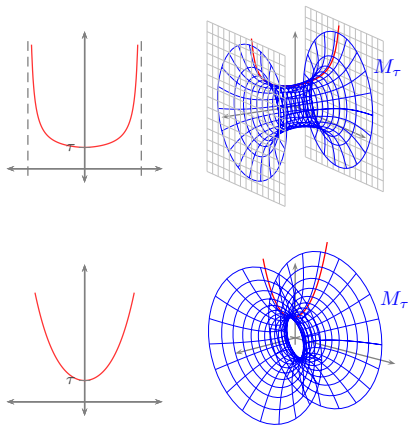
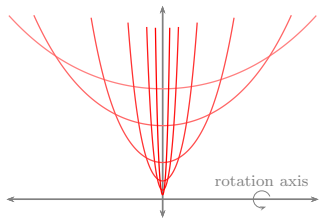
We extend the theory of complete minimal surfaces in $\mathbb{R}^3$ of finite total curvature to the wider class of elliptic special Weingarten surfaces of finite total curvature; in particular, we extend the seminal works of L. Jorge and W. Meeks and R. Schoen. Specifically, we extend the Jorge-Meeks formula relating the total curvature and the topology of the surface and we use it to classify planes as the only elliptic special Weingarten surfaces whose total curvature is less than $4 \pi$. Moreover, we show that a complete (connected), embedded outside a compact set, elliptic special Weingarten surface of minimal type in $\mathbb{R}^3$ of finite total curvature and two ends is rotationally symmetric; in particular, it must be one of the rotational special catenoids described by R. Sa Earp and E. Toubiana. This answers in the positive a question posed in 1993 by R. Sa Earp. We also prove that the special catenoids are the only connected non-flat special Weingarten surfaces whose total curvature is less than $8 \pi$.
Editorial analysis
A structured set of objections, weighed in public.
Referee Report
Summary. The paper extends the Jorge-Meeks formula relating total curvature to topology from minimal surfaces to the class of elliptic special Weingarten surfaces of minimal type in R^3. It classifies planes as the only such surfaces with total curvature less than 4π. It proves that any complete connected elliptic special Weingarten surface of minimal type with finite total curvature, embedded outside a compact set, and having exactly two ends must be rotationally symmetric and hence one of the rotational special catenoids of Sa Earp-Toubiana, answering a 1993 question of Sa Earp in the affirmative. It further shows that the special catenoids are the only connected non-flat special Weingarten surfaces with total curvature less than 8π.
Significance. If the extensions of the Jorge-Meeks formula and the symmetry arguments hold, the results generalize classical classification theorems for minimal surfaces of finite total curvature to a broader elliptic Weingarten class while preserving the key analytic properties (maximum principle, Gauss-map control) needed for the arguments. The positive resolution of Sa Earp's question and the sharp total-curvature bound of 8π constitute concrete advances in the geometry of Weingarten surfaces.
minor comments (1)
- The abstract and introduction state the main theorems clearly, but the provided materials do not include the full proofs of the extended Jorge-Meeks formula or the symmetry classification, preventing direct verification of the analytic estimates invoked for ellipticity.
Simulated Author's Rebuttal
We thank the referee for the detailed summary of our results and the positive evaluation of their significance. No specific major comments appear in the report, so we have no individual points requiring rebuttal or revision at this stage.
Circularity Check
No significant circularity; extends external theorems
full rationale
The derivation extends the Jorge-Meeks formula and Schoen's results to the elliptic special Weingarten class using the ellipticity assumption for analytic properties like the maximum principle. Central claims (rotational symmetry for two-ended surfaces, classification of planes and special catenoids) rest on these extensions plus the external Sa Earp-Toubiana rotational examples and the 1993 Sa Earp question, none of which reduce to self-definition, fitted inputs renamed as predictions, or load-bearing self-citations. The paper is self-contained against external benchmarks with independent content.
Axiom & Free-Parameter Ledger
axioms (2)
- standard math Gauss-Bonnet theorem and properties of the Gauss map for surfaces in R^3
- domain assumption Elliptic condition on the Weingarten relation for surfaces of minimal type
Lean theorems connected to this paper
-
IndisputableMonolith/Cost/FunctionalEquation.leanwashburn_uniqueness_aczel unclear?
unclearRelation between the paper passage and the cited Recognition theorem.
We extend the Jorge-Meeks formula relating the total curvature and the topology of the surface... adapted Codazzi pair... Simons type formula Δ_If ln|IIf| = 2Kf
-
IndisputableMonolith/Foundation/AlexanderDuality.leanalexander_duality_circle_linking unclear?
unclearRelation between the paper passage and the cited Recognition theorem.
D = 3 forcing via circle linking... Alexander duality
What do these tags mean?
- matches
- The paper's claim is directly supported by a theorem in the formal canon.
- supports
- The theorem supports part of the paper's argument, but the paper may add assumptions or extra steps.
- extends
- The paper goes beyond the formal theorem; the theorem is a base layer rather than the whole result.
- uses
- The paper appears to rely on the theorem as machinery.
- contradicts
- The paper's claim conflicts with a theorem or certificate in the canon.
- unclear
- Pith found a possible connection, but the passage is too broad, indirect, or ambiguous to say the theorem truly supports the claim.
Reference graph
Works this paper leans on
- [1]
-
[2]
L. Ahlfors. Lectures on Quasiconformal Mappings. D. Van Nostrand Com- pany, Inc, 1966
work page 1966
- [3]
-
[4]
A. Aleksandrov. Uniqueness theorems for surfaces in the large, I. Vestnik Leningrad University: Mathematics , 11:5–17, 1956
work page 1956
- [5]
- [6]
-
[7]
F. Braga and R. Sa Earp. On the structure of certain Weingarten surfaces with boundary a circle. Annales de la facult´ e des sciences de Toulouse , 6(2):243–255, 1997
work page 1997
-
[8]
R. Bryant. Complex analysis and a class of Weingarten surfaces. arXiv: 1105.5589v1 [math.DG]. Preprint, 2011. 38
work page internal anchor Pith review Pith/arXiv arXiv 2011
-
[9]
H. Chan. Nonexistence of nonpositively curved surfaces with one embedded end. Manuscripta Mathematica, 102:177–186, 2000
work page 2000
-
[10]
H. Chan and A. Treibergs. Nonpositively curved surfaces in R3. Journal of Differential Geometry, 57:389–407, 2001
work page 2001
-
[11]
S. Chern. Some new characterizations of the Euclidean sphere. Duke Math- ematical Journal, 12:279–290, 1945
work page 1945
-
[12]
S. Chern. On special W-surfaces. Proceedings of the American Mathemat- ical Society, 6(5):783–786, 1955
work page 1955
-
[13]
S. Chern and R. Osserman. Complete minimal surfaces in euclidean n- space. Journal d’Analyse Math´ ematique, 19(1):15–34, 1967
work page 1967
- [14]
- [15]
-
[16]
J. Espinar. La ecuaci´ on de Codazzi en superficies. PhD thesis, Universidad de Granada, 2008
work page 2008
-
[17]
R. Finn. On normal metrics, and a theorem of Cohn-Vossen. Bulletin of the American Mathematical Society, 70:772–773, 1964
work page 1964
-
[18]
R. Finn. On a class of conformal metrics, with applications to differential geometry in the large. Commentarii Mathematici Helvetici , 40(1):1–30, 1965
work page 1965
-
[19]
V. Gutlyanskii, V. Ryazanov, U. Srebro, and E. Yakubov. The Beltrami Equation. A Geometric Approach . Springer-Verlag New York, 2012
work page 2012
-
[20]
J. G´ alvez, A. Mart´ ınez, and F. Milan. Linear Weingarten surfaces in R3. Monatshefte f¨ ur Mathematik, 138:133–144, 2003
work page 2003
-
[21]
Complete Surfaces with Ends of Non Positive Curvature
J. G´ alvez, A. Mart´ ınez, and J. Teruel. Complete surfaces with ends of non positive curvature. arXiv: 1405.0851 [math.DG]. Preprint, 2016
work page internal anchor Pith review Pith/arXiv arXiv 2016
-
[22]
P. Hartman and A. Wintner. Umbilical points and W-surfaces. American Journal of Mathematics , 76(3):502–508, 1954
work page 1954
-
[23]
D. Hoffman and W. Meeks III. The strong halfspace theorem for minimal surfaces. Inventiones Mathematicae, 101:373–377, 1990
work page 1990
-
[24]
E. Hopf. Element¨ are bemerkungen ¨ uber die l¨ osungen partieller differen- tialgleichungen zweiter ordnung vom elliptischen typus. Sitzungsberichte Preussische Akademie der Wissenschaften , 19:147–152, 1927
work page 1927
-
[25]
E. Hopf. On S. Bernstein’s theorem on surfaces z(x, y) of nonpositive curvature. Proceedings of the American Mathematical Society , 1:80–85, 1950
work page 1950
-
[26]
E. Hopf. A theorem on the accessibility of boundary parts of an open point set. Proceedings of the American Mathematical Society, 1:76–79, 1950. 39
work page 1950
-
[27]
E. Hopf. A remark on linear elliptic differential equations of second order. Proceedings of the American Mathematical Society, 3(5):791–793, 1952
work page 1952
-
[28]
H. Hopf. Differential geometry in the large , volume 1000. Springer-Verlag Berlin Heidelberg, 1983
work page 1983
-
[29]
A. Huber. On subharmonic functions and differential geometry in the large. Commentarii Mathematici Helvetici , 32:13–72, 1957
work page 1957
-
[30]
L. Jorge and W. Meeks III. The topology of complete minimal surfaces of finite total Gaussian curvature. Topology, 22(2):203–221, 1983
work page 1983
- [31]
-
[32]
T. Klotz and R. Osserman. Complete surfaces in E3 with constant mean curvature. Commentarii Mathematici Helvetici , 41:313–318, 1966-1967
work page 1966
-
[33]
N. Korevaar, R. Kusner, and B. Solomon. The structure of complete em- bedded surfaces with constant mean curvature. Journal of Differential Geometry, 30:465–503, 1989
work page 1989
-
[34]
P. Li and L.-F. Tam. Complete surfaces with total finite curvature. Journal of Differentia Geometry, 33:139–168, 1991
work page 1991
- [35]
-
[36]
T. Milnor. Abstract Weingarten surfaces. Journal of Differential Geometry, 15:365–380, 1980
work page 1980
-
[37]
A. Mori. On an absolute constant in the theory of quasi-conformal map- pings. Journal of the Mathematical Society of Japan , 8(2):156–166, 1956
work page 1956
- [38]
- [39]
-
[40]
J. P´ erez. A new golden age of minimal surfaces. Notices of the AMS , 64(4):347–358, 2017
work page 2017
- [41]
-
[42]
H. Rosenberg and R. Sa Earp. The geometry of properly embedded special surfaces in R3; e.g., surfaces satisfying aH + bK = 1, where a and b are positive. Duke Mathematical Journal , 73(2):291–306, 1994
work page 1994
-
[43]
R. Sa Earp and E. Toubiana. A note on special surfaces in R3. Matem´ atica Contemporˆ anea, 4:108–118, 1993
work page 1993
-
[44]
R. Sa Earp and E. Toubiana. Sur les surfaces de Weingarten sp´ eciales de type minimal. Boletim da Sociedade Brasileira de Matem´ atica, 26(2):129– 148, 1995. 40
work page 1995
-
[45]
R. Sa Earp and E. Toubiana. Classification des surfaces de type Delaunay. American Journal of Mathematics , 121(3):671–700, 1999
work page 1999
-
[46]
R. Sa Earp and E. Toubiana. Symmetry of properly embedded special Weingarten surfaces in H3. Transactions of the American Mathematical Society, 351(12):4693–4711, 1999
work page 1999
-
[47]
R. Schoen. Uniqueness, symmetry, and embeddedness of minimal surfaces. Journal of Differential Geometry , 18:791–809, 1983
work page 1983
- [48]
-
[49]
S. Taliaferro. On the growth of superharmonic functions near isolated sigularity, I. Journal of Differential Equations , 158:28–47, 1999
work page 1999
-
[50]
S. Taliaferro. Isolated singularities of nonlinear elliptic inequalities. Indiana University Mathematics Journal , 50(4):1885–1898, 2001
work page 2001
-
[51]
S. Taliaferro. Isolated singularities of nonlinear elliptic inequalities II. Asymptotic behavior of solutions. Indiana University Mathematics Jour- nal, 55(6):1791–1812, 2006
work page 2006
-
[52]
B. White. Complete surfaces of finite total curvature. Journal of Differen- tial Geometry, 26:315–326, 1987
work page 1987
-
[53]
D. Yoon and J. Lee. Linear Weingarten helicoidal surfaces in isotropic space. Symmetry, 8(11):126, 2016. 41
work page 2016
discussion (0)
Sign in with ORCID, Apple, or X to comment. Anyone can read and Pith papers without signing in.