Spectroscopic analysis of RGB stars in nine open clusters
Pith reviewed 2026-06-27 11:47 UTC · model grok-4.3
The pith
Spectroscopic measurements of carbon and oxygen isotopes in red giant stars from nine open clusters support the predicted mass dependence of thermohaline mixing on the red giant branch.
A machine-rendered reading of the paper's core claim, the machinery that carries it, and where it could break.
Core claim
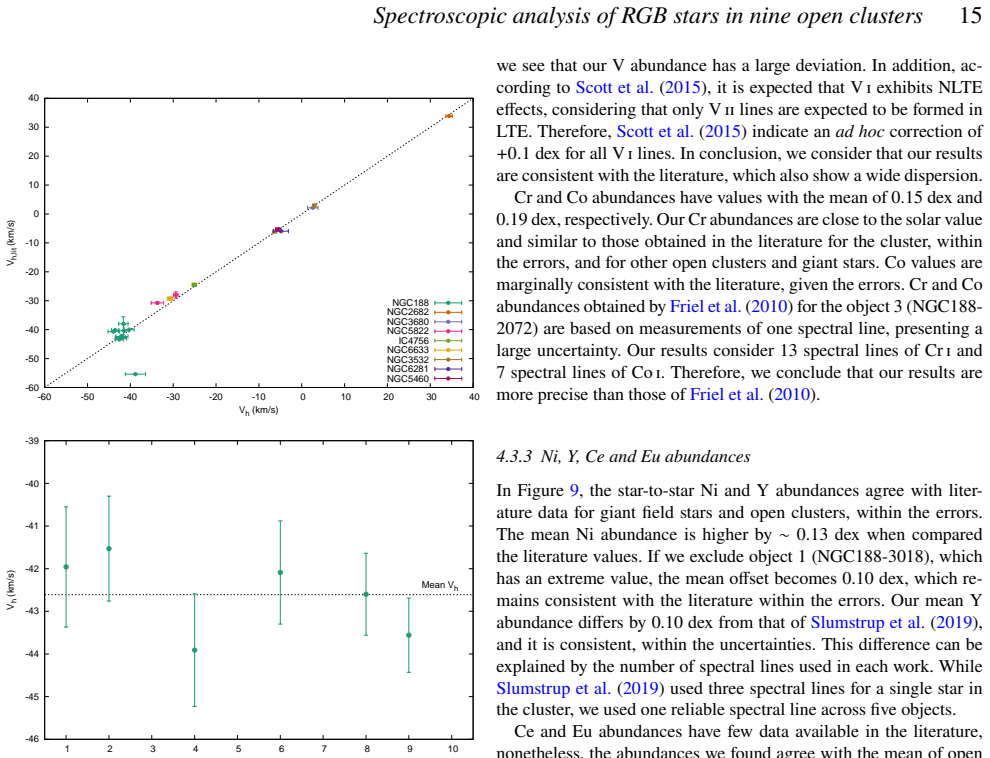
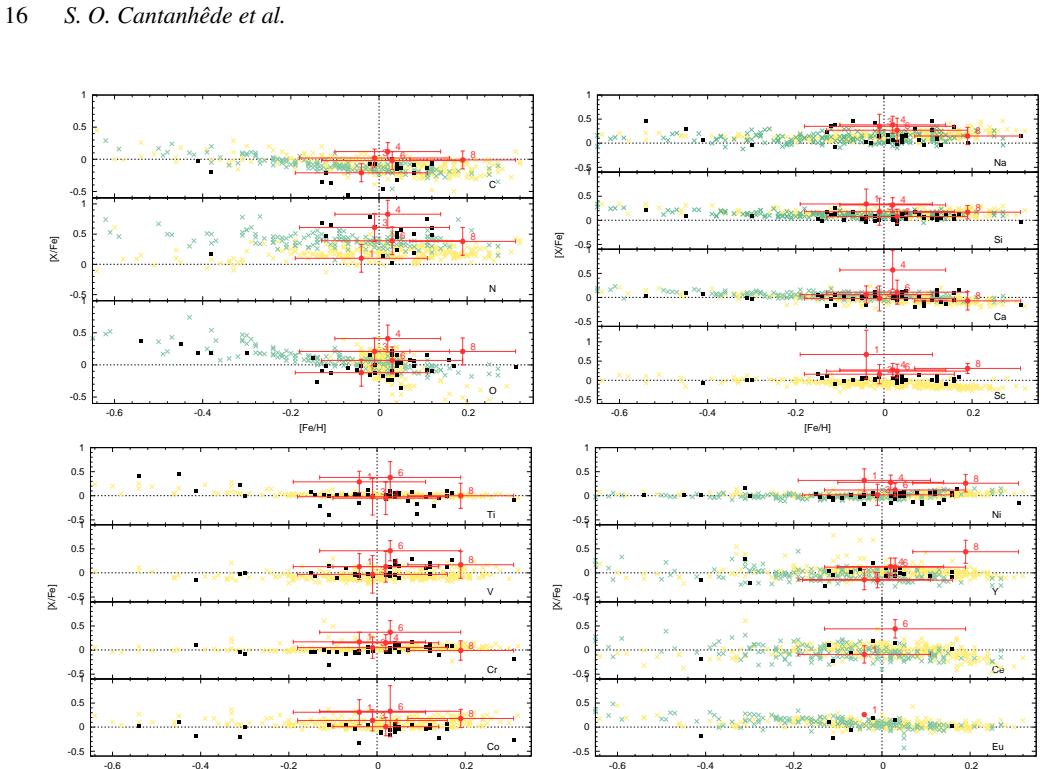
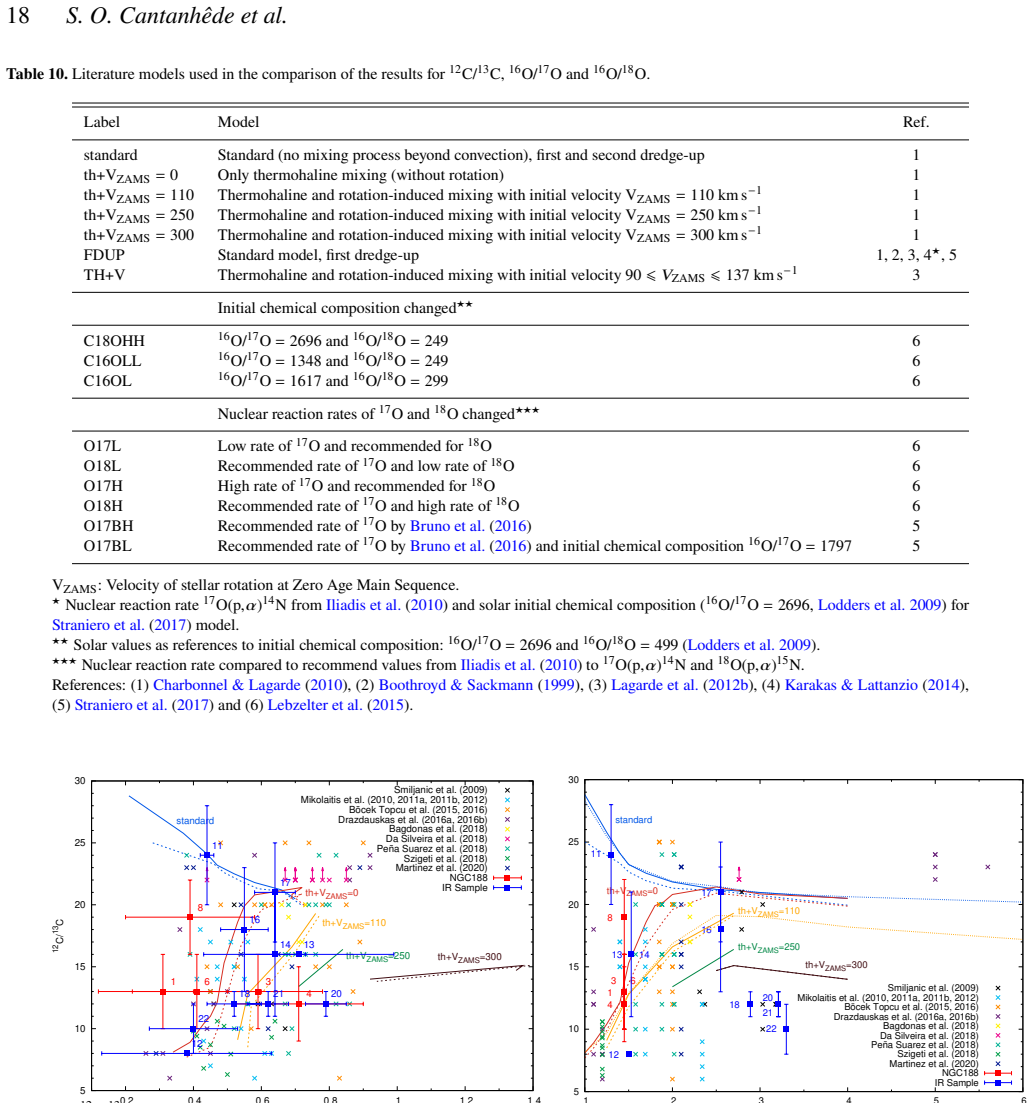
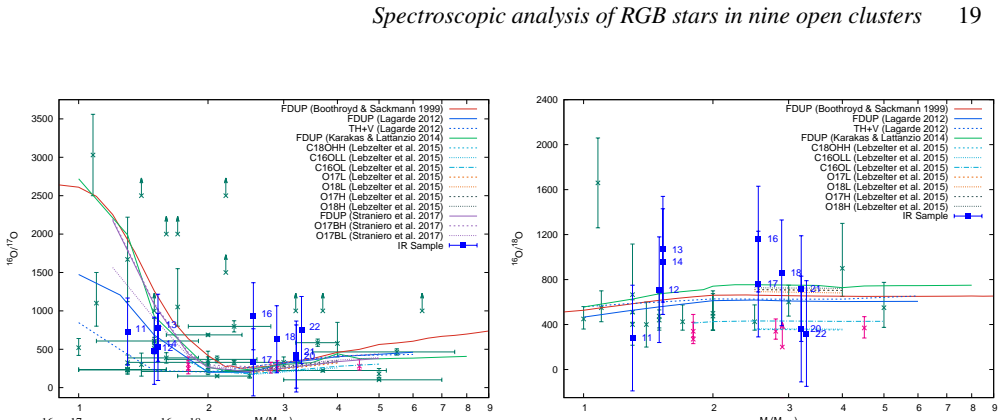
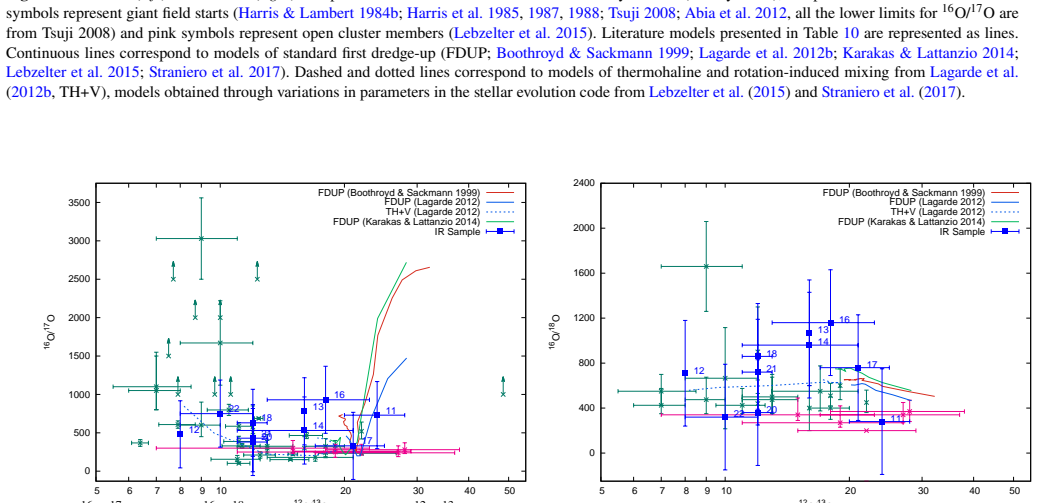
The values of radial velocities and chemical abundances match literature values for the clusters. The results obtained in both the visible and infrared spectral regions support the occurrence and predicted mass dependence of thermohaline mixing on the red giant branch together with rotation-induced mixing on the main sequence. Variations of the initial abundances of 17O and 18O may be required to account for the observed dispersion in the oxygen isotopic ratios among the red giant stars.
What carries the argument
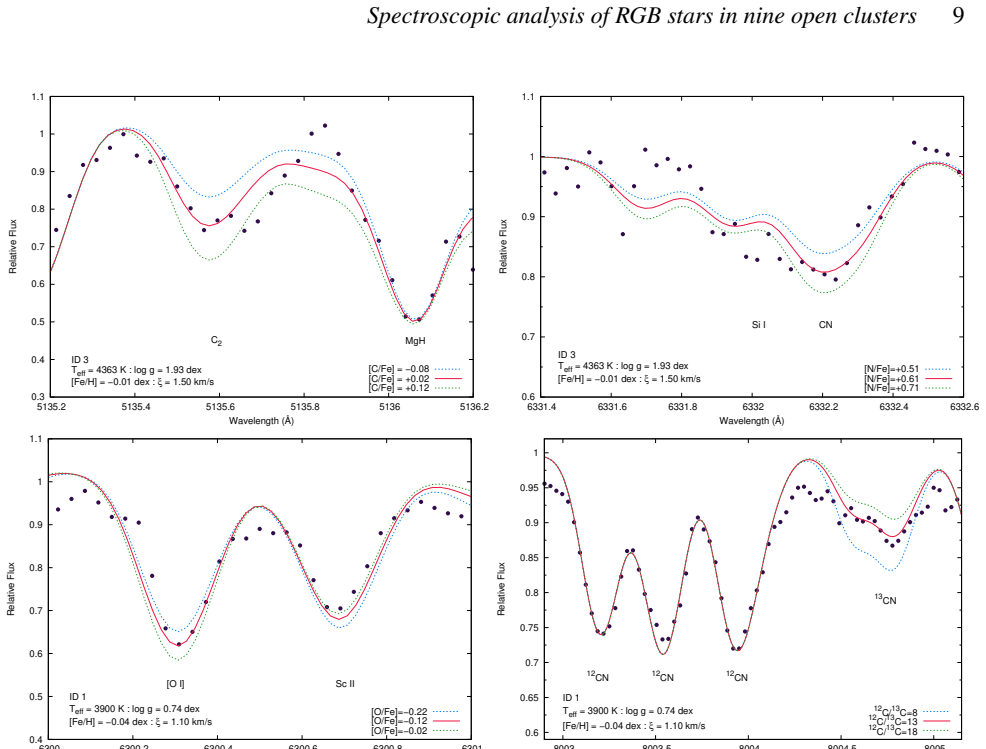
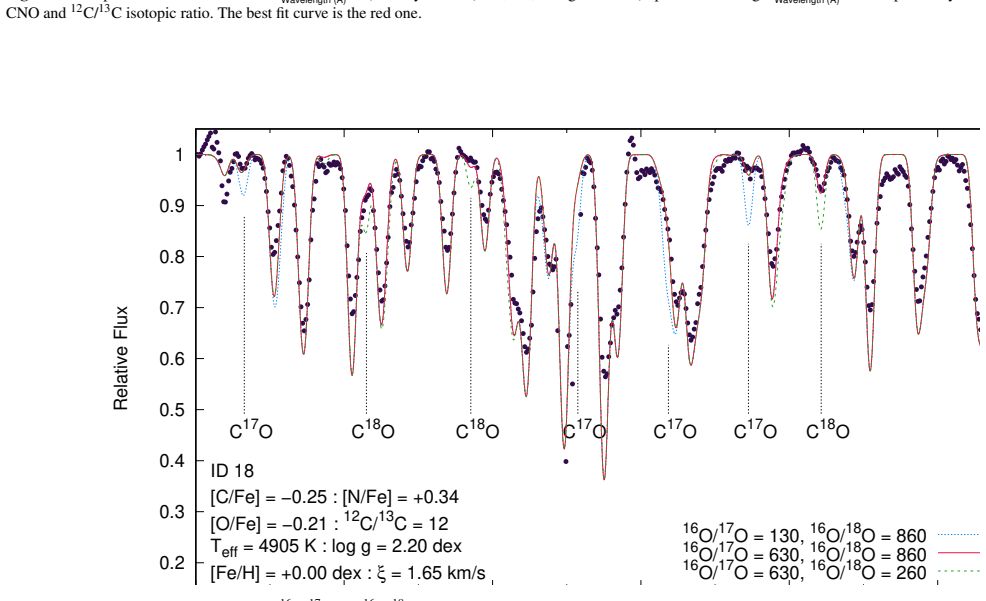
High-resolution spectra yielding CNO abundances and the isotopic ratios 12C/13C, 16O/17O and 16O/18O, analysed with Turbospectrum and MOOG and compared to model predictions that incorporate thermohaline and rotation-induced mixing.
If this is right
- Thermohaline mixing must operate on the red giant branch with a strength that increases with stellar mass.
- Rotation-induced mixing must operate on the main sequence and leave a detectable imprint on the surface abundances of red giants.
- Standard initial 17O and 18O abundances may need revision to reproduce the full range of observed oxygen isotopic ratios.
- Extra mixing beyond first dredge-up is required in stellar models to match observations in the 1–2 solar-mass range.
Where Pith is reading between the lines
- If the mass dependence holds, the same mixing physics should produce observable differences in the carbon and oxygen isotope ratios of field red giants at different metallicities.
- The need for adjusted initial oxygen isotopes points to possible revisions in the yields from asymptotic giant branch stars or supernovae that set the starting composition of open clusters.
- Extending the same analysis to clusters of different ages would test whether the mixing signatures accumulate predictably with time on the red giant branch.
Load-bearing premise
The isotopic ratios derived from the spectra can be compared directly to the mixing model predictions without systematic offsets arising from the choice of model atmospheres or line lists.
What would settle it
New high-resolution spectra of a comparable sample of red giants in open clusters that show no mass-dependent trend in the 12C/13C or oxygen isotopic ratios would falsify the central claim.
Figures
read the original abstract
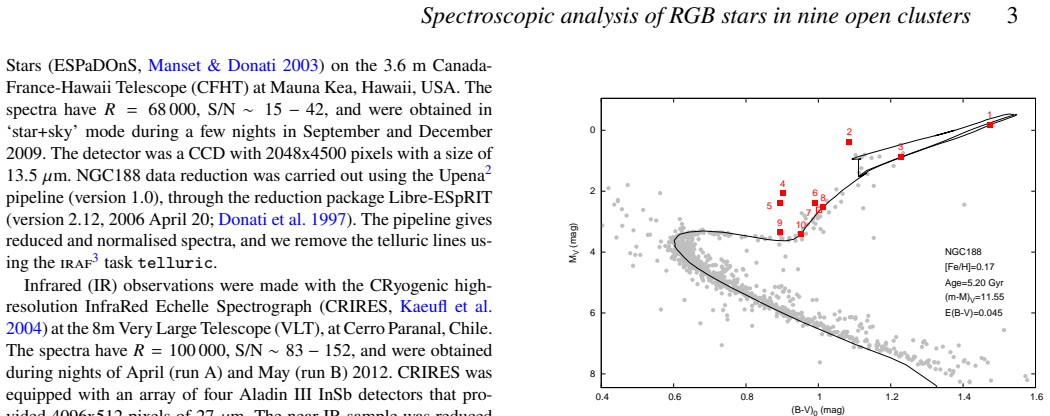
Stellar clusters are crucial tools for studying the age, spatial distribution, dynamics, kinematics, and chemical composition of different Galactic stellar populations. In this work, we used red giant stars from open clusters to better understand the extra-mixing process through the CNO abundances and $^{12}$C/$^{13}$C, $^{16}$O/$^{17}$O and $^{16}$O/$^{18}$O isotopic ratios determined using high-quality spectra in the visible and near-infrared regions. We analysed the radial velocities and chemical composition of 22 K-type giant stars from nine open clusters (NGC188, NGC2682, NGC3680, NGC5822, IC4756, NGC6633, NGC3532, NGC6281, and NGC5460). High-resolution and high signal-to-noise spectra of stars in the NGC188 cluster were obtained with the ESPaDOnS spectrograph at the CFHT in the visible region. The stars in the other clusters were observed with the CRIRES spectrograph at the VLT. We used IRAF to compute radial velocities and Turbospectrum and MOOG for the chemical analysis. The values obtained for the radial velocities and abundances of the sample are similar to those found in the literature. The results in the visible and infrared support the occurrence and predicted mass dependence of thermohaline mixing on the red giant branch and of rotation-induced mixing on the main sequence. Variations of the initial abundances of $^{17}$O and $^{18}$O may be needed to explain the dispersion of the oxygen isotopic ratios in red giant stars.
Editorial analysis
A structured set of objections, weighed in public.
Referee Report
Summary. The manuscript analyzes high-resolution visible (ESPaDOnS) and near-IR (CRIRES) spectra of 22 K-type RGB stars across nine open clusters. Radial velocities are derived with IRAF; CNO abundances and the isotopic ratios 12C/13C, 16O/17O and 16O/18O are obtained with Turbospectrum and MOOG. The derived quantities are stated to be consistent with literature values. The authors conclude that the isotopic ratios confirm the occurrence and mass dependence of thermohaline mixing on the RGB and rotation-induced mixing on the main sequence; dispersion in the oxygen ratios is ascribed to possible variations in initial abundances.
Significance. If the isotopic ratios prove robust, the work supplies cluster-based constraints on extra-mixing mechanisms at known ages and masses, directly testing stellar-evolution predictions for thermohaline and rotational mixing. The use of both optical and IR diagnostics on the same stars is a strength, and the agreement with published radial velocities and abundances supports the basic reduction pipeline.
major comments (1)
- [Chemical analysis / abstract] Abstract and chemical-analysis description: the central claim that the measured isotopic ratios support the predicted mass dependence of thermohaline and rotation-induced mixing requires that the ratios can be compared at face value to model predictions. No systematic error budget, alternative line-list tests, NLTE corrections, or model-atmosphere grid swaps are reported for the isotopic ratios, so it is unclear whether the observed trends survive plausible changes in atomic data or atmospheric assumptions.
minor comments (1)
- [Abstract] The abstract asserts that the derived values 'are similar to those found in the literature' but supplies neither quantitative offsets nor the specific literature references used for the comparison.
Simulated Author's Rebuttal
We thank the referee for the constructive comments on our manuscript. The major concern about the lack of a systematic error budget for the isotopic ratios is addressed point-by-point below. We agree that additional discussion is needed to support direct comparison with model predictions and will revise the manuscript accordingly.
read point-by-point responses
-
Referee: [Chemical analysis / abstract] Abstract and chemical-analysis description: the central claim that the measured isotopic ratios support the predicted mass dependence of thermohaline and rotation-induced mixing requires that the ratios can be compared at face value to model predictions. No systematic error budget, alternative line-list tests, NLTE corrections, or model-atmosphere grid swaps are reported for the isotopic ratios, so it is unclear whether the observed trends survive plausible changes in atomic data or atmospheric assumptions.
Authors: We agree that an explicit systematic error analysis would strengthen the comparison of our isotopic ratios to stellar evolution models. The submitted manuscript reports consistency with literature values for the same clusters and internal agreement between optical and near-IR diagnostics, but does not include the requested tests. In the revised version we will add a dedicated error-analysis subsection that (i) quantifies sensitivity of the 12C/13C, 16O/17O and 16O/18O ratios to the adopted line lists, (ii) discusses the expected magnitude of NLTE corrections for K-giant oxygen isotopes based on published calculations, and (iii) reports the effect of swapping between the two model-atmosphere grids already employed (MARCS and ATLAS). These additions will allow a clearer assessment of whether the observed mass-dependent trends remain robust. revision: yes
Circularity Check
No circularity: purely observational abundance analysis with external model comparisons
full rationale
The paper reports radial velocities and CNO abundances plus isotopic ratios derived from ESPaDOnS and CRIRES spectra using standard tools (IRAF, Turbospectrum, MOOG). These observed quantities are then compared to literature values and to pre-existing model predictions for thermohaline and rotation-induced mixing. No equations, fitted parameters, or self-citations are used to derive the target mixing predictions inside the paper; the central claim is a direct empirical comparison. The analysis contains no self-definitional loops, fitted-input predictions, or load-bearing self-citations that reduce the result to its inputs by construction.
Axiom & Free-Parameter Ledger
axioms (2)
- domain assumption Local thermodynamic equilibrium holds for the spectral lines used in the abundance analysis
- domain assumption Cluster ages and turn-off masses are known sufficiently well to test the predicted mass dependence of mixing
Reference graph
Works this paper leans on
-
[1]
, publisher=
Pols, O.R. , publisher=. Stellar Structure and Evolution , year=
-
[2]
Kepler, S. O. and Saraiva, M. F. O. , publisher=. Astronomia e Astrofísica , year=
-
[3]
Comins, N. F. and Kaufmann III, W. J. , publisher=. Descobrindo o universo , year=
-
[4]
and Lifshitz, E.M , publisher=
Landau, L.D. and Lifshitz, E.M , publisher=. The Classical Theory of Fields , year=
-
[5]
Clayton, D. D. , publisher=. Principles of Stellar Evolution and Nucleosynthesis , year=
-
[6]
, publisher=
Barbieri, C. , publisher=. Fundamentals of Astronomy , year=
-
[7]
and Kröger, P
Karttunen, H. and Kröger, P. and Oja, H. and Poutanen, M. and Donner, K. J. , publisher=. Fundamental Astronomy , year=
-
[8]
Lima, P. J. and Silva, M. T. X. and Silveira, F. L. V. and Eliane, A. , publisher=
-
[9]
doi:10.1051/0004-6361/201833739 , adsurl =
A&A , volume=. doi:10.1051/0004-6361/201833739 , adsurl =
-
[10]
AJ , volume=. doi:10.3847/1538-3881/aabc4f , adsurl =
-
[11]
AJ , volume=. doi:10.3847/1538-3881/ab77bc , adsurl =
-
[12]
doi:10.3847/1538-3881/aad635 , adsurl =
AJ , volume=. doi:10.3847/1538-3881/aad635 , adsurl =
-
[13]
, archivePrefix = "arXiv", eprint =
ApJS , volume=. doi:10.1088/0067-0049/214/2/26 , adsurl =
-
[14]
doi:10.1093/mnras/stt1105 , adsurl =
MNRAS , volume=. doi:10.1093/mnras/stt1105 , adsurl =
-
[15]
MNRAS , volume=. doi:10.1111/j.1365-2966.2012.21367.x , adsurl =
-
[16]
doi:10.1093/mnras/sty998 , adsurl =
MNRAS , volume=. doi:10.1093/mnras/sty998 , adsurl =
-
[17]
doi:10.1093/mnras/sty2050 , adsurl =
MNRAS , volume=. doi:10.1093/mnras/sty2050 , adsurl =
-
[18]
doi:10.1051/0004-6361/201936811 , adsurl =
A\ volume=. doi:10.1051/0004-6361/201936811 , adsurl =
-
[19]
doi:10.3103/S0884591315040078 , adsurl =
KPCB , volume=. doi:10.3103/S0884591315040078 , adsurl =
-
[20]
Kharchenko, N. V. and Piskunov, A. E. and Schilbach, E. and Röser, S. and Scholz, R.-D. , title=. A&A , volume=
-
[21]
and Kharchenko, N
Schmeja, S. and Kharchenko, N. V. and Piskunov, A. E. and Röser, S. and Schilbach, E. and Froebrich, D. and Scholz, R. D. , title=. A&A , volume=
-
[22]
and Schmeja, S
Dib, S. and Schmeja, S. and Parker, R. J. , title=. MNRAS , volume=
-
[23]
and Baseia, B
Valverde, C. and Baseia, B. and Bagnato, V. S. , title=. Rev. Bras. Ensino Fís. , volume=
-
[24]
doi:10.1051/0004-6361/201628944 , adsurl =
A&A , volume=. doi:10.1051/0004-6361/201628944 , adsurl =
-
[25]
, title =
Alves-Brito, A. , title =
-
[26]
Puls, A. A. , title =
-
[27]
JQSRT , volume=. doi:10.1016/j.jqsrt.2017.06.038 , adsurl =
-
[28]
and Bland-Hawthorn, J
Freeman, K. and Bland-Hawthorn, J. , title=. ARA&A , volume=
-
[29]
and Gerhard, O
Bland-Hawthorn, J. and Gerhard, O. , title=. ARA&A , volume=
-
[30]
ApJS , volume=. doi:10.1086/192110 , adsurl =
-
[31]
New catalogue of optically visible open clusters and candidates , journal=
-
[32]
and Kharchenko, N
Scholz, R.-D. and Kharchenko, N. V. and Piskunov, A. E. and Röser, S. and Schilbach, E. , title=. A&A , volume=
-
[33]
ARA&A , volume=. doi:10.1146/annurev.astro.46.060407.145222 , adsurl =
-
[34]
, title=
Froebrich, D. , title=. MNRAS , volume=
-
[35]
Exploring masses and CNO surface abundances of red giant stars
Exploring masses and CNO surface abundances of red giant stars. , keywords =. doi:10.1093/mnras/stv1141 , archivePrefix =. 1507.01517 , primaryClass =
work page internal anchor Pith review Pith/arXiv arXiv doi:10.1093/mnras/stv1141
-
[36]
doi:10.1088/1742-6596/703/1/012019 , adsurl =
JPhCS , volume=. doi:10.1088/1742-6596/703/1/012019 , adsurl =
-
[37]
doi:10.1093/mnras/stx3027 , adsurl =
MNRAS , volume=. doi:10.1093/mnras/stx3027 , adsurl =
-
[38]
and Scholz, R.-D
Conrad, C. and Scholz, R.-D. and Kharchenko, N. V. and Piskunov, A. E. and Schilbach, E. and Röser, S. and Boeche, C. and Kordopatis, G. and Siebert, A. and Williams, M. and Munari, U. and Matijevič, G. and Grebel, E. K. and Zwitter, T. and. A&A , volume=
-
[39]
arXiv e-prints , pages =
-
[40]
doi:10.3847/0004-6256/152/2/41 , adsurl =
AJ , volume=. doi:10.3847/0004-6256/152/2/41 , adsurl =
-
[41]
The Observation and Analysis of Stellar Photospheres , year=
-
[42]
Física Quântica: Átomos, Moléculas, Sólidos, Núcleos e Partículas , year=
Eisberg, Robert and Resnik, Robert , publisher=. Física Quântica: Átomos, Moléculas, Sólidos, Núcleos e Partículas , year=
-
[43]
Siderius Nuncius , year=
Galilei, Galileu , publisher=. Siderius Nuncius , year=
-
[44]
, publisher=
Griffiths, David J. , publisher=. Mecânica Quântica , year=
-
[45]
Carroll, B. W. and Ostlie, D. A. , publisher=. An Introduction to Modern Astrophysics , year=
-
[46]
Pearson Addison-Wesley , year=
-
[47]
doi:10.1051/0004-6361/201833390 , adsurl =
A&A , volume =. doi:10.1051/0004-6361/201833390 , adsurl =
-
[48]
and Hanson, M
Massey, P. and Hanson, M. M. , title=. Planets, Stars and Stellar Systems. Volume 2: Astronomical Techniques, Software and Data , pages =
-
[49]
A. A&A , volume =. doi:10.1051/0004-6361/201833476 , adsurl =
-
[50]
doi:10.1051/0004-6361/201834020 , adsurl =
A&A , volume =. doi:10.1051/0004-6361/201834020 , adsurl =
-
[51]
and Lardo, C
Bastian, N. and Lardo, C. , title =. AR&A , volume=
-
[52]
doi:10.1051/0004-6361/201629624 , adsurl =
A&A , volume=. doi:10.1051/0004-6361/201629624 , adsurl =
-
[54]
doi:10.3847/0004-637X/832/2/133 , adsurl =
ApJ , volume=. doi:10.3847/0004-637X/832/2/133 , adsurl =
-
[55]
doi:10.1088/0004-6256/144/2/54 , adsurl =
A&A , volume=. doi:10.1088/0004-6256/144/2/54 , adsurl =
-
[56]
doi:10.1051/0004-6361:200809869 , adsurl =
A&A , volume=. doi:10.1051/0004-6361:200809869 , adsurl =
-
[57]
doi:10.1051/0004-6361/200912323 , adsurl =
A&A , volume=. doi:10.1051/0004-6361/200912323 , adsurl =
-
[59]
doi:10.1051/0004-6361/201526370 , adsurl =
A&A , volume=. doi:10.1051/0004-6361/201526370 , adsurl =
-
[60]
ApJS , volume=. doi:10.1086/191940 , adsurl =
-
[61]
doi:10.1051/0004-6361/201526758 , adsurl =
A&A , volume=. doi:10.1051/0004-6361/201526758 , adsurl =
-
[62]
doi:10.1088/0004-6256/147/6/137 , adsurl =
AJ , volume=. doi:10.1088/0004-6256/147/6/137 , adsurl =
-
[63]
AJ , volume=. doi:10.1086/513194 , adsurl =
-
[64]
doi:10.1051/0004-6361:20065141 , adsurl =
A&A , volume=. doi:10.1051/0004-6361:20065141 , adsurl =
-
[65]
doi:10.1134/S1063772907050046 , adsurl =
ARep , volume=. doi:10.1134/S1063772907050046 , adsurl =
-
[66]
doi:10.1126/science.1133065 , adsurl =
Science , volume=. doi:10.1126/science.1133065 , adsurl =
-
[67]
doi:10.1093/mnras/stt412 , adsurl =
MNRAS , volume=. doi:10.1093/mnras/stt412 , adsurl =
-
[69]
doi:10.1093/mnras/staa647 , adsurl =
MNRAS , volume=. doi:10.1093/mnras/staa647 , adsurl =
-
[70]
doi:10.3847/1538-4357/ab0b43 , adsurl =
ApJ , volume=. doi:10.3847/1538-4357/ab0b43 , adsurl =
-
[71]
doi:10.3847/1538-4357/aaa017 , adsurl =
ApJ , volume=. doi:10.3847/1538-4357/aaa017 , adsurl =
-
[72]
ApJ , volume=. doi:10.1086/374037 , adsurl =
-
[73]
doi:10.1088/0004-6256/137/4/3743 , adsurl =
AJ , volume=. doi:10.1088/0004-6256/137/4/3743 , adsurl =
-
[74]
doi:10.1088/0004-6256/135/6/2264 , adsurl =
AJ , volume=. doi:10.1088/0004-6256/135/6/2264 , adsurl =
-
[75]
doi:10.1088/0004-6256/148/5/83 , adsurl =
AJ , volume=. doi:10.1088/0004-6256/148/5/83 , adsurl =
-
[76]
The Impact of Very High S/N Spectroscopy on Stellar Physics , volume=
-
[77]
Mém. Soc. R. Sci. Liège , volume=
-
[78]
ApJ , volume=. doi:10.1086/162151 , adsurl =
-
[79]
ApJ , volume=. doi:10.1086/162544 , adsurl =
-
[80]
ApJ , volume=. doi:10.1086/165201 , adsurl =
-
[81]
ApJ , volume=. doi:10.1086/166047 , adsurl =
-
[82]
Oxygen isotopic abundances in evolved stars. II. Eight MS and S stars. ApJ , volume=. doi:10.1086/163707 , adsurl =
-
[83]
ApJS , volume=. doi:10.1088/0067-0049/211/1/5 , adsurl =
discussion (0)
Sign in with ORCID, Apple, or X to comment. Anyone can read and Pith papers without signing in.