REVIEW 2 major objections 6 minor 17 references
Development of the Range Counter for the COMET Phase-$\alpha$ Experiment
T0 review · 2 major / 6 minor · reviewed 2026-08-15 · deepseek-v4-flash
Pith's one-line read The paper claims that a Range Counter with a 0.5 mm-thick T0 scintillator can measure the 30–100 MeV/c negative-muon momentum spectrum in COMET Phase-α by counting stopped muons through their decay-time distribution, with measured trigger…
desk verdict Solid detector performance study whose central muon-counting reconstruction rests on an unvalidated fit of the short decay component. read the letter →
The pith
A machine-rendered reading of the paper's core claim, the machinery that carries it, and where it could break.
The reading
What carries the argument
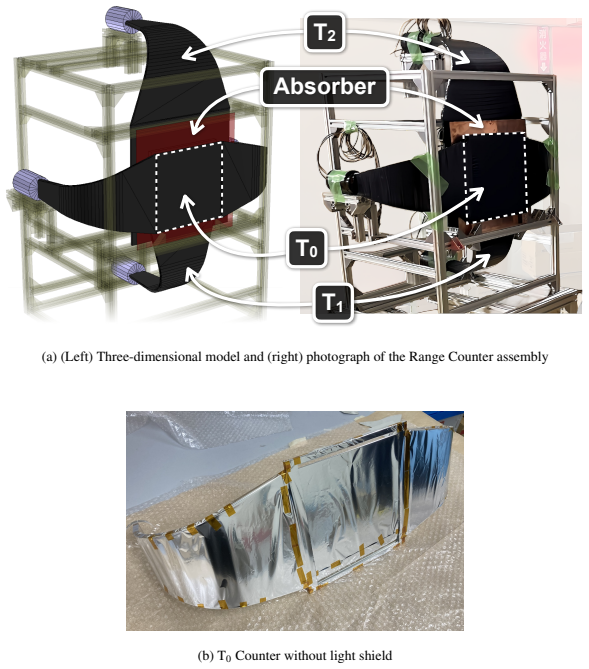
The load-bearing object is the fitted decay-time distribution $F(T_{\mathrm{decay}}) = (N_{\mathrm{short}}/\tau_{\mathrm{short}})\exp(-T_{\mathrm{decay}}/\tau_{\mathrm{short}}) + \mathrm{BG}(T_{\mathrm{decay}})$, where $T_{\mathrm{decay}}$ is the average of the T1 and T2 hit times minus the T0 time. The short exponential term is the signal: negative muons stopped in the copper absorber form muonic atoms with lifetime $\tau_{\mathrm{short}}\approx164$ ns, and the DIO electrons they emit appear as this short component against long-lived and constant backgrounds. The degrader stacks, the T1 thickness, and the energy-deposit thresholds all serve one purpose: to make that single short exponential cleanly extractable from the observed distribution.
What would settle it
An actual Phase-α run in which the fit to the T_decay distribution yields a short-component amplitude consistent with zero, or a fitted lifetime uncertainty comparable to its central value, would falsify the muon-counting claim; the same test with the Phase-α bunch spacing and prompt backgrounds would settle it directly.
Extended reading notes
Core claim
The paper's central claim is that the number of stopped negative muons in the RC absorber is obtainable from the measured decay-time distribution: $N_{\mathrm{stop}} = N_{\mathrm{short}}/(\eta_{\mathrm{DIO}}\,\epsilon_{\mathrm{trig}}\,R_{\mathrm{DIO}}\,A_{\mathrm{DIO}})$, where $N_{\mathrm{short}}$ comes from fitting a short exponential plus background terms to $T_{\mathrm{decay}}=(T_1+T_2)/2-T_0$. The copper absorber is chosen because its muonic-atom lifetime ($\tau_{\mathrm{short}}=164$ ns) is short enough to stand out from the roughly 2 microsecond background and long enough to avoid prompt beam-related hits; the measured T0 trigger efficiency of $99.97\pm0.01\pm0.03\%$ and the near-unity T1/T2 electron efficiencies mean the dominant corrections are the simulated DIO purity $\eta_{\mathrm{DIO}}=59.6\%$ and acceptance $A_{\mathrm{DIO}}=47.1\%$ at a normalised energy threshold of 0.4. The paper also establishes that the 20 cm-square T0 counter with dual-PMT waveform summing is the right choice, because the 30 cm version loses too much light yield.
Load-bearing premise
The load-bearing premise is that the copper short-decay component can be cleanly separated from the long-lived and constant backgrounds by fitting the decay-time distribution under Phase-α beam conditions; the paper's own 2022 test left the short-component parameters essentially unconstrained, so if that separation fails in the real bunch structure, the reconstruction of the number of stopped muons fails.
Editorial extensions
If this is right
- If the quoted figures hold in the final detector, the RC alone can deliver the Phase-α stopping-muon momentum spectrum from 30 to 100 MeV/c, with the T0 trigger inefficiency contributing a correction below 0.1 percent.
- The waveform-summing readout removes most beam-spot dependence in the T0 trigger efficiency, so the momentum measurement does not need a large position-dependent correction across the 20 cm counter.
- Because the T1 and T2 electron-detection efficiencies are above 99 percent at the analysis thresholds, the remaining corrections to the stopped-muon count are the simulated acceptance and purity, both of which have quoted systematic uncertainties from stopping-position dependence.
- The 164 ns copper muonic-atom lifetime keeps the fit window short enough to work within the 1.17 microsecond bunch interval of the COMET beam, which is why the copper absorber was chosen over aluminium.
- The measured efficiency curves support the conclusion that the RC is a workable primary momentum diagnostic for Phase-α while also providing a template for similar slow-muon beam monitors.
Reading between the lines
- Inferred: because the short-component parameters were essentially unconstrained in the 2022 copper test, the cleanest independent check of the paper's central claim is to compare N_stop reconstructed with the short lifetime fixed to the literature value versus left free in real Phase-α data; agreement within uncertainties would validate the separation, disagreement would indicate a missing backgro
- Inferred: the same range-counter principle could be transferred to other slow-muon beamlines by choosing an absorber element whose muonic-atom lifetime lies between the prompt window and the bunch interval, and then rescaling the degrader thickness for the target momentum range.
- Inferred: replacing simple energy thresholds with pulse-shape discrimination on the T1/T2 waveforms could raise the 60 percent purity by rejecting proton or neutron-induced hits that currently leak into the short component.
- Inferred: the measured efficiency curves suggest that a larger-area T0 would lose too much light yield; a segmented array of small thin scintillator tiles with per-tile summing could extend the momentum acceptance without sacrificing the >99.9 percent trigger efficiency.
Signed reviews
Editorial analysis
A structured set of objections, weighed in public.
Referee Report
Summary. The paper describes the design, construction, and performance evaluation of the Range Counter (RC) for the COMET Phase-alpha experiment. The RC consists of a thin T0 trigger counter, T1 and T2 electron counters, graphite degraders, and a copper absorber, and it is intended to measure the momentum spectrum of transported negative muons by reconstructing the number of stopped muons from the decay-time distribution of decay-in-orbit (DIO) electrons. The authors report a T0 muon-trigger efficiency of 99.97±0.01±0.03%, T1 and T2 electron-detection efficiencies above 99.9%, and Geant4-based estimates of DIO acceptance and purity of 47.1% and 59.6% at an energy threshold of 0.4. A 2022 MLF beam test comparing copper and aluminium absorbers is used to justify the choice of copper.
Significance. If the full reconstruction chain works, the RC is a simple and effective beam diagnostic for COMET Phase-alpha, and the efficiency measurements are a genuine strength: they are performed against external trigger counters, statistical and systematic uncertainties are separated, and the chosen thresholds are conservative. The simulation studies are also largely parameter-free, with no quantity fitted to the quoted acceptance or purity. The central weakness is that the reconstruction of the short-lived component N_short, which is the load-bearing input to Eq. (2), is not empirically validated: the only prototype fit does not resolve a short component. The paper is otherwise a useful instrumentation contribution, but this missing validation directly affects the main claim that the number of stopped muons can be reconstructed.
major comments (2)
- [Sec. 3.3, Fig. 4] The MLF copper fit returns N_short = 0.002 ± 0.023 and tau_short = 11.1 ± 137.4 ns. These values are statistically consistent with no short component at all, and the lifetime is unconstrained over the entire expected range. The statement that "for copper, the short component separation was found to be easier" is therefore not supported by the quoted fit. Since Eq. (2) reconstructs N_stop from N_short extracted by the fit of Eq. (1), the central measurement chain is not empirically demonstrated. Please provide a quantitative study, for example pseudo-experiments using the Phase-alpha bunch structure and expected background rates, showing that N_short can be extracted with acceptable bias and uncertainty.
- [Sec. 3.3 / Sec. 5] The Phase-alpha beam has a bunch interval of 1.17 µs and includes prompt beam-related backgrounds. The MLF prototype test used a 600 ns double-pulse structure and the fit excluded the prompt peak regions, yet the copper fit did not resolve the short component. The paper does not explain how the 164 ns short component will be separated from the ~2 µs long component and from constant and prompt backgrounds under Phase-alpha conditions. This is not an internal inconsistency, but it is a missing validation of the paper's central claim that the RC can reconstruct the number of stopped muons in the absorber.
minor comments (6)
- [Sec. 4, DAQ description] In the paragraph describing the digitiser dynamic range, "adjusted to to accommodate" contains a duplicated word; it should read "adjusted to accommodate".
- [References] Reference [16] is cited in connection with Geant4, but the author list and venue (K. He et al., Proc. IEEE CVPR 2016) correspond to a computer-vision paper; please verify and replace it with the correct Geant4-related reference.
- [Fig. 4] The vertical axis label of Fig. 4 appears garbled ("4−103−10−μ / ns / Beam"); please fix the label and specify the units clearly.
- [Eq. (4)] The parameter R_i appears in the fit function of Eq. (4) but is not defined in the text; please define it explicitly, for example as the fraction of events belonging to the first of the two beam pulses.
- [Sec. 3.6] The simulation records true energy deposits without fluctuation; please state explicitly how the finite energy resolution of the T1 and T2 counters is included, or why it is negligible for the chosen threshold of 0.4.
- [Sec. 5, Conclusion] The sentence "Systematic performance assessments confirm its capability to reconstruct the number of stopped muons in the absorber" is stronger than the evidence presented; please soften it to reflect that the short-component reconstruction still needs to be validated under Phase-alpha conditions.
Circularity Check
No circularity found: efficiency measurements use independent triggers and the acceptance/purity come from a parameter-free simulation; the unconstrained copper short-component fit is a validation gap, not a circular reduction.
full rationale
The derivation chain is self-contained against external benchmarks. The T0 muon-trigger efficiency is measured against independent TRG counters in coincidence, and the T1/T2 electron efficiencies are measured with an external electron beam. The acceptance ADIO and purity etaDIO are extracted from a Geant4 simulation using a standard physics list with no free parameters fitted to the claimed 47%/60% results; the 0.4 energy threshold is a design choice based on the simulated curves and the measured efficiency stability, not a fitted quantity that manufactures the quoted numbers. RDIO and tau_short are taken from published experimental data, not derived from the present measurement. Equation (2) combines independently determined factors, so no prediction reduces by construction to an input. The copper short-component fit in Fig. 4 has very large uncertainties (N_short = 0.002 +/- 0.023, tau_short = 11.1 +/- 137.4 ns), so the conclusion that copper separation is easier is not strongly validated, but that is a missing-validation concern about the reconstruction step, not circularity. There is also no load-bearing self-citation chain: the cited beamline and COMET references are background or hardware references, while the physics inputs are external literature values and standard simulation packages.
Assumptions & free parameters
free parameters (1)
- Normalized energy-cut threshold for T1/T2 =
0.4 (normalized to most probable DIO electron energy deposit)
assumptions (4)
- domain assumption The QGSP_BERT physics list in Geant4 10.6.p3 accurately models the energy deposits of DIO electrons and muon-capture products (e+-, gamma, n, p) in the T1/T2 scintillators.
- domain assumption The literature values for copper, tau_short = 164 +/- 3 ns and R_DIO = 7.20 +/- 0.04%, apply to the Phase-alpha stopped muons.
- domain assumption The decay-time distribution is described by Eq. (1): one exponential for the short component plus a long component and a constant background, with the short lifetime fixed to the copper value.
- domain assumption The 250 MeV/c beam-test results for T0 efficiency extrapolate to 30-100 MeV/c muons because lower momentum increases energy deposit in the thin scintillator.
Cite this review
Pith. "Pith review of Development of the Range Counter for the COMET Phase-$\alpha$ Experiment." pith.science (2026). https://pith.science/paper/KL43NAWB
@misc{pith2026250507464,
  author       = {Pith},
  title        = {Pith review of: Development of the Range Counter for the COMET Phase-$\alpha$ Experiment},
  year         = {2026},
  howpublished = {\url{https://pith.science/paper/KL43NAWB}},
  note         = {Machine review of arXiv:2505.07464}
}
abstract
The COMET Phase-$\alpha$ experiment aims to evaluate the novel muon transport beamline for the muon-to-electron conversion search at J-PARC, Japan. A dedicated Range Counter (RC) was developed to measure the momentum spectrum of transported negative muons with momenta of 30--100 MeV/$c$. The RC consists of graphite momentum degraders, a muon absorber, and plastic scintillation counters ($\rm T_0$, $\rm T_1$, and $\rm T_2$) to detect decay-in-orbit (DIO) electrons from stopped muons. The number of muons stopped in the absorber is reconstructed from the decay time distribution. A copper absorber was selected due to the short lifetime of muonic atoms in copper, which enhances signal separation. The counters' performance was evaluated experimentally. The $\rm T_0$ Counter, made of a $200\times 200\times 0.5~{\rm mm^3}$ scintillator plate, achieved a muon-trigger efficiency exceeding 99.9%. The $\rm T_1$ and $\rm T_2$ Counters also demonstrated high electron-detection efficiencies of $>99$%. Based on these results, simulation studies estimate the acceptance for reconstructing the number of DIO electrons from the absorber to be approximately 47% with a corresponding signal purity of 60% against muon capture-induced backgrounds.
Figures


Figures from the paper (12 more)



Reference graph
Works this paper leans on
-
[1]
The COMET Collaboration, et al., Prog. Theor. Exp. Phys. 2020 (3) (2020) 033C01. doi:10.1093/ptep/ptz125
-
[2]
N. Sumi, et al., IEEE Trans. Appl. Supercond. 33 (5) (2023) 1–5. doi:10.110 9/TASC.2023.3247679
-
[3]
Y . Arimoto, et al., IEEE Trans. Appl. Supercond. 34 (5) (2024) 1–5. doi:10.1 109/TASC.2023.3343683
arXiv 2024
-
[4]
Y . Xu, et al., Nucl. Sci. Tech. 35 (4) (2024) 79. doi:10.1007/s41365-024-0 1442-0
-
[5]
H. Nishiguchi, et al., Nucl. Instrum. Methods A 958 (2020) 162800, proc. Vienna Conf. Instrum. 2019. doi:10.1016/j.nima.2019.162800
-
[7]
J. C. Sens, et al., Phys. Rev. 113 (1959) 679–687. doi:10.1103/PhysRev.11 3.679
-
[8]
J. L. Lathrop, et al., Phys. Rev. Lett. 7 (1961) 107–109. doi:10.1103/PhysRe vLett.7.107
doi:10.1103/physre 1961
-
[9]
Eckhause, et al., Nuovo Cimento 24 (1962) 666
M. Eckhause, et al., Nuovo Cimento 24 (1962) 666. 26
work page 1962
Show all 17 references
-
[10]
Eckhause, et al., Nucl
M. Eckhause, et al., Nucl. Phys. 81 (1966) 575–584. doi:10.1016/S0029-558 2(66)80043-3
1966 doi
-
[11]
T. A. Filippas, et al., Phys. Lett. 6 (1963) 118–120. doi:10.1016/0031-916 3(63)90245-2
1963 doi
-
[12]
Miyake, et al., Nucl
Y . Miyake, et al., Nucl. Instrum. Methods A 600 (1) (2009) 22–24. doi:10.101 6/j.nima.2008.11.016
2009
-
[13]
Berger, et al., Stopping-power & range tables for electrons, protons, and he- lium ions (2017)
M. Berger, et al., Stopping-power & range tables for electrons, protons, and he- lium ions (2017). doi:10.18434/T4NC7P
2017 doi
-
[14]
Krane, et al., Phys
K. Krane, et al., Phys. Rev. C 20 (1979) 1873–1877. doi:10.1103/PhysRevC .20.1873
1979 doi
-
[15]
Allison, et al., Nucl
J. Allison, et al., Nucl. Instrum. Methods A 835 (2016) 186–225. doi:10.101 6/j.nima.2016.06.125
2016
-
[16]
He, et al., in: Proc
K. He, et al., in: Proc. IEEE Conf. Comput. Vis. Pattern Recognit. (CVPR), 2016, pp. 770–778. doi:10.1109/CVPR.2016.90
2016 doi
-
[17]
Agostinelli, et al., Nucl
S. Agostinelli, et al., Nucl. Instrum. Methods A 506 (3) (2003) 250–303. doi: 10.1016/S0168-9002(03)01368-8
2003 doi
-
[18]
Apostolakis, et al., Radiat
J. Apostolakis, et al., Radiat. Phys. Chem. 78 (10) (2009) 859–873. doi:10.101 6/j.radphyschem.2009.04.026. 27
2009
Reviewed August 15, 2026 · model on record in the stance chip above.
Discussion (0). Continue with ORCID to comment.