REVIEW 2 major objections 4 minor 20 references
Explicitly Computing with Fukaya Categories of Surfaces with Boundary
T0 review · 2 major / 4 minor · reviewed 2026-08-04 · deepseek-v4-flash
Pith's one-line read The paper provides an explicit combinatorial recipe — a dissection into polygons — for computing the partially wrapped Fukaya category of a marked surface, with detailed worked examples.
desk verdict Useful, clearly-written expository note on computing Fukaya categories of surfaces; the main thing to check is the Z-grading claim, which seems to conflict with the Z/2 tip-to-tail rule. read the letter →
The pith
A machine-rendered reading of the paper's core claim, the machinery that carries it, and where it could break.
The reading
What carries the argument
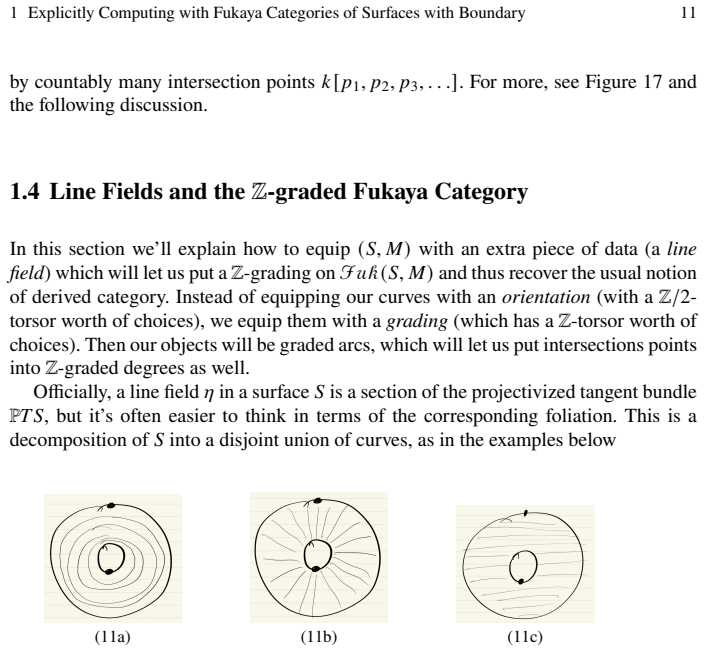
The load-bearing object is the dissection — a family of nonintersecting arcs cutting the surface into polygons — together with its dual 'laminate': perpendicular arcs whose endpoints lie on the boundary stops. The laminate's line field gives the Z-grading and makes all arrows degree 0 when using the dissection's canonical line field; the quiver of arcs and angles then directly encodes the A-infinite structure, with cones of degree-1 maps performing geometric gluing.
What would settle it
Take the once-punctured torus (or any surface with an interior marked point) and compute Ext^• between two arcs ending at the puncture using the dissection recipe; if the countably many generators do not match the geometric wrapping count, or if the differential fails to square to zero for one of the paper's worked matrices, the claimed correspondence fails at the computational level.
Extended reading notes
Core claim
The central claim is that the Z/2- and Z-graded partially wrapped Fukaya category of a marked surface is presented by the A-infinite category of a dissection: choose nonintersecting arcs including all boundary arcs that cut the surface into polygons with at most one boundary edge (or one interior marked point). Then vertices of a quiver are the arcs, arrows are the angles between them (surface on the right), degree 0 or 1 by tip-to-tail orientation, composition is concatenating adjacent angles, and higher multiplications are nonzero exactly for closed polygons. For a dissection the higher operations vanish, so ordinary quiver algebra computes the category. Every arc corresponds to a projecti
Load-bearing premise
The paper assumes, citing foundational work without proof, that the A-infinite category computed from any dissection is independent of the choice of arcs and equivalent to the actual partially wrapped Fukaya category; if this equivalence fails for non-simply-connected or multiply-punctured surfaces, the explicit complexes and degrees in the examples would be wrong.
Editorial extensions
If this is right
- Any curve with a rank-1 local system on a dissected surface has an explicit chain complex of projectives; the paper writes these matrices for the disk, annulus, pair of pants, and a once-punctured surface.
- Ext groups between two curves can be read off from their intersection points: each interior intersection contributes one generator in each direction, with degrees summing to 1 (or 0 in the Z/2 case if orientations match).
- Cones of degree-1 maps are computed by matrix block manipulation, so geometric resolutions can be produced by elementary row and column operations, as shown in the pair-of-pants example.
- For surfaces with interior marked points, wrapping produces countably many generators and infinite projective resolutions; the combinatorial model reproduces these infinite structures exactly.
- The resulting algebra is finite dimensional exactly when the surface has no interior marked points, and classical (no higher A-infinite operations) exactly when the chosen arc system is a dissection.
Reading between the lines
- The explicit matrices suggest a direct algorithm: choose a dissection, build the quiver by scanning angles, and mechanically compute cones; this could be automated in a computer algebra system, potentially making Fukaya-category computations routine for surfaces.
- The sensitivity of Z-grading to line-field choice implies that mirror-symmetry statements for surfaces must specify the grading datum; the Z/2-graded category is a safer target because it requires no such choices.
- The closed-curve construction with monodromy matrices offers a concrete laboratory for Hall-algebra and skein-relation computations, since cones of degree-1 maps between bands are written out explicitly.
- To teach the subject, one can sequence the material as the paper does: first Z/2-graded examples to learn quiver combinatorics, then line fields for integer gradings, since the latter build on the former without new geometric input.
Editorial analysis
A structured set of objections, weighed in public.
Referee Report
Summary. This expository paper presents a combinatorial method for computing the partially wrapped Fukaya category of a marked surface with boundary. The author explains how to choose a dissection (a full arc system that cuts the surface into polygons), associates a quiver to it, and states rules for reading off compositions and higher A∞-operations from angles and closed polygons. It then explains how to write explicit chain complexes for arbitrary arcs and for closed curves with local systems, working in both a Z/2-graded setting (using orientations) and a Z-graded setting (using line fields). The paper includes several detailed worked examples: the disk (A_n quiver), the annulus (Kronecker quiver), the pair of pants, and a surface with an interior marked point. The author states that nothing is original except the exposition, and the foundational equivalences are cited to [6,19,18].
Significance. If correct, the paper fills a useful gap by providing a single, accessible source with multiple detailed worked computations of Fukaya categories of surfaces. The examples appear internally consistent and are grounded in established theorems; the author explicitly disclaims originality and gives references for every foundational step. The figures and step-by-step chain-complex computations are likely to be genuinely helpful to newcomers. The main weakness is that the Z-graded machinery is introduced only through a citation, and the relation between the Z/2-degree convention and the Z-graded 'degree 0' claim is not explained, which makes the central Z-graded example (16f) impossible for the reader to verify independently.
major comments (2)
- [§1.4 and §1.5, Example 16(f), Eqs. (1.1)–(1.3)] The paper asserts that the canonical line field of a dissection 'places the algebra entirely in degree 0' (§1.4), but it never reconciles this with the Z/2-degree rule of §1.3, where arrows are degree 1 when the oriented arcs meet tip-to-tail. If the Z-grading is a lift of the Z/2-grading, then a tip-to-tail arrow must have odd Z-degree. The Z-graded example in §1.5 does not specify the integer grading shifts of the generating arcs A,C,R,M,D, so the reader cannot verify that the differential components ba, e, h, g in the complexes before (1.1) have the claimed degrees. A single odd shift would alter the computed Ext groups in (1.1)–(1.3). Please add an explicit explanation of how the Z/2 and Z conventions are related, and state the gradings used in the example.
- [§1.4, Figures 1.14 and 1.16] The existence and uniqueness of the canonical line field for a dissection is cited to [8] and [19, §2], but the paper does not verify it for the dissections actually depicted, nor does it show how the laminate construction yields the Z-degrees of the arrows used in the pair-of-pants example. The reader is asked to accept that 'after choosing Z-gradings' the blue and orange curves have the stated complexes and that (1.1)–(1.3) are correct. For an expository paper whose goal is to enable independent computation, a short verification for Figure 16(f) — even just the degree of one or two arrows — would make the example reproducible and would also help resolve the compatibility issue raised above.
minor comments (4)
- [§1.1] Typo: 'the higher the higher A∞-operations vanish' should read 'the higher A∞-operations vanish'.
- [§1.3, after Figure 1.7] The formula for μ^n is not clearly written: 'μ^n(γ α1, α2, ..., αn) = γ' appears to have n+1 arguments. Please clarify the intended notation.
- [§1.5, Example 16] The basis elements for Hom^0 and Hom^1 are written as matrices with shorthand like (id_A 0; 0 0). A short sentence explaining the ordering of the basis and the degrees of the generators a,b,c,d would help the reader follow the matrix differential.
- [General] The author states that the computations were verified with a computer, but no code or ancillary files are provided. While not required for an expository paper, a link to the scripts would strengthen reproducibility.
Circularity Check
No circularity: the paper is explicitly expository and all load-bearing computations are grounded in external foundational results.
full rationale
The derivation chain is not circular. Section 1.1 states "Nothing in this article is original except for the exposition"; the computational framework is imported from external works: the dissection-to-A-infinity-category correspondence is cited to [6,19,18], the classicality of dissections is cited to [3, Lemma 9.8], and the canonical line field placing the algebra in degree 0 is cited to Schroll's lecture [8] and [19, Section 2]. The only self-reference is in §1.2, where the author points to her upcoming PhD thesis "for worked out exposition of those topics" (A-infinity and twisted closure); this pointer is not used to justify any computation in the paper. The worked examples in §1.5 are generated by applying the explicit combinatorial rules stated in §1.3 (degree from tip-to-tail orientation, composition from adjacent angles, higher operations from closed polygons) and the cited line-field construction; they are not fitted parameters renamed as predictions, nor are alternatives forbidden by a self-cited uniqueness theorem. The skeptical concern about the Z/2 tip-to-tail degree-1 convention versus the Z-graded "entirely in degree 0" line-field placement is a possible mathematical/correctness issue in the cited material or its application, but it is not a circularity of the present paper's derivation: the grading rule is imported, not derived from the conclusions it is used to verify. Hence no circular step is present.
Assumptions & free parameters
assumptions (4)
- domain assumption The partially wrapped Fukaya category of a marked surface with nonempty boundary is equivalent to the A∞-category presented by an arc system/dissection.
- domain assumption Composition of morphisms corresponds to gluing adjacent angles, and higher A∞-operations correspond to closed polygons in the dissection.
- standard math Every local system on a contractible arc is trivial, and local systems on closed curves correspond to finite-dimensional k[X^{±1}]-modules, decomposing into companion matrices.
- domain assumption There exists a canonical line field attached to a dissection such that the Fukaya algebra is placed entirely in degree 0.
Cite this review
Pith. "Pith review of Explicitly Computing with Fukaya Categories of Surfaces with Boundary." pith.science (2026). https://pith.science/paper/KLIV5ABZ
@misc{pith2026251010867,
  author       = {Pith},
  title        = {Pith review of: Explicitly Computing with Fukaya Categories of Surfaces with Boundary},
  year         = {2026},
  howpublished = {\url{https://pith.science/paper/KLIV5ABZ}},
  note         = {Machine review of arXiv:2510.10867}
}
read the original abstract
Fukaya categories are deep and rich invariants of symplectic manifolds which are notoriously difficult to compute explicitly. In the case of surfaces, however, the situation is simple, combinatorial,and is very well understood (at least by experts). In this expository paper we will give an introduction with many examples to welcome newcomers to the area and hopefully equip them with the tools to independently compute Fukaya categories of surfaces.
Figures


Figures from the paper (10 more)




Reference graph
Works this paper leans on
-
[8]
HausdorffCenterforMathematics.AGeometricModelfortheBoundedDerived Category of a Gentle Algebra, Sibylle Schroll Lecture 3. Oct. 2020. (Visited on 09/20/2024)
2020
-
[19]
Sebastian Opper, Pierre-Guy Plamondon, and Sibylle Schroll.A Geometric ModelfortheDerivedCategoryofGentleAlgebras.Sept.2018.doi:10.48550/ arXiv.1801.09659. arXiv:1801.09659 [math]. (Visited on 08/27/2024)
-
[1]
PaoloAluffi.Algebra:Chapter0.GraduateStudiesinMathematicsv.104.Prov- idence, R.I: American Mathematical Society, 2009.isbn: 978-0-8218-4781-7
2009
-
[2]
A Beginner’s Introduction to Fukaya Categories
Denis Auroux. “A Beginner’s Introduction to Fukaya Categories”. In:Contact andSymplecticTopology.Ed.byFrédéricBourgeois,VincentColin,andAndrás Stipsicz. Vol. 26. Cham: Springer International Publishing, 2014, pp. 85–136. isbn: 978-3-319-02035-8 978-3-319-02036-5.doi:10 . 1007 / 978 - 3 - 319 - 02036-5_3. (Visited on 02/10/2023)
2014
-
[3]
Cambridge: Cambridge University Press, 2021.isbn: 978-1-108-48350-6.doi:10.1017/9781108692458
RafBocklandt.AGentleIntroductiontoHomologicalMirrorSymmetry.London Mathematical Society Student Texts. Cambridge: Cambridge University Press, 2021.isbn: 978-1-108-48350-6.doi:10.1017/9781108692458. (Visited on 07/06/2025)
-
[4]
QuantumGroupsviaHallAlgebrasofComplexes
TomBridgeland.“QuantumGroupsviaHallAlgebrasofComplexes”.In:Annals of Mathematics177.2 (Mar. 2013), pp. 739–759.issn: 0003-486X.doi:10 . 4007/annals.2013.177.2.9. (Visited on 01/03/2023)
2013
-
[5]
The Hall Algebras of Surfaces I
Benjamin Cooper and Peter Samuelson. “The Hall Algebras of Surfaces I”. In: JournaloftheInstituteofMathematicsofJussieu19.3(May2020),pp.971–1028. issn: 1474-7480, 1475-3030.doi:10.1017/S1474748018000324. (Visited on 10/31/2022)
-
[6]
Flat Surfaces and Stability Struc- tures
F. Haiden, L. Katzarkov, and M. Kontsevich. “Flat Surfaces and Stability Struc- tures”. In:Publications mathématiques de l’IHÉS126.1 (Nov. 2017), pp. 247– 318.issn: 1618-1913.doi:10 . 1007 / s10240 - 017 - 0095 - y. (Visited on 02/28/2023)
2017
Show all 20 references
-
[7]
HausdorffCenterforMathematics.AGeometricModelfortheBoundedDerived Category of a Gentle Algebra, Sibylle Schroll Lecture 2. Oct. 2020. (Visited on 09/19/2024)
2020
-
[9]
HausdorffCenterforMathematics.AGeometricModelfortheBoundedDerived Category of a Gentle Algebra, Sibylle Schroll, Lecture 1. Oct. 2020. (Visited on 08/27/2024)
2020
-
[10]
June 2024
Institut Fourier.Claire Amiot - Fukaya Categories Associated with Graded Sur- faces and Gentle Algebras 1. June 2024. (Visited on 08/07/2024)
2024
-
[11]
June 2024
Institut Fourier.Claire Amiot - Fukaya Categories Associated with Graded Sur- faces and Gentle Algebras 2. June 2024. (Visited on 08/07/2024)
2024
-
[12]
June 2024
Institut Fourier.Claire Amiot - Fukaya Categories Associated with Graded Sur- faces and Gentle Algebras 3. June 2024. (Visited on 08/24/2024)
2024
-
[13]
June 2024
Institut Fourier.Claire Amiot - Fukaya Categories Associated with Graded Sur- faces and Gentle Algebras 4. June 2024. (Visited on 08/27/2024)
2024
-
[14]
Introduction to $A$-Infinity Algebras and Modules
Bernhard Keller. “Introduction to $A$-Infinity Algebras and Modules”. In:Ho- mology,HomotopyandApplications3.1(Jan.2001),pp.1–35.issn:1532-0073, 1532-0081. (Visited on 07/17/2025). 1 Explicitly Computing with Fukaya Categories of Surfaces with Boundary 21
2001
-
[15]
On Differential Graded Categories
Bernhard Keller. “On Differential Graded Categories”. In:Proceedings of the International Congress of Mathematicians Madrid, August 22–30, 2006. Ed. by Marta Sanz-Solé et al. Zuerich, Switzerland: European Mathematical Society Publishing House, May 2007, pp. 151–190.isbn: 978-...
2006
-
[16]
Kirillov.Quiver Representations and Quiver Varieties
Alexander A. Kirillov.Quiver Representations and Quiver Varieties. Graduate StudiesinMathematicsvolume174.Providence,RhodeIsland:AmericanMath- ematical Society, 2016.isbn: 978-1-4704-2307-0
2016
-
[17]
(Visited on 03/19/2023)
MaximKontsevich.HomologicalAlgebraofMirrorSymmetry.Nov.1994.arXiv: alg-geom/9411018. (Visited on 03/19/2023)
1994 arXiv
-
[18]
Derived Equivalences of Gentle Alge- bras via Fukaya Categories
Yankı Lekili and Alexander Polishchuk. “Derived Equivalences of Gentle Alge- bras via Fukaya Categories”. In:Mathematische Annalen376.1-2 (Feb. 2020), pp. 187–225.issn: 0025-5831, 1432-1807.doi:10 . 1007 / s00208 - 019 - 01894-5. (Visited on 08/27/2024)
2020
-
[20]
Weibel.An Introduction to Homological Algebra
Charles A. Weibel.An Introduction to Homological Algebra. 1st ed. Cambridge University Press, Apr. 1994.isbn: 978-0-521-43500-0 978-0-521-55987-4 978- 1-139-64413-6.doi:10.1017/CBO9781139644136. (Visited on 12/04/2021)
1994 doi
Reviewed August 4, 2026 · model on record in the stance chip above.
Discussion (0). Continue with ORCID to comment.