REVIEW 3 major objections 6 minor 33 references
UAV-Enabled Uplink Non-Orthogonal Multiple Access System: Joint Deployment and Power Control
T0 review · 3 major / 6 minor · reviewed 2026-08-14 · deepseek-v4-flash
Pith's one-line read A single hover point maximizes the sum rate in UAV-enabled uplink NOMA.
desk verdict A solid, honest optimization paper with one genuinely useful closed-form power rule; the headline 4% gap is a single-scenario observation, not a proven bound. read the letter →
The pith
A machine-rendered reading of the paper's core claim, the machinery that carries it, and where it could break.
The reading
What carries the argument
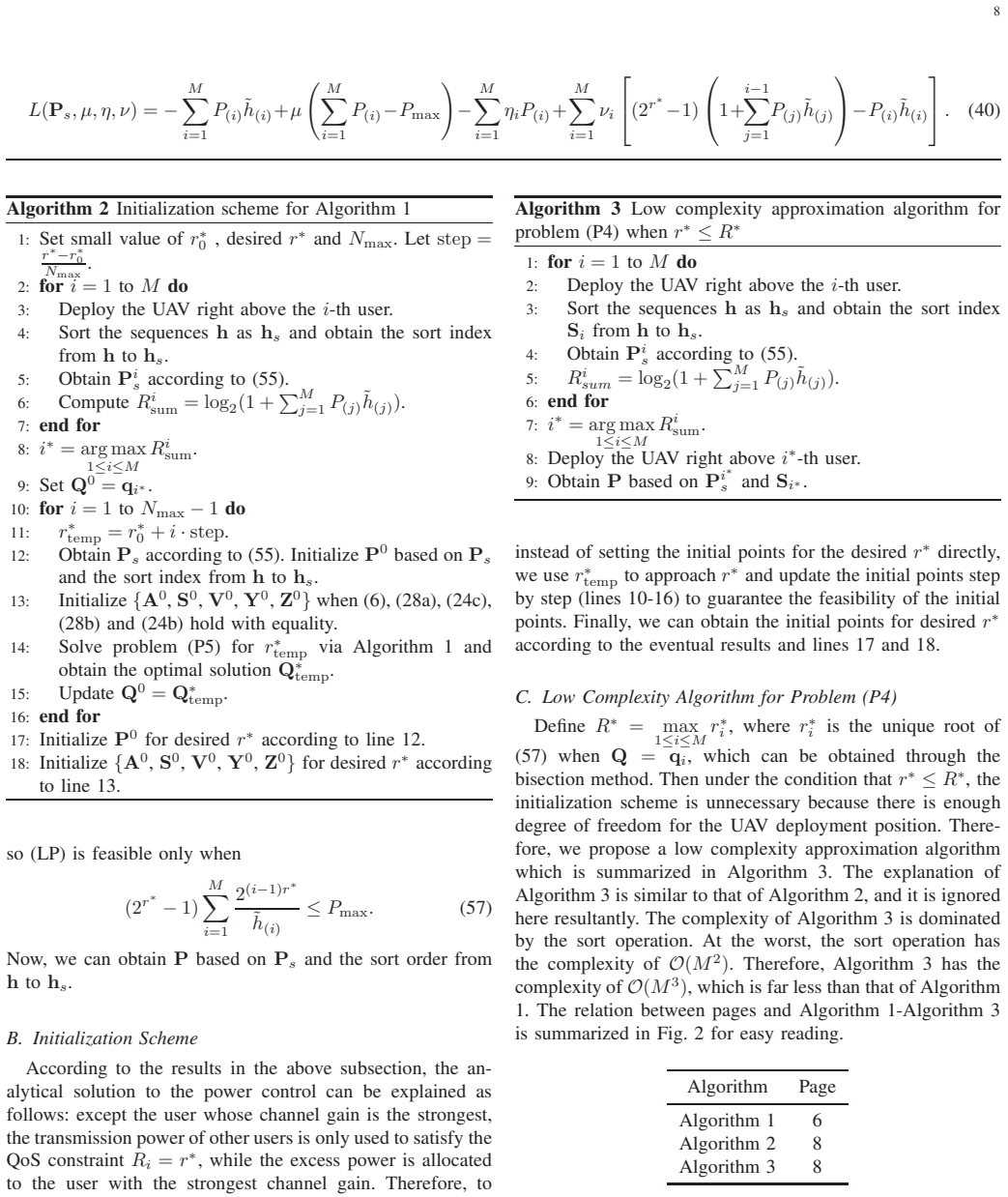
The load-bearing object is the distance-only free-space channel gain $h_i = \sqrt{\beta_0/(H^2+\|q-q_i\|^2)}$, which makes channel strength a deterministic function of horizontal distance and makes the SIC decoding order equivalent to a distance ordering. The identity that carries the argument is (11), $\sum_i R_i = \log_2(1+\sum_i P_i\tilde h_i)$, which removes the decoding order from the objective and turns the trajectory problem into a deployment problem. For the full problem, the machinery is successive convex approximation, which replaces each non-convex constraint by a convex surrogate at a current feasible point, together with a penalty term $\lambda\sum_{i,j}\phi_{ij}$ that relaxes the binary SIC-order variables and drives them to $\{0,1\}$ at convergence. For the fast scheme, the machine is the closed-form power allocation (55), which lets the sum rate at any candidate hover point be evaluated by sorting channel gains and applying a formula without any numerical search.
What would settle it
In the paper's own four-user, 400-by-400 meter setup, add a single tall building between the predicted hover point and the strongest user so that the line-of-sight assumption fails; if the iterative algorithm then selects a non-stationary trajectory or a different hover point, or if the closed-form powers (55) leave the weakest user's rate below $r^*$, the central claim is falsified.
Extended reading notes
Core claim
The central claim is that the trajectory variable can be eliminated. Because the per-slot sum rate satisfies $\sum_i R_i[n] = \log_2(1 + \sum_i P_i[n]\tilde h_i[n])$, independent of the SIC decoding order, every time slot faces the same optimization problem; the mobility constraints only force a return to the start, and the authors prove by contradiction that the optimum is therefore a stationary deployment position (Proposition 1). With the UAV fixed, ordering users by channel gain makes the QoS constraints linear in power, and Karush-Kuhn-Tucker analysis yields the closed-form powers of Eq. (55): for all but the strongest user, $P_{(i)} = (2^{r^*}-1)2^{(i-1)r^*}/\tilde h_{(i)}$, while the strongest user gets $P_{(M)} = P_{\max}-\sum_{i<M}P_{(i)}$. The paper further claims that the full non-convex problem can be approximated by a sequence of convex subproblems, using successive convex approximation for the rate and deployment constraints and a penalty function to drive the relaxed SIC indicators back to $\{0,1\}$, and that the resulting iterative algorithm converges. Finally, the paper claims that when the QoS target is no larger than $R^*$ (the largest target feasible by hovering over a single user), the simple low-complexity algorithm, which hovers over the user giving the highest sum rate evaluated with the closed-form powers, incurs less than 4% sum-rate loss relative to the full iterative algorithm.
Load-bearing premise
The result rests on the channel gain being a deterministic function of horizontal distance only (free-space line-of-sight); if shadowing, blockage, or small-scale fading makes the channel depend on anything else, the stationary deployment, the distance-based SIC order, the closed-form powers, and the hovering heuristic all lose their justification.
Editorial extensions
If this is right
- A UAV collecting uplink NOMA traffic should hover over a single optimized point rather than fly a periodic trajectory, which cuts motion energy and simplifies deployment planning.
- For a fixed UAV location, the optimal uplink powers are known directly: weaker users transmit at the minimum power that meets the per-slot rate target, and all leftover power goes to the strongest user.
- Jointly optimizing deployment and power can substantially raise sum rate over a fixed-base-station NOMA setup and over FDMA, because placement exploits the strongest channel.
- A near-optimal deployment can be found by evaluating only the candidate points directly above each user, with complexity $O(M^3)$, and it keeps more than 96% of the iterative solution's sum rate when the QoS target is below $R^*$.
- Per-slot QoS constraints ensure every user is served in every slot, avoiding the latency that average-rate constraints allow.
Reading between the lines
- Going beyond the paper: the stationary-optimality result depends on identical per-slot problems; with time-correlated shadowing or blockage, a moving UAV that follows the strongest channel could restore a throughput benefit, so a natural extension is to compare hovering against trajectory design under non-line-of-sight channels.
- Going beyond the paper: the closed-form power split reveals an extreme fairness-versus-sum-rate tradeoff; a network designer could use the same formulas to choose $r^*$ to hit a target fairness index without rerunning the optimizer.
- Going beyond the paper: because the sum-rate identity (11) assumes perfect successive interference cancellation, an imperfect-SIC model would break the closed-form powers; the same convex-approximation machinery could be retargeted to residual-interference terms, and the 4% gap would need to be re-measured.
Signed reviews
Editorial analysis
A structured set of objections, weighed in public.
Referee Report
Summary. The paper investigates a UAV-enabled uplink non-orthogonal multiple access (NOMA) system in which a single UAV collects messages from multiple ground users. The authors jointly optimize the UAV deployment position and the users' transmit powers to maximize the sum rate subject to per-slot quality-of-service (QoS) constraints. The problem is formulated as a mixed-integer non-convex program (P1). The paper first proves (Proposition 1) that the UAV should remain stationary at an optimal point, reducing the trajectory problem to a deployment problem. It then develops an iterative algorithm (Algorithm 1) based on successive convex approximation (SCA) and a penalty method to handle the binary SIC ordering variables and non-convex rate constraints. For a fixed deployment, a closed-form power allocation is derived from KKT conditions (Eqs. (55)-(57)). A low-complexity algorithm (Algorithm 3) is proposed that hovers above one user and uses the closed-form power allocation; the authors report that it achieves more than 96% of the iterative algorithm's sum rate when the QoS threshold r* is not too large. Numerical results compare the proposed schemes against a fixed-position NOMA benchmark and an FDMA benchmark.
Significance. If the claims hold, the paper offers a practical and computationally efficient solution to a relevant problem in UAV-assisted uplink NOMA. The stationarity result is a useful simplification, and the KKT-based closed-form power allocation is elegant and is numerically verified in Fig. 6. The SCA and penalty framework is a credible approach to a difficult non-convex problem, and the low-complexity algorithm has clear practical appeal for real-time deployment. The main weakness is that the headline near-optimality claim of the low-complexity algorithm is supported by only a single numerical scenario, and the penalty exactness and convergence guarantees are imported from an external reference without a self-contained verification. These issues, rather than the central derivation, currently limit the strength of the paper's conclusions.
major comments (3)
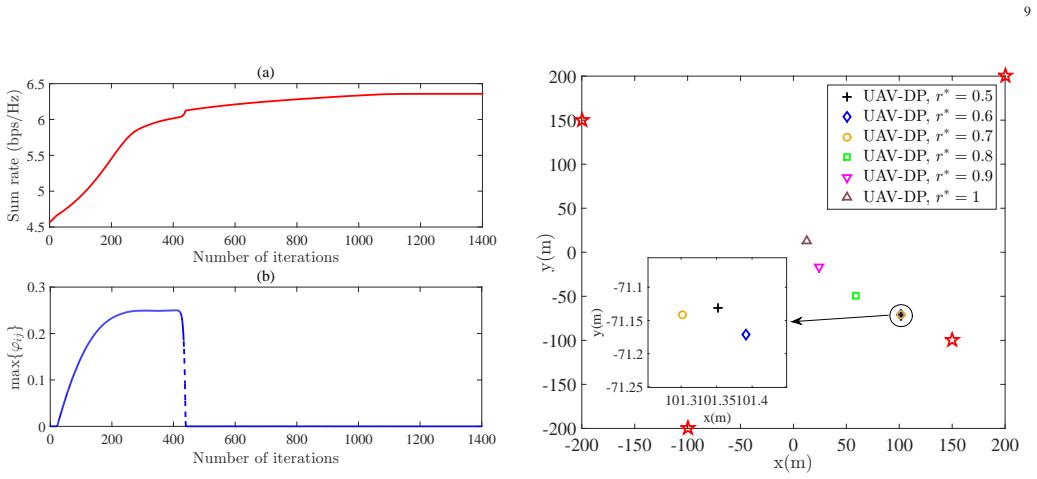
- [Section IV.C and Fig. 7] The claim that Algorithm 3 achieves 'less than 4% performance loss' compared with Algorithm 1 is supported only by one fixed scenario: M=4 users, Pmax=1 W, H=100 m, gamma0=10^6, and a single user geometry in a 400 x 400 m area. Fig. 4 shows that the continuous optimal deployment is not exactly above any user, so the 4% gap measures the cost of the hover-above-user restriction in this one configuration. No theorem or broader simulation establishes the gap as a function of M, user topology, H, or Pmax, and for symmetric or clustered placements the optimal deployment could be far from any single user. Since the low-complexity algorithm is a headline contribution, please either add Monte Carlo results over random user placements and parameter ranges (reporting mean and worst-case gaps) or explicitly qualify the claim as scenario-specific.
- [Section III.B, Eqs. (17)-(19) and Algorithm 1] The exactness of the penalty relaxation is asserted by reference to [31], and Algorithm 1's termination and feasibility rely on phi_ij approaching zero at convergence. The cited result is for a different system model (multicast multigroup multicell transmission), and the manuscript does not verify that the required assumptions (e.g., compactness of the feasible set, constraint qualification, and behavior of the SCA inner approximations under the penalty update) hold for P4/P5. Because this exactness is the mechanism that converts the binary SIC variables into continuous variables, the paper should provide a self-contained argument adapted to this problem, or state clearly that binary feasibility is guaranteed only under the conditions of the cited theorem.
- [Section III.B, Eqs. (22), (25), (27), (30)-(32)] The paper repeatedly states that non-convex constraints are 'transformed into convex constraints' via SCA, but the resulting constraints are sufficient inner approximations, not equivalent reformulations. For example, replacing a convex function by its first-order Taylor lower bound makes the constraint more restrictive, so P5 is an inner approximation of P4, not an equivalent problem. This distinction is important for the correct interpretation of Algorithm 1: its output is feasible for the original problem only if the sequence of inner approximations is maintained and the penalty term converges to zero. Please state this explicitly in Section III.B so that readers do not infer that P5 and P4 have the same feasible set.
minor comments (6)
- [Abstract] The first sentence is a sentence fragment: 'In order to overcome the inherent latency in multi-user unmanned aerial vehicle (UAV) networks with orthogonal multiple access (OMA).' It should be completed or merged with the next sentence.
- [Section II.A, Eq. (3)] Equation (3) defines d_i[n] as the distance but states d_i[n] = H^2 + ||q[n]-q_i||^2, which is dimensionally a squared distance. Please denote this quantity as d_i^2[n] or use a separate notation for the squared distance.
- [Section V, Figs. 3 and 4] The text refers to 'Fig. 2(a)' and 'Fig. 2(b)' for the convergence performance, but the convergence plots appear in Figs. 3(a) and 3(b); Fig. 2 is used for the algorithm-page table. Please correct the cross-references.
- [Throughout] There are several typographical errors: 'We proof Proposition 1' should be 'We prove Proposition 1'; 'Baesd' should be 'Based'; 'can-not' should be 'cannot'; 'poorer suers' should be 'poorer users'.
- [Section IV.C, paragraph on complexity] The complexity statement is unclear: the text says the sort operation is O(M^2) and therefore Algorithm 3 has complexity O(M^3). Sorting M elements with a comparison-based sort is O(M log M), so the M repetitions in Algorithm 3 would be O(M^2 log M), not O(M^3), unless a non-standard sorting cost is assumed. Please clarify the complexity model.
- [Section V, first paragraph] The statement 'we can work out that R* ≈ 1.09 bps/Hz' is given without showing which user yields this value or how the bisection is performed. A brief explanation or a reference to Eq. (57) would improve reproducibility.
Circularity Check
No circularity found: the power-control closed form is derived from KKT conditions, and the numerical benchmarks are external.
full rationale
The paper's central derivation is self-contained rather than circular. The closed-form power allocation in (55) is obtained by solving the linear program (39) with the Karush-Kuhn-Tucker conditions, using the QoS constraints (38) and the total power constraint (37b); it is not assumed from the objective. The stationarity result in Proposition 1 follows from the time-invariant per-slot problem and the identity in (11), not from a pre-supposed deployment. The penalty-function equivalence is imported from the external reference [31], which is not authored by the present authors, and it is a tooling assumption rather than a restatement of the paper's own results. The benchmarks FDMA and fixed-position NOMA are external comparison schemes, and the reported "less than 4% performance loss" for Algorithm 3 is an empirical observation from Fig. 7, not a quantity constructed from the algorithm's own inputs. Although the paper contains a few self-citations, none of them is load-bearing to the main derivation. No equation is shown to be equivalent to its own input, and no fitted parameter is renamed as a prediction. Therefore the paper does not exhibit circularity.
Assumptions & free parameters
free parameters (1)
- Algorithmic penalty parameters lambda, update factor c, thresholds epsilon1, epsilon2, N0
assumptions (6)
- domain assumption Free-space LoS channel model (Eq. (2)): h_i[n]=sqrt(beta0/(H^2+||q[n]-q_i||^2)).
- domain assumption Perfect SIC at the UAV with known decoding order alpha (Eqs. (6)-(8)).
- domain assumption Penalty exactness: phi_ij=0 at convergence so relaxed binary constraints recover {0,1} (Section III-B, citing [31]).
- ad hoc to paper H>>1 so that H^2+||Q-q_i||^2-alpha_ij stays positive, validating convexity of the SCA term in constraint (22).
- domain assumption Per-slot QoS constraint (10b) is feasible for the chosen r*; otherwise P3/P4 are infeasible.
- standard math Sum-rate identity (11): sum_i R_i[n]=log2(1+sum_i P_i[n] h_i[n]) independent of SIC order, attributed to [9].
Cite this review
Pith. "Pith review of UAV-Enabled Uplink Non-Orthogonal Multiple Access System: Joint Deployment and Power Control." pith.science (2026). https://pith.science/paper/KLWWZYFF
@misc{pith2026190809289,
  author       = {Pith},
  title        = {Pith review of: UAV-Enabled Uplink Non-Orthogonal Multiple Access System: Joint Deployment and Power Control},
  year         = {2026},
  howpublished = {\url{https://pith.science/paper/KLWWZYFF}},
  note         = {Machine review of arXiv:1908.09289}
}
read the original abstract
In order to overcome the inherent latency in multi-user unmanned aerial vehicle (UAV) networks with orthogonal multiple access (OMA). In this paper, we investigate the UAV enabled uplink non-orthogonal multiple access (NOMA) network, where a UAV is deployed to collect the messages transmitted by ground users. In order to maximize the sum rate of all users and to meet the quality of service (QoS) requirement, we formulate an optimization problem, in which the UAV deployment position and the power control are jointly optimized. This problem is non-convex and some variables are binary, and thus it is a typical NP hard problem. In this paper, an iterative algorithm is proposed with the assistance of successive convex approximate (SCA) technique and the penalty function method. In order to reduce the high computational complexity of the iterative algorithm, a low complexity approximation algorithm is then proposed, which can achieve a similar performance compared to the iterative algorithm. Compared with OMA scheme and conventional NOMA scheme, numerical results show that our proposed algorithms can efficiently improve the sum rate.
Figures

Figures from the paper (3 more)


Reference graph
Works this paper leans on
-
[31]
Max-min fairness for mu lticast multigroup multicell transmission under backhaul constra ints,
Q. Vu, K. Nguyen, and M. Juntti, “Max-min fairness for mu lticast multigroup multicell transmission under backhaul constra ints,” in Proc. IEEE Global Commun. Conf. , Washington DC, USA, Dec. 2016
work page 2016
-
[1]
L. Dai, B. Wang, Y . Y uan, S. Han, C. I, and Z. Wang, “Non-ort hogonal multiple access for 5G: solutions, challenges, opportunit ies, and future research trends,” IEEE Commun. Mag. , vol. 53, no. 9, pp. 74–81, Sep. 2015
work page 2015
-
[2]
Non-orthogonal multiple access (NOMA) for cel lular future radio access,
Y . Saito, Y . Kishiyama, A. Benjebbour, T. Nakamura, A. Li , and K. Higuchi, “Non-orthogonal multiple access (NOMA) for cel lular future radio access,” in Proc. IEEE 77th V eh. Technol. Conf. , Dresden, Germany, Jun. 2013
work page 2013
-
[3]
An optimization pe rspective of the superiority of NOMA compared to conventional OMA,
Z. Chen, Z. Ding, X. Dai, and R. Zhang, “An optimization pe rspective of the superiority of NOMA compared to conventional OMA,” IEEE Trans. Signal Process. , vol. 65, no. 19, pp. 5191–5202, Oct. 2017
work page 2017
-
[4]
PIC-based iterat ive SDR detector for OFDM systems in doubly-selective fading chann els,
S. Feng, H. Minn, L. Y an, and L. Jinhui, “PIC-based iterat ive SDR detector for OFDM systems in doubly-selective fading chann els,” IEEE Trans. Wireless Commun. , vol. 9, no. 1, pp. 86–91, Jan. 2010
work page 2010
-
[5]
Low-com plexity sphere decoding for detection of OFDM systems in doubly-sel ective fading channels,
Y . Liang, F. Shu, S. Berber, Q. Zhang, and Z. Liu, “Low-com plexity sphere decoding for detection of OFDM systems in doubly-sel ective fading channels,” Electron. Lett., vol. 45, no. 15, pp. 797–798, Jul. 2009
work page 2009
-
[6]
On the performanc e of non-orthogonal multiple access in 5G systems with randomly deployed users,
Z. Ding, Z. Y ang, P . Fan, and H. V . Poor, “On the performanc e of non-orthogonal multiple access in 5G systems with randomly deployed users,” IEEE Signal Process. Lett. , vol. 21, no. 12, pp. 1501–1505, Dec. 2014
work page 2014
-
[7]
Fairness for non-orthogo nal multiple access in 5G systems,
S. Timotheou and I. Krikidis, “Fairness for non-orthogo nal multiple access in 5G systems,” IEEE Signal Process. Lett. , vol. 22, no. 10, pp. 1647–1651, Oct. 2015
work page 2015
Show all 33 references
-
[8]
Uplink non-orthog onal multiple access in 5G systems,
N. Zhang, J. Wang, G. Kang, and Y . Liu, “Uplink non-orthog onal multiple access in 5G systems,” IEEE Commun. Lett. , vol. 20, no. 3, pp. 458–461, Mar. 2016
2016
-
[9]
Upli nk non- orthogonal multiple access for 5G wireless networks,
M. Al-Imari, P . Xiao, M. A. Imran, and R. Tafazolli, “Upli nk non- orthogonal multiple access for 5G wireless networks,” in Proc. 11th Int. Symp. Wireless Commun. Syst. , Barcelona, Spain, Aug. 2014, pp. 781–785
2014
-
[10]
Cooperative non-ortho gonal multiple access in 5G systems,
Z. Ding, M. Peng, and H. V . Poor, “Cooperative non-ortho gonal multiple access in 5G systems,” IEEE Commun. Lett. , vol. 19, no. 8, pp. 1462– 1465, Aug. 2015
2015
-
[11]
Impact of user pairing on 5G non- orthogonal multiple-access downlink transmissions,
Z. Ding, P . Fan, and H. V . Poor, “Impact of user pairing on 5G non- orthogonal multiple-access downlink transmissions,” IEEE Trans. V eh. Technol., vol. 65, no. 8, pp. 6010–6023, Aug. 2016
2016
-
[12]
A novel user pair ing in downlink non-orthogonal multiple access,
X. Zhang, J. Wang, J. Wang, and J. Song, “A novel user pair ing in downlink non-orthogonal multiple access,” in Proc. IEEE Int. Symp. Broadband Multimedia Syst. Broadcast. , V alencia, Spain, Jun. 2018
2018
-
[13]
Wireless communicatio ns with unmanned aerial vehicles: opportunities and challenges,
Y . Zeng, R. Zhang, and T. J. Lim, “Wireless communicatio ns with unmanned aerial vehicles: opportunities and challenges,” IEEE Commun. Mag., vol. 54, no. 5, pp. 36–42, May. 2016
2016
-
[14]
Joint trajectory and commu nication de- sign for UA V-enabled multiple access,
Q. Wu, Y . Zeng, and R. Zhang, “Joint trajectory and commu nication de- sign for UA V-enabled multiple access,” in Proc. IEEE Global Commun. Conf., Singapore, Singapore, Dec. 2017. 12
2017
-
[15]
Joint trajectory and communication design for mul ti-UA V en- abled wireless networks,
——, “Joint trajectory and communication design for mul ti-UA V en- abled wireless networks,” IEEE Trans. Wireless Commun., vol. 17, no. 3, pp. 2109–2121, Mar. 2018
2018
-
[16]
Energy-efficient data co llection in UA V enabled wireless sensor network,
C. Zhan, Y . Zeng, and R. Zhang, “Energy-efficient data co llection in UA V enabled wireless sensor network,” IEEE Wireless Commun. Lett. , vol. 7, no. 3, pp. 328–331, Jun. 2018
2018
-
[17]
UA V-enabled sec ure communications: Joint trajectory and transmit power optim ization,
X. Zhou, Q. Wu, S. Y an, F. Shu, and J. Li, “UA V-enabled sec ure communications: Joint trajectory and transmit power optim ization,” IEEE Trans. V eh. Technol., vol. 68, no. 4, pp. 4069–4073, Apr. 2019
2019
-
[18]
Securing UA V commu nica- tions via trajectory optimization,
G. Zhang, Q. Wu, M. Cui, and R. Zhang, “Securing UA V commu nica- tions via trajectory optimization,” in Proc. IEEE Global Commun. Conf. , Singapore, Singapore, Dec. 2017
2017
-
[19]
Dual-UA V-enabled secure communications: Joint trajectory design and user scheduli ng,
Y . Cai, F. Cui, Q. Shi, M. Zhao, and G. Y . Li, “Dual-UA V-enabled secure communications: Joint trajectory design and user scheduli ng,” IEEE J. Sel. Areas in Commun. , vol. 36, no. 9, pp. 1972–1985, Sep. 2018
1972
-
[20]
Energy-efficient UA V communicati on with trajectory optimization,
Y . Zeng and R. Zhang, “Energy-efficient UA V communicati on with trajectory optimization,” IEEE Trans. Wireless Commun. , vol. 16, no. 6, pp. 3747–3760, Jun. 2017
2017
-
[21]
Trajectory optimization and power allocation for multi-hop UA V relaying communicat ions,
G. Zhang, H. Y an, Y . Zeng, M. Cui, and Y . Liu, “Trajectory optimization and power allocation for multi-hop UA V relaying communicat ions,” IEEE Access , vol. 6, pp. 48 566–48 576, Aug. 2018
2018
-
[22]
Throughput maximizati on for UA V-enabled mobile relaying systems,
Y . Zeng, R. Zhang, and T. J. Lim, “Throughput maximizati on for UA V-enabled mobile relaying systems,” IEEE Trans. Commun. , vol. 64, no. 12, pp. 4983–4996, Dec. 2016
2016
-
[23]
Delay-constrained throughput maxi mization in UA V-enabled OFDM systems,
Q. Wu and R. Zhang, “Delay-constrained throughput maxi mization in UA V-enabled OFDM systems,” in Proc. IEEE Asia-Pacific Conf. Commun., Perth, Australia, Dec. 2017
2017
-
[24]
Common throughput maximization in UA V-enabled OF DMA systems with delay consideration,
——, “Common throughput maximization in UA V-enabled OF DMA systems with delay consideration,” IEEE Trans. Commun. , vol. 66, no. 12, pp. 6614–6627, Dec. 2018
2018
-
[25]
Joint trajec tory design and power allocation for UA V-enabled non-orthogonal multi ple access systems,
F. Cui, Y . Cai, Z. Qin, M. Zhao, and G. Y . Li, “Joint trajec tory design and power allocation for UA V-enabled non-orthogonal multi ple access systems,” in Proc. IEEE Global Commun. Conf. , Abu Dhabi, United Arab Emirates, Dec. 2018
2018
-
[26]
UA V-e nabled communication using NOMA,
A. A. Nasir, H. D. Tuan, T. Q. Duong, and H. V . Poor, “UA V-e nabled communication using NOMA,” IEEE Trans. Commun. , vol. 67, no. 7, pp. 5126–5138, Jul. 2019
2019
-
[27]
Placement and power allocation for NOMA-UA V networks,
X. Liu, J. Wang, N. Zhao, Y . Chen, S. Zhang, Z. Ding, and F. R. Y u, “Placement and power allocation for NOMA-UA V networks,” IEEE Wireless Commun. Lett. , vol. 8, no. 3, pp. 965–968, Jun. 2019
2019
-
[28]
A general pow er allocation scheme to guarantee quality of service in downlink and uplin k noma systems,
Z. Y ang, Z. Ding, P . Fan, and N. Al-Dhahir, “A general pow er allocation scheme to guarantee quality of service in downlink and uplin k noma systems,” IEEE Trans. Wireless Commun. , vol. 15, no. 11, pp. 7244– 7257, Nov. 2016
2016
-
[29]
Joint trajectory and precoding optimization for UA V-assi sted NOMA networks,
N. Zhao, X. Pang, Z. Li, Y . Chen, F. Li, Z. Ding, and M. Alou ini, “Joint trajectory and precoding optimization for UA V-assi sted NOMA networks,” IEEE Trans. Commun. , vol. 67, no. 5, pp. 3723–3735, May 2019
2019
-
[30]
CVX: Matlab software for discipli ned convex programming,
M. Grant and S. Boyd, “CVX: Matlab software for discipli ned convex programming,” [Online] Available: http://cvxr.com/cvx, Mar. 2014
2014
-
[32]
A novel cooperative N OMA for designing UA V-assisted wireless backhaul networks,
T. M. Nguyen, W. Ajib, and C. Assi, “A novel cooperative N OMA for designing UA V-assisted wireless backhaul networks,” IEEE J. Sel. Areas in Commun. , vol. 36, no. 11, pp. 2497–2507, Nov. 2018
2018
-
[33]
Outage cons trained robust transmit optimization for multiuser MISO downlinks : Tractable approximations by conic optimization,
K. Wang, A. M. So, T. Chang, W. Ma, and C. Chi, “Outage cons trained robust transmit optimization for multiuser MISO downlinks : Tractable approximations by conic optimization,” IEEE Trans. Signal Process. , vol. 62, no. 21, pp. 5690–5705, Nov. 2014
2014
Reviewed August 14, 2026 · model on record in the stance chip above.
Discussion (0). Continue with ORCID to comment.