REVIEW 3 major objections 4 minor 96 references
Asteroseismology of four eccentric double-lined spectroscopic eclipsing binaries
T0 review · 3 major / 4 minor · reviewed 2026-08-07 · deepseek-v4-flash
Pith's one-line read Using eclipses as spatial filters, the paper assigns every detected pulsation to a specific component of four eccentric binaries, classifying three delta Scuti, one gamma Dor, and two hybrid pulsators.
desk verdict Solid four-system study that gets three of four pulsation attributions right; the CX Phe 'both delta Sct' claim is internally inconsistent and over-sold in the abstract. read the letter →
The pith
A machine-rendered reading of the paper's core claim, the machinery that carries it, and where it could break.
The reading
What carries the argument
The central mechanism is the use of an eclipse as a spatial filter. Because the two stars in each system are similar in brightness and temperature, a primary or secondary eclipse blocks a comparable amount of light from one component; frequencies whose amplitudes weaken during a given eclipse are assigned to the star being covered, while frequencies that survive are assigned to the uncovered star. The frequency extraction itself is a classical prewhitening Fourier analysis of the out-of-eclipse residuals, with a signal-to-noise threshold near 5, followed by computation of the pulsation constant $Q$ from each frequency and the star's absolute parameters, and comparison with published $Q$ models to assign radial, non-radial, fundamental, or overtone modes. The absolute parameters that feed into $Q$ come from light-curve modeling of the TESS data with the mass ratio fixed by the radial-velocity semi-amplitudes.
What would settle it
Re-measure both components' radial-velocity curves with independent high-resolution spectra and recompute the masses, radii, and Q-values; if the new semi-amplitudes differ from the adopted K values by more than the quoted errors, the pulsation-mode identifications would need to be revised.
Extended reading notes
Core claim
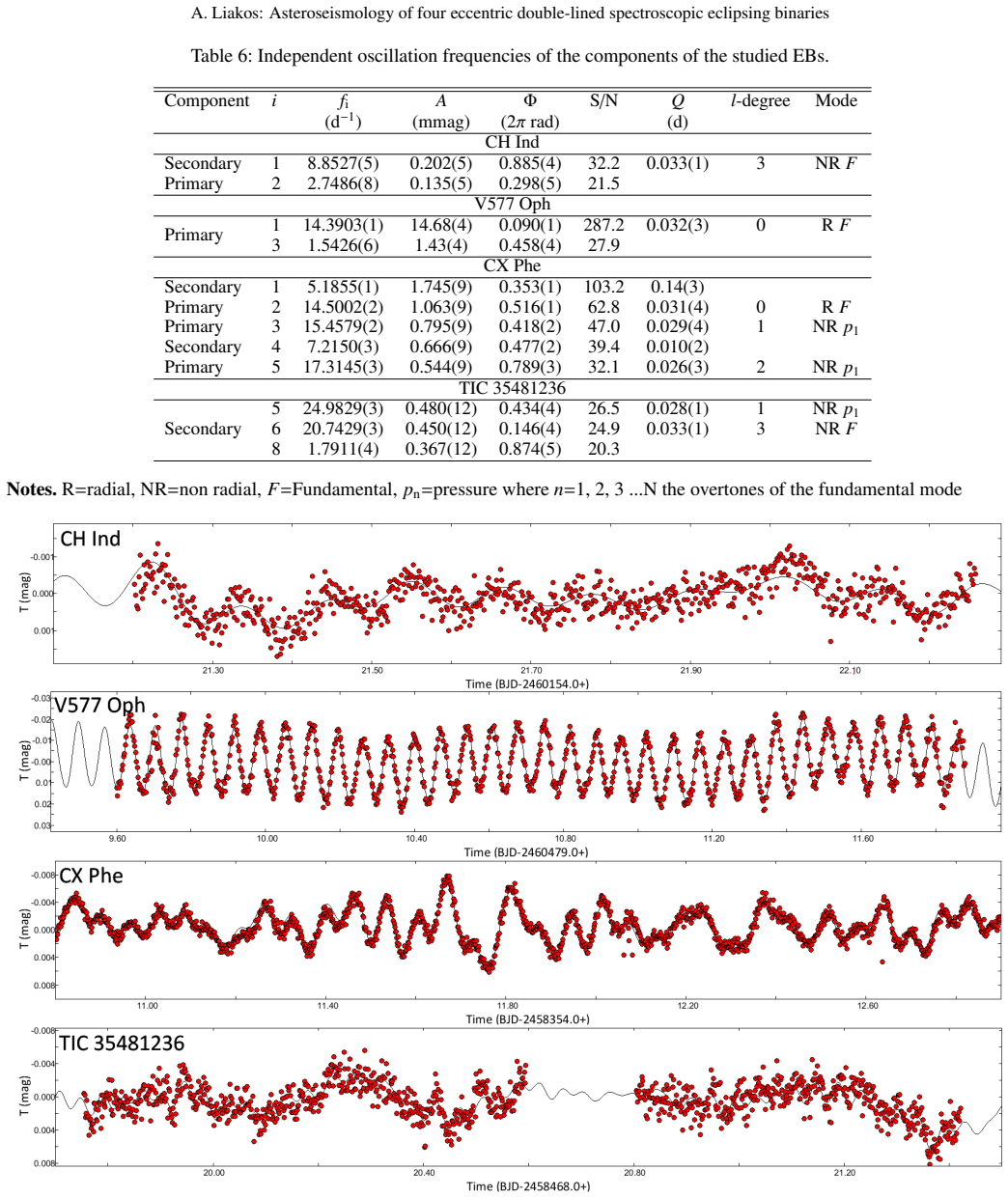
On the paper's own terms, the discovery is that eclipses can serve as a spatial filter even when they are partial: by comparing the Fourier spectra of in-eclipse and out-of-eclipse light, each system's pulsation frequencies can be assigned to a specific star. CH Ind is found to host two pulsators of different classes, a $\gamma$ Dor primary with dominant frequency $f_2 = 2.7486\,\mathrm{d}^{-1}$ and a $\delta$ Sct secondary with $f_1 = 8.8527\,\mathrm{d}^{-1}$, the latter identified as a non-radial fundamental mode. V577 Oph's primary is a hybrid: $f_1 = 14.3903\,\mathrm{d}^{-1}$ is a radial fundamental $\delta$ Sct mode and $f_3 = 1.5426\,\mathrm{d}^{-1}$ is a $\gamma$ Dor-type $g$ mode. In CX Phe both stars pulsate as $\delta$ Sct stars, the primary with three independent frequencies at 14.50, 15.46, and 17.31 $\mathrm{d}^{-1}$, the secondary with modes at 5.19 and 7.22 $\mathrm{d}^{-1}$. TIC 35481236's secondary is a hybrid $\delta$ Sct-$\gamma$ Dor star with independent frequencies at 1.79, 20.74, and 24.98 $\mathrm{d}^{-1}$. For V577 Oph the paper also establishes a roughly 5000-year apsidal-motion period and a light-travel-time modulation consistent with a third body of minimal mass $0.5\,M_\odot$.
Load-bearing premise
The load-bearing premise is that the radial-velocity semi-amplitudes used to fix each system's mass ratio are accurate; for one system the paper substitutes ground-based values for a satellite measurement it considers wrong, and for another its derived masses differ from the automatic satellite solution by about 11.5 percent.
Editorial extensions
If this is right
- The sample of detached double-lined eclipsing binaries with well-measured $\delta$ Sct components grows by about 14 percent, giving the empirical $P_{\rm orb}$--$P_{\rm puls}$ and $f$--$\log g$ relations more leverage.
- CH Ind becomes a rare benchmark: two stars of nearly equal mass, radius, and temperature in the same binary occupy different pulsation classes, $\gamma$ Dor versus $\delta$ Sct, so the pair can test what controls the transition between those instability regions.
- V577 Oph's apsidal motion with a period of about 5000 years and a 33-year periodic modulation imply a third body of at least $0.5\,M_\odot$ that is too faint to appear in the light curve.
- The hybrid pulsators in V577 Oph and TIC 35481236 add data points inside the overlap region of the $\delta$ Sct and $\gamma$ Dor instability strips, where both $p$ and $g$ modes can be observed.
- CX Phe's components sit off single-star evolutionary tracks, which the paper interprets as past mass exchange or mass loss; if true, its pulsation frequencies must be modeled in a binary-evolution context rather than as isolated stellar oscillations.
Reading between the lines
- The same eclipse-as-spatial-filter logic could be applied to the hundreds of eclipsing binaries whose pulsations are currently unattributed, even single-lined systems, to assign frequencies to components without waiting for a total eclipse.
- CH Ind's near-twin components belonging to different pulsation classes suggests that a small structural difference, such as rotation, tidal deformation, or a slight composition offset, tips a star between $\gamma$ Dor and $\delta$ Sct pulsation; asteroseismic modeling of the two stars could identify which parameter matters.
- The 11.5 percent mass discrepancy between this fit and the automatic satellite solution for CX Phe hints that eccentric SB2 systems may have systematically offset automated masses; checking the offset against orbital eccentricity in a larger sample would test that.
- The $0.014\,\mathrm{d}^{-1}$ signal in TIC 35481236, dismissed as an artifact, corresponds to a 71-day timescale; a few more TESS sectors would show whether it is a real low-frequency mode, an instrumental effect, or an alias.
Editorial analysis
A structured set of objections, weighed in public.
Referee Report
Summary. The manuscript analyzes TESS photometry and Gaia/ground-based radial velocities for four eccentric detached double-lined spectroscopic eclipsing binaries (CH Ind, V577 Oph, CX Phe, and TIC 35481236). It models the light curves with PHOEBE/Wilson-Devinney, derives absolute masses, radii, and luminosities, performs Fourier analyses of the light-curve residuals, and uses eclipses as spatial filters to attribute pulsation frequencies to individual components. The main claims are that CH Ind hosts a gamma Dor primary and a delta Sct secondary, V577 Oph hosts a hybrid delta Sct-gamma Dor primary, both CX Phe components are delta Sct stars, and TIC 35481236 hosts a hybrid delta Sct-gamma Dor secondary. The paper also presents an eclipse-timing-variation analysis for V577 Oph, obtaining apsidal motion parameters and a low-mass third body, and compares the delta Sct components with published samples in orbital-period, evolutionary, and mass-radius diagrams.
Significance. If the component attributions and absolute parameters are correct, this is a valuable contribution: it adds four well-characterized SB2+E systems with pulsating components, where eclipse light-curve modelling plus frequency analysis can constrain which star pulsates and at which mode. The paper supplies extensive frequency tables, Q-mode identifications, evolutionary diagrams, and comparisons with existing samples, and it is transparent about many data-selection choices. The spatial-filter method is a useful approach for systems without total eclipses. However, the central component-attribution claim is not equally secure for all four systems: the CX Phe attribution is internally inconsistent, and because the absolute parameters scale directly from adopted RV semi-amplitudes, the mode identifications inherit any systematic error in those K values. With the CX Phe issue repaired, the paper would make a solid contribution; as it stands, the headline claim about both CX Phe components being delta Sct stars is not established.
major comments (3)
- [6.3, Table 6] The assignment of f4 to the CX Phe secondary is not supported by the paper's own spatial-filter criterion. The text states that f2, f3, f4, and f5 are amplified during the secondary eclipse and uses this amplification to assign f2, f3, and f5 to the primary, but f4 is assigned to the secondary solely on the basis of the f1/f4 ratio of about 0.72. That ratio argument presumes that both frequencies originate from the same star, which is exactly the point at issue, so it cannot override the observed amplification. The paper also states that f1 'remains almost intact' during the secondary eclipse, rather than showing the decrease expected if f1 originated from the eclipsed secondary, and it concedes that no total eclipses occur and that the primary-eclipse analysis for CX Phe was unreliable. Therefore the abstract's definitive statement that both CX Phe components are delta Sct stars is not established, and the Section 7 summary counts and the comparison samples inherit this uncertainty.
- [3-4, Tables 2-3] All absolute masses, radii, luminosities, and hence the Q values used for mode identification are derived from the adopted K semi-amplitudes, but no RV curves or direct RV fits are shown in the paper. The input K values are heterogeneous: Gaia NSS values are used for three systems and Jeffery et al. (2017) values for V577 Oph, and the paper reports discrepancies of 10.9-11.7% for the CX Phe masses and 21.6% for the V577 Oph secondary mass against Gaia. Since Table 6's l-degree identifications and the positions of stars in Figures 2, 6, and 7 depend on these absolute parameters, a systematic error in any single adopted K value would propagate into the pulsational mode classification. Showing the RV fits, or at least quantitatively propagating the K uncertainties into Q and l, would materially strengthen the central claim.
- [5, Table 4] The claimed LITE third body around V577 Oph needs a stronger statistical justification. The fit uses approximately 20 photoelectric and CCD minima spanning roughly 70 years, with a derived third-body period of 33 years that is comparable to the usable baseline, and the 1928-1964 photographic minima are discarded without a quantitative sensitivity test. A bootstrap analysis, a residual periodogram, or a false-alarm estimate would help demonstrate that the 0.013-day LITE amplitude and the 0.50 solar-mass minimum mass are not an artifact of the few points and the chosen weighting.
minor comments (4)
- [7] There are several typographical errors, including 'pulsatots' in Section 7, 'agrement' in Section 7, and 'photoeletcric' in Section 5; these should be corrected in the revised version.
- [6.3] The abstract states definitively that both components of CX Phe are delta Sct stars, while Section 6.3 itself says that for f4 'the origin star cannot be determined with absolute certainty.' The abstract and the summary counts in Section 7 should be aligned with the actual degree of confidence expressed in the analysis.
- [6.4, Table C.1] For TIC 35481236, f2 is labeled as an artifact in the text but is still listed in Table C.1 with '???' as its combination; the table caption or a footnote should make clear whether this frequency is part of the final pulsation model.
- [4] The 42% distance discrepancy for V577 Oph is attributed to a possible error in the adopted BCTESS value, but no quantitative test is given; a short paragraph exploring the sensitivity of the derived distance to BCTESS or extinction would make the discussion more complete.
Circularity Check
No significant circularity: the binary, pulsation, and mode-identification chains are independent of their own outputs; self-citations provide methods and comparison samples but are not load-bearing.
full rationale
The paper's derivation chain is self-contained against external data and external benchmarks. Mass ratios are computed from published RV semi-amplitudes (q = K1/K2; Table 2, Sect. 3), and absolute masses, radii, and luminosities follow from the LC model plus these K values via AbsParEB; none of these quantities is defined in terms of the pulsation results. Frequencies are extracted by iterative Fourier prewhitening of the LC residuals (Sect. 6) with an S/N threshold around 5, and mode identifications are made by comparing computed Q values with the external Fitch (1981) models. Component attribution uses the eclipses as spatial filters, a geometric argument that does not presuppose the final classification. The V577 Oph third-body and apsidal-motion parameters are fitted to ETV residuals and are presented as detections, not as predictions, so they cannot reduce to their own inputs. The paper's self-citations (Liakos 2017 for the S/N method; Liakos & Niarchos 2017, Liakos 2020, 2025 for catalogues and comparison correlations) are used for methodology and for placing the new systems in context; the four systems' newly derived parameters do not depend on those catalogued values. The skeptical concern about CX Phe's f4 attribution is a consistency/correctness issue internal to the spatial-filter interpretation, not a circularity: the paper itself concedes that no total eclipses occur and that the primary-eclipse analysis for CX Phe was not reliable, but that concession does not make any claimed result equivalent to its input by construction. Overall, no circular step can be exhibited from the text.
Assumptions & free parameters
free parameters (3)
- Primary effective temperatures Teff,1 (four systems) =
6900, 7000, 7000, 7400 K for CH Ind, V577 Oph, CX Phe, TIC 35481236
- Secondary effective temperatures Teff,2 =
6908, 6901, 6478, 7463 K
- V577 Oph apsidal motion and LITE parameters =
U about 4956 yr, omega_dot = 0.0012 deg/cycle, P3 = 33 yr, A = 0.013 d, e3 = 0.28, M3,min = 0.50 solar masses
assumptions (5)
- domain assumption The Gaia NSS (or Jeffery et al. 2017 for V577 Oph) RV semi-amplitudes K are correct and set q = K1/K2 and the absolute mass scale.
- domain assumption Primary effective temperatures fixed from catalogues are accurate to about 200 K.
- domain assumption Eclipses act as clean spatial filters that separate the pulsation origin.
- domain assumption Q values computed with Breger (2000) and compared to Fitch (1981) identify radial versus non-radial modes.
- domain assumption All components rotate synchronously with the orbital frequency (F = 1.0).
invented entities (1)
-
Third body around V577 Oph with minimum mass 0.50 solar masses
independent evidence
Cite this review
Pith. "Pith review of Asteroseismology of four eccentric double-lined spectroscopic eclipsing binaries." pith.science (2026). https://pith.science/paper/KM6CC4GJ
@misc{pith2026250614395,
  author       = {Pith},
  title        = {Pith review of: Asteroseismology of four eccentric double-lined spectroscopic eclipsing binaries},
  year         = {2026},
  howpublished = {\url{https://pith.science/paper/KM6CC4GJ}},
  note         = {Machine review of arXiv:2506.14395}
}
abstract
Photometric data from the Transiting Exoplanet Survey Satellite (TESS) mission and radial velocities from the Gaia mission and ground-based observations were used to model the light curves and calculate the physical parameters of the eccentric eclipsing systems CH Ind, V577 Oph, CX Phe, and TIC 35481236. The components of these systems have temperatures between 6450 and 7500 K, masses between 1.4 and 1.85 solar masses, and radii between 1.49 and 3.05 solar radii. The residuals of these models were further analyzed using the Fourier method to reveal the pulsational frequencies of their oscillating components. Due to the similarity of the components of each system, the eclipses were used as spatial filters in order to determine which member is the pulsating star. CH Ind was found to pulsate in 46 frequencies; its primary component is a $\gamma$ Dor star and the secondary a $\delta$ Sct star. The primary component of V577 Oph oscillates in both the regimes of $\gamma$ Dor and $\delta$ Sct stars. Moreover, using past timings of minima, an eclipse timing variation analysis was also performed for V577 Oph, resulting in the calculation of the apsidal motion parameters and the existence of a third body around the system. Both components of CX Phe were found to be $\delta$ Sct stars; its primary has three independent frequencies in the range of 14.5-17.4 d$^{-1}$ and its secondary has two main modes of 5.19 and 7.22 d$^{-1}$. The analysis of TIC 35481236 indicates the hybrid $\delta$ Sct-$\gamma$ Dor nature of its secondary component. The physical and pulsational properties of the $\delta$ Sct stars of these systems were compared with those of other $\delta$ Sct stars-members of binaries in evolutionary diagrams.
Figures


Figures from the paper (4 more)



Reference graph
Works this paper leans on
-
[1]
, " * write output.state after.block = add.period write newline
ENTRY address archiveprefix author booktitle chapter edition editor howpublished institution eprint journal key month note number organization pages publisher school series title type volume year label extra.label sort.label short.list INTEGERS output.state before.all mid.sentence after.sentence after.block FUNCTION init.state.consts #0 'before.all := #1 ...
-
[2]
write newline
" write newline "" before.all 'output.state := FUNCTION n.dashify 't := "" t empty not t #1 #1 substring "-" = t #1 #2 substring "--" = not "--" * t #2 global.max substring 't := t #1 #1 substring "-" = "-" * t #2 global.max substring 't := while if t #1 #1 substring * t #2 global.max substring 't := if while FUNCTION word.in bbl.in " " * FUNCTION format....
-
[3]
Aerts , C., Christensen-Dalsgaard , J., & Kurtz , D. W. 2010, Asteroseismology (Springer Netherlands)
2010
-
[4]
Anders , F., Khalatyan , A., Queiroz , A. B. A., et al. 2022, , 658, A91
2022
-
[5]
2014, , 796, 118
Antoci , V., Cunha , M., Houdek , G., et al. 2014, , 796, 118
2014
-
[6]
Bailer-Jones , C. A. L., Rybizki , J., Fouesneau , M., Demleitner , M., & Andrae , R. 2021, , 161, 147
2021
-
[7]
A., Daszy \'n ska-Daszkiewicz , J., & Pamyatnykh , A
Balona , L. A., Daszy \'n ska-Daszkiewicz , J., & Pamyatnykh , A. A. 2015, , 452, 3073
2015
-
[8]
S., Koen , C., & Pokrzywka , B
Baran , A. S., Koen , C., & Pokrzywka , B. 2015, , 448, L16
2015
Show all 96 references
-
[9]
J., Koch , D., Basri , G., et al
Borucki , W. J., Koch , D., Basri , G., et al. 2010, Science, 327, 977
2010
-
[10]
Bowman , D. M. & Kurtz , D. W. 2018, , 476, 3169
2018
-
[11]
Bowman , D. M. & Michielsen , M. 2021, , 656, A158
2021
-
[12]
2000, in Astronomical Society of the Pacific Conference Series, Vol
Breger , M. 2000, in Astronomical Society of the Pacific Conference Series, Vol. 210, Delta Scuti and Related Stars, ed. M. Breger & M. Montgomery , 3
2000
-
[13]
2018, , 618, A20
Claret , A. 2018, , 618, A20
2018
-
[14]
L., Telting , J., Belmonte , J
Creevey , O. L., Telting , J., Belmonte , J. A., et al. 2010, Astronomische Nachrichten, 331, 952
2010
-
[15]
2018, , 616, A5
Cropper , M., Katz , D., Sartoretti , P., et al. 2018, , 616, A5
2018
-
[16]
1993, Information Bulletin on Variable Stars, 3894
Diethelm , R. 1993, Information Bulletin on Variable Stars, 3894
1993
-
[17]
J., Bayliss , D., Rodel , T., & Kunovac , V
Doyle , L., Armstrong , D. J., Bayliss , D., Rodel , T., & Kunovac , V. 2024, , 529, 1802
2024
-
[18]
A., Grigahc \`e ne , A., Garrido , R., Gabriel , M., & Scuflaire , R
Dupret , M. A., Grigahc \`e ne , A., Garrido , R., Gabriel , M., & Scuflaire , R. 2005, , 435, 927
2005
-
[19]
2023, , 268, 4
Fetherolf , T., Pepper , J., Simpson , E., et al. 2023, , 268, 4
2023
-
[20]
Fitch , W. S. 1981, , 249, 218
1981
-
[21]
A., Lindegren , L., et al
Gaia Collaboration , Klioner , S. A., Lindegren , L., et al. 2022, , 667, A148
2022
-
[22]
Gaia Collaboration , Prusti , T., de Bruijne , J. H. J., et al. 2016, , 595, A1
2016
-
[23]
Gaia Collaboration , Vallenari , A., Brown , A. G. A., et al. 2023, , 674, A1
2023
-
[24]
2000, , 141, 371
Girardi , L., Bressan , A., Bertelli , G., & Chiosi , C. 2000, , 141, 371
2000
-
[25]
2010, , 713, L192
Grigahc \`e ne , A., Antoci , V., Balona , L., et al. 2010, , 713, L192
2010
-
[26]
1988, Bulletin d'Information du Centre de Donnees Stellaires, 35, 15
Hagedus , T. 1988, Bulletin d'Information du Centre de Donnees Stellaires, 35, 15
1988
-
[27]
& Shobbrook , R
Handler , G. & Shobbrook , R. R. 2002, , 333, 251
2002
-
[28]
W., Fekel , F
Henry , G. W., Fekel , F. C., & Henry , S. M. 2007, , 133, 1421
2007
-
[29]
1935, Astronomische Nachrichten, 255, 401
Hoffmeister , C. 1935, Astronomische Nachrichten, 255, 401
1935
-
[30]
Irwin , J. B. 1959, , 64, 149
1959
-
[31]
J., Barnes , III, T
Jeffery , E. J., Barnes , III, T. G., Skillen , I., & Montemayor , T. J. 2017, , 154, 127
2017
-
[32]
2017, , 470, 915
Kahraman Ali c avu s , F., Soydugan , E., Smalley , B., & Kub \'a t , J. 2017, , 470, 915
2017
-
[33]
G., C elik , E., et al
Kahraman Ali c avu s , F., C oban , C . G., C elik , E., et al. 2023, , 524, 619
2023
-
[34]
B., Handler , G., Krisciunas , K., Poretti , E., & Zerbi , F
Kaye , A. B., Handler , G., Krisciunas , K., Poretti , E., & Zerbi , F. M. 1999, , 111, 840
1999
-
[35]
2022, , 657, A7
Kervella , P., Arenou , F., & Th \'e venin , F. 2022, , 657, A7
2022
-
[36]
2024, , 691, A98
Khalatyan , A., Anders , F., Chiappini , C., et al. 2024, , 691, A98
2024
-
[37]
W., Lee , C.-U., et al
Kim , S.-L., Lee , J. W., Lee , C.-U., et al. 2021, , 162, 212
2021
-
[38]
G., Borucki , W
Koch , D. G., Borucki , W. J., Basri , G., et al. 2010, , 713, L79
2010
-
[39]
S., Kusakin , A
Kozyreva , V. S., Kusakin , A. V., Krajci , T., & Bogomazov , A. I. 2019, Astrophysical Bulletin, 74, 424
2019
-
[40]
2017, , 153, 75
Kunder , A., Kordopatis , G., Steinmetz , M., et al. 2017, , 153, 75
2017
-
[41]
W., Handler , G., Rappaport , S
Kurtz , D. W., Handler , G., Rappaport , S. A., et al. 2020, , 494, 5118
2020
-
[42]
Kwee , K. K. & van Woerden , H. 1956, , 12, 327
1956
-
[43]
& Breger , M
Lenz , P. & Breger , M. 2005, Communications in Asteroseismology, 146, 53
2005
-
[44]
2015, in Astronomical Society of the Pacific Conference Series, Vol
Liakos , A. 2015, in Astronomical Society of the Pacific Conference Series, Vol. 496, Living Together: Planets, Host Stars and Binaries, ed. S. M. Rucinski , G. Torres , & M. Zejda , 286
2015
-
[45]
2017, , 607, A85
Liakos , A. 2017, , 607, A85
2017
-
[46]
2020, , 642, A91
Liakos , A. 2020, , 642, A91
2020
-
[47]
2025, Contributions of the Astronomical Observatory Skalnate Pleso, 55, 172
Liakos , A. 2025, Contributions of the Astronomical Observatory Skalnate Pleso, 55, 172
2025
-
[48]
Liakos , A., Moriarty , D. J. W., Blackford , M. G., et al. 2022, , 663, A137
2022
-
[49]
Liakos , A., Moriarty , D. J. W., Erdem , A., West , J. F., & Evans , P. 2024, , 691, A260
2024
-
[50]
& Niarchos , P
Liakos , A. & Niarchos , P. 2015, in Astronomical Society of the Pacific Conference Series, Vol. 496, Living Together: Planets, Host Stars and Binaries, ed. S. M. Rucinski , G. Torres , & M. Zejda , 195
2015
-
[51]
& Niarchos , P
Liakos , A. & Niarchos , P. 2016, in 12th Hellenic Astronomical Conference
2016
-
[52]
& Niarchos , P
Liakos , A. & Niarchos , P. 2017, , 465, 1181
2017
-
[53]
& Niarchos , P
Liakos , A. & Niarchos , P. 2020, Galaxies, 8, 75
2020
-
[54]
2012, , 422, 1250
Liakos , A., Niarchos , P., Soydugan , E., & Zasche , P. 2012, , 422, 1250
2012
-
[55]
Loumos , G. L. & Deeming , T. J. 1978, , 56, 285
1978
-
[56]
Lucy , L. B. 1967, , 65, 89
1967
-
[57]
A., & Boyer , M
McDonald , I., Zijlstra , A. A., & Boyer , M. L. 2012, , 427, 343
2012
-
[58]
2022, Galaxies, 10, 97
Mkrtichian , D., Gunsriviwat , K., Lehmann , H., et al. 2022, Galaxies, 10, 97
2022
-
[59]
E., Kusakin , A
Mkrtichian , D. E., Kusakin , A. V., Gamarova , A. Y., & Nazarenko , V. 2002, in Astronomical Society of the Pacific Conference Series, Vol. 259, IAU Colloq. 185: Radial and Nonradial Pulsationsn as Probes of Stellar Physics, ed. C. Aerts , T. R. Bedding , & J. Christensen-Dal...
2002
-
[60]
2016, , 463, 4210
Nascimbeni , V., Piotto , G., Ortolani , S., et al. 2016, , 463, 4210
2016
-
[61]
2005, Batch Minima
Nelson, R. 2005, Batch Minima
2005
-
[62]
A., & Kinemuchi , K
Oaster , L., Smith , H. A., & Kinemuchi , K. 2006, , 118, 405
2006
-
[63]
Otero , S. A. 2003, Information Bulletin on Variable Stars, 5480, 1
2003
-
[64]
G., Collins , K
Paegert , M., Stassun , K. G., Collins , K. A., et al. 2021, arXiv e-prints, arXiv:2108.04778
2021 arXiv
-
[65]
2015, , 580, A23
Paunzen , E. 2015, , 580, A23
2015
-
[66]
B., et al
Paxton , B., Schwab , J., Bauer , E. B., et al. 2018, , 234, 34
2018
-
[67]
1997, , 47, 467
Pojmanski , G. 1997, , 47, 467
1997
-
[68]
& Zwitter , T
Pr s a , A. & Zwitter , T. 2005, , 628, 426
2005
-
[69]
2019, Research in Astronomy and Astrophysics, 19, 001
Qian , S.-B., Li , L.-J., He , J.-J., et al. 2019, Research in Astronomy and Astrophysics, 19, 001
2019
-
[70]
2014, Experimental Astronomy, 38, 249
Rauer , H., Catala , C., Aerts , C., et al. 2014, Experimental Astronomy, 38, 249
2014
-
[71]
R., Winn , J
Ricker , G. R., Winn , J. N., Vanderspek , R., et al. 2015, Journal of Astronomical Telescopes, Instruments, and Systems, 1, 014003
2015
-
[72]
Ruci \'n ski , S. M. 1969, , 19, 245
1969
-
[73]
J., Huber , D., et al
Schofield , M., Chaplin , W. J., Huber , D., et al. 2019, , 241, 12
2019
-
[74]
2022, , 259, 50
Shi , X.-d., Qian , S.-b., & Li , L.-J. 2022, , 259, 50
2022
-
[75]
Shugarov , S. Y. 1985, Astronomicheskij Tsirkulyar, 1359, 4
1985
-
[76]
2025, arXiv e-prints, arXiv:2501.17068
Southworth , J. 2025, arXiv e-prints, arXiv:2501.17068
2025 arXiv
-
[77]
C., & Demircan , O
Soydugan , E., \.I bano g lu , C., Soydugan , F., Akan , M. C., & Demircan , O. 2006 a , , 366, 1289
2006
-
[78]
2006 b , , 370, 2013
Soydugan , E., Soydugan , F., Demircan , O., & \.I bano g lu , C. 2006 b , , 370, 2013
2006
-
[79]
G., Oelkers , R
Stassun , K. G., Oelkers , R. J., Paegert , M., et al. 2019, , 158, 138
2019
-
[80]
J., et al
Steinmetz , M., Guiglion , G., McMillan , P. J., et al. 2020, , 160, 83
2020
-
[81]
J., Stassun , K
Stevens , D. J., Stassun , K. G., & Gaudi , B. S. 2017, , 154, 259
2017
-
[82]
1966, Information Bulletin on Variable Stars, 120, 1
Strohmeier , W., Fischer , H., & Ott , H. 1966, Information Bulletin on Variable Stars, 120, 1
1966
-
[83]
1965, Information Bulletin on Variable Stars, 107, 1
Strohmeier , W., Knigge , R., & Ott , H. 1965, Information Bulletin on Variable Stars, 107, 1
1965
-
[84]
L., Denneau , L., Flewelling , H., et al
Tonry , J. L., Denneau , L., Flewelling , H., et al. 2018, , 867, 105
2018
-
[85]
2022, , 659, A95
Tsantaki , M., Pancino , E., Marrese , P., et al. 2022, , 659, A95
2022
-
[86]
2011, , 534, A125
Uytterhoeven , K., Moya , A., Grigahc \`e ne , A., et al. 2011, , 534, A125
2011
-
[87]
E., Rossi , E
Verberne , S., Koposov , S. E., Rossi , E. M., et al. 2024, , 684, A29
2024
-
[88]
& Volkova , N
Volkov , I. & Volkova , N. 2010, in Astronomical Society of the Pacific Conference Series, Vol. 435, Binaries - Key to Comprehension of the Universe, ed. A. Pr s a & M. Zejda , 323
2010
-
[89]
Volkov , I. M. 1990, Information Bulletin on Variable Stars, 3493
1990
-
[90]
1924, , 84, 665
von Zeipel , H. 1924, , 84, 665
1924
-
[91]
B., Kaye , A
Warner , P. B., Kaye , A. B., & Guzik , J. A. 2003, , 593, 1049
2003
-
[92]
Wilson , R. E. & Devinney , E. J. 1971, , 166, 605
1971
-
[93]
2009, , 14, 121
Zasche , P., Liakos , A., Niarchos , P., et al. 2009, , 14, 121
2009
-
[94]
2013, , 777, 77
Zhang , X.-B., Luo , C.-Q., & Fu , J.-N. 2013, , 777, 77
2013
-
[95]
Zhevakin , S. A. 1963, , 1, 367
1963
-
[96]
2001, Information Bulletin on Variable Stars, 5087
Zhou , A.-Y. 2001, Information Bulletin on Variable Stars, 5087
2001
Reviewed August 7, 2026 · model on record in the stance chip above.
Discussion (0). Continue with ORCID to comment.