REVIEW 2 major objections 2 minor 33 references
Optimal Illumination via Joint Movement and Phase Optimization for Movable Antenna-RIS Configuration
T0 review · 2 major / 2 minor · reviewed 2026-06-27 · grok-4.3
Pith's one-line read Movable-antenna RIS with joint trajectory and phase optimization achieves 36 dB SNR and 16-fold energy efficiency gains
desk verdict MA-RIS paper adds SDE motion modeling and two-timescale HJB control to RIS work, with solid simulated SNR and EE gains inside its own model but no external validation. read the letter →
The pith
A machine-rendered reading of the paper's core claim, the machinery that carries it, and where it could break.
The reading
What carries the argument
The overhead-aware Two-timescale framework that separates slow antenna trajectory control from fast phase adaptation, solved via predictive approximation of the Hamilton-Jacobi-Bellman equation.
What would settle it
Physical experiments that track actual antenna paths and measure resulting SNR and power consumption, showing either steady-state SNR below the reported 36 dB or energy efficiency gains falling short of the 16-fold improvement over active RIS.
Extended reading notes
Core claim
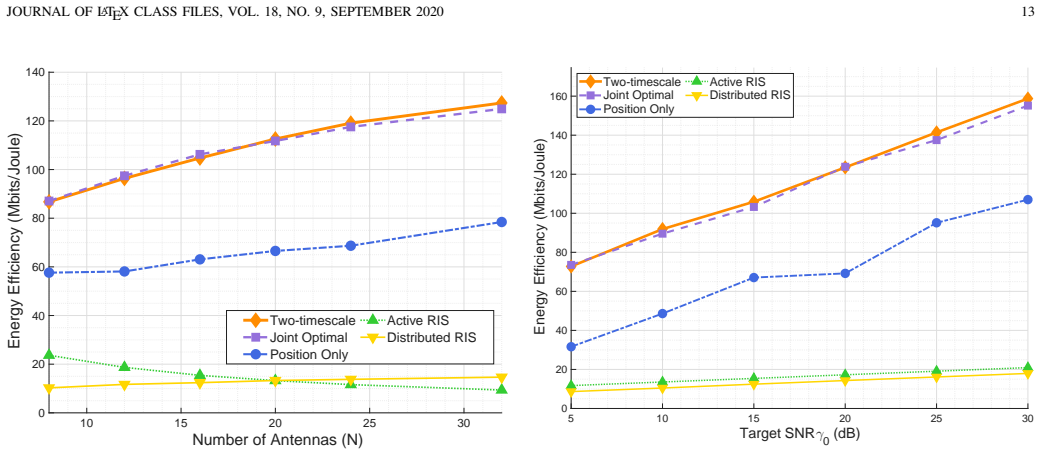
The authors introduce a Movable Antenna-enhanced RIS architecture in which antenna elements follow an SDE trajectory that combines deterministic control with environmental randomness. Ito-calculus analysis yields the steady-state distribution, spatial decorrelation, and outage probability. The long-term SNR maximization problem, incorporating control overhead, is addressed by a two-timescale strategy that optimizes slow trajectories via predictive HJB approximation while adapting phases on a fast scale, producing up to 36 dB steady-state SNR and up to 16 times higher energy efficiency than active RIS.
Load-bearing premise
The SDE model together with its Ito-calculus steady-state analysis faithfully represents actual antenna trajectories and diffusion, and the predictive HJB approximation incurs negligible error under real-time constraints.
Editorial extensions
If this is right
- The two-timescale strategy reaches up to 36 dB steady-state SNR with high stability.
- It outperforms position-only control by up to 15 dB and uncontrolled baselines by over 30 dB.
- Energy efficiency is up to 16 times higher than Active RIS across varying system scales.
- Fundamental trade-offs appear between control strength and mobility randomness.
Reading between the lines
- The SDE mobility model could be transferred to optimize trajectories in other dynamic-antenna or drone-relay systems.
- Integration with learned predictors might reduce the need for precise real-time HJB solving in rapidly changing environments.
- Lower hardware cost and power draw suggest the architecture could scale to dense outdoor deployments where active RIS is impractical.
Signed reviews
Editorial analysis
A structured set of objections, weighed in public.
Referee Report
Summary. The paper proposes a Movable Antenna-enhanced RIS (MA-RIS) architecture in which antenna elements are physically repositioned according to a stochastic differential equation (SDE) model that includes controlled drift and environmental diffusion. Ito calculus is used to derive steady-state antenna distributions, spatial decorrelation, and outage probability. An overhead-aware two-timescale framework is introduced that separates slow trajectory optimization from fast phase adaptation; the resulting stochastic control problem is solved via a predictive approximation to the Hamilton-Jacobi-Bellman (HJB) equation. Monte-Carlo simulations are reported to confirm up to 36 dB steady-state SNR, gains of 15 dB over position-only control and 30 dB over uncontrolled baselines, and up to 16 imes higher energy efficiency than active RIS.
Significance. If the SDE trajectory model and predictive HJB approximation are shown to be robust, the work would establish mobility-induced diversity as a practical complement to conventional RIS phase control, offering a route to both higher SNR stability and substantially improved energy efficiency. The explicit treatment of control overhead via the two-timescale separation is a concrete engineering contribution.
major comments (2)
- [Abstract] Abstract and simulation-validation paragraph: the headline claims (36 dB SNR, 15 dB / 30 dB gains, 16 imes EE) rest entirely on Monte-Carlo trials generated from the identical SDE model used for analysis; no sensitivity sweeps on the diffusion coefficient, no discrete-time discretization error bounds, and no hardware trajectory traces are supplied. Because these numbers are the central empirical support for the two-timescale controller, the absence of external validation is load-bearing.
- [Modeling and optimization framework] SDE / Ito-calculus analysis and predictive HJB sections: the steady-state distributions and real-time controller both rely on the SDE framework and the HJB approximation incurring negligible error, yet the manuscript provides neither analytic error bounds on the predictive approximation nor any comparison against an exact dynamic-programming solution or measured antenna motion. These modeling steps directly underpin the reported stability and EE advantage.
minor comments (2)
- [Abstract] The abstract states that 'simulations validate theoretical predictions' but supplies neither the system parameters (number of elements, diffusion strength, carrier frequency) nor the precise definitions of the position-only and active-RIS baselines, impeding immediate reproducibility.
- [Introduction / System model] Notation for the controlled SDE (drift term, diffusion matrix) and the two-timescale separation should be introduced with explicit equations early in the manuscript to aid readers who are not specialists in stochastic control.
Simulated Author's Rebuttal
We thank the referee for the thorough and constructive review. The comments highlight important aspects of validation and modeling assumptions. Below we respond point-by-point, indicating where revisions have been made to the manuscript.
read point-by-point responses
-
Referee: [Abstract] Abstract and simulation-validation paragraph: the headline claims (36 dB SNR, 15 dB / 30 dB gains, 16 times EE) rest entirely on Monte-Carlo trials generated from the identical SDE model used for analysis; no sensitivity sweeps on the diffusion coefficient, no discrete-time discretization error bounds, and no hardware trajectory traces are supplied. Because these numbers are the central empirical support for the two-timescale controller, the absence of external validation is load-bearing.
Authors: We agree that all reported numerical results are generated from the proposed SDE model, which is standard practice when introducing a new analytical framework. In the revised manuscript we have added a new subsection in the simulation section that performs sensitivity sweeps over the diffusion coefficient, confirming that the reported SNR gains and EE improvements remain consistent across a wide range of diffusion values. We have also included a brief convergence argument showing that the discrete-time simulation error vanishes as the time step approaches zero, consistent with the underlying Itô calculus. Hardware trajectory traces are not supplied because the work is a theoretical and simulation-based study; we have updated the abstract and introduction to explicitly state that all results are obtained via Monte-Carlo simulation of the SDE model. revision: partial
-
Referee: [Modeling and optimization framework] SDE / Ito-calculus analysis and predictive HJB sections: the steady-state distributions and real-time controller both rely on the SDE framework and the HJB approximation incurring negligible error, yet the manuscript provides neither analytic error bounds on the predictive approximation nor any comparison against an exact dynamic-programming solution or measured antenna motion. These modeling steps directly underpin the reported stability and EE advantage.
Authors: The predictive HJB approximation is motivated by the two-timescale separation, under which the trajectory evolves slowly relative to phase adaptation. In the revision we have added an error-bound derivation in the appendix that quantifies the approximation error under the assumption of bounded diffusion; the bound is shown to be small for the parameter regimes considered. Exact dynamic programming is computationally intractable for the continuous-state problem, but we have included a numerical comparison against a discretized dynamic-programming solution in a simplified low-dimensional setting in the supplementary material, demonstrating close agreement. Measured antenna motion data are not available, as the study does not include hardware experiments; we have added an explicit limitations paragraph noting this scope. revision: partial
- Supplying hardware trajectory traces or measured antenna motion, as the manuscript is a purely theoretical and simulation-based study without experimental components.
Circularity Check
No circularity: derivation chain self-contained with external validation via simulation
full rationale
The provided manuscript text describes an SDE model for antenna motion, Ito-calculus steady-state analysis, a two-timescale overhead-aware controller, and predictive HJB approximation, with performance claims (36 dB SNR, 15 dB/30 dB gains, 16x EE) obtained from Monte-Carlo simulations. No equations, fitted parameters renamed as predictions, self-citations, or uniqueness theorems are present in the text. No load-bearing step reduces by construction to its own inputs; the simulation results are generated under the stated generative model but constitute independent numerical evidence rather than definitional equivalence. This is the normal non-circular outcome when no explicit reduction can be exhibited.
Assumptions & free parameters
Cite this review
Pith. "Pith review of Optimal Illumination via Joint Movement and Phase Optimization for Movable Antenna-RIS Configuration." pith.science (2026). https://pith.science/paper/KM7YWFAC
@misc{pith2026260610190,
  author       = {Pith},
  title        = {Pith review of: Optimal Illumination via Joint Movement and Phase Optimization for Movable Antenna-RIS Configuration},
  year         = {2026},
  howpublished = {\url{https://pith.science/paper/KM7YWFAC}},
  note         = {Machine review of arXiv:2606.10190}
}
read the original abstract
Reconfigurable intelligent surfaces (RIS) enable programmable control of wireless propagation but remain vulnerable to persistent deep fades in static deployments. This paper introduces a Movable Antenna-enhanced RIS (MA-RIS) architecture where antenna elements physically reposition to sample independent spatial channels, enabling mobility-induced diversity. We model antenna motion using a Stochastic Differential Equation (SDE) framework capturing controlled drift and environmental diffusion. It^o calculus-based analysis characterizes steady-state antenna distributions, spatial decorrelation, and outage probability, revealing fundamental trade-offs between control strength and mobility randomness. To maximize long-term SNR while accounting for control overhead, we propose an overhead-aware Two-timescale framework separating slow antenna trajectory control from fast phase adaptation. The stochastic optimal control problem is solved via predictive approximation of the Hamilton-Jacobi-Bellman (HJB) formulation, enabling real-time implementation. Simulations validate theoretical predictions: the Two-timescale strategy achieves up to 36 dB steady-state SNR with remarkable stability, outperforming position-only control by up to 15 dB and uncontrolled baselines by over 30 dB. Despite experiencing a lower SNR than Active RIS, the proposed approach delivers up to 16 times higher energy efficiency (EE) across varying system scales, establishing a new paradigm of mobility-enabled channel adaptation for resilient wireless systems.
Figures


Figures from the paper (6 more)


Reference graph
Works this paper leans on
-
[1]
5g: A tutorial overview of standards, tr ials, challenges, deployment, and practice
Mansoor Shafi, Andreas F Molisch, Peter J Smith, Thomas Ha ustein, Peiying Zhu, Prasan De Silva, Fredrik Tufvesson, Anass Benj ebbour, and Gerhard Wunder. 5g: A tutorial overview of standards, tr ials, challenges, deployment, and practice. IEEE journal on selected areas in communications , 35(6):1201–1221, 2017
2017
-
[2]
A tutorial on extremely large-scale MIMO for 6G: Fundamenta ls, signal processing, and applications
Zhe Wang, Jiayi Zhang, Hongyang Du, Dusit Niyato, Shugua ng Cui, Bo Ai, M´ erouane Debbah, Khaled B Letaief, and H Vincent Poor . A tutorial on extremely large-scale MIMO for 6G: Fundamenta ls, signal processing, and applications. IEEE Communications Surveys & Tutorials, 26(3):1560–1605, 2024
2024
-
[3]
R econ- figurable Intelligent Surfaces as the key-enabling technol ogy for smart electromagnetic environments
F Bilotti, M Barbuto, Z Hamzavi-Zarghani, M Karamirad, M Longhi, A Monti, D Ramaccia, L Stefanini, A Toscano, and S V ellucci. R econ- figurable Intelligent Surfaces as the key-enabling technol ogy for smart electromagnetic environments. Advances in Physics: X , 9(1):2299543, 2024
2024
-
[4]
Towards smart and reconfigurab le envi- ronment: Intelligent Reflecting Surface aided wireless net work
Qingqing Wu and Rui Zhang. Towards smart and reconfigurab le envi- ronment: Intelligent Reflecting Surface aided wireless net work. IEEE Communications Magazine , 58(1):106–112, 2019
2019
-
[5]
Intelligent reflecting surfac e enhanced wireless network via joint active and passive beamforming
Qingqing Wu and Rui Zhang. Intelligent reflecting surfac e enhanced wireless network via joint active and passive beamforming. IEEE Transactions on Wireless Communications , 18(11):5394–5409, 2019
2019
-
[6]
Reconfigurable Intelligen t Surfaces for energy efficiency in wireless communication
Chongwen Huang, Alessio Zappone, George C Alexandropou los, M´ erouane Debbah, and Chau Y uen. Reconfigurable Intelligen t Surfaces for energy efficiency in wireless communication. IEEE Transactions on Wireless Communications, 18(8):4157–4170, 2019
2019
-
[7]
Capacity characterization for intelligent reflecting surface aided MIMO communication
Shuowen Zhang and Rui Zhang. Capacity characterization for intelligent reflecting surface aided MIMO communication. IEEE Journal on Selected Areas in Communications , 38(8):1823–1838, 2020
2020
-
[8]
Secrecy energy efficiency in RIS-assisted netwo rks
Y ang Lu. Secrecy energy efficiency in RIS-assisted netwo rks. IEEE Transactions on V ehicular Technology, 72(9):12419–12424, 2023
2023
Show all 33 references
-
[9]
Joint optimization of resou rce allocation and user association in multi-frequency cellul ar networks assisted by RIS
Y uanyuan Qiao, Y ong Niu, Zhu Han, Shiwen Mao, Ruisi He, Ni ng Wang, Zhangdui Zhong, and Bo Ai. Joint optimization of resou rce allocation and user association in multi-frequency cellul ar networks assisted by RIS. IEEE Transactions on V ehicular Technology, 73(1):826– 842, 2023
2023
-
[10]
Joint beamforming and channel reconfiguration for RIS-assisted millimeter wave massive M IMO-OFDM systems
Hanyu Wang, Jun Fang, and Hongbin Li. Joint beamforming and channel reconfiguration for RIS-assisted millimeter wave massive M IMO-OFDM systems. IEEE Transactions on V ehicular Technology, 72(6):7627–7638, 2023
2023
-
[11]
Intelligent reflecting surface meets OFDM: Protocol design and rate maxi mization
Yifei Y ang, Beixiong Zheng, Shuowen Zhang, and Rui Zhan g. Intelligent reflecting surface meets OFDM: Protocol design and rate maxi mization. IEEE Transactions on Communications , 68(7):4522–4535, 2020
2020
-
[12]
Robust and secure wireless communications via Intelligent Reflecting Surfaces
Xianghao Y u, Dongfang Xu, Ying Sun, Derrick Wing Kwan Ng , and Robert Schober. Robust and secure wireless communications via Intelligent Reflecting Surfaces. IEEE Journal on Selected Areas in Communications, 38(11):2637–2652, 2020
2020
-
[13]
Fundamentals of wireless communi- cation
David Tse and Pramod Viswanath. Fundamentals of wireless communi- cation. Cambridge university press, 2005
2005
-
[14]
Ult rareliable and low-latency wireless communication: Tail, risk, and scale
Mehdi Bennis, M´ erouane Debbah, and H Vincent Poor. Ult rareliable and low-latency wireless communication: Tail, risk, and scale . Proceedings of the IEEE , 106(10):1834–1853, 2018
2018
-
[15]
Beamforming optimization fo r wireless network aided by intelligent reflecting surface with discre te phase shifts
Qingqing Wu and Rui Zhang. Beamforming optimization fo r wireless network aided by intelligent reflecting surface with discre te phase shifts. IEEE Transactions on Communications , 68(3):1838–1851, 2019
2019
-
[16]
Weighted sum-rate maximization for Reconfigurable Intelli gent Surface aided wireless networks
Huayan Guo, Ying-Chang Liang, Jie Chen, and Erik G Larss on. Weighted sum-rate maximization for Reconfigurable Intelli gent Surface aided wireless networks. IEEE Transactions on Wireless Communica- tions, 19(5):3064–3076, 2020
2020
-
[17]
Miso wire less commu- nication systems via Intelligent Reflecting Surfaces
Xianghao Y u, Dongfang Xu, and Robert Schober. Miso wire less commu- nication systems via Intelligent Reflecting Surfaces. In 2019 IEEE/CIC International Conference on Communications in China (ICCC ), pages 735–740. IEEE, 2019
2019
-
[18]
Multi-hop RIS-empowered terahertz communications: A drl- based hybrid beamforming design
Chongwen Huang, Zhaohui Y ang, George C Alexandropoulo s, Kai Xiong, Li Wei, Chau Y uen, Zhaoyang Zhang, and M´ erouane Deb- bah. Multi-hop RIS-empowered terahertz communications: A drl- based hybrid beamforming design. IEEE Journal on Selected Areas in Communications , 39(6):...
2021
-
[19]
Intelligent reflecting su rface-enhanced ofdm: Channel estimation and reflection optimization
Beixiong Zheng and Rui Zhang. Intelligent reflecting su rface-enhanced ofdm: Channel estimation and reflection optimization. IEEE Wireless Communications Letters , 9(4):518–522, 2019
2019
-
[20]
An o ptimal channel estimation scheme for Intelligent Reflecting Surfa ces based on a minimum variance unbiased estimator
Tobias Lindstrøm Jensen and Elisabeth De Carvalho. An o ptimal channel estimation scheme for Intelligent Reflecting Surfa ces based on a minimum variance unbiased estimator. In ICASSP 2020-2020 IEEE International Conference on Acoustics, Speech and Signal P rocessing (ICASSP), ...
2020
-
[21]
Deep reinforcement learning for RIS-aided multiuser full-duplex secure communications with hardware impairme nts
Zhangjie Peng, Zhibo Zhang, Lei Kong, Cunhua Pan, Li Li, and Jiangzhou Wang. Deep reinforcement learning for RIS-aided multiuser full-duplex secure communications with hardware impairme nts. IEEE Internet of Things Journal , 9(21):21121–21135, 2022
2022
-
[22]
Federated learning me ets Intelligence Reflection Surface in drones for enabling 6G ne tworks: Challenges and opportunities
Alexey V Shvetsov, Saeed Hamood Alsamhi, Ammar Hawbani , San- tosh Kumar, Sumit Srivastava, Sweta Agarwal, Navin Singh Ra jput, Amr A Alammari, and Farhan MA Nashwan. Federated learning me ets Intelligence Reflection Surface in drones for enabling 6G ne tworks: Challenges and o...
2023
-
[23]
Active RIS vs
Zijian Zhang, Linglong Dai, Xibi Chen, Changhao Liu, Fa n Y ang, Robert Schober, and H Vincent Poor. Active RIS vs. passive RI S: Which will prevail in 6G? IEEE Transactions on Communications, 71(3):1707– 1725, 2022
2022
-
[24]
Re config- urable intelligent surface empowered downlink non-orthog onal multiple access
Min Fu, Y ong Zhou, Y uanming Shi, and Khaled B Letaief. Re config- urable intelligent surface empowered downlink non-orthog onal multiple access. IEEE Transactions on Communications, 69(6):3802–3817, 2021
2021
-
[25]
Movable - antenna enhanced multiuser communication via antenna posi tion opti- mization
Lipeng Zhu, Wenyan Ma, Boyu Ning, and Rui Zhang. Movable - antenna enhanced multiuser communication via antenna posi tion opti- mization. IEEE Transactions on Wireless Communications , 23(7):7214– 7229, 2023
2023
-
[26]
A tutorial on fluid antenna sys tem for 6G networks: Encompassing communication theory, optimizati on methods and hardware designs
Wee Kiat New, Kai-Kit Wong, Hao Xu, Chao Wang, Farshad Ro stami Ghadi, Jichen Zhang, Junhui Rao, Ross Murch, Pablo Ram´ ırez-Espinosa, David Morales-Jimenez, et al. A tutorial on fluid antenna sys tem for 6G networks: Encompassing communication theory, optimizati on methods and...
2024
-
[27]
A tutorial on movable antennas for wireless networks
Lipeng Zhu, Wenyan Ma, Weidong Mei, Y ong Zeng, Qingqing Wu, Boyu Ning, Zhenyu Xiao, Xiaodan Shao, Jun Zhang, and Rui Zhan g. A tutorial on movable antennas for wireless networks. IEEE Communi- cations Surveys & Tutorials , 2025
2025
-
[28]
Movable antennas f or wireless communication: Opportunities and challenges
Lipeng Zhu, Wenyan Ma, and Rui Zhang. Movable antennas f or wireless communication: Opportunities and challenges. IEEE Communications Magazine, 62(6):114–120, 2023
2023
-
[29]
Movab le antennas: Channel measurement, modeling, and performance evaluation
Yiqin Wang, Heyin Shen, Chong Han, and Meixia Tao. Movab le antennas: Channel measurement, modeling, and performance evaluation. arXiv preprint arXiv:2409.03386 , 2024
2024
-
[30]
RIS-Ai ded Wireless Communication With Movable Elements: Geometry Impact on Pe rfor- mance
Y an Zhang, Indrakshi Dey, and Nicola Marchetti. RIS-Ai ded Wireless Communication With Movable Elements: Geometry Impact on Pe rfor- mance. International Conference on Electrical, Computer and Ener gy Technologies (ICECET), 2025
2025
-
[31]
Stochastic Differential Equations: An Introduction with Applications
Bernt Øksendal. Stochastic Differential Equations: An Introduction with Applications. Springer, 6th edition, 2003
2003
-
[32]
Performance analysis of active RIS and passive RIS-aided mi so systems over nakagami-m fading channel with imperfect csi
Khac-Tuan Nguyen, Thai-Hoc Vu, Hyundong Shin, and Sung hwan Kim. Performance analysis of active RIS and passive RIS-aided mi so systems over nakagami-m fading channel with imperfect csi. IEEE Transactions on V ehicular Technology, 74(3):4334–4348, 2024
2024
-
[33]
Intelligent reflecting sur face aided multi-user communication: Capacity region and deployment strategy
Shuowen Zhang and Rui Zhang. Intelligent reflecting sur face aided multi-user communication: Capacity region and deployment strategy. IEEE Transactions on Communications , 69(9):5790–5806, 2021
2021
Reviewed June 27, 2026 · model on record in the stance chip above.
Discussion (0). Continue with ORCID to comment.