REVIEW 3 major objections 6 minor 19 references
VIScore: Diagnosing Planning-Relevant Quality in Latent World Models
T0 review · 3 major / 6 minor · reviewed 2026-08-12 · deepseek-v4-flash
Pith's one-line read VIScore predicts planning success with a 0.91 Spearman correlation.
desk verdict A genuinely useful and carefully validated diagnostic for latent world model planning, but the unverified horizon-consistency assumption in the influence factor needs a direct test before I'd trust its cross-task numbers. read the letter →
The pith
A machine-rendered reading of the paper's core claim, the machinery that carries it, and where it could break.
The reading
What carries the argument
The central object is the product identity that composes three bounded, task-scaled diagnostics: veracity $\mathrm{erf}(d_{\mathrm{tol}} / (2\sqrt{2}\,\sigma_{\mathrm{roll}}))$, influence $\min(m_{\mathrm{emp}}/\tau, 1)$, and sobriety $1-\hat{p}$. Veracity is a ratio, so it is invariant to latent rescaling; influence is capped empowerment with a shared cap $\tau$ chosen by cross-validation, which lets one numerical scale mean the same thing across tasks; sobriety is a sign-based search-exploitation probe. The product forces all three conditions to hold simultaneously and is fixed before observing test pools, so it functions as a diagnostic rather than a fitted success predictor. A key technical assumption sits in the influence estimator: the one-step teacher-forced residual covariance is rescaled to horizon $H$ by matching trace, which presumes the error eigendirections do not rotate with horizon.
What would settle it
Measure the full $H$-step residual covariance matrix directly from open-loop rollouts and compare its eigenbasis with the one-step teacher-forced residual covariance rescaled by trace; if the principal eigendirections rotate substantially on a task where VIScore currently correlates well, that task's VIScore–success association should weaken. Alternatively, recompute VIScore using the empirically measured $H$-step covariance instead of the trace-rescaled one-step covariance and check whether the pooled Spearman correlations and calibration errors change materially.
Extended reading notes
Core claim
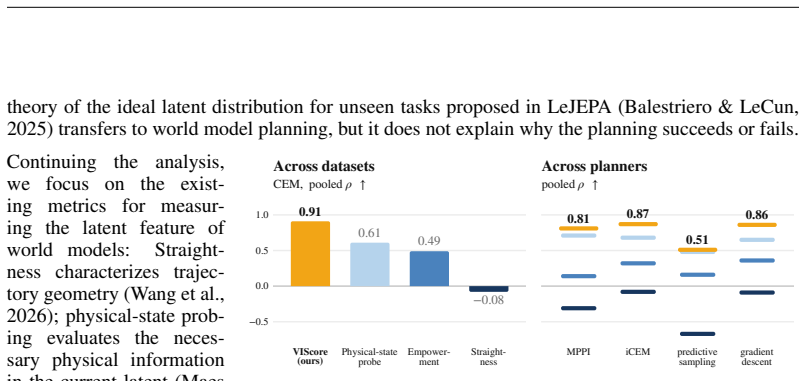
VIScore is the product of three bounded factors, $\mathrm{VIScore} = \mathrm{erf}(d_{\mathrm{tol}} / (2\sqrt{2}\,\sigma_{\mathrm{roll}})) \cdot \min(m_{\mathrm{emp}}/\tau, 1) \cdot (1-\hat{p})$. Veracity converts the ratio of the task's success tolerance to the RMS open-loop rollout error into a monotone map to $[0,1]$; influence takes latent empowerment—the channel capacity from action perturbations to terminal latent displacements—and clips it at a shared sufficiency threshold $\tau$; sobriety measures the fraction of expert anchors for which a small internal search finds an imagined action with lower terminal cost than the recorded expert action. The paper claims that all three conditions must hold at once: a model can roll out accurately and have capacity yet still fail because the planner exploits localized predictor errors. Validation against planning success uses leave-one-task-out isotonic calibration and run-level splits, and reports pooled Spearman correlations of $+0.88$ on the development pool, $+0.91$ on held-out checkpoints, $+0.75$ on held-out methods, and $+0.87$ on an unseen task, with calibration error below the constant predictor in every pool.
Load-bearing premise
The load-bearing premise is that the directions in which the predictor makes errors stay roughly the same between one-step and $H$-step rollouts, so rescaling the one-step error covariance by matching its trace to the observed $H$-step rollout error gives an unbiased noise floor; if error directions rotate with the horizon, the influence factor misallocates the noise floor and VIScore's cross-task correlations and calibration would be biased.
Editorial extensions
If this is right
- Developers can run a roughly seven-second-per-checkpoint probe that reports which of the three components—reachability, capacity, or search-exploitable hallucination—is binding, instead of relying on training loss or latent-space statistics.
- A shared influence cap makes VIScore numerically comparable across tasks, so a single threshold can rank checkpoints from different environments on the same scale, something raw empowerment cannot do.
- Because VIScore transfers to unseen world-modeling methods and an unseen task with all constants frozen, it can be used to vet new architectures without retuning.
- The SIGReg–VISReg intervention shows that self-supervised flexibility does not transfer to planning, while realized distribution-match accuracy does; this separates regularization flexibility from planning quality.
- VIScore works across sampling-based and gradient-based searching planners when the planner is comparably effective on all tasks; task-selective planner weakness breaks cross-task comparability.
Reading between the lines
- If the three factors are genuinely the binding constraints, planning can be improved by targeted interventions: raise rollout fidelity when veracity is low, expand action-conditioned capacity when influence is below the cap, and regularize against search exploitation when sobriety is low.
- The trace-matching assumption in the influence estimator is testable in isolation; if error directions rotate, a direction-aware horizon correction, such as a low-rank update of the noise floor, might preserve VIScore's cross-task scale.
- The Cube outlier suggests a fourth factor—representation of discrete mode transitions—may be needed for tasks whose success hinges on a discontinuous event; extending VIScore with a mode-conditioned term is a natural next step.
- A practical extension would be to use VIScore during training as an early-stopping or checkpoint-selection signal, since it costs far less than a full multi-seed planning evaluation.
Editorial analysis
A structured set of objections, weighed in public.
Referee Report
Summary. The paper has two connected parts. First, it presents a controlled comparison of SIGReg and VISReg in the LeWorldModel latent planning stack, finding that VISReg's component-level flexibility does not improve planning on in-distribution tasks, while a closer match to the target isotropic Gaussian (obtained with larger batch sizes) improves out-of-domain PushObj performance. Second, it proposes VIScore, a product of veracity, influence, and sobriety, and evaluates this diagnostic against planning success rate using Spearman correlation and calibration error on run-level split development and held-out checkpoint pools, plus held-out methods, an unseen MAZE task, and six planner families. The central claim is that VIScore is the best available diagnostic of planning-relevant quality for predictor-based latent world models, with pooled correlations above 0.75 and calibration error below a constant reference in the Table 6 pools.
Significance. If the central claim is correct, VIScore is a practically useful diagnostic because it covers encoder, predictor, and planner rather than the latent alone. The paper's validation design is a genuine strength: checkpoints are split at the training-run level, all constants are fixed on a development pool before testing, cluster bootstraps over runs are used for intervals, held-out methods and an unseen task are evaluated under a frozen calibration map, and the failure modes (Cube's discrete mode, amortized planners, factor saturation) are explicitly scoped. The paper also reports computational cost and provides code. The main risk is not leakage or circularity but an unverified technical assumption in the influence estimator, plus overstatement of the planner-transfer and unseen-dataset evidence. These are fixable with additional analysis and more careful claims.
major comments (3)
- [Appendix B.1.1, Eq. (11)] The construction of the H-step noise floor E_H = (sigma_roll^2 / tr E) E assumes that the eigendirections of the predictor error are stable between one-step teacher-forced rollouts and H-step open-loop rollouts, with only the magnitude changing. The manuscript explicitly states that this is an assumption it does not verify and that a violation would bias m_emp in a way the experiments cannot detect. Since influence is one third of VIScore and is the component that makes the score scale-comparable across tasks, an unverified bias in m_emp directly threatens the central pooled-correlation and calibration-error claims in Table 6. This is fixable within the scope of the paper: the authors have open-loop rollouts available for every checkpoint and can estimate the full H-step residual covariance directly instead of rescaling the one-step covariance by a scalar, or at least can compare the eigenbasis of the H-step residual covariance with that of E and report the overlap; a sensitivity analysis showing that pooled correlations are stable under random perturbations of E_H's eigenbasis would be the minimal version. As written, the central claim rests on an admitted unverified assumption.
- [Section 4.3 and Appendix B.6, Table 10] The manuscript's claim that 'VIScore fits into any searching-based planner' and that VIScore 'consistently achieves the most stable and competitive results' overstates the evidence. For predictive sampling the pooled Spearman correlation is +0.51, and for single-start gradient descent it is +0.12 while raw empowerment reaches +0.82 in the same column. The appendix's explanation that task-selective planner weakness moves labels without moving scores is a reasonable post-hoc account, but it does not change the fact that the strong cross-task comparability claim fails for two of the six planner families shown. The abstract and Section 1 should either restrict the claim to the CEM-family and multi-start gradient planners, or present the planner-transfer result as a qualified extension with explicit failure modes.
- [Section 4.2, Table 6] The claim that VIScore generalizes to 'both seen and unseen models and datasets' rests on a held-out method pool of 23 checkpoints and a held-out dataset pool of 20 checkpoints from only two independent MAZE runs. With two clusters, the cluster bootstrap has essentially no resolution, and the +0.75 held-out-method correlation is exactly at the stated threshold rather than above it. The paper should report bootstrap intervals or per-run correlations for these transfer pools, and the 'unseen dataset' evidence should be described as preliminary rather than as a fully established transfer result.
minor comments (6)
- [Abstract and Section 1] The wording 'Spearman correlation over 0.75' should be reconciled with the held-out method pool value of +0.75, which is not strictly over 0.75 unless the unrounded value exceeds the threshold; please state the precision or rephrase to 'at least 0.75'.
- [Section 4.2, Table 6 note] The note describing calibration error is ambiguous about which pools use leave-one-task-out isotonic fits and which use the frozen development-pool map; a separate sentence for the held-out checkpoint pool versus the held-out methods and held-out dataset pools would remove confusion.
- [Section 3.2, Table 2] Several references in Table 2 are incomplete, such as 'FICReg (Seo et al.)' with no year and 'SD-JEPA (Thil et al., 2026)' with a truncated author list; please complete these citations.
- [Section 3.3] The sentence about single-seed evaluation overconfidence cites the numbers '(1025/3014/5976)' without explaining what they are; please clarify whether these are episode counts or another quantity, and define them in the text.
- [Section 4.1, Eq. (10)] The expression for m_emp in Eq. (10) uses the form log det(I + E_H^{-1} S), while the derivation in Appendix B.1.1 uses the symmetric form log det(I + E_H^{-1/2} S E_H^{-1/2}); the paper should note that the two are equal under the standing assumptions or use a consistent notation.
- [Appendix B.1] The main text says that 'three alternative monotone maps give rank-identical results' for veracity, but the product VIScore is not rank-invariant because it mixes factor values; the appendix correctly acknowledges this, so the main-text sentence should be qualified to avoid implying rank-invariance of the full score.
Circularity Check
No load-bearing circularity: VIScore is defined from model rollouts, task tolerances, and planner search, with success labels used only as a run-disjoint external validation signal.
full rationale
VIScore is constructed from quantities that are not the validation labels. Veracity is a function of open-loop rollout error and the task tolerance (d_tol / sigma_roll); influence is a local Gaussian-channel capacity m_emp with a saturating cap tau; sobriety is the fraction of expert anchors where search finds a lower imagined cost. None of the three factors is defined from measured success rates. The paper uses success labels only to select the constant tau and calibration maps on a development pool, then evaluates on pools whose training runs were excluded from that selection. The text states this directly: 'no checkpoint in a test pool comes from a run used to choose any constant.' The central held-out numbers (+0.91 pooled Spearman, 7.0 calibration error) are therefore genuine out-of-sample assessments rather than fits renamed as predictions. The main self-citations (VISReg, LeJEPA) supply the regularization intervention and an interpretive hypothesis, but the experiments re-test those inputs empirically (SIGReg-VISReg tables, OOD batch ladder), and the VIScore validation does not depend on a self-cited 'uniqueness' or 'optimality' theorem. The one admitted assumption, Eq. (11), is that one-step residual covariance directions are stable to the H-step horizon; the paper explicitly labels this an unverified limitation. If false, m_emp is biased and cross-task comparisons could be distorted, but that is a validity/correctness risk rather than a circular reduction, because E_H is estimated from predictor rollouts rather than from success labels. No circular step can therefore be exhibited from the paper's own equations or citations.
Assumptions & free parameters
free parameters (4)
- Influence sufficiency cap tau =
82 nats
- d_tol retention threshold =
20% of success tolerance
- Half-tolerance strictness factor =
1/2 (d_tol/2)
- Veracity monotone map =
erf (alternative Rayleigh)
assumptions (4)
- domain assumption Predictor error directions are approximately stable between one and H steps (Eq. 11 trace matching).
- domain assumption The success tolerance can be faithfully mapped to latent distance d_tol via probe pairs whose physical displacement is within 20% of the tolerance.
- domain assumption The local linear-Gaussian channel model z_{t+H}(a*+delta) = z_{t+H}(a*) + G delta + epsilon approximates the H-step dynamics around expert actions.
- standard math Training runs are independent sampling units for the cluster bootstrap.
Cite this review
Pith. "Pith review of VIScore: Diagnosing Planning-Relevant Quality in Latent World Models." pith.science (2026). https://pith.science/paper/KO2MR6KO
@misc{pith2026260811174,
  author       = {Pith},
  title        = {Pith review of: VIScore: Diagnosing Planning-Relevant Quality in Latent World Models},
  year         = {2026},
  howpublished = {\url{https://pith.science/paper/KO2MR6KO}},
  note         = {Machine review of arXiv:2608.11174}
}
read the original abstract
Regulating the latent space to an isotropic Gaussian distribution provides a stable and information-maximized landscape for world model planning. However, the latent space property and successful planning remain disconnected. We first study this by comparing SIGReg and VISReg, two regularization loss functions with the same distribution target but different properties. Compared with SIGReg, VISReg has more flexibility in controlling the weights of center, scale, and shape regularization, and a larger batch size brings a finer distribution approximation. We find that the former, despite being beneficial in self-supervised learning (SSL), does not help the planning, whereas the latter improves the planning success on out-of-domain (OOD) datasets. This motivates a deep understanding of the factors that correlate with the success rate. Unlike the previous metrics focusing on the encoded latent only, we propose the Veracity-Influence-Sobriety score (VIScore), a metric that quantifies the reachability and capacity of a predictor given the encoded feature, and the hallucination of the searching-based planner. Compared with straightness, physical-state probing, and empowerment, we show that, with the measurement covering encoder, predictor, and planner, VIScore explains the success rate better than the others, as reflected by a strong Spearman correlation. Specifically, VIScore consistently achieves a Spearman correlation over 0.75 on both seen and unseen models and datasets on the cross-task success rate pool. Moreover, VIScore is the only metric that has a calibration error below the constant fit across all testing scenarios, showcasing the importance of these three aspects in planning success. We hope this metric can help future studies on world model design and diagnosis.
Figures


Figures from the paper (1 more)

Reference graph
Works this paper leans on
-
[6]
Wenyuan Li, Guang Li, Keisuke Maeda, Takahiro Ogawa, and Miki Haseyama
Accessed: 2026-01-11. Wenyuan Li, Guang Li, Keisuke Maeda, Takahiro Ogawa, and Miki Haseyama. Predictive but not plannable: Rc-aux for latent world models.arXiv preprint arXiv:2605.07278,
arXiv 2026
-
[7]
Decoupled weight decay regularization.arXiv preprint arXiv:1711.05101,
Ilya Loshchilov and Frank Hutter. Decoupled weight decay regularization.arXiv preprint arXiv:1711.05101,
-
[11]
INTACT: Isomorphic Intent-to-Action Learning for Search-Free World Models
Junhan Sun, Hao Zhao, and Guofeng Zhang. Intact: Isomorphic intent-to-action learning for search- free world models.arXiv preprint arXiv:2607.26056,
-
[12]
Deepmind control suite.arXiv preprint arXiv:1801.00690,
Yuval Tassa, Yotam Doron, Alistair Muldal, Tom Erez, Yazhe Li, Diego de Las Casas, David Bud- den, Abbas Abdolmaleki, Josh Merel, Andrew Lefrancq, et al. Deepmind control suite.arXiv preprint arXiv:1801.00690,
-
[16]
Efficient Empowerment Estimation for Unsupervised Stabilization
arXiv:2007.07356. Gaoyue Zhou, Hengkai Pan, Yann LeCun, and Lerrel Pinto. Dino-wm: World models on pre-trained visual features enable zero-shot planning. InICML,
work page Pith review arXiv 2007
-
[17]
12 A APPENDIX The appendix follows the experimental flow of the main paper. We first provide the training details and the SSL observations that motivate the regularization intervention. We then derive the three VIScore factors and describe the validation protocol. The final sections report the method, task, factor, and planner transfer experiments. A.1 TR...
work page 2021
-
[18]
and Galaxy10 (Leung, 2025). We train ViT-S/8 from scratch for 400epochs and compare with SWD (Bon- neel et al., 2015), DINO (Caron et al., 2021), VICReg (Bardes et al., 2022), and SIGReg. Reweighting the shape term improves VISReg in both data regimes. This observation moti- vates the loss-component transfer experiment in Section 3; the main paper then sh...
work page 2025
-
[19]
The frozen mapping is fit on the three supported development tasks only
runs. The frozen mapping is fit on the three supported development tasks only. Cube contributes no checkpoint to the development pool, so it cannot enter the fit even in principle, and its unresolvable labels would in any case not constrain a monotone map (Appendix B.3). The method-shift pool is12Qantara checkpoints (3seeds×4tasks),9INTACT (3seeds×3tasks,...
work page 2017
Show all 19 references
-
[1983]
D4rl: Datasets for deep data-driven reinforcement learning.arXiv preprint arXiv:2004.07219,
Justin Fu, Aviral Kumar, Ofir Nachum, George Tucker, and Sergey Levine. D4rl: Datasets for deep data-driven reinforcement learning.arXiv preprint arXiv:2004.07219,
2004 arXiv
-
[2005]
Offline reinforcement learning with implicit q- learning.arXiv preprint arXiv:2110.06169,
Ilya Kostrikov, Ashvin Nair, and Sergey Levine. Offline reinforcement learning with implicit q- learning.arXiv preprint arXiv:2110.06169,
-
[2017]
Visreg: Variance-invariance-sketching regular- ization for jepa training.arXiv preprint arXiv:2606.02572,
Haiyu Wu, Randall Balestriero, and Morgan Levine. Visreg: Variance-invariance-sketching regular- ization for jepa training.arXiv preprint arXiv:2606.02572,
-
[2018]
Subspace-decomposed jepas: Dis- entangling progression and content in latent world models.arXiv preprint arXiv:2605.31111,
Lucas Thil, Jesse Read, Rim Kaddah, and Guillaume Doquet. Subspace-decomposed jepas: Dis- entangling progression and content in latent world models.arXiv preprint arXiv:2605.31111,
-
[2019]
Predictive sampling: Real-time behaviour synthesis with mujoco.arXiv preprint arXiv:2212.00541,
Taylor Howell, Nimrod Gileadi, Saran Tunyasuvunakool, Kevin Zakka, Tom Erez, and Yuval Tassa. Predictive sampling: Real-time behaviour synthesis with mujoco.arXiv preprint arXiv:2212.00541,
-
[2020]
Qantara: Bridge-flow training for multi-paradigm jepa control
Ruslan Rakhimov, George Bredis, Yuriy Maksyuta, and Daniil Gavrilov. Qantara: Bridge-flow training for multi-paradigm jepa control. InICML 2026 Workshop on Decision-Making from Offline Datasets to Online Adaptation: Black-Box Optimization to Reinforcement Learning,
2026
-
[2021]
Hierarchical planning with latent world models.arXiv preprint arXiv:2604.03208,
Wancong Zhang, Basile Terver, Artem Zholus, Soham Chitnis, Harsh Sutaria, Mido Assran, Randall Balestriero, Amir Bar, Adrien Bardes, Yann LeCun, et al. Hierarchical planning with latent world models.arXiv preprint arXiv:2604.03208,
-
[2022]
V-jepa 2: Self-supervised video models enable understanding, prediction and planning.arXiv preprint arXiv:2506.09985,
Mido Assran, Adrien Bardes, David Fan, Quentin Garrido, Russell Howes, Matthew Muckley, Am- mar Rizvi, Claire Roberts, Koustuv Sinha, Artem Zholus, et al. V-jepa 2: Self-supervised video models enable understanding, prediction and planning.arXiv preprint arXiv:2506.09985,
-
[2023]
Foundation policies with hilbert representations
Seohong Park, Tobias Kreiman, and Sergey Levine. Foundation policies with hilbert representations. arXiv preprint arXiv:2402.15567,
-
[2025]
Lejepa: Provable and scalable self-supervised learning with- out the heuristics.arXiv preprint arXiv:2511.08544,
Randall Balestriero and Yann LeCun. Lejepa: Provable and scalable self-supervised learning with- out the heuristics.arXiv preprint arXiv:2511.08544,
-
[2026]
Reuven Y Rubinstein
URLhttps://arxiv.org/abs/2607.04978. Reuven Y Rubinstein. The cross-entropy method for combinatorial and continuous optimization. Methodology and Computing in Applied Probability, 1(2):127–190,
Reviewed August 12, 2026 · model on record in the stance chip above.
Discussion (0). Continue with ORCID to comment.