Generic Long-Range Order-Parameter Correlations in Metallic Quantum Magnets
Pith reviewed 2026-05-21 12:10 UTC · model grok-4.3
The pith
Coupling of the order parameter to conduction electrons produces long-ranged susceptibility at zero temperature in every class of metallic magnet.
A machine-rendered reading of the paper's core claim, the machinery that carries it, and where it could break.
Core claim
It is shown that in all types of metallic magnets the coupling of the order parameter to the conduction electrons leads to an order-parameter susceptibility that is long-ranged at zero temperature. This is true for all known classes of ferromagnets, and also for antiferromagnets and spin-density wave systems, helimagnets, magnetic nematics, and altermagnets. The consequences for the magnetic quantum phase transition vary between different classes of magnets. In almost all 3-d systems with a homogeneous magnetization, as well as in magnetic nematics and in altermagnets, the long-ranged correlations generically modify the nature of the magnetic quantum phase transition from second order to the
What carries the argument
Order-parameter susceptibility generated by the response of single-particle excitations in the nonmagnetic phase to a field conjugate to the order parameter.
If this is right
- In almost all three-dimensional systems with homogeneous magnetization the long-ranged correlations turn the quantum phase transition first-order.
- Non-centrosymmetric ferromagnets with strong spin-orbit coupling see the change only in two dimensions, not three.
- Helimagnets, spin-wave systems, and Néel antiferromagnets retain a second-order transition provided the ordering wave number is large enough, except in flat-band cases.
- With quenched disorder the transition stays second-order but the critical exponents are altered by the long-range correlations.
Where Pith is reading between the lines
- Similar long-range effects are likely to appear in other electron-coupled ordered phases such as charge-density waves or unconventional superconductivity.
- Materials searches could target non-centrosymmetric or strongly disordered compounds to realize continuous quantum transitions in metallic magnets.
- Neutron scattering or susceptibility measurements at very low temperature could directly map the wave-vector dependence predicted by the single-particle mechanism.
Load-bearing premise
The physics is fully captured by the single-particle excitations of the nonmagnetic state and how they respond to a field that favors the ordered phase, together with renormalization-group scaling.
What would settle it
A measurement of the order-parameter susceptibility versus wave vector in a clean three-dimensional metallic ferromagnet at millikelvin temperatures that shows only short-range decay rather than the predicted long-range form would disprove the central claim.
Figures
read the original abstract
It is shown that in all types of metallic magnets the coupling of the order parameter to the conduction electrons leads to an order-parameter susceptibility that is long-ranged at zero temperature. This is true for all known classes of ferromagnets, and also for antiferromagnets and spin-density wave systems, helimagnets, magnetic nematics, and altermagnets. The consequences for the magnetic quantum phase transition vary between different classes of magnets. In almost all 3-d systems with a homogeneous magnetization, as well as in magnetic nematics and in altermagnets, the long-ranged correlations generically modify the nature of the magnetic quantum phase transition from second order to first order. The only exception are non-centrosymmetric ferromagnets with a strong spin-orbit interaction, where the correlations change the order of the transition in 2-d systems, but not in 3-d ones. In helimagnets, spin-wave systems, and Neel antiferromagnets their effect is even weaker and does not change the order of the transition if the ordering wave number is sufficiently large, except in flat-band systems. In systems with quenched disorder the transition generically is of second order, but the correlations modify the critical behavior. These conclusions are reached by very simple considerations that are based entirely on the single-particle excitations in the nonmagnetic phase and their modifications by a field conjugate to the order parameter, augmented by renormalization-group considerations.
Editorial analysis
A structured set of objections, weighed in public.
Referee Report
Summary. The paper claims that coupling of the magnetic order parameter to conduction electrons in metallic systems generically produces long-ranged order-parameter susceptibility at T=0 for all classes of magnets (ferromagnets, antiferromagnets, SDW systems, helimagnets, magnetic nematics, altermagnets). This long-range tail is derived from modifications to single-particle excitations in the nonmagnetic phase under a conjugate field, augmented by RG arguments, and is shown to alter the order of the magnetic quantum phase transition (typically to first order) in most 3d homogeneous-magnetization cases, with specified exceptions for non-centrosymmetric ferromagnets with strong SOI, helimagnets with large ordering wavevector, and disordered systems.
Significance. If the central claim holds, the result provides a unified, parameter-free mechanism for long-range correlations across itinerant magnets and explains why many metallic quantum phase transitions are first-order. The generality across multiple ordering types (including altermagnets and nematics) and the reliance on single-particle band shifts plus RG would constitute a significant conceptual advance in the theory of metallic quantum magnets.
major comments (2)
- [main text (derivation of susceptibility)] The load-bearing step—that single-particle band shifts under a conjugate field produce a non-analytic term (e.g., |q| or |q|^2 ln|q|) in the static order-parameter susceptibility without cancellation by vertex corrections or finite-Q coupling—is asserted via 'very simple considerations' but not demonstrated by an explicit integral or diagrammatic evaluation. An explicit calculation for at least one representative case (ferromagnet or SDW) is required to confirm the claimed long-range tail survives for every listed class.
- [discussion of helimagnets and antiferromagnets] The statement that the effect 'does not change the order of the transition if the ordering wave number is sufficiently large' (helimagnets, Néel antiferromagnets) needs a quantitative criterion or scaling argument showing when the long-range tail is subdominant to the usual |q|^2 term; without it the exception remains qualitative.
minor comments (2)
- [introduction] Clarify the precise definition of the order-parameter susceptibility (static vs. dynamic, uniform vs. staggered) when the ordering wavevector Q is finite.
- [abstract] The abstract lists 'spin-wave systems' separately from helimagnets; a brief definition or reference to distinguish them would aid readability.
Simulated Author's Rebuttal
We thank the referee for the careful reading of the manuscript and the constructive comments. The points raised help clarify the presentation of the central arguments. We address each major comment below and have revised the manuscript to incorporate explicit demonstrations and quantitative criteria where appropriate.
read point-by-point responses
-
Referee: [main text (derivation of susceptibility)] The load-bearing step—that single-particle band shifts under a conjugate field produce a non-analytic term (e.g., |q| or |q|^2 ln|q|) in the static order-parameter susceptibility without cancellation by vertex corrections or finite-Q coupling—is asserted via 'very simple considerations' but not demonstrated by an explicit integral or diagrammatic evaluation. An explicit calculation for at least one representative case (ferromagnet or SDW) is required to confirm the claimed long-range tail survives for every listed class.
Authors: We agree that an explicit evaluation strengthens the argument. In the revised manuscript we have added a detailed calculation for the ferromagnetic case. Starting from the single-particle Hamiltonian in the nonmagnetic phase, we apply a conjugate field that shifts the bands and compute the resulting correction to the static susceptibility via an integral over the modified Fermi surface. This yields the non-analytic |q| term. We further show that leading vertex corrections do not cancel this contribution because the order-parameter coupling enters at the level of the single-particle spectrum. The same single-particle mechanism, with appropriate adjustments for the ordering wave vector, extends to SDW, helimagnet, and altermagnet cases; these extensions are now spelled out in the updated text. revision: yes
-
Referee: [discussion of helimagnets and antiferromagnets] The statement that the effect 'does not change the order of the transition if the ordering wave number is sufficiently large' (helimagnets, Néel antiferromagnets) needs a quantitative criterion or scaling argument showing when the long-range tail is subdominant to the usual |q|^2 term; without it the exception remains qualitative.
Authors: We thank the referee for this observation. The revised manuscript now contains an explicit scaling argument. The long-range tail contributes a term whose leading non-analyticity scales as |q| (or |q|^2 ln|q|), while the conventional gradient term scales as |q|^2. Comparing coefficients, the non-analytic piece is subdominant when the ordering wave vector Q satisfies Q ≫ k_F (where k_F is a characteristic Fermi wave vector set by the band filling). In this regime the effective coefficient of the long-range term is suppressed by (k_F/Q)^2 or higher, restoring the usual |q|^2 dominance and leaving the transition second-order. This quantitative criterion is stated in the revised discussion of helimagnets and Néel antiferromagnets. revision: yes
Circularity Check
No circularity: derivation rests on independent single-particle considerations
full rationale
The paper derives long-ranged order-parameter susceptibility at T=0 from general properties of single-particle excitations in the nonmagnetic phase and their modifications under a conjugate field, augmented only by standard RG considerations. This chain is presented as applying uniformly across ferromagnets, antiferromagnets, helimagnets, nematics and altermagnets without invoking fitted parameters, self-referential definitions, or load-bearing self-citations. No equation or step reduces the claimed non-analyticity (e.g., |q| or |q|^2 ln|q| tails) to an input by construction; the argument is framed as first-principles and externally falsifiable via explicit response-function calculations or diagrammatic checks. The central claim therefore retains independent content and is self-contained against external benchmarks.
Axiom & Free-Parameter Ledger
axioms (2)
- domain assumption Single-particle excitations in the nonmagnetic metallic phase determine the order-parameter susceptibility at T=0
- domain assumption Renormalization-group considerations suffice to determine the order of the quantum phase transition
Lean theorems connected to this paper
-
IndisputableMonolith/Cost/FunctionalEquation.leanwashburn_uniqueness_aczel unclear?
unclearRelation between the paper passage and the cited Recognition theorem.
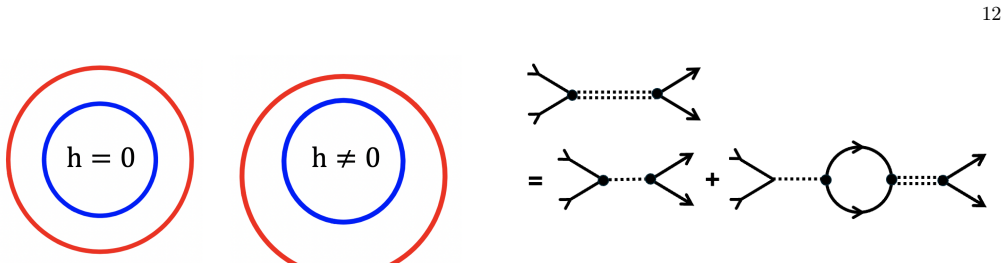
soft modes of the first kind (SM1) if h ≠ 0 gives M a mass … equivalent to the statement that two energy sheets E_β_k = μ … are degenerate in zero field but not in a nonzero field
-
IndisputableMonolith/Foundation/AbsoluteFloorClosure.leanreality_from_one_distinction unclear?
unclearRelation between the paper passage and the cited Recognition theorem.
δχ_O(q,h) = b^{-(d-1)} S_O(q b, h b) … χ_O(q→0,h=0) ∝ q^{d-1}
-
IndisputableMonolith/Foundation/AlphaCoordinateFixation.leanJ_uniquely_calibrated_via_higher_derivative unclear?
unclearRelation between the paper passage and the cited Recognition theorem.
nonanalytic free-energy functional … f(Φ) = -h Φ + r Φ² - v Φ^{d+1} + …
What do these tags mean?
- matches
- The paper's claim is directly supported by a theorem in the formal canon.
- supports
- The theorem supports part of the paper's argument, but the paper may add assumptions or extra steps.
- extends
- The paper goes beyond the formal theorem; the theorem is a base layer rather than the whole result.
- uses
- The paper appears to rely on the theorem as machinery.
- contradicts
- The paper's claim conflicts with a theorem or certificate in the canon.
- unclear
- Pith found a possible connection, but the passage is too broad, indirect, or ambiguous to say the theorem truly supports the claim.
Reference graph
Works this paper leans on
-
[1]
This leads to complicated logarithmic corrections to the scaling behavior predicted by the generalized Landau theory, see Sec. IIIA1. We will discuss various magnetic order parameters and their conjugate fields. In all cases the crucial question with respect to the nature of the quantum phase transi- tion is the existence of soft modes of the first kind. ...
-
[2]
This is the simple exam- ple we already discussed in Sec
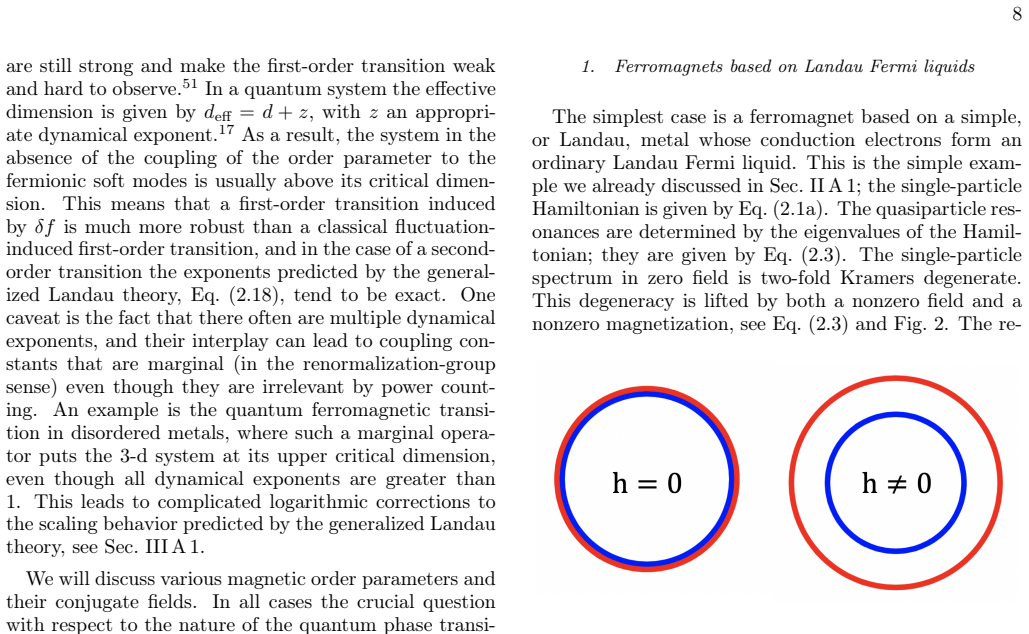
Ferromagnets based on Landau Fermi liquids The simplest case is a ferromagnet based on a simple, or Landau, metal whose conduction electrons form an ordinary Landau Fermi liquid. This is the simple exam- ple we already discussed in Sec. IIA1; the single-particle HamiltonianisgivenbyEq.(2.1a). Thequasiparticleres- onances are determined by the eigenvalues ...
-
[3]
IIIA1 also hold if the homogeneous magnetization is the result of a more com- plicated spin texture
Ferrimagnets, and canted antiferromagnets The arguments given in Sec. IIIA1 also hold if the homogeneous magnetization is the result of a more com- plicated spin texture. An example is provided by fer- rimagnets, i.e., antiferromagnets where the moments on the two sublattices do not completely compensate one another, which results in a net magnetization. ...
-
[4]
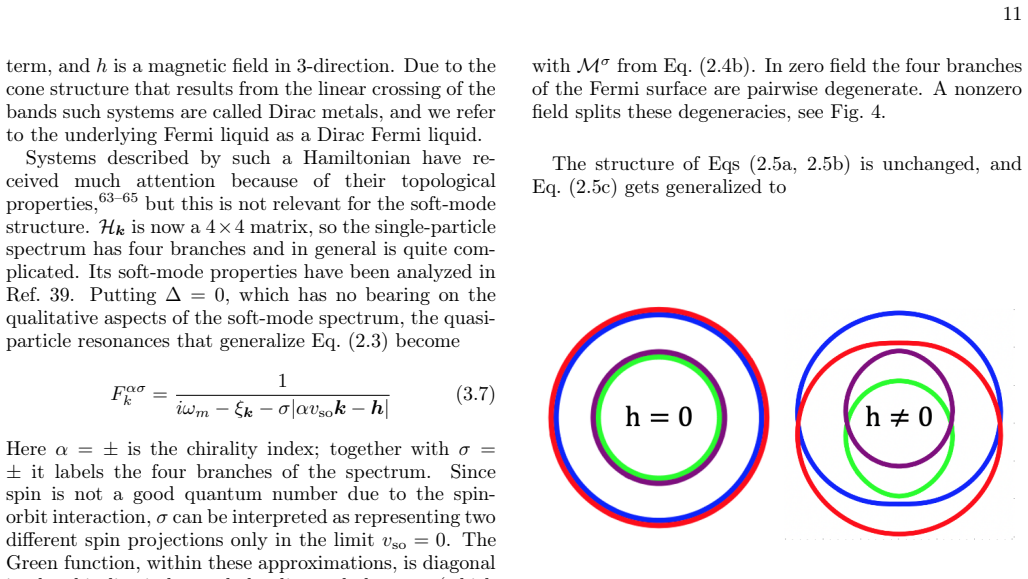
Ferromagnets based on Dirac Fermi liquids Different kinds of soft modes exist in metals where a strong spin-orbit interaction of the formσ·kleads to a linear crossing of two bands.60 Such a term can appear with either sign, which leads to electron species with two different chiralities. In systems that are invariant under both time reversal (in the absenc...
-
[5]
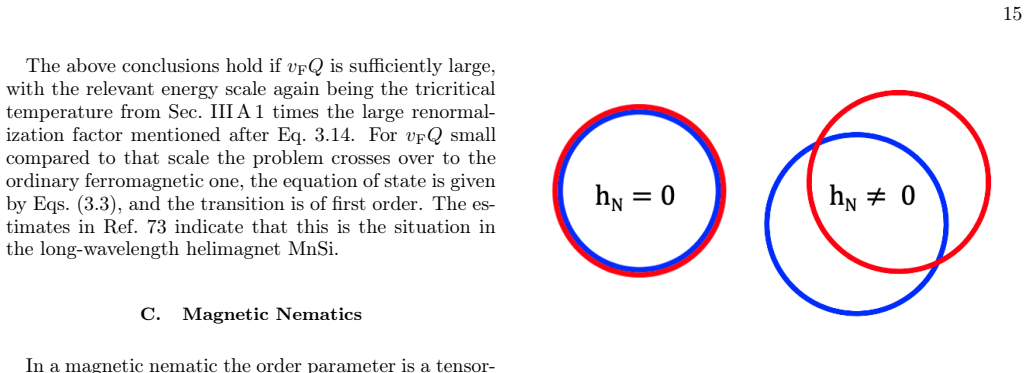
Non-centrosymmetric ferromagnets with strong spin-orbit coupling In all of the examples discussed so far the single- particle Hamiltonian has been invariant under spatial inversions. In the Landau ferromagnet case the single- 12 Figure 5: Schematic Fermi surface of a non-centrosymmetric FM with a strong spin-orbit interaction. The sheets cannot be labeled...
-
[6]
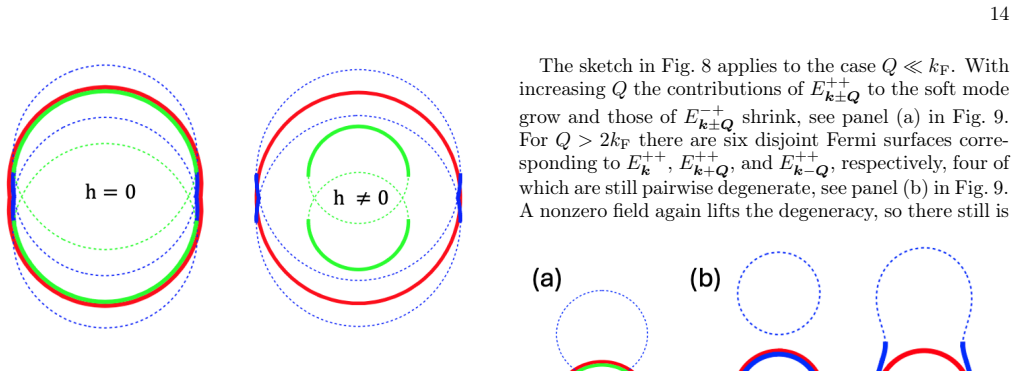
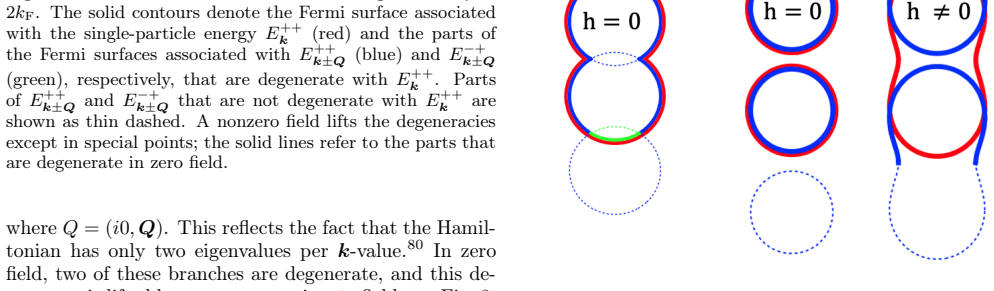
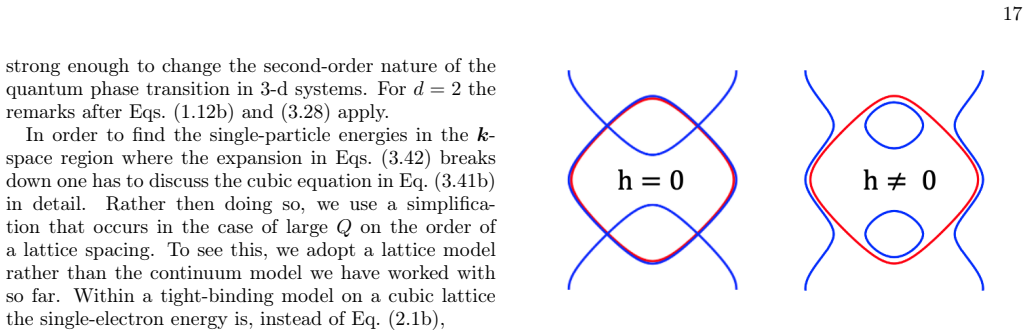
Helimagnets revisited ConsiderthehelimagneticHamiltonianfromEq.(3.22) and the corresponding eigenproblem, Eq. (A1). Writing the eigenvector asvk = (uk, wk), we have (λ−ξ k)uk =−h w k+Q ,(3.36a) (λ−ξ k)wk =−h u k−Q .(3.36b) Forh= 0, this yields one doubly degenerate eigenvalue perkvector,λ=ξ k. While this is consistent with the 16 fact that the Hamiltonian...
-
[7]
Magnetic smectics Now consider the spin-wave Hamiltonian, Eq. (3.35). The eigenequations analogous to Eqs. (3.36) read (λ−ξ k)uk = −h 2 (wk+Q +w k−Q),(3.39a) (λ−ξ k)wk = −h 2 (uk+Q +u k−Q).(3.39b) We now follow the procedure from Sec. IIID1, i.e., we use Eq. (3.39b) to eliminatewfrom Eq. (3.39a) and Eq. (3.39a) to eliminateufrom Eq. (3.39b). We then obtai...
-
[8]
We have chosen the staggered magnetization to point in thex-direction
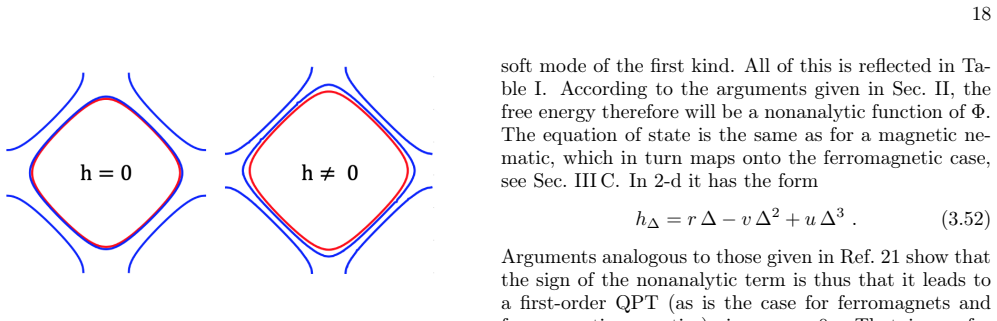
Néel Antiferromagnets In Néel antiferromagnets, i.e., collinear antiferromag- nets with fully compensated magnetization, the order pa- rameter is the staggered magnetization, which can be modeled as N(x) =N 0 (cos(Q·x),0,0),(3.49a) with an ordering wave vector Q= (π/a)(1,1,1),(3.49b) withathe lattice spacing. We have chosen the staggered magnetization to ...
-
[9]
Long-range correlations in response and correlation functions A remarkable aspect of our results is that long-range order-parameter correlations exist inallknown magnets and are all equally strong. In particular, they are equally strong in magnets with a nonzero ordering wave vector, such as antiferromagnets, or helimagnets, as in ferromag- nets with a ho...
-
[10]
(2.5) and underly, for instance, the scaling behavior of the Lindhard func- tion
Origin of the soft modes The soft modes causing the long-ranged correlations that are reflected in both correlation functions and re- sponse functions all originate from the soft particle-hole excitations that are reflected in Eqs. (2.5) and underly, for instance, the scaling behavior of the Lindhard func- tion. Such a continuum of soft modes that obey a ...
-
[11]
Nature of the quantum phase transition As we have discussed, the presence of soft modes of the first kind often renders the magnetic phase transition at low temperatures first order. It is interesting to con- trast these low-temperature transitions of first order with thosethataresecondorder. Atanynonzerotemperature, the asymptotic critical behavior at a ...
-
[12]
Relation to experiment The predictions of the soft-mode arguments presented in the present paper are in excellent agreement with ex- periment; for a review that focuses on ferromagnets, see Ref. 21. However, in considering specific materials one needs to keep in mind that quantitative considerations come into play. For instance, in systems with a nonzero ...
discussion (0)
Sign in with ORCID, Apple, or X to comment. Anyone can read and Pith papers without signing in.