REVIEW 3 major objections 6 minor 43 references
Implicit Neural Representation for Multiuser Continuous Aperture Array Beamforming
T0 review · 3 major / 6 minor · reviewed 2026-07-14 · grok-4.5
Pith's one-line read BeamINR embeds functional WMMSE iterations in a graph neural network so continuous multiuser CAPA beamformers approach optimal sum rate at far lower online cost.
desk verdict Solid CAPA methods paper: closed-form multiuser multi-CAPA rate + functional WMMSE + structure-aware BeamINR that actually beats the INR baselines on rate, latency, and generalization under the stated model. read the letter →
The pith
A machine-rendered reading of the paper's core claim, the machinery that carries it, and where it could break.
The reading
What carries the argument
Functional WMMSE: orthonormal-basis conversion of the functional rate problem into coefficient-matrix MSE minimization, followed by first-order conditions that produce closed-form continuous updates for combining functions, weight matrices, and beamforming functions; BeamINR then uses those updates as its GNN aggregation/combination rule.
What would settle it
Retrain and re-evaluate BeamINR versus functional WMMSE after replacing the ideal continuous LoS kernels with multipath or imperfectly estimated kernels, or after changing quadrature order; if BeamINR’s sum-rate ratio to WMMSE falls well below the reported high-nineties percentages, the central claim fails under realistic conditions.
Extended reading notes
Core claim
A closed-form multiuser multi-CAPA sum rate plus a functional WMMSE algorithm whose continuous-domain updates can be turned into a GNN layer update yield BeamINR, an implicit neural representation that approaches the functional WMMSE sum rate while cutting inference latency and improving generalization over conventional INR beamformers.
Load-bearing premise
The base station is assumed to know the exact continuous line-of-sight channel kernels between every aperture point pair, and continuous integrals can be replaced by fixed-order quadrature without changing the learned policy.
Editorial extensions
If this is right
- Continuous multiuser CAPA beamforming can be run online at near-WMMSE rates with inference times roughly an order of magnitude lower than iterative functional solvers.
- Embedding permutation equivariance and WMMSE iteration structure reduces the samples and parameters needed to train CAPA beamforming INRs.
- The same trained network generalizes across unseen user counts, CAPA areas, and carrier frequencies without retraining.
- Fourier-truncated and discrete-array approximations leave measurable sum-rate gaps that pure functional and model-structured INR methods close.
Reading between the lines
- The functional-iteration-to-GNN template may transfer to other continuous-domain wireless designs such as continuous RIS phase profiles or near-field focusing.
- Hybrid fixed-quadrature plus scrambled-Sobol training is a reusable recipe for preventing coordinate overfitting whenever an INR must evaluate aperture integrals.
- If continuous CSI must be estimated rather than given, the reported generalization edge may shrink unless the network is trained end-to-end with estimated kernels.
Editorial analysis
A structured set of objections, weighed in public.
Referee Report
Summary. The paper studies multiuser multi-CAPA downlink beamforming where both the BS and users have continuous apertures. It derives a closed-form sum-rate expression (Prop. 1) that accounts for both intra- and inter-user interference, reformulates sum-rate maximization as an equivalent weighted MSE problem (Prop. 2) via a functional Woodbury identity, and obtains a functional WMMSE algorithm whose updates for the combining functions, weights, and beamforming functions are written in the continuous domain after orthonormal expansions (Sec. IV, Table I). Building on the PE property of the optimal policy (Prop. 3) and an explicit recursion of the functional WMMSE iterates (Prop. 4), the authors propose BeamINR, a GNN-based INR whose layer update (45) aggregates channel kernels weighted by previous-layer representations. Simulations under LoS uni-polarized channels show that functional WMMSE attains the highest sum rate, while BeamINR approaches it with much lower inference latency and better generalization to user count, CAPA size, and carrier frequency than ConINR/VarINR baselines (Figs. 3–6, Tables II–V).
Significance. If the results hold under the stated model, the paper makes two concrete contributions to CAPA beamforming: (i) an explicit multiuser multi-CAPA rate formula and a functional WMMSE algorithm that updates continuous beamforming functions without Fourier truncation, and (ii) a model-structured PE GNN INR that substantially reduces online latency and training sample/time cost relative to unstructured INRs while improving scale and frequency generalization. The appendices supply a coherent derivation path (KLE rate, functional Woodbury, optimality conditions mapped back to functions, and the WMMSE-to-GNN recursion), and the simulation suite is reasonably comprehensive (rate vs. power/users/size/frequency, generalization tables, and complexity). These are useful advances for continuous-aperture systems, even though operational significance remains limited by perfect continuous CSI and quadrature surrogates.
major comments (3)
- Sec. II (perfect-CSI paragraph) and channel model (3): all rate claims and both algorithms assume perfect continuous LoS uni-polarized kernels at the BS. The paper cites parametric estimators [35], [36] but never evaluates BeamINR or functional WMMSE under estimated or noisy kernels. Because the strongest claim is operational (near-WMMSE rate at low latency with better generalization), at least one imperfect-CSI or parametric-channel experiment is needed to show that the ranking in Figs. 3–6 and Tables II–V is not an artifact of oracle continuous CSI.
- Sec. V-C and VI-A (GL/Sobol training and testing): continuous integrals in the rate objective, GNN layers (51), and evaluation are replaced by fixed-order quadrature (M_B,G^2=100 train / 400 test; M_B,S=100). There is no ablation of quadrature order, no comparison against denser or alternative integrators, and no quantification of the residual policy/rate error relative to the continuous functional WMMSE. A short sensitivity study is load-bearing for the claim that BeamINR “approaches” functional WMMSE rather than a shared discrete surrogate.
- Table II (user generalizability): models trained at K=5 and tested for K=2…8 show BeamINR ratios as low as ~53% at K=2 and ~87% at K=8 versus functional WMMSE. The abstract and Sec. VII state improved generalization to the number of users without quantifying this degradation or discussing when retraining is still required. The claim should be tempered, or the table should be accompanied by absolute rates and a clear statement of the usable generalization range.
minor comments (6)
- Abstract vs. body: the abstract claims improved generalization to CAPA sizes and carrier frequencies; Table III shows strong size generalization for all INRs, while Table IV shows a clearer BeamINR/VarINR advantage on frequency. Align the abstract wording with the tables.
- Notation: S_U is defined as the union of user apertures in Prop. 1, but several integrals (e.g., (6a) and later) mix S_U and S_k^U; a short clarifying sentence would help.
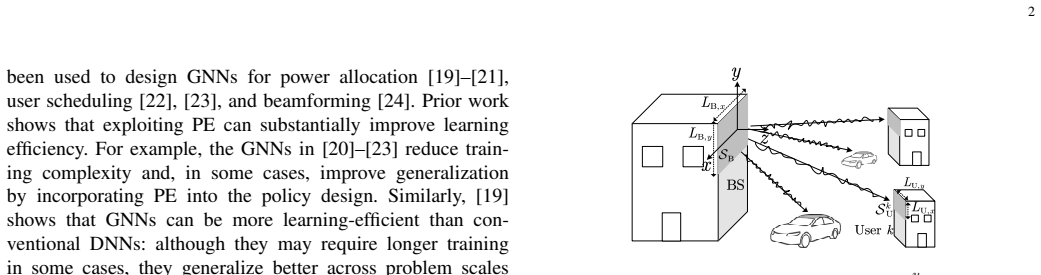
- Fig. 1 caption is truncated (“Illustration of the downlink CAPA system L_x^B, L_y^B.”); complete the caption.
- Table V reports inference time and training complexity to reach 95% of functional WMMSE; state hardware (CPU/GPU) and whether times include quadrature overhead so the latency comparison is reproducible.
- Related-work placement: the conference precursor [34] is cited for functional WMMSE; a one-sentence delineation of what is new in the journal version (closed-form multiuser multi-CAPA rate, BeamINR, extended sims) already appears in footnote 1 and could be mirrored briefly in Sec. I-B.
- Typos / wording: “It also provides additional simulation results…” (footnote 1); “Teb.” for Feb. in [20]; occasional missing spaces before citations. Light copy-edit would suffice.
Circularity Check
No significant circularity: rate, functional WMMSE, and BeamINR are self-contained derivations/learning, not inputs renamed as predictions.
full rationale
The load-bearing chain is independent of fitted constants and of self-justifying uniqueness claims. Proposition 1 obtains the multiuser multi-CAPA sum rate from mutual information via KLE of the Gaussian received process, coefficient-domain Woodbury, and conversion back to kernels (App. A); the channel model (3) and perfect CSI are stated assumptions, not results fitted from the rate itself. Proposition 2 and Sec. IV map sum-rate max to weighted MSE min by the standard WMMSE equivalence (optimal combiner/weights), expand with complete orthonormal bases, then push first-order conditions back to the functional domain to get the closed-form updates (29), (31), (38)—algebraic, not circular. Proposition 3 is a KKT permutation argument for 1D-PE; Proposition 4 rewrites one WMMSE iterate as an aggregation/combination of channel kernels, which motivates the GNN update (45) as model-driven architecture design, not a prediction forced by a prior fit. BeamINR is trained unsupervised on the negative of the same sum-rate objective it is evaluated on (Sec. V-C); that is ordinary learning-for-optimization, not “fitted input called prediction.” The only self-citation of note is the transparent conference precursor [34] for the functional WMMSE portion; the journal adds the closed-form rate, BeamINR, PE/GNN design, and generalization experiments, so [34] is not a load-bearing uniqueness theorem. No ansatz is smuggled in via citation, and no known empirical pattern is merely renamed. Under the paper’s stated model the math and simulations cohere; score 0.
Assumptions & free parameters
free parameters (6)
- BeamINR hidden-layer widths [64,128,512,512,128,64]
- Hybrid loss weight α=0.1
- Adam learning rate 1e-3, batch size 32, 500k samples per dataset
- GL/Sobol sample counts (M_B,G^2=100 train / 400 test; M_B,S=100)
- Current budget C_max and noise variance σ_n^2
- Lagrange multiplier μ via bisection in functional WMMSE
assumptions (6)
- domain assumption Perfect continuous channel-state information of kernels h_k(r,s) is available at the BS.
- domain assumption Uni-polarized LoS CAPA channel model (3) with free-space dyadic Green’s function.
- standard math Complete orthonormal bases exist on BS/user apertures so continuous kernels and beamformers admit expansions (14)–(21).
- standard math Functional inverse kernels exist for J_k and T_k (Definition 1) and the functional Woodbury identity (Lemma 1) applies.
- ad hoc to paper Gauss–Legendre / Sobol quadrature sufficiently approximates continuous integrals for training and evaluation.
- domain assumption Optimal multiuser beamforming policy is 1D permutation-equivariant in user geometry (Proposition 3).
invented entities (2)
-
Functional WMMSE algorithm for multiuser multi-CAPA
-
BeamINR (WMMSE-structured PE GNN INR)
Cite this review
Pith. "Pith review of Implicit Neural Representation for Multiuser Continuous Aperture Array Beamforming." pith.science (2026). https://pith.science/paper/KOC6EDXJ
@misc{pith2026260316053,
  author       = {Pith},
  title        = {Pith review of: Implicit Neural Representation for Multiuser Continuous Aperture Array Beamforming},
  year         = {2026},
  howpublished = {\url{https://pith.science/paper/KOC6EDXJ}},
  note         = {Machine review of arXiv:2603.16053}
}
read the original abstract
This paper studies the optimization of beamforming functions for multiuser multi-continuous aperture array (CAPA) systems, where both the base station and the users are equipped with CAPAs. We first derive a closed-form expression for the achievable sum rate, and then develop a functional weighted minimum mean-squared error (WMMSE) algorithm, which transforms the functional optimization problem into an equivalent parameter optimization problem by employing orthonormal basis expansion. Based on the functional WMMSE algorithm, we further propose BeamINR, an implicit neural representation (INR) method for learning continuous beamforming functions. BeamINR is designed as a graph neural network to exploit the permutation equivariance of the optimal beamforming policy, with an update equation designed according to the functional WMMSE iterations. Simulation results show that both the functional WMMSE algorithm and BeamINR outperform existing numerical and INR-based baselines. BeamINR approaches the sum rate of the functional WMMSE with substantially lower inference latency. Compared with INR-based baselines, BeamINR reduces training complexity and improves generalization to the number of users, CAPA sizes, and carrier~frequencies.
Figures


Figures from the paper (2 more)


Reference graph
Works this paper leans on
-
[35]
Parametric channel estimation for LoS dominated holographic massive MIMO systems,
M. Ghermezcheshmeh and N. Zlatanov, “Parametric channel estimation for LoS dominated holographic massive MIMO systems,”IEEE Access, vol. 11, pp. 44 711–44 724, May 2023
2023
-
[36]
Fourier plane wave series expansion for holographic MIMO communications,
A. Pizzo, L. Sanguinetti, and T. L. Marzetta, “Fourier plane wave series expansion for holographic MIMO communications,”IEEE Trans. Wireless Commun., vol. 21, no. 9, pp. 6890–6905, Sept. 2022
2022
-
[1]
Massive MIMO for next generation wireless systems,
E. G. Larsson, O. Edfors, F. Tufvesson, and T. L. Marzetta, “Massive MIMO for next generation wireless systems,”IEEE Commun. Mag., vol. 52, no. 2, pp. 186–195, 2014
2014
-
[2]
Massive MIMO: ten myths and one critical question,
E. Bj ¨ornson, E. G. Larsson, and T. L. Marzetta, “Massive MIMO: ten myths and one critical question,”IEEE Commun. Mag., vol. 54, no. 2, pp. 114–123, 2016
2016
-
[3]
Holographic MIMO surfaces for 6G wireless networks: Opportunities, challenges, and trends,
C. Huang, S. Hu, G. C. Alexandropoulos, A. Zappone, C. Yuen, R. Zhang, M. D. Renzo, and M. Debbah, “Holographic MIMO surfaces for 6G wireless networks: Opportunities, challenges, and trends,”IEEE Wirel. Commun., vol. 27, no. 5, pp. 118–125, 2020
2020
-
[4]
Holographic MIMO: How many antennas do we need for energy efficient communi- cation?
S. Bahanshal, Q.-U.-A. Nadeem, and M. Jahangir Hossain, “Holographic MIMO: How many antennas do we need for energy efficient communi- cation?”IEEE Trans. Wireless Commun., vol. 24, no. 1, pp. 118–133, 2025. 13
2025
-
[5]
Learning-based multiuser beamforming for holographic mimo systems,
S. Chen and S. Han, “Learning-based multiuser beamforming for holographic mimo systems,”arXiv preprint arXiv:2504.19522, 2026
arXiv 2026
-
[6]
Reconfigurable intelligent surfaces: Principles and opportunities,
Y . Liu, X. Liu, X. Mu, T. Hou, J. Xu, M. Di Renzo, and N. Al-Dhahir, “Reconfigurable intelligent surfaces: Principles and opportunities,”IEEE Commun. Surv. Tutor., vol. 23, no. 3, pp. 1546–1577, 2021
2021
Show all 43 references
-
[7]
Wireless communications through reconfigurable intelligent surfaces,
E. Basar, M. Di Renzo, J. De Rosny, M. Debbah, M.-S. Alouini, and R. Zhang, “Wireless communications through reconfigurable intelligent surfaces,”IEEE Access, vol. 7, pp. 116 753–116 773, 2019
2019
-
[8]
Continuous-aperture ar- ray (CAPA)-based wireless communications: Capacity characterization,
B. Zhao, C. Ouyang, X. Zhang, and Y . Liu, “Continuous-aperture ar- ray (CAPA)-based wireless communications: Capacity characterization,” IEEE Trans. Wireless Commun., 2025, early access
2025
-
[9]
Wavenumber-division multiplexing in line-of-sight holographic MIMO communications,
L. Sanguinetti, A. A. D’Amico, and M. Debbah, “Wavenumber-division multiplexing in line-of-sight holographic MIMO communications,” IEEE Trans. Wireless Commun., vol. 22, no. 4, pp. 2186–2201, Apr. 2023
2023
-
[10]
On the spectral efficiency of multi-user holographic MIMO uplink transmission,
M. Qian, L. You, X.-G. Xia, and X. Gao, “On the spectral efficiency of multi-user holographic MIMO uplink transmission,”IEEE Trans. Wireless Commun., vol. 23, no. 10, pp. 15 421–15 434, Oct. 2024
2024
-
[11]
Pattern-division multiplexing for multi-user continuous-aperture MIMO,
Z. Zhang and L. Dai, “Pattern-division multiplexing for multi-user continuous-aperture MIMO,”IEEE J. Sel. Areas Commun., vol. 41, no. 8, pp. 2350–2366, Aug. 2023
2023
-
[12]
Beamforming optimization for continuous aperture array (CAPA)-based communications,
Z. Wang, C. Ouyang, and Y . Liu, “Beamforming optimization for continuous aperture array (CAPA)-based communications,”IEEE Trans. Wireless Commun., 2025, early access
2025
-
[13]
Optimal beamforming for multi-user continuous aperture array (CAPA) systems,
——, “Optimal beamforming for multi-user continuous aperture array (CAPA) systems,”IEEE Trans. Commun., 2025, early access
2025
-
[14]
CAPA: Continuous-aperture arrays for revolutionizing 6G wireless communica- tions,
Y . Liu, C. Ouyang, Z. Wang, J. Xu, X. Mu, and Z. Ding, “CAPA: Continuous-aperture arrays for revolutionizing 6G wireless communica- tions,”arXiv:2412.00894, 2024
2024 arXiv
-
[15]
Continuous aper- ture array (CAPA)-based multi-group multicast communications,
M. Qian, X. Mu, L. You, and M. Matthaiou, “Continuous aper- ture array (CAPA)-based multi-group multicast communications,” arXiv:2505.01190, 2025
2025
-
[16]
Beamforming design for continuous aperture array (CAPA)-based MIMO systems,
Z. Wang, C. Ouyang, and Y . Liu, “Beamforming design for continuous aperture array (CAPA)-based MIMO systems,”arXiv:2504.00181, 2025
2025 arXiv
-
[17]
Multi-user continuous-aperture array communications: How to learn current distribution?
J. Guo, Y . Liu, and A. Nallanathan, “Multi-user continuous-aperture array communications: How to learn current distribution?” inProc. IEEE 43rd Glob. Commun. Conf., 2024, pp. 1–6
2024
-
[18]
Implicit neural representation of beamforming for continuous aperture array systems,
S. Chen, J. Guo, and S. Han, “Implicit neural representation of beamforming for continuous aperture array systems,”IEEE Trans. Veh. Technol., 2026, early Access
2026
-
[19]
Optimal wireless resource allocation with random edge graph neural networks,
M. Eisen and A. Ribeiro, “Optimal wireless resource allocation with random edge graph neural networks,”IEEE Trans. Signal Process., vol. 68, pp. 2977–2991, 2020
2020
-
[20]
Learning power allocation for multi-cell-multi- user systems with heterogeneous graph neural networks,
J. Guo and C. Yang, “Learning power allocation for multi-cell-multi- user systems with heterogeneous graph neural networks,”IEEE Trans. Wireless Commun., vol. 21, no. 2, pp. 884–897, Teb. 2021
2021
-
[21]
Graph neural networks for scalable radio resource management: Architecture design and theoretical analysis,
Y . Shen, Y . Shi, J. Zhang, and K. B. Letaief, “Graph neural networks for scalable radio resource management: Architecture design and theoretical analysis,”IEEE J. Sel. Areas Commun,, vol. 39, no. 1, pp. 101–115, 2021
2021
-
[22]
Graph embedding-based wireless link scheduling with few training samples,
M. Lee, G. Yu, and G. Y . Li, “Graph embedding-based wireless link scheduling with few training samples,”IEEE Trans. Wireless Commun., vol. 20, no. 4, pp. 2282–2294, 2021
2021
-
[23]
Learning based user scheduling in reconfigurable intelligent surface assisted multiuser downlink,
Z. Zhang, T. Jiang, and W. Yu, “Learning based user scheduling in reconfigurable intelligent surface assisted multiuser downlink,”IEEE J. Sel. Topics Signal Process., vol. 16, no. 5, pp. 1026–1039, 2022
2022
-
[24]
Understanding the performance of learn- ing precoding policies with graph and convolutional neural networks,
B. Zhao, J. Guo, and C. Yang, “Understanding the performance of learn- ing precoding policies with graph and convolutional neural networks,” IEEE Trans. Commun., vol. 72, no. 9, pp. 5657–5673, 2024
2024
-
[25]
Joint user scheduling and beamforming design for multiuser MISO downlink systems,
S. He, J. Yuan, Z. An, W. Huang, Y . Huang, and Y . Zhang, “Joint user scheduling and beamforming design for multiuser MISO downlink systems,”IEEE Trans. Wireless Commun., vol. 22, no. 5, pp. 2975–2988, 2023
2023
-
[26]
A model-based GNN for learning precoding,
J. Guo and C. Yang, “A model-based GNN for learning precoding,” IEEE Trans. Wireless Commun., vol. 23, no. 7, pp. 6983–6999, 2024
2024
-
[27]
Gradient-driven graph neural networks for learning digital and hybrid precoder,
L. Zhang, S. Han, and C. Yang, “Gradient-driven graph neural networks for learning digital and hybrid precoder,”IEEE Trans. Commun., vol. 74, pp. 706–722, 2026
2026
-
[28]
Iterative algorithm induced deep-unfolding neural networks: Precoding design for multiuser MIMO systems,
Q. Hu, Y . Cai, Q. Shi, K. Xu, G. Yu, and Z. Ding, “Iterative algorithm induced deep-unfolding neural networks: Precoding design for multiuser MIMO systems,”IEEE Trans. Wireless Commun., vol. 20, no. 2, pp. 1394–1410, 2021
2021
-
[29]
Deep graph unfolding for beamforming in MU-MIMO interference networks,
A. Chowdhury, G. Verma, A. Swami, and S. Segarra, “Deep graph unfolding for beamforming in MU-MIMO interference networks,”IEEE Trans. Wireless Commun., vol. 23, no. 5, pp. 4889–4903, 2024
2024
-
[30]
Learn to rapidly and robustly optimize hybrid precoding,
O. Lavi and N. Shlezinger, “Learn to rapidly and robustly optimize hybrid precoding,”IEEE Trans. Commun., vol. 71, no. 10, pp. 5814– 5830, 2023
2023
-
[31]
Transfer learning and meta learning-based fast downlink beamforming adapta- tion,
Y . Yuan, G. Zheng, K.-K. Wong, B. Ottersten, and Z.-Q. Luo, “Transfer learning and meta learning-based fast downlink beamforming adapta- tion,”IEEE Trans. Wireless Commun.s, vol. 20, no. 3, pp. 1742–1755, 2021
2021
-
[32]
A bipartite graph neural network approach for scalable beamforming optimization,
J. Kim, H. Lee, S.-E. Hong, and S.-H. Park, “A bipartite graph neural network approach for scalable beamforming optimization,”IEEE Trans. Wireless Commun., vol. 22, no. 1, pp. 333–347, 2023
2023
-
[33]
Gradient-based information aggregation of GNN for precoder learning,
S. Chen, S. Han, and Y . Li, “Gradient-based information aggregation of GNN for precoder learning,” inProc. IEEE 97th Veh. Technol. Conf., Dec. 2023, pp. 1–6
2023
-
[34]
Functional WMMSE algorithm for multiuser continuous aperture array systems,
S. Chen, S. Han, and J. Guo, “Functional WMMSE algorithm for multiuser continuous aperture array systems,” inProc. IEEE 24th Int. Conf. Commun., 2026, pp. 1–6
2026
-
[37]
H. F. Davis,Fourier Series and Orthogonal Functions. New York: Dover Publications, 1953
1953
-
[38]
Learning resource allocation policy: Vertex-GNN or edge-GNN?
Y . Peng, J. Guo, and C. Yang, “Learning resource allocation policy: Vertex-GNN or edge-GNN?”IEEE Trans. Mach. Learn. Commun. Netw., vol. 2, pp. 190–209, 2024
2024
-
[39]
Recursive gnns for learning precoding policies with size-generalizability,
J. Guo and C. Yang, “Recursive gnns for learning precoding policies with size-generalizability,”IEEE Trans. Mach. Learn. Commun. Netw., vol. 2, pp. 1558–1579, Oct. 2024
2024
-
[40]
P. J. Davis and P. Rabinowitz,Methods of Numerical Integration. Courier Corporation, 2007
2007
-
[41]
Practical hash-based owen scrambling,
B. Burley, “Practical hash-based owen scrambling,”J. Comput. Graph. Tech., vol. 9, no. 4, pp. 1–20, 2020
2020
-
[42]
Enabling 6G performance in the upper mid-band by transitioning from massive to gigantic MIMO,
E. Bj ¨ornson, F. Kara, N. Kolomvakis, A. Kosasih, P. Ramezani, and M. B. Salman, “Enabling 6G performance in the upper mid-band by transitioning from massive to gigantic MIMO,”IEEE Open J. Commun. Soc., 2025
2025
-
[43]
T. M. Cover and J. A. Thomas,Elements of Information Theory, 2nd ed. Hoboken, NJ, USA: John Wiley & Sons, 2006
2006
Reviewed July 14, 2026 · model on record in the stance chip above.
Discussion (0). Continue with ORCID to comment.