REVIEW 3 major objections 6 minor 85 references
A simplified unified wave-particle method for diatomic gases with rotational and vibrational non-equilibrium
T0 review · 3 major / 6 minor · reviewed 2026-08-06 · deepseek-v4-flash
Pith's one-line read The paper extends the simplified unified wave-particle (SUWP) method to diatomic gases with rotational and vibrational non-equilibrium, deriving a quantified model-competition (QMC) mechanism that splits molecules into free-transport…
desk verdict A useful extension of the SUWP wave-particle framework to vibrational nonequilibrium, with a real but unquantified question about how free-transport particles are reconstructed. read the letter →
The pith
A machine-rendered reading of the paper's core claim, the machinery that carries it, and where it could break.
The reading
What carries the argument
The quantified model-competition (QMC) mechanism is the central machinery. Starting from the integral solution $f(t) = e^{-\Delta t/\tau} f(\mathbf{x}_0, \mathbf{u}, t_0) + \tau^{-1} \int_0^{\Delta t} g(\mathbf{x}', \mathbf{u}, t') e^{t'/\tau} dt'$, the fraction $e^{-\Delta t/\tau}$ of molecules that never collide is treated as free transport and sampled as particles, while the complement is treated as hydrodynamic. A second-order Taylor expansion of the equilibrium state $g$ turns the hydrodynamic part into the N-S flux with the scale-dependent viscous coefficient $c_{\text{vis}}$ multiplying the viscous flux. The reconstruction of Type-F particles draws from the three equilibrium distributions $f^{\text{tr}}$, $f^{\text{rot}}$, $f^{\text{vib}}$ with probabilities set by the relaxation numbers $Z_{\text{rot}}$ and $Z_{\text{vib}}$, and the macroscopic flux is closed by a three-temperature kinetic inviscid flux (KIF) scheme.
What would settle it
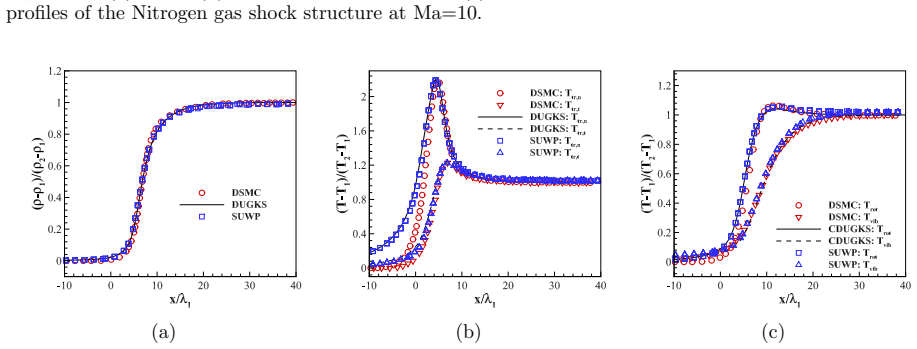
A refinement study of the Mach-15 nitrogen shock structure: increase cell resolution and particle count while holding the physical model fixed, and compare the normal translational-temperature profile with DSMC. If the early rise upstream of the shock maximum persists or grows under refinement, it is an artifact of the equilibrium-sampling reconstruction; if it shrinks, it was a discretization effect. A second check is the leeward-side cylinder flow at Mach 5, where the paper reports faster temperature rise than DUGKS; quantifying that gap against DSMC would reveal the same mechanism.
Extended reading notes
Core claim
The central claim is that a second-order Chapman-Enskog expansion of the time-integral solution of the vibrational kinetic model collapses the colliding-molecule fraction onto the three-temperature Navier-Stokes equations, leaving a complementary free-transport fraction that can be handled by a collisionless particle solver. This produces an explicit weight $w_{\text{free}} = e^{-\Delta t/\tau}$ for particles and $w_{\text{hydro}} = 1 - e^{-\Delta t/\tau}$ for hydrodynamic molecules, together with a scale-dependent viscous coefficient $c_{\text{vis}} = 1 - (\Delta t/\tau) e^{-\Delta t/\tau}/(1 - e^{-\Delta t/\tau})$. The paper argues that the resulting SUWP-vib method reproduces reference solutions across Knudsen numbers from $10$ to $10^{-3}$ and Mach numbers up to $25$, and that because it reuses an N-S solver and a DSMC component, existing results for both can be directly adopted.
Load-bearing premise
The accuracy in strong non-equilibrium regions rests on the assumption that newly created free-transport particles can be sampled from the equilibrium distributions $f^{\text{tr}}$, $f^{\text{rot}}$, and $f^{\text{vib}}$ instead of from the actual non-equilibrium distribution, because those particles are supposed to carry the non-equilibrium part of the flow.
Editorial extensions
If this is right
- The SUWP-vib method adapts cell by cell between continuum and rarefied descriptions, so one solver covers flows that cross the entire Knudsen range.
- Because it is built from standard N-S and DSMC components, improvements to either component (relaxation models, boundary conditions, collision sampling) carry over directly into the coupled method.
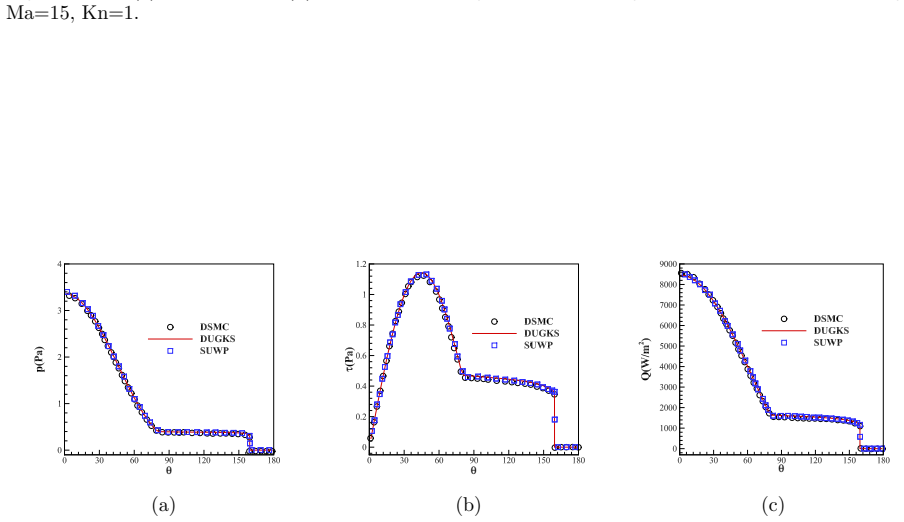
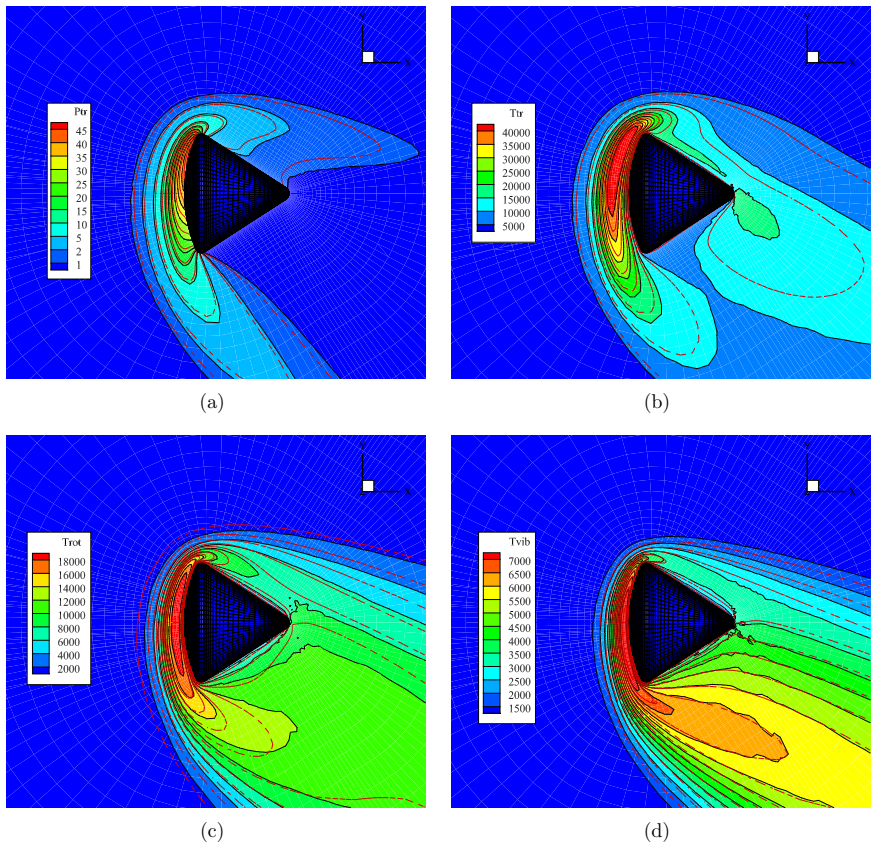
- The Apollo 6 case shows drag and lift within 0.42% and 3.06% of the DSMC benchmark while using about 57% fewer CPU-hours than the implicit DUGKS solver on the same mesh.
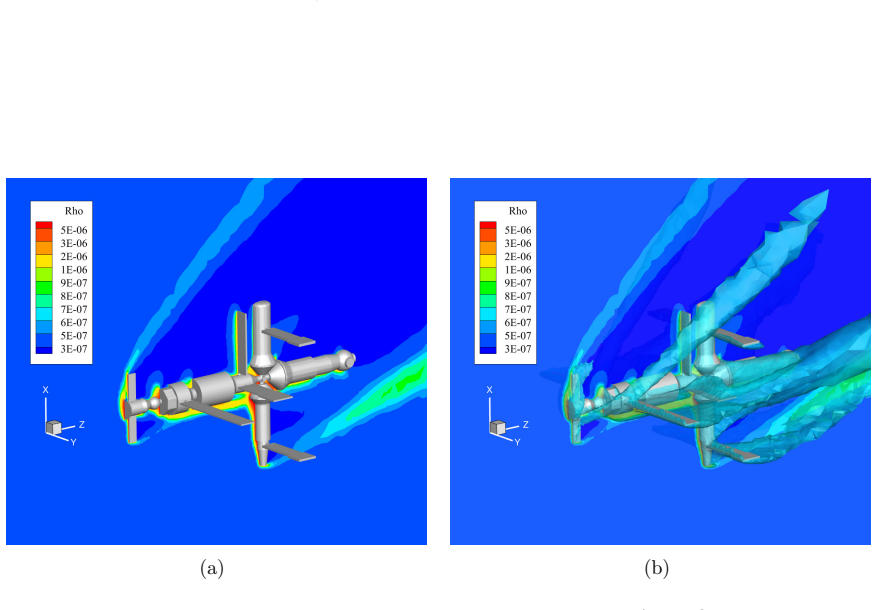
- The space station Mir case shows the method runs on complex three-dimensional geometries with millions of cells, keeping memory demand well below that of deterministic velocity-space solvers.
- The paper identifies an 'early rise' of translational temperature in shock structures and notes that modifying the relaxation time, as done in prior wave-particle work, is a possible future correction.
Reading between the lines
- (Editorial inference) Because Type-F particles are reconstructed from equilibrium distributions $f^{\text{tr}}, f^{\text{rot}}, f^{\text{vib}}$, the non-equilibrium deviation they are meant to carry may be under-sampled in strong non-equilibrium zones, which would worsen exactly where the method is most needed.
- (Editorial inference) The QMC mechanism depends only on the form of the integral solution, so the same weighting could extend to dissociating and ionizing air by adding chemical or electronic energy modes to the relaxation targets.
- (Editorial inference) The reported speedup compares an implicit DUGKS run on one hardware setup with SUWP-vib on another; a same-machine comparison with matched particle counts would make the efficiency claim more direct.
- (Editorial inference) Mapping $w_{\text{free}}$ and $c_{\text{vis}}$ onto local continuum-breakdown parameters could give a quantitative criterion for when the particle solver must take over, usable in other hybrid methods.
Editorial analysis
A structured set of objections, weighed in public.
Referee Report
Summary. This paper extends the simplified unified wave-particle (SUWP) method to diatomic gases with rotational and vibrational non-equilibrium. Starting from the time-integral solution of a vibrational kinetic model, the authors derive a quantified model-competition (QMC) mechanism that splits molecules into colliding (Type-C) and free-transport (Type-F) parts, weights them by w_hydro = 1 - exp(-Δt/τ) and w_free = exp(-Δt/τ), and couples a three-temperature Navier-Stokes solver with a collisionless DSMC-type particle solver. The N-S solver uses a kinetic inviscid flux (KIF) and explicit relaxation source terms for rotational and vibrational energies; the particle solver handles particle removal, reconstruction, transport, and boundary conditions. The method is applied to shock tube, shock structure, cylinder, blunt wedge, sphere, Apollo 6, and Space Station Mir cases, with a reported efficiency comparison against implicit DUGKS.
Significance. If the central reconstruction approximation is sound, the paper offers a practical low-memory multiscale solver for high-speed aerospace flows, with an original derivation of the QMC weights for the three-temperature diatomic model and an explicit Chapman-Enskog reduction to three-temperature N-S equations. The manuscript ships a substantial set of benchmark computations, including a 2.6-million-cell Mir reentry, and reports concrete CPU-hour and memory advantages. No new free parameters are introduced beyond standard rotational/vibrational collision numbers and VHS gas data. The main strengths are the algorithmic construction and the breadth of demonstration; the main weaknesses are that most validation is against another discretization of the same kinetic model and that the particle-reconstruction approximation is not quantitatively bounded.
major comments (3)
- [Section 3.2, Eqs. (13)-(15), (26)] In the reconstruction step, Type-F particles are sampled from the equilibrium target distributions f_tr, f_rot, and f_vib rather than from the actual non-equilibrium distribution f(x0,u,ηrot,ηvib,0) that appears in the free-streaming term of Eq. (26). Since Type-F particles are precisely the fraction that should carry non-equilibrium information, replacing f by these equilibrium forms discards at least the deviatoric stress and higher-order moments; the Shakhov-like heat-flux terms in Eqs. (13)-(15) restore only part of the heat flux. In the intermediate-Knudsen regime w_free is not small, so this approximation can bias the particle flux and therefore the claimed accuracy. The reported early rise of Ttr,n (Sec. 4.2) and the leeward-side temperature discrepancy (Sec. 4.3) are consistent with such a bias, but they are not quantified and are partly shared with DUGKS, so they do not isolate the reconstruction error. Please add a quantitative test, for example comparing the statistical moments of reconstructed Type-F particles with the pre-removal particle distribution, or a benchmark in which the reconstruction is replaced by direct particle statistics, to bound the error in the target flow regimes.
- [Sections 4.1-4.7] Most validation is against the authors' own DUGKS solution [27] of the same vibrational kinetic model. This confirms consistency between two discretizations, but it cannot validate the physical model or the particle-reconstruction approximation independently. Independent DSMC comparisons appear in shock structures and cylinder/blunt-wedge cases, but the known discrepancies (early rise in Ttr,n, leeward-side temperature increase in cylinder flow, post-shock temperature decay) are described qualitatively and no error metrics are reported. For the paper's central claim of 'maintaining accuracy' in strong non-equilibrium, please provide quantitative errors against DSMC (for example L1 or L2 norms of profile deviations) for rotational and vibrational temperatures and for wall heat flux, and state the range of Knudsen and Mach numbers over which the stated accuracy holds.
- [Section 4.6, Table 10] The efficiency comparison is not controlled: the implicit DUGKS calculation used a different processor generation (Xeon Gold 6258, 2.70 GHz, 640 cores) than the SUWP-vib calculation (EPYC 7763, 2.45 GHz, 108 cores), and no memory usage is measured even though the abstract and conclusion claim one-to-two-orders-of-magnitude memory reduction. The reported speedup is based on CPU-hours (2092.8 vs 887.86 GHz·h), while the wall-clock time is actually larger for SUWP-vib (8.22 h vs 3.27 h); with different architectures and core counts this does not establish a robust efficiency advantage. Please report measured memory, provide a controlled or at least well-characterized comparison, and clarify whether the 60,000 KIF initialization steps are included in the SUWP total cost.
minor comments (6)
- [Throughout] There are numerous typographical errors, including 'desity' in figure captions, 'Fig. 3, Fig. 4 和Fig. 5' in Sec. 4.1, 'The the first term' in Sec. 3.1, and a stray 'equilibrium' in Eq. (A.7); a careful copyedit is needed.
- [Eq. (43)] The fixed-point iteration as written uses T_eq^{n+1,i} on the left-hand side and K_vib(T_eq^{n+1,i+1}) on the right-hand side, which is index-inconsistent; please state the intended iteration and the initial guess.
- [Section 4.6] The sentence 'The total computation takes 25000 time steps' after describing a 60,000-step KIF initialization is ambiguous; please clarify whether the KIF warm-up is included in the reported runtime and CPU-hours.
- [Section 3.2, Eqs. (13)-(15)] The heat-flux correction terms in f_tr, f_rot, and f_vib can make these distributions locally negative, but the paper does not describe how the sampling algorithm handles this; a brief reproducibility-oriented description is needed.
- [Section 4.4] The blunt-wedge case specifies ω1=0.75, ω2=0.25, ω3=0.75, and ω4=0.4, but the model in Section 2.2 defines only ω0 through ω3 and no ω4; please clarify the mapping of these coefficients to Eqs. (13)-(15) and whether δ also changes.
- [Section 3.3, Eq. (52)] The definition of the KIF weighting parameter β refers to ΔP and M_back from Ref. [11] without a local summary; for a self-contained presentation, please state the smooth-function arguments and typical parameter values.
Circularity Check
No significant circularity: the QMC weights and N-S flux are derived in-paper from the integral solution and Chapman-Enskog expansion, and the self-citations are contextual rather than load-bearing.
full rationale
The paper's central derivation is self-contained. The quantified model-competition weights w_free = exp(-Dt/tau) and w_hydro = 1 - exp(-Dt/tau) follow algebraically from the exact time integral solution of the stated BGK-type kinetic model (Eqs. 26-34), and the hydrodynamic flux is identified with the Navier-Stokes flux through the Chapman-Enskog expansion given in Appendix A, which recovers the Euler and N-S equations from the same model. No fitted constant is relabeled as a prediction, and no load-bearing result is imported solely from a self-citation: the QMC mechanism, the three-temperature N-S equations, and the KIF inviscid flux are all reproduced in the manuscript rather than merely cited. The paper cites prior work by the same group (Refs. 11, 27, 64, 71, 72, 80), but those citations provide context, model parameters, and benchmark data rather than the forced content of the derivation. The validation against DUGKS using the same physical model is a consistency check between two discretizations of the same kinetic model, but the paper also compares against DSMC in shock-structure, cylinder, blunt-wedge, and Apollo-6 cases, and against the independent DSMC benchmark of Moss et al. for Apollo-6, which supplies external support. The acknowledged Type-F particle reconstruction from the equilibrium-form distributions f_tr, f_rot, and f_vib is a modeling approximation that may limit accuracy in strong non-equilibrium, but it is not circular: the method's equations do not define the predicted result in terms of that approximation. Overall, no step in the claimed derivation reduces to its own inputs by construction, so the circularity score is low.
Assumptions & free parameters
free parameters (4)
- Zvib (vibrational collision number) =
10, 30, 35, 50 per test case
- Zrot (rotational collision number) =
3, 3.5, 4, 5 per case, or Parker formula
- Model heat flux coupling parameters =
δ=1/1.55, ω0=0.2354, ω1=0.2354, ω2=0.3049, ω3=0.2354 (N2)
- VHS gas parameters =
ω=0.74, μref=1.656e-5, Tref=273.15 K, Θvib=3371 K
assumptions (4)
- domain assumption The vibrational kinetic model (Eq. 12) with three equilibrium states f_tr, f_rot, f_vib accurately describes diatomic gas dynamics with translational, rotational, and vibrational nonequilibrium.
- standard math Chapman-Enskog expansion truncated at first order (Appendix A) yields the three-temperature N-S equations used for the colliding-particle flux.
- ad hoc to paper Free-transport particles can be sampled from the equilibrium (or quasi-equilibrium) distributions f_tr, f_rot, f_vib rather than from the actual non-equilibrium distribution f.
- domain assumption The time-integral solution (Eq. 26) assumes τ is constant during the time step, and the Taylor expansion of g to second order is valid.
Cite this review
Pith. "Pith review of A simplified unified wave-particle method for diatomic gases with rotational and vibrational non-equilibrium." pith.science (2026). https://pith.science/paper/KPGAFLUP
@misc{pith2026250700720,
  author       = {Pith},
  title        = {Pith review of: A simplified unified wave-particle method for diatomic gases with rotational and vibrational non-equilibrium},
  year         = {2026},
  howpublished = {\url{https://pith.science/paper/KPGAFLUP}},
  note         = {Machine review of arXiv:2507.00720}
}
read the original abstract
The hypersonic flow around near-space vehicles constitutes a multi-scale flow problem. Due to insufficient molecular collisions to achieve equilibrium, rarefied gas effects are present in the flow field. Thus, numerical methods capable of accurately resolving multi-scale flows are required. Furthermore, high-temperature gas effects in hypersonic flows mean vibrational excitation of polyatomic molecules. Consequently, numerical methods accounting for non-equilibrium in rotational and vibrational internal energy modes are required. This study derives a quantified model-competition (QMC) mechanism for diatomic gases with rotational and vibrational non-equilibrium, starting from integral solutions of kinetic model equations with rotational and vibrational energy. The QMC mechanism categorize collisional and free-transport particles in cell, applying computational weighting based on their local scale regimes. We developed a simplified unified wave-particle (SUWP) method for diatomic gases based on QMC mechanism. For the macroscopic of the method, a three-temperature model accounting for rotational and vibrational energy is incorporated into both the kinetic inviscid flux scheme and {Navier-Stokes} solvers. For the microscopic of the method, a collisionless DSMC solver is employed to resolve non-equilibrium flow physics. This work validates the proposed SUWP method with rotational and vibrational non-equilibrium through benchmark cases, including shock tube, shock structures, flow past a cylinder, Apollo 6 command module and space station Mir. Compared to the DSMC and deterministic methods, the SUWP method exhibits favorable computational efficiency while maintaining accuracy.
Figures


Figures from the paper (29 more)









Reference graph
Works this paper leans on
- [27]
-
[1]
J. D. Schmisseur, Hypersonics into the 21st century: A perspective on AFOSR-sponsored research in aerothermodynamics, Progress in Aerospace Sciences 72 (2015) 3–16
2015
-
[2]
Schouler, Y
M. Schouler, Y. Pr´ evereaud, L. Mieussens, Survey of flight and numerical data of hypersonic rarefied flows encountered in earth orbit and atmospheric reentry, Progress in Aerospace Sciences 118 (2020) 100638
2020
-
[3]
Gijare, A
H. Gijare, A. Bhagat, N. Dongari, Effect of knudsen layer on the heat transfer in hypersonic rarefied gas flows, International Journal of Thermal Sciences 142 (2019) 134–141
2019
-
[4]
Z. Li, H. Zhang, Gas-kinetic numerical studies of three-dimensional complex flows on spacecraft re-entry, Journal of Computational Physics 228 (4) (2009) 1116–1138
2009
-
[5]
V. A. Rykov, V. N. Skobelkin, Macroscopic description of the motions of a gas with rotational degrees of freedom, Fluid Dynamics 13 (1) (1978) 144–147
1978
-
[6]
I. D. Boyd, T. E. Schwartzentruber, Nonequilibrium gas dynamics and molecular simulation, Vol. 42, Cambridge University Press, 2017
work page 2017
-
[7]
J. D. Anderson, Hypersonic and high temperature gas dynamics, Aiaa, 1989
work page 1989
Show all 85 references
-
[8]
S. Peng, Y. Feng, X. Zheng, Numerical study on plasma layer manipulation for blackout mitigation by pulsed magnetic field, Aerospace Science and Technology (2025) 110039
2025
-
[9]
Blazek, Computational fluid dynamics: Principles and applications, Butterworth-Heinemann, 2015
J. Blazek, Computational fluid dynamics: Principles and applications, Butterworth-Heinemann, 2015
2015
-
[10]
J. C. Maxwell, On stresses in rarified gases arising from inequalities of temperature, Philosophical Transactions of the royal society of London (170) (1879) 231–256
-
[11]
J. Cao, S. Liu, C. Zhong, C. Zhuo, An implicit kinetic inviscid flux for predicting continuum flows in all speed regimes, Physics of Fluids 33 (4) (2021)
2021
-
[12]
Grad, On the kinetic theory of rarefied gases, Communications on pure and applied mathematics 2 (4) (1949) 331–407
H. Grad, On the kinetic theory of rarefied gases, Communications on pure and applied mathematics 2 (4) (1949) 331–407
1949
-
[13]
Myong, A generalized hydrodynamic computational model for rarefied and microscale diatomic gas flows, Journal of Computational Physics 195 (2) (2004) 655–676
R. Myong, A generalized hydrodynamic computational model for rarefied and microscale diatomic gas flows, Journal of Computational Physics 195 (2) (2004) 655–676
2004
-
[14]
J. Cao, S. Liu, C. Zhong, C. Zhuo, K. Xu, Multiple solutions of nonlinear coupled constitutive rela- tion model and its rectification in non-equilibrium flow computation, Computers & Mathematics with Applications 174 (2024) 1–17
2024
-
[15]
Bird, Molecular gas dynamics and the direct simulation of gas flows, Clarendon Press, 1994
G. Bird, Molecular gas dynamics and the direct simulation of gas flows, Clarendon Press, 1994
1994
-
[16]
Bird, The DSMC method, CreateSpace Independent Publishing Platform, 2013
G. Bird, The DSMC method, CreateSpace Independent Publishing Platform, 2013
2013
-
[17]
S. Liu, K. Xu, C. Zhong, Progress of the unified wave-particle methods for non-equilibrium flows from continuum to rarefied regimes, Acta Mechanica Sinica 38 (6) (2022) 122123
2022
-
[18]
S. Yang, S. Liu, C. Zhong, J. Cao, C. Zhuo, A direct relaxation process for particle methods in gas- kinetic theory, Physics of Fluids 33 (7) (2021) 076109
2021
-
[19]
Chapman, T
S. Chapman, T. G. Cowling, The mathematical theory of non-uniform gases: an account of the kinetic theory of viscosity, thermal conduction and diffusion in gases, Cambridge university press, 1990
1990
-
[20]
Cercignani, C
C. Cercignani, C. Cercignani, The Boltzmann equation, Springer, 1988
1988
-
[21]
P. L. Bhatnagar, E. P. Gross, M. Krook, A model for collision processes in gases. I. small amplitude processes in charged and neutral one-component systems, Physical review 94 (3) (1954) 511
1954
-
[22]
Shakhov, Generalization of the Krook kinetic relaxation equation, Fluid Dynamics 3 (5) (1968) 95–96
E. Shakhov, Generalization of the Krook kinetic relaxation equation, Fluid Dynamics 3 (5) (1968) 95–96
1968
-
[23]
L. H. Holway, New statistical models for kinetic theory: Methods of construction, Physics of Fluids 9 (9) (1966) 1658–1673
1966
-
[24]
Z. Wang, H. Yan, Q. Li, K. Xu, Unified gas-kinetic scheme for diatomic molecular flow with transla- tional, rotational, and vibrational modes, Journal of Computational Physics 350 (2017) 237–259
2017
-
[25]
Titarev, A
V. Titarev, A. Frolova, Application of model kinetic equations to calculations of super-and hypersonic molecular gas flows, Fluid Dynamics 53 (2018) 536–551
2018
-
[26]
B. N. Todorova, C. White, R. Steijl, Modeling of nitrogen and oxygen gas mixture with a novel diatomic kinetic model, AIP Advances 10 (9) (2020)
2020
-
[28]
A. D. Fokker, Die mittlere energie rotierender elektrischer dipole im strahlungsfeld, Annalen der Physik 348 (5) (1914) 810–820
1914
-
[29]
Macrossan, ν-DSMC: A fast simulation method for rarefied flow, Journal of Computational Physics 173 (2) (2001) 600–619
M. Macrossan, ν-DSMC: A fast simulation method for rarefied flow, Journal of Computational Physics 173 (2) (2001) 600–619
2001
-
[30]
M. Pfeiffer, Particle-based fluid dynamics: Comparison of different bhatnagar-gross-krook models and the direct simulation monte carlo method for hypersonic flows, Physics of Fluids 30 (10) (2018)
2018
-
[31]
Zhang, B
J. Zhang, B. John, M. Pfeiffer, F. Fei, D. Wen, Particle-based hybrid and multiscale methods for nonequilibrium gas flows, Advances in Aerodynamics 1 (2019) 1–15
2019
-
[32]
F. Fei, J. Zhang, J. Li, Z. Liu, A unified stochastic particle Bhatnagar-Gross-Krook method for multi- scale gas flows, Journal of Computational Physics 400 (2020) 108972
2020
-
[33]
Jenny, M
P. Jenny, M. Torrilhon, S. Heinz, A solution algorithm for the fluid dynamic equations based on a stochastic model for molecular motion, Journal of computational physics 229 (4) (2010) 1077–1098
2010
-
[34]
Gorji, M
M. Gorji, M. Torrilhon, P. Jenny, Fokker-Planck model for computational studies of monatomic rarefied gas flows, Journal of Fluid Mechanics 680 (2011) 574–601
2011
-
[35]
F. Fei, Z. Liu, J. Zhang, C. Zheng, A particle Fokker-Planck algorithm with multiscale temporal discretization for rarefied and continuum gas flows, Communications in Computational Physics 22 (2) (2017) 338–374
2017
-
[36]
W. Ren, H. Liu, S. Jin, An asymptotic-preserving Monte Carlo method for the Boltzmann equation, Journal of Computational Physics 276 (2014) 380–404
2014
-
[37]
Degond, G
P. Degond, G. Dimarco, L. Pareschi, The moment-guided Monte Carlo method, International Journal for Numerical Methods in Fluids 67 (2) (2011) 189–213
2011
-
[38]
Pareschi, G
L. Pareschi, G. Russo, Time relaxed Monte Carlo methods for the Boltzmann equation, SIAM Journal on Scientific Computing 23 (4) (2001) 1253–1273
2001
-
[39]
Pirner, A consistent kinetic Fokker-Planck model for gas mixtures, Journal of Statistical Physics 191 (11) (2024) 143
M. Pirner, A consistent kinetic Fokker-Planck model for gas mixtures, Journal of Statistical Physics 191 (11) (2024) 143
2024
-
[40]
S. Kim, E. Jun, A stochastic particle method based on the Fokker-Planck master equation for rarefied gas flows of diatomic mixtures, Physics of Fluids 37 (3) (2025)
2025
-
[41]
R. Yuan, C. Zhong, A conservative implicit scheme for steady state solutions of diatomic gas flow in all flow regimes, Computer Physics Communications 247 (2020) 106972
2020
-
[42]
K. Xu, J. Huang, A unified gas-kinetic scheme for continuum and rarefied flows, Journal of Computa- tional Physics 229 (20) (2010) 7747–7764
2010
-
[43]
S. Liu, P. Yu, K. Xu, C. Zhong, Unified gas-kinetic scheme for diatomic molecular simulations in all flow regimes, Journal of Computational Physics 259 (2014) 96–113
2014
-
[44]
C. Liu, K. Xu, Q. Sun, Q. Cai, A unified gas-kinetic scheme for continuum and rarefied flows IV: Full Boltzmann and model equations, Journal of Computational Physics 314 (2016) 305–340
2016
-
[45]
S. Li, Q. Li, S. Fu, K. Xu, A unified gas-kinetic scheme for axisymmetric flow in all Knudsen number regimes, Journal of Computational Physics 366 (2018) 144–169
2018
-
[46]
S. Chen, K. Xu, C. Lee, Q. Cai, A unified gas kinetic scheme with moving mesh and velocity space adaptation, Journal of Computational Physics 231 (20) (2012) 6643–6664
2012
-
[47]
Z. Guo, K. Xu, R. Wang, Discrete unified gas kinetic scheme for all Knudsen number flows: Low-speed isothermal case, Physical Review E 88 (3) (2013) 033305
2013
-
[48]
J. Chen, S. Liu, Y. Wang, C. Zhong, Conserved discrete unified gas-kinetic scheme with unstructured discrete velocity space, Physical Review E 100 (2019) 043305
2019
-
[49]
G. Zhao, C. Zhong, S. Liu, J. Chen, C. Zhuo, Numerical simulation of lateral jet interaction with rarefied hypersonic flow over a two-dimensional blunt body, Physics of Fluids 35 (8) (2023) 086107
2023
-
[50]
A. Peng, Z. Li, J. Wu, X. Jiang, Implicit gas-kinetic unified algorithm based on multi-block docking grid for multi-body reentry flows covering all flow regimes, Journal of Computational Physics 327 (2016) 919–942
2016
-
[51]
J. Wu, Z. Li, Z. Zhang, A. Peng, On derivation and verification of a kinetic model for quantum 52 vibrational energy of polyatomic gases in the gas-kinetic unified algorithm, Journal of Computational Physics 435 (2021) 109938
2021
-
[52]
L. Yang, C. Shu, W. Yang, Z. Chen, H. Dong, An improved discrete velocity method (dvm) for efficient simulation of flows in all flow regimes, Physics of Fluids 30 (6) (2018)
2018
-
[53]
R. Yuan, S. Liu, C. Zhong, A novel multiscale discrete velocity method for model kinetic equations, Communications in Nonlinear Science and Numerical Simulation 92 (1) (2021) 105473
2021
-
[54]
Zhang, C
Q. Zhang, C. Zhuo, J. Mu, C. Zhong, S. Liu, A multiscale discrete velocity method for diatomic molecular gas, Physics of Fluids 35 (7) (2023) 076118
2023
-
[55]
W. Su, L. Zhu, L. Wu, Fast convergence and asymptotic preserving of the general synthetic iterative scheme, SIAM Journal on Scientific Computing 42 (6) (2020) B1517–B1540
2020
-
[56]
Y. Wang, S. Liu, C. Zhuo, C. Zhong, Investigation of nonlinear squeeze-film damping involving rarefied gas effect in micro-electro-mechanical systems, Computers & Mathematics with Applications 114 (2022) 188–209
2022
-
[57]
J. Chen, S. Liu, Y. Wang, C. Zhong, A compressible conserved discrete unified gas-kinetic scheme with unstructured discrete velocity space for multi-scale jet flow expanding into vacuum environment, Commun. Comput. Phys. 28 (2020) 1502–1535
2020
-
[58]
G. Zhao, C. Zhong, S. Liu, J. Chen, C. Zhuo, Interaction between lateral jet and hypersonic rarefied flow, Aerospace Science and Technology (2024) 109342
2024
-
[59]
W. Sun, S. Jiang, K. Xu, An asymptotic preserving unified gas kinetic scheme for gray radiative transfer equations, Journal of Computational Physics 285 (2015) 265–279
2015
-
[60]
W. Wang, Q. Sun, I. D. Boyd, Assessment of a hybrid method for hypersonic flows, AIP Conference Proceedings 663 (1) (2003) 923–930
2003
-
[61]
D. Hash, H. Hassan, A hybrid DSMC/Navier-Stokes solver, in: 33rd Aerospace Sciences Meeting and Exhibit, 1995, p. 410
1995
-
[62]
I. D. Boyd, G. Chen, G. V. Candler, Predicting failure of the continuum fluid equations in transitional hypersonic flows, Physics of fluids 7 (1) (1995) 210–219
1995
-
[63]
Y. Wei, Y. Zhu, K. Xu, Unified gas-kinetic wave-particle methods VII: Diatomic gas with rotational and vibrational nonequilibrium, Journal of Computational Physics 497 (2024) 112610
2024
-
[64]
S. Yang, S. Liu, J. Cao, C. Zhong, M. Fang, Simplified unified wave-particle method for diatomic gases based on rykov model, Acta Mechanica Sinica (2024)
2024
-
[65]
C. Liu, Y. Zhu, K. Xu, Unified gas-kinetic wave-particle methods I: Continuum and rarefied gas flow, Journal of Computational Physics 401 (2020) 108977
2020
-
[66]
K. Xu, A gas-kinetic BGK scheme for the Navier-Stokes equations and its connection with artificial dissipation and Godunov method, Journal of Computational Physics 171 (1) (2001) 289–335
2001
-
[67]
C. Liu, W. Li, Y. Wang, P. Song, K. Xu, An implicit unified gas-kinetic wave–particle method for radiative transport process, Physics of Fluids 35 (11) (2023)
2023
-
[68]
Z. Pu, K. Xu, Unified gas-kinetic wave-particle method for multiscale flow simulation of partially ionized plasma, Journal of Computational Physics 530 (2025) 113918
2025
-
[69]
H. Liu, X. Yang, C. Zhang, X. Ji, K. Xu, Unified gas-kinetic wave-particle method for multi-scale phonon transport, arXiv preprint arXiv:2505.09297 (2025)
2025 arXiv
-
[70]
Y. Chen, Y. Zhu, K. Xu, A three-dimensional unified gas-kinetic wave-particle solver for flow compu- tation in all regimes, Physics of Fluids 32 (2020) 096108
2020
-
[71]
S. Liu, C. Zhong, M. Fang, Simplified unified wave-particle method with quantified model-competition mechanism for numerical calculation of multiscale flows, Physical Review E 102 (2020) 013304
2020
-
[72]
S. Liu, J. Cao, C. Zhong, Multiscale kinetic inviscid flux extracted from a gas-kinetic scheme for simulating incompressible and compressible flows, Physical Review E 102 (3) (2020)
2020
-
[73]
Liu, Metropolized independent sampling with comparisons to rejection sampling and importance sampling, Statistics and Computing 6 (2) (1996) 113–119
J. Liu, Metropolized independent sampling with comparisons to rejection sampling and importance sampling, Statistics and Computing 6 (2) (1996) 113–119
1996
-
[74]
J. Wu, Z. Li, Z. Zhang, A. Peng, On derivation and verification of a kinetic model for quantum vibrational energy of polyatomic gases in the gas-kinetic unified algorithm, Journal of Computational Physics 435 (2021) 109938. 53
2021
-
[75]
Parker, Rotational and vibrational relaxation in diatomic gases, The Physics of Fluids 2 (4) (1959) 449–462
J. Parker, Rotational and vibrational relaxation in diatomic gases, The Physics of Fluids 2 (4) (1959) 449–462
1959
-
[76]
I. D. Boyd, Rotational-translational energy transfer in rarefied nonequilibrium flows, Physics of Fluids A: Fluid Dynamics 2 (3) (1990) 447–452
1990
-
[77]
Xu, Gas-kinetic schemes for unsteady compressible flow simulations, in: Computational Fluid Dy- namics, Annual Lecture Series, 29 th, Rhode-Saint-Genese, Belgium, 1998
K. Xu, Gas-kinetic schemes for unsteady compressible flow simulations, in: Computational Fluid Dy- namics, Annual Lecture Series, 29 th, Rhode-Saint-Genese, Belgium, 1998
1998
-
[78]
Venkatakrishnan, D
V. Venkatakrishnan, D. J. Mavriplis, Implicit solvers for unstructured meshes, Journal of Computa- tional Physics 105 (1) (1993) 83–91
1993
-
[79]
C. Cai, D. Liu, K. Xu, One-dimensional multiple-temperature gas-kinetic Bhatnagar-Gross-Krook scheme for shock wave computation, AIAA journal 46 (5) (2008) 1054–1062
2008
-
[80]
Zhang, S
R. Zhang, S. Liu, J. Chen, H. Jin, C. Zhuo, C. Zhong, Implicit unified gas-kinetic scheme for steady state solution of hypersonic thermodynamic non-equilibrium flows, Communications in Nonlinear Science and Numerical Simulation 140 (2025) 108367
2025
-
[81]
J. Moss, C. Glass, F. Greene, DSMC simulations of Apollo capsule aerodynamics for hypersonic rarefied conditions, in: 9th AIAA/ASME Joint Thermophysics and Heat Transfer Conference, 2006, p. 3577
2006
-
[82]
Zhang, S
R. Zhang, S. Liu, J. Chen, C. Zhuo, C. Zhong, A conservative implicit scheme for three-dimensional steady flows of diatomic gases in all flow regimes using unstructured meshes in the physical and velocity spaces, Physics of Fluids 36 (1) (2024) 016114
2024
-
[83]
Markelov, A
G. Markelov, A. Kashkovsky, M. Ivanov, Space station mir aerodynamics along the descent trajectory, Journal of Spacecraft and Rockets 38 (1) (2001) 43–50
2001
-
[84]
URL https://nasa3d.arc.nasa.gov/
NASA Johnson Space Center - Space Educators’ Handbook, Nasa 3d resources (2009). URL https://nasa3d.arc.nasa.gov/
2009
-
[85]
W. Long, Y. Wei, K. Xu, An implicit adaptive unified gas-kinetic scheme for steady-state solutions of nonequilibrium flows, Physics of Fluids 36 (10) (2024). 54
2024
Reviewed August 6, 2026 · model on record in the stance chip above.
Discussion (0). Continue with ORCID to comment.