Ollivier Ricci curvature on graphs obtained by removing edges from complete graphs
Pith reviewed 2026-06-28 22:17 UTC · model grok-4.3
The pith
Ollivier Ricci curvature on three families of edge-deleted complete graphs equals the number of shared triangles divided by the maximum degree of the two vertices.
A machine-rendered reading of the paper's core claim, the machinery that carries it, and where it could break.
Core claim
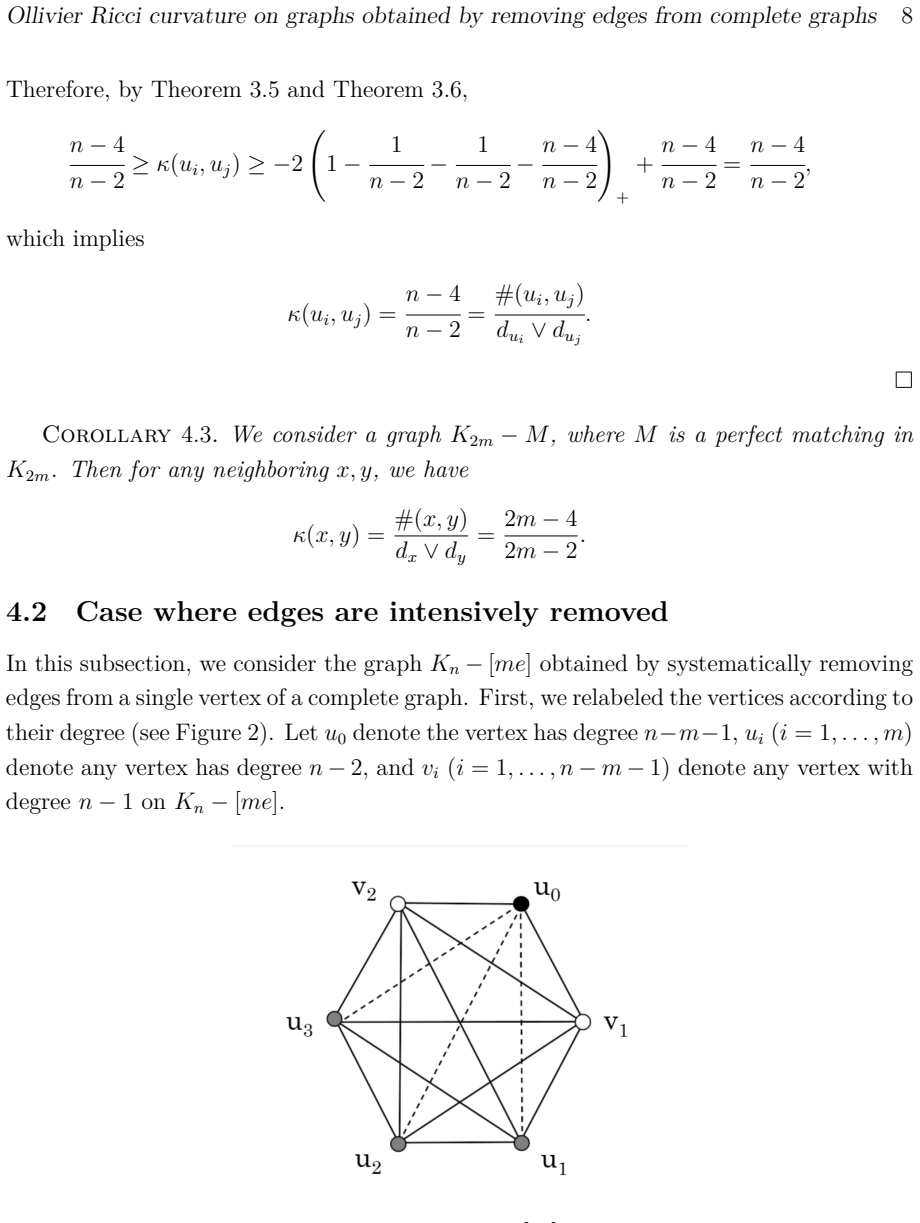
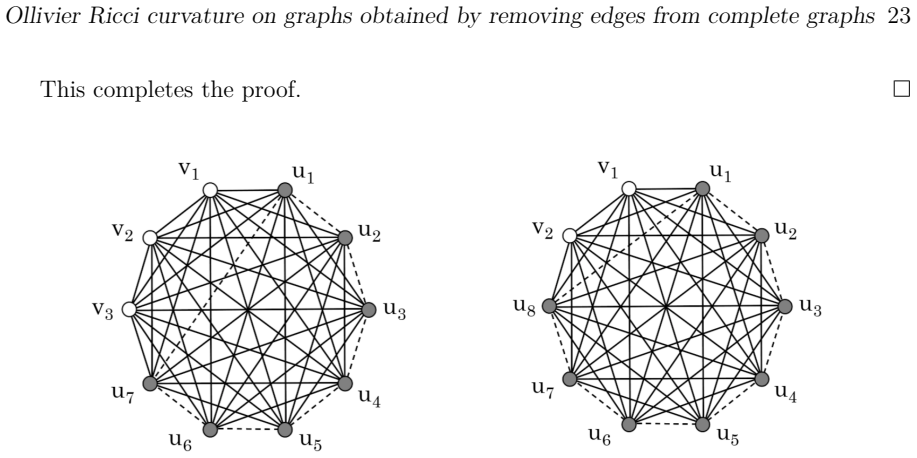
The curvature of the graphs obtained by removing matching edges, edges incident to a vertex, or cycle edges from complete graphs equals the number of triangles including the two vertices divided by the maximum degree of the two vertices. This shows that the curvature remains zero or positive.
What carries the argument
The closed-form expression for Ollivier Ricci curvature derived from triangle counts divided by maximum degree in the three edge-deletion families.
If this is right
- Curvature stays non-negative after these three kinds of edge deletion.
- Positive curvature of complete graphs is preserved under matching, star, and cycle deletions.
- Sign of curvature can be read directly from local triangle counts in these families.
- These constructions give families of graphs whose curvature sign is controlled by triangle density.
Where Pith is reading between the lines
- The same triangle-based simplification might hold for other systematic edge deletions from complete graphs.
- The result supplies concrete test cases for studying how curvature sign changes with graph density.
- It may be useful to check whether the formula extends to graphs obtained by adding edges to other base graphs.
Load-bearing premise
The standard definition of Ollivier Ricci curvature on graphs applies without change, and the triangle count exactly determines the Wasserstein distance term for every pair of vertices in these graphs.
What would settle it
Take a small complete graph minus a matching, compute the actual Wasserstein distance between the neighborhood measures of two adjacent vertices, and check whether the resulting curvature matches the triangle-count formula.
Figures


read the original abstract
Under what conditions does the sign of the Ollivier Ricci curvature on a graph of a certain order change? In this paper, we discuss the curvature of graphs obtained by removing edges from complete graphs, as complete graphs have a stable positive curvature. We defined graphs obtained by removing matching edges, the set of edges incident with the vertex, and cycle edges from complete graphs, and then analyzed the Ollivier Ricci curvature of those graphs. The results show that the curvature of the graphs in the above three patterns is equal to the value obtained by dividing the number of triangles, including two vertices, by the maximum degree of the two vertices. This result also indicates that the curvature of the above graphs is zero or positive. This study concludes that the Ollivier Ricci curvature is predicted to be positive even if some edges are removed from a complete graph, and we suggest that these discussions are suitable for investigating the conditions under which the sign of the Ollivier Ricci curvature on a graph.
Editorial analysis
A structured set of objections, weighed in public.
Referee Report
Summary. The manuscript claims that for three families of graphs obtained by deleting edges from K_n (matching deletions, star deletions incident to one vertex, and cycle deletions), the Ollivier-Ricci curvature between vertices u and v equals the number of triangles containing both vertices divided by max(deg(u), deg(v)), implying the curvature is always zero or positive.
Significance. If the claimed closed-form expression holds and matches the Wasserstein-1 definition, the result would supply explicit curvature formulas for these edge-deleted complete graphs and demonstrate robustness of positive curvature under the listed deletions. This could be useful for analyzing curvature sign changes in near-complete graphs.
major comments (3)
- [Abstract] Abstract and results: the equality to (# triangles / max(deg(u),deg(v))) is asserted as the outcome of direct computation, yet no definition of Ollivier-Ricci curvature, no expression for the measures m_u and m_v, and no evaluation of the 1-Wasserstein distance W_1(m_u,m_v) under the graph metric are supplied anywhere in the text.
- [Results] Results section: the claimed formula is presented without any small-case verification (e.g., explicit W_1 computation for K_4 minus one edge or K_5 minus a matching) that would confirm the triangle-count expression exactly equals 1 - W_1 rather than merely bounding it.
- [Main claim] The normalization by max(deg(u),deg(v)) rather than a symmetric function of both degrees is used without justification; standard Ollivier curvature on graphs is 1 - W_1(m_u,m_v) where the measures are normalized by the respective degrees, so the given expression cannot be guaranteed to coincide with the definition unless additional cancellations are proved.
minor comments (1)
- The three families of graphs should be formally defined with notation (e.g., G = K_n - M, K_n - S_v, K_n - C) in a dedicated preliminary section before the curvature statements.
Simulated Author's Rebuttal
We thank the referee for the careful reading and constructive comments. The observations correctly identify omissions in the presentation of definitions and supporting arguments. We will undertake a major revision of the manuscript to supply the missing material while preserving the core claims.
read point-by-point responses
-
Referee: [Abstract] Abstract and results: the equality to (# triangles / max(deg(u),deg(v))) is asserted as the outcome of direct computation, yet no definition of Ollivier-Ricci curvature, no expression for the measures m_u and m_v, and no evaluation of the 1-Wasserstein distance W_1(m_u,m_v) under the graph metric are supplied anywhere in the text.
Authors: We agree that the manuscript must contain these foundational elements. The revised version will add a preliminary section that recalls the definition of Ollivier-Ricci curvature, writes the explicit form of the measures m_u and m_v (normalized by vertex degree), and carries out the evaluation of W_1(m_u, m_v) with respect to the graph distance, showing how the computation produces the stated triangle-count formula. revision: yes
-
Referee: [Results] Results section: the claimed formula is presented without any small-case verification (e.g., explicit W_1 computation for K_4 minus one edge or K_5 minus a matching) that would confirm the triangle-count expression exactly equals 1 - W_1 rather than merely bounding it.
Authors: We will insert explicit small-case calculations in the results section. In particular, we will compute W_1 directly for K_4 minus a single edge and for K_5 minus a matching of two edges, verifying that the triangle-count expression equals 1 - W_1(m_u, m_v) exactly in each instance. revision: yes
-
Referee: [Main claim] The normalization by max(deg(u),deg(v)) rather than a symmetric function of both degrees is used without justification; standard Ollivier curvature on graphs is 1 - W_1(m_u,m_v) where the measures are normalized by the respective degrees, so the given expression cannot be guaranteed to coincide with the definition unless additional cancellations are proved.
Authors: We accept that a justification is required. The revised manuscript will contain a dedicated lemma proving that, for the three families of graphs obtained by the listed edge deletions from K_n, the Wasserstein distance admits cancellations that make the expression (# triangles / max(deg(u),deg(v))) identical to the standard Ollivier curvature 1 - W_1(m_u, m_v). The proof will compare the optimal couplings under the two normalizations and exploit the near-completeness of the graphs. revision: yes
Circularity Check
No circularity: direct computation on explicit graph families
full rationale
The paper computes Ollivier curvature explicitly for three families of edge-deleted complete graphs and states that the value equals (# triangles containing the pair) / max(deg(u),deg(v)). This is presented as the outcome of applying the standard definition (1 - W_1) to the resulting neighborhoods, not as a self-definition, fitted parameter renamed as prediction, or result imported via self-citation. No load-bearing step reduces to its own input by construction; the triangle-count expression is an evaluated quantity rather than an ansatz or renaming. The derivation is therefore self-contained against the graph metric and Wasserstein definition.
Axiom & Free-Parameter Ledger
axioms (1)
- domain assumption Ollivier Ricci curvature on a graph is defined via the Wasserstein-1 distance between lazy random-walk measures centered at adjacent vertices.
Forward citations
Cited by 1 Pith paper
-
An extremal theorem for positive curvature of graphs
Every graph on n≥8 vertices with more than T(n) edges has positive Ollivier/Lin-Lu-Yau curvature, with T(n) optimal and uniqueness results for certain n.
Reference graph
Works this paper leans on
-
[1]
Bhattacharya and Sumit Mukherjee
Bhaswar B. Bhattacharya and Sumit Mukherjee. Exact and asymptotic results on coarse ricci curvature of graphs. Discrete Mathematics, 338(1):23–42, 2015
2015
-
[2]
Extremal Graph Theory
Béla Bollobás. Extremal Graph Theory . Dover Publications, 2004
2004
-
[3]
Ollivier’s Ricci curvature, local clustering and curvature-dimension inequalities on graphs
Jürgen Jost and Shiping Liu. Ollivier’s Ricci curvature, local clustering and curvature-dimension inequalities on graphs. Discrete Comput. Geom. , 51(2):300– 322, 2014
2014
-
[4]
Discrete curvature and abelian groups
Bo’az Klartag, Gady Kozma, Peter Ralli, and Prasad Tetali. Discrete curvature and abelian groups. Canadian Journal of Mathematics , 68(3):655–674, 2016
2016
-
[5]
Ricci curvature of graphs
Yong Lin, Linyuan Lu, and Shing-Tung Yau. Ricci curvature of graphs. Tohoku Math. J. (2) , 63(4):605–627, 2011
2011
-
[6]
Ricci curvature of the internet topology
Chien-Chun Ni, Yu-Yao Lin, Jie Gao, Xianfeng David Gu, and Emil Saucan. Ricci curvature of the internet topology. In Proceedings of IEEE INFOCOM , pages 2758– 2766, 2015
2015
-
[7]
Community detection on networks with ricci flow
Chien-Chun Ni, Yu-Yao Lin, Feng Luo, and Jie Gao. Community detection on networks with ricci flow. Scientific Reports, 9:9984, 2019. Ollivier Ricci curvature on graphs obtained by removing edges from complete graphs 25
2019
-
[8]
Ricci curvature of metric spaces
Yann Ollivier. Ricci curvature of metric spaces. Comptes Rendus Mathématique , 345(11):643–646, 2007
2007
-
[9]
Ricci curvature of markov chains on metric spaces
Yann Ollivier. Ricci curvature of markov chains on metric spaces. Journal of Func- tional Analysis , 256(3):810–864, 2009
2009
-
[10]
A survey of ricci curvature for metric spaces and markov chains
Yann Ollivier. A survey of ricci curvature for metric spaces and markov chains. In Probabilistic Approach to Geometry , volume 57 of Advanced Studies in Pure Mathe- matics, pages 343–381. Mathematical Society of Japan, 2010
2010
-
[11]
Graph curvature for differentiating cancer net- works
Romeil Sandhu, Tryphon Georgiou, Elisha Reznik, Li Zhu, Ivan Kolesov, Yasin Sen- babaoglu, and Allen Tannenbaum. Graph curvature for differentiating cancer net- works. Scientific Reports, 5:12323, 2015
2015
-
[12]
Ollivier–ricci curvature-based method to community detection in complex networks
Jasmine Sia, Edmond Jonckheere, and Paul Bogdan. Ollivier–ricci curvature-based method to community detection in complex networks. Scientific Reports , 9:9800, 2019
2019
-
[13]
Spielman and Shang-Hua Teng
Daniel A. Spielman and Shang-Hua Teng. Spectral sparsification of graphs. SIAM Journal on Computing , 40(4):981–1025, 2011
2011
-
[14]
Optimal Transport: Old and New , volume 338 of Grundlehren der mathematischen Wissenschaften
Cédric Villani. Optimal Transport: Old and New , volume 338 of Grundlehren der mathematischen Wissenschaften . Springer, Berlin, 2009. Interdisciplinary F aculty of Science and Engineering Shimane University Matsue 690-8504 Japan E-mail address : n25m001@matsu.shimane- u.ac.jp Interdisciplinary F aculty of Science and Engineering Shimane University Matsue...
2009
discussion (0)
Sign in with ORCID, Apple, or X to comment. Anyone can read and Pith papers without signing in.