REVIEW 3 major objections 4 minor 82 references
Comparing population synthesis models of compact double white dwarfs to electromagnetic observations
T0 review · 3 major / 4 minor · reviewed 2026-08-07 · deepseek-v4-flash
Pith's one-line read The paper claims that the BPASS population synthesis model produces at least ten times too few short-period double white dwarfs compared to electromagnetic observations, while the SeBa model matches the observed counts beyond 500 parsecs.
desk verdict A useful first comparison of BPASS and SeBa DWD galaxy models to ZTF short-period binaries: the BPASS underprediction is robust as an empirical statement, but the CEE interpretation needs a galaxy-model control. read the letter →
The pith
A machine-rendered reading of the paper's core claim, the machinery that carries it, and where it could break.
The reading
What carries the argument
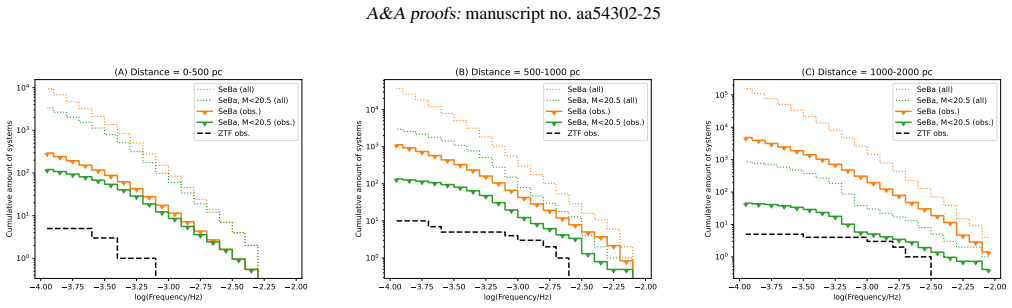
The load-bearing object is the frequency distribution of DWDs, viewed as a cumulative count that starts at the high-frequency end and is split into distance bins of 0–500 pc, 500–1000 pc, and 1–2 kpc. The conversion from model to observable uses the geometric eclipse probability $P_{\rm ecl}\simeq (R_1+R_2)/a$, proportional to $P^{-2/3}$ for random orbital orientations, together with a sky-coverage factor of 0.6 and a magnitude cut, which together give an upper limit on how many model systems ZTF could see. This machinery matters because the short-period end of the distribution is governed by how much orbital shrinkage a code's common-envelope and mass-transfer treatment produces; BPASS's detailed stellar-structure common-envelope model is far more efficient (effective $\alpha\lambda$ of order 8–30) than the $\alpha\lambda=2$ used in SeBa, and that is why the two models diverge exactly where the observations are sensitive.
What would settle it
Re-simulate BPASS using the SeBa galaxy model (or SeBa using the BPASS galaxy model) and check whether the factor-of-ten high-frequency deficit survives; if it vanishes, the shortfall is a Milky Way model artifact rather than a common-envelope effect, and if it persists, the common-envelope conclusion is confirmed. A future LISA resolved-DWD count in the 0.1–1 mHz band provides the same test on real data: roughly 10,000 sources would support the paper's claim, while a count near 1,000 would support BPASS.
Extended reading notes
Core claim
The central claim is that BPASS underpredicts short-period (high-frequency) DWDs by a factor of at least ten relative to electromagnetic observations, while SeBa is roughly consistent with the observations between 500 pc and 1 kpc and clearly consistent beyond 1 kpc. The evidence is a comparison of two synthetic DWD populations with 24 eclipsing systems observed by ZTF and a catalogue of 94 DWDs with measured periods and distances, where model systems are weighted by their eclipse probability, ZTF's sky coverage, and an r-band magnitude limit. On the paper's interpretation, the missing high-frequency systems in BPASS are the signature of common-envelope and mass-transfer physics that is too efficient for low- and intermediate-mass stars, leaving orbits too wide after the common-envelope phase. The paper therefore concludes that the total number of resolved LISA DWDs will likely be on the order of 10,000 rather than the fewer than 1,000 predicted by the BPASS model, and that different common-envelope prescriptions may be needed for different stellar mass ranges.
Load-bearing premise
The attribution of BPASS's deficit to its binary evolution physics assumes that the BPASS galaxy model's Milky Way structure and star formation history do not themselves explain the shortfall, yet the paper does not rerun BPASS inside the SeBa galaxy model to rule that out.
Editorial extensions
If this is right
- The resolved LISA sample of Galactic double white dwarfs will be of order 10,000 systems, not fewer than 1,000.
- BPASS's common-envelope and mass-transfer prescriptions are too efficient for low- and intermediate-mass stars, so they must be modified before using BPASS to forecast LISA source counts.
- Because BPASS already matches gravitational-wave observations of massive black-hole binaries, a single common-envelope prescription may not describe both low-mass and high-mass stellar evolution.
- The SeBa model's overprediction within 500 pc, if real, points to the local structure of its assumed Milky Way model rather than to its binary physics.
Reading between the lines
- A direct test the paper does not run is to exchange the Milky Way models between the two codes; if the BPASS deficit persists, the common-envelope interpretation is much stronger, and if it disappears, the deficit is a galaxy-model artifact.
- The paper's observability corrections omit eclipse-depth thresholds and crowding, so the corrected model counts are upper limits; including those effects would deepen BPASS's shortfall and move SeBa closer to the observations beyond 500 pc.
- LISA's resolved DWD sample will allow a cleaner diagnostic than total counts: the ratio of short- to long-period systems is sensitive to common-envelope efficiency but nearly independent of the overall Galactic normalization.
- If the BPASS galaxy model's star formation history is the true cause of the deficit, then any LISA source-count predictions built on that galaxy model would need reworking even if the binary physics is correct.
Editorial analysis
A structured set of objections, weighed in public.
Referee Report
Summary. The paper compares two population synthesis models of Galactic double white dwarfs (DWDs), the BPASS-based Milky Way model of Tang et al. (2024) and the SeBa-based model of Korol et al. (2017), against two electromagnetic samples: a 24-system ZTF eclipsing/ellipsoidal sample and a 94-system literature catalogue. Applying analytic corrections for eclipse probability, ZTF sky coverage, and (for SeBa) an r-band magnitude limit, the authors build cumulative frequency distributions in three distance bins. They find that even the bias-corrected BPASS upper limit lies below the observed ZTF counts at high GW frequencies, implying an underprediction of short-period DWDs by at least an order of magnitude, while SeBa is consistent with observations beyond 500 pc but may overpredict within 500 pc. They conclude that BPASS's common-envelope treatment is too efficient for low- and intermediate-mass stars and that the resolved LISA DWD population is likely of order 10,000.
Significance. If the result is correct, it is important: it would provide a direct electromagnetic discriminator between major binary population synthesis models for the compact DWD population that LISA will observe, and it would identify a specific deficiency in BPASS's treatment of mass transfer and common-envelope events. The paper has several genuine strengths: the use of cumulative frequency comparisons in distance bins, the explicit upper-limit corrections for eclipse probability and sky coverage, the variation of the SeBa magnitude limit over a realistic range, and a mass-distribution sanity check. The direction of the BPASS underprediction is robust to the main modeled selection effects because the model line is an upper limit and still lies below observed counts. However, the claim that the deficit is caused specifically by BPASS's common-envelope efficiency is not established until the galaxy-model confound is addressed, and the SeBa agreement is partially by construction given its calibration to DWD observations.
major comments (3)
- [Sections 2.1, 4.2, 5] The central attribution of BPASS's underprediction to its common-envelope treatment is confounded by the fact that the BPASS and SeBa realizations differ in their Milky Way models as well as in binary physics. The BPASS model uses the FIRE m12i star formation history and disk structure (Tang et al. 2024), while the SeBa model uses the Boissier and Prantzos (1999) axisymmetric prescription (Korol et al. 2017). The two models therefore differ in local stellar density, disk scale parameters, and recent star formation history. Section 4.2 explicitly considers a galaxy-model explanation for SeBa's overprediction within 500 pc, but no analogous test is made for BPASS. Tang et al. (2024) validated the total WD space density within 25 pc, but that does not validate the young, short-period DWD population that dominates the high-frequency bins in Fig. 4. Please provide a control that isolates binary physics from galaxy physics, for example by populating the same galaxy model with both BPASS and SeBa binary outputs, or by comparing the ratio of high-frequency DWDs to total WDs in each model and in the observed samples. Without such a control, the factor-of-ten underprediction could be a galaxy-model artifact rather than evidence that BPASS's common-envelope efficiency is too high.
- [Section 4.1] The paper notes that SeBa's αλ and γ parameters were originally fitted to astrophysical observations of DWDs (Nelemans et al. 2000, 2001b), yet later treats SeBa's agreement with the ZTF DWD sample as evidence for its realism. This is a partially circular test: if the calibration sample included short-period DWDs or overlapped with the systems in the ZTF/Munday compilations, the agreement is expected and should not be presented as independent validation. The central BPASS underprediction is not affected because BPASS was not calibrated to these observations, but the secondary claim that SeBa is 'consistent with' and therefore preferred should be explicitly reframed as a consistency check. Please state which DWD samples were used in the original calibration of the adopted αλ and γ values and whether they overlap with the ZTF sample used here.
- [Section 5 and Figs. 4-5] The quantitative claim that BPASS underpredicts short-period DWDs 'by a factor of at least ten' is presented without an uncertainty estimate. The cumulative counts at the high-frequency end are based on a small number of observed systems, and the model lines depend on the visually estimated 3/2 WD-radius inflation factor, the adopted 0.6 sky coverage, and the assumed magnitude limit. Although the direction of the discrepancy is robust because the corrected BPASS line is an upper limit, the size of the factor should be accompanied by a sensitivity analysis or at least Poisson uncertainties for the bins that drive the factor-of-ten statement.
minor comments (4)
- [Section 2.3.3] Typo: 'as descried in Sect. 2.3.3' should read 'as described in Sect. 2.3.3.'
- [Figs. 4 and 5] The labels 'BPASS (obs.)' and 'SeBa (obs.)' denote upper limits that include only eclipse and sky-coverage corrections; for BPASS no brightness limit is applied. Consider renaming these curves 'eclipse/sky-corrected upper limit' to avoid implying a full observability correction.
- [Fig. 5 and Fig. 7] The legend notation 'M<20.5' is ambiguous because smaller magnitudes correspond to brighter objects; please clarify with 'r-band magnitude limit' or 'brighter than 20.5 mag.'
- [Section 4.4] The argument that the Munday sample is incomplete uses the SeBa model as the reference (41 vs 791 and 15 vs 96). Since the SeBa model itself is under test in this paper, please add an external completeness argument or explicitly acknowledge this circularity.
Circularity Check
Central BPASS underprediction is an independent model-vs-data comparison; partial circularity is confined to disclosed, secondary fitted inputs (SeBa's CEE calibration and ZTF-calibrated detectability corrections).
-
fitted input called prediction
[Section 4.1 (Implications for CEE models); cf. Section 2.1]
"The SeBa values for αλ and γ were calculated based on fits to astrophysical observations of DWDs (Nelemans et al. 2000, 2001b), which raises the question of whether the much higher values from the bpass CEE model are not representative in this case. Our results in this study, in which bpass clearly underpredicts short-period DWDs compared to observations, suggest that the bpass CEE model is indeed too efficient."
SeBa's short-period DWD population is generated with CEE parameters (the γ-formalism for the first interaction, αλ = 2 in the Toonen et al. 2012 version) that were themselves fitted to EM observations of DWD period distributions (Nelemans et al. 2000, 2001b). The paper then reports SeBa as 'roughly consistent with the DWD observations' (Sect. 5) and uses that agreement, together with the known calibration, as evidence that BPASS's much higher effective αλ is wrong. The agreement is therefore in part the input fit returning as a model test. The circularity is only partial: the ZTF and Munday samples consist mostly of systems discovered after the 2000/2001 calibration, the paper is transparent about the fit, and the headline BPASS underprediction is independent of this step.
-
fitted input called prediction
[Section 2.3.1 (Probability of eclipsing), Eqs. 1-2 and Figure 2]
"when we compared the radii produced by Eq. 2 to the WD masses and radii actually measured in the ZTF dataset, we found that the radii predicted by Eq. 2 were generally smaller than those actually measured; ... by manual inspection, this line fits most of the ZTF WDs reasonably well ... we used a value of 3/2 for this coe fficient."
The eclipse-probability correction applied to both model populations (Eq. 1 with radii from Eq. 2 multiplied by 3/2) is calibrated on the same ZTF sample whose cumulative frequency-distance counts are the comparison target in Figs. 4-5. The corrected model lines are therefore partly a function of the very data they are compared to. The effect is mild and directional: the 3/2 radius boost increases eclipse probabilities and hence predicted counts, which makes the BPASS underprediction claim harder, not easier, to sustain, and the paper notes the coefficient uncertainty is 'small compared to the order-of-magnitude differences between the population models.' No model parameter is fitted to the observed counts themselves, so this does not manufacture the headline result.
full rationale
The central claim — that the BPASS galaxy model underpredicts short-period DWDs by at least an order of magnitude relative to ZTF — is not circular. It is a direct comparison of an independently generated model population to observed counts, corrected by explicitly stated upper-limit selection factors; no BPASS parameter is fitted to the ZTF counts, and the corrections (eclipse probability, sky coverage) are intentionally upper limits, so the underprediction cannot be manufactured by the comparison procedure. The real but partial circularities sit in the secondary SeBa leg and in the detectability corrections. SeBa's CEE parameters (the γ-formalism and αλ = 2) were themselves fitted to EM-observed DWD period distributions before being used here to generate the model, so SeBa's reported consistency with DWD observations (Sect. 5) is partly a fitted input returning as a 'test'; the paper discloses this in Sect. 4.1, and the ZTF sample consists mostly of systems discovered after that 2000/2001 calibration, so independent content remains. The WD-radius correction factor of 3/2 in Sect. 2.3.1 is calibrated by eye on the same ZTF sample whose counts are the comparison target, a mild in-sample calibration that, if anything, inflates predicted counts and therefore makes the BPASS underprediction claim conservative. Finally, the causal attribution ('the bpass CEE prescription is too efficient') rests on a self-citation (van Zeist et al. 2024) for the claim that CEE treatment is the main difference between the codes, and on the untested premise that the FIRE m12i galaxy realization does not itself suppress local short-period systems; the paper flags the analogous galaxy-model confound for SeBa in Sect. 4.2 ('it is possible that the overprediction at low distances is caused by the spatial distribution of the MW model... a detailed examination of these MW structure models is beyond the scope of this paper') but does not run that control for BPASS. That gap is a correctness and validity risk, not a circular reduction: the observed-versus-predicted comparison is not equivalent to its inputs by construction. Overall circularity is therefore partial and confined to the disclosed, secondary fitted inputs; the headline comparison stands independently.
Assumptions & free parameters
free parameters (1)
- WD radius inflation factor =
1.5
assumptions (3)
- domain assumption The ZTF catalogue of 24 DWDs is sufficiently complete and representative to serve as an observational benchmark for the cumulative frequency comparison.
- domain assumption The population synthesis galaxy models' star formation history and Milky Way structure are accurate enough that discrepancies in short-period DWD counts can be attributed to binary evolution treatments rather than to the galaxy model.
- standard math The eclipse probability for a randomly oriented binary equals (R1+R2)/a, and the eclipse depth threshold of 10% is negligible relative to the order-of-magnitude comparisons.
Cite this review
Pith. "Pith review of Comparing population synthesis models of compact double white dwarfs to electromagnetic observations." pith.science (2026). https://pith.science/paper/KQ7OXUFY
@misc{pith2026250520953,
  author       = {Pith},
  title        = {Pith review of: Comparing population synthesis models of compact double white dwarfs to electromagnetic observations},
  year         = {2026},
  howpublished = {\url{https://pith.science/paper/KQ7OXUFY}},
  note         = {Machine review of arXiv:2505.20953}
}
read the original abstract
Context: Studies of the Galactic population of double white dwarfs (DWDs) that would be detectable in gravitational waves by LISA have found differences in the number of predicted detectable DWDs of more than an order of magnitude, depending on the binary stellar evolution model used. Particularly, the binary population synthesis code BPASS predicts 20 to 40 times fewer detectable DWDs than the codes SeBa or BSE, which relates to differing treatments of mass transfer and common-envelope events (CEEs). Aims: We aimed to investigate which of these models are closer to reality by comparing their predictions to the DWDs known from electromagnetic observations. Methods: We compared the DWDs predicted by a BPASS galaxy model and a SeBa galaxy model to a DWD catalogue and the sample of DWDs observed by the Zwicky Transient Facility (ZTF), taking into account the observational limits and biases of the ZTF survey. Results: We found that BPASS underpredicts the number of short-period DWDs by at least an order of magnitude compared to the observations, while the SeBa galaxy model is consistent with the observations for DWDs more distant than 500 pc. These results highlight how LISA's observations of DWDs will provide invaluable information on aspects of stellar evolution such as mass transfer and CEEs, which will allow theoretical models to be better constrained.
Figures


Figures from the paper (5 more)




Reference graph
Works this paper leans on
-
[1]
D., Acernese, F., et al
Abbott, R., Abbott, T. D., Acernese, F., et al. 2023, Physical Review X, 13, 041039
2023
-
[2]
Abt, H. A. 1983, ARA&A, 21, 343
1983
-
[3]
2023, Living Reviews in Relativity, 26, 2
Amaro-Seoane, P., Andrews, J., Arca Sedda, M., et al. 2023, Living Reviews in Relativity, 26, 2
2023
-
[4]
2017, arXiv e-prints, arXiv:1702.00786 Antunes Amaral, L., Munday, J., Vuˇckovi´c, M., et al
Amaro-Seoane, P., Audley, H., Babak, S., et al. 2017, arXiv e-prints, arXiv:1702.00786 Antunes Amaral, L., Munday, J., Vuˇckovi´c, M., et al. 2024, A&A, 685, A9
arXiv 2017
-
[5]
Bailer-Jones, C. A. L., Rybizki, J., Fouesneau, M., Demleitner, M., & Andrae, R. 2021, AJ, 161, 147
2021
-
[6]
2002, ApJ, 572, 407
Belczynski, K., Kalogera, V ., & Bulik, T. 2002, ApJ, 572, 407
2002
-
[7]
A., et al
Belczynski, K., Kalogera, V ., Rasio, F. A., et al. 2008, ApJS, 174, 223
2008
-
[8]
& Prantzos, N
Boissier, S. & Prantzos, N. 1999, MNRAS, 307, 857
1999
Show all 82 references
-
[9]
Bours, M. C. P., Marsh, T. R., Parsons, S. G., et al. 2014, MNRAS, 438, 3399
2014
-
[10]
2025, arXiv e-prints, arXiv:2502.03523
Breivik, K. 2025, arXiv e-prints, arXiv:2502.03523
2025 arXiv
-
[11]
M., Stevance, H
Briel, M. M., Stevance, H. F., & Eldridge, J. J. 2023, MNRAS, 520, 5724
2023
-
[12]
R., Kilic, M., Allende Prieto, C., & Kenyon, S
Brown, W. R., Kilic, M., Allende Prieto, C., & Kenyon, S. J. 2010, ApJ, 723, 1072
2010
-
[13]
R., Kilic, M., Hermes, J
Brown, W. R., Kilic, M., Hermes, J. J., et al. 2011, ApJ, 737, L23
2011
-
[14]
R., Kilic, M., Kosakowski, A., et al
Brown, W. R., Kilic, M., Kosakowski, A., et al. 2020, ApJ, 889, 49
2020
-
[15]
R., Kilic, M., Kosakowski, A., & Gianninas, A
Brown, W. R., Kilic, M., Kosakowski, A., & Gianninas, A. 2017, ApJ, 847, 10
2017
-
[16]
R., Kilic, M., Kosakowski, A., & Gianninas, A
Brown, W. R., Kilic, M., Kosakowski, A., & Gianninas, A. 2022, ApJ, 933, 94
2022
-
[17]
B., Coughlin, M
Burdge, K. B., Coughlin, M. W., Fuller, J., et al. 2019, Nature, 571, 528
2019
-
[18]
B., Rappaport, S
Chakraborty, J., Burdge, K. B., Rappaport, S. A., et al. 2024, ApJ, 977, 262
2024
-
[19]
2024, arXiv e-prints, arXiv:2402.07571
Colpi, M., Danzmann, K., Hewitson, M., et al. 2024, arXiv e-prints, arXiv:2402.07571
2024 arXiv
-
[20]
Condon, J. J. 1974, ApJ, 188, 279
1974
-
[21]
W., Burdge, K., Phinney, E
Coughlin, M. W., Burdge, K., Phinney, E. S., et al. 2020, MNRAS, 494, L91
2020
-
[22]
Delfavero, V ., Breivik, K., Thiele, S., O’Shaughnessy, R., & Baker, J. G. 2025, ApJ, 981, 66
2025
-
[23]
2022, MNRAS, 517, 4916
El-Badry, K., Conroy, C., Fuller, J., et al. 2022, MNRAS, 517, 4916
2022
-
[24]
J., Stanway, E
Eldridge, J. J., Stanway, E. R., Xiao, L., et al. 2017, PASA, 34, e058 Gaia Collaboration, Vallenari, A., Brown, A. G. A., et al. 2023, A&A, 674, A1 Gentile Fusillo, N. P., Tremblay, P. E., Cukanovaite, E., et al. 2021, MNRAS, 508, 3877
2017
-
[25]
Ghodla, S., van Zeist, W. G. J., Eldridge, J. J., Stevance, H. F., & Stanway, E. R. 2022, MNRAS, 511, 1201
2022
-
[26]
2016, MNRAS, 458, 845
Hallakoun, N., Maoz, D., Kilic, M., et al. 2016, MNRAS, 458, 845
2016
-
[27]
Heggie, D. C. 1975, MNRAS, 173, 729
1975
-
[28]
L., & Webbink, R
Hils, D., Bender, P. L., & Webbink, R. F. 1990, ApJ, 360, 75
1990
-
[29]
& Mandel, I
Hirai, R. & Mandel, I. 2022, ApJ, 937, L42
2022
-
[30]
Holberg, J. B. & Bergeron, P. 2006, AJ, 132, 1221
2006
-
[31]
B., Oswalt, T
Holberg, J. B., Oswalt, T. D., Sion, E. M., & McCook, G. P. 2016, MNRAS, 462, 2295
2016
-
[32]
F., Kereš, D., Oñorbe, J., et al
Hopkins, P. F., Kereš, D., Oñorbe, J., et al. 2014, MNRAS, 445, 581
2014
-
[33]
R., Tout, C
Hurley, J. R., Tout, C. A., & Pols, O. R. 2002, MNRAS, 329, 897
2002
-
[34]
A., Korol, V ., & Rossi, E
Keim, M. A., Korol, V ., & Rossi, E. M. 2023, MNRAS, 521, 1088
2023
-
[35]
M., Breedt, E., Hodgkin, S., et al
Keller, P. M., Breedt, E., Hodgkin, S., et al. 2022, MNRAS, 509, 4171
2022
-
[36]
R., Allende Prieto, C., et al
Kilic, M., Brown, W. R., Allende Prieto, C., et al. 2011, ApJ, 727, 3
2011
-
[37]
J., Gianninas, A., et al
Kilic, M., Hermes, J. J., Gianninas, A., et al. 2014, MNRAS, 438, L26
2014
-
[38]
2001, A&A, 378, 556
Koester, D., Napiwotzki, R., Christlieb, N., et al. 2001, A&A, 378, 556
2001
-
[39]
2022, MNRAS, 511, 5936
Korol, V ., Hallakoun, N., Toonen, S., & Karnesis, N. 2022, MNRAS, 511, 5936
2022
-
[40]
M., Groot, P
Korol, V ., Rossi, E. M., Groot, P. J., et al. 2017, MNRAS, 470, 1894
2017
-
[41]
Kowalski, P. M. & Saumon, D. 2006, ApJ, 651, L137 Królak, A., Tinto, M., & Vallisneri, M. 2004, Phys. Rev. D, 70, 022003
2006
-
[42]
A., & Gilmore, G
Kroupa, P., Tout, C. A., & Gilmore, G. 1993, MNRAS, 262, 545
1993
-
[43]
U., Neunteufel, P
Kruckow, M. U., Neunteufel, P. G., Di Stefano, R., Gao, Y ., & Kobayashi, C. 2021, ApJ, 920, 86
2021
-
[44]
B., et al
Kupfer, T., Korol, V ., Littenberg, T. B., et al. 2024, ApJ, 963, 100
2024
-
[45]
B., et al
Lamberts, A., Blunt, S., Littenberg, T. B., et al. 2019, MNRAS, 490, 5888
2019
-
[46]
2020, ApJ, 893, 2
Li, Z., Chen, X., Chen, H.-L., et al. 2020, ApJ, 893, 2
2020
-
[47]
2023, A&A, 669, A82
Li, Z., Chen, X., Ge, H., Chen, H.-L., & Han, Z. 2023, A&A, 669, A82
2023
-
[48]
2024, Nature Astronomy, 8, 491
Lin, J., Wu, C., Xiong, H., et al. 2024, Nature Astronomy, 8, 491
2024
-
[49]
Maoz, D., Badenes, C., & Bickerton, S. J. 2012, ApJ, 751, 143
2012
-
[50]
2018, MNRAS, 476, 2584
Maoz, D., Hallakoun, N., & Badenes, C. 2018, MNRAS, 476, 2584
2018
-
[51]
R., Dhillon, V
Marsh, T. R., Dhillon, V . S., & Duck, S. R. 1995, MNRAS, 275, 828
1995
-
[52]
& Di Stefano, R
Moe, M. & Di Stefano, R. 2017, ApJS, 230, 15
2017
-
[53]
Morris, S. L. 1985, ApJ, 295, 143
1985
-
[54]
E., et al
Munday, J., Pelisoli, I., Tremblay, P. E., et al. 2024, MNRAS, 532, 2534
2024
-
[55]
E., Hermes, J
Munday, J., Tremblay, P. E., Hermes, J. J., et al. 2023, MNRAS, 525, 1814
2023
-
[56]
2001, Astronomische Nachrichten, 322, 411
Napiwotzki, R., Christlieb, N., Drechsel, H., et al. 2001, Astronomische Nachrichten, 322, 411
2001
-
[57]
& Tout, C
Nelemans, G. & Tout, C. A. 2005, MNRAS, 356, 753
2005
-
[58]
R., & Portegies Zwart, S
Nelemans, G., Verbunt, F., Yungelson, L. R., & Portegies Zwart, S. F. 2000, A&A, 360, 1011
2000
-
[59]
R., & Portegies Zwart, S
Nelemans, G., Yungelson, L. R., & Portegies Zwart, S. F. 2004, MNRAS, 349, 181
2004
-
[60]
Nissanke, S., Vallisneri, M., Nelemans, G., & Prince, T. A. 2012, ApJ, 758, 131 O’Brien, M. W., Tremblay, P. E., Klein, B. L., et al. 2024, MNRAS, 527, 8687
2012
-
[61]
Olsen, K. A. G., Blum, R. D., & Rigaut, F. 2003, AJ, 126, 452
2003
-
[62]
G., Gänsicke, B
Parsons, S. G., Gänsicke, B. T., Marsh, T. R., et al. 2017, MNRAS, 470, 4473
2017
-
[63]
G., Marsh, T
Parsons, S. G., Marsh, T. R., Gänsicke, B. T., Drake, A. J., & Koester, D. 2011, ApJ, 735, L30 Portegies Zwart, S. F. & Verbunt, F. 1996, A&A, 309, 179
2011
-
[64]
G., et al
Rebassa-Mansergas, A., Hollands, M., Parsons, S. G., et al. 2024, A&A, 686, A221
2024
-
[65]
1998, AJ, 115, 2459
Renzini, A. 1998, AJ, 115, 2459
1998
-
[66]
Robinson, E. L. & Shafter, A. W. 1987, ApJ, 322, 296
1987
-
[67]
J., Belczynski, K., Benacquista, M., Larson, S
Ruiter, A. J., Belczynski, K., Benacquista, M., Larson, S. L., & Williams, G. 2010, ApJ, 717, 1006
2010
-
[68]
Scheuer, P. A. G. 1957, Proceedings of the Cambridge Philosophical Society, 53, 764
1957
-
[69]
Schneider, R., Ferrari, V ., Matarrese, S., & Portegies Zwart, S. F. 2001, MNRAS, 324, 797
2001
-
[70]
Stanway, E. R. & Eldridge, J. J. 2018, MNRAS, 479, 75
2018
-
[71]
Steinfadt, J. D. R., Kaplan, D. L., Shporer, A., Bildsten, L., & Howell, S. B. 2010, ApJ, 716, L146
2010
-
[72]
F., Eldridge, J
Stevance, H. F., Eldridge, J. J., Stanway, E. R., et al. 2023, Nature Astronomy, 7, 444
2023
-
[73]
J., Meyer, R., et al
Tang, P., Eldridge, J. J., Meyer, R., et al. 2024, MNRAS, 534, 1707
2024
-
[74]
T., & Boekholt, T
Toonen, S., Hollands, M., Gänsicke, B. T., & Boekholt, T. 2017, A&A, 602, A16
2017
-
[75]
& Nelemans, G
Toonen, S. & Nelemans, G. 2013, A&A, 557, A87
2013
-
[76]
2012, A&A, 546, A70
Toonen, S., Nelemans, G., & Portegies Zwart, S. 2012, A&A, 546, A70
2012
-
[77]
A., Rieder, S., Tanikawa, A., et al
Trani, A. A., Rieder, S., Tanikawa, A., et al. 2022, Phys. Rev. D, 106, 043014
2022
-
[78]
E., Bergeron, P., & Gianninas, A
Tremblay, P. E., Bergeron, P., & Gianninas, A. 2011, ApJ, 730, 128 van Roestel, J., Burdge, K., Caiazzo, I., et al. 2025, arXiv e-prints, arXiv:2505.15580 van Roestel, J., Kupfer, T., Green, M. J., et al. 2022, MNRAS, 512, 5440 van Roestel, J., Kupfer, T., Ruiz-Carmona, R., et...
2011 arXiv
-
[79]
& Rappaport, S
Verbunt, F. & Rappaport, S. 1988, ApJ, 332, 193
1988
-
[80]
Webbink, R. F. 1984, ApJ, 277, 355
1984
-
[81]
C., Sanderson, R
Wetzel, A., Hayward, C. C., Sanderson, R. E., et al. 2023, ApJS, 265, 44
2023
-
[82]
J., Zheng, X
Xu, Y ., Reid, M. J., Zheng, X. W., & Menten, K. M. 2006, Science, 311, 54 Article number, page 11 of 11
2006
Reviewed August 7, 2026 · model on record in the stance chip above.
Discussion (0). Sign in to comment.