REVIEW 3 major objections 5 minor 25 references
Coherent control of Optical limiting in atomic systems
T0 review · 3 major / 5 minor · reviewed 2026-08-14 · deepseek-v4-flash
Pith's one-line read This paper claims that a coherently driven four-level Y-type rubidium-87 system can exhibit reverse saturable absorption and act as an optical limiter whose threshold and intensity range are set by the coupling laser, a static magnetic…
desk verdict Plausible new atomic scheme for coherent control of optical limiting, but the transmission formula and propagation treatment need major correction before the quantitative claims can be trusted. read the letter →
The pith
A machine-rendered reading of the paper's core claim, the machinery that carries it, and where it could break.
The reading
What carries the argument
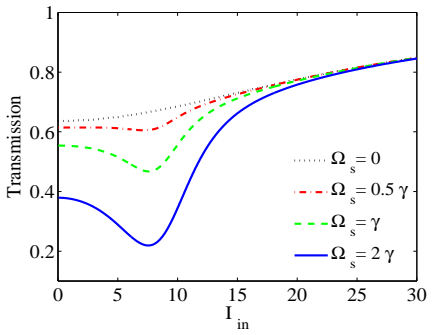
The load-bearing object is the normalized probe susceptibility $S_p = \rho_{21}\gamma/\Omega_p$ computed from the steady-state solution of the four-level Y-type density-matrix equations. Its imaginary part is the probe absorption, and the paper identifies the RSA region as the intensity interval in which $\mathrm{Im}[S_p]$ grows with input intensity; the transmission formula $T = e^{-\alpha_l \mathrm{Im}[S_p]}$ then converts that growing absorption into flat or falling output, the signature of optical limiting. The coupling Rabi frequencies $\Omega_s$ and $\Omega_c$, the detunings, and the magnetic-field splitting $2\Delta_B$ enter through the coherences in the density matrix, while $\alpha_l$ packages the medium length and density into a single exponential factor.
What would settle it
Recompute the transmission with Doppler broadening and with the probe intensity updated along the cell length for the paper's stated parameters ($\Omega_s = 2\gamma$, $\Omega_c = 65\gamma$, $\Delta_c = 100\gamma$, $\Delta_p = 1.5\gamma$, $\Delta_B = 3\gamma$, $\alpha_l = 800\gamma$); if the peak in $\mathrm{Im}[S_p]$ and the flat or falling segment in $T$ disappear, the central claim does not survive realistic vapor conditions.
Extended reading notes
Core claim
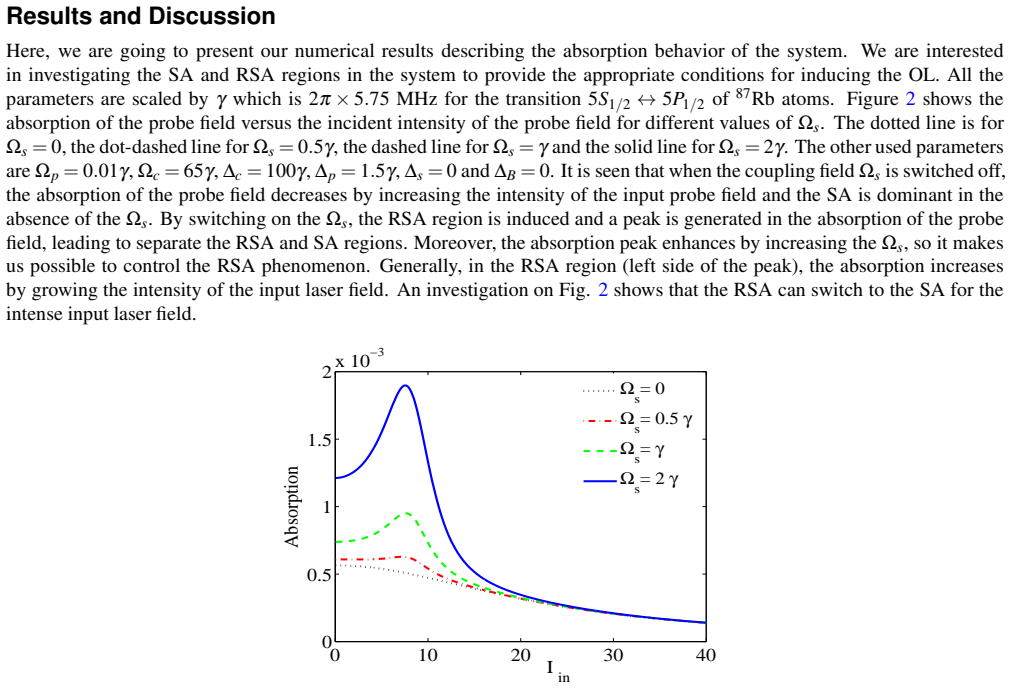
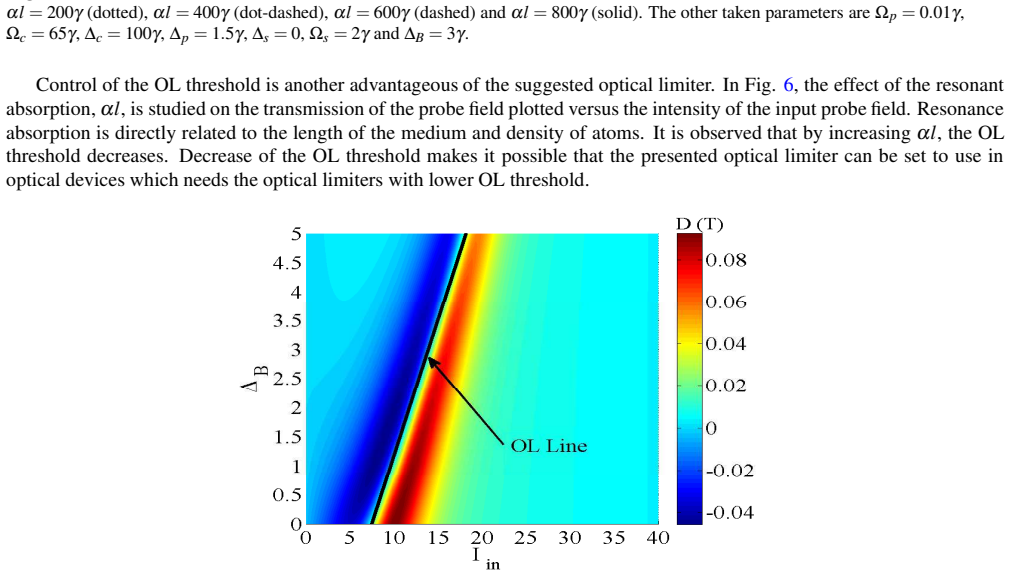
The central claim is that the absorption of the probe field on the 5S1/2–5P1/2 transition is not fixed by the material but can be organized by the two coupling fields: without the coupling field $\Omega_s$ the medium shows ordinary saturable absorption, while with $\Omega_s$ present the same medium develops a finite range of input intensities over which absorption rises with intensity, the RSA region. In that region, the probe transmission computed from $T = \exp(-\alpha_l \mathrm{Im}[S_p])$, with $S_p = \rho_{21}\gamma/\Omega_p$, is flat or decreasing, which is exactly the optical-limiting condition. The paper reports that the RSA peak grows with $\Omega_s$, that the static magnetic field's Zeeman splitting $\Delta_B$ extends the RSA and limiting range, and that increasing $\alpha_l$, the product of atomic density and medium length, lowers the limiting threshold. Z-scan curves are presented as confirmation: a transmission dip appears at the focus for input intensities inside the RSA region and disappears outside it.
Load-bearing premise
The calculations assume a uniform, motion-free gas in a steady state with only radiative decay, and they judge the limiting behavior from the absorption at the input intensity rather than from the intensity that survives along the cell; in a real room-temperature vapor, Doppler shifts and collisions could erase the predicted RSA peak.
Editorial extensions
If this is right
- With the coupling field on, the same atomic system can switch from saturable absorption (SA) to reverse saturable absorption (RSA) by changing the input intensity, so a single device could act as either a limiter or a more transparent material depending on operating point.
- Increasing $\Omega_s$ raises the RSA absorption peak and lowers the optical-limiting threshold, giving intensity-based coherent control of when limiting begins.
- A static magnetic field extends the RSA region and the optical-limiting range, so the limiter can protect over a wider intensity window.
- Increasing the resonant absorption $\alpha_l$ by making the cell longer or denser lowers the limiting threshold, allowing the limiter to be tuned to the sensitivity of the device it protects.
- Z-scan measurements should show a transmission dip at the focal point for input intensities inside the RSA range and no dip for intensities in the SA range, a signature that can be checked directly.
Reading between the lines
- A natural extension the paper does not pursue is to propagate the probe intensity along the cell instead of evaluating $S_p$ at the input parameters, and to add Doppler broadening; those changes would test whether the RSA peak survives in a realistic room-temperature vapor.
- The same Y-type coherence arrangement could be transferred to other alkali atoms or to solid-state emitters with two near-degenerate upper states, making the magnetic-field control a general tuning knob rather than a rubidium-specific feature.
- Because the limiting window is set by $\Delta_B$, an external coil could sweep the operating range in real time, yielding a limiter whose protection band is adjusted electronically; the paper only treats static fields.
- The depth of the Z-scan dip as a function of $\alpha_l$ could serve as a direct measurement of the effective nonlinear absorption cross-section of the coherent atomic medium, linking this resonant picture to standard material characterization.
Signed reviews
Editorial analysis
A structured set of objections, weighed in public.
Referee Report
Summary. The manuscript proposes a four-level Y-type scheme in 87Rb to realize reverse saturable absorption (RSA) and optical limiting (OL). Starting from the density-matrix equations for a weak probe field, two coupling fields, and a static magnetic field, the authors derive a susceptibility and a plane-wave transmission formula, then scan the coupling-field Rabi frequency, the magnetic-field detuning, and the resonant absorption parameter to show that the transmission develops an RSA/OL plateau with controllable threshold and intensity range. A Z-scan calculation is added at the end. The paper is purely theoretical and uses no fitted experimental data.
Significance. If the claims survive scrutiny, the scheme would be a useful addition to coherent all-optical limiting: the same atomic system can switch between saturable absorption and reverse saturable absorption by changing Omega_s, and the OL window can be extended by a static magnetic field. The use of a concrete 87Rb level structure and explicit parameter sets makes the calculation falsifiable. The density-matrix model is standard, and because the control parameters are scanned rather than fitted, the conclusions do not reduce to circular data fitting. However, the quantitative predictions for the OL threshold and range currently rest on an invalid constant-susceptibility propagation treatment and on an incorrectly printed transmission formula; these issues must be repaired before the significance of the results can be accepted.
major comments (3)
- [Model and Equations, Eq. (10)] Equation (10) writes T = e^{-i alpha_l Im[Sp]}. Since Sp is complex, this expression has unit modulus and cannot describe the plotted transmission. From Eq. (9), |epsilon_p(l)/epsilon_p(0)|^2 = exp(-alpha_l Im[Sp]). The displayed formula should therefore be T = exp(-alpha_l Im[Sp]). The figures presumably used the correct real-exponent form, but the paper must be corrected and the authors should verify that the numerical code does not contain the factor i.
- [Model and Equations, Eqs. (5)-(9), and Figs. 4-6] The transmission formula is derived by treating chi_p, and hence Sp = rho_21 gamma / Omega_p, as independent of z. But the density-matrix equations in Eq. (2) show that Sp depends on Omega_p, and Omega_p varies with z through Eq. (5). Since the figures use alpha_l = 200 gamma to 800 gamma, the optical depth alpha_l Im[Sp] is of order unity or larger, so the probe field changes substantially inside the medium. The output must be obtained by integrating dOmega_p/dz = i (alpha_l/(2l)) Sp(Omega_p(z)) Omega_p over the medium length; exponentiating a single input susceptibility is only valid for alpha_l << 1. Until this propagation is treated, the threshold and intensity-range predictions in Figs. 4-6 are not consequences of the stated model. The authors should either add the full propagation calculation or explicitly restrict the claims to the thin-sample limit and use correspondingly small alpha_l.
- [Results and Discussion, Figs. 2-7] The figures plot all quantities against I_in, yet the parameter lists state Omega_p = 0.01 gamma and no formula connecting I_in to Omega_p is given. Because Omega_p is the only probe-field amplitude appearing in Eq. (2), the scans are not reproducible and the 'intensity range' statements have no definite meaning. Please state the conversion explicitly (for example, I_in proportional to |Omega_p|^2, or I_in = |Omega_p|^2/gamma^2) and make the figure captions consistent with that definition.
minor comments (5)
- [Figs. 4-6 captions and Eq. (8)] The parameter alpha_l is defined as dimensionless in Eq. (8), but the figure captions write 'alpha_l = 800 gamma'. Clarify that the numerical values are expressed in units of gamma, or correct the definition.
- [Z-scan, Eq. (12)] In Eq. (12), the symbol T is used both for the normalized transmission and for the integrand transmission function; using different symbols would avoid confusion.
- [Z-scan section] The sentence 'Z-scan technique is presented to confirm our theoretical results' is overstated because Eqs. (11)-(12) are computed from the same model, not from experimental data; 'illustrate' or 'demonstrate' would be more accurate.
- [Model and Equations] The description of the system as a 'realistic atomic system' should specify the assumed temperature and beam geometry. At room temperature the Doppler width of the 87Rb D1 line is much larger than gamma, which would require either a Doppler average or a Doppler-free configuration; a clarifying sentence is needed.
- [References] Reference [2] contains an incorrect year ('1393'); please correct it.
Circularity Check
No material circularity: the paper's predictions are computed, not fitted, from the stated density-matrix equations.
full rationale
The derivation chain is self-contained. Equation (2) defines the density-matrix dynamics; the susceptibility and normalized susceptibility are defined in Eqs. (7)-(9), and the absorption and transmission curves in Figs. 2-6 are direct evaluations of Im[Sp] or of the resulting transmission for scanned parameters (Omega_s, Delta_B, alpha_l). No parameter is fitted to the claimed outcome, no target quantity is inserted into the input equations, and no load-bearing self-citation appears: the cited references are standard external literature, and none of the authors' prior results is invoked as a uniqueness constraint. The Z-scan section recomputes transmission from the same susceptibility through Eq. (12) rather than importing independent experimental data; this weakens the word "confirm" but is not circular because the plotted behavior is not an input to the calculation. The thin-sample/constant-field form of Eq. (9) used with alpha_l up to 800, and the sign/typographical issue in Eq. (10), are modeling and correctness concerns rather than circularity: an incorrect printed formula can be self-inconsistent, but it is not a case of a prediction reducing by construction to its inputs. Accordingly, no circular step is identified and the circularity score is 0.
Assumptions & free parameters
free parameters (5)
- Rabi frequency of the control coupling field Omega_s =
0, 0.5 gamma, gamma, 2 gamma in Figs. 2 and 4
- Coupling field Omega_c and detunings Delta_c, Delta_p, Delta_s =
Omega_c = 65 gamma, Delta_c = 100 gamma, Delta_p = 1.5 gamma, Delta_s = 0
- Static magnetic field detuning Delta_B =
0, gamma, 2 gamma, 3 gamma
- Resonant absorption alpha_l =
200 gamma, 400 gamma, 600 gamma, 800 gamma
- Input intensity variable I_in =
scanned from 0 to 40, units not defined
assumptions (5)
- standard math Dipole and rotating-wave approximations in the interaction Hamiltonian (Eq. (1))
- domain assumption Steady-state solution of the Lindblad-form density-matrix equations (Eq. (2)) with only radiative decay rates
- standard math Slowly varying envelope approximation for the probe propagation (Eq. (5))
- domain assumption Uniform mean-field propagation: output amplitude is epsilon_p(0) exp(i alpha_l Sp/2) with Sp computed at input parameters
- domain assumption Zeeman shifts enter only as added detunings +/- Delta_B without modifying dipole moments or polarization selection rules
Cite this review
Pith. "Pith review of Coherent control of Optical limiting in atomic systems." pith.science (2026). https://pith.science/paper/KQYXQIOE
@misc{pith2026190801186,
  author       = {Pith},
  title        = {Pith review of: Coherent control of Optical limiting in atomic systems},
  year         = {2026},
  howpublished = {\url{https://pith.science/paper/KQYXQIOE}},
  note         = {Machine review of arXiv:1908.01186}
}
read the original abstract
Generation and control of the reverse saturable absorption (RSA) and optical limiting (OL) are investigated in a four-level Y-type quantum system. It is demonstrated that the applied laser fields induce the RSA and it can be coherently controlled by either intensity or frequency of the applied laser fields. The effect of the static magnetic field on the induced RSA is studied and we obtain that it has a constructive role in determining the intensity range in which the OL is established in the system. In addition, we find that the OL threshold can be decreased either by increasing the length of the medium or by getting the atomic system denser. Finally, Z-scan technique is presented to confirm our theoretical results. The proposed scheme can be used in designing the coherent optical limiters with controllable threshold and intensity range of OL.
Figures


Figures from the paper (5 more)



Reference graph
Works this paper leans on
- [1]
-
[2]
Tutt, L. W ., & Boggess, T. F. A review of optical limiting mechanisms and devices using organics, fullerenes, semiconduc - tors and other materials. Prog. Quantum Electron. 17, 299-338 (1393)
-
[3]
Sun, Y . P ., & Riggs, J. E. Organic and inorganic optical limiting materials. From fullerenes to nanoparticles. Int. Rev. Phys. Chem. 18, 43-90 (1999)
work page 1999
-
[4]
Broadband optical limitin g and two-photon absorption properties of colloidal GaAs nanocrystals
Li, Q., Liu, C., Liu, Z., & Gong, Q. Broadband optical limitin g and two-photon absorption properties of colloidal GaAs nanocrystals. Opt. Express 13, 1833-1838 (2005)
work page 2005
- [5]
-
[6]
Optical limiting in the presence of simultaneous one and two photon absorption
Rao, S. Optical limiting in the presence of simultaneous one and two photon absorption. Optik 157, 900-905 (2018)
work page 2018
-
[7]
V enkatram, N., Rao, D. N., & Akundi, M. A. Nonlinear absorpti on, scattering and optical limiting studies of CdS nanopar- ticles. Opt. Express 13, 867-872 (2005). 7/8
work page 2005
-
[8]
V enkatram, N., Kumar, R. S. S., & Narayana Rao, D. Nonlinear a bsorption and scattering properties of cadmium sulphide nanocrystals with its application as a potential optical li miter. J. Appl. Phys. 100, 074309 (2006)
work page 2006
Show all 25 references
-
[9]
J., & V an Stryland, E
Kobyakov, A., Hagan, D. J., & V an Stryland, E. W . Analytical approach to dynamics of reverse saturable absorbers. J. Opt. Soc. Am. B 17, 1884-1893 (2000)
2000
-
[10]
Dong, P ., & Tang, S. H. Reverse-saturated absorption and nar row line in the absorption spectrum of a V -type three-level medium. Phys. Lett. A 290, 255-260 (2001)
2001
-
[11]
J., & V an Stryland, E
Lepkowicz, R., Kobyakov, A., Hagan, D. J., & V an Stryland, E. W . Picosecond optical limiting in reverse saturable absorbers: a theoretical and experimental study. J. Opt. Soc. Am. B 19, 94-101 (2002)
2002
-
[12]
I., & Kildishev, A
Azzam, S. I., & Kildishev, A. V . Time-domain dynamics of reve rse saturable absorbers with application to plasmon- enhanced optical limiters. Nanophotonics 8, 145-151 (2018)
2018
-
[13]
Nanosecond reverse saturable absorption and optical limiting in (Me 4 N) 2 [Cd (dmit)(Sph) 2]
Sun, Z., Tong, M., Zeng, H., Ding, L., Wang, Z., Dai, J., Bian, G., & Xu, Z. Nanosecond reverse saturable absorption and optical limiting in (Me 4 N) 2 [Cd (dmit)(Sph) 2]. J. Opt. Soc. Am. B 18, 1464-1468 (2001)
2001
-
[14]
R., Rawat, H
Mishra, S. R., Rawat, H. S., & Mehendale, S. C. Reverse satura ble absorption and optical limiting in C60 solution in the near-infrared. Appl. Phys. Lett. 71, 46-48 (1997)
1997
-
[15]
P ., Ji, W ., & Lin, J
Pan, H., Chen, W ., Feng, Y . P ., Ji, W ., & Lin, J. Optical limiti ng properties of metal nanowires. Appl. Phys. Lett. 88, 223106 (2006)
2006
-
[16]
Wang, J., & Blau, W . J. Inorganic and hybrid nanostructures f or optical limiting. J. Opt. 11, 024001 (2009)
2009
-
[17]
Recent Progress in Two-Dimensi onal Nanomaterials for Laser Protection
Liu, Z., Zhang, B., & Chen, Y . Recent Progress in Two-Dimensi onal Nanomaterials for Laser Protection. Chemistry 1, 17-43 (2019)
2019
-
[18]
Muller, O., Pichot, V ., Merlat, L., & Spitzer, D. (2019). Optical limiting properties of surface functionalized nanodiamonds probed by the Z-scan method. Sci. Rep. 9, 519 (2019)
2019
-
[19]
Tintu, R., Nampoori, V . P . N., Radhakrishnan, P ., & Thomas, S . Reverse saturable absorption in nano colloidal Ge28Sb12Se60 chalcogenide glass. J. Non-Cryst. Solids 375, 2888-2891 (2011)
2011
-
[20]
P ., Reddy, D
Kiran, P . P ., Reddy, D. R., Maiya, B. G., Dharmadhikari, A. K., Kumar, G. R., & Desai, N. R. Enhanced optical limiting and nonlinear absorption properties of azoarene-appended phosphorus (V) tetratolylporphyrins. App. Opt. 41, 7631-7636 (2002)
2002
-
[21]
Optical limiting properties of two phthalocyanines using 1064-nm laser in solution
Li, F., Zheng, Q., Y ang, G., Dai, N., & Lu, P . Optical limiting properties of two phthalocyanines using 1064-nm laser in solution. Mater . Lett.62, 3059-3062 (2008)
2008
-
[22]
Allam, S. R. Theoretical study on nonlinear properties of fo ur level systems under nano-second illumination. Laser Phys., 25, 055701 (2015)
2015
-
[23]
Abdullah, M., Bakhtiar, H., Krishnan, G., Aziz, M. S. A., Dan ial, W . H., & Islam, S. Transition from saturable absorp- tion to reverse saturable absorption of carmoisine dye unde r low-powered continuous wave laser excitation. OPT LASER TECHNOL, 115, 97-103 (2019)
2019
-
[24]
A., Wei, T
Sheik-Bahae, M., Said, A. A., Wei, T. H., Hagan, D. J., & V an St ryland, E. W . Sensitive measurement of optical nonlin- earities using a single beam. IEEE journal of quantum electr onics, IEEE J. Quantum Electron. 26, 760-769 (1990)
1990
-
[25]
B., Liu, Y
Liu, Z. B., Liu, Y . L., Zhang, B., Zhou, W . Y ., Tian, J. G., Zang , W . P ., & Zhang, C. P . Nonlinear absorption and optical limiting properties of carbon disulfide in a short-waveleng th region. J. Opt. Soc. Am. B 24, 1101-1104 (2007). Author contributions M. Mahmoudi conc...
2007
Reviewed August 14, 2026 · model on record in the stance chip above.
Discussion (0). Continue with ORCID to comment.