REVIEW 2 major objections 6 minor 20 references
Exact computation of posterior distribution of mixture weights in hierarchical Bayesian models
T0 review · 2 major / 6 minor · reviewed 2026-07-11 · grok-4.5
Pith's one-line read The exact posterior of a two-component mixture weight is a finite mixture of Betas, obtained in one O(n²) pass with no sampling.
desk verdict Clean exact algorithm for the Beta-weighted two-groups posterior: useful closed form, solid validation, fixed-component caveat already owned by the author. read the letter →
The pith
A machine-rendered reading of the paper's core claim, the machinery that carries it, and where it could break.
The reading
What carries the argument
The O(n²) dynamic program for the elementary-symmetric generating function of the likelihood ratios (and its Beta-weighted sum), which simultaneously evaluates the marginal likelihood and produces the finite Beta-mixture posterior of the weight.
What would settle it
On repeated draws from a two-groups model with known true weight and known components, check whether the exact 95% credible interval covers the true weight at the nominal rate while a logit-Laplace interval under-covers in the small-n, rare-signal corner; any systematic under-coverage of the exact interval would refute the calibration claim.
Extended reading notes
Core claim
For a two-component mixture with known components and a Beta(α, β) prior on the weight, the exact posterior of the weight is the finite mixture p(w|X) = ∑_m π_m Beta(w | m+α, n−m+β), where the mixing weights π_m are the normalized products of elementary symmetric polynomials of the likelihood ratios with Beta functions. The same O(n²) log-domain dynamic program that evaluates the marginal likelihood therefore returns every posterior summary and every local FDR in one deterministic pass. The latent count of non-null observations is log-concave and unimodal by Newton’s inequalities, its moments are exact evidence ratios at shifted hyperparameters, and the posterior is stochastically monotone i
Load-bearing premise
The component densities are treated as known and fixed; any misspecification of those densities is inherited by the exact posterior.
Editorial extensions
If this is right
- Credible intervals for the signal proportion become available in hierarchical meta-analyses and pathway analyses where EM previously returned only a boundary point with no interval.
- Empirical-Bayes fitting of shared priors or alternative scales becomes a smooth, deterministic evidence maximisation rather than a nested Monte-Carlo or EM loop.
- Per-observation local FDRs and the global null proportion are obtained together from one O(n²) pass, with the global proportion carrying a calibrated posterior interval.
- For K≥3 components the joint count dynamic program supplies an exact model evidence usable for Bayesian model comparison once hyperparameters are optimised.
- Structural guarantees (log-concavity of the count posterior, monotone response to the data, exact moment identities) become available for decision rules that approximations cannot match.
Reading between the lines
- The same elementary-symmetric recurrence may extend to other conjugate hierarchical models whose likelihood expands into a product of affine forms, not only Beta and Beta-Liouville mixtures.
- Because the evidence surface is smooth and noise-free, gradient-based or second-order optimisers become natural for joint estimation of component parameters and weight hyperparameters.
- In multi-study designs the method turns partial pooling into a single outer optimisation whose cost scales with the sum of the squared stratum sizes rather than with MCMC chain length.
- When component densities must themselves be estimated, the exact weight posterior can serve as an inner block inside an outer EM or variational loop that still avoids sampling the weights.
Editorial analysis
A structured set of objections, weighed in public.
Referee Report
Summary. The paper develops exact algorithms for marginalizing the mixing weight in hierarchical two- and K-component mixture models under Beta and Beta-Liouville priors. For the two-component case it gives an O(n^{2}) log-domain dynamic program (and an O(n log^{2} n) FFT complexity result) for the marginal likelihood, and shows that the posterior of the weight is a finite mixture of Beta distributions, yielding closed-form means, variances, credible intervals, and per-observation local FDRs without sampling. Three structural properties of this posterior—log-concavity/unimodality of the latent signal-count law via Newton’s inequalities, evidence-ratio moment identities, and stochastic monotonicity in the data—are proved. For K≥3 a joint count DP of cost O(n^{K-1}) in storage is given. Validation against brute-force, high-precision, quadrature and MCMC references, frequentist coverage studies, and applications to meta-analysis, leukemia pathway dysregulation, a plasmode with known ground truth, and the prostate microarray benchmark support the claims, with the largest gains in the small-sample, rare-signal regime where EM collapses and Laplace intervals mis-cover.
Significance. If the results hold as stated, the paper supplies a missing closed-form object in the two-groups / hierarchical-mixture literature: the exact posterior of the mixing weight itself, not only point estimates or local FDRs. The Beta-mixture representation, the O(n^{2}) algorithm, and the structural guarantees (Newton log-concavity, moment identities, monotonicity) are genuine contributions that approximations cannot match. Strengths that raise the bar include: machine-checkable combinatorial identities with accompanying scripts, systematic validation to round-off against independent references (Table 1), frequentist coverage experiments (R=300) that separate calibration from shape error, and a stated reference implementation. The fixed-component assumption is the main scope limit and is acknowledged; within that scope the work is useful for small-strata meta-analysis, pathway prevalence, and empirical-Bayes evidence maximisation.
major comments (2)
- Lemma 3 (and the dependence of Proposition 4 on it) is presented with an informal combinatorial bijection and the author’s own caveat that a strong algebraic proof is missing. Proposition 4 is used only to prune the DP table (Figure 3), not for the core O(n^{2}) recurrence (Eq. 5) or the Beta-mixture posterior (Eqs. 6–8). Either supply a clean algebraic proof of Lemma 3, or demote Proposition 4 / the quarter-matrix claim to a remark so that the load-bearing algorithm does not rest on an incompletely proved identity.
- The central claims treat component densities f,g (or the K densities) as fixed while only w is marginalized. In the applications (§5.6–5.8) the non-null scale σ₁ is fitted by maximising the exact evidence, which is standard empirical Bayes but is not the same as the pure fixed-component theory of §§2–3. The plasmode (§5.7) already shows a coverage dip to 0.85 under misspecification of the alternative. The manuscript should state more prominently (Introduction and §5.4) that calibration guarantees apply under correctly specified fixed components, and that joint estimation of θ with w is left as future work (as the Conclusion briefly notes).
minor comments (6)
- Several informal asides are inappropriate for a journal article and should be removed or rewritten: the “weird balls experiment” framing (Remark 1), “this nonsense” / “High IQ individuals…” (Remark 4), and “kinda proven” (Lemma 3). Keep the combinatorial intuition if useful, but in standard mathematical prose.
- Typos and wording: “orginated”, “stratas”, “arbibtrary”, “fasciliate”, “quiet happy”, “P´ olya” spacing, “Beta-Liouville as a stick-breaking process” restatement that is not a distinct recursion. A careful copy-edit pass is needed.
- Notation: t_i is defined both as g/f (Eq. 1 region) and as f/g (subsection 2.1); the switch is explained but easy to miss. Use a single convention or mark the reciprocal explicitly at every transition.
- Figure 3’s “bβ” label and the DP-matrix shading legend are hard to parse in greyscale; clarify which cells are free vs. recovered by the linear dependence.
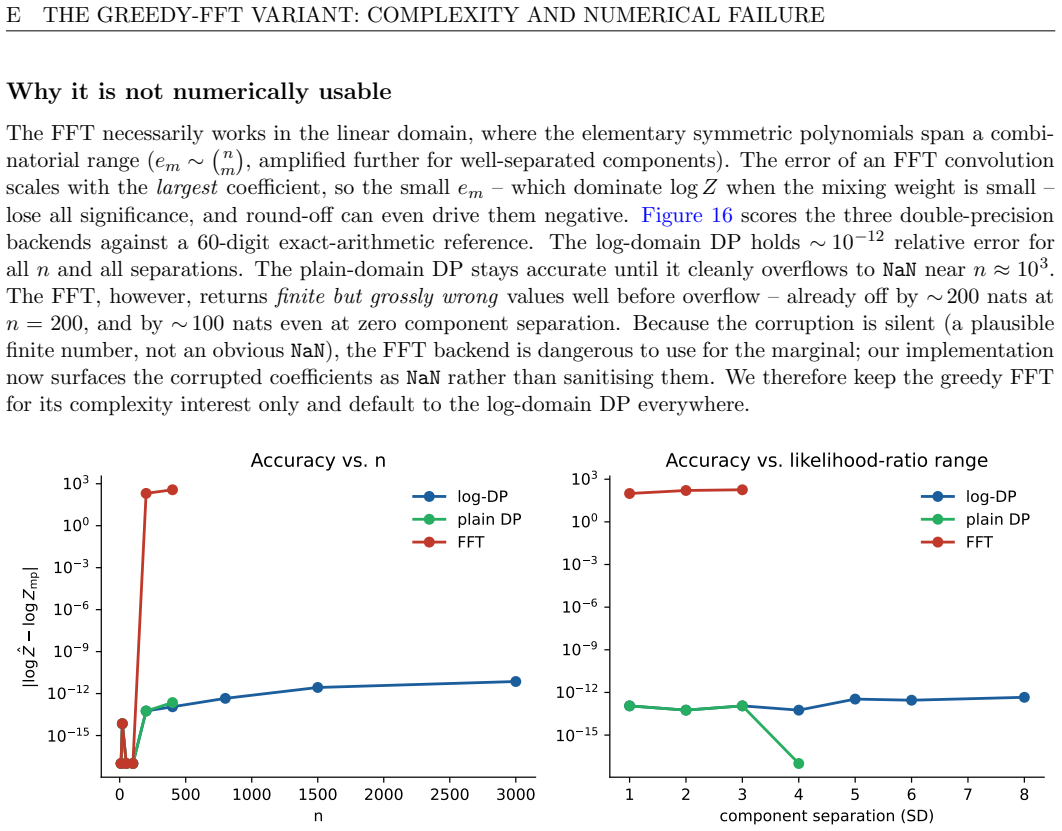
- Appendix E correctly documents that the greedy FFT is not numerically usable in double precision; the main text already says so, but a single sentence in §2 pointing to Figure 16 would prevent readers from implementing the FFT backend by default.
- References: Patra & Sen (2012) is cited as arXiv without final venue if published; check consistency of Efron / Storey / Stephens citations with the two-groups discussion in the Introduction.
Circularity Check
No significant circularity; the finite Beta-mixture posterior and O(n^{2}) DP follow directly from term-by-term Beta integration of the expanded likelihood, with independent validation against brute-force and MCMC.
full rationale
The load-bearing derivation (Eqs. 1–8, Prop. 1–5, Thm. 1) expands the two-component likelihood into elementary symmetric polynomials, integrates term-by-term against the Beta prior via the Euler integral, and obtains the exact posterior as a finite mixture of Betas whose weights are the normalized ESP–Beta products; the same recurrence that evaluates the marginal also yields all summaries and local FDRs. Structural claims (log-concavity, moment identities, stochastic monotonicity) are classical consequences of real-rootedness/Newton inequalities and the Beta–Binomial factor, proved in Appendix B without reference to the target posterior. Empirical-Bayes hyperparameter fits maximize the exact evidence (an external objective), and coverage is checked on independent simulations and plasmodes with known ground truth. No step reduces a claimed prediction or uniqueness result to a fitted input or self-citation by construction; the algorithms simply evaluate a well-defined integral.
Assumptions & free parameters
free parameters (2)
- Beta hyperparameters α, β (or BL α, γ)
- non-null scale σ₁ (or component parameters θ)
assumptions (4)
- domain assumption Component densities f and g (or the K densities) are known and fixed while only the weight is marginalized.
- standard math Newton’s inequalities for real-rooted polynomials with non-negative coefficients.
- standard math Euler integral representation of the Beta function and the mixed-moment formula for the Beta-Liouville distribution.
- domain assumption Observations within a stratum are i.i.d. given the weight.
invented entities (2)
-
St(n,α,β) recurrence and the associated dynamic-programming table
independent evidence
-
Joint count dynamic program for K-component Beta-Liouville marginal
independent evidence
Cite this review
Pith. "Pith review of Exact computation of posterior distribution of mixture weights in hierarchical Bayesian models." pith.science (2026). https://pith.science/paper/KS6AX63V
@misc{pith2026260705692,
  author       = {Pith},
  title        = {Pith review of: Exact computation of posterior distribution of mixture weights in hierarchical Bayesian models},
  year         = {2026},
  howpublished = {\url{https://pith.science/paper/KS6AX63V}},
  note         = {Machine review of arXiv:2607.05692}
}
abstract
Hierarchical mixture models are a powerful tool for modeling data generated from heterogeneous sources, particularly when the mixing proportion $\boldsymbol{w}$ itself is treated as a random variable with a Dirichlet or Beta-Liouville prior. Such models are widely employed in scenarios where uncertainty in class membership or data-generating processes must be probabilistically quantified. This paper studies the exact marginalization of the mixture weight. For the two-component case we give an $O(n^2)$ dynamic program -- and an $O(n \log^2 n)$ FFT variant -- for the marginal likelihood, and show that the exact posterior of the weight is a finite mixture of Beta distributions, delivering closed-form posterior summaries, credible intervals and per-observation local false-discovery rates without any sampling. For $K \ge 3$ components we give an exact joint dynamic program. The gain is largest in the small-sample regime the method is built for: on a real multilevel meta-analysis, a pathway-level dysregulation analysis of leukemia gene expression, and a leukemia-derived gene-panel benchmark with known ground truth, the exact interval for the signal proportion is calibrated where EM gives no interval at all (collapsing to a boundary) and Gaussian/Laplace approximations mis-cover, and it is two orders of magnitude faster than the sampler that would match it. On the large prostate-cancer benchmark, where every method has ample data, it agrees with locfdr on the gene ranking while adding a posterior interval for the null proportion.
Figures


Figures from the paper (13 more)


Reference graph
Works this paper leans on
-
[1]
Majumdar, Koyel and Silva, Romina and Perry, Antoinette Sabrina and Watson, Ronald William and Rau, Andrea and Jaffrezic, Florence and Murphy, Thomas Brendan and Gormley, Isobel Claire , editor =. A novel family of beta mixture models for the differential analysis of DNA methylation data: An application to prostate cancer , volume =. PLOS ONE , publisher ...
-
[2]
Estimation of a Two-component Mixture Model with Applications to Multiple Testing
Patra, Rohit Kumar and Sen, Bodhisattva. Estimation of a two-component mixture model with applications to multiple testing. 2012 , copyright =. doi:10.48550/ARXIV.1204.5488 , url =. 1204.5488
work page Pith review arXiv doi:10.48550/arxiv.1204.5488 2012
-
[3]
Veillette, John P. and Nusbaum, Howard C. , year =. Bayesian p-curve mixture models as a tool to dissociate effect size and effect prevalence , volume =. Communications Psychology , publisher =. doi:10.1038/s44271-025-00190-0 , number =
-
[4]
Dias, José G. and Wedel, Michel , year =. An empirical comparison of EM, SEM and MCMC performance for problematic Gaussian mixture likelihoods , volume =. Statistics and Computing , publisher =. doi:10.1023/b:stco.0000039481.32211.5a , number =
-
[5]
Gupta, A.K. and Song, D. , year =. Generalized liouville distribution , volume =. Computers and Mathematics with Applications , publisher =. doi:10.1016/0898-1221(96)00107-1 , number =
-
[6]
Schr\". A hybrid parameter estimation algorithm for beta mixtures and applications to methylation state classification , volume =. Algorithms for Molecular Biology , publisher =. 2017 , month = aug, pages =. doi:10.1186/s13015-017-0112-1 , number =
-
[7]
Efron, Bradley , journal =. Microarrays, Empirical. 2008 , publisher =
work page 2008
-
[8]
Journal of the American Statistical Association , volume =
Large-Scale Simultaneous Hypothesis Testing: The Choice of a Null Hypothesis , author =. Journal of the American Statistical Association , volume =. 2004 , publisher =
work page 2004
Show all 20 references
-
[9]
The Annals of Statistics , volume =
Size, Power and False Discovery Rates , author =. The Annals of Statistics , volume =. 2007 , publisher =
2007
-
[10]
Journal of the Royal Statistical Society: Series B (Statistical Methodology) , volume =
A Direct Approach to False Discovery Rates , author =. Journal of the Royal Statistical Society: Series B (Statistical Methodology) , volume =. 2002 , publisher =
2002
-
[11]
fdrtool: A Versatile
Strimmer, Korbinian , journal =. fdrtool: A Versatile. 2008 , publisher =
2008
-
[12]
Biostatistics , volume =
False Discovery Rates: A New Deal , author =. Biostatistics , volume =. 2017 , publisher =
2017
-
[13]
Biostatistics , volume =
Detecting Differential Gene Expression with a Semiparametric Hierarchical Mixture Method , author =. Biostatistics , volume =. 2004 , publisher =
2004
-
[14]
Liberzon, Arthur and Birger, Chet and Thorvaldsd\'. The. Cell Systems , volume =. 2015 , publisher =
2015
-
[15]
Science , volume =
Molecular Classification of Cancer: Class Discovery and Class Prediction by Gene Expression Monitoring , author =. Science , volume =. 1999 , publisher =
1999
-
[16]
Cancer Cell , volume =
Gene Expression Correlates of Clinical Prostate Cancer Behavior , author =. Cancer Cell , volume =. 2002 , publisher =
2002
-
[17]
Research Synthesis Methods , volume =
Fixed Effects and Variance Components Estimation in Three-Level Meta-Analysis , author =. Research Synthesis Methods , volume =. 2011 , publisher =
2011
-
[18]
The Annals of Statistics , volume =
A Stochastic Process Approach to False Discovery Control , author =. The Annals of Statistics , volume =. 2004 , publisher =
2004
-
[19]
1952 , publisher =
Inequalities , author =. 1952 , publisher =
1952
-
[20]
1998 , publisher =
Asymptotic Statistics , author =. 1998 , publisher =
1998
Reviewed July 11, 2026 · model on record in the stance chip above.
Discussion (0). Sign in to comment.