REVIEW 2 major objections 7 minor 25 references
Tropically planar graphs
T0 review · 2 major / 7 minor · reviewed 2026-08-14 · deepseek-v4-flash
Pith's one-line read The paper proves that tropically planar graphs are asymptotically 0% of connected trivalent planar graphs, with explicit upper and lower bounds on their number.
desk verdict Solid new upper bound and a plausible lower bound that needs computational verification; the zero-density result is correct despite a gap in one of its proofs. read the letter →
The pith
A machine-rendered reading of the paper's core claim, the machinery that carries it, and where it could break.
The reading
What carries the argument
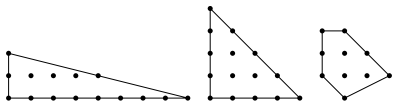
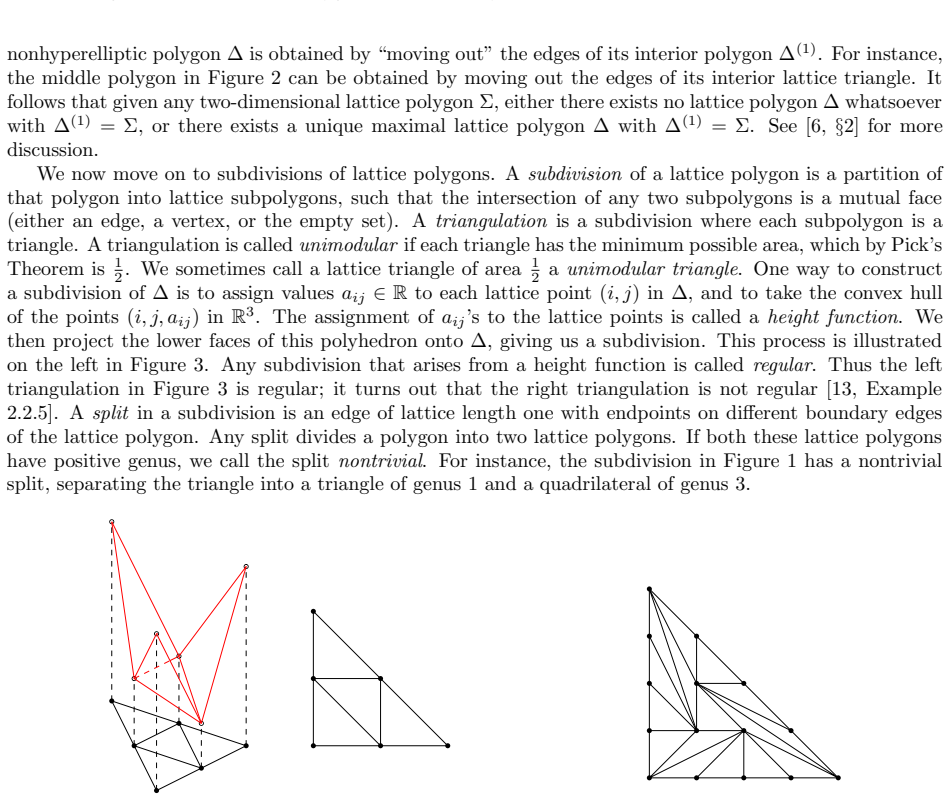
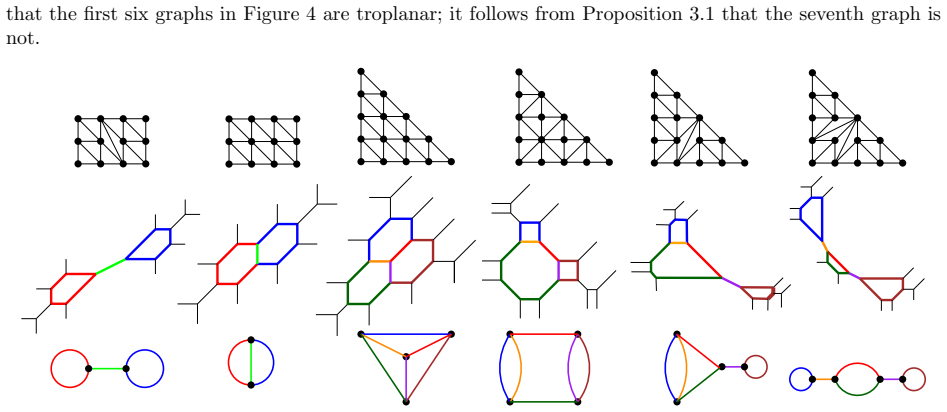
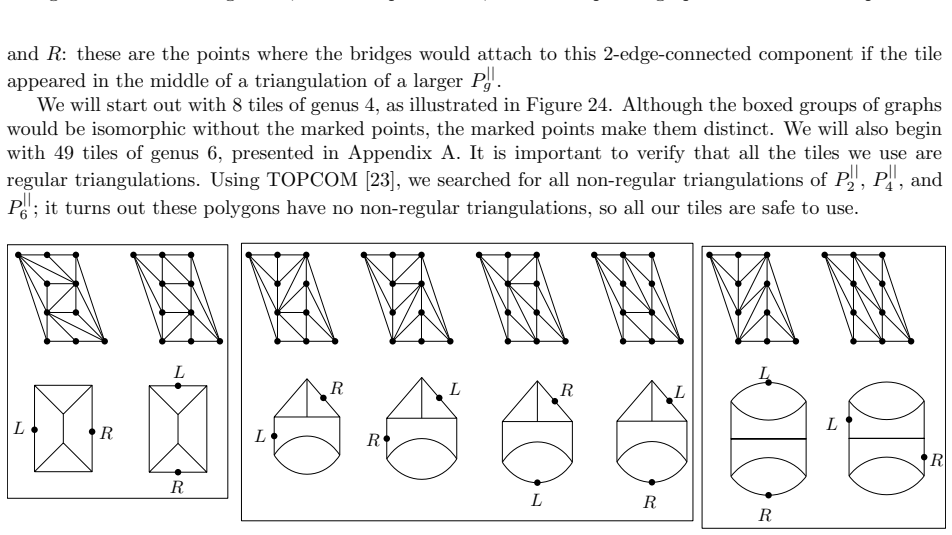
The argument runs on three engines. First, the duality between a smooth tropical plane curve and a regular unimodular triangulation of its Newton polygon: each troplanar graph is the skeleton dual to such a triangulation, so counting troplanar graphs becomes counting regular unimodular triangulations of lattice polygons of genus $g$ up to the graphs they yield. Second, an upper-bound engine that stratifies polygons by lattice width $\ell$: width-2 (hyperelliptic) polygons contribute $O(2^g)$ graphs, width-3 polygons contribute $O(8^g\sqrt g)$ each via the binomial coefficient $\binom{g-2}{a}$ of unimodular triangulations of the interior trapezoid, and width-at-least-4 polygons are bounded using $r\le 2g/\ell+4\sqrt{g+8/3}+2$ boundary points together with the general triangulation bound $2^{3g+r-3}$. Third, a lower-bound engine that tiles the parallelogram $P^{\parallel}_{2n}$ with 2 tiles of genus 2, 13 of genus 4, and 75 of genus 6; regularity is preserved when gluing along lattice-length-1 edges, and Proposition 5.1 ensures different tile sequences yield non-isomorphic graphs, producing the recurrence $a_n=2a_{n-1}+13a_{n-2}+75a_{n-3}$ whose dominant root $\alpha\approx 6.1233$ gives $\gamma=\sqrt{\alpha}\approx 2.47$. A supporting surgery, bridge reduction, uses a bistellar flip to show that reducing all bridges of a troplanar graph yields a 2-edge-connected troplanar graph, giving $T(g)\le 2^{g-1}T^{(2)}(g)$.
What would settle it
Independently enumerate all regular unimodular triangulations of the parallelograms $P^{\parallel}_2$, $P^{\parallel}_4$, and $P^{\parallel}_6$ and compare the resulting marked skeletons against the paper's Appendix A tiles. A duplicate marked graph, a tile that is not a regular triangulation, or a genus-6 or genus-7 total different from 152 or 672 would force the corresponding bound or count to be revised downward.
Extended reading notes
Core claim
On the paper's own terms, the central discovery is that troplanar graphs are exponentially rare among all connected trivalent planar graphs: $\lim_{g\to\infty} T(g)/P(g)=0$, with the quantitative bounds $T(g)=O(2^{11g/3+O(\sqrt g)})$ and $T(g)=\Omega(\gamma^g)$, where $\gamma=\sqrt{\alpha}\approx 2.47$ and $\alpha$ is the unique real root of $x^3-2x^2-13x-75$. The upper bound comes from stratifying lattice polygons by lattice width and bounding the number of their unimodular triangulations; the lower bound comes from tiling a genus-$2n$ parallelogram with fixed tiles of genus 2, 4, and 6, giving a recurrence whose growth rate is governed by $\alpha$. The paper also settles the exact enumeration through genus 7: $T(6)=152$ and $T(7)=672$, continuing the sequence 2, 4, 13, 38, 152, which does not appear in the OEIS. These results supersede the previously known lower bound $T(g)=\Omega(2^g)$ from hyperelliptic chains.
Load-bearing premise
The lower bound assumes that the 75 genus-6 tiles and 13 genus-4 tiles listed in the appendix are all distinct as marked graphs and all realizable as regular triangulations of the parallelogram; if any two are actually the same, or one fails regularity, the tiling count and the base $\gamma\approx 2.47$ would shrink.
Editorial extensions
If this is right
- If the bounds are correct, troplanar graphs are not just a minority but an exponentially negligible proportion of connected trivalent planar graphs: the ratio $T(g)/P(g)$ tends to 0 at an exponential rate.
- The exact counts $T(6)=152$ and $T(7)=672$ give the first data beyond genus 5, and the sequence 2, 4, 13, 38, 152 matches no OEIS sequence, so any proposed formula for $T(g)$ must reproduce these values.
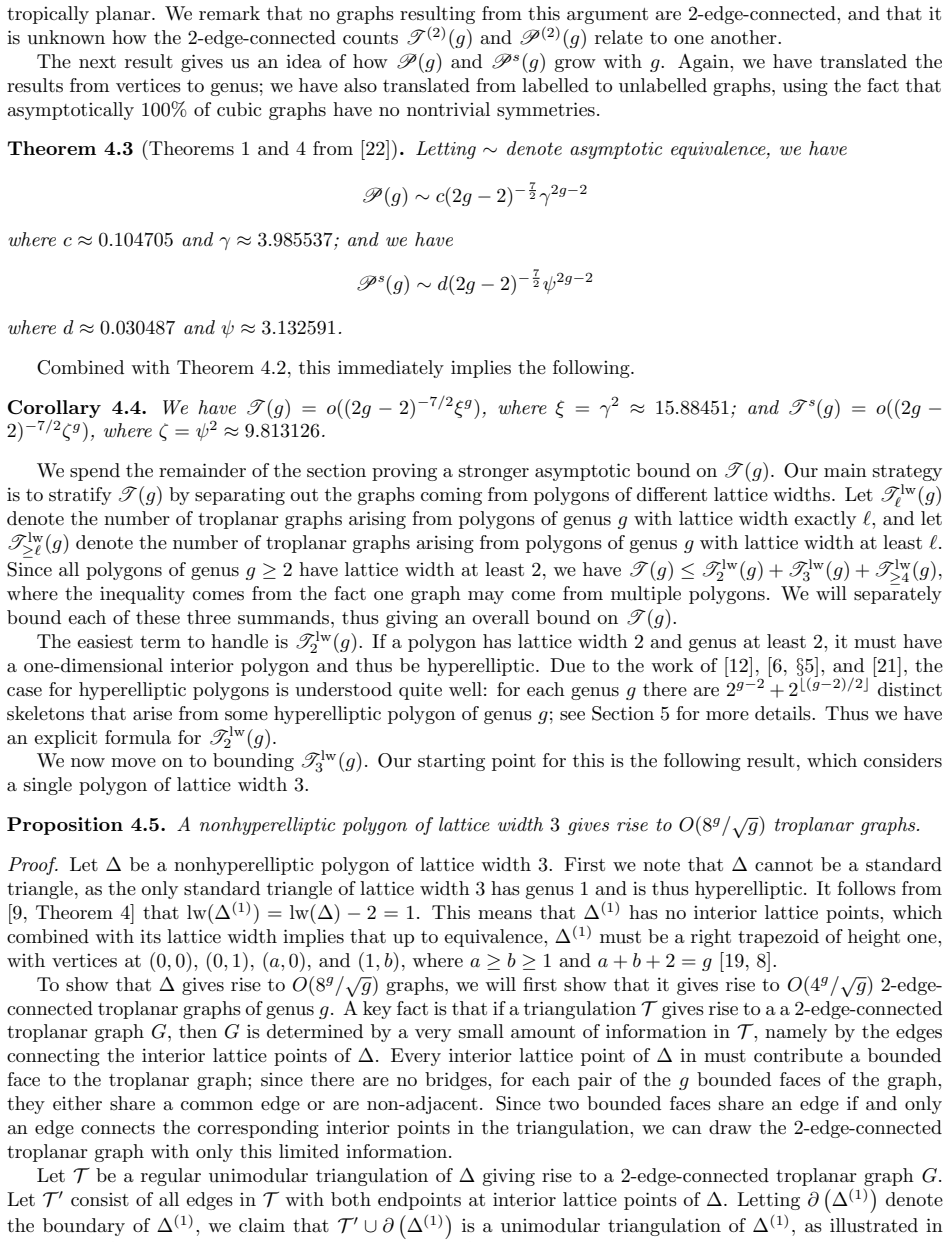
- The upper bound $O(2^{11g/3+O(\sqrt g)})$ improves on the generic planar-graph bound (base roughly 15.88) and shows the exponential base of $T(g)$ is at most $2^{11/3}\approx 12.7$.
- The lower bound $\Omega(\gamma^g)$ with $\gamma\approx 2.47$ supersedes the hyperelliptic-chain lower bound $\Omega(2^g)$, so the true exponential base lies somewhere in $[2.47,12.7]$.
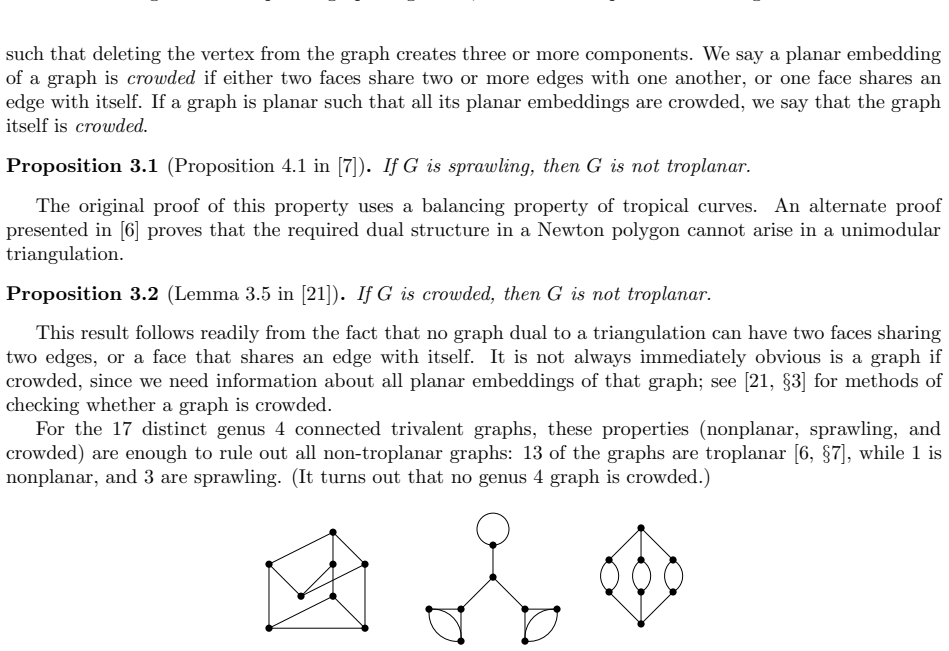
- New necessary conditions, namely that TIE-fighter graphs are never troplanar and that bridge reduction preserves troplanarity, give practical tests for ruling graphs in or out at any fixed genus.
Reading between the lines
- If regular triangulations are as rare among all unimodular triangulations as numerical experiments suggest, the true exponential base of $T(g)$ could be much closer to the lower bound 2.47 than to the upper bound 12.7; this is an extrapolation, not a paper claim.
- Extending the tiling construction to tiles of genus 8 or higher would change the recurrence's characteristic polynomial, and the growth base of the lower bound is the dominant root of that polynomial, so each new tile family is a lever for raising $\gamma$; the authors mention this direction only in passing.
- The paper notes that proving a 'two loops in a row' obstruction analogous to Corollary 3.5 would remove 18 of the 28 genus-6 graphs not ruled out by any known criterion; supplying that proof is a direct way to test whether $T(6)=152$ can be improved.
- Because the upper bound counts all unimodular triangulations rather than only regular ones, a sharper census of regular triangulations of lattice polygons could both validate the lower-bound tile list and narrow the gap between 2.47 and 12.7.
Signed reviews
Editorial analysis
A structured set of objections, weighed in public.
Referee Report
Summary. The paper studies trophically planar graphs, defined as skeletons of smooth tropical plane curves. It develops new necessary conditions for a graph to be trophically planar (notably the TIE-fighter obstruction), computes the exact numbers of trophically planar graphs of genus 6 and 7 (152 and 672), and proves asymptotic estimates: an upper bound T(g) = O(2^{11g/3+O(√g)}) and a lower bound T(g) = Ω(γ^g) with γ ≈ 2.47. From these results the authors conclude that, asymptotically, 0% of connected trivalent planar graphs are trophically planar.
Significance. If the claims hold, the paper makes a substantial contribution to the quantitative study of trophically planar graphs. The upper bound is a nontrivial exponential estimate, and the lower bound improves the previously known Ω(2^g) to a base γ ≈ 2.47, a genuine advance. The zero-density statement is a strong negative result. The TIE-fighter obstruction is an elegant new structural tool, and the exact counts for genus 6 and 7 provide valuable data. The paper also includes a large set of computational tiles, but the reproducibility of that finite verification is a major weakness, as detailed below.
major comments (2)
- [Section 5, Corollary 5.5] The lower bound rests on an unverified finite tile inventory. The paper asserts that a TOPCOM search shows that the parallelograms P^||_2, P^||_4, and P^||_6 admit no non-regular triangulations, and that the 2+13+75 pictured tiles are distinct marked graphs, but it supplies no code, input files, output logs, or the actual triangulations. Appendix A presents only the marked skeletons, not the triangulations of the parallelograms. A duplicate or non-regular tile would change the coefficients of the recurrence a_n = 2a_{n-1} + 13a_{n-2} + 75a_{n-3} in Proposition 5.4 and could lower γ below the claimed value of √α ≈ 2.47, potentially even below the previously known Ω(2^g) bound. The lower-bound theorem is therefore conditional on a finite verification that is not made reproducible.
- [Section 5, Proposition 5.3] The proof of Proposition 5.3 relies on two unproved assertions about the tile set: that no two tiles give the same ordered pair of marked graphs, and that no tile contributing two 2-edge-connected components contributes a component that is also available from a single-tile component. These are nontrivial combinatorial properties over a set of 90 tiles. The paper neither proves them nor provides a machine-checkable certificate. Since the injectivity of the construction (and hence the lower bound on T(g)) depends on these properties, they should be verified explicitly, for example by a table of the ordered pairs or a reproducible script.
minor comments (7)
- [Section 2.3] There is a typo in the sentence 'a tropical curves has one vertex for each subpolygon in the subdivision'; it should read 'a tropical curve has'.
- [Section 3] The sentence 'It is not always immediately obvious is a graph if crowded' is grammatically garbled; it should likely read 'It is not always immediately obvious whether a graph is crowded.'
- [Section 5, proof of Proposition 5.2] In the last paragraph, the text says 'H1,··· ,Hm are the graphs arising from the tiles T′_1,··· ,T′_k' but the index should be m, not k.
- [Section 5, proof of Corollary 5.5] There is a duplicated word: 'we have have T(g) ≥ ...' should read 'we have T(g) ≥ ...'.
- [Section 5, Proposition 5.4] The derivation of the asymptotic lower bound uses numerical approximations A ≈ 0.49999, B ≈ 0.25001 + 0.00543i, α ≈ 6.1233, and r ≈ 3.4998. Since the conclusion a_n = Ω(α^n) requires exact inequalities such as A > 0 and α > r, the authors should replace these floating-point approximations with rigorous bounds, e.g. via interval arithmetic or explicit algebraic estimates.
- [Section 4, Theorem 4.2] The claim that any trivalent graph containing a copy of H is sprawling is not immediate because H contains a degree-1 vertex and the copy need not be induced. The statement is true, since all other vertices of H have degree 3 in H and hence are saturated in any ambient trivalent graph, but a brief justification would make the proof self-contained.
- [Section 5] The markings L and R are used throughout the construction, but the paper does not formally define a 'marked graph' or what it means for two marked graphs to be isomorphic. A precise definition would improve rigor and readability.
Circularity Check
No circularity: the exact counts and upper/lower bounds are derived from independent computer enumeration, external structural results, and a combinatorial tiling argument, none of which reduce to the paper's target data.
full rationale
The paper's derivation chain does not reduce to its inputs by construction. The exact counts T(6)=152 and T(7)=672 are obtained by enumerating regular unimodular triangulations of maximal genus-6 and genus-7 polygons with TOPCOM and then computing dual skeletons; this is a computation, not a fit to known values. The upper bound in Theorem 4.14 rests on external results: Bodirsky-Kang-Löffler-McDiarmid and Noy-Requile-Rue for random cubic planar graphs, De Loera-Rambau-Santos for triangulation counts, and Castryck's polygon bounds; the lattice-width-2 contribution is an explicit formula from prior work and only contributes O(2^g), so even if that cited formula were wrong, the exponential base 2^{11g/3} would be unchanged. The lower bound in Section 5 is a combinatorial tiling construction: the 2 genus-2 tiles, 13 genus-4 tiles, and 75 genus-6 tiles produce the recurrence a_n = 2a_{n-1} + 13a_{n-2} + 75a_{n-3}, and Proposition 5.1 gives a genuine graph-theoretic argument that distinct tile sequences yield non-isomorphic graphs. The tile inventory is input data verified by TOPCOM and by inspection of the pictures, not data fitted to T(g). The self-citations to [6] and [21], which share author Morrison, are used as prior published results (maximal-polygon reduction, crowded criterion, hyperelliptic skeleton counts) with independent content, and they are not restatements of the present paper's new claims. The main legitimate concern is reproducibility, not circularity: the TOPCOM search is described without code or logs, and the distinctness of the pictured marked tiles is asserted rather than formally proved. Those gaps affect correctness verification, but no equation in the paper is equivalent to its own input by definition and no fitted parameter is renamed as a prediction.
Assumptions & free parameters
assumptions (6)
- standard math Pick's theorem relates area, boundary lattice points, and interior lattice points.
- domain assumption Duality between tropical plane curves and regular subdivisions of Newton polygons, with smoothness equivalent to unimodular triangulations.
- domain assumption Every maximal nonhyperelliptic polygon is obtained by moving out the edges of its interior polygon.
- domain assumption Patching regular triangulations along edges of lattice length 1 preserves regularity, and all unimodular triangulations of hyperelliptic polygons are regular.
- domain assumption Asymptotic growth and concentration results for random cubic planar graphs, including the fixed-subgraph concentration theorem and the exponential growth rate of P(g).
- domain assumption The TOPCOM software correctly computes all regular unimodular triangulations of the input polygons and tile configurations.
Cite this review
Pith. "Pith review of Tropically planar graphs." pith.science (2026). https://pith.science/paper/KS6GT7IF
@misc{pith2026190804320,
  author       = {Pith},
  title        = {Pith review of: Tropically planar graphs},
  year         = {2026},
  howpublished = {\url{https://pith.science/paper/KS6GT7IF}},
  note         = {Machine review of arXiv:1908.04320}
}
abstract
We study tropically planar graphs, which are the graphs that appear in smooth tropical plane curves. We develop necessary conditions for graphs to be tropically planar, and compute the number of tropically planar graphs up to genus $7$. We provide non-trivial upper and lower bounds on the number of tropically planar graphs, and prove that asymptotically $0\%$ of connected trivalent planar graphs are tropically planar.
Figures

Figures from the paper (27 more)


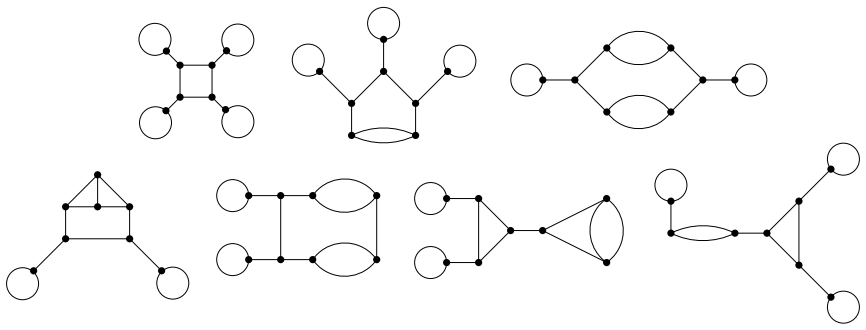


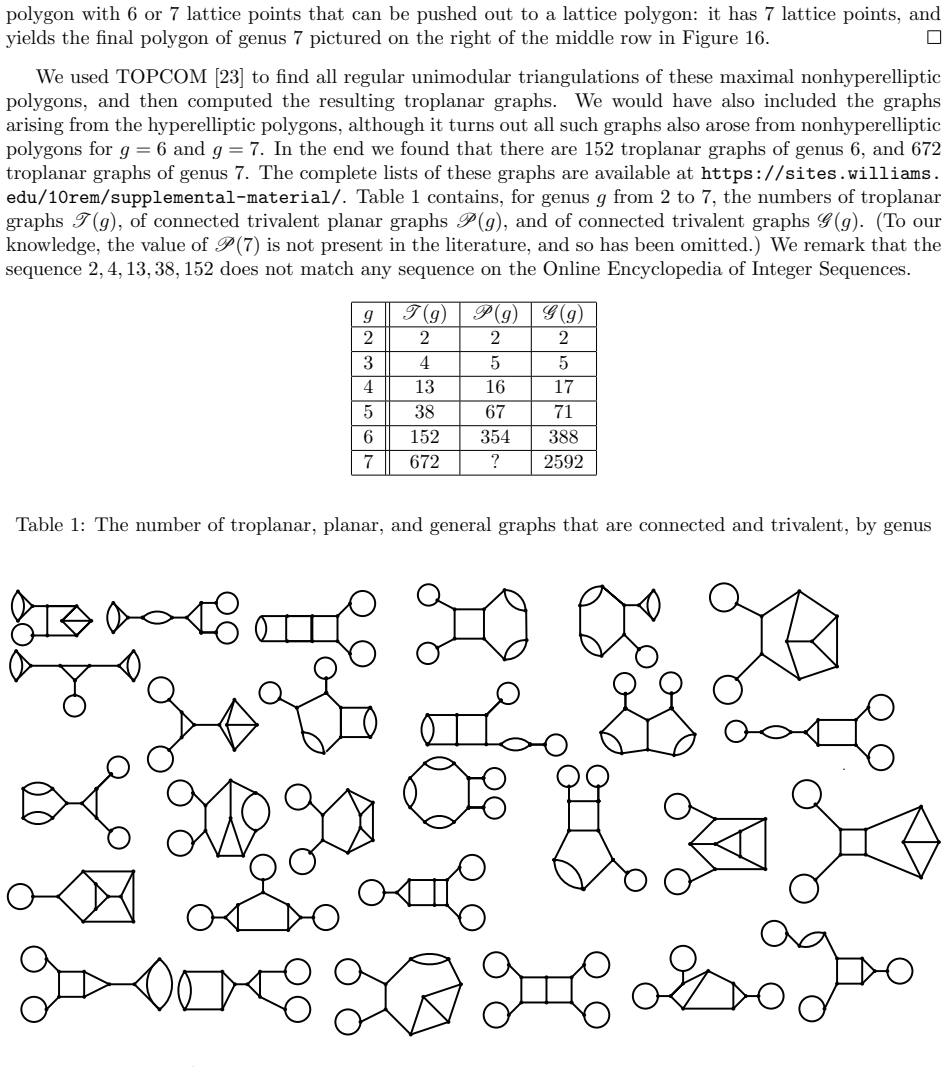





Reference graph
Works this paper leans on
-
[1]
V. I. Arnold. Statistics of integral convex polygons. Funktsional. Anal. i Prilozhen. , 14(2):1–3, 1980
work page 1980
-
[2]
M. Baker. Specialization of linear systems from curves to graphs. Algebra Number Theory, 2(6):613–653,
-
[3]
A. Balaban. Chemical applications of graph theory . Academic Press, 1976
work page 1976
-
[4]
I. B´ ar´ any and A. M. Vershik. On the number of convex lattice polytopes.Geom. Funct. Anal., 2(4):381– 393, 1992
work page 1992
-
[5]
M. Bodirsky, M. Kang, M. L¨ offler, and C. McDiarmid. Random cubic planar graphs.Random Structures Algorithms, 30(1-2):78–94, 2007
work page 2007
-
[6]
S. Brodsky, M. Joswig, R. Morrison, and B. Sturmfels. Moduli of tropical plane curves. Res. Math. Sci., 2:Art. 4, 31, 2015
work page 2015
-
[7]
D. Cartwright, A. Dudzik, M. Manjunath, and Y. Yao. Embeddings and immersions of tropical curves. Collect. Math., 67(1):1–19, 2016
work page 2016
- [8]
Show all 25 references
-
[9]
Castryck and F
W. Castryck and F. Cools. Newton polygons and curve gonalities. J. Algebraic Combin., 35(3):345–366, 2012
2012
-
[10]
Castryck and F
W. Castryck and F. Cools. Linear pencils encoded in the Newton polygon. Int. Math. Res. Not. IMRN , (10):2998–3049, 2017
2017
-
[11]
Castryck and J
W. Castryck and J. Voight. On nondegeneracy of curves. Algebra Number Theory, 3(3):255–281, 2009
2009
-
[12]
M. Chan. Tropical hyperelliptic curves. J. Algebraic Combin., 37(2):331–359, 2013
2013
-
[13]
J. A. De Loera, J. Rambau, and F. Santos. Triangulations, volume 25 of Algorithms and Computation in Mathematics. Springer-Verlag, Berlin, 2010
2010
-
[14]
Fejes T´ oth and E
L. Fejes T´ oth and E. Makai, Jr. On the thinnest non-separable lattice of convex plates.Stud. Sci. Math. Hungar., 9:191–193 (1975), 1974
1975
-
[15]
J. E. Goodman, J. O’Rourke, and C. D. T´ oth, editors.Handbook of discrete and computational geometry. Discrete Mathematics and its Applications (Boca Raton). CRC Press, Boca Raton, FL, 2018. Third edition of [ MR1730156]. 25
2018
-
[16]
M. A. Hahn, H. Markwig, Y. Ren, and I. Tyomkin. Tropicalized quartics and canonical embeddings for tropical curves of genus 3. Int. Math. Res. Not. IMRN , 2019
2019
-
[17]
W. R. Inc. Mathematica, Version 11.3. Champaign, IL, 2018
2018
-
[18]
Kaibel and G
V. Kaibel and G. M. Ziegler. Counting lattice triangulations. In Surveys in combinatorics, 2003 (Bangor), volume 307 of London Math. Soc. Lecture Note Ser. , pages 277–307. Cambridge Univ. Press, Cambridge, 2003
2003
-
[19]
R. Koelman. The number of moduli of families of curves on a toric surface . PhD thesis, Katholieke Universiteit de Nijmegen, 1991
1991
-
[20]
Maclagan and B
D. Maclagan and B. Sturmfels. Introduction to tropical geometry , volume 161 of Graduate Studies in Mathematics. American Mathematical Society, Providence, RI, 2015
2015
-
[21]
Morrison
R. Morrison. Tropical hyperelliptic curves in the plane, 2017
2017
-
[22]
M. Noy, C. Requile, and J. Rue. Random cubic planar graphs revisited. to appear in Random Structures and Algorithms, 2019
2019
-
[23]
J. Rambau. TOPCOM: Triangulations of point configurations and oriented matroids. In A. M. Co- hen, X.-S. Gao, and N. Takayama, editors, Mathematical Software—ICMS 2002, pages 330–340. World Scientific, 2002
2002
-
[24]
P. R. Scott. On convex lattice polygons. Bull. Austral. Math. Soc. , 15(3):395–399, 1976. 26 L L L L L L L L L L L L L L L L L L L L L L L L L L L L L L L L L L L L L L L L L L L L L L L R R R R R R R R R R L R R R R R R R L R R R R R R R R R R R R R R R R R R R R R R R R R R ...
1976
-
[2008]
With an appendix by Brian Conrad
Reviewed August 14, 2026 · model on record in the stance chip above.
Discussion (0). Continue with ORCID to comment.